You are using an out of date browser. It may not display this or other websites correctly.
You should upgrade or use an alternative browser.
You should upgrade or use an alternative browser.
Los Angeles Zoo & Botanical Gardens Golden monkeys
- Thread starter MARK
- Start date
on keeping doucs...
zooboy,
that problem zooish described related to gorillas and was related not to the humidity of singapore but instead a bacteria the (in the soil i believe) animals had no immunity to..
i have seen two places that breed doucs. one was the EPRC, who have probably had more success than any other institution in the world, ever.
they bred a lot of red-shanks, had a few breeding pairs of grey shanked and had even accidently crossed a grey shank with a black shanked douc. they are quite radically different types when seen up close. definately seperate species. the EPRC is quiet and the animals recieve few, visitors and planty of fresh foliage ina natural climate.
the other place was dusit zoo in thailand. noisy and unattractive, the animals lived in a very large tall cage with virtually no attempt at naturalistic landscaping. they did however probably have a good diet of fresh leaves and a of course a warm climate. and the baby langur was quite intersested in people.
i also know singapore breed doucs well. i assume again that they get plenty of fresh native asian foliage and a good climate..
i'm sure stress is a big factor too, but i think its a little niave to think that fresh tropical foliage and possibly a warm climate isnt a largely contributing factor.
unfortunately the cologne doucs represent another dead-end breeding program since they have not passed them on. they should have been offered to sinagpore, who would no doubt be greatful for another bloodline, that can easily be invogorated with their own stock. certainly, i would be intersted to see how the european animals setting into a more natural-type surround...
zooboy,
that problem zooish described related to gorillas and was related not to the humidity of singapore but instead a bacteria the (in the soil i believe) animals had no immunity to..
i have seen two places that breed doucs. one was the EPRC, who have probably had more success than any other institution in the world, ever.
they bred a lot of red-shanks, had a few breeding pairs of grey shanked and had even accidently crossed a grey shank with a black shanked douc. they are quite radically different types when seen up close. definately seperate species. the EPRC is quiet and the animals recieve few, visitors and planty of fresh foliage ina natural climate.
the other place was dusit zoo in thailand. noisy and unattractive, the animals lived in a very large tall cage with virtually no attempt at naturalistic landscaping. they did however probably have a good diet of fresh leaves and a of course a warm climate. and the baby langur was quite intersested in people.
i also know singapore breed doucs well. i assume again that they get plenty of fresh native asian foliage and a good climate..
i'm sure stress is a big factor too, but i think its a little niave to think that fresh tropical foliage and possibly a warm climate isnt a largely contributing factor.
unfortunately the cologne doucs represent another dead-end breeding program since they have not passed them on. they should have been offered to sinagpore, who would no doubt be greatful for another bloodline, that can easily be invogorated with their own stock. certainly, i would be intersted to see how the european animals setting into a more natural-type surround...
Keeping a nervous and stress-prone species in a climate different from its natural one, and with a different diet is obviously a recipe for failure- as several overseas zoos have proved.
Many years back I too saw Douc Langurs in the Dusit zoo in Thailand,- despite basic housing they looked remarkably well- due to natural climate and a near natural diet? But I wonder what their longevity records are under these conditions?
Where is ERPC- is that the Langur breeding centre in Vietnam? It was featured in a DVD on Auckland zoo as they have a linkup. They even have several Delacour's langurs there- a very impressive animal.
Its interesting that many zoos in the UK/Europe now exhibit Javan Langurs- in contrast to Douc's these do seem easy to maintain and they multiply accordingly.
Many years back I too saw Douc Langurs in the Dusit zoo in Thailand,- despite basic housing they looked remarkably well- due to natural climate and a near natural diet? But I wonder what their longevity records are under these conditions?
Where is ERPC- is that the Langur breeding centre in Vietnam? It was featured in a DVD on Auckland zoo as they have a linkup. They even have several Delacour's langurs there- a very impressive animal.
Its interesting that many zoos in the UK/Europe now exhibit Javan Langurs- in contrast to Douc's these do seem easy to maintain and they multiply accordingly.

In Singapore we keep our doucs on a fairly large vegetated island. The moat surrounding the island is 10 metres wide, giving the doucs quite a bit of privacy.
New bloodlines have been acquired from Thai and Vietnam zoos over the years. They are a top priority species, so every effort will be taken to ensure they don't inbreed. San Diego has been working with us on monitoring the stress levels of our doucs, as well as charting development of the babies.
grantsmb > EPRC Endangered Primate Rescue Centre is in Vietnam. They specialize in doucs, delacours, francois and cat ba langurs and gibbons. Very respected facility.
New bloodlines have been acquired from Thai and Vietnam zoos over the years. They are a top priority species, so every effort will be taken to ensure they don't inbreed. San Diego has been working with us on monitoring the stress levels of our doucs, as well as charting development of the babies.
grantsmb > EPRC Endangered Primate Rescue Centre is in Vietnam. They specialize in doucs, delacours, francois and cat ba langurs and gibbons. Very respected facility.
Zooish- thanks for ERPC info- that's the place I saw featured on the Auckland Zoo DVD. It looks great and all their Langurs look really fit and healthy.
I guess your Doucs at Singapore must have a pretty good existence too from the description of the enclosure. If they are increasing their numbers that would prove it....
I guess your Doucs at Singapore must have a pretty good existence too from the description of the enclosure. If they are increasing their numbers that would prove it....
the animals at the EPRC are all bred their or rehabilitated confiscated animals. its a fantastic facility. they are with the xception of newcomers, very healthy, well cared-for animals. its worth every bit of the (then) difficult motorbike ride out to the national park to see them. the gorgeous cat ba langurs at the centre were mother/son when i was there. the mature male had been bitten by a snake and died. don't kow if they have aquired more since.
they also have breeding groups of grey langurs and the two loris species. next door is a breeding centre for endangered turtles and ownston's palm civets.
black-shanked douc langurs are bizarre. they look somewhat like a grey-shanked douc with a blue face!
they also have breeding groups of grey langurs and the two loris species. next door is a breeding centre for endangered turtles and ownston's palm civets.
black-shanked douc langurs are bizarre. they look somewhat like a grey-shanked douc with a blue face!
I think all members of the snub-nosed monkey family including doucs are spectacular.
Golden monkeys are the most well-known members of their family but the Tonkin, Guizhou and Yunnan varieties are equally if not even more stunning.
Sadly they're all so rare.
Golden monkeys are the most well-known members of their family but the Tonkin, Guizhou and Yunnan varieties are equally if not even more stunning.
Sadly they're all so rare.

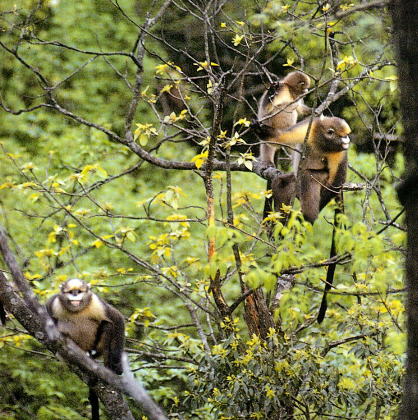


leaf monkeys
even though china's rent-a-panda scheme has merits in terms of ploughing money back into wildlife conservation, im sure were all aware just how contentious this scheme has been in the past, particularly in the US where zoos have faced court battles to gain permits from Wildlife and Fisheries and all sorts of allegations from welfare groups. i think it damaged zoos credibilty quite a bit (san diego, colombus, toronto), and even though zoos recovered from this in the eyes of the public, animal liberationists have never really forgotten how commercial these early imports really were and still harp on about it.
the scheme is now alot more legit and not only has it generated alot of money for wildlife conservation in China but San Diego particularly has come up with the goods in terms of research.
on the other hand, a recent National Geographic article closely explored the whole scheme and found many US zoos were finding it increasingly hard to afford the pandas. Atlanta was one zoo prepared to bow out of the scheme. although the arrangement is not commercial, the zoo simply couldnt blance their books and justify the cost of renting the animals. according to the zoos, keeping a pair of pandas is many times more expensive then a herd of elephants, the next most expensive zoo animal.
and the birth of a giant panda is a double-edged sword. great news for panda conservation, but the rent increases on the pandas, off-setting any extra revenue generated from the birth.
the golden monkeys, well thats great. but unless some moratorium of understanding could be passed where China's Zoos entered into an international breeding program, whereby this species could be established in captivity then i cant see golden monkeys being anything but a travelling show to the highest bidder.
establishing douc langurs in western zoos??? for now i'd rather see Western Zoos support the Endangered Primate Centre in Vietnam through funding and staff/technical skills then a major emphasis placed on establishing this species ex-situ.
in the future an ex-situ population might be established using zoos like singapore as an interface between Asia and the West. animals captive bred in Singapore could be conditioned to accept humans, etc, and maybe a less-specialised diet, before being exported.
any hurdles facing this species in the past in places like Europe could, conceivably, be rectified; inbreeding, adaption to climate, diet, etc. but a slow and steady approach is probably best. there are lots of endangered species around the world that need help. seeming as though these langurs are lucky enough to have a specialist centre already, the most cost-effective approach to conserving them would probably be to ensure the survival of the centre...
even though china's rent-a-panda scheme has merits in terms of ploughing money back into wildlife conservation, im sure were all aware just how contentious this scheme has been in the past, particularly in the US where zoos have faced court battles to gain permits from Wildlife and Fisheries and all sorts of allegations from welfare groups. i think it damaged zoos credibilty quite a bit (san diego, colombus, toronto), and even though zoos recovered from this in the eyes of the public, animal liberationists have never really forgotten how commercial these early imports really were and still harp on about it.
the scheme is now alot more legit and not only has it generated alot of money for wildlife conservation in China but San Diego particularly has come up with the goods in terms of research.
on the other hand, a recent National Geographic article closely explored the whole scheme and found many US zoos were finding it increasingly hard to afford the pandas. Atlanta was one zoo prepared to bow out of the scheme. although the arrangement is not commercial, the zoo simply couldnt blance their books and justify the cost of renting the animals. according to the zoos, keeping a pair of pandas is many times more expensive then a herd of elephants, the next most expensive zoo animal.
and the birth of a giant panda is a double-edged sword. great news for panda conservation, but the rent increases on the pandas, off-setting any extra revenue generated from the birth.
the golden monkeys, well thats great. but unless some moratorium of understanding could be passed where China's Zoos entered into an international breeding program, whereby this species could be established in captivity then i cant see golden monkeys being anything but a travelling show to the highest bidder.
establishing douc langurs in western zoos??? for now i'd rather see Western Zoos support the Endangered Primate Centre in Vietnam through funding and staff/technical skills then a major emphasis placed on establishing this species ex-situ.
in the future an ex-situ population might be established using zoos like singapore as an interface between Asia and the West. animals captive bred in Singapore could be conditioned to accept humans, etc, and maybe a less-specialised diet, before being exported.
any hurdles facing this species in the past in places like Europe could, conceivably, be rectified; inbreeding, adaption to climate, diet, etc. but a slow and steady approach is probably best. there are lots of endangered species around the world that need help. seeming as though these langurs are lucky enough to have a specialist centre already, the most cost-effective approach to conserving them would probably be to ensure the survival of the centre...
Decent remarks, depending on one thing in my opinion though which is the number of animals in Vietnam in need on rehabilitation and the room at the centre. If their are many animals in Vietnam in poor condition and the only reason they are not confiscated is because the centre has no room for them, then i'd say ship them over.
You can't expand the centre forever and confiscating and fining the people involved sends a powerfull and important message to the local people. Then the centre can be used to rehabilitate the animals to a good condition and get them ready to ship them to serious zoo's that are willing and able to keep these animals under the perfect conditions needed.
But i guess the "Monkey World approach" would be best. Either adopt a centre in the country of origin, provide them with money and expertise and if they become in dire need of space, import some of the animals (like they do with the Ping-Tung resque centre in ... Thailand i think?) or if that is not available, build one yourself (like they are now doing in Cat Tien national park in Vietnam).
You can't expand the centre forever and confiscating and fining the people involved sends a powerfull and important message to the local people. Then the centre can be used to rehabilitate the animals to a good condition and get them ready to ship them to serious zoo's that are willing and able to keep these animals under the perfect conditions needed.
But i guess the "Monkey World approach" would be best. Either adopt a centre in the country of origin, provide them with money and expertise and if they become in dire need of space, import some of the animals (like they do with the Ping-Tung resque centre in ... Thailand i think?) or if that is not available, build one yourself (like they are now doing in Cat Tien national park in Vietnam).
the EPRC is sponsored by many zoos, especially in germany but also here in australasia and afew others around the globe. the aim of the center is as a rescue center for endangered primates specifically (they do not care for macaques for example) but they also breed the rare primates for eventual release back int the wild. since reintroduction is one of their primary goals, i don't think running out of space is ever going to be a major issue, so long as they have room for more immediate expansions.
Rumours about a baby Douc Langur at Zoo Cologne, they are also saying all the animals (1.3) are brothers and sisters, so breeding wouldn't be genetically advisable. I heared before they are elderly and hence they didn't think they where going to last long. Still if it's true it can provide valuable information about this rare species... I'll keep you posted on the developments.
The females at Cologne Zoo are:
leila; *05.03.1987; mother: laraII, father: alex
dolly; *26.03.1987; mother: dunja, father: alex
djung; 01.03.1998; mother: ditja, father: leo
djungs mother ditja (*03.09.1984) is a full sister of dolly.
Only male in the group:
meo; *11.12.2001; mother: leila, father: mischa
Now they have a baby Meo*Djung
According to rumours they were waiting for Leila and Dolly to die and then send Meo and Djung to Asia so they still could play a part in the breeding program, wether or not this baby will change these idea's i don't know...
leila; *05.03.1987; mother: laraII, father: alex
dolly; *26.03.1987; mother: dunja, father: alex
djung; 01.03.1998; mother: ditja, father: leo
djungs mother ditja (*03.09.1984) is a full sister of dolly.
Only male in the group:
meo; *11.12.2001; mother: leila, father: mischa
Now they have a baby Meo*Djung
According to rumours they were waiting for Leila and Dolly to die and then send Meo and Djung to Asia so they still could play a part in the breeding program, wether or not this baby will change these idea's i don't know...
I presume these are now the only Douc Langurs in Europe? I guess they have had an unbroken line here since the original group were imported but with births & deaths roughly counteracting each other.
If they rear the new baby maybe they will be stimulated to continue with them though probably they would be better of sending them back to Asia...
If they rear the new baby maybe they will be stimulated to continue with them though probably they would be better of sending them back to Asia...
I presume these are now the only Douc Langurs in Europe? I guess they have had an unbroken line here since the original group were imported but with births & deaths roughly counteracting each other.
If they rear the new baby maybe they will be stimulated to continue with them though probably they would be better of sending them back to Asia...
Yup they are now the only Douc's in Europe. Basel had a few not that long ago i heared, but the remainder of that group has been sent to San Diego...
Wheither or not this species should be kept in Europe off course depends on a number of circumstances. In short, there should be a good, stable and reliable source of new blood available from south-east asia and there should be enough zoo's in europe that have the money, expertise and willingness to display this animal under the right conditions (I haven't seen Cologne's exhibit but i heared it's far from ideal). If any if these conditions is not met, the animals are better off in the hands of the EPRC or Singapore Zoo (imo anyways).
I would regret the disappearance of another charismatic and endangered species from the european zoological community though. Too bad the animal list is becoming more bland every minute :S
Last edited:
well it is too bad really. alaskan residents probably feel that the loss of maggie the elephant from their zoo would lead to it becoming a little 'bland', but lets face it, if these animals cant be maintained for the time being in a sustainable way then get rid of them. zoos in europe, particularly england, still tread a thin line in the terms of justifying themselves in the eyes of the public. animal welfare basket cases, like douc langurs, just become bad statistics, undermining the good work of zoos.
as ive said before there are many endangered species in the world. just because these animals are beautiful and endangered is not a good enough justification to keep them in a region where they display unacceptably high levels of mortality.
conserve these guys in SEAsia first, whether in the wild, propogation facilites or local zoos...
as ive said before there are many endangered species in the world. just because these animals are beautiful and endangered is not a good enough justification to keep them in a region where they display unacceptably high levels of mortality.
conserve these guys in SEAsia first, whether in the wild, propogation facilites or local zoos...
I think we are all agreed, that sad as it may be, Douc Langurs are an example of a species that for whatever reason, does not flourish in zoos in temperate climates, so they're best kept within South East Asia. Without a sustainable population, there isn't much point in Cologne trying to continue alone with their animals.