32. You exit the Hall of Evolution via another glassed in walkway which introduces you to Alfred Russel Wallace, the father of biogeography and arguably a co-developer of the theory of evolution. (
http://wallacefund.info/; [ame]http://en.wikipedia.org/wiki/Alfred_Russel_Wallace;[/ame]
http://people.wku.edu/charles.smith/index1.htm; Alfred Russel Wallace | biography - British naturalist | Britannica.com Alfred Russel Wallace. )
33. The Wallace Walkway brings you to the Hall of Biogeography, providing something of an integration of all that you’ve already toured and where you begin one floor up. Two floors of exhibits:
a. trace the history of the science’s development and how it relates to earth history, including paleontology and introduce the distinctions among the several types of biogeography: historical/paleo-; ecological; conservation; systematic; and evolutionary biogeography;
b. explore the key concepts of Biogeography such as dispersal, migration, endemism, range and distribution, vicariance (splitting of a population by a geographic or biotic barrier), and island biogeography (both in water bodies and sky islands)(for each concept pointing to animals exhibited at the zoo as illustrations);
c. show the history of dividing the earth into biogeographical divisions, beginning with Wallace’s six regions (including “Wallace’s Line”) and working towards the current system of ecozones-bioregions-ecoregions (terrestrial) and realms-provinces-ecoregions (marine) that are the basis for the Zoo’s own organization and design; and
d. illustrate the impact of humans.
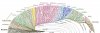
34. From the Hall of Biogeography, you move into the center of the museum, the Hall of the Tree of Life (slightly larger than the others, 110 feet/33.5 meters on a side), which houses an enormous three dimensional representation of all the lines of living organisms of all time, much like you can see here but made tangible, filling the hall:
https://visual.ly/great-tree-life. Imagine that tree of life, essentially an enormous flattened bush, fan shaped, with the stem at one end, rooted in the floor, each branch rising straight up into the hall, forming a large open circle of these vertical branches. Around the outer part of the hall are exhibits on alternative representations of the tree of life and the great extinction events of geologic history – what we know of their cause and of their effect on the diversity of life.
35. Once you have viewed the surrounding exhibits, a walkway of staircases and landings, wrapped around the tree and supported by scaffolding, takes you along, around and up the outside of the tree. An elevator and another set of walkways make the interior available to those who cannot walk up. Moving up along the walkways is the equivalent of traveling through time from the origins of life towards the present (although the scale is not linear).
36. You start at the base of the walkway, where the Tree of Life emerges from the floor, symbolizing the origins of life at about 3.5 billion years ago. From here, branches for bacteria and archaea spread out and rise towards the roof. You begin climbing the stairs, and after you have ascended ten feet (a), you are at two billion years ago, the first eukaryotes have appear, and the branches for single-cell organisms rise up from your feet. Five more feet up (b), and you are at one billion years ago; multicellular organisms have appeared and proliferated, and the branches for plants and fungi rise up and begin to branch and spread. At twenty feet above the floor (c), you are at about 700 million years ago, and the branches for sponges, placozoans, ctenophores, corals and acoel flatworms are in front of you. Between twenty and twenty-five feet up (d), the first animals appear and then you are at the Cambrian Explosion, 540 million years ago, bilateral animals proliferate, and you see the stalks and branches for the protostome invertebrates begin to spread. As you ascend these five feet, you see the first deuterostomes, both the invertebrate branch (echinoderms) and the first chordates, which soon give rise to fish, but at thirty feet above the floor (e) you reach the Ordovician-Silurian mass extinction events, at 445-447 million years ago (the second worst of all time), and you can look back and see many of the branches behind you simply end. Five more feet up (f), and a branch from the lobe-finnned fishes has become the first amphibians, about 370 million years ago, but the late Devonian mass extinction event has cut off others of the existing branches behind you. When you have reached forty feet up (g), at 250 million years ago, the branches for the first reptiles have appeared, but the worst mass extinction event of all time, the Permian-Triassic, trims off a great many branches and the diversity of life, i.e., the number of continuing branches, shrinks drastically. You look back at the branches whose lower reaches you have passed, and you can see around you the holes the extinction event has left in the tree. You climb another five feet (h), you are at 200 million years ago, and you can see a therapsid reptile branch becoming mammals, but the end Triassic extinction event does some modest trimming, to pave the way for the rise of the dinosaurs, whose branches you can see spreading behind you. But in another five feet (i), at fifty feet up, you have reached 65 million years ago, and all those branches end abruptly, except for one that continues up and radiates. At the top of its many branches sit today’s dinosaur descendants, the birds, while the mammal branches are proliferating as well, which you watch as you climb the next ten feet. When you reach the top of the ramp, sixty feet up (j), there are branches on the top of which stand apes and a human being. Sixty-five feet from the floor represents the present moment, and as you pass the last of the branches, an exhibit asks: “How many of the branches behind will never grow any higher?”
37. From there, you cross a bridge back into the fourth floor of the Hall of Biogeography, the top two floors of which are exhibits tracing the evolution of the primates.
38. In the Hall or Primate Evolution, you start by learning how the Permian-Triassic extinction event nearly wiped out the therapsid reptiles, and how the climate at the time and the rise of the dinosaurs exerted a selective pressure on the surviving therapsids that led to the evolution of mammals, including a look at the evolution of their defining characteristics such as differentiated teeth, more efficient locomotion, homeothermic metabolism, fur, enhanced smell and hearing and their influence on increasing relative brain size, increased care of the young, milk production, and eventually live birth along with the marsupial pouch and the placenta, but also the loss of color vision. The next step shown will be the end-Cretaceous extinction event, and how first the demise of the dinosaurs and then the return of plant life opened up the scansorial and later arboreal insectivore niches, how this led to a more omnivorous diet and adaptations such as nails, binocular vision and opposable first digits, and thus the appearance of the prosimians. (At this location, there will be a cage containing live tree shrews.) By this time, the rise of the forests had resulted in the development of fruits, and some primates found advantage by specializing in fruit eating and eventually re-evolved some of the color vision that their nocturnal ancestors had lost. The need to use color vision to discern ripe fruit required a diurnal lifestyle, living in social groups was advantageous in coping with the increased exposure to predation, and social living provided selective advantage to increased brain size as well. Thus arose monkeys, who largely displaced the then existing prosimians, relegating them to nocturnal and geographically isolated niches. An exhibit will address the split between the Old World and New World monkeys. As the climate became cooler and drier, resulting in time and space gaps in the availability of ripe fruit, most monkeys adapted by broadening their diet to include unripe fruit and certain leaves, as evidenced by a change in their teeth apparent in the fossil record (and a change in their digestive system which can be seen today). But, in the Old World, one group persisted with a focus on ripe fruit and kept the ancestral monkey tooth pattern; they instead evolved brachiation so that they could move more efficiently through trees (eliminating the need for a tail) and enhanced brain function to be able to remember when and where fruit would be available and to navigate between those opportunities, evidence of both of which can be seen in the fossil record. From here, the exhibits will trace the evolution of all the extant apes (except one): gibbons; siamangs; orang-u-tans; gorillas; bonobos; and chimpanzees. The final exhibit will show you where in the zoo you can see today’s living primates and be an invitation to learn of the evolution of the remaining ape at the Museum of Human Evolution in the Afrotropic Zone.
39. Stairs or elevators will take you back down to the ground floor, where you will exit through the gift shop.