NUMBER SEVENTY-FOUR: California dinosaurs are far and few between but if you know where to look, they're there
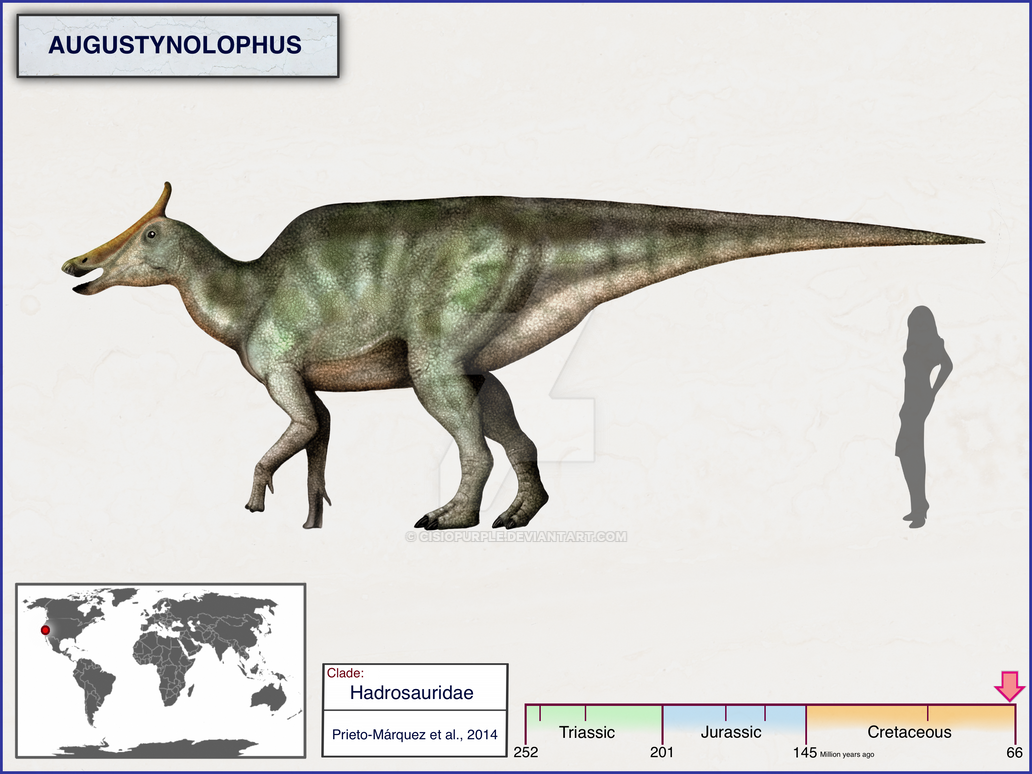
- Animal: Augustynolophus
- Name Pronunciation: Aw-gus-tin-o-lo-fus
- Name Meaning: "Augustyn’s crest"
- Named By: Albert Prieto-Márquez et al. - 2014
- Species: A. morrisi
- Classification: Life, Eukaryota, Animalia, Chordata, Vertebrata, Gnathostomata, Osteichthyes, Sarcopterygii, Tetrapodomorpha, Tetrapoda, Reptiliomorpha, Amniota, Sauropsida, Archosauria, Dinosauria, Ornithischia, Ornithopoda, Hadrosauridae, Saurolophinae, Saurolophini
- When: ~ 70,000,000 B.C.E. to 65,500,000 B.C.E. (Maastrichtian stage of the Late Cretaceous epoch)
- Where: North America - United States - California - Moreno Formation (near Fresno)
- Size: 34 feet (10.36) long
- Diet: Omnivore
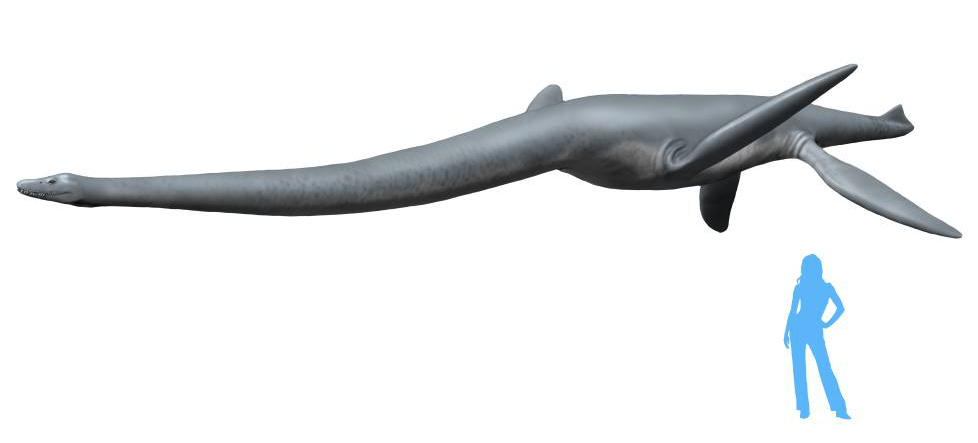
- Three Contemporaries: Plotosaurus (mosasaur), Hydrotherosaurus (plesiosaur), and Basilemys (turtle)
First described in 2013 as
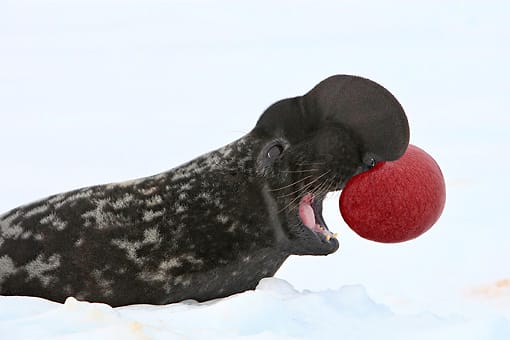
Saurolophus morrisi, it was re-described as a distinct species only one year later. All saurolophin hadrosaurs has spike-like cranial crests. It is thought they functioned as visual signals to members of the same species (a male's crest would have likely be very colorful). It has also been suggest that they possibly had inflatable skin flaps over their nostrils that could of acted as vocal resonators and additional visual signals (picture something similar to what the modern day hooded seal does). Not much is know about
Augustynolophus directly, due to limited fossil remains, but much can be theorized as hadrosaurids in general are a well studied group.
Augustynolophus likely lived in herds as many times hadrosaur remains are found in groups, suggesting a gregarious lifestyle. Comparisons between the scleral rings of several hadrosaur genera (
Corythosaurus,
Prosaurolophus, and
Saurolophus) and modern birds and reptiles suggest that they may have been cathemeral, active throughout the day at short intervals. Hadrosaurs were facultative bipeds: they normally meandered around on four legs, but if they needing to get a-move on, to say avoid a predator, they could have run bipedally. We know a great deal of how hadrosaurs raised their young thanks to fossils discovered in Montana of the genus
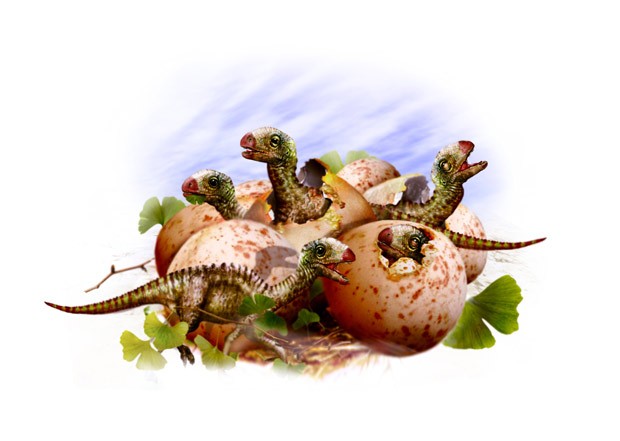
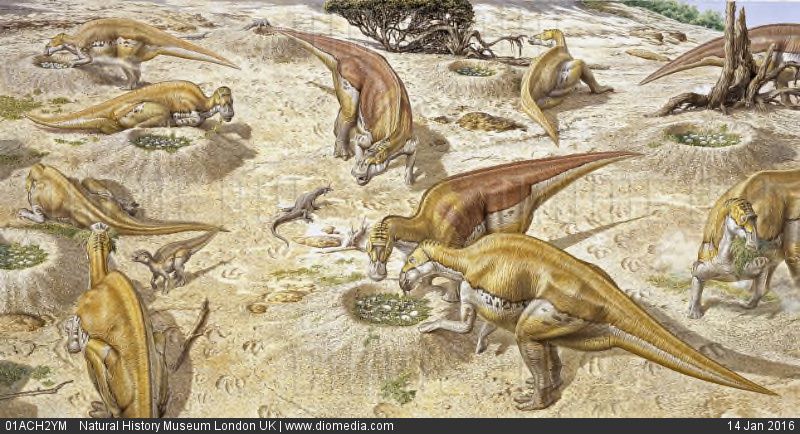
Maiasaura. They raised their young in nesting colonies. The nests were made of earth and contained 30 to 40 eggs laid in a circular or spiral pattern. The eggs were about the size of ostrich eggs. The eggs were incubated by the heat resulting from rotting vegetation placed into the nest by the parents, rather than a parent sitting on the nest. Upon hatching, fossils of baby
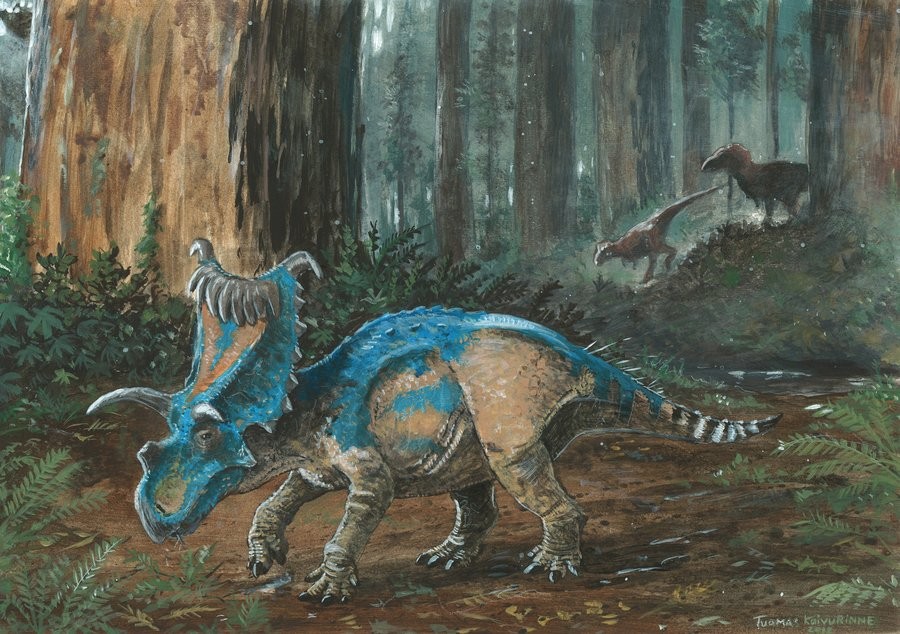
Maiasaura show that their legs were not fully developed and thus they were incapable of walking. However, fossils also show that their teeth were partly worn, which means that the adults must have brought food to the nest. Hadrosaurs are thought to have been browsers, eating higher-growing vegetation like leaves and twigs. By rearing up on their hind legs, some species could of had access to plant material up to 16 feet (4.88 m) above the ground, well out of the reach of the ceratopsians, ankylosaurs, and pachycephalosaurs they lived alongside. Coprolites (fossilized poop) shows us that hadrosaurs also sometimes snacked on decaying wood, perhaps trying to gain nutrients from the fungi or detritus-eating invertebrates contained within the wood. Coprolites from Utah have also shown us that these herbivores also occasionally practiced durophagy, as the poop contained partially digested crustacean shells. Considering
Augustynolophus was a coastal species (as is shown by all the marine fossils that have come out of the Moreno Formation) it is possible marine arthropods actually made up a large part of its diet. Hadrosaurs had hundreds of teeth kept in "dental batteries." These teeth would of been replaced constantly like in sharks. Hadrosaurs were among the few dinosaurs that could chew. One last thing, in September 2017,
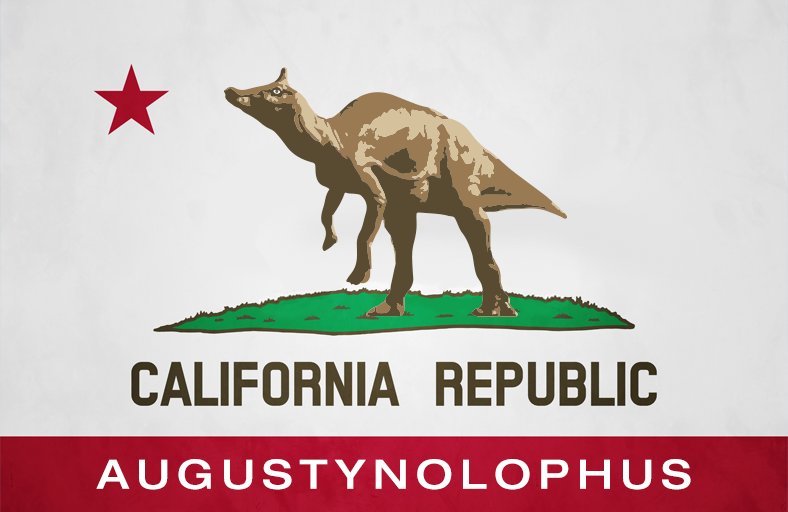
Augustynolophus was declared the official state dinosaur of California.
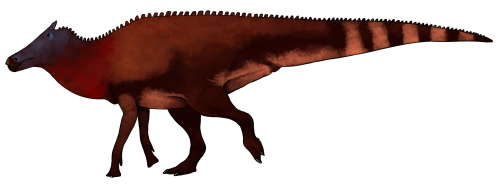
(Below:
Augustynolophus with hypothetical inflatable skin flap)
(Below: Hooded seal)
(Below:
Plotosaurus skeleton)
(Below:
Hydrotherosaurus)
(Below:
Basilemys)
(Below:
Corythosaurus)
(Below:
Prosaurolophus)
(Below:
Saurolophus)
(Below:
Maiasaura nesting grounds)
Picture and Information Sources:
- My brain
- Augustynolophus - Wikipedia
- Augustynolophus
- Augustynolophus morrisi | A Dinosaur A Day | Dinosaur Artwork | Dinosaur art, Prehistoric creatures, Prehistoric
- Meet California’s New State Dinosaur | Smart News | Smithsonian
- California's official state dinosaur: The Augustynolophus
- California's official state dinosaur: The Augustynolophus
- At last, California has an official state dinosaur
- Augustynolophus morrisi, a species of hadrosaur from California that just happens to be one of the last known dinosaurs in the fossil, just before the K-T extinction event. : Naturewasmetal
- Augustynolophus
- Augustynolophus on Twitter
- Hooded Seal (Bladder-nosed Seal) Facts, Habitat, Diet, Life Cycle, Baby, Pictures
- Plotosaurus bennisoni
- Hydrotherosaurus - Wikipedia
- Basilemys
- https://jurassicworld-evolution.fandom.com/wiki/Corythosaurus
- https://a-dinosaur-a-day.com/post/153062736970/prosaurolophus-maximus
- https://www.nhm.ac.uk/discover/dino-directory/saurolophus.html
- https://www.pinterest.com/pin/648307308831501810/






















 )
)