Hipporex's Guide to Interesting and Unique Prehistoric Fauna

NUMBER ONE HUNDRED EIGHTEEN: @ThylacineAlive we've got a bit of a situation here.

latest


  • Animal: Crassigyrinus scoticus
  • Name Pronunciation: Crass-i-ji-rin-us scott-i-kus
  • Name Meaning: "Thick tadpole/ from Scotland"
  • Named By: David Watson - 1926
  • Classification: Life, Eukaryota, Animalia, Chordata, Vertebrata, Gnathostomata, Osteichthyes, Sarcopterygii, Tetrapodomorpha, Crassigyrinidae
  • When: ~ 345,000,000 B.C.E. to 329,000,000 B.C.E. (Mississippian epoch of the Carboniferous period)
  • Where: Limestone Coal Group (Scotland)
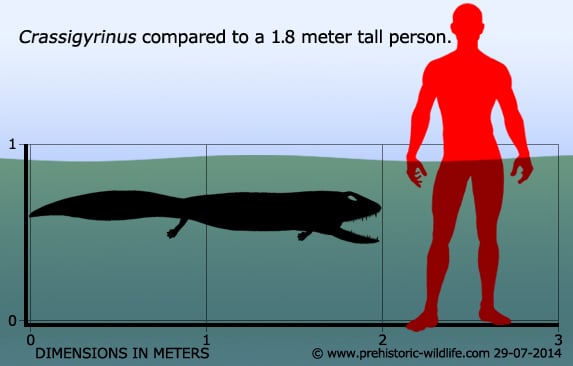
  • Size: 6.56 feet (2 m) long
  • Diet: Carnivore
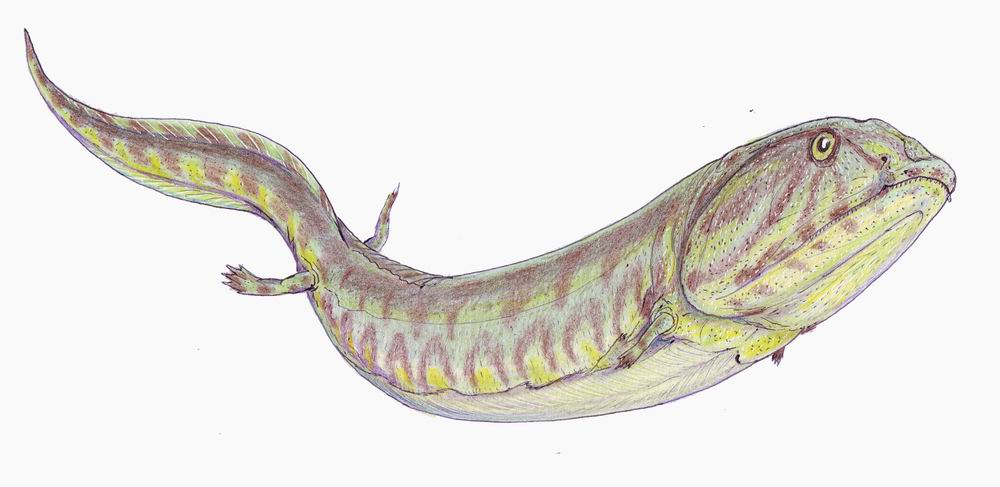
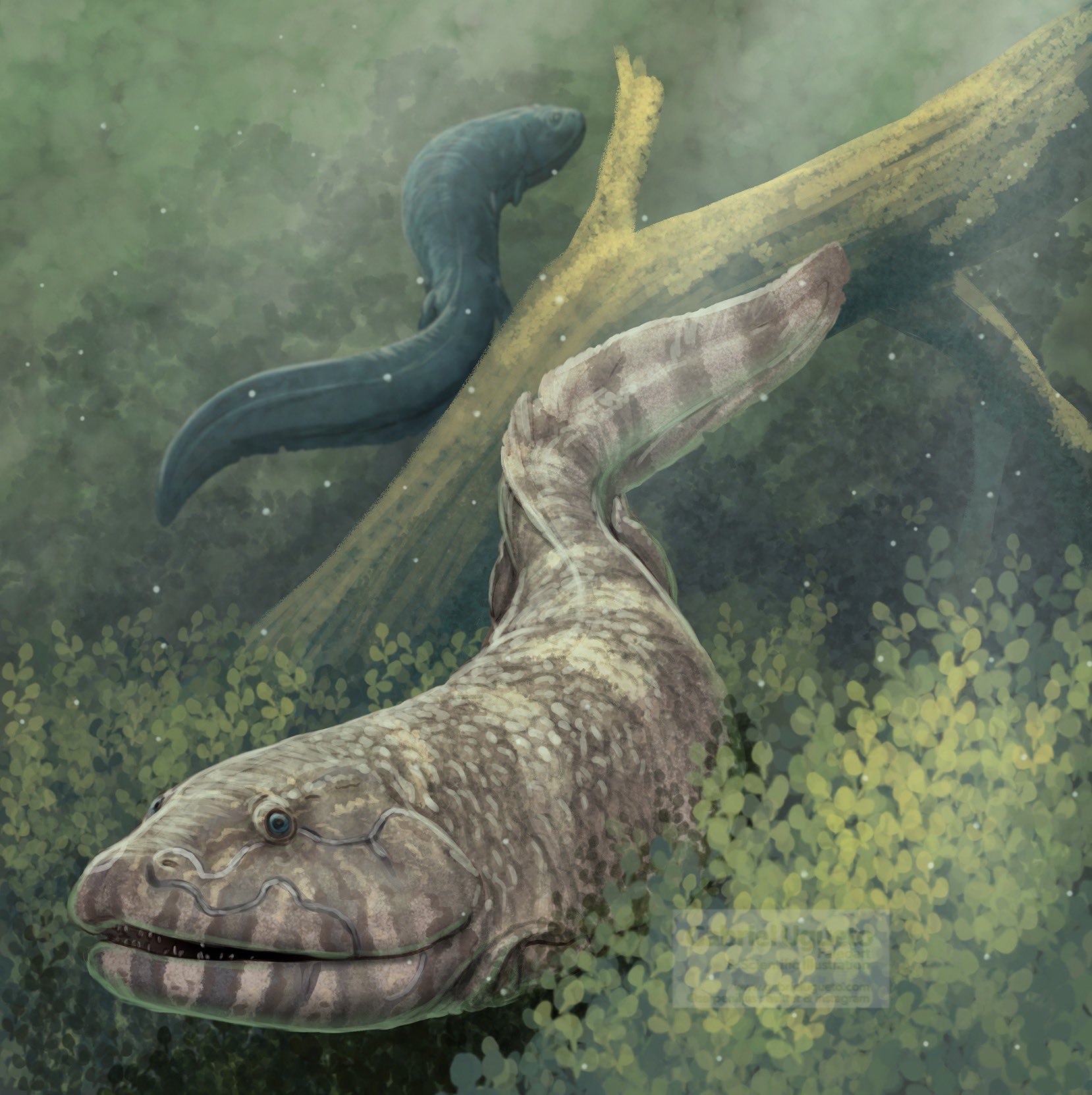
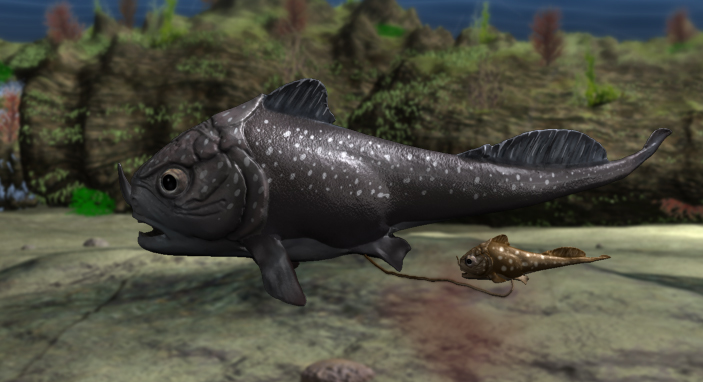
C. scoticus (AKA the "swamp monster" according to Nigel Marvin, the world's first time-traveling zoologist) appears to have to have completely abandoned terrestrial life in favor of an entirely freshwater lifestyle. ‬Its limbs,‭ ‬particularly those at the front,‭ ‬were greatly reduced and would have been no use for land locomotion.‭ They weren't completely useless though as they would have still served as rudders ‬and may have been used for pushing through dense undergrowth of aquatic plants. They may also have still been used for mating,‭ ‬allowing a male to hold onto a female during the spawning process. Another feature suggestive of an aquatic lifestyle was the fact that in the pelvis the ilium lacked a bony connection to the vertebral column (a classic feature of aquatic tetrapods). The tail is only known from a few vertebrae fragments but is assumed to have been long and laterally compressed. C. scoticus had unusually large jaws, equipped with two rows of sharp teeth, the second row having a pair of palatal fangs. Studies have shown that Crassigyrinus may have been able to open its mouth as wide as 60 degrees, which suggests that it was a powerful predator with a strong bite. This strongly suggests that it was ideally suited for catching fish, and the animal was probably a fast-moving predator. The eyes appear to be enlarged,‭ ‬an adaptation for low ambient light,‭ ‬suggesting either a nocturnal lifestyle or low-light hunting. The swamp monster is taxonomically enigmatic, having confused paleontologists for decades with its apparent fish-like and tetrapod features. It was traditionally placed within the group Labyrinthodontia along with many other early tetrapods. Some paleontologists have even considered it as the most basal Crown group tetrapod, while others hesitate to even place it within the Tetrapoda superclass.‭ Crassigyrinus was a monotypic genus.

crassigyrinus-size.jpg

Crassygyrinus_scoticusDB.jpg

EPnh947WsAAZ1NG.jpg:large


Picture and Information Resources:
 
Last edited:
Great entry! Man, I miss Prehistoric Park. But God do I ever hate that crassigyrinus animatronic. If I tried wrestling with it like Nigel Marvin does, I think I'd need a lot of therapy. Not a real crassigyrinus, mind you, just that animatronic.
 
NUMBER ONE HUNDRED NINETEEN: Last night I binge-watched Jurassic World: Camp Cretaceous. I enjoyed it more than I thought I would (I was honestly expecting some dumb kids show). If you have Netflix I recommend giving it a watch. I wanted to do a profile about a species seen in the show but alas all of the creatures are well-known and thus don't qualify for this thread, except for one...

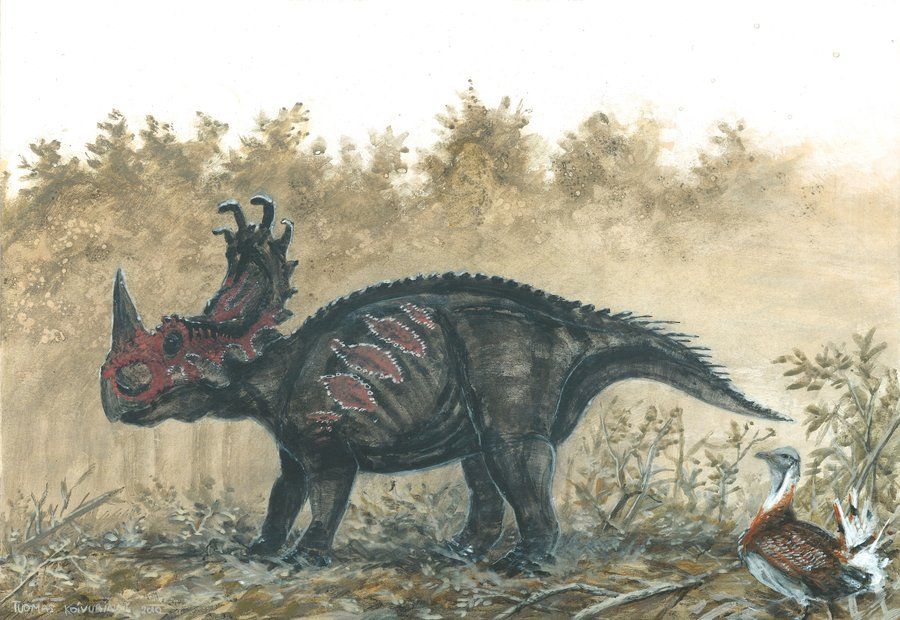
Sinoceratops%2B%2528wm%2529.jpg

  • Animal: Sinoceratops zhuchengensis
  • Name Pronunciation: Sye-noh-sarah-tops zoo-cheng-en-sis
  • Name Meaning: "Chinese horned-face from Zhucheng"
  • Named By: Xu Xing et al. - 2010
  • Classification: Life, Eukaryota, Animalia, Chordata, Vertebrata, Gnathostomata, Osteichthyes, Sarcopterygii, Tetrapodomorpha, Tetrapoda, Reptiliomorpha, Amniota, Sauropsida, Archosauria,‭ ‬Dinosauria,‭ Ornithischia, Ceratopsia, Ceratopsidae, Centrosaurinae
  • When: ~ 73,500,000 B.C.E. (Campanian stage of the Late Cretaceous epoch)
  • Where: Xingezhuang Formation of the Wangshi Group (Shandong, China, Asia)
  • Size: 19.7 feet (6 m) long, 6.6 feet (2 m) tall, and the 2.2 U.S. tons (2 metric tons)
  • Diet: Herbivore
Sinoceratops was a medium-sized ceratopsian dinosaur. It bore a short, hooked horn on its nose (a nasal horn) and a short neck frill (a parietosquamosal frill) with a series of forward-curving hornlets that gave the frill a crown-like appearance. Inside this row of hornlets there were a series of low knobs on the top of the frill, a feature not seen in any other horned dinosaur. The holotype specimen, ZCDM V0010, consists of a partial skull with most elements of the skull roof and a partial braincase. The skull of Sinoceratops is estimated to have been 5.9 feet (1.8 m) long, making it one of the largest known centrosaurine skulls. Like most ceratopsids, Sinoceratops had large skull openings (fenestrae) in its frill. However, unlike the "Sinoceratops" of the Jurassic franchise, these openings would not have been visible on a living animal. The front of the mouth had a toothless beak. Sinoceratops is known from the Xingezhuang Formation of southern China. Alongside it, lived dinosaur genera like Shantungosaurus, a very common enormous duck-billed dinosaur (hadrosaurid), Zhuchengtyrannus, an Asian tyrannosaurid related to Tarbosaurus, Zhuchengceratops, an Asian leptoceratopsid, and Zhuchengtitan, a long-necked dinosaur (sauropod). Sinoceratops is significant for two reasons: 1) it is the first and only ceratopsid know from Asia (all other known ceratopsids lived in North America) and 2) it was one of the largest known centrosaurine dinosaurs.

sinoceratops_by_cisiopurple_dcyioyj-fullview.jpg

09a48dc76c6f477be2a0e0e28f1f6a00.jpg

1200px-Sinoceratops_skeleton.jpg

Below: "Sinoceratops" as it appears in Camp Cretaceous
GMC98_01


Picture and Information Resources:
 
Now, I'm new and haven't seen which ones you have or haven't missed. But definitely add paleothele, anrthropleura, meganeura and pulmonoscorpus
 
NUMBER ONE HUNDRED TWENTY: The Monterey Bay Aquarium (Monterey, California, U.S.A.) just announced in 2022 they'll open the world's first large-scale deep sea animal exhibit. In honor of this fantastic news I thought I'd showcase a species that might be included in the exhibit if time travel is invented between now and 2022.

image_3498_1-Phosphorosaurus-ponpetelegans.jpg

Above: Phosphorosaurus ponpetelegans hunting bioluminescent prey at night.
  • Animal: Phosphorosaurus ponpetelegans
  • Name Pronunciation: Fah-sfer-us-oh-sore-us pon-pet-el-egans
  • Name Meaning: "Phosphate lizard from an elegant creek"
  • Named By: Takuya Konishi et al. - 2015
  • Classification: Life, Eukaryota, Animalia, Chordata, Vertebrata, Gnathostomata, Osteichthyes, Sarcopterygii, Tetrapodomorpha, Tetrapoda, Reptiliomorpha, Amniota, Sauropsida, Eureptilia, Sauria, Lepidosauromorpha, Lepidosauria, Squamata, Toxicofera, Mosasauroidea, Mosasauridae, Halisaurinae
  • When: ~ 72,100,000 B.C.E. (Maastrichtian stage of the Late Cretaceous epoch)
  • Where: Hakobuchi Formation (Hokkaido, Japan)
  • Size: 10 feet (3.048 m) long
  • Diet: Carnivore
Analysis of the skull provides compelling evidence that Phosphorosaurus ponpetelegans had well-developed binocular vision, with an estimated binocular field of view (BFoV) of 35 degrees. This value is unusually high for non-ophidian squamates that typically exhibit a BFoV of 10 to 20 degrees, and is higher than those of other measured mosasaur taxa by at least 5 degrees. Among colubrid snakes (mosasaurs were closely related to snakes), species that dwell in the dark exhibit greater BFoV than diurnal ones in both arboreal and terrestrial taxa. Known also from the Maastrichtian of Hokkaido are fossils of lantern fish (myctophids) and 10-armed cephalopods (coleoids), both of which are typically bioluminescent today. It was hence proposed that the exceptionally large, forward-facing eyes of P. ponpetelegans may well have been a special adaptation for a deep sea or nocturnal lifestyle, where it hunted small, bioluminescent prey while avoiding direct competition with larger, more piscine mosasaurine species such as Mosasaurus hobetsuensis that co-existed with it. It is not hard to imagine a scenario where this species only rose to the surface at night while the larger predators were away. Studies also indicate that the animal was likely an ambush predator that would lie in wait for prey, as it was not as efficient a swimmer as larger mosasaurs, much like other halisaurines. P. ponpetelegans was one of two species of Phosphorosaurus, the other being the younger (66 mya) P. ortliebi. The generic name refers to the fact that the first species to be described, P. ortliebi, was found in the Phosphatic chalk of the Mons Basin (Belgium). The species name, ponpetelegans, refers the exceptional preservation of the holotype specimen of the species and the clean Pankerusano-sawa Creek where the fossil was discovered.

1920px-Phosphorosaurus_ponpetelegans.jpg

Above: P. ponpetelegans skeleton replica on display at the National Museum of Nature and Science (Tokyo, Japan).
image_3498_2-Phosphorosaurus-ponpetelegans.jpg

Above: HMG-1528, the holotype skull of P. ponpetelegans.
sea_dragon_by_theterritorialtrike_dab9krj-pre.jpg

Above: P. ponpetelegans hunting a bioluminescent squid in the deep sea.
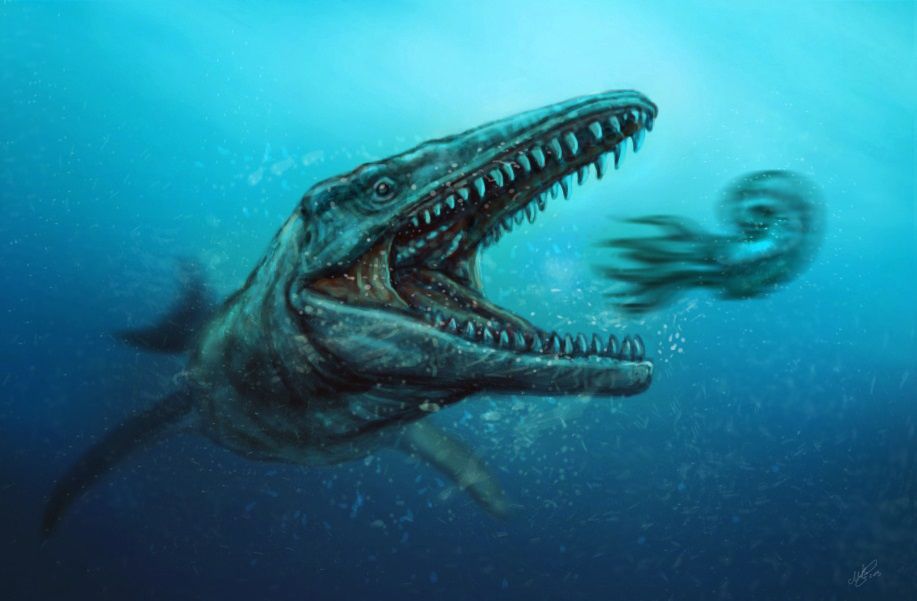
07574b232de957ed7872d4566e28af20.jpg

Above: Mosasaurus hobetsuensis hunting an ammonite.
800px-Carcass_of_Kamuysaurus.jpg

Above: Some of the creatures known from the Hakobuchi Formation, including P. ponpetelegans, Mesodermochelys undulatus (the sea turtles), and Kamuysaurus japonicus (the hadrosaurid dinosaur carcass).

Picture and Information Resources:
 
NUMBER ONE HUNDRED TWENTY ONE: Today is the first day of Inktober/Paleoctober. I will be participating by each day drawing very subpar paleoart. I should note that while I don't trace, I usually highly reference other pieces and I will give credit to said pieces. So here we go...

EjQxHogVgAEpDJ8

Above: Titanosarcolites giganteus by me.
  • Animal: Titanosarcolites
  • Name Pronunciation: Tie-tan-sar-ko-lyts
  • Name Meaning: "Titanic flesh stone"
  • Named By: Charles Trenchman - 1924
  • Classification: Life, Eukaryota, Animalia, Mollusca, Bivalvia, Heterodonta, Hippuritida, Hippuritidina, Caprinoidea, Antillocaprinidae, Titanosarcolitinae
  • When: ~ 70,000,000 B.C.E. to 66,000,000 B.C.E. (Maastrichtian stage of the Late Cretaceous epoch)
  • Where: Jamaica
  • Size: 3.3 feet (1 m) wide
  • Diet: Phytoplankton
Titanosarcolites was a rudist clam that lived on the sea floor in warm, shallow ocean waters of what is now Jamaica. It was a filter-feeder and fed on phytoplankton like modern clams. During the Jurassic and Cretaceous periods most reefs were not made of corals but rather of rudist clams. These "rudist reefs" were so successful that they may have driven sclerctinian corals out of tropical environments around the globe during the Cretaceous Period. It is considered likely that their success was at least partially due to the extreme environment of the Cretaceous. During this period tropical waters were between 42.8 and 57.2 degrees F (6 and 14 degrees C) warmer than they are today and also much more saline, and while this may of been a suitable environment for rudists, it was not nearly so hospitable to corals and other contemporary reef builders. This genus was monotypic, containing only one species, T. giganteus. Rudist clams, like Titanosarcolites, went extinct at the end of the Cretaceous, as a result of the Cretaceous-Paleogene extinction event, however, a decline of species in this order also occurred just before the K-Pg event. For the making of this drawing I used a Twitter post by "Museum Association of the Caribbean" for reference (https://twitter.com/caribmuse/status/726794746660790275).

titanosarcolites_gigantea_by_avancna_d143wro-fullview.jpg

Above: T. giganteus, Praebarrettia sparcilirata (in the center of the larger T. giganteus), and Thyrastylon coryi (clinging to the largest P. sparcilirata). All of these were rudist clams.
Examples-of-rudists-found-in-the-Guinea-Corn-Formation-at-Cabbage-Hill-Scale-bar-is-5-cm.png

Above: Examples of rudists found in the Guinea Corn Formation at Cabbage Hill (Jamaica).
6.09_M-01G-01_Rudist_mural-full_0.jpg

Above: A rudist reef.
titanosarcolites53136s.jpg

Above: A T. sp. fossil.
titanosarcolites-150x150.jpg

Above: A large T. giganteus fossil.

Picture and Information Resources:
 
Last edited:
NUMBER ONE HUNDRED TWENTY TWO: Day 2 of subpar paleoart.

EjTswOUU4AArg4B

Above: Diictodon feliceps by me.
  • Animal: Diictodon
  • Name Pronunciation: Die-ick-toe-don
  • Name Meaning: "Two weasel tooth"
  • Named By: Richard Owen - 1876
  • Classification: Life, Eukaryota, Animalia, Chordata, Vertebrata, Gnathostomata, Osteichthyes, Sarcopterygii, Tetrapodomorpha, Tetrapoda, Reptiliomorpha, Amniota, Synapsida, Therapsida, Dicynodontia, Pylaecephalidae
  • When: ~ 259,800,000 B.C.E. to 254,100,000 B.C.E. (Lopingian epoch of the Permian period)
  • Where: China, South Africa, and Zambia
  • Size: 17.7 inches (45 cm) long
  • Diet: Herbivore
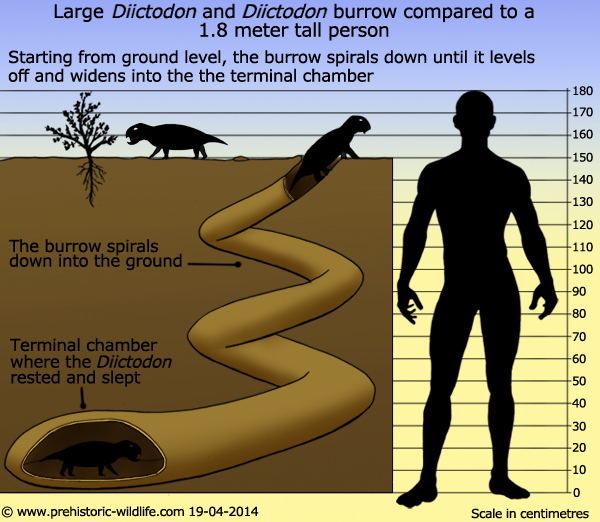
Diictodon was a dicyodont. Dicynodontia was a clade of herbivorous non-mammalian synapsids that lived during the Permian and Triassic periods. They ranged in size from as small as a rat to as big as an elephant. It is believed dicyondonts were warm-blooded and there is some evidence suggesting they had sparse hairs. Diictodon was incredibly abundant, with roughly half of all South African Permian vertebrae fossils being those of this genus. Many, but not all, skeletons have been found possessing a pair of tusks sticking out from the upper jaw. It has been suggested that these tusked individuals represent males and untusked individuals represent females. Diictodon dug and lived in burrows like modern gophers and had numerous adaptations for digging, such as highly developed muscles, a cylindrical body, and wide, clawed hands. Their burrows were up to 4.9 feet (1.5 m) deep. These burrows could have been used to escape the heat of the desert, which was the dominant environment on the supercontinent of Pangea. Numerous Diictodon species have been proposed but only one is universally considered valid, D. feliceps. For the making of this drawing I highly referenced a piece by "DiegoOA" on DeviantArt. (Diictodon feliceps by DiegoOA on DeviantArt)

diictodon-burrow-size.jpg

Above: Diictodon size comparison.
dcqqqi9-9e985510-b190-43b1-9138-4a89526787bc.jpg

Above: Diictodon emerging from their burrows.
340

Above: Diictodon in BBC's Walking with Monsters.
Above: Funny video of Diictodon in BBC's Primeval.

Picture and Information Resources:
 
Last edited:
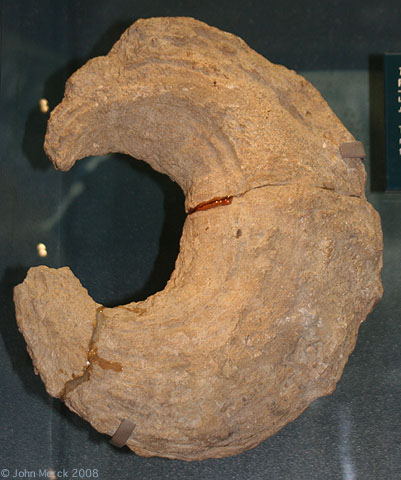
Yep! I should of included it in the profile. Not only have we found fossilized burrows, but we've found Diictodon that died in their burrow. This suggests something killed them rapidly, like perhaps a flash flood, before they could make an escape.
800px-Iziko_Diictodon_Corkscrew.JPG

That's really, really cool!

~Thylo
 
NUMBER ONE HUNDRED TWENTY THREE: Day 3 of subpar paleoart.
EjYvGWYVcAAzTGw

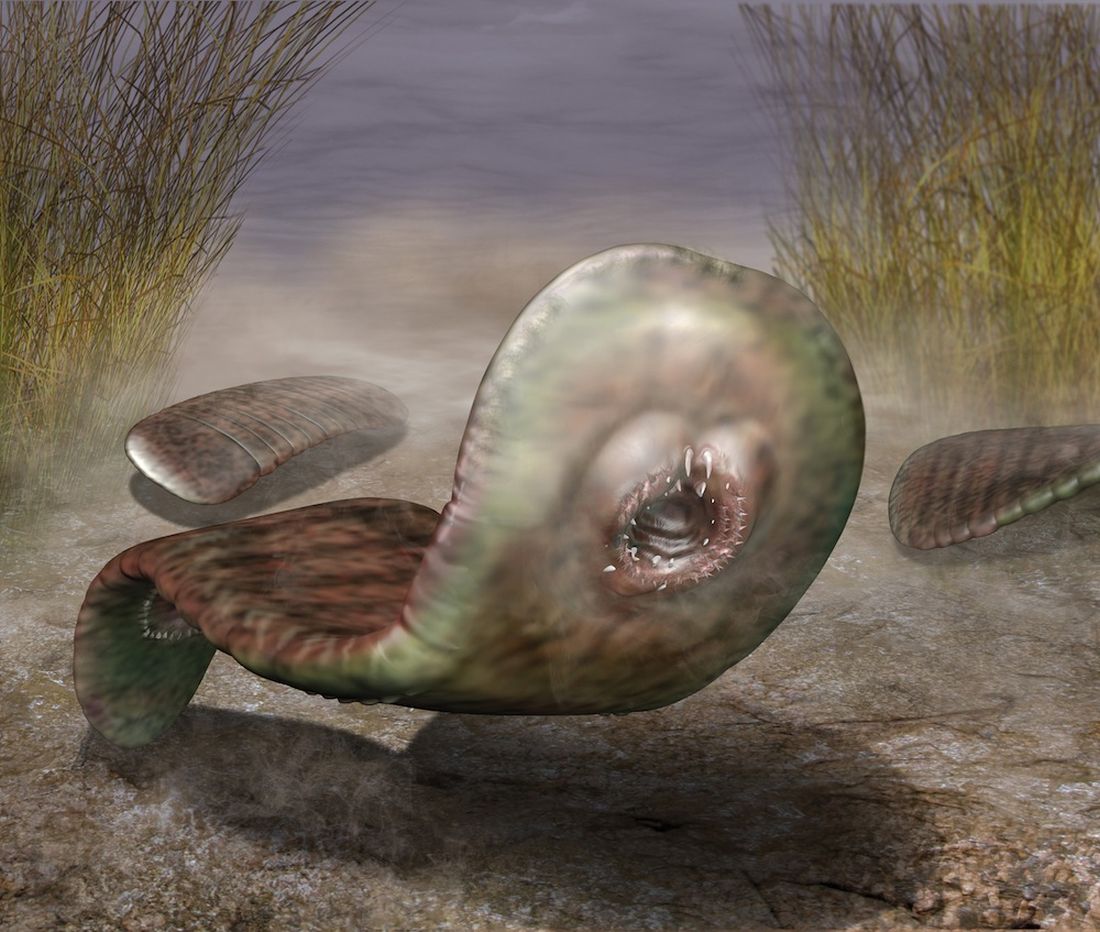
Above: Titanichthys clarkii by me.
  • Animal: Titanichthys
  • Name Pronunciation: Tit-tan-ick-theez
  • Name Meaning: "Titanic fish"
  • Named By: John Strong Newberry‭ ‬-‭ ‬1885
  • Classification: Life, Eukaryota, Animalia, Chordata, Vertebrata, Gnathostomata,
  • When: ~ 360,000,000 B.C.E. (Famennian stage of the Late Devonian epoch)
  • Where: North America, Morocco, and possibly Europe
  • Size: Largest species were up to 26.2 to 32.8 feet (8 to 10 m) long
  • Diet: Filter feeder
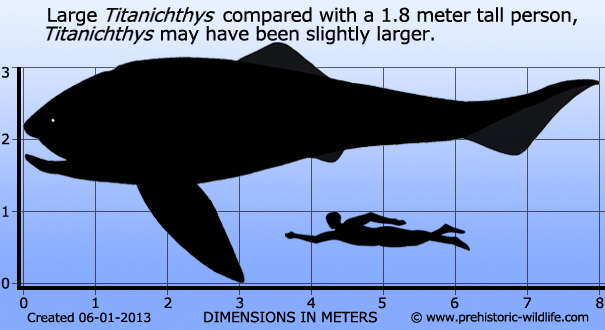
Titanichthys was a placoderm fish. Placodermi was a class of armored fishes that ruled earth’s oceans (some species lived in freshwater) 430 to 358.9 million years ago (during the Silurian and Devonian periods). They were among the first jawed vertebrates and their heads and thoraxes were covered in bony armor. Titanichthys lived in shallow ocean waters in what is now eastern North America (particularly Ohio), Morocco, and possibly Europe. The largest species, T. clarkii, possibly measured up to 32.8 feet (10 m) long. Most large placoderms, such as the famous Dunkleosteus, had strong jaws well suited to crushing and biting through the armor of smaller placoderms. However, a May 2020 study found that the jaws of Titanichthys were functionally closer to that of baleen whales and basking sharks (Cetorhinus maximus). And what do baleen whales and basking snakes have in common? They’re both filter feeders. It is thought Titanichthys used its capacious mouth to swallow or inhale schools of small fishes and/or krill-like zooplankton. This would make this genus that world’s first large filter feeder. Placoderms gave live birth. We know this because a female Materpiscis, a small placoderm from Australia, was found to of died while in the process of giving birth and was fossilized with the umbilical cord intact. This fish genus contained 7 species. What we traditionally think of as placoderms went extinct at the end of the Devonian period. However it has been suggested that placoderms are ancestral to all jawed vertebrates alive today, including us (Homo sapiens), which would mean placoderms didn’t go extinct, but instead are one of the most successful animal groups to have ever evolved. However this hypothesis is not universally accepted. For the making of this drawing I highly referenced a piece by the excellent paleoartist Mark Witton. (https://twitter.com/MarkWitton/status/859512755317092352)

titanichthys-size.jpg

Above: Titanichthys size comparison.
paleoctober_3___titanichthys_by_emilystepp_de67yy6-pre.jpg

Above: Titanichthys.
diving_with_dunkleosteus_by_hodarinundu_ddlmovp-fullview.jpg

Above: Dunkleosteus terrelli.
Materpiscis.jpg

Above: Materpiscis attenboroughi.

Picture and Information Resources:
 
Yep! I should of included it in the profile. Not only have we found fossilized burrows, but we've found Diictodon that died in their burrow. This suggests something killed them rapidly, like perhaps a flash flood, before they could make an escape.

Diictodon is probably my favourite dicynodont. The background on the photo of the fossilized burrow system looked familair to me being at the Iziko and I guess have seen it, but I don't have a photo to be sure. I do have a photo of a pair of hibernating Diictodon.
 
NUMBER ONE HUNDRED TWENTY FOUR: Day 4 of subpar paleoart.

EjgmkpfU0AA-OeY

Above: Mesosaurus tenuidens by me.
  • Animal: Mesosaurus
  • Name Pronunciation: Mess-oh-sore-us
  • Name Meaning: "Middle lizard"
  • Named By: Francois-Louis Paul Gervais - 1864-66
  • Classification: Life, Eukaryota, Animalia, Chordata, Vertebrata, Gnathostomata, Osteichthyes, Sarcopterygii, Tetrapodomorpha, Tetrapoda, Reptiliomorpha, Amniota, Sauropsida, Parareptilia, Mesosauria, Mesosauridae
  • When: ~ 299,000,000 B.C.E. to 280,000,000 B.C.E. (Cisuralian epoch of the Permian period)
  • Where: Whitehill Formation (Southern Africa), Melo Formation (Uruguay), and Irati Formation (Brazil)
  • Size: 3.3 feet (1 m) long
  • Diet: Carnivore
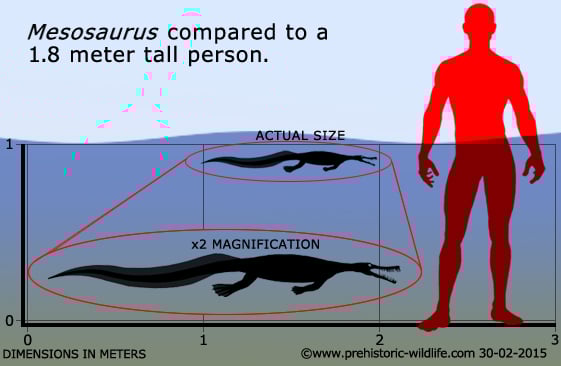
Mesosaurus lived in hypersaline bodies of water in what is now southern Africa and South America. Mesosaurus was one of the first vertebrates to return to the water after Tiktaalik and kin came to land in the Late Devonian. It had webbed feet, a streamlined body, and a long tail that may of supported a fin. It probably propelled itself through the water with its long hind legs and flexible tail. The nostrils were located at the top of the skull, allowing the animal to breathe with only the upper side of its head breaking the surface. Its teeth were very fine and originally interpreted as straining devices for filter feeding on planktonic organisms. However, newly examined remains show that it had too few teeth for such a feeding strategy. It more likely hunted small fishes and invertebrates. One specimen of Mesosaurus, a mid-sized adult, was found with a small individual in its rib cage which has been interpreted as a fetus in utero, suggesting female Mesosaurus, like many other marine reptiles, gave live birth. If this is correct, this specimen would be the oldest known example of viviparity in the animal kingdom. However, another specimen, an isolated fetus, suggest an ovoviviparous reproduction strategy instead. A July 2018 study suggested that while young Mesosaurus were fully aquatic, adults could occasionally venture onto land. When the theory of continental drift was still being debate by scientists, the fact the Mesosaurus fossils have been found on two continents currently separate by an ocean was taken as evidence to support the theory. There was only one species in this genus, M. tenuidens. For the making of this piece I highly referenced a piece by Nobu Tamura on Wikipedia. (Mesosaurus - Wikipedia)

mesosaurus-size.jpg

Above: Mesosaurus size comparison.
marine-science-mesosaur-lifestyle.jpg

Above: Two Mesosaurus swimming and one resting on land.
1024px-Mesosaurus_tenuidens_1.jpg

Above: A fossil of Mesosaurus tenuidens (syn. Mesosaurus brasiliensis) from Brazil.

Picture and Information Resources:
 
  • Classification: Life, Eukaryota, Animalia, Chordata, Vertebrata, Gnathostomata,
Just realized I forgot to finish the Titanichthys taxonomy. So, here is is: Life, Eukaryota, Animalia, Chordata, Vertebrata, Gnathostomata, Placodermi, Arthrodira, Brachythoraci, Coccosteina, Dinichthyloidea, Titanichthyidae
Diictodon is probably my favourite dicynodont. The background on the photo of the fossilized burrow system looked familair to me being at the Iziko and I guess have seen it, but I don't have a photo to be sure. I do have a photo of a pair of hibernating Diictodon.
I don't know if I have a favorite dicynodont but if I did it'd be Lisowicia because of its size, Placerias because of Walking With Dinosaurs nostalgia, or Diictodon because of its lifestyle. That's cool that you have that photo.
 
NUMBER ONE HUNDRED TWENTY FIVE: Day 5 of subpar paleoart.

EjmDTA7U0AASIy1

Above: Odontogriphus omalus by me.
  • Animal: Odontogriphus
  • Name Pronunciation: Oh-don-tog-riff-us
  • Name Meaning: "Tooth riddle
  • Named By: Conway Morris - 1976
  • Classification: Life, Eukaryota, Animalia, Mollusca
  • When: ~ 505,000,000 B.C.E. (Cambrian period)
  • Where: Burgess Shale (British Columbia, Canada)
  • Size: Up to 4.9 inches (12 cm) long
  • Diet: Detritivore
Where exactly Odontogriphus fits onto the tree of life has been debated since its description. This small creature has been pegged as everything from a chordate to a polychate worm, but various recent studies have determined it was a basal mollusk. It had a radula, a tongue-like structure covered in tiny teeth which was/is used by mollusks for feeding. Odontogriphus's radula was used for scraping detritus off the sea floor. The dorsal surface was smooth and didn't bear and shells, spines, or plates. It had saliva glands on either side of the mouth which is some reconstructions could be easily mistaken for eyes, a feature this creature lacked. To move along the seabed, this critter used a muscular "foot" which extended from behind the mouth to its posterior end. The foot was surrounded by gills on all sides except at the front. This genus contained a single species, O. omalus. The species name, omalus, means "flat," referring to the animal's flattened body. For the making of this drawing I highly referenced a piece by Marianne Collins (Odontogriphus - Fossil Gallery - The Burgess Shale) and a piece by an unknown artist (Canada, earliest mollusc fossil ever found).

0b1-odontogriphus-turntable.jpg

C7szfhbVUAAeSKi.jpg

800px-Odontogriphus_ROM57723.JPG


Picture and Information Resources:
 
While on the topic of Cambrian taxa we don't actually know whether they were animals or not, I wouldn't be opposed to seeing a spread on a Rangeomorph or Dickinsonia.

~Thylo
 
NUMBER ONE HUNDRED TWENTY-SIX: Teeny herbivore with unexpected integument.

EjqpEkNVcAAWvu4

Above: Kulindadromeus zabaikalicus by me.
  • Animal: Kulindadromeus
  • Name Pronunciation: Koo-lin-dah-droh-mee-us
  • Name Meaning: "Runner from Kulinda"
  • Named By: Pascal Godefroit et al. - 2014
  • Classification: Life, Eukaryota, Animalia, Chordata, Vertebrata, Gnathostomata, Osteichthyes, Sarcopterygii, Tetrapodomorpha, Tetrapoda, Reptiliomorpha, Amniota, Sauropsida, Archosauria,‭ ‬Dinosauria,‭ Ornithischia
  • When: ~ 168,300,000 B.C.E. to 166,100,000 B.C.E. (Bathonian stage of the Middle Jurassic epoch)
  • Where: Kulinda sites, Ukureyskaya Formation, Russia
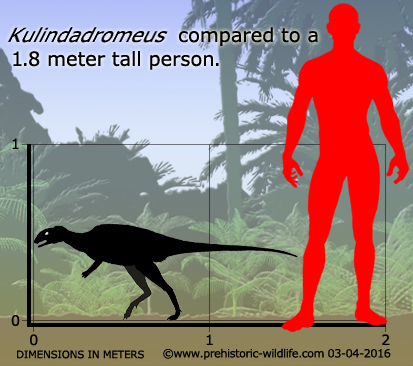
  • Size: 4.9 feet (1.5 m) long
  • Diet: Herbivore
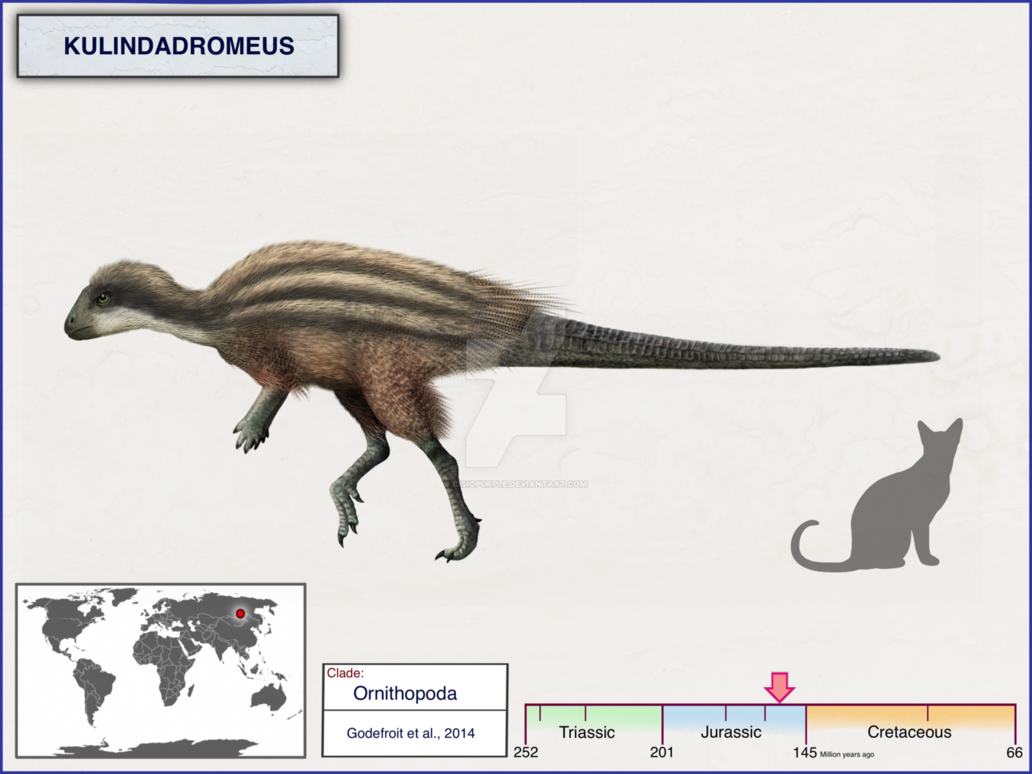
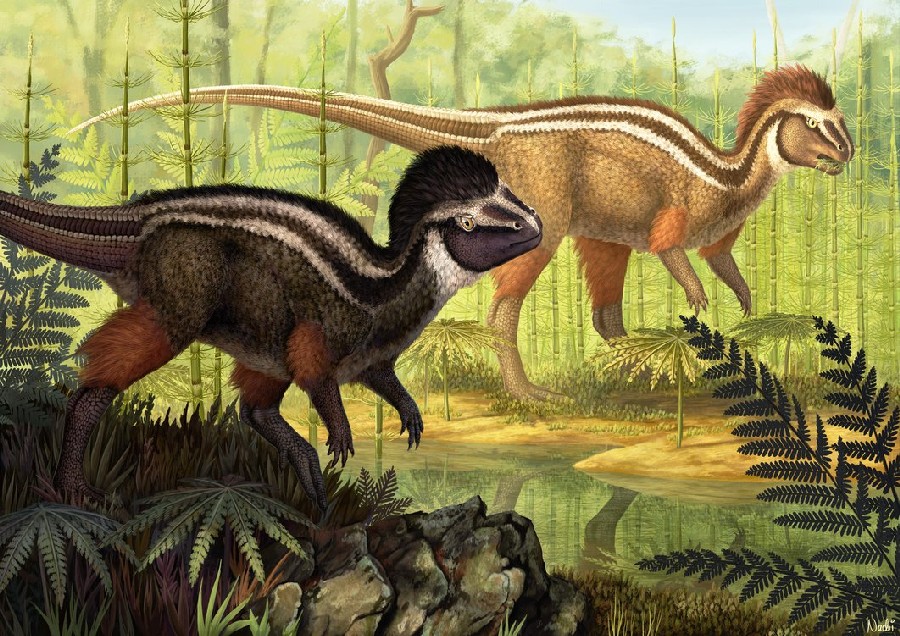
Kulindadromeus was an ornithischian dinosaur. Ornithischia was a clade of herbivorous dinosaurs that first appeared 200.91 million years ago (during the Early Jurassic epoch) and died out 66 million years ago (during the Late Cretaceous epoch) when a massive asteroid caused the extinction of all non-avian dinosaurs (dinosaurs that aren’t birds). Ornithischia included many famous dinosaurs, such as Stegosaurus, Triceratops, and Parasaurolophus. Kulindadromeus had a shot head, short forelimbs, long hindlimbs, and a long tail. The hands of this dinosaur bore five strong fingers (my reconstruction inaccurately only has four, which is my bad). Various specimens of Kulindadromeus show us what kind of integument this little guy sported. Its tail and shins were covered in scales but its body was covered in something surprising: proto-feathers. The feather remains discovered were of three types, adding a level of complexity to the evolution of feathers in dinosaurs. The first type consists of hair-like filaments covering the trunk, neck, and head. These are up to three centimetres long and resemble the stage 1 "dino-fuzz" already known from theropods like Sinosauropteryx. The second type is represented by groups of six or seven downwards-projecting filaments up to 0.59 inces (1.5 cm) long, originating from a base plate. These are present on the upper arm and thigh. They resemble the type 3 feathers of theropods. The base plates are ordered in a hexagonal pattern but do not touch each other. The third type is unique. It was found on the upper lower legs and consists of bundles of six or seven ribbon-like structures, up to two centimetres long. Each ribbon is constructed from about ten parallel filaments up to 0.0039 inches (0.1 mm) wide. Until the 2014 description of this animal, it was thought feathers were exclusively found on coelurosaurian theropods (the group that includes Tyrannosaurus, Velociraptor, and modern Aves). This discovery suggested that feathers and feather-like structures were likely widespread in Dinosauria, perhaps even in the earliest members of the group. In all fairness, two other ornithischians, Tianyulong and Psittacosaurus, were previously known to have sported quill-like bristles, but this new find is the first example of actual filamentous “dinofuzz” in the group. This genus is monotypic, containing only K. zabaikalicus. For the making of this drawing I highly referenced piece by ”Nix” on Tumblr (Nix Draws Stuff). The colors are based off the male golden pheasant (Chrysolophus pictus).

kulindadromeus-size.jpg

GGVMOBm16RZsL20obciYBaDIPNdPTj2ylzl_FKRieHNB6exXljAWzpgbsi5hPn3x6jU4SBUOlMWMO3uSLscpUFAoFO0jlG5tXhdLiqXzNk5o6dIshTz3KmmbLUMe_XNO7IfmGrKWpl_AkQ

43da8b4ff4a7b7398f259c137957ea4e.png

kulindadromeus_zabaikalicus_by_nachiii-d88j6df_fd50.jpg


Picture and Information Resources:
 
NUMBER ONE HUNDRED TWENTY-SEVEN: This threads focus is prehistoric fauna, however, I committed to the #Paleoctober prompt on Twitter and today's prompt is a plant. I honestly didn't realize there were any plants on the prompt when I "signed up" but regardless I enjoyed learning about this genus.

EjwBq4tUcAEfMAk

Above: Lepidodedron by me.
  • Animal: Lepidodedron
  • Name Pronunciation: Lep-i-doh-den-dron
  • Name Meaning: "Scale tree"
  • Named By: Sternberg - 1820
  • Classification: Life, Eukaryota, Plantae, Tracheophytes, Lycopodiopsida, Lepidodendrales, Lepidodendrales
  • When: ~ 358,900,000 B.C.E. to 289,900,000 B.C.E. (Carboniferous period)
  • Where: Worldwide
  • Size: 100 to 160 feet (30.48 to 48.77 m) tall
  • Diet: Photosynthesis
This tree-like plant was a lycopod. Lycopodiopsida is a class of primitive herbaceous vascular plants that have been around for more than 400 million years and are still alive today. Lepidodendron lived in hot humid swamps 358.9 to 289.9 million years ago (during the Carboniferous period). Its fossils have been found as far north as Spitsbergen, Norway and as far south as South America. Unlike modern lycopods, which are small, this genus was a giant, standing up to 160 feet (50 m) tall with a tapering trunk as wide as 6.6 feet (2 m) at the base. Lepidodendron means "scale tree." The name stems from the fossilized remains of their bark, which show these plants were covered in diamond-shaped leaf scars. These leaf scars were formed when juveniles dropped their bottom leaves (juveniles were converted "head to toe" in needle-like leaves, but adults were only leafed at the top). These “trees” branched (grew branches) later in life. The trunk produced little wood and was instead mostly composed of soft tissues. Paleontologists once thought that “scale trees” lived for as little as 10 to 15 years. However, more recent studies have cast doubt on this idea. The authors of one study suggested a typical lifespan was more likely measured in centuries than years. Like all organisms, Lepidodendron eventually had to reproduce. It did not produce true seeds but rather reproduced by elaborate, encapsulated spore-bearing cones. Analysis of some of the fossilized remains suggests that these plants were monocarpic, meaning each plant died after a single reproductive event. It has been suggested that the "trees" in a forest all established at around the same time, grew up and reproduced together, and then all died en masse. Their deaths would have cleared the way for their developing offspring. The end of the Carboniferous was a time of change: the two supercontinents Laurasia and Gondwana were smashing into each other creating Pangea, the CO2 levels (which were high throughout the Carboniferous) plummeted, and the planet was going from mostly tropical to the dawn of a new ice age. Ultimately, these changes were too much for Lepidodendron to handle and these giant lycopods went extinct. It is hard to say for sure just how many species of scale tree there were. Early on, each fragmentary fossil was given its own unique taxonomic classification; a branch was considered to be one species while a root fragment was considered to be another, and juvenile tree fossils were classified differently than adults. As more complete specimens were unearthed, a better picture of scale tree diversity started to emerge. Between 4 and 13 species of "scale tree" are currently considered valid depending on who you ask. For the making of this drawing I highly referenced a piece by Tim Bertelink on Wikipedia (Lepidodendron - Wikipedia).

Lepidodendrales_reconstrucci%C3%B3n.jpg

Above: Juvenile (on the left) and adult (on the right) Lepidodendron.
lepidodendron-carboniferous-plants-richard-bizleyscience-photo-library.jpg

Above: Lepidodendron forest.
SS2139210.jpg

Above: Lepidodendron "scales."
320px-Lepidostrobus_variabilis_2.jpg

Above: The strobilus (the spore-bearing cone) of Lepidodendron.

Picture and Information Resources:
 
Back
Top