History of Australasia’s Zebra Population

Zoofan15

Well-Known Member
10+ year member
Introduction

The Australasian region contains around 110 zebra, with the current population detailed in this population thread by @Jambo:

https://www.zoochat.com/community/threads/australasian-zebra-population.486386/

This thread however, will be concerned with the history of the regional population, including:

The early years (pre-1950’s)
The purebred Grant’s zebra population (1950’s-2000’s)
The purebred Chapman’s zebra population (1980’s-2000’s)

I will begin by uploading what information I have found.
 
Introduction

The Australasian region contains around 110 zebra, with the current population detailed in this population thread by @Jambo:

https://www.zoochat.com/community/threads/australasian-zebra-population.486386/

This thread however, will be concerned with the history of the regional population, including:

The early years (pre-1950’s)
The purebred Grant’s zebra population (1950’s-2000’s)
The purebred Chapman’s zebra population (1980’s-2000’s)

I will begin by uploading what information I have found.
I believe that if pure bred Grants Stallions were imported every "few years" by "some" holders as the older Stallions pass they could dilute the pool with more and more Grants, they are not difficult to aquire as compared to other species of Zebra.
 
Last edited:
Early History (1800’s-1901)

In 1862, Governor George Grey bought Kawau Island in New Zealand and later imported zebra from South Africa. His imports have no living descendants and are otherwise only notable for being what appears to be the first zebra in Australasia.

On 25/06/1885, a Burchell’s zebra mare named ‘Juba’ was imported by Sydney’s zoological gardens, which opened to the public in 1984 and later reopened on the current site as Taronga Zoo in 1916. It appears this was the first zebra exhibited in an Australasian zoo.

On 02/12/1893, Melbourne Zoo announced the birth of a hybrid colt, born in November that year. The mother was a Burchell’s zebra mare and the father was a Siamese ass. It was noted Melbourne had a pair of Burchell’s zebra, which had come from Paris (where they had been captive bred). It was also noted zebras did not breed readily and the hybrid colt has been produced as an experiment.

Two Burchell’s zebra were imported by Adelaide Zoo in 1894. Their gender was not noted; but a Burchell’s zebra stallion was imported by Adelaide Zoo from Hamburg on 10/08/1901, with it noted he was joining two Burchell’s mares that had been at the zoo for some time. This was likely the two zebra, that had arrived seven years earlier in 1894.
 
Early History (Burchell’s zebra)

Adelaide Zoo imported a Burchell’s zebra mare in 1906, that apparently died before 1908.

On 06/01/1908, Adelaide Zoo welcomed the birth of the first zebra born in an Australian zoo. The colt was born to the stallion imported in 1901 from Hamburg and a mare received from Wirth’s Circus. This mare arrived at Adelaide Zoo in 1894 with a female companion (see post above), who was also still alive in 1908. The birth took the zoo’s herd to 2.2 Burchell’s zebra.

A Burchell’s zebra foal was born at Adelaide Zoo in 1911. This foal died at three and a half months old.

In 1915, Adelaide Zoo imported a Burchell’s zebra mare and a Mountain zebra stallion. The Mountain zebra was housed in an adjacent exhibit to the Burchell’s zebras (numbers unknown).

In December 1925, Adelaide Zoo imported a Burchell’s zebra stallion. The zoo had ambitions to saddle-break it to give children rides. I wonder how that turned out…

A Burchell’s zebra was photographed at Perth Zoo in March 1932.

Adelaide Zoo acquired a Burchell’s zebra stallion from Hobart Zoo when it closed in 1937. It was the only specimen at the zoo when it died in 1946 and the zoo were without zebra until 1954.
 
Early History (Chapman’s zebra)

Melbourne Zoo acquired two Chapman’s zebra in 1920. The stallion was named ‘Billy’ and lived with a mare. They had produced no foals, though the article mentioned the hybrid detailed above, which was apparently a huge attraction. It was therefore implied no zebra foals had been born throughout Melbourne’s history (as of 1926).

On 30/11/1937, a Chapman’s zebra foal was born at Perth Zoo. It was noted to be the first surviving foal, with two previous foals killed by their mother and father respectively. This herd had apparently died out by 1947.

In Novemver 1949, a colt named Zeke was born at Perth Zoo. The parents were the only other zebras at the zoo and had been imported from South Africa in 1947. This pair produced colts in March 1951 and November 1952; and a filly in October 1953.

The filly born in 1953 was noted to take Perth Zoo’s herd to five zebra. The missing foal was the colt born in March 1951. He was killed by his two year old brother at six months of age.

In December 1942, Taronga was noted to have Chapman’s zebra.

Adelaide Zoo received two Chapman’s from Perth Zoo in 1954. A colt named ‘Jimmy’ arrived 12/03/1954; and an unnamed filly arrived 28/06/1954. The pair were transferred from Perth Zoo and from the descriptions given would have been the colt born November 1952 and the filly born October 1953.

Melbourne Zoo received a Chapman’s zebra filly from Perth Zoo in October 1955. This foal was bred at Perth Zoo to their successful breeding pair in 1954 and was their fifth foal. It was noted they’d supplied every zoo in Australia with zebras, implying Taronga received Zeke (born 1949).
 
I believe all holders should get together and work out a national plan forward!

I agree. It’s interesting how cohesive the regional population was in the mid-20th century by virtue of limited breeding success. Perth Zoo established themselves as the breeding hub, producing five foals in as many years from two purebred founders and supplying the other three main zoos with offspring from this pairing.

The only other zoo breeding at this time was Taronga, who produced a colt in 1949. They had a herd (likely Chapman’s since they had them in 1942) of 1.2 zebra.

All the zoos held small herds, which were vulnerable to extinction. Adelaide had some early success in breeding Burchell’s zebra, with that small herd dying out; and later replaced with Chapman’s stock from Perth Zoo.
 
I agree. It’s interesting how cohesive the regional population was in the mid-20th century by virtue of limited breeding success. Perth Zoo established themselves as the breeding hub, producing five foals in as many years from two purebred founders and supplying the other three main zoos with offspring from this pairing.

The only other zoo breeding at this time was Taronga, who produced a colt in 1949. They had a herd (likely Chapman’s since they had them in 1942) of 1.2 zebra.

All the zoos held small herds, which were vulnerable to extinction. Adelaide had some early success in breeding Burchell’s zebra, with that small herd dying out; and later replaced with Chapman’s stock from Perth Zoo.
These days with quite a few very large zoos herds could be held and displayed, I believe we should be looking at the long term of many species more so with hard to get species!
 
So the current Generic population is a general mix of the Grant's, Burchell's and Chapman's subspecies? Any other subspecies present?

Monarto's population strikes me as highly Burchell-like many of their Zebras lack the the clean cut stripes of Grant's, possessing strong shadow stripes and a few are missing stripes beneath their knees, akin to Burchell's. Genetically I'd say the Monarto population would be 50% Burchell's, 25% Grant's, and 25% Chapman's.

The Chapman's and Burchell's subspecies natural ranges border each other so I'd imagine there would be a rather large genetic overlap in this range, hence hybridisation between these two subspecies wouldn't be terrible, as it would reflect the mixed 'border' populations in Southern Africa.

Unfortunately, our Australasian Generic population also has Grant's admixture which would not naturally occur, thus they are entirely artificial.
 
So the current Generic population is a general mix of the Grant's, Burchell's and Chapman's subspecies? Any other subspecies present?

Monarto's population strikes me as highly Burchell-like many of their Zebras lack the the clean cut stripes of Grant's, possessing strong shadow stripes and a few are missing stripes beneath their knees, akin to Burchell's. Genetically I'd say the Monarto population would be 50% Burchell's, 25% Grant's, and 25% Chapman's.

The Chapman's and Burchell's subspecies natural ranges border each other so I'd imagine there would be a rather large genetic overlap in this range, hence hybridisation between these two subspecies wouldn't be terrible, as it would reflect the mixed 'border' populations in Southern Africa.

Unfortunately, our Australasian Generic population also has Grant's admixture which would not naturally occur, thus they are entirely artificial.

To my knowledge that’s correct, with only Chapman’s, Burchell’s and Grant’s being represented in current stock. The Chapman’s zebra actually has shadow stripes as well, so zebras with shadow stripes in the region could have the heritage of either Burchell’s or Chapman’s.

As of the mid-1950’s, it appears all Burchell’s stock had died out and all zoos at that time had Chapman’s stock. Presumably some Burchell’s zebra were imported after to have purebred descendants at Monarto. The National Zoo reportedly held Burchell’s zebra in 2001.

Auckland imported their first Grant’s zebra in 1959 and exported several zebras to Australian zoos in the 1980’s.
 
So the current Generic population is a general mix of the Grant's, Burchell's and Chapman's subspecies? Any other subspecies present?

Monarto's population strikes me as highly Burchell-like many of their Zebras lack the the clean cut stripes of Grant's, possessing strong shadow stripes and a few are missing stripes beneath their knees, akin to Burchell's. Genetically I'd say the Monarto population would be 50% Burchell's, 25% Grant's, and 25% Chapman's.

The Chapman's and Burchell's subspecies natural ranges border each other so I'd imagine there would be a rather large genetic overlap in this range, hence hybridisation between these two subspecies wouldn't be terrible, as it would reflect the mixed 'border' populations in Southern Africa.

Unfortunately, our Australasian Generic population also has Grant's admixture which would not naturally occur, thus they are entirely artificial.
That would make a lot of sense!

The Chapman's representation is probably coming from Christou (Werribee's former stallion), who fathered Monarto's current stallion, Storm.

I'd imagine Monarto's group would've probably be majority Burchell's, if we can assume Adelaide's group were too.

It would be very intriguing to see which zoos held which sub-species before hybridising began (I believe this would've been as late as the 80's). We know Werribee had Chapmans, but still blank on the others.
 
That would make a lot of sense!

The Chapman's representation is probably coming from Christou (Werribee's former stallion), who fathered Monarto's current stallion, Storm.

I'd imagine Monarto's group would've probably be majority Burchell's, if we can assume Adelaide's group were too.

It would be very intriguing to see which zoos held which sub-species before hybridising began (I believe this would've been as late as the 80's). We know Werribee had Chapmans, but still blank on the others.

The following zoos historically held purebred Grant’s zebra:

Auckland Zoo (from 1950’s)
Hamilton Zoo (from 1990’s)
Wellington Zoo (from 1980’s)
Taronga Western Plains Zoo (from 1980’s)
Perth Zoo (from 1980’s)

All were descended from Auckland stock. Marbles (2003) is the last purebred from this line.
 
With the size increase especially with Monartos Wild Africa and TWPZ planned expansion I feel now more than ever there is a perfect chance not only to hold a much bigger number of Zebras but to start to focus upon breeding more of a pure line of stock such as the Grants, I can't see any real reason as to why holders can't start to import more stock and work towards a real plan for the future!
 
With the size increase especially with Monartos Wild Africa and TWPZ planned expansion I feel now more than ever there is a perfect chance not only to hold a much bigger number of Zebras but to start to focus upon breeding more of a pure line of stock such as the Grants, I can't see any real reason as to why holders can't start to import more stock and work towards a real plan for the future!

Some of the open range zoos have held up to four herds of zebras in recent years. I’d also like to see them cease breeding generics and reallocate that space to purebred Grant’s.

It seems pointless having the main zoos breeding all these generics, which have zero conservation value (as noted by @Swanson02, Grant’s and Burchell’s/Chapman’s don’t overlap); and which will never be of interest to zoos outside the region.

We inbreed Barbary sheep and hippopotamus because we can’t import them (fair enough); but zoos could certainly import purebred zebras as Darling Downs Zoo have done. Since this represents the only viable breeding population of purebred zebra in the region, it makes sense for the others to support this by either importing Grant’s zebra or at the very least, acquiring surplus Grant’s as they become available.
 
Difference between Burchell’s and Chapman’s Zebra

Since Burchell’s zebra and Chapman’s zebra both have shadow stripes, I was curious to know if there were an observable differences between the two.

Apparently the differences are:

Burchell’s zebra have defined black strips, with brown shadow stripes

Chapman’s zebra have less defined or incomplete stripes, spidery stripes and more white on the legs, hindquarters and underside.

It should be noted that there will be variation within individuals. I’ve found both textbook examples and weak examples of the above online, thought it’s possible those demonstrating said variation are hybrids of the two or misidentified.

A few photos:

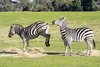
This photo was taken by @marmolady in 2021 and shows two zebras at Werribee. Werribee’s herd is known to have a strong Chapman’s influence and the zebra on the left is a textbook example of a Chapman’s. The one on the right has very weak shadow stripes and likely has a higher percentage of Grant’s zebra heritage.

upload_2023-10-10_14-31-36.jpeg

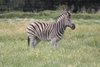
This photo was taken by @Hix at Werribee in 2012 and is also a textbook example of a Chapman’s zebra (note the amount of white on the underside and legs, the spidery stripes and the pale shadow stripes:

upload_2023-10-10_14-36-41.jpeg

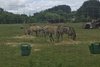
This photo was taken by myself at Hamilton Zoo in 2020. Marbles (the only purebred Grant’s zebra) can be identified as the the middle zebra in the group of three by her lack of shadow stripes; while all others in the herd have shadow stripes. My judgement may be clouded by the heavy Grant’s influence, by my instinct is to say the foals are hybrids with the Burchell’s subspecies over Chapman’s. This is supported by the fact the stallion (Malawi) comes from the National Zoo, which reportedly held Burchell’s around the time of his birth.

upload_2023-10-10_14-39-58.jpeg
 

Attachments

  • upload_2023-10-10_14-31-36.jpeg
    upload_2023-10-10_14-31-36.jpeg
    232.3 KB · Views: 50
  • upload_2023-10-10_14-36-41.jpeg
    upload_2023-10-10_14-36-41.jpeg
    133.6 KB · Views: 47
  • upload_2023-10-10_14-39-58.jpeg
    upload_2023-10-10_14-39-58.jpeg
    148.7 KB · Views: 46
Early Chapman’s Wrap Up/Origin of Burchell’s

Early Chapman’s breeding in Australia:

Taronga Zoo imported three zebra on 21/03/1947. The two Chapman’s zebra that were at Taronga in 1942 were deceased by then. This trio produced a foal in November 1949.

The foal born at Taronga Zoo in November 1949 was a colt and looking at photos, it appears he (and his parents) were Chapman’s zebras. As per Post #6 above, I believe a Chapman‘s colt was transferred from Perth Zoo (which bred five foals between 1949-1954) to Taronga Zoo in the 1950’s.

An interesting note from an article in 1953 notes the importation of zebra was then prohibited, with zoos relying on local breeding. I’m not sure how long this ban was in place for and whether it only applied to Australia. Auckland Zoo imported a zebra from England in 1959.

On 14/11/1961, a filly named Candy Bar was born at Taronga Zoo. Photos show this foal to have the spidery Chapman’s stripes.

Origin of the Burchell’s:

So where did the Burchell’s come in?

In the mid-1950’s, all of Australia’s main zoos had Chapman’s zebra; two of these facilities were successfully breeding; and there was an apparent import ban in place within Australia that potentially lasted until 1980 (when Werribee imported Chapman’s zebra from Rotterdam).

My assumption at this point is a zoo (probably Adelaide or Monarto) imported Burchell’s zebra in the 1980’s. This explains why several zoos claimed in the following decades to have purebred Burchell’s zebra, which would otherwise be a dubious claim if those animals were descended from stock imported in the first half of the 20th century (given the prevalence of Chapman’s stock).
 
After looking at the above photos I checked out some other pics of Zebras on the Western Plains zoo gallery of which there are some showing what appear to be a very Grants looking animals.

That makes sense as they imported four Grant’s zebra in 1983, which likely still have descendants to this day. The Grant’s influence is similarly seen in Auckland’s herd.

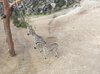
This is mother and daughter (Layla and Eve):

Layla was born to a purebred Grant’s mare and a generic stallion at Hamilton Zoo, so is a minimum of 50% Grant’s. Her daughter was sired by a male whose sire was a purebred Grant’s, so Eve is at least 75% Grant’s.

upload_2023-10-10_18-33-8.jpeg
 

Attachments

  • upload_2023-10-10_18-33-8.jpeg
    upload_2023-10-10_18-33-8.jpeg
    184.7 KB · Views: 48
This photo was taken by myself at Hamilton Zoo in 2020. Marbles (the only purebred Grant’s zebra) can be identified as the the middle zebra in the group of three by her lack of shadow stripes; while all others in the herd have shadow stripes. My judgement may be clouded by the heavy Grant’s influence, by my instinct is to say the foals are hybrids with the Burchell’s subspecies over Chapman’s. This is supported by the fact the stallion (Malawi) comes from the National Zoo, which reportedly held Burchell’s around the time of his birth.
I agree with this; not sure on the origins of Malawi’s exact parents, but they were Zambezi and Zahra, both of whom were born in the early 90’s. We can therefore assume one of the two was purebred (with them only being two of the three adults at the time).

From photos, it appears that Zambezi is at least pure or majority Burchells. He left in 2012 to Australia, so that would potentially explain National losing Burchell’s at the time.
 
After looking at the above photos I checked out some other pics of Zebras on the Western Plains zoo gallery of which there are some showing what appear to be a very Grants looking animals.
Would make a lot of sense. Werribee acquired some of Dubbo’s females to add to their ‘generic’ herd within the last decade, so that would potentially explain the Grant’s looking female @Zoofan15 mentioned above.
 
Back
Top