
Day 15 / 30th September
The lions roared intermittently throughout the night, but despite this I still slept soundly, waking a little after 6:00am. I lay in the very comfortable bed listening to the avian dawn chorus, wishing I recognised just one of the calls. At around 6:30 I heard the camp staff and the rattle of some buckets at the back of the tent, and minute later someone said “shower ready”.
After a quick shower and breakfast I had a quick look around the camp. The grass was long, in some places knee-high, and wet with dew. At the back of the camp, where the buffalos had been the night before, there was an animal path through the grass running parallel to the camp, about 70 metres behind my tent. Beyond that the ground sloped down for another 30 metres before rising again, and I got the impression there was a small stream there during the wet season, but it was dry now. All around there were shrubs and bushes between the trees, and more animal paths through the grass and foliage. The other side of the dry stream was more thickly vegetated and the sloped upwards into a hill. I had hoped to see some of the birds that had been vocalising earlier but they had gone quiet and all I saw was a white-backed vulture in the top of a tree.
While I was in the shower I had heard Innocent start the 4WD and drive off to the airstrip to collect the inverter, and now he returned to collect me. I grabbed my cameras and broken binoculars and jumped in and we headed into the park. Innocent told me the plane did not have the inverter or spare parts he was expecting – maybe tomorrow. I would just have to use my laptop sparingly. Luckily I had spare batteries for my cameras, and in case my laptops battery dies and I couldn’t upload photos, I also had spare memory cards.
“What do you want to see today?” asked Innocent as we left camp.
“Lions, Leopards and Cheetahs” I replied without hesitation.
The words were barely out of my mouth when I saw my first lifer for the day – only a couple of hundred metres from camp – a plain looking antelope that looked a little different to the other I’d seen: a Bohor Reedbuck female. She froze and looked at us for a few seconds before bounding away, but not before I got a couple of photos.
Continuing on I saw more of the common birds from the day before – Lilac-breasted Roller, Magpie Shrike and White-crowned Shrike – and some zebra and impala. And then another lifer, a small group of four Coke’s Hartebeest, including two juveniles, some wildebeest, a lappet-faced vulture, a pair of marabous in a tree, and then three lions under tree. They weren’t in a good position, and my binoculars weren’t much good so I did most of my wildlife gazing through my camera, as the 300mm zoom was almost as good as the binoculars. They were about 30 metres from the road and lying in the grass, which wasn’t ideal, but 30 minutes later we came across a group of eight lying down right beside the road and I was able to get some nice shots of them. And those weren’t the last lions we saw that day either.

One of the roads we took crossed a small stream and when we arrived five giraffes were about to cross from the other side, using the road as it was a more secure footing (I imagine). Innocent stopped the car and we waited while they walked sedately along the road towards us, yellowbilled oxpeckers hanging off their necks and rumps, before turning away to walk alongside the stream. The first to cross was the tallest animal, a male although his skull was not as lumpy as others I’ve seen, suggesting he was a mature male, but not a very old one. His coat pattern was also very different to the others, looking very pale, and I later leant this was a form of mange.

A short time later we came across a Leopard Tortoise by the side of the road and I had just enough time to get a few photos before he determinedly (and relatively quickly, for a tortoise) made his way into the grasses. Another lifer.
But it was the birds that were most visible (apart from the zebra, wildebeest and impala) – Wattled Starlings, Brown Parrots, Purple Grenadiers, Red-cheeked Cordons, Emerald-spotted Wood Pigeons, Tawny Eagles, Rufous-tailed Weavers, Egyptian Geese, Little Bee-eaters, Helmeted Guineafowl, Grey-backed Fiscals, Grey-breasted Spurfowl, White-headed Buffalo Weavers, Blacksmith Plovers and Barefaced Go-away Birds.
At one point we stopped so I could photograph a bird flying overhead and I noticed a black bird sitting on an exposed branch almost directly above the vehicle. The only way I could get a good angle for a photo was to lie down on the seat and shoot upwards.
“What is it?” asked Innocent, whose lack of bird knowledge had become apparent the day before.
“A drongo” I answered, “though I don’t know which”.
Innocent pulled out his field guide and went straight to the contents, found the page for drongos and turned to it. (Most bird people I know don’t use the Contents or Index of a field guide, they tend to flip through the plates until they find the family they are looking for. And they usually know if the plates they want are in the front, or back, or middle of the book).
Three drongos were illustrated – Fork-tailed, Velvet-mantled and Square-tailed. And all look almost identical. Innocent looked at the illustrations, then at the bird, then stabbed one with his finger. “This one!” he said.
From my vantage point on the seat I couldn’t see the book at all. “Which one?”
“Velvet-mantled” he replied. And it could have been, because from below there was no way I could see the mantle, let alone if it was velvety or not.
“Why?” I asked.
“Because it has red eyes.”
I paused for a second before responding “All drongos have red eyes”.

Innocent looked at the bird and the pictures again before saying “this one”.
Again I asked “Why?”
“Because it has a forked tail”. To which I replied immediately “But all drongos have forked tails”.
He looked at the book again and after a minute said “I don’t know” and handed the book to me. I sat up and had a quick look at the plate, then handed it back and said “it’s this one”, pointing at the Common (or Fork-tailed drongo).
“Why?”
“Because it’s the only one found in this part of Tanzania” and I showed him the maps that clearly illustrated the other two species being found several hundred kilometres away in opposite direction.
But despite his lack of ornithological knowledge, Innocent was very good at his job. Every time we stopped so I could take a photograph he would turn off the engine so there would be no vibrations. And if we were driving and I wanted to take a scenic shot out the window, and he saw me, he would immediately slow down, and would have stopped had I not told him to keep going.
And his spotting skills were excellent. He found me a cheetah, some distance from the road under a tree, my first (and only) cheetah, and he also spied a dikdik in the scrub. And there was the jackals seen in the rain on the previous day when we drove into the park.
At about 1pm, having been out for several hours, we arrived at the Serengeti Visitor Centre for lunch. The centre consisted of a restaurant/cafe, souvenir shop and information centre. We sat in the carpark eating our sandwiches and I discovered the wildlife here was fairly bold and were not to botherd by all the people. Grey-capped Social Weavers and Speckle-fronted Weavers hopped around on the ground looking for leftover titbits, and Bush Hyrax wandered about amongst feet with impunity. There was even a dwarf mongoose lolling around under a thornbush.

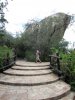
After lunch I went to visit the Information Centre, which is designed as a path through a kopje with information plaques along the way. Very informative, and I saw more hyrax, mongooses and a several brightly coloured red-and-blue Mwanza Flat-headed Agamas. At the end was a small building, the top floor of which was mostly dedicated to Bernhard Grzimek and his sons, and the work they did in the Serengeti in the 1950’s.

Before leaving I visited the little shop and bought myself several bottles of Coke and Ginger Beer so I would have something to drink for the next few days. I thought we were at least an hour away from camp, but I was back in my tent in about 15 minutes.
As the grey clouds were looking ominous, and we could hear thunder and see the lightning, we decided to spend the rest of the day in camp where I relaxed in my tent, doing some reading and uploading the photos onto my laptop.
Around 3:30pm, while reading, I heard a loud cracking sound coming from the far end of camp, the sound of breaking branches. I recognised the sound immediately and knew what was creating the noise. Grabbing my camera I looked outside and at the edge of camp was a herd of elephants, and one in the lead was pulling off and eating branches from one of the smaller trees.
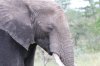
I watched them for about ten or fifteen minutes as they followed the animal trail behind the camp, about 50 metres behind my tent. There was about 30 in the group, including six youngsters, and one that appeared to be only a few months old. The lead animal that was breaking the larger branches had ventured a few metres from the track toward camp and although she was happily munching away on bark and leaves, she kept her eye on the camp and never turned her back on us. So I remained in the open, in clear view, and was able to approach close enough to get some nice close-ups, about 30 metres away. She didn’t seem perturbed, but she watched me like a hawk. Once I had the photos I wanted I returned to my tent and watched the herd move off into the bush.

So Day 2 in the Serengeti had been a good day, with 47 species of bird, 18 species of mammal and two species of reptile. Day 3 would be spent here as well, and on Day 4 we would head up to the northern part of the park where I would spend the night in a hotel where I could recharge my computer and camera batteries.
Innocent went back to the airport in the evening to see if the inverter and engine part were on the plane. At dinner he returned empty-handed and with bad news. Lobo Lodge had cancelled. He couldn’t tell me why, just that they had cancelled my booking. I asked what we were going to do instead, to which he replied he had no idea. This is not what you want to hear from a guide, and I don’t like people telling me there’s a problem and not offering a solution. He suggested another day in camp and then continue on to Lake Natron, which also had no electricity and nowhere to recharge my equipment. I wasn’t happy, and I got rather grumpy and a little frustrated that I didn’t know what was going to happen the day after tomorrow.
But I went to bed thinking that if the inverter comes on the plane tomorrow then it won’t be quite so bad. And there was always more Coke at the Visitor Centre 15 minutes away.
New Bird Species: Red-billed Duck, Coqui Francolin, Black-breasted Snake Eagle, Steppe Eagle, Little Stint, Slate-coloured Boubou, White-bellied Canary, White-headed Buffalo Weaver, Speckle-fronted Weaver.
New Mammals: Bohor Rhebok, Coke’s Hartebeest, Cheetah
New Reptiles: Leopard Tortoise, Mwanza Flat-headed Agama
Hix
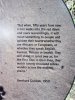
Attached below is the Entrance to the Kopje, The Grzimek Room, a quote from Grzimek and the lead elephant in camp.
The lions roared intermittently throughout the night, but despite this I still slept soundly, waking a little after 6:00am. I lay in the very comfortable bed listening to the avian dawn chorus, wishing I recognised just one of the calls. At around 6:30 I heard the camp staff and the rattle of some buckets at the back of the tent, and minute later someone said “shower ready”.
After a quick shower and breakfast I had a quick look around the camp. The grass was long, in some places knee-high, and wet with dew. At the back of the camp, where the buffalos had been the night before, there was an animal path through the grass running parallel to the camp, about 70 metres behind my tent. Beyond that the ground sloped down for another 30 metres before rising again, and I got the impression there was a small stream there during the wet season, but it was dry now. All around there were shrubs and bushes between the trees, and more animal paths through the grass and foliage. The other side of the dry stream was more thickly vegetated and the sloped upwards into a hill. I had hoped to see some of the birds that had been vocalising earlier but they had gone quiet and all I saw was a white-backed vulture in the top of a tree.
While I was in the shower I had heard Innocent start the 4WD and drive off to the airstrip to collect the inverter, and now he returned to collect me. I grabbed my cameras and broken binoculars and jumped in and we headed into the park. Innocent told me the plane did not have the inverter or spare parts he was expecting – maybe tomorrow. I would just have to use my laptop sparingly. Luckily I had spare batteries for my cameras, and in case my laptops battery dies and I couldn’t upload photos, I also had spare memory cards.
“What do you want to see today?” asked Innocent as we left camp.
“Lions, Leopards and Cheetahs” I replied without hesitation.
The words were barely out of my mouth when I saw my first lifer for the day – only a couple of hundred metres from camp – a plain looking antelope that looked a little different to the other I’d seen: a Bohor Reedbuck female. She froze and looked at us for a few seconds before bounding away, but not before I got a couple of photos.
Continuing on I saw more of the common birds from the day before – Lilac-breasted Roller, Magpie Shrike and White-crowned Shrike – and some zebra and impala. And then another lifer, a small group of four Coke’s Hartebeest, including two juveniles, some wildebeest, a lappet-faced vulture, a pair of marabous in a tree, and then three lions under tree. They weren’t in a good position, and my binoculars weren’t much good so I did most of my wildlife gazing through my camera, as the 300mm zoom was almost as good as the binoculars. They were about 30 metres from the road and lying in the grass, which wasn’t ideal, but 30 minutes later we came across a group of eight lying down right beside the road and I was able to get some nice shots of them. And those weren’t the last lions we saw that day either.
One of the roads we took crossed a small stream and when we arrived five giraffes were about to cross from the other side, using the road as it was a more secure footing (I imagine). Innocent stopped the car and we waited while they walked sedately along the road towards us, yellowbilled oxpeckers hanging off their necks and rumps, before turning away to walk alongside the stream. The first to cross was the tallest animal, a male although his skull was not as lumpy as others I’ve seen, suggesting he was a mature male, but not a very old one. His coat pattern was also very different to the others, looking very pale, and I later leant this was a form of mange.
A short time later we came across a Leopard Tortoise by the side of the road and I had just enough time to get a few photos before he determinedly (and relatively quickly, for a tortoise) made his way into the grasses. Another lifer.
But it was the birds that were most visible (apart from the zebra, wildebeest and impala) – Wattled Starlings, Brown Parrots, Purple Grenadiers, Red-cheeked Cordons, Emerald-spotted Wood Pigeons, Tawny Eagles, Rufous-tailed Weavers, Egyptian Geese, Little Bee-eaters, Helmeted Guineafowl, Grey-backed Fiscals, Grey-breasted Spurfowl, White-headed Buffalo Weavers, Blacksmith Plovers and Barefaced Go-away Birds.
At one point we stopped so I could photograph a bird flying overhead and I noticed a black bird sitting on an exposed branch almost directly above the vehicle. The only way I could get a good angle for a photo was to lie down on the seat and shoot upwards.
“What is it?” asked Innocent, whose lack of bird knowledge had become apparent the day before.
“A drongo” I answered, “though I don’t know which”.
Innocent pulled out his field guide and went straight to the contents, found the page for drongos and turned to it. (Most bird people I know don’t use the Contents or Index of a field guide, they tend to flip through the plates until they find the family they are looking for. And they usually know if the plates they want are in the front, or back, or middle of the book).
Three drongos were illustrated – Fork-tailed, Velvet-mantled and Square-tailed. And all look almost identical. Innocent looked at the illustrations, then at the bird, then stabbed one with his finger. “This one!” he said.
From my vantage point on the seat I couldn’t see the book at all. “Which one?”
“Velvet-mantled” he replied. And it could have been, because from below there was no way I could see the mantle, let alone if it was velvety or not.
“Why?” I asked.
“Because it has red eyes.”
I paused for a second before responding “All drongos have red eyes”.
Innocent looked at the bird and the pictures again before saying “this one”.
Again I asked “Why?”
“Because it has a forked tail”. To which I replied immediately “But all drongos have forked tails”.
He looked at the book again and after a minute said “I don’t know” and handed the book to me. I sat up and had a quick look at the plate, then handed it back and said “it’s this one”, pointing at the Common (or Fork-tailed drongo).
“Why?”
“Because it’s the only one found in this part of Tanzania” and I showed him the maps that clearly illustrated the other two species being found several hundred kilometres away in opposite direction.
But despite his lack of ornithological knowledge, Innocent was very good at his job. Every time we stopped so I could take a photograph he would turn off the engine so there would be no vibrations. And if we were driving and I wanted to take a scenic shot out the window, and he saw me, he would immediately slow down, and would have stopped had I not told him to keep going.
And his spotting skills were excellent. He found me a cheetah, some distance from the road under a tree, my first (and only) cheetah, and he also spied a dikdik in the scrub. And there was the jackals seen in the rain on the previous day when we drove into the park.
At about 1pm, having been out for several hours, we arrived at the Serengeti Visitor Centre for lunch. The centre consisted of a restaurant/cafe, souvenir shop and information centre. We sat in the carpark eating our sandwiches and I discovered the wildlife here was fairly bold and were not to botherd by all the people. Grey-capped Social Weavers and Speckle-fronted Weavers hopped around on the ground looking for leftover titbits, and Bush Hyrax wandered about amongst feet with impunity. There was even a dwarf mongoose lolling around under a thornbush.
After lunch I went to visit the Information Centre, which is designed as a path through a kopje with information plaques along the way. Very informative, and I saw more hyrax, mongooses and a several brightly coloured red-and-blue Mwanza Flat-headed Agamas. At the end was a small building, the top floor of which was mostly dedicated to Bernhard Grzimek and his sons, and the work they did in the Serengeti in the 1950’s.
Before leaving I visited the little shop and bought myself several bottles of Coke and Ginger Beer so I would have something to drink for the next few days. I thought we were at least an hour away from camp, but I was back in my tent in about 15 minutes.
As the grey clouds were looking ominous, and we could hear thunder and see the lightning, we decided to spend the rest of the day in camp where I relaxed in my tent, doing some reading and uploading the photos onto my laptop.
Around 3:30pm, while reading, I heard a loud cracking sound coming from the far end of camp, the sound of breaking branches. I recognised the sound immediately and knew what was creating the noise. Grabbing my camera I looked outside and at the edge of camp was a herd of elephants, and one in the lead was pulling off and eating branches from one of the smaller trees.
I watched them for about ten or fifteen minutes as they followed the animal trail behind the camp, about 50 metres behind my tent. There was about 30 in the group, including six youngsters, and one that appeared to be only a few months old. The lead animal that was breaking the larger branches had ventured a few metres from the track toward camp and although she was happily munching away on bark and leaves, she kept her eye on the camp and never turned her back on us. So I remained in the open, in clear view, and was able to approach close enough to get some nice close-ups, about 30 metres away. She didn’t seem perturbed, but she watched me like a hawk. Once I had the photos I wanted I returned to my tent and watched the herd move off into the bush.
So Day 2 in the Serengeti had been a good day, with 47 species of bird, 18 species of mammal and two species of reptile. Day 3 would be spent here as well, and on Day 4 we would head up to the northern part of the park where I would spend the night in a hotel where I could recharge my computer and camera batteries.
Innocent went back to the airport in the evening to see if the inverter and engine part were on the plane. At dinner he returned empty-handed and with bad news. Lobo Lodge had cancelled. He couldn’t tell me why, just that they had cancelled my booking. I asked what we were going to do instead, to which he replied he had no idea. This is not what you want to hear from a guide, and I don’t like people telling me there’s a problem and not offering a solution. He suggested another day in camp and then continue on to Lake Natron, which also had no electricity and nowhere to recharge my equipment. I wasn’t happy, and I got rather grumpy and a little frustrated that I didn’t know what was going to happen the day after tomorrow.
But I went to bed thinking that if the inverter comes on the plane tomorrow then it won’t be quite so bad. And there was always more Coke at the Visitor Centre 15 minutes away.
New Bird Species: Red-billed Duck, Coqui Francolin, Black-breasted Snake Eagle, Steppe Eagle, Little Stint, Slate-coloured Boubou, White-bellied Canary, White-headed Buffalo Weaver, Speckle-fronted Weaver.
New Mammals: Bohor Rhebok, Coke’s Hartebeest, Cheetah
New Reptiles: Leopard Tortoise, Mwanza Flat-headed Agama
Hix
Attached below is the Entrance to the Kopje, The Grzimek Room, a quote from Grzimek and the lead elephant in camp.
Attachments

Last edited:






 . I actually think that you saw an African hoopoe, I don't think European hoopoe goes that far south, we get them here in Ethiopia and also northern Kenya. Not that it matters much as they are now usually lumped in one species and they are both awesome