Day 7 – Tuesday, September 3
I was woken well before dawn by some loud monotonous grunting, one grunt every few seconds. Wondering what the hell it was I got out of bed and went outside with my headlamp and found Joseph working on the 4WD, but he wasn’t making the sound – it was coming from a large tree nearby.
“Morning Joseph” I greeted him “What’s making that sound?”
“Morning - Vervet” he replied.
It didn’t sound much like a Vervet Monkey and I scanned the tree for the grunter, eventually finding two big green eyes reflected in the light from my headlamp, looking down at me. And they moved slightly everytime there was a grunt. It was an owl, but I couldn’t make out what sort. I went and got my camera and struggling, managed to get a few shots.
Photography like this, by myself, was always difficult. The camera can’t focus in the dark so I need to manually focus, and to do that I need to hold the headlamp steady on the subject, meaning I have no free hand to focus (it can't stay on my head because it gets in the way of the camera). So it’s usually a more of a juggling act than anything photographic. Joseph by this stage had gone back inside so I wasn’t able to use his help in holding the headlamp.
Back in my cottage I uploaded the photos to my computer and confirmed it was an owl, but it wasn’t quite clear which species. At the time I thought it was a Scops Owl, but since posting the pics on ZooChat I have been informed it’s actually an Eagle Owl – so thanks to Condor and Lintworm for that!
http://www.zoochat.com/1682/verreauxs-eagle-owl-336916/
~~~~~~~~~~~~~~~~~~~~~~~~~~~~~~~~~~~~~~
The cottages at the Chimpanzee Guesthouse were very nice, and they had a good view over the tea plantation to the forests of Kibale National Park, but I didn’t see them when I went for breakfast – there was a fog covering the mountains. Not a heavy pea-souper, but visibility was down to a couple of hundred metres. As Joseph had promised, breakfast this morning was at the more decent hour of 7 o’clock. Half-an-hour later were on the road again.
Our destination was the Visitor’s Centre at Kanyanchu, in the middle of the forest. Although it was only a 20 minute drive away, most of it was driving through Kibale National Park. I kept my eyes open for any interesting birds, but all we saw was a group of Olive Baboons sitting on both sides of the road. There were several babies so we stopped to take some photos.
Over the last few days we had often seen large male baboons alone in the bush or on the road, many with injuries (frequently to their hands or feet giving them a limp) so it wasn’t a surprise a few minutes later when we rounded a bend and saw a single very large baboon crossing the road. It was a few hundred metres ahead, and in the shadows of the trees it looked black, but it was the way it was walking that caught my attention.
Most baboons walk in a rather flat-footed way (in my opinion) where they lift their hands vertically up of the ground and move them forward, put them down, then move the other side. Similar to a way a dog walks. But this baboon was striding. His whole arms were stiff and were swinging like giant powerful pendulums, a gait that I had seen many times before at Taronga Zoo. I didn’t need to confirm the absence of a tail to know this was not a baboon. And I was not the only one to realise this.
“That’s a chimp!” I exclaimed. At precisely the same moment Orangeperson blurted out “Oh my goodness, a chimp!” and Joseph pointed and said “Chimp!” All three of us at the same time.
The chimp crossed the road and vanished into the bush on the other side, and although we stopped a few seconds later at the spot (or what we thought was the spot) where he entered the forest, we couldn’t see or hear anything. However, we all took this as a very good sign, as our morning was to be spent tracking an habituated group of chimps.
There were 15 to 20 people at the Visitor’s Centre, all there for the chimp tracking. We were given a briefing and then split into three groups and driven off to different locations. Our group consisted of the four of us, plus a couple of Americans. Our ranger/guide named Silver gave us a further briefing before we set off into the forest, following paths at first, and then just following Silver as he pushed his way through the undergrowth.
http://www.zoochat.com/1682/briefing-orangeperson-ranger-guide-silver-angela-336942/
The forest was magnificent, with very tall mature trees. It had been raining overnight, but the ground wasn’t too muddy because of the thick covering of leaves on the forest floor. And because the leaves were damp we were able to move relatively quietly through the forest. Except for one of the Americans whose backpack seemed to catch on every bush, as did his tripod. And when he was recording video he provided his own commentary: “Here we are walking through the forest ..... walking ..... walking..... walking ..... big trees ..... very big trees ..... no chimps ..... and here’s Doris* ..... in the forest .....”
*Names have been changed to protect the innocent.
http://www.zoochat.com/1682/kibale-forest-336943/
The Kibale Forest is sometimes called the Kibale Primate Forest because they have probably the highest diversity of primates of any forest in Africa, with thirteen different species (four of which are nocturnal). Not surprisingly, we encountered some of the other species before we found the chimps. The first were Red-tailed Monkeys, sitting high in the trees and twittering away like small birds. Although I had seen one already in the Botanic Gardens in Entebbe, I was keen to see more. And anyway, the lone individual in the Botanic Gardens was actually released there – Red-tails don’t occur in that part of the country. I quite like these small monkeys, part of a group known as Spot-nosed (or Putty-nosed) Guenons because of the brilliant white nose they possess. And their long tail is a rich red colour, giving them their common name.
http://www.zoochat.com/1682/chimp-336937/
Nearby to the Red-tails was a small group of Grey-cheeked Mangabeys – I couldn’t see if their cheeks were grey, but they did have long grey hair growing over their shoulders, like some sort of shawl. They were feeding in the tops of the trees, grunting periodically, and didn’t seem too bothered by the larger bipedal primates on the ground below. The Red-tails, on the other hand, were very nervous.
Photography was not good. Although the fog had lifted there was still considerable cloud cover, fairly thick, and most of the photos I took were of silhouettes (again). But if I could position a lot of foliage in the background then the exposure would be much better. The problem was that most of the monkeys liked sitting on the ends of branches eating the young new leaves.
We moved on and eventually found the chimps – it had only taken an hour. There was probably about two dozen of them in the group, but it was hard to count as they were in the tops of these tall trees, and there was a lot of foliage between us and them. Silver had said we could only stay with the chimps for an hour – if they were on the ground. He would give us a bit more time if the chimps were in the trees, and I can understand why.
http://www.zoochat.com/1682/chimp-336931/
http://www.zoochat.com/1682/chimp-336929/
The chimps weren’t moving around much. Like the mangabeys they were sitting in the branches feeding. Only some of the young ones were moving around, but again it was hard to see them. I ended up with a lot of photos of chimpanzee bums. I hoped they would come down to the ground, but Silver said that they probably wouldn’t because it had been raining and the ground was wet.
http://www.zoochat.com/1682/chimp-336935/
I’ve spent a lot of time in front of chimp exhibits all over the world, and in large groups chimps are often rowdy and mischievous, and usually noisy. Very noisy. (A former Taronga keeper once referred to the chimps - while they were screaming at each other -as "The Apes of Wrath"). So it was an interesting experience being with this group that were virtually silent and seemingly well behaved. As sedate as gorillas, I thought.
http://www.zoochat.com/1682/chimp-336937/
http://www.zoochat.com/1682/chimp-336940/
After about an hour watching them we all had ‘chimp-neck’ from looking straight up, but I don’t think anybody cared. I knew we’d have to leave shortly, which was a shame because some of the chimps had started to come down into the lower branches. And then one climbed down onto the ground. Then another, and another. They all started walking off in different directions through the undergrowth, and Silver led us after one individual. He had recognised the dominant male of the group, and by following him, we saw many of the other chimps who met up with him along the way. It was a surreal experience to be walking on a path, behind an adult male chimp, with other females and their young walking parallel to us on their own paths.
http://www.zoochat.com/1682/chimp-336933/
http://www.zoochat.com/1682/chimp-336934/
http://www.zoochat.com/1682/chimp-336941/
http://www.zoochat.com/1682/following-chimps-336944/
Eventually Silver told us our time was up and he then led us back to the Visitor’s Centre, about a half-hour walk away. How he knew where we were I have no idea, because we had left the path for a time to push through the bush, but he seemed to recognise the tracks. Along the way we saw safari ants (which we avoided, for obvious reasons) and dung beetles, with their balls of you-know-what. Silver had also warned us at the beginning of the walk that the forest was inhabited by other animals like buffalo, forest elephant, leopard, giant forest hog, bushpig etc, which was why he carried an AK47. I was hoping we would see one of these creatures, but all we saw was a pair of Black-and-White Casqued Hornbills.
http://www.zoochat.com/1682/orangeperson-angela-two-big-buttresses-336946/
http://www.zoochat.com/1682/dung-beetles-ball-336945/
Still, it had been a good morning and we were all thrilled to have seen wild chimps, especially Orangeperson who is a chimp-nut.
~~~~~~~~~~~~~~~~~~~~~~~~~~~~~~~~~~~~~~
We left the forest and headed a bit further down the road to a protected wetland called Bigodi Swamp. This is a well-known wetland and particularly good for birding. It is somehow run or managed by the local community women’s group, but I’m not sure of the actual structure as Park Rangers run the tours, and they all appear to be male. However it is definitely a community-run project, and there are two gift shops selling handicrafts at the entrance.
We arrived a little before midday, just as it started to rain. Heavily. Bucketloads. After I had bought a Coke the girls and I looked through the two handicraft shops while we waited for the rain to stop. There was lots to look at, they had many souvenirs, but I tend to be a bit particular in what I like. Carvings of animals, for instance, need to be life-like and not caricatures or cartoonish. It is very rare I see a hippo or sea turtle that I like as the mouths of those two very different species appear to be hard to replicate accurately. I also don’t like anything that looks cheap or mass-produced. Birds are often stylised in shape or colour, and not realistic. So it was with some surprise I found something I liked – a wooden carving of a Great Blue Turaco. It was a little dusty, but it was the only one in the shop. Although it looked very cartoony, that’s exactly what this species looks like. If Dame Edna Everage was an African bird, she’d be a Great Blue Turaco. It only cost me 15,000 shillings – about $6.
When we’d finished with the handicraft shopping it was still bucketing down. In a large tree beside the reception area was a large number of weaver nests, and lots of weavers still constructing their nests in the rain. I spent a bit of time taking photos of them – two species, the Black-headed Weaver (yellow with a black head, some chestnut on the neck and a red eye) and Veillot’s Black Weaver (all black with a cream eye). But twenty minutes later it was still bucketing down so we decided to give the Swamp a miss for today, jumped back into the 4WD and drove back to the Chimp Guesthouse for lunch.
During lunch the rain stopped. We decided not to go back to Bigodi Swamp, we’d stop in the next morning on our way to our next destination; this afternoon we would relax in our cottages. I started by uploading the morning’s photos, and started labelling some because by this stage I was a long way behind in sorting and labelling photos. I was interrupted by a bird flying around outside my window. It was a sunbird.
Heading outside with my camera I found the sun had poked through the clouds, and a lot of birds had become quite active. So I spent the next couple of hours photographing anything that moved (or rather, anything that flew and perched). Before that time, I had only seen four or five species of birds here; by that evening I’d photographed about twentysix.
http://www.zoochat.com/1682/bronze-sunbird-336922/
http://www.zoochat.com/1682/african-blue-flycatcher-336918/
http://www.zoochat.com/1682/crowned-hornbill-336919/
http://www.zoochat.com/1682/double-toothed-barbet-336917/
~~~~~~~~~~~~~~~~~~~~~~~~~~~~~~~~~~~~~~
At the briefing prior to the Chimp walk, Silver had said that there were thirteen primate species in the forest, four of which were nocturnal. “But we only see them on nightwalks” he had said.
At the sound of the magic word ‘Nightwalk’ I became rather interested.
“When do you run nightwalks?” I asked.
“At night” was the reply.
“So there’s one tonight?”
“Yes. Just come along. We leave after dark.”
I didn’t know if the girls were interested, but I was keen to ‘just come along’ and go spotlighting for nocturnal primates. The four species they have are Potto and three galagos – Thomas’s, Spectacled and Demidoff’s. I would have been happy to see any of them, but the Potto and Demidoff’s were high on my list, particularly the latter as it is the smallest of the galagos.
The girls were also keen to come along so we all rocked up at the Visitor’s Centre around 8:15pm. Silver had already left with another group, so our guide for tonight was Africano, and after a brief briefing we headed into the forest.
Western Uganda is very dark at night, and in the magnificent forest it was pitch black. Africano and the girls had torches (flashlights, for our American friends), I had my headlamp and I’d just put in new batteries as we’d used up the others on the night game drive in Murchison.
For anyone who has never spotlighted before there are a couple of things you should know. The idea is that when light is shined in the eyes of an animal, the light is reflected back. A small amount of light will still make eyes shine like car headlights, so it’s fairly easy to see nocturnal animals this way. But there are some limitations which are rather obvious, but often not realised by beginners:
- Firstly, the animal has to have it’s eyes open and it has to be looking at you. An animal that is asleep, or one that is looking the other way will not be seen by you.
- Secondly, in a forest environment and animal may be looking at you, but if there is a leaf or branch between your light source and the animal, and that leaf casts a shadow on the eyes, then you will see nothing. So it’s important to keep looking around as you move, looking back at the same places from a different points on the trail.
- Thirdly, the further the light source is from your eyes, the less reflection you are likely to see. Someone standing three feet to your left, with an unobstructed view of the foliage your torch is shining on, may not be able to see any eyeshine at all.
For this reason I find headlamps more effective because they are positioned on my forehead. If I only have a torch, I will hold it against my temple to achieve the same result. So I was rather surprised when I saw Africano holding his torch at waist height and waving it from side-to-side and up-and-down. When we later met up with Silver I saw him doing the same thing. Admittedly, waist height will probably give you eyeshine, but I don’t think it will be as bright.
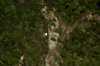
Anyhow, to cut a long story short, we saw about 8 pairs of Demidoff’s eyes over the space of an hour or so. Africano thinks we saw a Spectacled too, because it’s eyes were a different colour, but I only saw the orange of the Demidoff’s. Ocassionally we would also glimpse the body or tail as it ran along a branch or a vine, but that was rare. The eyeshine is so great it’s hard to see what is immediately around the eyes, as if someone is shining a pair of torches at you. I tried taking some photos with Angela holding my lamp, but I didn’t get good focus and all I got was eye-shine and a blurred face.
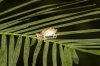
Oh, and I found a tree-frog on a palm leaf.
And so we returned to the Guesthouse. It had been a full but very productive day, and I think we were all very happy with the results.
New Birds: Rock Martin, Cardinal Woodpecker, Bronze Sunbird, African Blue Flycatcher, Scarlet-chested Sunbird, Crowned Hornbill, Verreaux’s Eagle Owl, Brimstone Canary, Yellow-bellied Waxbill, Black-crowned Waxbill, Veillot’s Black Weaver, Grey-headed Sparrow,.
New Mammals: Chimpanzee, Grey-crowned Mangabey, Demidoff’s Galago (Bushbaby)
Attached below are the crappy photos from the nightwalk. In the second one you can make out a face just below centre of photo, next to the stick. The stick is visible in the third shot without the face.

Hix


 ) through both threads, it seems Uganda is a much easier place to see neat wildlife! Sorry Chlidonias, you put Mongolia on my list at least.