You are using an out of date browser. It may not display this or other websites correctly.
You should upgrade or use an alternative browser.
You should upgrade or use an alternative browser.
Hix Does Uganda (Part I) - All But A Shoebill

Day 13 – 9th September
At breakfast Joseph told us he wanted to change our route. Today we were going to Lake Mburo, but if we went the regular route – and he rattled off a number of towns and villages none of us had heard of – there was roadworks and delays. So he suggested we go via another bunch of towns and villages none of us had heard of, which would be quicker. We agreed.
Before leaving the Silverback Lodge I popped into their gift shop and bought a wooden carved gorilla with baby, a laminated photo-card of the Rushegura Group, and a brand new walking pole with little gorilla carvings on it. And then, with the sun shining brightly, we left Bwindi.
http://www.zoochat.com/1681/buhoma-342577/
After a couple of hours we passed by the entrance to the Ishasha section of Queen Elizabeth National Park (QENP), and a short time later we crossed some bridges I recognised from a few days before.
“Are we going back to Kyambura?” I asked, and Joseph replied that we were. This seemed to me to be a massive detour, and I suspect I wasn’t the only one who thought this as the girls in the back had opened up their map. When they had finished I asked to see it, and saw that the route we were taking wasn’t really much longer than the normal route. Still, it did feel like we were going backwards.
Because we had a long journey we didn’t stop much for wildlife, only once when I saw a Nile Monitor, covered in mud, wading out of a muddy pool. Joseph slowed down but even thought we were more than 100 metres away, the monitor bolted into the bushes and out of sight. They seem to be very, very timid; the only monitor I saw that wasn’t timid was the wild one in the enclosure at the zoo in Entebbe.
Eventually we arrived back at Kyambura and continued straight through. A little later, after cresting a hill overlooking the QENP, we stopped to take some scenic shots of the park. And a short time after that we stopped on another hill overlooking the Maramagambo Forest, for the same purpose. Next time I’m in this area I will visit this extensive forest and see what wildlife I can find.
By this time we had been travelling for about 4 hours, but we still had a long way to go. At least we were now on a tarmac road that appeared to be reasonably good. And after a few more hours we eventually drove into Uganda’s third largest city, Mbarara. It reminded me of Entebbe, but a bit more open (possibly more open because it is so flat, whereas Entebbe has some low hills. Surprisingly, we found some wildlife here worth stopping for.
There are two species of bird found in every large town or village – Marabou and Pied Crows. They feed on the rubbish that is left in the streets, and rubbish tips support large numbers of them. In Kampala we had thought it iconic to see marabous perched on the roofs of the big buildings, like banks and businesses. Large towns/small cities like Kampala and Mbarara also have feral pigeons, but they are not as common as they are in the western world. So when we drove past the hospital in Mbarara and I saw a large number of birds flying amongst the trees in the hospital grounds, with the sun behind them making them appear black, I thought they were Pied Crows and paid them little attention. However, their manner of flight – they were flapping their wings too much – and the fact there were so many of them prompted me to look again more closely and I realised they weren’t birds at all, but large fruit bats. I asked Joseph to stop, but because he was on a main road he wasn’t able to do so for a few hundred metres, and by the time he had reversed up, all the bats had gone. I looked in the trees but couldn’t see them roosting, so maybe they had flown off. Something must have disturbed them to cause them to take flight, but I couldn’t see anything obvious.
On the other side of the road was a large tree, and on top was at least a couple of dozen Pink-backed Pelicans. So while we were stopped I quickly took a couple of photos. Then we continued on. Although we weren’t far from Lake Mburo now, there was a boat ride on the lake departing at 4pm, in less than two hours. The clouds had been increasing all day and I hoped it wouldn’t rain before the boat trip.
http://www.zoochat.com/1682/pink-backed-pelicans-342625/
Apart from the lack of traffic and people, and all the trees and vegetation, one of the things I had come to like about the villages was the children. Every time we’d drive through a village the children would come rushing up to the road waving and grinning, and calling out in their own language. Kids walking along the road with their parents would stop, smile and wave. This didn’t happen in the big towns or cities, which just made those places appear less friendly. When we started out from Kampala I had ignored them, or just smiled back at them, but after a few days I found you couldn’t help but waving back. All the kids were barefoot, and most of them had shaved heads, including the girls (a requirement of attending school). They were usually wearing some grotty, muddy clothes – the girls in dresses and the boys in shorts and possibly a t-shirt. Out of the several hundred kids we saw, two stick out in my mind.
The first was a small boy of about three that we encountered as we were leaving Kyambura Lodge. When the driveway met the road Joseph had to stop to check for traffic, so we were in first gear and going relatively slowly as we turned. The small boy was alone, playing with a stick in what could loosely be referred to as his front yard, and he had seen us coming up the driveway when he ran up to the roads edge. Most roads have a one metre embankment on either side, the result of graders regularly smoothing out the dirt road surface, and when the boy ran up on his unsteady little legs he stopped on this embankment alongside us as we turned onto the road. He was wearing a floppy hat, a shirt that was unbuttoned, and no pants. He stood on the embankment waving at us with his left hand, and swishing his stick aggressively through the air with his other hand. On his face was one of those scowls small kids get – not an aggressive scowl, but a determined one. He was the cutest kid I saw in Uganda.
The other child I remember for a completely different reason. On our way to Bwindi we passed this girl of about 12 or 13, I guess. She was alone too, but ran up towards the car shouting “HEY! HEY! HEY!” which was different because it was the first time someone had shouted at us in English. She wasn’t waving or smiling either. We had just driven passed, but then Joseph slowed down to go through a pothole and she ran after us, catching up and stopping alongside the car, and shouted into the open side window “Give me an APPLE!” in a very demanding way. I was in the front seat and looked around at her, as I hadn’t heard anyone in Uganda speak with any sort of attitude before (and I wanted to make sure she didn’t have an AK47). She looked at me and smiled, and I remember thinking she had a beautiful smile with perfect white teeth. Then she opened her mouth and again demanded “GIVE ME AN APPLE!!!” Joseph had gone through the pothole and now drove off, and I chose to look forward and ignore the girl without smiling.
We eventually arrived at Lake Mburo National Park. Our accommodation for the night, the Arcadia Cottages, are actually in the park and right next to the lake, so we still had a bit of a drive to get there. This part of Uganda is a different type of habitat to other parts of Uganda, although it looks similar. It still had Euphorbia Cactus and acacia thorn-scrub, but there was less grass and it was drier and not as thick. The habitat is an extension of the great Tanzanian grass plains and this was the northern-most place in Uganda to find this habitat. Because of this it is the only place in Uganda that has Zebra, Impala and Eland. Driving to our cottages we saw both impala and zebra (and a foal), but not very good views as they were all grazing in the bush. And we also saw the ubiquitous warthog families.
http://www.zoochat.com/1681/entrance-sign-342584/
http://www.zoochat.com/1682/warthoglet-342618/
http://www.zoochat.com/1682/zebra-foal-342599/
The Arcadia Cottages are right by the lake. The cottages had names like Leopard Cottage and Marabou Cottage, and I was in staying in Shoebill Cottage. As it was almost 4pm we quickly dumped our luggage and went back to the car with our cameras. It only took a few minutes to get to the boat dock. Joseph introduced us to the guy who owns the boat, appropriately named Noah, although he didn’t captain it when we left. Apart from the four of us, one other passenger joined us. The boat was smallish, with bench seats that extend right across the boat. I got a seat all to myself so I was able to slide from one side of the boat to the other as required.
http://www.zoochat.com/1681/arcadia-cottages-lake-mburo-342578/
http://www.zoochat.com/1681/boat-dock-left-342579/
There is a large papyrus swamp (with shoebills) at this end of the lake and this was the first place we visited, but I was disappointed once again for shoebills. However we did see Hippos, several Malachite Kingfishers, and a Little Sparrowhawk perched on a dead stump at the water’s edge. Leaving the papyrus we followed the shoreline into another bay. Like the rest of Uganda, Pied Kingfishers were everywhere, as were African Fish Eagles (we saw at least six pairs and a few immature). Striated Herons and Black Crakes stalked amongst the roots at the water’s edge, and at a small beach we saw half a dozen Water Thick-knees and some Common Sandpipers.
http://www.zoochat.com/1681/papyrus-swamp-342583/
http://www.zoochat.com/1682/malachite-kingfisher-342610/
http://www.zoochat.com/1682/hippo-342605/
http://www.zoochat.com/1682/hippo-342606/
http://www.zoochat.com/1682/little-sparrowhawk-342604/
http://www.zoochat.com/1682/pied-kingfisher-342612/
http://www.zoochat.com/1682/african-fish-eagles-342595/
http://www.zoochat.com/1682/african-fish-eagles-342596/
http://www.zoochat.com/1682/african-paradise-flycatcher-342611/
http://www.zoochat.com/1682/striated-heron-342603/
http://www.zoochat.com/1682/striated-heron-342602/
http://www.zoochat.com/1682/water-thick-knee-342617/
http://www.zoochat.com/1682/water-thick-knee-342616/
http://www.zoochat.com/1682/common-sandpiper-342614/
On the other side of the bay we turned and started to cross the bay back to where we had been, but stopped in partway across so our captain could buy some fish from one of the fisherman in a canoe. He appeared to buy everything in the fisherman’s canoe, a dozen or so fish. I guess the Captain has a big family. We continued over the bay and then headed back towards the dock. The two most notable sightings we saw from the boat were for two species that Lake Mburo is probably the best place to see them, Giant Kingfisher and African Finfoot.
http://www.zoochat.com/1681/fisherman-342581/
http://www.zoochat.com/1681/fisherman-s-catch-342580/
The Kingfisher is certainly a giant, twice as large as a Pied Kingfisher, and significantly larger than the small Malachite Kingfisher. It was perched on a dead branch sticking out of the water and allowed us to get quite close to it. The finfoot was not quite so accommodating. The two we saw, both females, swam away from us when we appeared, and sheltered in amongst the twisted tree roots and vegetation on the shoreline.
http://www.zoochat.com/1682/giant-kingfsher-342600/
http://www.zoochat.com/1682/giant-kingfisher-342601/
Finfoots are an odd species of bird. There are three species – the African Finfoot, found throughout much of Africa wherever there is suitable habitat, the Masked Finfoot in Asia, and the Sungrebe of South America. Taxonomically they are problematic: currently they are placed in the Gruiformes and have their own suborder (currently placed between the rails and Kagu), but some have suggested they could be related to the grebes. In the water they look like cormorants or darters, and when they swim they have the same neck-rocking motion as darters. But they have similarities to rails, and one DNA analysis suggested a relationship to limpkins. To top it off, the African Finfoot has claws on its wings which help it when climbing in trees and other lakeside vegetation (like a young Hoatzin), and is very similar in shape and colouration to South American Torrent Ducks, although this is probably just convergent evolution. As their name suggests, their feet are webbed which gives them excellent propulsion in the water, but not fully webbed, allowing them to nimbly clamber amongst the branches. On the ground they are, apparently, quite good at running. So I was quite happy to have seen two individuals of this weird species.
http://www.zoochat.com/1682/african-finfoot-342597/
http://www.zoochat.com/1682/african-finfoot-342598/
Returning to the cottages we had about an hour before dark so, despite the increased cloud cover and lack of sun, I went walking through the grounds looking for birds or mammals. There were a number of birds around – Long-tailed Starlings, immature Fish Eagles and Hadada Ibis were all obvious, as were some Warthogs, Bushbuck and Impala, but it was a squirrel that caught my attention. It was quite a distance ahead of me, and through my camera lens I could see some red on it and thought it might be a Red-legged Sun Squirrel, but there are other reddish coloured squirrels and I would need a closer look to get a better ID. Stupidly I had left my binoculars in the cottage, so I went back and grabbed them. Returning to the spot where I had seen the squirrel anther five red squirrels burst out of a pile of leaves at the base of a tree and took off in a blur of movement to the edge of the bush some distance away. Through my binoculars I could see they weren’t squirrels at all, but Dwarf Mongooses! There was a group of about a dozen, but they were very shy and I only got photos of them from a distance.
http://www.zoochat.com/1682/impala-342609/
http://www.zoochat.com/1682/impala-342608/
http://www.zoochat.com/1682/impala-342607/
http://www.zoochat.com/1682/bushbuck-342590/
http://www.zoochat.com/1682/bushbuck-342591/
http://www.zoochat.com/1682/bushbuck-342592/
http://www.zoochat.com/1682/dwarf-mongoose-342593/
http://www.zoochat.com/1682/dwarf-mongoose-342594/
A bird wave moved through the thorn-trees near me and in the failing light I tried to photograph as many as I could before they were gone, but the shrubbery made good photos near impossible. However, I was able to get enough to identify Yellow-rumped Tinkerbird, Spot-flanked Barbet, Red-headed Weaver and Chinspot Batis. There was also a group of African Yellow White-eyes, and some type of weaver but I haven’t yet been able to identify the weavers. There was also a Green-backed Woodpecker and a Broad-billed Roller, but they weren’t part of the wave. And as the sun was going down, two pairs of Brown Parrots (also known as Meyer’s Parrots) flew over the cottages.
http://www.zoochat.com/1681/acacia-spines-342585/
http://www.zoochat.com/1682/spot-flanked-barbet-342586/
http://www.zoochat.com/1682/chinspot-batis-342587/
http://www.zoochat.com/1682/chinspot-batis-342588/
http://www.zoochat.com/1682/chinspot-batis-342589/
http://www.zoochat.com/1682/greenbacked-woodpecker-female-342620/
http://www.zoochat.com/1682/red-headed-weaver-342619/
http://www.zoochat.com/1682/grey-headed-sparrow-342615/
http://www.zoochat.com/1682/broad-billed-roller-342613/
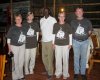
In the dark, and using my headlamp, I walked alone to the restaurant for dinner. I say alone, because at this place a guide normally escorts you to and from the restaurant after dark. As this was to be the last night our group would all be together, we had decided to all wear our Churchill Safaris t-shirts and have a group photo with Joseph. We had received these on our first day with Joseph, and he always wore his to dinner, so we thought it would be nice to all be wearing the same logo. Unfortunately, no-one thought to tell Joseph, and he arrived for dinner in a plain white shirt. After dinner I again walked back to my cottage alone, scanning the trees for and grounds for eye-shine and wary of hippos that often graze in the grounds. Alas, I saw nothing.
And as I went to sleep I was aware this would be my last night sleeping in the bush; tomorrow night I would be back at Entebbe and remain there until my departure in five days time.
New Birds seen: Brown Parrot, Giant Kingfisher, African Finfoot, Little Sparrowhawk, African Paradise-Flycatcher, Red-headed Weaver, Chinspot Batis, Green-backed Woodpecker.
New Mammals seen: Plains Zebra, Impala, Dwarf Mongoose

Hix
At breakfast Joseph told us he wanted to change our route. Today we were going to Lake Mburo, but if we went the regular route – and he rattled off a number of towns and villages none of us had heard of – there was roadworks and delays. So he suggested we go via another bunch of towns and villages none of us had heard of, which would be quicker. We agreed.
Before leaving the Silverback Lodge I popped into their gift shop and bought a wooden carved gorilla with baby, a laminated photo-card of the Rushegura Group, and a brand new walking pole with little gorilla carvings on it. And then, with the sun shining brightly, we left Bwindi.
http://www.zoochat.com/1681/buhoma-342577/
After a couple of hours we passed by the entrance to the Ishasha section of Queen Elizabeth National Park (QENP), and a short time later we crossed some bridges I recognised from a few days before.
“Are we going back to Kyambura?” I asked, and Joseph replied that we were. This seemed to me to be a massive detour, and I suspect I wasn’t the only one who thought this as the girls in the back had opened up their map. When they had finished I asked to see it, and saw that the route we were taking wasn’t really much longer than the normal route. Still, it did feel like we were going backwards.
Because we had a long journey we didn’t stop much for wildlife, only once when I saw a Nile Monitor, covered in mud, wading out of a muddy pool. Joseph slowed down but even thought we were more than 100 metres away, the monitor bolted into the bushes and out of sight. They seem to be very, very timid; the only monitor I saw that wasn’t timid was the wild one in the enclosure at the zoo in Entebbe.
Eventually we arrived back at Kyambura and continued straight through. A little later, after cresting a hill overlooking the QENP, we stopped to take some scenic shots of the park. And a short time after that we stopped on another hill overlooking the Maramagambo Forest, for the same purpose. Next time I’m in this area I will visit this extensive forest and see what wildlife I can find.
By this time we had been travelling for about 4 hours, but we still had a long way to go. At least we were now on a tarmac road that appeared to be reasonably good. And after a few more hours we eventually drove into Uganda’s third largest city, Mbarara. It reminded me of Entebbe, but a bit more open (possibly more open because it is so flat, whereas Entebbe has some low hills. Surprisingly, we found some wildlife here worth stopping for.
There are two species of bird found in every large town or village – Marabou and Pied Crows. They feed on the rubbish that is left in the streets, and rubbish tips support large numbers of them. In Kampala we had thought it iconic to see marabous perched on the roofs of the big buildings, like banks and businesses. Large towns/small cities like Kampala and Mbarara also have feral pigeons, but they are not as common as they are in the western world. So when we drove past the hospital in Mbarara and I saw a large number of birds flying amongst the trees in the hospital grounds, with the sun behind them making them appear black, I thought they were Pied Crows and paid them little attention. However, their manner of flight – they were flapping their wings too much – and the fact there were so many of them prompted me to look again more closely and I realised they weren’t birds at all, but large fruit bats. I asked Joseph to stop, but because he was on a main road he wasn’t able to do so for a few hundred metres, and by the time he had reversed up, all the bats had gone. I looked in the trees but couldn’t see them roosting, so maybe they had flown off. Something must have disturbed them to cause them to take flight, but I couldn’t see anything obvious.
On the other side of the road was a large tree, and on top was at least a couple of dozen Pink-backed Pelicans. So while we were stopped I quickly took a couple of photos. Then we continued on. Although we weren’t far from Lake Mburo now, there was a boat ride on the lake departing at 4pm, in less than two hours. The clouds had been increasing all day and I hoped it wouldn’t rain before the boat trip.
http://www.zoochat.com/1682/pink-backed-pelicans-342625/
~~~~~~~~~~~~~~~~~~~~~~~~~~~~~~~~~~~~~~~
Apart from the lack of traffic and people, and all the trees and vegetation, one of the things I had come to like about the villages was the children. Every time we’d drive through a village the children would come rushing up to the road waving and grinning, and calling out in their own language. Kids walking along the road with their parents would stop, smile and wave. This didn’t happen in the big towns or cities, which just made those places appear less friendly. When we started out from Kampala I had ignored them, or just smiled back at them, but after a few days I found you couldn’t help but waving back. All the kids were barefoot, and most of them had shaved heads, including the girls (a requirement of attending school). They were usually wearing some grotty, muddy clothes – the girls in dresses and the boys in shorts and possibly a t-shirt. Out of the several hundred kids we saw, two stick out in my mind.
The first was a small boy of about three that we encountered as we were leaving Kyambura Lodge. When the driveway met the road Joseph had to stop to check for traffic, so we were in first gear and going relatively slowly as we turned. The small boy was alone, playing with a stick in what could loosely be referred to as his front yard, and he had seen us coming up the driveway when he ran up to the roads edge. Most roads have a one metre embankment on either side, the result of graders regularly smoothing out the dirt road surface, and when the boy ran up on his unsteady little legs he stopped on this embankment alongside us as we turned onto the road. He was wearing a floppy hat, a shirt that was unbuttoned, and no pants. He stood on the embankment waving at us with his left hand, and swishing his stick aggressively through the air with his other hand. On his face was one of those scowls small kids get – not an aggressive scowl, but a determined one. He was the cutest kid I saw in Uganda.
The other child I remember for a completely different reason. On our way to Bwindi we passed this girl of about 12 or 13, I guess. She was alone too, but ran up towards the car shouting “HEY! HEY! HEY!” which was different because it was the first time someone had shouted at us in English. She wasn’t waving or smiling either. We had just driven passed, but then Joseph slowed down to go through a pothole and she ran after us, catching up and stopping alongside the car, and shouted into the open side window “Give me an APPLE!” in a very demanding way. I was in the front seat and looked around at her, as I hadn’t heard anyone in Uganda speak with any sort of attitude before (and I wanted to make sure she didn’t have an AK47). She looked at me and smiled, and I remember thinking she had a beautiful smile with perfect white teeth. Then she opened her mouth and again demanded “GIVE ME AN APPLE!!!” Joseph had gone through the pothole and now drove off, and I chose to look forward and ignore the girl without smiling.
~~~~~~~~~~~~~~~~~~~~~~~~~~~~~~~~~~~~~~~
We eventually arrived at Lake Mburo National Park. Our accommodation for the night, the Arcadia Cottages, are actually in the park and right next to the lake, so we still had a bit of a drive to get there. This part of Uganda is a different type of habitat to other parts of Uganda, although it looks similar. It still had Euphorbia Cactus and acacia thorn-scrub, but there was less grass and it was drier and not as thick. The habitat is an extension of the great Tanzanian grass plains and this was the northern-most place in Uganda to find this habitat. Because of this it is the only place in Uganda that has Zebra, Impala and Eland. Driving to our cottages we saw both impala and zebra (and a foal), but not very good views as they were all grazing in the bush. And we also saw the ubiquitous warthog families.
http://www.zoochat.com/1681/entrance-sign-342584/
http://www.zoochat.com/1682/warthoglet-342618/
http://www.zoochat.com/1682/zebra-foal-342599/
The Arcadia Cottages are right by the lake. The cottages had names like Leopard Cottage and Marabou Cottage, and I was in staying in Shoebill Cottage. As it was almost 4pm we quickly dumped our luggage and went back to the car with our cameras. It only took a few minutes to get to the boat dock. Joseph introduced us to the guy who owns the boat, appropriately named Noah, although he didn’t captain it when we left. Apart from the four of us, one other passenger joined us. The boat was smallish, with bench seats that extend right across the boat. I got a seat all to myself so I was able to slide from one side of the boat to the other as required.
http://www.zoochat.com/1681/arcadia-cottages-lake-mburo-342578/
http://www.zoochat.com/1681/boat-dock-left-342579/
There is a large papyrus swamp (with shoebills) at this end of the lake and this was the first place we visited, but I was disappointed once again for shoebills. However we did see Hippos, several Malachite Kingfishers, and a Little Sparrowhawk perched on a dead stump at the water’s edge. Leaving the papyrus we followed the shoreline into another bay. Like the rest of Uganda, Pied Kingfishers were everywhere, as were African Fish Eagles (we saw at least six pairs and a few immature). Striated Herons and Black Crakes stalked amongst the roots at the water’s edge, and at a small beach we saw half a dozen Water Thick-knees and some Common Sandpipers.
http://www.zoochat.com/1681/papyrus-swamp-342583/
http://www.zoochat.com/1682/malachite-kingfisher-342610/
http://www.zoochat.com/1682/hippo-342605/
http://www.zoochat.com/1682/hippo-342606/
http://www.zoochat.com/1682/little-sparrowhawk-342604/
http://www.zoochat.com/1682/pied-kingfisher-342612/
http://www.zoochat.com/1682/african-fish-eagles-342595/
http://www.zoochat.com/1682/african-fish-eagles-342596/
http://www.zoochat.com/1682/african-paradise-flycatcher-342611/
http://www.zoochat.com/1682/striated-heron-342603/
http://www.zoochat.com/1682/striated-heron-342602/
http://www.zoochat.com/1682/water-thick-knee-342617/
http://www.zoochat.com/1682/water-thick-knee-342616/
http://www.zoochat.com/1682/common-sandpiper-342614/
On the other side of the bay we turned and started to cross the bay back to where we had been, but stopped in partway across so our captain could buy some fish from one of the fisherman in a canoe. He appeared to buy everything in the fisherman’s canoe, a dozen or so fish. I guess the Captain has a big family. We continued over the bay and then headed back towards the dock. The two most notable sightings we saw from the boat were for two species that Lake Mburo is probably the best place to see them, Giant Kingfisher and African Finfoot.
http://www.zoochat.com/1681/fisherman-342581/
http://www.zoochat.com/1681/fisherman-s-catch-342580/
The Kingfisher is certainly a giant, twice as large as a Pied Kingfisher, and significantly larger than the small Malachite Kingfisher. It was perched on a dead branch sticking out of the water and allowed us to get quite close to it. The finfoot was not quite so accommodating. The two we saw, both females, swam away from us when we appeared, and sheltered in amongst the twisted tree roots and vegetation on the shoreline.
http://www.zoochat.com/1682/giant-kingfsher-342600/
http://www.zoochat.com/1682/giant-kingfisher-342601/
Finfoots are an odd species of bird. There are three species – the African Finfoot, found throughout much of Africa wherever there is suitable habitat, the Masked Finfoot in Asia, and the Sungrebe of South America. Taxonomically they are problematic: currently they are placed in the Gruiformes and have their own suborder (currently placed between the rails and Kagu), but some have suggested they could be related to the grebes. In the water they look like cormorants or darters, and when they swim they have the same neck-rocking motion as darters. But they have similarities to rails, and one DNA analysis suggested a relationship to limpkins. To top it off, the African Finfoot has claws on its wings which help it when climbing in trees and other lakeside vegetation (like a young Hoatzin), and is very similar in shape and colouration to South American Torrent Ducks, although this is probably just convergent evolution. As their name suggests, their feet are webbed which gives them excellent propulsion in the water, but not fully webbed, allowing them to nimbly clamber amongst the branches. On the ground they are, apparently, quite good at running. So I was quite happy to have seen two individuals of this weird species.
http://www.zoochat.com/1682/african-finfoot-342597/
http://www.zoochat.com/1682/african-finfoot-342598/
Returning to the cottages we had about an hour before dark so, despite the increased cloud cover and lack of sun, I went walking through the grounds looking for birds or mammals. There were a number of birds around – Long-tailed Starlings, immature Fish Eagles and Hadada Ibis were all obvious, as were some Warthogs, Bushbuck and Impala, but it was a squirrel that caught my attention. It was quite a distance ahead of me, and through my camera lens I could see some red on it and thought it might be a Red-legged Sun Squirrel, but there are other reddish coloured squirrels and I would need a closer look to get a better ID. Stupidly I had left my binoculars in the cottage, so I went back and grabbed them. Returning to the spot where I had seen the squirrel anther five red squirrels burst out of a pile of leaves at the base of a tree and took off in a blur of movement to the edge of the bush some distance away. Through my binoculars I could see they weren’t squirrels at all, but Dwarf Mongooses! There was a group of about a dozen, but they were very shy and I only got photos of them from a distance.
http://www.zoochat.com/1682/impala-342609/
http://www.zoochat.com/1682/impala-342608/
http://www.zoochat.com/1682/impala-342607/
http://www.zoochat.com/1682/bushbuck-342590/
http://www.zoochat.com/1682/bushbuck-342591/
http://www.zoochat.com/1682/bushbuck-342592/
http://www.zoochat.com/1682/dwarf-mongoose-342593/
http://www.zoochat.com/1682/dwarf-mongoose-342594/
A bird wave moved through the thorn-trees near me and in the failing light I tried to photograph as many as I could before they were gone, but the shrubbery made good photos near impossible. However, I was able to get enough to identify Yellow-rumped Tinkerbird, Spot-flanked Barbet, Red-headed Weaver and Chinspot Batis. There was also a group of African Yellow White-eyes, and some type of weaver but I haven’t yet been able to identify the weavers. There was also a Green-backed Woodpecker and a Broad-billed Roller, but they weren’t part of the wave. And as the sun was going down, two pairs of Brown Parrots (also known as Meyer’s Parrots) flew over the cottages.
http://www.zoochat.com/1681/acacia-spines-342585/
http://www.zoochat.com/1682/spot-flanked-barbet-342586/
http://www.zoochat.com/1682/chinspot-batis-342587/
http://www.zoochat.com/1682/chinspot-batis-342588/
http://www.zoochat.com/1682/chinspot-batis-342589/
http://www.zoochat.com/1682/greenbacked-woodpecker-female-342620/
http://www.zoochat.com/1682/red-headed-weaver-342619/
http://www.zoochat.com/1682/grey-headed-sparrow-342615/
http://www.zoochat.com/1682/broad-billed-roller-342613/
In the dark, and using my headlamp, I walked alone to the restaurant for dinner. I say alone, because at this place a guide normally escorts you to and from the restaurant after dark. As this was to be the last night our group would all be together, we had decided to all wear our Churchill Safaris t-shirts and have a group photo with Joseph. We had received these on our first day with Joseph, and he always wore his to dinner, so we thought it would be nice to all be wearing the same logo. Unfortunately, no-one thought to tell Joseph, and he arrived for dinner in a plain white shirt. After dinner I again walked back to my cottage alone, scanning the trees for and grounds for eye-shine and wary of hippos that often graze in the grounds. Alas, I saw nothing.
And as I went to sleep I was aware this would be my last night sleeping in the bush; tomorrow night I would be back at Entebbe and remain there until my departure in five days time.
New Birds seen: Brown Parrot, Giant Kingfisher, African Finfoot, Little Sparrowhawk, African Paradise-Flycatcher, Red-headed Weaver, Chinspot Batis, Green-backed Woodpecker.
New Mammals seen: Plains Zebra, Impala, Dwarf Mongoose
Hix
Attachments
Last edited:
Day 14 – 10th September
Unlike most of the other places we visited, we only stayed at Lake Mburo for one night, which was a shame as at 37,000 ha and would take at least a few days to see completely. As well as the boat trip on the lake they also offer guided walks and horse-riding safaris. There are also other extensive papyrus swamps worth visiting, and the boatride the previous day only introduced us to a very small part of the lake. However, our itinerary dictated that we head back to Kampala and Entebbe today, but at least we could have a game drive on the way out of the park as the Cottages were about 20 kilometres or so from the park boundary.
Before leaving the cottages I spent about 15 minutes wandering around looking for wildlife. No birds, but the impala and warthogs were still present, and a troop of several dozen baboons were moving through the grounds. No sign of the Dwarf Mongooses. I joined the others at the car and we left Arcadia Cottages.
http://www.zoochat.com/1682/olive-baboons-343594/
http://www.zoochat.com/1682/olive-baboons-343595/
It was still early morning and a bit cool. One of the first animals we came across was an impala with a calf that looked like it had been born the night before. It was walking well, although still had problems, so I suspect it might have been closer to 48 hours old. There were a couple of males nearby, and a pair of bushbucks. A bit further on we passed a large contingent of ungulates crossing the road on the way to the lake for a drink. They crossed mostly in single file, and I counted 17 Topi, 15 Zebra and about a dozen waterbuck. They all looked less well-fed than the antelope we had seen at Murchison and Queen Elizabeth, and the grass looked significantly drier; we surmised it wasn’t as good quality as the grass in the other National Parks. I later learnt that Lake Mburo is in a rainshadow caused by the Rwenzori Mountains a couple of hundred kilometres away, and this area has relatively little rainfall compared to other places.
http://www.zoochat.com/1682/impala-calf-343598/
http://www.zoochat.com/1682/impala-male-343599/
http://www.zoochat.com/1682/bushbuck-343597/
http://www.zoochat.com/1682/topi-343605/
http://www.zoochat.com/1682/topi-343606/
http://www.zoochat.com/1682/zebra-343611/
And then we saw some vervets and we stopped to take some photos. While there I also saw an Emerald-spotted Wood Dove foraging on the ground (but couldn’t get a decent shot of it) and a Marico Sunbird feeding on some flowers.
http://www.zoochat.com/1682/vervet-343607/
http://www.zoochat.com/1682/marico-sunbird-343602/
Further along the road we saw a Kingfisher that we hadn’t seen before, a Striped Kingfisher. While photographing it we became aware of some zebras grazing in the scrub and we waited for them to move to a better location for photos. Just we were finishing with the zebras I saw about six little birds fly into a large tree about 100 metres away. I couldn’t really make out what they were through my binoculars, Linda with her more powerful binoculars said they looked like parrots, green with red heads. This didn’t sound right to me, as the only parrots I could think of were Brown Parrots (which are mostly brown) and Grey Parrots (which are grey overall), and both species are much larger than what I had seen flying into the tree. I told Linda I didn’t think it was a parrot for those reasons, and I couldn’t think of any parrot which was green with a red head in Africa anyway, but she was certain. Eventually one of the birds moved onto an exposed twig where I could get a good look at it, and I realised I was wrong, and Linda had been 100% correct. And I kicked myself for not guessing it sooner – it was a Red-headed Lovebird. When I was younger I had kept and bred Peach-faced, Fishers and Masked Lovebirds, and I was keen to see them in the wild but the Red-headed was the only species commonly seen in Uganda (the Black-collared is also present but rare). I immediately apologised to Linda, but chose not to disclose the fact I had kept lovebirds previously as I was feeling like a schmuck already. The birds were rather distant and even with my 300mm lens I still couldn’t get a decent photo.
http://www.zoochat.com/1682/striped-kingfisher-343600/
http://www.zoochat.com/1682/zebra-343608/
http://www.zoochat.com/1682/zebra-343609/
http://www.zoochat.com/1682/zebra-343610/
http://www.zoochat.com/1682/red-headed-lovebird-343601/
Many of the roads in Lake Mburo are named after animals – Impala Track, Zebra track etc. And when we passed one called the Eland Track I asked Joseph if we could go down that track a short way because we hadn’t seen any eland yet. Joseph agreed, we backed up and turned onto the track and almost immediately we saw some Dwarf Mongooses. They were darting for cover in the bush, but at least the girls got to get a brief look at them (they hadn’t seen the ones I’d seen the night before). But they were gone before I could get a photo. Still, I thought it a good omen for the eland track.
I was mistaken. We drove for about ten minutes seeing little more than warthogs and guineafowl. I was about to tell Joseph to head back to the main track when he informed us that the Eland Track actually met up with the main road, so we could keep on going. Which we did. For about 40 minutes. Seeing very little wildlife. More warthogs, some ankole cattle, and not much else. The track had turned from a road into a couple of tyres marks through the long grass, but eventually these disappeared too. Joseph was driving around obstacles like holes and fallen logs, and I suspected we may have been lost. We stopped to photograph some more Little Bee-eaters, and a Long-billed Pipit, and I commented to Joseph on the absence of a road, but Joseph was convinced we were still on the road. I was sceptical but I needn’t have worried – a few minutes later the tyre-marks reappeared in the grass and eventually we were on a gravel road again. I thought that we had possibly stumbled onto another one of the tracks, but when we met the main road there was a sign indicating we had been on Eland Track, so Joseph had known where we were all along.
http://www.zoochat.com/1682/bateleur-immature-343596/
http://www.zoochat.com/1682/spot-pipit-343603/
We left the park without seeing anything else of note – and without having seen eland, which was disappointing – but after we passed through the small town of Lyantonde we saw a small swamp by the main road. The swamp must have been the only water around because there were lots of birds congregated here, so we stopped for a look for a few minutes. There were several Marabous (to be expected) and a number of Yellowbilled Storks including some immatures. There were also a few Open-billed Storks, sitting around like statues while the other birds were foraging, and a new tick for us – Woolly-necked Storks. Plus the usual swampland suspects – Hadada and Sacred Ibis, Hamerkops, Black Crakes, Intermediate Egrets and Jacanas.
http://www.zoochat.com/1682/yellowbill-storks-343682/
http://www.zoochat.com/1682/yellowbill-open-billed-storks-343680/
http://www.zoochat.com/1682/marabous-other-storks-343679/
http://www.zoochat.com/1682/woolly-neck-stork-juv-yellowbill-behind-343681/
It was overcast, and not long after it started to rain. A few hours later, between Masaka and Kampala, we came to the equator again. Like the equator crossing in Queen Elizabeth National Park, there are markers on either side of the road as a touristy photo opportunity. A small town has been built here and we stopped at a cafe and handicraft shop for lunch. We had planned to do the touristy thing at the Equator again, but it was raining rather heavily so we decided against it. After checking out the handicrafts we crossed back into the Northern Hemisphere and kept on going towards Kampala.
The rain eventually stopped, but the sky looked like it could open up again at any time. Somewhere along the Masaka-Kampala road where it passes through a large forest all traffic was stopped in both directions. There were police and fire engines and a several other large vehicles blocking the road, and a lot of people in orange overalls and yellow hardhats running into the forest, and then back out again. Then some else would run in, then out again. Then someone with a chainsaw came running out. But apart from that nothing else appeared to be happening. We were watching all the activity through binoculars, because we were perhaps a kilometre away in the traffic. After about a ten minute wait a massive tree – massive in both height and girth – came crashing down across the road and smashed to pieces, bringing down some powerlines with it. The powerlines ran on poles that were parallel to the road, and the poles alongside our vehicle were now not vertical anymore, leaning at a noticeable angle towards the tree. Almost immediately the traffic started again, driving off the road and around the broken tree. By the time we got there parts of the tree had already been chain-sawed into smaller pieces, but I imagine it would take a while before the road was clear and unobstructed again.
We only stopped at one other place, the Royal Drum-makers. This appears to be on the itinerary of most of the safari companies, as I had seen it listed as a stop on all the safari company’s websites and brochures during my pre-trip research. Over ten minutes we were shown how they make the wooden base, stretch and dry the hide, then cut it and attach it to the drum. We were then shown a large selection of completed drums for sale, and to encourage us the workers put on an impromptu drumming recital. One of the drums had a noticeably different skin to the others (which were cowhide) and I asked what it was – Monitor.
As we got closer to Kampala we came to Mpanga Forest, a forest I would be visiting the next day as it was known to be good for birding. I was a little disappointed to see the big forest leaves all covered with a whitish dust, probably from gravel. As this is one of the busiest roads outside Kampala I suppose some level of contamination is expected, but it’s a shame all the same. Just after the forest Joseph turned off onto an unsealed (=dirt) road that led to Entebbe, because that’s where I was going to be staying, and about an hour later we arrived at The Boma, a lovely hotel near the airport that has a colonial feel to it, and with large lush gardens.
The girls got out to stretch their legs and I got my baggage into the reception area. As this was probably going to be the last time I saw Joseph it was time to thank him and say goodbye. And I gave him a significant tip, as the previous 12 days had been a wonderful adventure and his knowledge and skill had afforded us all some fantastic memories. It was a brief farewell as Joseph had to get the ladies to their hotel in Kampala, and he wanted to beat the peak hour rush.
The Boma has about 15 rooms in several small buildings scattered around the grounds. They are large rooms and I really enjoyed my stay. There’s also a pool and two restaurants. The man on the front counter was named Patrick. From his accent and the way he spoke I could tell he had been educated in the UK because he spoke clearly and fluently and, although not loud, at a volume you could understand (most of the local people spoke quietly, and some mumbled). He was also rather proactive and was very helpful to me with my requests.
I had a quick look around the grounds for birds and found Green-headed Sunbird, Ringneck Doves, Common Bulbul, African Thrush and White-browed Coucal. And then, as it was getting dark, I had dinner and retired to my room to download photos onto my laptop and get a good night’s sleep. For tomorrow I visit Mabamba Swamp, the best place in Uganda to see Shoebill.
New birds seen: Red-headed Lovebird, Marico Sunbird, Striped Kingfisher, Long-billed Pipit, Emerald-Spotted Wood Dove, Woolly-necked Stork, Green-headed Sunbird.
Hix
Unlike most of the other places we visited, we only stayed at Lake Mburo for one night, which was a shame as at 37,000 ha and would take at least a few days to see completely. As well as the boat trip on the lake they also offer guided walks and horse-riding safaris. There are also other extensive papyrus swamps worth visiting, and the boatride the previous day only introduced us to a very small part of the lake. However, our itinerary dictated that we head back to Kampala and Entebbe today, but at least we could have a game drive on the way out of the park as the Cottages were about 20 kilometres or so from the park boundary.
Before leaving the cottages I spent about 15 minutes wandering around looking for wildlife. No birds, but the impala and warthogs were still present, and a troop of several dozen baboons were moving through the grounds. No sign of the Dwarf Mongooses. I joined the others at the car and we left Arcadia Cottages.
http://www.zoochat.com/1682/olive-baboons-343594/
http://www.zoochat.com/1682/olive-baboons-343595/
It was still early morning and a bit cool. One of the first animals we came across was an impala with a calf that looked like it had been born the night before. It was walking well, although still had problems, so I suspect it might have been closer to 48 hours old. There were a couple of males nearby, and a pair of bushbucks. A bit further on we passed a large contingent of ungulates crossing the road on the way to the lake for a drink. They crossed mostly in single file, and I counted 17 Topi, 15 Zebra and about a dozen waterbuck. They all looked less well-fed than the antelope we had seen at Murchison and Queen Elizabeth, and the grass looked significantly drier; we surmised it wasn’t as good quality as the grass in the other National Parks. I later learnt that Lake Mburo is in a rainshadow caused by the Rwenzori Mountains a couple of hundred kilometres away, and this area has relatively little rainfall compared to other places.
http://www.zoochat.com/1682/impala-calf-343598/
http://www.zoochat.com/1682/impala-male-343599/
http://www.zoochat.com/1682/bushbuck-343597/
http://www.zoochat.com/1682/topi-343605/
http://www.zoochat.com/1682/topi-343606/
http://www.zoochat.com/1682/zebra-343611/
And then we saw some vervets and we stopped to take some photos. While there I also saw an Emerald-spotted Wood Dove foraging on the ground (but couldn’t get a decent shot of it) and a Marico Sunbird feeding on some flowers.
http://www.zoochat.com/1682/vervet-343607/
http://www.zoochat.com/1682/marico-sunbird-343602/
Further along the road we saw a Kingfisher that we hadn’t seen before, a Striped Kingfisher. While photographing it we became aware of some zebras grazing in the scrub and we waited for them to move to a better location for photos. Just we were finishing with the zebras I saw about six little birds fly into a large tree about 100 metres away. I couldn’t really make out what they were through my binoculars, Linda with her more powerful binoculars said they looked like parrots, green with red heads. This didn’t sound right to me, as the only parrots I could think of were Brown Parrots (which are mostly brown) and Grey Parrots (which are grey overall), and both species are much larger than what I had seen flying into the tree. I told Linda I didn’t think it was a parrot for those reasons, and I couldn’t think of any parrot which was green with a red head in Africa anyway, but she was certain. Eventually one of the birds moved onto an exposed twig where I could get a good look at it, and I realised I was wrong, and Linda had been 100% correct. And I kicked myself for not guessing it sooner – it was a Red-headed Lovebird. When I was younger I had kept and bred Peach-faced, Fishers and Masked Lovebirds, and I was keen to see them in the wild but the Red-headed was the only species commonly seen in Uganda (the Black-collared is also present but rare). I immediately apologised to Linda, but chose not to disclose the fact I had kept lovebirds previously as I was feeling like a schmuck already. The birds were rather distant and even with my 300mm lens I still couldn’t get a decent photo.
http://www.zoochat.com/1682/striped-kingfisher-343600/
http://www.zoochat.com/1682/zebra-343608/
http://www.zoochat.com/1682/zebra-343609/
http://www.zoochat.com/1682/zebra-343610/
http://www.zoochat.com/1682/red-headed-lovebird-343601/
Many of the roads in Lake Mburo are named after animals – Impala Track, Zebra track etc. And when we passed one called the Eland Track I asked Joseph if we could go down that track a short way because we hadn’t seen any eland yet. Joseph agreed, we backed up and turned onto the track and almost immediately we saw some Dwarf Mongooses. They were darting for cover in the bush, but at least the girls got to get a brief look at them (they hadn’t seen the ones I’d seen the night before). But they were gone before I could get a photo. Still, I thought it a good omen for the eland track.
I was mistaken. We drove for about ten minutes seeing little more than warthogs and guineafowl. I was about to tell Joseph to head back to the main track when he informed us that the Eland Track actually met up with the main road, so we could keep on going. Which we did. For about 40 minutes. Seeing very little wildlife. More warthogs, some ankole cattle, and not much else. The track had turned from a road into a couple of tyres marks through the long grass, but eventually these disappeared too. Joseph was driving around obstacles like holes and fallen logs, and I suspected we may have been lost. We stopped to photograph some more Little Bee-eaters, and a Long-billed Pipit, and I commented to Joseph on the absence of a road, but Joseph was convinced we were still on the road. I was sceptical but I needn’t have worried – a few minutes later the tyre-marks reappeared in the grass and eventually we were on a gravel road again. I thought that we had possibly stumbled onto another one of the tracks, but when we met the main road there was a sign indicating we had been on Eland Track, so Joseph had known where we were all along.
http://www.zoochat.com/1682/bateleur-immature-343596/
http://www.zoochat.com/1682/spot-pipit-343603/
We left the park without seeing anything else of note – and without having seen eland, which was disappointing – but after we passed through the small town of Lyantonde we saw a small swamp by the main road. The swamp must have been the only water around because there were lots of birds congregated here, so we stopped for a look for a few minutes. There were several Marabous (to be expected) and a number of Yellowbilled Storks including some immatures. There were also a few Open-billed Storks, sitting around like statues while the other birds were foraging, and a new tick for us – Woolly-necked Storks. Plus the usual swampland suspects – Hadada and Sacred Ibis, Hamerkops, Black Crakes, Intermediate Egrets and Jacanas.
http://www.zoochat.com/1682/yellowbill-storks-343682/
http://www.zoochat.com/1682/yellowbill-open-billed-storks-343680/
http://www.zoochat.com/1682/marabous-other-storks-343679/
http://www.zoochat.com/1682/woolly-neck-stork-juv-yellowbill-behind-343681/
It was overcast, and not long after it started to rain. A few hours later, between Masaka and Kampala, we came to the equator again. Like the equator crossing in Queen Elizabeth National Park, there are markers on either side of the road as a touristy photo opportunity. A small town has been built here and we stopped at a cafe and handicraft shop for lunch. We had planned to do the touristy thing at the Equator again, but it was raining rather heavily so we decided against it. After checking out the handicrafts we crossed back into the Northern Hemisphere and kept on going towards Kampala.
The rain eventually stopped, but the sky looked like it could open up again at any time. Somewhere along the Masaka-Kampala road where it passes through a large forest all traffic was stopped in both directions. There were police and fire engines and a several other large vehicles blocking the road, and a lot of people in orange overalls and yellow hardhats running into the forest, and then back out again. Then some else would run in, then out again. Then someone with a chainsaw came running out. But apart from that nothing else appeared to be happening. We were watching all the activity through binoculars, because we were perhaps a kilometre away in the traffic. After about a ten minute wait a massive tree – massive in both height and girth – came crashing down across the road and smashed to pieces, bringing down some powerlines with it. The powerlines ran on poles that were parallel to the road, and the poles alongside our vehicle were now not vertical anymore, leaning at a noticeable angle towards the tree. Almost immediately the traffic started again, driving off the road and around the broken tree. By the time we got there parts of the tree had already been chain-sawed into smaller pieces, but I imagine it would take a while before the road was clear and unobstructed again.
We only stopped at one other place, the Royal Drum-makers. This appears to be on the itinerary of most of the safari companies, as I had seen it listed as a stop on all the safari company’s websites and brochures during my pre-trip research. Over ten minutes we were shown how they make the wooden base, stretch and dry the hide, then cut it and attach it to the drum. We were then shown a large selection of completed drums for sale, and to encourage us the workers put on an impromptu drumming recital. One of the drums had a noticeably different skin to the others (which were cowhide) and I asked what it was – Monitor.
As we got closer to Kampala we came to Mpanga Forest, a forest I would be visiting the next day as it was known to be good for birding. I was a little disappointed to see the big forest leaves all covered with a whitish dust, probably from gravel. As this is one of the busiest roads outside Kampala I suppose some level of contamination is expected, but it’s a shame all the same. Just after the forest Joseph turned off onto an unsealed (=dirt) road that led to Entebbe, because that’s where I was going to be staying, and about an hour later we arrived at The Boma, a lovely hotel near the airport that has a colonial feel to it, and with large lush gardens.
The girls got out to stretch their legs and I got my baggage into the reception area. As this was probably going to be the last time I saw Joseph it was time to thank him and say goodbye. And I gave him a significant tip, as the previous 12 days had been a wonderful adventure and his knowledge and skill had afforded us all some fantastic memories. It was a brief farewell as Joseph had to get the ladies to their hotel in Kampala, and he wanted to beat the peak hour rush.
The Boma has about 15 rooms in several small buildings scattered around the grounds. They are large rooms and I really enjoyed my stay. There’s also a pool and two restaurants. The man on the front counter was named Patrick. From his accent and the way he spoke I could tell he had been educated in the UK because he spoke clearly and fluently and, although not loud, at a volume you could understand (most of the local people spoke quietly, and some mumbled). He was also rather proactive and was very helpful to me with my requests.
I had a quick look around the grounds for birds and found Green-headed Sunbird, Ringneck Doves, Common Bulbul, African Thrush and White-browed Coucal. And then, as it was getting dark, I had dinner and retired to my room to download photos onto my laptop and get a good night’s sleep. For tomorrow I visit Mabamba Swamp, the best place in Uganda to see Shoebill.
New birds seen: Red-headed Lovebird, Marico Sunbird, Striped Kingfisher, Long-billed Pipit, Emerald-Spotted Wood Dove, Woolly-necked Stork, Green-headed Sunbird.
Hix
Last edited:
Addendum 1:
On the way out of the National park I took some photos of the Euphorbia cactus (which I'm now told is not actually a cactus). We had seen them virtually everywhere apart from Bwindi and I still didn't have a photo, so I made the effort here. You can see why the species name is candelabrum.
http://www.zoochat.com/1681/euphorbia-candelabrum-343593/
Addendum 2:
While driving on the main road between Lake Mburo and Kampala (probably as we were coming into Masaka) we saw a truck transporting Ankole Cattle. The truck had no roof covering them, only cross bars, and the cattle's horns and tails were all tied to the crossbars with rope, presumably to keep them moving around too much. Moving would have been difficult anyway because they were jammed in like sardines.
And there were people riding on the crossbars, sitting atop the truck between the tips of the horns.
Never in my life have I wished so much for speed humps or potholes.
http://www.zoochat.com/1681/ankole-cattle-transport-343592/
Hix
On the way out of the National park I took some photos of the Euphorbia cactus (which I'm now told is not actually a cactus). We had seen them virtually everywhere apart from Bwindi and I still didn't have a photo, so I made the effort here. You can see why the species name is candelabrum.
http://www.zoochat.com/1681/euphorbia-candelabrum-343593/
Addendum 2:
While driving on the main road between Lake Mburo and Kampala (probably as we were coming into Masaka) we saw a truck transporting Ankole Cattle. The truck had no roof covering them, only cross bars, and the cattle's horns and tails were all tied to the crossbars with rope, presumably to keep them moving around too much. Moving would have been difficult anyway because they were jammed in like sardines.
And there were people riding on the crossbars, sitting atop the truck between the tips of the horns.
Never in my life have I wished so much for speed humps or potholes.
http://www.zoochat.com/1681/ankole-cattle-transport-343592/
Hix
Last edited:
Was that the last blog entry, or is there more to come?
There are still three more to go!
Hix

we saw a truck transporting Ankole Cattle. The truck had no roof covering them, only cross bars, and the cattle's horns and tails were all tied to the crossbars with rope, presumably to keep them moving around too much.
This still haunts me, the way the ropes were so tight they were pulling the flesh off - it's one of those things that makes me think I ought to be a vegetarian and then... I don't!

nanoboy
Well-Known Member
This still haunts me, the way the ropes were so tight they were pulling the flesh off - it's one of those things that makes me think I ought to be a vegetarian and then... I don't!
I guess that given the brutality that we inflict on our own species, it's no surprise that we mistreat animals.
nanoboy
Well-Known Member
There are still three more to go!
Hix
When are those three going to be published? We are (still) eagerly awaiting them.
Day 15 – 11th September
Mabamba Swamp is not too far from Entebbe as the crow flies, just across the bay, but it still takes an hour to drive there as you have to drive halfway back to Kampala before turning off onto dirt roads and negotiating back streets and small villages. And none of the roads have signposts, so you need a guide who knows their way around.
My plan for today was to go straight to the wetlands to see the shoebills and any other birds I could find, and then we would go to Mpanga Forest and do a bit of forest birding. Joseph was taking the ladies on a city tour of Kampala today, so Churchill Safaris sent me another guide named Oketa. He collected me from the Boma Guesthouse at 7:00am and we arrived at the swamp at around 8:00.
The Mabamba Wetlands is managed by the community of Mabamba Village, and on arrival we met out guide to the swamp, Richard. He ushered us into a small building where I had to sign a waiver (the usual things – if I fall out if the boat, or drop something in the water, it’s my fault and they are not liable etc). One wall of this office was covered in writing, 32 rules for visitors. The rules were painted onto the wall. They were what you would expect – no touching or catching birds, do not get out of the boat unless instructed by your guide, no swimming in the swamp, no horseplay in the boat, children accompanied by a responsible adult, that sort of thing. One rule which caught my eye stated:
A maximum of three people are allowed in a boat, unless there are four people in the boat in which case the maximum is four.
Our boat was going to have four – Me, Oketa, Richard, and the guy driving the boat. I should point out that the ‘boat’ is actually a large canoe with an outboard motor. So we all climbed in and motored slowly out into the swamp. The sun had been blazing down all morning, but now large grey clouds started moving in from the east, and after 30 minutes the entire sky was overcast (shortly thereafter it became noticeably darker, but it didn’t start to rain until after Oketa and I had left the swamp).
Mabamba Swamp is a large wetland covering more than 16,000 hectares and encompasses most of Mabamba Bay, an inlet of Lake Victoria. The bay (and swamp) is a valuable resource for the local people as fish are a major part of their diet, and the swamp is home to the African Lungfish which is prized by the locals (as well as Shoebills). Sitatunga are also present in the swamp and are hunted as well, but their numbers seem to be diminishing rapidly.
Next to where the boats dock is a channel, I presume cut through the papyrus, that heads straight through the swamp to the open waters of the bay several hundred metres away. As we moved down this channel, with impenetrable walls of papyrus on either side, I wondered why Shoebills would favour this habitat. I could understand the small birds which could dart through the vegetation finding this a very safe refuge, but for a large 2-metre tall bird like a shoebill it seemed a tad inhospitable. Even the first bird we saw – a purple heron – would not have been able to push its way through the papyrus. I began to think we wouldn’t see too many birds at all.
http://www.zoochat.com/1681/main-channel-where-boats-depart-347609/
I had never been in a papyrus swamp before, so this was an education. About 300 metres down the main channel we turned the boat into a very narrow channel only 2 metres wide that went directly into the papyrus, and 20 metres along this channel I discovered that my perception of the swamp was completely wrong. I believed the swamp to be one big dense stand of 3 metre tall papyrus, like a thick forest, with channels for boats cut through it (see photo above). This was certainly the impression you get from outside the swamp, but this is not the case. It appears the papyrus lines the edges of the swamp, because once we had passed this ‘impenetrable’ wall the swamp opened up into a vast wetland of reeds and lilies only a few feet high. The best way I can describe it is to imagine walking through a dense forest and then walking out onto a large grassland, completely surrounded by the forest, with the occasional tree dotting the plains here and there. This is what the swamp was like. And suddenly it was full of birds.
The first thing we saw was a cisticola. These are small passerines that all look pretty similar. My field guide has eight plates describing 37 different East-African species of which 20 are found in Uganda. Only eleven are found in this area, however. Because many of them look similar, they are often identified by their calls, and so the common names of these species reflect the sound they make. So we have the Croaking Cisticola, the Rattling Cisticola, the Wailing, Churring, Chirping, Whistling, Trilling, Wing-snapping, Sifliing and Zitting Cistocolas. The first one I saw was the Winding Cisticola, identified from its call by Richard. We later saw some more that weren’t calling, but from some bad photos I eventually identified them as Singing and Red-faced Cisticolas.
There were plenty of ducks here too. There were a few families of White-faced Whistling-ducks with youngsters almost full grown, but the commonest species was the Yellow-billed Duck. I found this to be a very attractive species due to the bright yellow bill. Otherwise it was just another grey-brown duck with the green wing panel typical of so many ducks in the genus Anas. This was also a new species for me.
http://www.zoochat.com/1682/whitefaced-whistle-ducks-347604/
http://www.zoochat.com/1682/whitefaced-whistle-duck-family-347597/
http://www.zoochat.com/1682/yellow-billed-ducks-347607/
http://www.zoochat.com/1682/yellow-billed-ducks-347606/
The water was shallow here – only a few feet deep – and was choked with vegetation so we couldn’t use the outboard motor, instead we were pushed along slowly by poles. When stopped we stood up to get a better view, balancing ourselves with our feet planted on either side of the canoe. I saw many new species here – Fantailed and Marsh Widowbirds, Pied Cuckoos, Blue-breasted Bee-eater (my seventh Ugandan bee-eater species), an African Marsh Harrier flying low over the swamp, and a Rufous-bellied Heron stalking frogs in the reeds.
http://www.zoochat.com/1682/fan-tailed-widowbird-347605/
A small bird suddenly exploded from the lilies by the canoe, almost at my feet, and flew away with its legs and long toes trailing conspicuously behind it. “Lesser Jacana” said Richard. Having seen the more common African Jacana pretty much everywhere up till now – and this swamp was stuffed full of them too – I was very glad to finally see the smaller version, even if it was only a glimpse of it speeding away. I carefully scanned the lilies nearby looking for a better view of one, but although we saw a total of about seven, they were all in flight after we had inadvertently flushed them. They appear to have very good camouflage, and seem to be much shyer than their larger counterparts.
http://www.zoochat.com/1682/lesser-jacana-347601/
While standing up in the boat looking through my binoculars, I shifted my weight from one leg to another to maintain my balance and felt three muscles in my back spasm simultaneously. Rather painful, but it could have been much worse – on occasion in the past all the muscles have locked up and I’ve been almost unable to move, and what movement I do have has been excruciating. I didn’t want this to happen in the boat so I sat down and took it easy.
After a while, finding no shoebills, we made our way back and headed into a wider channel through the swamp. Here we came across some fishermen in their canoes, returning from the mornings fishing. One of them had caught a few lungfish and he held one up for me to photograph. There are six species of lungfish in the world, four in Africa, one in South America, and one in Australia. I’m familiar with the Australian species having seen them in several Australian zoos and aquaria, so I was keen to get a look at an African one as they are a little different. Australian lungfish have rounded pectoral and pelvic fins but the Africans have long filamentous structures that look more like barbels than fins.
http://www.zoochat.com/1681/fishermen-swamp-347608/
http://www.zoochat.com/1682/african-lungfish-347602/
Following this new, wider channel we came into another large marshy area but in the middle the waterway expanded into what George referred to as “the Lake”, a deep part of the swamp which had no lilies or water weeds growing except at the edges. Similar birds were also seen here, along with several Long-tailed Cormorants, Malachite and Pied Kingfishers, a Lesser Moorhen, a weaver, and some sandpipers, and lots more African Jacanas (walking on the flimsy-looking lilypads on those long toes of their) and Yellow-billed Ducks. But still no Shoebills.
http://www.zoochat.com/1682/long-tailed-cormorant-347595/
http://www.zoochat.com/1682/long-tailed-cormorant-347596/
http://www.zoochat.com/1682/wood-sandpiper-347603/
http://www.zoochat.com/1682/long-toed-lapwing-347600/
http://www.zoochat.com/1682/african-jacana-347598/
http://www.zoochat.com/1682/african-jacana-347599/
We had been out for two hours, which was a bit longer than the tour was meant to last, and so we had to return back to shore. To say I was disappointed was an understatement, as everyone had said I was virtually guaranteed seeing shoebills at Mabamba.
“Do you know, roughly, how many shoebills are in the swamp?” I asked Richard
“Nine” he answered, then added “That’s the second time I’ve gone out and not seen shoebill.”
“How long have you been guiding here?” I asked.
“Eight years” he answered.
I guess where birding is concerned, that’s the luck of the draw. And I was particularly unlucky today.
After reaching the shore Richard suggested I quickly follow him and we hurried along a village path that led up onto a hillside that overlooked the swamp. From this elevated position we could see down into the swamp and I could see the vast marshy area we first visited. We spent a few minutes with our binoculars scanning the marsh and papyrus in a last desperate attempt to see shoebills, but it was not to be. Apparently visitors don't get to come up here as it's part of the village, but not seeing a shoebill was enough of a reason to make an exception.
We left Mabamba for Mpanga Forest but I decide to change my plans for the day. My back was getting worse and all I wanted to do was lie down, so Oketa took me back to Entebbe and my hotel. I had a quick lunch, took some painkillers and went to bed where, with some difficulty, I fell asleep. About five o’clock I woke and found nothing had changed, my back was still just as painful. After dinner I took some more painkillers and did some work on the computer before going to bed at midnight. Oketa was returning the next day to take me to a reptile park and I hoped a good night’s rest would allow me to tolerate the pain long enough to see the park.
New Birds: Yellow-billed Duck, Purple Heron, Rufous-bellied Heron, Lesser Moorhen, Lesser Jacana, Pied Cuckoo, Blue-breasted Bee-eater, Winding Cisticola, Red-faced Cisticola, Singing Cisticola, Fan-tailed Widowbird, Hartlaub’s Marsh Widowbird, Northern Brown-throated Weaver, African Marsh Harrier.
Hix
Mabamba Swamp is not too far from Entebbe as the crow flies, just across the bay, but it still takes an hour to drive there as you have to drive halfway back to Kampala before turning off onto dirt roads and negotiating back streets and small villages. And none of the roads have signposts, so you need a guide who knows their way around.
My plan for today was to go straight to the wetlands to see the shoebills and any other birds I could find, and then we would go to Mpanga Forest and do a bit of forest birding. Joseph was taking the ladies on a city tour of Kampala today, so Churchill Safaris sent me another guide named Oketa. He collected me from the Boma Guesthouse at 7:00am and we arrived at the swamp at around 8:00.
The Mabamba Wetlands is managed by the community of Mabamba Village, and on arrival we met out guide to the swamp, Richard. He ushered us into a small building where I had to sign a waiver (the usual things – if I fall out if the boat, or drop something in the water, it’s my fault and they are not liable etc). One wall of this office was covered in writing, 32 rules for visitors. The rules were painted onto the wall. They were what you would expect – no touching or catching birds, do not get out of the boat unless instructed by your guide, no swimming in the swamp, no horseplay in the boat, children accompanied by a responsible adult, that sort of thing. One rule which caught my eye stated:
A maximum of three people are allowed in a boat, unless there are four people in the boat in which case the maximum is four.
Our boat was going to have four – Me, Oketa, Richard, and the guy driving the boat. I should point out that the ‘boat’ is actually a large canoe with an outboard motor. So we all climbed in and motored slowly out into the swamp. The sun had been blazing down all morning, but now large grey clouds started moving in from the east, and after 30 minutes the entire sky was overcast (shortly thereafter it became noticeably darker, but it didn’t start to rain until after Oketa and I had left the swamp).
Mabamba Swamp is a large wetland covering more than 16,000 hectares and encompasses most of Mabamba Bay, an inlet of Lake Victoria. The bay (and swamp) is a valuable resource for the local people as fish are a major part of their diet, and the swamp is home to the African Lungfish which is prized by the locals (as well as Shoebills). Sitatunga are also present in the swamp and are hunted as well, but their numbers seem to be diminishing rapidly.
Next to where the boats dock is a channel, I presume cut through the papyrus, that heads straight through the swamp to the open waters of the bay several hundred metres away. As we moved down this channel, with impenetrable walls of papyrus on either side, I wondered why Shoebills would favour this habitat. I could understand the small birds which could dart through the vegetation finding this a very safe refuge, but for a large 2-metre tall bird like a shoebill it seemed a tad inhospitable. Even the first bird we saw – a purple heron – would not have been able to push its way through the papyrus. I began to think we wouldn’t see too many birds at all.
http://www.zoochat.com/1681/main-channel-where-boats-depart-347609/
I had never been in a papyrus swamp before, so this was an education. About 300 metres down the main channel we turned the boat into a very narrow channel only 2 metres wide that went directly into the papyrus, and 20 metres along this channel I discovered that my perception of the swamp was completely wrong. I believed the swamp to be one big dense stand of 3 metre tall papyrus, like a thick forest, with channels for boats cut through it (see photo above). This was certainly the impression you get from outside the swamp, but this is not the case. It appears the papyrus lines the edges of the swamp, because once we had passed this ‘impenetrable’ wall the swamp opened up into a vast wetland of reeds and lilies only a few feet high. The best way I can describe it is to imagine walking through a dense forest and then walking out onto a large grassland, completely surrounded by the forest, with the occasional tree dotting the plains here and there. This is what the swamp was like. And suddenly it was full of birds.
The first thing we saw was a cisticola. These are small passerines that all look pretty similar. My field guide has eight plates describing 37 different East-African species of which 20 are found in Uganda. Only eleven are found in this area, however. Because many of them look similar, they are often identified by their calls, and so the common names of these species reflect the sound they make. So we have the Croaking Cisticola, the Rattling Cisticola, the Wailing, Churring, Chirping, Whistling, Trilling, Wing-snapping, Sifliing and Zitting Cistocolas. The first one I saw was the Winding Cisticola, identified from its call by Richard. We later saw some more that weren’t calling, but from some bad photos I eventually identified them as Singing and Red-faced Cisticolas.
There were plenty of ducks here too. There were a few families of White-faced Whistling-ducks with youngsters almost full grown, but the commonest species was the Yellow-billed Duck. I found this to be a very attractive species due to the bright yellow bill. Otherwise it was just another grey-brown duck with the green wing panel typical of so many ducks in the genus Anas. This was also a new species for me.
http://www.zoochat.com/1682/whitefaced-whistle-ducks-347604/
http://www.zoochat.com/1682/whitefaced-whistle-duck-family-347597/
http://www.zoochat.com/1682/yellow-billed-ducks-347607/
http://www.zoochat.com/1682/yellow-billed-ducks-347606/
The water was shallow here – only a few feet deep – and was choked with vegetation so we couldn’t use the outboard motor, instead we were pushed along slowly by poles. When stopped we stood up to get a better view, balancing ourselves with our feet planted on either side of the canoe. I saw many new species here – Fantailed and Marsh Widowbirds, Pied Cuckoos, Blue-breasted Bee-eater (my seventh Ugandan bee-eater species), an African Marsh Harrier flying low over the swamp, and a Rufous-bellied Heron stalking frogs in the reeds.
http://www.zoochat.com/1682/fan-tailed-widowbird-347605/
A small bird suddenly exploded from the lilies by the canoe, almost at my feet, and flew away with its legs and long toes trailing conspicuously behind it. “Lesser Jacana” said Richard. Having seen the more common African Jacana pretty much everywhere up till now – and this swamp was stuffed full of them too – I was very glad to finally see the smaller version, even if it was only a glimpse of it speeding away. I carefully scanned the lilies nearby looking for a better view of one, but although we saw a total of about seven, they were all in flight after we had inadvertently flushed them. They appear to have very good camouflage, and seem to be much shyer than their larger counterparts.
http://www.zoochat.com/1682/lesser-jacana-347601/
While standing up in the boat looking through my binoculars, I shifted my weight from one leg to another to maintain my balance and felt three muscles in my back spasm simultaneously. Rather painful, but it could have been much worse – on occasion in the past all the muscles have locked up and I’ve been almost unable to move, and what movement I do have has been excruciating. I didn’t want this to happen in the boat so I sat down and took it easy.
After a while, finding no shoebills, we made our way back and headed into a wider channel through the swamp. Here we came across some fishermen in their canoes, returning from the mornings fishing. One of them had caught a few lungfish and he held one up for me to photograph. There are six species of lungfish in the world, four in Africa, one in South America, and one in Australia. I’m familiar with the Australian species having seen them in several Australian zoos and aquaria, so I was keen to get a look at an African one as they are a little different. Australian lungfish have rounded pectoral and pelvic fins but the Africans have long filamentous structures that look more like barbels than fins.
http://www.zoochat.com/1681/fishermen-swamp-347608/
http://www.zoochat.com/1682/african-lungfish-347602/
Following this new, wider channel we came into another large marshy area but in the middle the waterway expanded into what George referred to as “the Lake”, a deep part of the swamp which had no lilies or water weeds growing except at the edges. Similar birds were also seen here, along with several Long-tailed Cormorants, Malachite and Pied Kingfishers, a Lesser Moorhen, a weaver, and some sandpipers, and lots more African Jacanas (walking on the flimsy-looking lilypads on those long toes of their) and Yellow-billed Ducks. But still no Shoebills.
http://www.zoochat.com/1682/long-tailed-cormorant-347595/
http://www.zoochat.com/1682/long-tailed-cormorant-347596/
http://www.zoochat.com/1682/wood-sandpiper-347603/
http://www.zoochat.com/1682/long-toed-lapwing-347600/
http://www.zoochat.com/1682/african-jacana-347598/
http://www.zoochat.com/1682/african-jacana-347599/
We had been out for two hours, which was a bit longer than the tour was meant to last, and so we had to return back to shore. To say I was disappointed was an understatement, as everyone had said I was virtually guaranteed seeing shoebills at Mabamba.
“Do you know, roughly, how many shoebills are in the swamp?” I asked Richard
“Nine” he answered, then added “That’s the second time I’ve gone out and not seen shoebill.”
“How long have you been guiding here?” I asked.
“Eight years” he answered.
I guess where birding is concerned, that’s the luck of the draw. And I was particularly unlucky today.
After reaching the shore Richard suggested I quickly follow him and we hurried along a village path that led up onto a hillside that overlooked the swamp. From this elevated position we could see down into the swamp and I could see the vast marshy area we first visited. We spent a few minutes with our binoculars scanning the marsh and papyrus in a last desperate attempt to see shoebills, but it was not to be. Apparently visitors don't get to come up here as it's part of the village, but not seeing a shoebill was enough of a reason to make an exception.
We left Mabamba for Mpanga Forest but I decide to change my plans for the day. My back was getting worse and all I wanted to do was lie down, so Oketa took me back to Entebbe and my hotel. I had a quick lunch, took some painkillers and went to bed where, with some difficulty, I fell asleep. About five o’clock I woke and found nothing had changed, my back was still just as painful. After dinner I took some more painkillers and did some work on the computer before going to bed at midnight. Oketa was returning the next day to take me to a reptile park and I hoped a good night’s rest would allow me to tolerate the pain long enough to see the park.
New Birds: Yellow-billed Duck, Purple Heron, Rufous-bellied Heron, Lesser Moorhen, Lesser Jacana, Pied Cuckoo, Blue-breasted Bee-eater, Winding Cisticola, Red-faced Cisticola, Singing Cisticola, Fan-tailed Widowbird, Hartlaub’s Marsh Widowbird, Northern Brown-throated Weaver, African Marsh Harrier.
Hix
Last edited:
Day 16 – 12th September
My back was still hurting this morning when I forced myself to go to breakfast, but once I had finished and got up to return to my room I noticed the pain had vanished completely. This was a relief because I was planning on visiting a reptile park, and I didn’t want to spend too much time exerting myself if my back wasn’t getting better.
The Reptile House at the Ugandan Wildlife Education Centre (a.k.a. Entebbe Zoo) had a rather small reptile collection, so I was keen to visit the Ugandan Reptile Village to see what they had on display. The Reptile Village is located within Entebbe, but down a number of backstreets and dirt roads and is essentially in suburbia. It’s only a couple of acres in size, quite small, but backs onto a wetland on the edge of Lake Victoria (and I was told they were planning on developing this area into a wetland educational area).
Oketa picked me up at 9:00am – a later start today because the Reptile Village doesn’t open until 10:00, and I had a couple of things to do beforehand. Firstly, Oketa drove me to the only Post Office in Entebbe (which was completely devoid of customers) to mail home the Gorilla Walking Stick I had bought at Bwindi because at 1.3 metres it wouldn’t fit in my suitcase, and I seriously doubted the airlines would allow me take a potential weapon onboard. Mailing it home was my only option. Patrick, the clerk at the Boma, had flattened a couple of cardboard boxes and we had taped this around the stick. At the Post Office they opened and inspected the stick, then repacked it and taped it more securely. It cost 79,000 Ugandan Shillings to airmail home to Australia, which worked out at around USD$32.
But this left me a little short of cash, so we went to one of the few banks with an ATM and after failing to get money from any of my credit cards, I was amazed to be able to access my Australian Savings account via eftpos and get the cash I required. And it said my remaining balance was over 17 million shillings.
The Reptile Village cost 20,000 shillings for me and only 5,000 for Oketa (because he’s a local), but that price also included a guide. Her name was Angel and she had worked at the village for the past three months. The Reptile Village is a Community Project; some of the local people are comfortable handling snakes and so the park was created firstly as a community activity but also to educate people that not all reptiles are bad. However, we seemed to be the only visitors there. Maybe it gets busier on weekends.
The park consists of a few buildings housing enclosures for snakes, a walk through aviary with no birds, and a few outdoor enclosures and pits. Surprisingly, all the enclosures were quite large. There were no tanks here, all exhibits were big enough for the keepers to walk in.
The first few structures housed snakes. Each enclosure was made of concrete with glass fronts and wire roofs for natural sunlight (and rain too, I guess). But apart from the size and construction, many of the enclosures seemed dirty – the walls and glass hadn’t been cleaned of late, and there wasn’t much vegetation apart from some grass and weeds growing, and some enclosures didn’t even have that. All the enclosures had climbing structures for the snakes, even the displays with ground snakes.
http://www.zoochat.com/2043/displays-347705/
http://www.zoochat.com/2043/displays-347704/
http://www.zoochat.com/2043/sun-olive-tree-snake-enclosure-347709/
http://www.zoochat.com/2043/mamba-enclosure-347700/
http://www.zoochat.com/2043/adder-exhibit-347683/
Some enclosures only had two three snakes, others had many more. I have attached a picture of the Forest Cobra enclosure – I can see why they don’t want vegetation in this exhibit, but I would still be concerned if I was the keeper that had to go in here.
http://www.zoochat.com/2043/forest-cobra-enclosure-347692/
I noticed one or two sick animals – one appeared to have canker, another looked almost dead (but may have looked worse because it was having a bad shed), and several looked a little on the thin side. I pointed out these snakes to Angel, our guide, who steadfastly refused to believe anything was wrong with the snakes – they just look like that normally.
Angel had learnt her stuff. At each exhibit she told us the species name (which I often had trouble understanding), its geographic range, habitat, maximum length, usual diet, how many eggs it lays and how long it incubates them for. It sounded like she had memorised the facts and was able to rattle them off in sequence.
The snakes on display included: Rock Python, Forest Cobra, Egyptian Cobra, Puff Adder, Night Adder, Jameson’s Mamba, Blandings Tree Snake (including one rather aggressive individual), Great Lakes Bush Viper, Jackson’s Tree Snake, Sun Olive Tree Snake and a very attractive Rhinoceros Viper. And in an outdoor pit there was a large Gaboon Viper.
http://www.zoochat.com/2043/blandings-tree-viper-347684/
http://www.zoochat.com/2043/blandings-tree-viper-347685/
http://www.zoochat.com/2043/egyptian-cobra-347691/
http://www.zoochat.com/2043/forest-cobra-347689/
http://www.zoochat.com/2043/forest-cobra-347690/
http://www.zoochat.com/2043/sun-olive-tree-snake-347716/
http://www.zoochat.com/2043/african-rock-python-347708/
http://www.zoochat.com/2043/african-rock-python-347707/
http://www.zoochat.com/2043/puff-adder-347706/
http://www.zoochat.com/2043/night-adder-347703/
http://www.zoochat.com/2043/jamesons-mamba-347699/
http://www.zoochat.com/2043/jacksons-tree-snake-347697/
http://www.zoochat.com/2043/gaboon-viper-347695/
http://www.zoochat.com/2043/rhinoceros-viper-347714/
After the snakes we saw an outdoor exhibit for tortoises, including leopard tortoise, Bell’s Hingeback Tortoise and Helmeted Terrapins. Nearby a large pit had an adult Nile Monitor, and another pit had a Nile Crocodile that was submerged in the murky water and invisible.
http://www.zoochat.com/2043/tortoise-exhibit-347712/
http://www.zoochat.com/2043/leopard-tortoise-347711/
http://www.zoochat.com/2043/bells-hingeback-tortoise-347696/
http://www.zoochat.com/2043/helmeted-terrapin-347710/
http://www.zoochat.com/2043/monitor-pit-347702/
http://www.zoochat.com/2043/nile-monitor-347701/
http://www.zoochat.com/2043/nile-crocodile-enclosure-347693/
The Walk-through aviary with no birds had instead three different species of chameleon. Angel obviously enjoyed this part of the tour, because she would happily pick up a chameleon and show it off to me and Oketa. Although the structure wasn’t all that large, there were lots of chameleons housed in it, and plenty of flowering plants to attract insects. Upon exiting we found a wild Elliot’s Montane Chameleon on the outside of the aviary.
http://www.zoochat.com/2043/chameleon-exhibit-347688/
http://www.zoochat.com/2043/elliotts-montane-chameleon-347687/
The only other things of note was a cage with a greater bushbaby fast asleep, and a couple of wooden cages for breeding rats as food.
http://www.zoochat.com/2043/greater-bushbaby-347686/
http://www.zoochat.com/2043/rat-breeding-cages-347698/
As mentioned earlier, the park backs onto a wetland on the shores of the lake, and they have dug a canal into the back part of the park to develop into an educational area. In the canal I saw some Yellow-billed Ducks and I asked about other ducks and waterbirds that might be present. Angel replied that they frequently get the other ducks and geese, ibis and jacanas visiting. Even shoebills.
“You get shoebills here?” I asked
“Yes,” she replied “there was one here yesterday”.
I was sorry I asked.
http://www.zoochat.com/2043/yellow-billed-ducks-wild-birds-347694/
Some of the standards in the Uganda Reptile Village would not be acceptable in the Western World, but I need to remind myself that this is not the Western World; Uganda is a very poor nation with different cultural values. Keeping enclosures looking aesthetically pleasing may not be a high priority, especially when working with some of the deadliest snakes in Africa. Finding a vet in Uganda would be a challenge – finding one with knowledge of reptiles is probably impossible.
But I believe the true value of this facility – its educational value – outweighs any shortcomings it might have. Overall, I thought it was OK.
Oketa dropped me back at the Boma where I caught up with the ladies who had spent the day on Ngamba Island with the chimp group there. We all had dinner together before getting an early night. The ladies were flying out the next day, and I had to go through my reptile book to try and identify many of the reptiles I had seen at the Reptile Village – although Angel had told me what they were, I had trouble understanding her and had written down what she said. So ‘Banded Tree Viper’ was actually Blanding’s Tree Viper, and ‘Lamented Terrapin‘ was Helmeted Terapin etc. I'm still not sure what 'Sun Olive Tree Snake' actually is.
New Reptiles Seen: Elliott’s Montane Chameleon
Hix
My back was still hurting this morning when I forced myself to go to breakfast, but once I had finished and got up to return to my room I noticed the pain had vanished completely. This was a relief because I was planning on visiting a reptile park, and I didn’t want to spend too much time exerting myself if my back wasn’t getting better.
The Reptile House at the Ugandan Wildlife Education Centre (a.k.a. Entebbe Zoo) had a rather small reptile collection, so I was keen to visit the Ugandan Reptile Village to see what they had on display. The Reptile Village is located within Entebbe, but down a number of backstreets and dirt roads and is essentially in suburbia. It’s only a couple of acres in size, quite small, but backs onto a wetland on the edge of Lake Victoria (and I was told they were planning on developing this area into a wetland educational area).
Oketa picked me up at 9:00am – a later start today because the Reptile Village doesn’t open until 10:00, and I had a couple of things to do beforehand. Firstly, Oketa drove me to the only Post Office in Entebbe (which was completely devoid of customers) to mail home the Gorilla Walking Stick I had bought at Bwindi because at 1.3 metres it wouldn’t fit in my suitcase, and I seriously doubted the airlines would allow me take a potential weapon onboard. Mailing it home was my only option. Patrick, the clerk at the Boma, had flattened a couple of cardboard boxes and we had taped this around the stick. At the Post Office they opened and inspected the stick, then repacked it and taped it more securely. It cost 79,000 Ugandan Shillings to airmail home to Australia, which worked out at around USD$32.
But this left me a little short of cash, so we went to one of the few banks with an ATM and after failing to get money from any of my credit cards, I was amazed to be able to access my Australian Savings account via eftpos and get the cash I required. And it said my remaining balance was over 17 million shillings.
~~~~~~~~~~~~~~~~~~~~~~~~~~~~~~~~~~~~~~~~~~~~~~~~~~~~
The Reptile Village cost 20,000 shillings for me and only 5,000 for Oketa (because he’s a local), but that price also included a guide. Her name was Angel and she had worked at the village for the past three months. The Reptile Village is a Community Project; some of the local people are comfortable handling snakes and so the park was created firstly as a community activity but also to educate people that not all reptiles are bad. However, we seemed to be the only visitors there. Maybe it gets busier on weekends.
The park consists of a few buildings housing enclosures for snakes, a walk through aviary with no birds, and a few outdoor enclosures and pits. Surprisingly, all the enclosures were quite large. There were no tanks here, all exhibits were big enough for the keepers to walk in.
The first few structures housed snakes. Each enclosure was made of concrete with glass fronts and wire roofs for natural sunlight (and rain too, I guess). But apart from the size and construction, many of the enclosures seemed dirty – the walls and glass hadn’t been cleaned of late, and there wasn’t much vegetation apart from some grass and weeds growing, and some enclosures didn’t even have that. All the enclosures had climbing structures for the snakes, even the displays with ground snakes.
http://www.zoochat.com/2043/displays-347705/
http://www.zoochat.com/2043/displays-347704/
http://www.zoochat.com/2043/sun-olive-tree-snake-enclosure-347709/
http://www.zoochat.com/2043/mamba-enclosure-347700/
http://www.zoochat.com/2043/adder-exhibit-347683/
Some enclosures only had two three snakes, others had many more. I have attached a picture of the Forest Cobra enclosure – I can see why they don’t want vegetation in this exhibit, but I would still be concerned if I was the keeper that had to go in here.
http://www.zoochat.com/2043/forest-cobra-enclosure-347692/
I noticed one or two sick animals – one appeared to have canker, another looked almost dead (but may have looked worse because it was having a bad shed), and several looked a little on the thin side. I pointed out these snakes to Angel, our guide, who steadfastly refused to believe anything was wrong with the snakes – they just look like that normally.
Angel had learnt her stuff. At each exhibit she told us the species name (which I often had trouble understanding), its geographic range, habitat, maximum length, usual diet, how many eggs it lays and how long it incubates them for. It sounded like she had memorised the facts and was able to rattle them off in sequence.
The snakes on display included: Rock Python, Forest Cobra, Egyptian Cobra, Puff Adder, Night Adder, Jameson’s Mamba, Blandings Tree Snake (including one rather aggressive individual), Great Lakes Bush Viper, Jackson’s Tree Snake, Sun Olive Tree Snake and a very attractive Rhinoceros Viper. And in an outdoor pit there was a large Gaboon Viper.
http://www.zoochat.com/2043/blandings-tree-viper-347684/
http://www.zoochat.com/2043/blandings-tree-viper-347685/
http://www.zoochat.com/2043/egyptian-cobra-347691/
http://www.zoochat.com/2043/forest-cobra-347689/
http://www.zoochat.com/2043/forest-cobra-347690/
http://www.zoochat.com/2043/sun-olive-tree-snake-347716/
http://www.zoochat.com/2043/african-rock-python-347708/
http://www.zoochat.com/2043/african-rock-python-347707/
http://www.zoochat.com/2043/puff-adder-347706/
http://www.zoochat.com/2043/night-adder-347703/
http://www.zoochat.com/2043/jamesons-mamba-347699/
http://www.zoochat.com/2043/jacksons-tree-snake-347697/
http://www.zoochat.com/2043/gaboon-viper-347695/
http://www.zoochat.com/2043/rhinoceros-viper-347714/
After the snakes we saw an outdoor exhibit for tortoises, including leopard tortoise, Bell’s Hingeback Tortoise and Helmeted Terrapins. Nearby a large pit had an adult Nile Monitor, and another pit had a Nile Crocodile that was submerged in the murky water and invisible.
http://www.zoochat.com/2043/tortoise-exhibit-347712/
http://www.zoochat.com/2043/leopard-tortoise-347711/
http://www.zoochat.com/2043/bells-hingeback-tortoise-347696/
http://www.zoochat.com/2043/helmeted-terrapin-347710/
http://www.zoochat.com/2043/monitor-pit-347702/
http://www.zoochat.com/2043/nile-monitor-347701/
http://www.zoochat.com/2043/nile-crocodile-enclosure-347693/
The Walk-through aviary with no birds had instead three different species of chameleon. Angel obviously enjoyed this part of the tour, because she would happily pick up a chameleon and show it off to me and Oketa. Although the structure wasn’t all that large, there were lots of chameleons housed in it, and plenty of flowering plants to attract insects. Upon exiting we found a wild Elliot’s Montane Chameleon on the outside of the aviary.
http://www.zoochat.com/2043/chameleon-exhibit-347688/
http://www.zoochat.com/2043/elliotts-montane-chameleon-347687/
The only other things of note was a cage with a greater bushbaby fast asleep, and a couple of wooden cages for breeding rats as food.
http://www.zoochat.com/2043/greater-bushbaby-347686/
http://www.zoochat.com/2043/rat-breeding-cages-347698/
As mentioned earlier, the park backs onto a wetland on the shores of the lake, and they have dug a canal into the back part of the park to develop into an educational area. In the canal I saw some Yellow-billed Ducks and I asked about other ducks and waterbirds that might be present. Angel replied that they frequently get the other ducks and geese, ibis and jacanas visiting. Even shoebills.
“You get shoebills here?” I asked
“Yes,” she replied “there was one here yesterday”.
I was sorry I asked.
http://www.zoochat.com/2043/yellow-billed-ducks-wild-birds-347694/
Some of the standards in the Uganda Reptile Village would not be acceptable in the Western World, but I need to remind myself that this is not the Western World; Uganda is a very poor nation with different cultural values. Keeping enclosures looking aesthetically pleasing may not be a high priority, especially when working with some of the deadliest snakes in Africa. Finding a vet in Uganda would be a challenge – finding one with knowledge of reptiles is probably impossible.
But I believe the true value of this facility – its educational value – outweighs any shortcomings it might have. Overall, I thought it was OK.
~~~~~~~~~~~~~~~~~~~~~~~~~~~~~~~~~~~~~~~~~~~~~~~~~~~~
Oketa dropped me back at the Boma where I caught up with the ladies who had spent the day on Ngamba Island with the chimp group there. We all had dinner together before getting an early night. The ladies were flying out the next day, and I had to go through my reptile book to try and identify many of the reptiles I had seen at the Reptile Village – although Angel had told me what they were, I had trouble understanding her and had written down what she said. So ‘Banded Tree Viper’ was actually Blanding’s Tree Viper, and ‘Lamented Terrapin‘ was Helmeted Terapin etc. I'm still not sure what 'Sun Olive Tree Snake' actually is.
New Reptiles Seen: Elliott’s Montane Chameleon
Hix
Last edited:

So I guess Sun olive tree snake is also a new species to you ? ( when I've time I'll try to find out what it is ).
It's a new species for me as far as I'm aware, but I haven't been counting captive animals, which is why it's not listed at the end of my previous post. Where I've listed "New Birds/Mammals/Reptiles", it has referred to species I have never seen in the wild before.
Hix
Hix
Day 17 – 13th September, 2013
My last full day in Uganda and I spent all of it at the Boma. The ladies were leaving today, and they departed for the airport a few hours after breakfast, but before they left they gave me a delightful little gift – a wooden carved Malachite Kingfisher keyring. I was expecting anything and was touched by this, and a little embarrassed as I hadn’t even thought about getting them anything. Then the ladies went back to their room to finish packing and get ready to depart, and so it was that I farewelled Janet, Angela and Linda (aka Orangeperson, WalksNoisily, and AlwaysLooksCold).
I spent most of my time that day either on the computer labelling slides, identifying birds I had photographed, doing a bit of reading, doing Killer Sudokus, and logging onto the internet. I also kept a lookout for birds in the gardens and sighted a pair of Brown Parrots (aka Meyer’s Parrots) in one of the trees, and a pair of Woodland Kingfishers on a powerline near the swimming pool. Every minute or so one of the kingfishers would fly down into the pool for a second, get completely wet, and fly back up to the line to preen. A couple of minutes later it would fly back down again.
While I was labeling my pictures I longed to go back to Mabamba and look for Shoebills again. The sky was clear and the sun shining so it would have been great for photography. Unfortunately, I was a little low on cash and what I had left was needed to pay my bill at the Boma. Plus, I didn’t want to put more stress on my back again because flying with a bad back would be very painful indeed. So I remained at the Boma.
In the afternoon, while I was having a late lunch in the restaurant, Joseph suddenly appeared. He had dropped the ladies at the airport and just popped in to say goodbye before heading back to Kampala. We chatted for a short while, and I thanked him again for the previous couple of weeks. Then he left, and I went back to my room and started packing (and later, repacking).
The Boma has a little giftshop on site and I hadn’t had a chance to visit it yet, so I did now. I usually bring home some souvenirs, almost always animal-related, but I had purchased few on this trip. I’m rather fussy about what I get – I don’t like the cheap crap that you often see, and a badly carved animal is of no interest to me. For some reason, hippos appear difficult to do well, most people have problems with the head and the mouth frequently looks caricatured (to my eye anyway). But in this giftshop there was a hippo that, even though it had the large mouth, it still took my fancy. And it wasn’t wood, but stone. So I bought it.
So my souvenirs from Uganda were: a stone-carved hippo, a Malachite Kingfisher keyring, the Gorilla Walking Stick from the Silverback Lodge, a carved wooden Gorilla with baby on its back, the carved wooden gorilla mask, a laminated A4 photo montage of the Gorrilla group we saw, and the wooden Great Blue Turaco. I’d also bought a couple of small books on the wildlife of Uganda. Although the Walking Stick had been mailed home, the rest of the souvenirs barely fit in my luggage. But finally it was all repacked and I was ready for home.
Day 18 – 14th September
Last day in Africa. My flight was due to depart at 3:30pm but I wanted to be at the airport well in advance. It had taken a long time to clear Immigration on arrival, so I wanted to leave plenty of time for long queues and slow public servants.
After an early breakfast I logged onto the internet one last time and finished getting ready to depart. At 11:30 I went to reception to settle my bill, and as the Boma doesn’t take credit cards (like so many other places in Uganda) I paid in a combination of both US Dollars and Ugandan Shillings. While we were doing this I saw something I hadn’t noticed before – sitting on the counter were three little stone carvings of the three wise monkeys (See No Evil, Hear No Evil, Speak No Evil), but instead of monkeys they were Mountain Gorillas. I asked Patrick about them and he said they were for sale, for $20. As I had very little cash left I decided, with much reluctance, not to purchase them.
The Boma has a minivan which was taking myself and another guest to the airport at 12:00. I was loading my luggage into the van and saying goodbye to Patrick when I changed my mind and decided I’d take the three gorillas. We went back inside, he boxed up the gorillas, and I gave him a US $20 note. And that left me with exactly $2 and 2,000 shillings (about 80¢).
At the airport there were only a few delays so I had time to visit the large DutyFree giftshop. Unfortunately, the only thing that took my fancy was a rather large carved gorilla which stood about 2 feet high and 2 ½ feet long. I asked the shopkeeper its price: $800. A little out of my budget. So I bought a book instead – A Field Guide to the Reptiles of East Africa.
My flight to Dubai was uneventful, I spent the five hours watching movies. We arrived in Dubai at 10pm and my flight to Sydney was due to depart at 2:15am. While waiting I looked around the terminal and found some information that said Dubai had a flight landing or taking off every 92 seconds. On the Departures Board there were 21 flights listed leaving between 2:00am and 3:00am; this must be one of the busiest airports in the world, and with only two runways.
After boarding the Captain told us there would be a short delay. So I started watching a movie, initially interrupted by the Captain advising us that we were still waiting. The movie finished and I looked out the window, surprised to see we hadn’t even pushed back from the terminal. A few minutes later the Captain announced the flight would be delayed, we would need to disembark to the terminal and return to the gate at 9:00am for a 10:am departure.
Apparently India had decided to launch a missile and closed their airspace. They waited until the last minute to advise anyone they were closing airspace, so several flights heading to Asia had to turn around and return to Dubai. This impacted upon Dubai’s departure schedule. And one of the returning planes somehow damaged the runway it landed on, effectively leaving only one runway operational.
Sydney Airport has a curfew – no planes arrive or leave between 11pm and 5am – and the delay had pushed us past an 11pm arrival, so we had to wait another seven hours at least. When we eventually did push back onto the runaway everyone cheered. The rest of the flight was uneventful.
And so endeth my Ugandan adventure.
Hix
My last full day in Uganda and I spent all of it at the Boma. The ladies were leaving today, and they departed for the airport a few hours after breakfast, but before they left they gave me a delightful little gift – a wooden carved Malachite Kingfisher keyring. I was expecting anything and was touched by this, and a little embarrassed as I hadn’t even thought about getting them anything. Then the ladies went back to their room to finish packing and get ready to depart, and so it was that I farewelled Janet, Angela and Linda (aka Orangeperson, WalksNoisily, and AlwaysLooksCold).
I spent most of my time that day either on the computer labelling slides, identifying birds I had photographed, doing a bit of reading, doing Killer Sudokus, and logging onto the internet. I also kept a lookout for birds in the gardens and sighted a pair of Brown Parrots (aka Meyer’s Parrots) in one of the trees, and a pair of Woodland Kingfishers on a powerline near the swimming pool. Every minute or so one of the kingfishers would fly down into the pool for a second, get completely wet, and fly back up to the line to preen. A couple of minutes later it would fly back down again.
While I was labeling my pictures I longed to go back to Mabamba and look for Shoebills again. The sky was clear and the sun shining so it would have been great for photography. Unfortunately, I was a little low on cash and what I had left was needed to pay my bill at the Boma. Plus, I didn’t want to put more stress on my back again because flying with a bad back would be very painful indeed. So I remained at the Boma.
In the afternoon, while I was having a late lunch in the restaurant, Joseph suddenly appeared. He had dropped the ladies at the airport and just popped in to say goodbye before heading back to Kampala. We chatted for a short while, and I thanked him again for the previous couple of weeks. Then he left, and I went back to my room and started packing (and later, repacking).
The Boma has a little giftshop on site and I hadn’t had a chance to visit it yet, so I did now. I usually bring home some souvenirs, almost always animal-related, but I had purchased few on this trip. I’m rather fussy about what I get – I don’t like the cheap crap that you often see, and a badly carved animal is of no interest to me. For some reason, hippos appear difficult to do well, most people have problems with the head and the mouth frequently looks caricatured (to my eye anyway). But in this giftshop there was a hippo that, even though it had the large mouth, it still took my fancy. And it wasn’t wood, but stone. So I bought it.
So my souvenirs from Uganda were: a stone-carved hippo, a Malachite Kingfisher keyring, the Gorilla Walking Stick from the Silverback Lodge, a carved wooden Gorilla with baby on its back, the carved wooden gorilla mask, a laminated A4 photo montage of the Gorrilla group we saw, and the wooden Great Blue Turaco. I’d also bought a couple of small books on the wildlife of Uganda. Although the Walking Stick had been mailed home, the rest of the souvenirs barely fit in my luggage. But finally it was all repacked and I was ready for home.
Day 18 – 14th September
Last day in Africa. My flight was due to depart at 3:30pm but I wanted to be at the airport well in advance. It had taken a long time to clear Immigration on arrival, so I wanted to leave plenty of time for long queues and slow public servants.
After an early breakfast I logged onto the internet one last time and finished getting ready to depart. At 11:30 I went to reception to settle my bill, and as the Boma doesn’t take credit cards (like so many other places in Uganda) I paid in a combination of both US Dollars and Ugandan Shillings. While we were doing this I saw something I hadn’t noticed before – sitting on the counter were three little stone carvings of the three wise monkeys (See No Evil, Hear No Evil, Speak No Evil), but instead of monkeys they were Mountain Gorillas. I asked Patrick about them and he said they were for sale, for $20. As I had very little cash left I decided, with much reluctance, not to purchase them.
The Boma has a minivan which was taking myself and another guest to the airport at 12:00. I was loading my luggage into the van and saying goodbye to Patrick when I changed my mind and decided I’d take the three gorillas. We went back inside, he boxed up the gorillas, and I gave him a US $20 note. And that left me with exactly $2 and 2,000 shillings (about 80¢).
At the airport there were only a few delays so I had time to visit the large DutyFree giftshop. Unfortunately, the only thing that took my fancy was a rather large carved gorilla which stood about 2 feet high and 2 ½ feet long. I asked the shopkeeper its price: $800. A little out of my budget. So I bought a book instead – A Field Guide to the Reptiles of East Africa.
My flight to Dubai was uneventful, I spent the five hours watching movies. We arrived in Dubai at 10pm and my flight to Sydney was due to depart at 2:15am. While waiting I looked around the terminal and found some information that said Dubai had a flight landing or taking off every 92 seconds. On the Departures Board there were 21 flights listed leaving between 2:00am and 3:00am; this must be one of the busiest airports in the world, and with only two runways.
After boarding the Captain told us there would be a short delay. So I started watching a movie, initially interrupted by the Captain advising us that we were still waiting. The movie finished and I looked out the window, surprised to see we hadn’t even pushed back from the terminal. A few minutes later the Captain announced the flight would be delayed, we would need to disembark to the terminal and return to the gate at 9:00am for a 10:am departure.
Apparently India had decided to launch a missile and closed their airspace. They waited until the last minute to advise anyone they were closing airspace, so several flights heading to Asia had to turn around and return to Dubai. This impacted upon Dubai’s departure schedule. And one of the returning planes somehow damaged the runway it landed on, effectively leaving only one runway operational.
Sydney Airport has a curfew – no planes arrive or leave between 11pm and 5am – and the delay had pushed us past an 11pm arrival, so we had to wait another seven hours at least. When we eventually did push back onto the runaway everyone cheered. The rest of the flight was uneventful.
And so endeth my Ugandan adventure.
Hix
Last edited:
I'm sorry you didn't see a shoebill, but... I'd have been well fed-up if you'd seen one whilst we were on our bizarre tour of Kampala.
You certainly seemed to have back luck Shoebill-wise- sorry to rub it in. Seems like you took every option available to see one but it just didn't happen. How frustrating, especially with the information you got at the Reptile Park.
Very enjoyable blog Hix.
Seems like you took every option available to see one but it just didn't happen. How frustrating, especially with the information you got at the Reptile Park.Very enjoyable blog Hix.
