Day 8: Cape Borda to Stokes Bay, via Parndana Wildlife Park
Despite the clear evening and cloudless sunset, the following morning was overcast, grey and cool. After a quick breakfast and then packing the car I set out east along the Playford Highway.
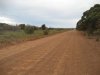
About 15kms down the highway (a dirt road at this point) I came to a cove called Harvey's Return. The cliffs are high around the coast, but there is a track leading several hundred metres down a steep incline to the cove at the bottom.
On my previous trip I had photographed Tawny Dragons at the bottom, but I wasn't happy with the shots and wanted to try again. This is one of the few coves where Tawny's exist on the island. Unfortunately, because it was so cloudy and the wind so cold, there were no lizards to be found. So I hiked all the way back up again, kicking myself for not visiting the afternoon before.
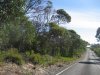
The Last time I had been there I noted that the north side of the road was either private property (of farmland or pine plantations) or parkland of predominantly eucalyptus forest. The south side was part of the National Park and was almost all Banksia scrub. For miles and miles along the road, and several hundred metres back, was one species - the Silver Banksia (
B. marginata) - like a sea of Banksia punctuated by the odd Eucalypt and Grass Tree.
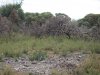
The fires had changed all that. The northside of the road was relativekly untouched (although some areas had been burnt), but the southern side of the road had been completely scorched. The grass trees were recovering and sprouting, and there were many new eucalypt saplings already the size of the few banksia skeletons that hadn't been completely destroyed, but not a single Banksia to be seen. The ground was covered in a carpet of green, but I was driving to fast to be able to tell what it was - either a grass, or a herb, bracken or some variety of heathland plant. I felt very disappointed because this was signalling a change in the ecosystem, from Banksia scrub to open Eucalypt woodland, and this would consequently change the wildlife assemblage that would repopulate the area.
Odd, I thought, as Banksia seeds need fire to germinate. But maybe these Banksias were differnt to the other 90 or so species, having evolved on the island in isolation. After all, their grass trees were gigantic monsters compared to what I was used to (see photo attachment below).
Some way down the road I spied a pair of wedgetail eagles circling on updrafts and brought my car to a quick halt so I could get out and photograph them. Against the grey sky they appeared as sillhouettes, just like the ones I had photographed at Monarto a few days earlier but closer.
http://www.zoochat.com/674/wedgetailed-eagle-142746/
http://www.zoochat.com/674/wedgetailed-eagle-142745/
http://www.zoochat.com/674/wedgetailed-eagle-142744/
http://www.zoochat.com/674/wedgetailed-eagle-142743/
http://www.zoochat.com/674/wedgetailed-eagle-142742/
Before getting back into the car I wandered over to look at the former banksia scrub, previously a great place to photograph birds as it was full of flowers, insects and cover for smaller species.
And then I kicked myself.
The green carpet was composed of thousands of Banksia seedlings, all about a foot tall. Banksias are very slow growers, and I know this, but I didn't think about it when I saw the Eucalypt saplings, two or three metres tall. So the ecosystem will recover, it may take several years, but it will be similar to the way it was.
Halfway along the island, just north of the middle, is the township of Parndana. An important little town as it has fuel and a pub and a general store. And just outside the town is the Parndana Wildlife Park.
See my review:
http://www.zoochat.com/24/parndana-wildlife-park-march-2010-a-145972/
After leaving Parndana I headed down the Stokes Bay Rd to Stokes Bay. There were two places I wanted to go to - Paul's Place and the Stokes Bay Native Garden.
I had seen Paul's Place advertised on a brochure, lots of animals apparently. The name was familiar and I wondered why I hadn't visited there on my last trip.
Just as I was approaching I saw another Black Tiger Snake crossing the road, right opposite the driveway to Paul's Place. I stopped the car to take some more photos.
Unlike the one at Flinder's Chase, this snake was well aware of what was going on and very wary. It stopped when I stopped the car, and when I got close it tried to bolt for the undergrowth near the side of the road. I ran in front and it stopped, then turned around and went back across the road. Another car came up and stopped and some tourists got out to look at it. The snake stopped again, sized up the situation, then took the only escape route back into the undergrowth. I had my photos, the tourist had got some video of it, so I decided not to annoy it by heading it off again and let it go. I don't like to unduly stress animals.
http://www.zoochat.com/674/black-tiger-snake-146132/
http://www.zoochat.com/674/black-tiger-snake-146133/
http://www.zoochat.com/674/black-tiger-snake-146134/
I drove down the driveway to Paul's Place and then discovered why I hadn't visited before - a large sign said:
Paul's Place
Opens at 12:00 midday
Last tour at 1pm
Closed Monday, Wednesday, Friday
It was now just after 2pm, on a Sunday. Looks like I won't be seeing it this time either.
Further down the road the Stokes Bay Native Gardens was open. I have found Botanical Gardens are great places to see and photograph birds (because of the high density and variety of flowering plants in a small area) so was keen to see what was on offer.
The Gardens are actually someone's backyard, but it's an enormous yard. I got a little lost following the paths and spent over an hour there. I got to see New Holland Honeyeater, Purple-crowned Lorikeet, Crimson Rosella, a striated pardalote that scrutinised me when I entered, the ubiquitous blue wren, and a koala. There were smaller birds in the dense shrubs but it was a bit cold for them to be out.
http://www.zoochat.com/674/striated-pardalote-146160/
http://www.zoochat.com/674/new-holland-honeyeater-146159/
http://www.zoochat.com/674/new-holland-honeyeater-146158/
http://www.zoochat.com/674/crimson-rosella-146156/
http://www.zoochat.com/674/immature-crimson-rosella-146161/
http://www.zoochat.com/674/koala-146157/
The New Holland Honeyeaters are interesting because they are almost identical to New Holland Honeyeaters on the mainland, except they have evolved a slightly longer tarsus, and a longer bill and forage differently.
And just as I left, the sun finally came out and shone strongly for the rest of the day.
There is a campsite right down next to a cafe at the 'beach' at Stokes Bay,and that was where I was planning on staying the night. I say 'beach' because there is no sand in the bay, it is all rock, pebbles and seaweed. There were a few other people at the campsite, with large tents and caravans and setup for an extended stay. I pitched my tent under a small mallee.
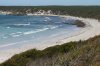
Although Stokes Bay has no beach there is a path through the nearest headland leading to the neighbouring cove which has quite a long beach. Although surfing is permitted, swimmimg is only allowed in a constructed rock pool because there are very strong rips present. So, as the sun was now out, once I had setup my tent I went for a much needed swim.
On the way back I passed some of the campers heading down to the rocks at the far end of the beach and we exchanged some pleasantries. I don't fish, so wasn't too interested in going with them, but the next morning I wished I had.
When I got back to my campsite it was just beginning to get dark and the kangaroos began to appear. As it got darker the Tammar Wallabies started to come out too - and there was lots of them!
http://www.zoochat.com/674/kangaroo-island-kangaroo-146147/
http://www.zoochat.com/674/tammar-wallaby-browsing-146152/
As I drifted of to sleep I heard the sound of light rain on the tent, although I was sure it wasn't rain. Must have been a possum in the malle, knocking little gumnuts out of the tree and they were bouncing of my tent.

Hix
~~~~~~~~~~~~~~~~~~~~~~~~~~~~~~~~~~~~~~~~~~~~~~~~
Below attachments:
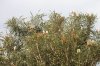
Banksia and Eucalypt regrowth, Playford Highway
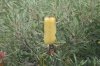
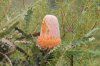
Banksia marginata, Stokes Bay Native Garden
Banksia prionotes, Stokes Bay Native Garden
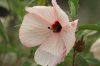
Hibiscus lutea, Stokes Bay Native Garden