Identification help on this parrot please.

zooman

Well-Known Member
15+ year member
While travelling through Europe last year visiting zoos l also stopped at pet shops, just can't help myself!

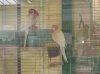
Outside of Hanover l came across these unusual parrots, apologies or bad picture quality.

They are about the size of a cockatiel with a yellow body and a unusually red neck and head. I am thinking they may just be selective breeding???
 

Attachments

  • image.jpg
    image.jpg
    680.2 KB · Views: 29
hey, you're Australian -- you should recognise those! :p

They are eastern rosellas, but you are right they are a (pretty horrible-looking) mutation.
 
Really!

Now that you mention it, mutation Yikes! Brutal however there must be a demand... I don't think breeders have done this in Australia, why would you as rosellas are beautifull just the way they are!
 
Last edited:
While travelling through Europe last year visiting zoos l also stopped at pet shops, just can't help myself!

Pet Shops have always had an attraction for me too, particularly in the 'old days' when even small pet shops used to carry stocks of interesting small animals and birds. Fewer seem to do so nowadays, concentrating more on feedstuffs and 'pet paraphernalia'(toys,leads etc) In the UK at least, the actual animal market seems to have shifted more to some of the larger out of town 'pet and garden' type centres. Some nowadays charge quite exorbitant amounts for birds and small animals like mice, rabbits and guineapigs etc, which are often half the price or less if obtained from breeders. But that's the nature of retail I guess and the animals are there on site with no further travelling cost or need for enquiries before purchase, which can often be a plus for many buyers.

Regarding mutations, some can be very attractive, the Lutino and Blue Ringneck Parakeet varieties spring to mind. Others not so much, for example what is the point of producing 'White' Gouldian finches or Mandarin Ducks?
 
Really!

Now that you mention it, mutation Yokes! Brutal however there must be a demand... I don't think breeders have done this in Australia, why would you as rosellas are beautifull just the way they are!
you know what they say, if you want to make a beautiful bird ugly -- give it to a breeder :D

(I don't know if anyone does say that because I just made it up, but it is often true). I'm pretty sure there are rosella mutations in Australia. I know there are mutations of things like Bourke's and turquoisines and so forth.

Really, as Pertinax says some mutations are actually very nice but others are just horrible or completely pointless. Sometimes even cruel.
 
I know there are mutations of things like Bourke's and turquoisines and so forth.

The most popular mutation of Bourke's is 'Rosa' where the bird is salmon-pink coloured in what would otherwise be the grey areas. Of interest to Chlidonias might be the Kakariki, a popular avicultural subject in UK/Europe- particularly the Lutino and Pied versions- but the latter isn't attractive IMO.
 
The most popular mutation of Bourke's is 'Rosa' where the bird is salmon-pink coloured in what would otherwise be the grey areas. Of interest to Chlidonias might be the Kakariki, a popular avicultural subject in UK/Europe- particularly the Lutino and Pied versions- but the latter isn't attractive IMO.
yes the pieds are horrible, they almost look like they are suffering some sort of feather disease! The lutinos look quite nice, but not at all as nice as the original colours. (Although I do quite like lutino and blue ringnecks). We don't have mutation kakariki in NZ at all but we do have loads from other exotic parrots, including the rosa Bourke's. I have seen a photo of a museum specimen of a wild blue mutation kakariki from the 19th century which was interesting.
 
Last edited:
wow that took a lot of effort to find a cover photo of!! Here's the blue kakariki I mentioned above...
 

Attachments

  • bav8alnMeLkhdWE4.jpg
    bav8alnMeLkhdWE4.jpg
    211.8 KB · Views: 3
I think it's not the beauty why mutations are bred but the price ! When a new mutation is bred, the so-called big breeders want it and are paying big bucks for them. With species which bred quite easy in captivity the price will drop very soon ( think of most of the Australian parakeets, Kakarikis, Australian finches, Lovebirds and so on.
Also in the Herp-world mutation breeding is done on a large scale and if you think some of the bird-mutations are ugly, think again and have a look at some of the snake-mutations which are around ! ( but they ARE expensive ! ....... )
 
The bird in the photo is an Eastern Rosella, and the mutation is called Rubino. They are derived from wild-caught birds that were then bred in Australia. There's usually a few available at the bird sales.

:p

Hix
 
Actually rubino is a combination of 2 mutations: Lutino (which removes all black pigment in the feathers) and Opaline (which is a mutation which rearranges the colour fields; that through a crossing-over ended up on the same chromosome which in this case is the Z-chromosome.

And you're right it is quite an ugly combination. In Kakariki's blue has appeared again with a breeder in Netherlands and is being sold for too much money currently. As Kakarikis breed faster then mice it will become cheaper quite soon and to be fair it is actually quite a nice mutation.
 
And looking more closely at the picture I actually think they are lutino as if opaline would have been thrown in the mix the red would going down into the back which isn't the case now.
 
In Kakariki's blue has appeared again with a breeder in Netherlands and is being sold for too much money currently. As Kakarikis breed faster then mice it will become cheaper quite soon and to be fair it is actually quite a nice mutation.
oh I was not aware of that. I'm not surprised (it isn't particularly hard for blue mutations to appear in green birds after all), and I would like to see one in real life. I think they would look very nice in blue.
 
P2949125-9f41b70b5c373734a860e88e79c10ca1.jpg


82517_foto%20(1).jpg


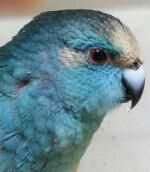
Most likely it is actually not a true blue mutation but what is called a partial psittacin reduction (PPR) and one that is called turquoise. There is still some psittacin left in the feathers causing a green shine on parts of the birds. This is mutation has the characteristic that there is anticipation, so through selection you can come to a bird that has no psittacin left, although genetically it would not be a true blue.
 
that's quite nice. I was expecting the crown and "ear" patch to still be red. (Obviously the crown would be white if it was bred from a yellow-crowned, but this appears to be of a red-crowned form with the "ear" patch).

You can still see the green quite clearly on the rump can't you.
 
The green is more of a shine then really green, so it depends also on the light angle how clearly you see it. And red and yellow in parrots is "caused" by a pigment called psittacin wich can vary from red to yellow (and everything in between like orange) so if you have a psittacin reduction you not only remove all yellow but as well all red colour. There have been some odd cases where you had blue birds with still red b.e. Psittacara (formerly Aratinga) wagleri. This might be caused by the fact that the psittacin production on the head and on the body is regulated by separate genes, with most parrots it is actually regulated by a single gene so if you remove yellow you also remove red.

And yes these blue are born from red-crowned kakarikis, although I wouldn't be surprised that some idiot quite soon will try to transfer it to yellow-crowns as well.
 
And red and yellow in parrots is "caused" by a pigment called psittacin wich can vary from red to yellow (and everything in between like orange) so if you have a psittacin reduction you not only remove all yellow but as well all red colour. There have been some odd cases where you had blue birds with still red b.e. Psittacara (formerly Aratinga) wagleri. This might be caused by the fact that the psittacin production on the head and on the body is regulated by separate genes, with most parrots it is actually regulated by a single gene so if you remove yellow you also remove red.
oh I didn't realise that. That explains it then!
 
Back
Top