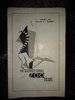
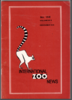
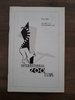
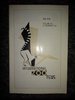
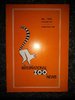
As my guidebook project throughout 2022 will have made clear, one of my long-standing interests is the preservation of historical information pertaining to zoological collections, and making this information accessible to a wider audience. As such, having made steps in this direction over the course of the last year, I have decided to make use of another noteworthy aspect of my personal collection of zoological documents, and in doing so provide a long-term resource for those interested in zoological history.
The International Zoo News was published between 1951 and 2016, and comprised a valuable source of information on a vast range of subjects relating to zoological collections; research articles, reviews of zoological collections and literature, opinion pieces and letters, news, annual reports and stocklists to name but a few. The following, written in 2001 by the then-editor Nicolas Gould and published within the 306th edition to mark the 50th anniversary of the IZN, provides a better summary than I can:
Ultimately, the waning health of the final editor - the aforementioned Richard Perron - and the fact that the journal was making a significant financial loss led to the IZN ceasing production as an independent publication at the end of 2016; fortunately, something of the "spirit" of the original publication has been preserved by the IZES, which has incorporated the IZN into its quarterly Zoo Grapevine magazine. However, the original IZN website (which contained a fairly lengthy archive of back issues and articles extending into the mid-1990s with a small smattering of earlier content) went offline shortly afterwards, with the result that a massive quantity of valuable information was no longer accessible to a general audience.
This is where I come in.
Over the years that followed, I obtained several copies of the International Zoo News and added them to my personal collection of zoological documents, but the loss of the digital archive continued to prey on my mind somewhat; I hoped that some of this content may have been preserved on the Internet Archive, but suspected that a thorough search would require significantly more time than I had to hand. Then COVID-19 hit, and I suddenly had a *lot* of free time! Unfortunately, several of the back-editions uploaded to the old IZN site had not been archived, and others (primarily those which were uploaded as direct hyperlinks to articles rather than PDF documents reproducing the entire edition in a single file) were only partially recovered by myself, but nonetheless I managed to locate and download over a hundred back editions. More recently, I have been able to locate a significant number of further physical copies of the IZN, representing hard copies of some I had downloaded, others which filled gaps caused by incomplete preservation on the Internet Archive, and several which had never been uploaded to the IZN website.
And now I get to the point; within this thread I intend to produce a full index of all editions of the IZN which are located within my personal collection - whether physical or digital - and the articles therein. Once this resource has been created, I will happily share any articles/reviews/information which may interest those reading this thread - either through posting scans/documents within this thread as attachments, or by sending them directly to the individuals concerned. It goes without saying that the index will be formatted to allow expansion and additions - whether this is because I have obtained further back-issues, or because other individuals reading this thread already own editions which I lack and are willing to provide information relating to their contents. I certainly hope that the latter comes to pass, especially given the fact that I know several active forum members contributed to the journal, or were subscribers.
I shall start posting the index within the coming day or two
The International Zoo News was published between 1951 and 2016, and comprised a valuable source of information on a vast range of subjects relating to zoological collections; research articles, reviews of zoological collections and literature, opinion pieces and letters, news, annual reports and stocklists to name but a few. The following, written in 2001 by the then-editor Nicolas Gould and published within the 306th edition to mark the 50th anniversary of the IZN, provides a better summary than I can:
International Zoo News is something of an oddity among the world's specialist journals. It has always been a small-scale production – a `cottage industry' is the term I sometimes apply to it when explaining my job to outsiders. None of its editors except Geoffrey Schomberg had previously had more than a very peripheral experience of zoo work. Although for more than half its existence its survival has been financially dependent upon a great zoo owner and the foundation he established, I.Z.N. has retained almost complete editorial independence and never become a mouthpiece for any particular sub-group within the zoo community. It is, in short, an amateur production whose readership consists mostly of professionals. The fact that it has even so managed to survive for half a century suggests that this apparent handicap may in fact be a source of strength.
Nothing could have been more amateur than the magazine's origins. But its founder, the 17-year-old Bent Jørgensen, was an amateur not merely in the negative sense of not being a professional, but much more importantly in the word's primary etymological sense – he loved zoos. Only the most passionate enthusiasm could have led this teenager – living in a remote (and zoo-less) corner of Europe, working at a poorly-paid job, and possessing only such rudimentary duplicating facilities as were available at the time – to launch an English-language international publication for zoos. And only his extraordinary determination – and, let's admit it, an element of chutzpah – could have enabled him to keep it going for two years and win the cooperation and support of many leading zoos around the world. (The same qualities must explain Mr Jørgensen's subsequent career, in which, after a variety of jobs unconnected with animals, he obtained a zoology degree, worked at Copenhagen's Zoological Museum, and eventually became director of Copenhagen Zoo and a distinguished figure in the world zoo community.)
Enclosed with this issue of I.Z.N. is a near-facsimile of the very first number, which I hope will interest readers (and not cause too much embarrassment to Bent Jørgensen!). It might have been less misleading to reproduce one of Mr Jørgensen's later issues, for, as John Tuson points out below in his appraisal of the magazine's first two years, I.Z.N. was improving all the time, and the final edition of 1952 had ten pages and a number of photographs. By then, in fact, it had become so successful that it had outgrown its founder's limited resources in time and money; but luckily, a second proprietor and editor was ready to take it on.
Gerard van Dam was a Dutch zoo enthusiast who, by 1950, had met a number of European zoo directors. A public relations officer by training, he was shocked to learn from them how little international contact there was between zoos. In 1952 he found a copy of International Zoo News in a zoo library and, as he later wrote, `clearly realized that such an information bulletin could serve as a unique communication medium.' He became Bent Jørgensen's friend and co-worker, and then his successor. After a year's gap, Mr van Dam's first issue appeared in January 1954. (The magazine's numbering dates from this relaunch, which is why the current volume number is 48 rather than 51.) Thereafter for 20 years van Dam single-handedly edited the magazine as a `hobby' in the intervals of a full-time job. It grew steadily, from a total of 56 pages in 1954 to 196 in 1959 and 300 in 1973. It grew in influence, too; particularly in the early years, when the zoo community was fragmented and parochial to an extent hardly credible today, it was the principal medium through which zoos everywhere could keep in touch. In 1956 van Dam published a list containing 531 addresses of zoos all over the world – probably the most comprehensive of its kind ever issued up to that time. (A few years later, the first volume of the International Zoo Yearbook listed only 312 zoos.) For years, I.Z.N. printed annual zoo attendance figures and animal stock lists, when this information could not be found anywhere else. Hundreds of international exchanges of zoo animals were facilitated through the magazine; and it served as a clearing-house for new ideas on such topics as animal management, diet and housing.
At the end of 1973, when a severe illness compelled Gerard van Dam to give up producing I.Z.N., John Aspinall took over as proprietor. Without the generous subsidy which he and his foundation have ever since provided, it is very unlikely that the magazine could have survived to celebrate its first half-century. At this point, a note on the magazine's finances may be useful. The income from subscriptions is generally little more than sufficient to pay my salary and cover postage and office costs. This means that the John Aspinall Foundation pays almost all the printers' bills, which currently come to around £2,000 per issue. Over the past 12 years these bills have been rising, not merely with the general rate of inflation, but additionally to cover the growing size of the magazine. In 1989, the year I took over as editor, I.Z.N. totalled just 272 pages; last year's total was 556. Every one of these extra pages represents an additional cost to the Foundation. If readers paid an economic price for each copy, the subscription would need to be more than doubled.
Obviously the ever-increasing communication and cooperation between zoos over the past half-century has usurped many of the functions which I.Z.N. served in earlier years. It is hard today to imagine a world without the International Zoo Yearbook, Zoo Biology, ISIS, EEPs, SSPs, international studbooks. . . But even so, the niche which Bent Jørgensen discovered in 1951 still seems to exist. Circulation continues to creep upwards (though never as fast as I'd like!), and I.Z.N. is currently read in more than 50 countries. When van Dam was editor, he made several unsuccessful attempts to have I.Z.N. accepted as an official organ by various national and international zoo organisations; but many readers – including some whose messages are printed below – now regard its independence as one of the magazine's great assets, enabling it to promote free discussion of `taboo' topics such as the problem of bad zoos, the shortcomings of cooperative breeding programmes, and the extent to which zoos really promote the survival of endangered species, rather than merely using `conservation' as a convenient, politically correct slogan.
Some of the changes which have taken place during my years with I.Z.N. are responses to the opportunities presented by modern technology. In 1989 I typed out the text of each issue with two fingers on an Amstrad computer with a daisy-wheel printer (almost Dark Age equipment viewed from the 21st century, though at the time it seemed to me like the last word in technical wizardry); the pile of `daisy-wheeled' sheets was then sent to our printers, who had the job of typesetting the text and designing the layout. The first big change came in 1991–2, when I acquired first an IBM personal computer and shortly afterwards a scanner. The latter enabled me to input text for word-processing via `optical character recognition', a marvellous invention which has since saved me many thousand hours of tedious copy-typing. Finally, about seven years ago I went over to the PageMaker `desktop publishing' system, and since then the typesetting and layout has been my responsibility (all except the photos and some other graphic material, which at present I still leave for the printers to insert in the spaces I leave for them).
The latest innovations to affect I.Z.N. have been e-mail and the Internet. Thanks to the generous help of Richard Perron of Quantum Conservation, the text of each issue now appears online almost simultaneously with the printed version. So far this has had a beneficial effect on circulation, with a steady trickle of new subscribers who first heard about the magazine by seeing the website. The site, which includes much other material as well as I.Z.N., has an efficient `search engine' which makes me wonder whether the work of indexing the printed volumes is worth the trouble. In particular, it is able to pick up all the minor references which for reasons of space have to be omitted from the printed indexes; thus, e.g., the website turned up five occurrences of `mountain tapir' from the last three years' issues, whereas the printed indexes show only one reference in nine years. (The advantage isn't all on one side: the indexes pinpoint page references, whereas the search engine – unless I'm using it wrong – only guides one to the issue and brief context of the word/s being sought.) Recently, aquarium-related items from I.Z.N. have also begun to be published on the website of Natural Habitats Ltd. I am glad of this, as it raises the magazine's profile in the public aquarium industry, which I feel has always been under-represented among our readership.
I'd like to end this editorial on a personal note. Writing below, Gerard van Dam comments that when he was editing I.Z.N. he `always had a great deal of fun.' That goes for me too. He admits that it `cost a lot of time' as well; but no doubt, like me, he found that the effort and problems of the job were vastly outweighed by its pleasure and satisfaction. I've fortunately never been sent an elephant, as he was (see below); but I get some amusement from the mail which arrives addressed to the Subscriptions Department, Public Relations Manager, Book Review Editor, Office Supplies Purchaser, Advertising Department et al., all of whom are in practice just me in my three-metre by four-metre office. (Something once came addressed to the Head Penguin Keeper. . .) Perhaps the best part of the job is the contact it brings me with so many charming and interesting people around the world, I.Z.N.'s readers and contributors (two categories often, of course, embodied in the same person). My main regret is that I don't meet as many of these people, or visit as many zoos, as I'd like. But it would be ungrateful to grumble, when mail, phone, fax and e-mail bring so many friends to me right here in my office, and I'm sent a flow of publications which would make any zoo-collector's mouth water. At 59 years old, I'm unlikely to make it through to I.Z.N.'s centenary; but I hope at least to carry it on some way into its second half-century.
Ultimately, the waning health of the final editor - the aforementioned Richard Perron - and the fact that the journal was making a significant financial loss led to the IZN ceasing production as an independent publication at the end of 2016; fortunately, something of the "spirit" of the original publication has been preserved by the IZES, which has incorporated the IZN into its quarterly Zoo Grapevine magazine. However, the original IZN website (which contained a fairly lengthy archive of back issues and articles extending into the mid-1990s with a small smattering of earlier content) went offline shortly afterwards, with the result that a massive quantity of valuable information was no longer accessible to a general audience.
This is where I come in.
Over the years that followed, I obtained several copies of the International Zoo News and added them to my personal collection of zoological documents, but the loss of the digital archive continued to prey on my mind somewhat; I hoped that some of this content may have been preserved on the Internet Archive, but suspected that a thorough search would require significantly more time than I had to hand. Then COVID-19 hit, and I suddenly had a *lot* of free time! Unfortunately, several of the back-editions uploaded to the old IZN site had not been archived, and others (primarily those which were uploaded as direct hyperlinks to articles rather than PDF documents reproducing the entire edition in a single file) were only partially recovered by myself, but nonetheless I managed to locate and download over a hundred back editions. More recently, I have been able to locate a significant number of further physical copies of the IZN, representing hard copies of some I had downloaded, others which filled gaps caused by incomplete preservation on the Internet Archive, and several which had never been uploaded to the IZN website.
And now I get to the point; within this thread I intend to produce a full index of all editions of the IZN which are located within my personal collection - whether physical or digital - and the articles therein. Once this resource has been created, I will happily share any articles/reviews/information which may interest those reading this thread - either through posting scans/documents within this thread as attachments, or by sending them directly to the individuals concerned. It goes without saying that the index will be formatted to allow expansion and additions - whether this is because I have obtained further back-issues, or because other individuals reading this thread already own editions which I lack and are willing to provide information relating to their contents. I certainly hope that the latter comes to pass, especially given the fact that I know several active forum members contributed to the journal, or were subscribers.
I shall start posting the index within the coming day or two