infra red cameras and nocturnal exhibits

bongorob

Well-Known Member
15+ year member
I've just been asked if it is possible to use an infra red camera in the Twilight Zone at Chester Zoo (though the same information would apply anywhere).

Does anyone know if such equipment would disturb the animals? I have no idea myself but would guess that it would not.
 
best to ask the respective establishment on their rules. So long as there is no visible white light the animals shouldn't mind, but often the case for not allowing photograpy at all is because the general public don't know how to use their cameras ("oh there's no flash on it" etc) which ruins it for everybody. A firm no-photography policy is easier to police than one rule for some and a different rule for others, if you see what I mean.
 
I've seen photos on Flickr from a guy who has done this at Frankfurt. His results look very good to me. I think I'd practise on the cat at home for a while before I approached the zoo to ask for permission - which I'm sure you'd have to do.

Alan
 
Did you get to the bottom of and/or try this? I was wondering the same myself and thought id see if anyone asked before.

I never considered the permission aspect just infra red vs bats (i have goldfish being able to see remote controls in my head, and thats not even the same difference lol)

Specifically regarding Chester and permission, since the signs in the Twilight Zone just say No Flash Photography, I presume it's fine. Backed up by the fact I have taken long exposures in there before, with staff in the room, and nobody said anything.
 
I just found the photostream on Flickr - have a look here Zoo Frankfurt - 2008 - a set on Flickr
The photos are B&W only, but very impressive. I was pleased to learn that in German an aye-aye is a fingertier :)

Alan

Infrared will always be black and white. I've taken some with my Sony DSC-F828 but I find it very restrictive. Although the light doesn't bother the animals at all, it can be hard to see the subject and moving subjects are a real pain. Plus, infrared emitters vary in power meaning the effective distance can vary. The one built into my camera is OK, but a more powerful attachment is available as an optional extra. Ideally, you should be trying to photograph a stationary or slow moving subject that you can get reasonably close to.

Example: http://www.zoochat.com/34/spinifex-hopping-mouse-56902/

I was about 5 feet from this Notomys - through glass - and it had stopped to feed. I got several photos of this guy and his friends, but most were blurred because they are so quick.

Example 2: http://www.zoochat.com/674/loggerhead-turtle-mon-repos-47939/
http://www.zoochat.com/674/loggerhead-female-mon-repos-47940/

This female Loggerhead was busy laying eggs so she wasn't moving at all. A nbit further away than the Mouse photo, about 8 feet. You can see from the black halo some of the limitations imposed by the infrared emitter.

:p

Hix
 
I've just been asked if it is possible to use an infra red camera in the Twilight Zone at Chester Zoo (though the same information would apply anywhere).

Chester have confirmed that it is permissible to use an infra red camera in the Twilight Zone.
 
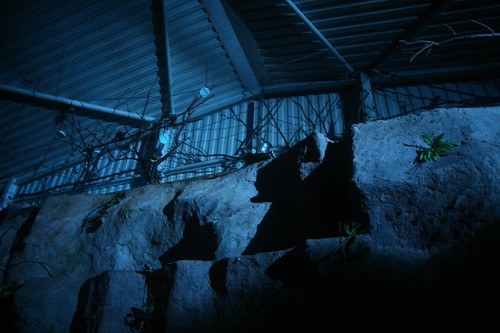
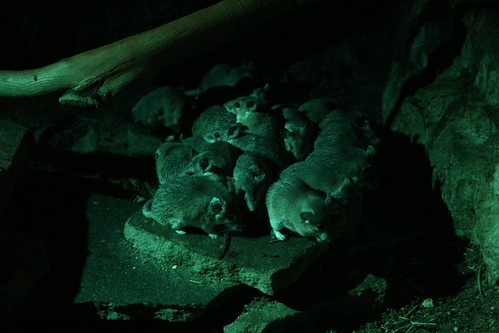
I've also had some success with longish exposures in the Twilight Zone.

Bat cave cliffs (shame about the lack of obliging bats)

4112162036_1d4a12a115.jpg


1/5 sec exposure, f3.5, 1600 ISO

Turkish Spiny Mice

2885531101_9ea484f90e.jpg


1/15 exposure, f4, 1600 ISO
 
Someone mentioned infrared emitters, but I am not sure what that is. Is it some kind of attachment that goes on a regular camera?

As far as I know (and I have worked in the photo industry at a pro lab for 17 years), there are two ways to get true infrared photos:

(1) Use a 35mm SLR with black & white infrared film. Unfortunately, the film of choice - Kodak HIE - is no longer made. Ilford makes a near infrared (but not true infrared) called SFX, but you have to use a special filter that they make. (You cannot use a true opaque IR filter, like you could with HIE, because that will just give you black photos). EFKE makes a true IR called Aura, but when you use it with a true IR filter it has an ISO of between 1 and 3 (NOT 100, but 1). Obviously not practical for moving animals.

(2) Use a digital SLR that has been converted for infrared use only. These will be color, but are often converted to black & white in Photoshop for articstic effect (so the earlier statement that IR will always be black & white is not true). I have not seen the German zoo photos mentioned above, but I would guess that is what he is using. These cameras work really well, with normal ISO speeds, as long as you do not mind having one camera that cannot take normal pictures and is used strictly for infrared. A lot of people take an older (outdated) digital SLR and convert it after they buy a newer model for their regular shots.

Conversion is done by a professional service (unless you are really saavy at tech stuff) by removing the IR cutoff filter over the sensor that comes with every digital SLR. One guy in San Diego that I have contacted goes an extra step and puts an opaque IR filter in its place for a stronger IR effect. You can also achieve this by putting an IR filter on the lens itself.

I have not personally used one of these (but I have used Kodak HIE with an IR filter on lens - I have a couple samples in the Reid Park Zoo gallery). However, I would like to pick one up from the San Diego guy - I think his name is Jim Chen - if I ever get some extra money.
 
I dont know much about infrared but have a friend who is a private investigator and he uses what he calls an infrared floodlight while videoing people he is investigating at night. This is probobly the same thing as you are reffering to as an infrared emitter.
 
I made a reference above to emitters.

One of my digital cameras - a Sony DSC-F828, a fixed lens digital - has an emitter that emits an infrared beam. However, the emitter isn't that strong and you need to be withiin a few meters of the subject to get a good clear shot. However, you can get a more powerful emitter that you attach in the same way as you would a more powerful flash, and this permits you to photograph subjects at a greater distance.

:p

Hix
 
Back
Top