Is the animal in this picture zonkey or somalia wild ass?

dt644

Well-Known Member
5+ year member
First, I'll give you an explanation. Korea's first modern zoo was Chang-gyeong-won, which was converted Chang-gyeong-gung Palace, the one of the palaces of the Joseon Dynasty, into a zoo and a botanical garden in 1909, when the Japanese Empire forcibly colonized the Joseon Kingdom on the Korean Peninsula.

The early and mid 1940s, Japan empire feeling threatened by defeat on World War II, so the Japanese government ordered the killing of large and dangerous animals in zoos. By this order, many animals in Changgyeongwon were dead, and followed by the outbreak of the Korean War in 1950, almost all of the rest animals in Changgyeongwon were also dead.

However, since 1955, some wealthy people have donated animals to Changgyeongwon, and according to history book about korean zoo history that I have, Namseon Electric Co., Ltd. imported a pair of three-year-old zonkeys from the Netherlands for $2,200, and donated them to Changgyeongwon, and that zonkeys arrived on zoo Jan. 26, 1955.

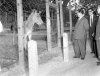
The photo data on that zonkeys did not exist separately, but two years ago, while I was looking for pictures related to the zoo at the Korean government's National Archives, I found one of the pictures taken by South Vietnamese President Ngô Đình Diệm in 1957 when he visited Changgyeongwon and took a picture with an animal believed to be that zonkey.

archWebViewerStream (1).jpg
That picture.
But I think that zonkey's leg stripes looked more close somalia wild ass's leg stripes. So, I would like to ask for the opinions of the zoochatters. Is the animal in this picture zonkey or somalia wild ass? If the animal in this picture is a real somali wild ass, it will be a huge discovery in the history of Korean zoos.
 

Attachments

  • archWebViewerStream (1).jpg
    archWebViewerStream (1).jpg
    144.2 KB · Views: 23
Not an expert but it looks like an authentic hybrid to me and these do frequently have stripes around their front and hind legs.

The resemblance may just be coincidental as the wild ancestor of the domesticated donkey (which technically is the Somali wild ass) has striped legs too so add a zebra into the mix and it is highly likely that the foal is going to have these characteristics.

Also , if it was indeed a wild ass species and not a "zonkey" wouldn't it be more likely to be an onager , Mongolian wild ass, or a kiang (given that these are Asiatic species and also probably were more widely available)?

Finally, this is totally unrelated but the history of Changgyeongwon zoo during Japanese Imperial occupation puts me in mind of a sub-story (except it is set in a zoo in Manchuria not Korea) in the novel "The wind up bird chronicle" by the writer Haruki Murakami.
 
Last edited:
Somali Ass doesn't have shoulder stripe, has darker, more contrasting, leg stripes and has longer ears than this animal, so I think definately not Somali Ass. Either Zonkey or some other Ass species-Nubian?- but given the import of the Zonkey(s) that seems most likely identity.
 
Thank you for your opinions. When I checked the book again, it was January 26, 1956 that a pair of zonkeys had been brought in. In my confirm part, there was a typo wrongly written in 1955. And males existed until 1967 and females existed until 1971.

According to that book's description of the zonkeys imported to Changgyeongwon at the time, they were smaller than horse but larger than zebras, with brown fur but striped waist and hip, mane was standing, head was big, and ears were donkey-like ears. If the record true that their fur was brown and has stripes, they would not be specific species of donkey.

캡처_2020_05_02_19_48_14_949.png

캡처_2020_05_02_19_48_15_881.png

캡처_2020_05_02_19_48_06_319.png

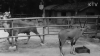
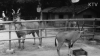
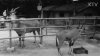
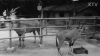
The above pictures are capture of some parts of the news aired on Korea's Daehan News on Sept. 11, 1971. In the video, an animal that appears to be a female zonkey in Changgyeongwon briefly appears from a distance, and if you look closely you can see a horizontal stripe on her hips. The donkey will have no stripes on its hips, so I think the female zonkeys in Changgyeongwon must be zonkey.
 

Attachments

  • 캡처_2020_05_02_19_48_06_319.png
    캡처_2020_05_02_19_48_06_319.png
    285.3 KB · Views: 24
  • 캡처_2020_05_02_19_48_14_949.png
    캡처_2020_05_02_19_48_14_949.png
    295.4 KB · Views: 24
  • 캡처_2020_05_02_19_48_15_881.png
    캡처_2020_05_02_19_48_15_881.png
    303 KB · Views: 24
There are many breeds of domestic donkey. Some show the characteristic 'Jesus cross', but others do not. Some are the result of a very long separation and selection process, sometimes over many centuries.
I remember seeing a stud of miniature donkeys in Holland over 20 years ago, which had fully striped legs on all four legs. They had been bred true to type as a closed herd for many generations.
The stripes on 'zeedonks' and 'zorses' can be highly variable too, depending not only on what donkey breed and zebra species are involved, but also individually.
 
There are many breeds of domestic donkey. Some show the characteristic 'Jesus cross', but others do not. Some are the result of a very long separation and selection process, sometimes over many centuries.
I remember seeing a stud of miniature donkeys in Holland over 20 years ago, which had fully striped legs on all four legs. They had been bred true to type as a closed herd for many generations.
The stripes on 'zeedonks' and 'zorses' can be highly variable too, depending not only on what donkey breed and zebra species are involved, but also individually.
I agree with you. I haven't directly seen any kind of zebroid yet, but I felt that their stripes were slightly different from individual to individual without a particular form by many pictures on internet. Perhaps it is right to say that there is no fixed form of stripes on zebroid's stripes because of crossbreeding.

I remember seeing a picture of a donkey with stripes on its legs a long time ago, but I don't know if what I saw was a somali ass or a zonkey, or a unique breed of domestic donkey you said. But I think it is not easy for domestic donkeys to have stripes that come up to their hips.
 
I agree with you. I haven't directly seen any kind of zebroid yet, but I felt that their stripes were slightly different from individual to individual without a particular form by many pictures on internet. Perhaps it is right to say that there is no fixed form of stripes on zebroid's stripes because of crossbreeding.

I remember seeing a picture of a donkey with stripes on its legs a long time ago, but I don't know if what I saw was a somali ass or a zonkey, or a unique breed of domestic donkey you said. But I think it is not easy for domestic donkeys to have stripes that come up to their hips.

The small donkey herd I remember, was (from memory) in a sanded paddock at the entrance (or at the entrance to a pets corner maybe..) in either Rhenen or Amersfoort Zoo. The animals were small, lightly built, pale grey and very similar due to the presumed in-breeding or line-breeding, and had striped legs - though yes of course only the lower part and not as far as the hips. They were very different in type to the American miniature donkey bloodlines being imported at the time, and now dominating Europe.

Zebroids stripes often cover over the whole body as in their father, in the case of a horse mother - or usually only on the legs with a offspring from a donkey jenny, or on the fore-quarters giving a slightly 'Quagga'ish' appearance.

In the case of piebald/spotted hybrids, the stripes are usually confined to the coloured parts of the body, in the same way that a spotted donkey will only show the 'Jesus cross' on the pigmented parts.

It is interesting that coloured donkeys (correctly called 'spots' or 'spotted') usually show heavier pigmentation over the fore-quarters rather than hind, with the back part of the animal usually white. These pigmented areas do often roughly equate to the striped fore-quarters of the Quagga...
 
Last edited:
Zebroids stripes often cover over the whole body as in their father, in the case of a horse mother - or usually only on the legs with a offspring from a donkey jenny, or on the fore-quarters giving a slightly 'Quagga'ish' appearance.

The three female Zebroid hybrids at Colchester Zoo had a black jenny donkey as mother and a Grants zebra as father. All three had stripes on hindquarters and upper body to some extent. These were in the form of narrower lines, more like a Grevy's Zebra. There's a photo of the last one, 'Shadow' somewhere in the gallery.
 
The three female Zebroid hybrids at Colchester Zoo had a black jenny donkey as mother and a Grants zebra as father. All three had stripes on hindquarters and upper body to some extent. These were in the form of narrower lines, more like a Grevy's Zebra. There's a photo of the last one, 'Shadow' somewhere in the gallery.

I remember seeing these in a small paddock at the bottom of the car park. They were very consistent in 'type', but then they were all from the same pairing...
 
Yes, they were very similar though the ground colour in each one differed slightly, one was 'peachy'/fawn coloured, one greyer, the third a sooty/darker colour (that was the last one, Shadow I think.)

Question about Hamerton- will you keep the Dingo pups, or some of them?
 
The three female Zebroid hybrids at Colchester Zoo had a black jenny donkey as mother and a Grants zebra as father. All three had stripes on hindquarters and upper body to some extent. These were in the form of narrower lines, more like a Grevy's Zebra. There's a photo of the last one, 'Shadow' somewhere in the gallery.
I looked up your reply and looked up the gallery. Is this the picture you were talking about?

full

Zeedonks in 2003 - ZooChat
 
Question about Hamerton- will you keep the Dingo pups, or some of them?
I'm not usually drawn ;) - but these are special times.. Whilst we do have some zoos already interested, all will stay into the medium term. They will be quite a pack by summer!
It is not a time for making quick decisions about anything..!
 
Wikipedia seem8s to list this one Gallery - Groombridge Place as one of Colchester's Zeedonks.
If it is, it must have been born much later...?
The zeedonk at Groombridge Place is definitely not one of those born in Colchester.

I visited Groombridge in 2012 and, according to the label, the zebra x donkey hybrid “Adam” was born in Florida on 13th June 1998.

I loaded some pictures of the Groombridge animal to the gallery which may be of interest:

Zebra x donkey hybrid; Groombridge Place; 6th April 2012 - ZooChat

Zebra x donkey hybrid; Groombridge Place; 6th April 2012 - ZooChat

Zebra x donkey hybrid; Groombridge Place; 6th April 2012 - ZooChat
 
The zeedonk at Groombridge Place is definitely not one of those born in Colchester.

I visited Groombridge in 2012 and, according to the label, the zebra x donkey hybrid “Adam” was born in Florida on 13th June 1998.

I loaded some pictures of the Groombridge animal to the gallery which may be of interest:

Zebra x donkey hybrid; Groombridge Place; 6th April 2012 - ZooChat

Zebra x donkey hybrid; Groombridge Place; 6th April 2012 - ZooChat

Zebra x donkey hybrid; Groombridge Place; 6th April 2012 - ZooChat

I assumed not as the timing was not really possible. It always surprises me that people have enough interest in these hybrids to go to the huge effort and expense of shipping them from the US. There is a 'zorse' around featured in 'Horse&Hound' which has been imported thus, too. Along with other hybrids they are fashionable in the US, so presumably will cost many thousands of dollars to purchase, then a months pre-export quarantine in a Government approved quarantine station, blood testing, crate training to get them into the plane and then commercial freight into Prestwick, LHR or Luxembourg. Not much change out of US$15,000 or $20,000 a-piece in total, perhaps...
 
Let me ask you another question. Is the eland in the second image I uploaded is common eland or giant eland? In the book I refer to, the elands at Changgyeongwon are stated as common eland, and I think so too, but I am ask this question because someone once said that eland in that video is giant eland.

캡처_2020_05_02_19_48_15_881.png

For your information, the animal in front of eland is beisa oryx. I've never seen giant eland, but I heard that giant eland and common eland are not much different in size, so I think it would be difficult to discern them into their size. But please give me your opinions.
 

Attachments

  • 캡처_2020_05_02_19_48_15_881.png
    캡처_2020_05_02_19_48_15_881.png
    303 KB · Views: 23
Let me ask you another question. Is the eland in the second image I uploaded is common eland or giant eland? In the book I refer to, the elands at Changgyeongwon are stated as common eland, and I think so too, but I am ask this question because someone once said that eland in that video is giant eland.

View attachment 439382

For your information, the animal in front of eland is beisa oryx. I've never seen giant eland, but I heard that giant eland and common eland are not much different in size, so I think it would be difficult to discern them into their size. But please give me your opinions.

Very clearly a Common Eland based on the horns, coat pattern and build.
 
Back
Top