
jbnbsn99
Well-Known Member
Voyage to South America
Concept
The whole concept of Voyage to South America is one of adventure. You, as the guest, are retracing the voyage of a 19th century explorer naturalist like Charles Darwin or Alexander von Humbolt. Both of these men were keen observers of nature, and traveled around South America documenting their findings for the eager European audiences. Darwin's voyage to South America was so important that it led him to develop his Theory of Natural Selection, which has proven to be the foundation of all modern biology.
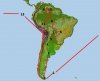
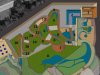
You voyage will take you throughout the entire continent to thirteen different eco-regions. Each eco-region is highlighted by a different species and native flora. The map below will guide you through your Voyage to South America
1. Falkland Islands
2. Tierra del Fuego
3. Pampas
4. Ischigaulasto
5. Gran Chaco
6. Cerrado
7. Pantanal
8. Amazon
9. Llanos
10. Tepui
11. Andean Cloud Forest
12. Altiplano
13. Galápagos Islands
Exhibit Layout
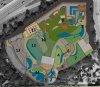
1 – Ship
2 – Falkland Islands
3 – Tierra del Fuego
4 – Pampas
5 – Ischigaulasto
6 – Gran Chaco
7 – Cerrado
8 – Pantanal
9 – Amazon
10 – Llanos
11 – Tepui
12 – Andean Cloud Forest
13 – Altiplano
14 – Galápagos Islands
I. Entry Ship
The entrance and exit of the entire exhibit will be through a replica of a 19th century British sailing ship. This ship is intended to recreate the HMS Beagle, the ship that carried Charles Darwin on his famous voyage around South America documenting the wildlife and nature of the continent.
The ship would be constructed in three levels, two of which will be accessible to the public. For after hours events the Ship can be used as an event center for parties, sleep-overs, meetings, etc.
Level 1. Filtration and service. This will be for the salt water filtration needed for the adjacent exhibits.
Level 2. Entry and exit.
a. Entry. In the first half (entry side) of the ship the visitors will have underwater viewing of the Falkland Islands exhibit (Penguins). The interior of the ship will be decorated in such a manner that it will appear that the visitor is in the ship study/captains quarters. Various bookshelves, specimen drawers, and artifacts will give the guest lots of interpretation and discovery moments.
b. Exit. The exit side of the exhibit will feature underwater viewing for the Galápagos Islands exhibit (sea lions). The exit side will be decorated in such a way that the guest feels like they are in the sleeping cabins of the ship. This will mainly include several bunk-beds as well as other artifacts.
c. Videos. Videos introducing the exhibit will play before the guest enters the Falkland Islands side and before they enter the Galápagos Islands side. Falklands video will introduce the whole exhibit, while the Galápagos video will recap the exhibit and hit home messages of conservation.
d. Headset Kiosk (optional).
e. Event Center – Doorways between both sides may be opened and the whole of the ship can become an event center. This area would be perfect for parties and sleepovers.
f. Restrooms – As this area can function as an event center, a small family style restroom must be included.
Level 3. Ship Top
The top of the ship is intended to be a playground for young kids. All activities are based on ship life (captain's wheel, periscopes, rope climbs, netting, crow's nest etc.). Access to the ship top would be from a ramp/staircase located in the Galápagos area. Ship top also serves as the end point of the zip line.
Total area of the ship (one level) is approx. 2,300 sq. ft. Total length is 100 ft.
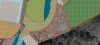
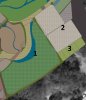
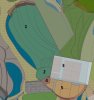
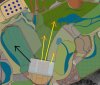
Map key – 1) Ship 2) Falkland Islands exhibit 3) Sea Lion exhibit
2. Falkland Islands and Tierra del Fuego
1. Falkland Islands. This exhibit will be entirely indoors and only visible from inside the ship. Water line should be positioned half-way up the viewing windows to give guests both an above water and underwater view. A glass or transparent ceiling should be provided to give the animals and plants natural light. During winter months ceiling panels can be opened to give direct access to sunlight and outside temperatures when those temperatures fall within the animals needs. Species included are penguins known to have major breeding colonies on the Falkland Islands and are represented in North American collections. King Penguin, Rockhopper Penguin, and Gentoo Penguin.
2. Tierra del Fuego. This is the outdoor penguin exhibit. Guests will view the penguins entirely above the water's surface, however part of the pathway will be clear so to view the penguins swimming underneath the guest's feet. Exhibit should focus on penguins in the forest. Species included are known to nest in the region and are represented in North American collection. Macaroni Penguins and Magellanic Penguins. Also Chilöe Widgeon can share the exhibit.
3. Holding will be shared for both exhibits.
Interpretation.
Falklands – Graphics should be places above the viewing window to not obstruct the view. Some attention should also be put on the Warrah, or Falkland Islands Wolf that went extinct in the past 100 or so years.
Tierra del Fuego – Basic graphics here describing the animals and the region. Talk about Magellan’s voyage around the world in reference to the Magellanic Penguins.
Exhibit size
1. Falkland Islands – 1,500 sq. ft.
2. Tierra del Fuego – 2,850 sq. ft.
3. holding – 970 sq. ft.
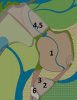
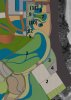
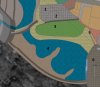
Map Key – 1) Ship 2) Falkland Islands exhibit 3) Tierra del Fuego exhibit 4) Penguin holding
3. Pampas
The Pampas is the grasslands of Argentina, and is one of the most misrepresented regions in South America. Many times, zoos will associate animals such as Maned Wolves, Giant Anteater, and Tapirs with the Pampas. However, none of these animals are actually found in the region, or if they are, they only occur on the northern edge. The Pampas exhibit in VtSA shows a true sampling of animals actually found in the Argentine Pampas. This exhibit will consist of two separate exhibits in a predator/prey style setting.
1. Prey. This is the larger of the two exhibits and will be closest to the guests. Landscaping will be minimal and consist of mainly grasses, with a few sparse small trees (like mesquite trees). A water feature will be necessary for some of the species. Due to the hardy nature of most of the species, indoor holding is not as necessary, but is provided. Species included are all native to the region and well known in North American collections. Greater Rhea, Black-Necked Swan, Patagonian Cavy, and Nutria.
2. Predator. This slightly smaller exhibit will be behind the main prey exhibit. Landscaping should have more trees than the prey exhibit as well as lots of rocks and climbing opportunities. This exhibit will be part of a series of three exhibits that can be rotated between 2 species (Jaguar and Puma). Pumas are very rarely associated with South America, but are known to range throughout the continent.
Exhibit size.
Prey – 6,800 sq. ft.
Predator – 4,450 sq. ft.
Prey holding (shared with Gran Chaco) - 1,700 sq. ft.
Predator holding
4,500 sq. ft. indoors,
2,800 sq. ft. outdoors.
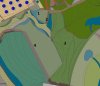
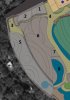
Map Key – 1) Mixed species prey exhibit 2) Puma (Predator) exhibit 3) Predator holding 4)Prey holding (underneath Seriema exhibit)
4. Ischigaulasto
Ischigaulasto (ee-she-gow-laas-toe) is a geologic formation in northwest Argentina also known as the Valley of the Moon. This area is world famous for producing spectacular dinosaur fossils. South America, and Argentina in particular is known to have some of the most bizarre and important dinosaurs known. A zoo should not only focus on animals of the present, but also give a link to those of the past, and dinosaurs still capture the imaginations of both young and old. In order to portray this region and the wondrous dinosaurs of South America, a rock maze has been designed. Throughout this winding maze will be placed bones of significant discoveries. It should not be just dinosaurs in the maze either, but all sorts of extinct South American fauna. Preferentially, the maze should have the fossils placed in chronological order from oldest to youngest. Various galleries off of the main paths will highlight a different extinct species. Doing the exhibit as a maze will create a wonderful play and discovery opportunity for children. No live animals will be in this area.
Species to be considered for the maze
Eoraptor – oldest dinosaur known
Herrasaurus – 2nd oldest dinosaur known
Mussasaurus – smallest dinosaur known
Argentinasaurus – largest dinosaur known
Giganotosaurus – largest carnivorous dinosaur known
Amargasaurus – sail-finned sauropod dinosaur
Carnotaurus – carnivorous dinosaur with horns
Pterosaurs – flying reptiles
Giant ground sloth
Glyptodont – giant armadillo
Mammoth/Mastodon
Exhibit size - 3,200 sq. ft.
Concept
The whole concept of Voyage to South America is one of adventure. You, as the guest, are retracing the voyage of a 19th century explorer naturalist like Charles Darwin or Alexander von Humbolt. Both of these men were keen observers of nature, and traveled around South America documenting their findings for the eager European audiences. Darwin's voyage to South America was so important that it led him to develop his Theory of Natural Selection, which has proven to be the foundation of all modern biology.
You voyage will take you throughout the entire continent to thirteen different eco-regions. Each eco-region is highlighted by a different species and native flora. The map below will guide you through your Voyage to South America
1. Falkland Islands
2. Tierra del Fuego
3. Pampas
4. Ischigaulasto
5. Gran Chaco
6. Cerrado
7. Pantanal
8. Amazon
9. Llanos
10. Tepui
11. Andean Cloud Forest
12. Altiplano
13. Galápagos Islands
Exhibit Layout
1 – Ship
2 – Falkland Islands
3 – Tierra del Fuego
4 – Pampas
5 – Ischigaulasto
6 – Gran Chaco
7 – Cerrado
8 – Pantanal
9 – Amazon
10 – Llanos
11 – Tepui
12 – Andean Cloud Forest
13 – Altiplano
14 – Galápagos Islands
I. Entry Ship
The entrance and exit of the entire exhibit will be through a replica of a 19th century British sailing ship. This ship is intended to recreate the HMS Beagle, the ship that carried Charles Darwin on his famous voyage around South America documenting the wildlife and nature of the continent.
The ship would be constructed in three levels, two of which will be accessible to the public. For after hours events the Ship can be used as an event center for parties, sleep-overs, meetings, etc.
Level 1. Filtration and service. This will be for the salt water filtration needed for the adjacent exhibits.
Level 2. Entry and exit.
a. Entry. In the first half (entry side) of the ship the visitors will have underwater viewing of the Falkland Islands exhibit (Penguins). The interior of the ship will be decorated in such a manner that it will appear that the visitor is in the ship study/captains quarters. Various bookshelves, specimen drawers, and artifacts will give the guest lots of interpretation and discovery moments.
b. Exit. The exit side of the exhibit will feature underwater viewing for the Galápagos Islands exhibit (sea lions). The exit side will be decorated in such a way that the guest feels like they are in the sleeping cabins of the ship. This will mainly include several bunk-beds as well as other artifacts.
c. Videos. Videos introducing the exhibit will play before the guest enters the Falkland Islands side and before they enter the Galápagos Islands side. Falklands video will introduce the whole exhibit, while the Galápagos video will recap the exhibit and hit home messages of conservation.
d. Headset Kiosk (optional).
e. Event Center – Doorways between both sides may be opened and the whole of the ship can become an event center. This area would be perfect for parties and sleepovers.
f. Restrooms – As this area can function as an event center, a small family style restroom must be included.
Level 3. Ship Top
The top of the ship is intended to be a playground for young kids. All activities are based on ship life (captain's wheel, periscopes, rope climbs, netting, crow's nest etc.). Access to the ship top would be from a ramp/staircase located in the Galápagos area. Ship top also serves as the end point of the zip line.
Total area of the ship (one level) is approx. 2,300 sq. ft. Total length is 100 ft.
Map key – 1) Ship 2) Falkland Islands exhibit 3) Sea Lion exhibit
2. Falkland Islands and Tierra del Fuego
1. Falkland Islands. This exhibit will be entirely indoors and only visible from inside the ship. Water line should be positioned half-way up the viewing windows to give guests both an above water and underwater view. A glass or transparent ceiling should be provided to give the animals and plants natural light. During winter months ceiling panels can be opened to give direct access to sunlight and outside temperatures when those temperatures fall within the animals needs. Species included are penguins known to have major breeding colonies on the Falkland Islands and are represented in North American collections. King Penguin, Rockhopper Penguin, and Gentoo Penguin.
2. Tierra del Fuego. This is the outdoor penguin exhibit. Guests will view the penguins entirely above the water's surface, however part of the pathway will be clear so to view the penguins swimming underneath the guest's feet. Exhibit should focus on penguins in the forest. Species included are known to nest in the region and are represented in North American collection. Macaroni Penguins and Magellanic Penguins. Also Chilöe Widgeon can share the exhibit.
3. Holding will be shared for both exhibits.
Interpretation.
Falklands – Graphics should be places above the viewing window to not obstruct the view. Some attention should also be put on the Warrah, or Falkland Islands Wolf that went extinct in the past 100 or so years.
Tierra del Fuego – Basic graphics here describing the animals and the region. Talk about Magellan’s voyage around the world in reference to the Magellanic Penguins.
Exhibit size
1. Falkland Islands – 1,500 sq. ft.
2. Tierra del Fuego – 2,850 sq. ft.
3. holding – 970 sq. ft.
Map Key – 1) Ship 2) Falkland Islands exhibit 3) Tierra del Fuego exhibit 4) Penguin holding
3. Pampas
The Pampas is the grasslands of Argentina, and is one of the most misrepresented regions in South America. Many times, zoos will associate animals such as Maned Wolves, Giant Anteater, and Tapirs with the Pampas. However, none of these animals are actually found in the region, or if they are, they only occur on the northern edge. The Pampas exhibit in VtSA shows a true sampling of animals actually found in the Argentine Pampas. This exhibit will consist of two separate exhibits in a predator/prey style setting.
1. Prey. This is the larger of the two exhibits and will be closest to the guests. Landscaping will be minimal and consist of mainly grasses, with a few sparse small trees (like mesquite trees). A water feature will be necessary for some of the species. Due to the hardy nature of most of the species, indoor holding is not as necessary, but is provided. Species included are all native to the region and well known in North American collections. Greater Rhea, Black-Necked Swan, Patagonian Cavy, and Nutria.
2. Predator. This slightly smaller exhibit will be behind the main prey exhibit. Landscaping should have more trees than the prey exhibit as well as lots of rocks and climbing opportunities. This exhibit will be part of a series of three exhibits that can be rotated between 2 species (Jaguar and Puma). Pumas are very rarely associated with South America, but are known to range throughout the continent.
Exhibit size.
Prey – 6,800 sq. ft.
Predator – 4,450 sq. ft.
Prey holding (shared with Gran Chaco) - 1,700 sq. ft.
Predator holding
4,500 sq. ft. indoors,
2,800 sq. ft. outdoors.
Map Key – 1) Mixed species prey exhibit 2) Puma (Predator) exhibit 3) Predator holding 4)Prey holding (underneath Seriema exhibit)
4. Ischigaulasto
Ischigaulasto (ee-she-gow-laas-toe) is a geologic formation in northwest Argentina also known as the Valley of the Moon. This area is world famous for producing spectacular dinosaur fossils. South America, and Argentina in particular is known to have some of the most bizarre and important dinosaurs known. A zoo should not only focus on animals of the present, but also give a link to those of the past, and dinosaurs still capture the imaginations of both young and old. In order to portray this region and the wondrous dinosaurs of South America, a rock maze has been designed. Throughout this winding maze will be placed bones of significant discoveries. It should not be just dinosaurs in the maze either, but all sorts of extinct South American fauna. Preferentially, the maze should have the fossils placed in chronological order from oldest to youngest. Various galleries off of the main paths will highlight a different extinct species. Doing the exhibit as a maze will create a wonderful play and discovery opportunity for children. No live animals will be in this area.
Species to be considered for the maze
Eoraptor – oldest dinosaur known
Herrasaurus – 2nd oldest dinosaur known
Mussasaurus – smallest dinosaur known
Argentinasaurus – largest dinosaur known
Giganotosaurus – largest carnivorous dinosaur known
Amargasaurus – sail-finned sauropod dinosaur
Carnotaurus – carnivorous dinosaur with horns
Pterosaurs – flying reptiles
Giant ground sloth
Glyptodont – giant armadillo
Mammoth/Mastodon
Exhibit size - 3,200 sq. ft.






 ). This is truly an exhibit design worthy to be brought to life by the world's best. I commend you on this incredible and unbelievable work of art. These words do not come close to expressing how awestruck I am by this exhibit design.