June 1st Lockdown Puzzle

gentle lemur

Well-Known Member
15+ year member

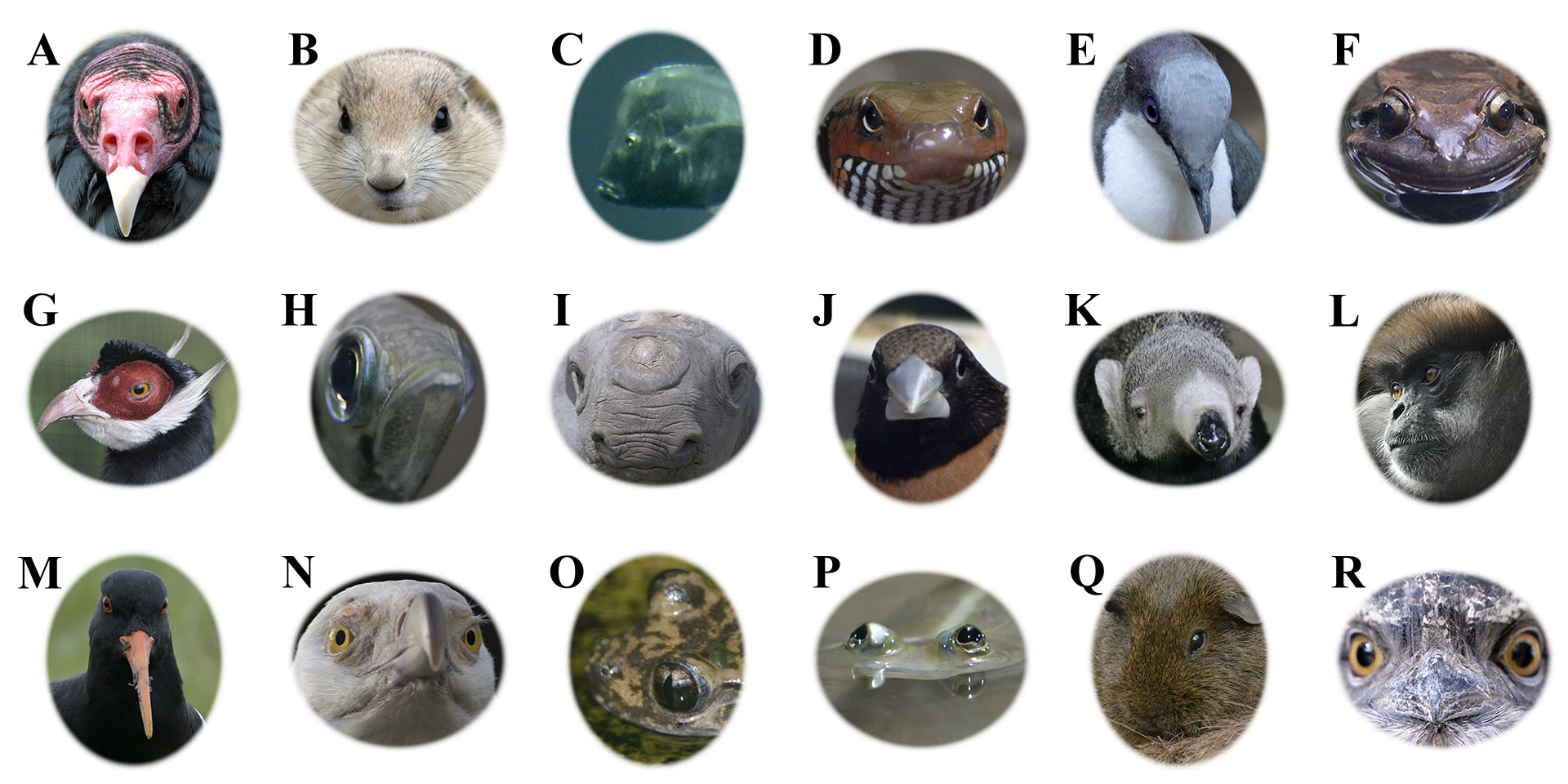
I think I have made this month's puzzle a little easier. There are only 18 species and I have tried to show their faces head-on or in profile, so they should be easier to identify, indeed for one or two you don't even have to identify the exact species.
But of course there is another question - which is the Odd One Out? As a possible tie-breaker, please also suggest a suitable 18th species which could replace the Odd One Out.
If you have a question, please send me a PM. Post your answers in this thread after noon UST (11 am BST) on Monday 8th June.
 
Last edited:
I don't know what the theme/odd one out is, but here are my identifications (tentative answers with question mark):

A Turkey vulture Cathartes aura
B Black-tailed prairie dog Cynomys ludovicianus
C Jack/trevally Caranx melampygus?
D Fire skink Mochlus fernandi
E Luzon bleeding-heart Gallicolumba luzonica
F Mountain chicken Leptodactylus fallax
G Blue eared pheasant Crossoptilon auritum
H Archer fish Toxotes jaculatrix?
I Indian rhino Rhinoceros unicornis?
J Chestnut-breasted munia Lonchura castaneothorax
K Giant anteater Myrmecophaga tridactyla
L Red colobus Piliocolobus rufomitratus?
M Oystercatcher Haematopus ostralegus
N Palm-nut vulture Gypohierax angolensis
O Midwife toad Alytes muletensis?
P Four-eyed fish Anableps anableps?
Q Guinea pig Cavia aperea?
R Tawny frogmouth Podargus strigoides
 
I don't know what the theme/odd one out is, but here are my identifications (tentative answers with question mark):
Good work, but 3 of the queries are wrong. The rest are OK - or near enough, but you also need an alternative name for one of them to have everything you need to spot the Odd One Out.
 
Here is my (very incomplete) list:

A- Turkey vulture
B- Black-tailed prairie dog
C- ?
D- Fire skink
E- Luzon bleeding heart dove
F- Mountain chicken
G- Blue-eared pheasant
H- Banded archerfish?
I- Black rhinoceros
J- Chestnut-breasted munia
K- Giant anteater
L- Purple-faced langur?
M- Eurasian oystercatcher
N- Palm-nut vulture
O- Midwife toad
P- ?
Q- Brazilian guinea pig
R- Tawny frogmouth.

And I have no idea what the odd one out is, but I'll have a good think about it.
 
@gentle lemur I wonder if we could have a clue or two more for working out the odd one out, e.g. is it to do with distribution, habitat, English or scientific name, pop culture reference, presence in zoos? I've been stumped for so long and there have not yet been any guesses.
 
@gentle lemur I wonder if we could have a clue or two more for working out the odd one out, e.g. is it to do with distribution, habitat, English or scientific name, pop culture reference, presence in zoos? I've been stumped for so long and there have not yet been any guesses.
OK. Think about the English names ;)
Perhaps I should have said before that the order of the names is quite irrelevant.
 
The closest I think I can get is that many of them seem to contain a lie or misconception within their names (giant anteater doesn't eat ants, mountain chicken is a frog, midwife toad is male). If I is black rhino rather than Indian, then that strengthens the hypothesis as black is a misnomer. Many of them don't fit this trend however, so I can't tell which is the odd one out or if that's even the correct deduction.

OK, I'll make this my formal guess: all of them contain a misnomer in their names, apart from J (chestnut-breasted munia).
 
I thought Letter I was a white rhino because of the flatter lip? I’m no expert but I feel the black rhino’s ‘hook’ lip is more pronounced.
 
The closest I think I can get is that many of them seem to contain a lie or misconception within their names (giant anteater doesn't eat ants, mountain chicken is a frog, midwife toad is male). If I is black rhino rather than Indian, then that strengthens the hypothesis as black is a misnomer. Many of them don't fit this trend however, so I can't tell which is the odd one out or if that's even the correct deduction.

OK, I'll make this my formal guess: all of them contain a misnomer in their names, apart from J (chestnut-breasted munia).

I thought Letter I was a white rhino because of the flatter lip? I’m no expert but I feel the black rhino’s ‘hook’ lip is more pronounced.

I believe it is a black rhino but I can't quite pinpoint why. The snout is nowhere near wide enough for a white rhino, and the face comes in towards the end. The lip isn't terribly hooked, but there are black rhino specimens without a very hooked lip. But the main clue is that it has two horns instead of one :)
 
The closest I think I can get is that many of them seem to contain a lie or misconception within their names (giant anteater doesn't eat ants, mountain chicken is a frog, midwife toad is male). If I is black rhino rather than Indian, then that strengthens the hypothesis as black is a misnomer. Many of them don't fit this trend however, so I can't tell which is the odd one out or if that's even the correct deduction.
OK, I'll make this my formal guess: all of them contain a misnomer in their names, apart from J (chestnut-breasted munia).
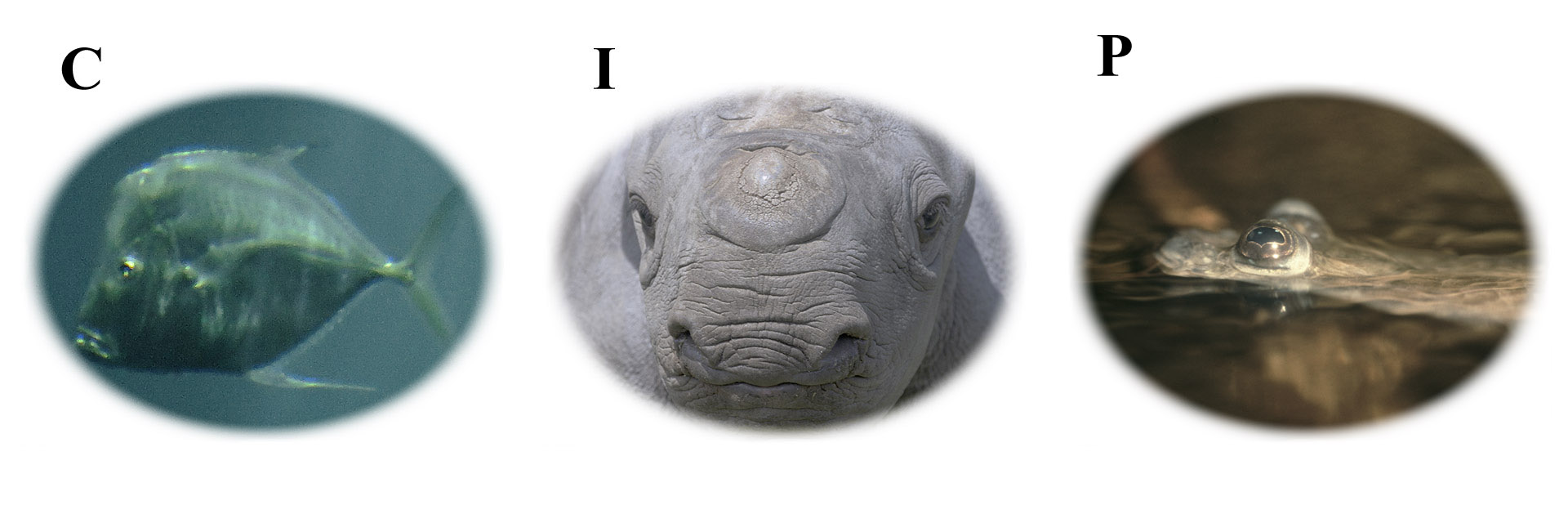
You're making good progress and getting much warmer, but to spot the Odd One Out you need to identify all the species. I suggest that you check common names of the possible species on the English version of Zootierliste. I will try to find clearer photos of C, I and P, which seem to be causing most of the problems.
I don't know how much this will help, but I remembered the words that Conan Doyle put into the mouth into the greatest detective of them all 'Once you eliminate the impossible, whatever remains, no matter how improbable, must be the truth.'
 
If P isn't Anableps, I honestly don't know what it is. I thought it might be an amphibian based on the eye shape but I'm stumped as to which.

"I" could be any rhino as far as I can tell - the horn(s) aren't really visible and the lip is somewhat obscured. It's a calf, right? I will go with black rhino and my original hypothesis for odd one out still stands (I think!).

(By the way, as I'm watching Sherlock a lot these days, I have the Doylian methodology in my mind - and I have had that exact quote come to mind - but it falls apart when I can't be sure of the identities).
 
Black rhino calf:

6a010535647bf3970b01b7c93697ea970b-600wi


Note similarities between that and 'I'.

Pretty sure it is that, and it helps your hypothesis, so...
 
Back
Top