KCZooFan
Well-Known Member
This is my first review, let me know what you think
Kansas City Zoo is one of my favorite zoos. Though the collection cannot compete with nearby zoos (Sedgwick County, St. Louis, and Omaha), the exhibitory is incredible. It is home to some of the largest exhibits in the country. The Africa section is absolutely brilliant, but the rest of the zoo has some catching up to do. Overall, it is defiantly a good zoo, but still cannot compete with the “giants” of North America.
Africa
Africa is huge, bigger than many zoos. Its immersion is very subtle, but believable. The whole area is open, but surrounded by a forest, and one side has tall hills, giving a calm and reclusive atmosphere. It is split into 5 sections, representing countries: Botswana, Kenya, Tanzania, Uganda, and The Congolese Forest. A tram will transport you through Botswana, and drop you off in Nairobi Market in Kenya. A mile long loop circling a lake takes you around the exhibit. A boat travels across this lake from Nairobi market to near the hippo exhibit, but this only cuts off about a fourth or less of the walking, skipping the Uganda section. Most exhibits are spaced widely apart from each other, and have a variety of display techniques.
Botswana
Botswana is home to two exhibits. The smaller one is a large valley exhibit home to black-necked swans, a mute swan, lesser flamingos, and Chilean flamingos. The main attraction, however, is African elephants. The all-female heard can be seen in a quarter mile long, 4.5 acre exhibit, complete with a watering hole. The main walk can be skipped, however, by a shortcut created in 2007, that leads visitors right to the end of the elephant exhibit. Botswana can be seen by tram also, but the animals can be viewed for only a short time, making walking preferable. At the end of Botswana is a long bridge over the Blue river, leading to Nairobi Market in Kenya.
Kenya
Kenya starts with an authentic African village. It can be reached by crossing Botswana on foot, or by tram. Nairobi Village is home to a restaurant, bar/boat house, snack stand, gift shop, tram station, and small aviary with masked lovebirds and a white-cheeked turaco. Also here, is a viewing deck onto the incredible 17 acre African plains exhibit. This large, grassy exhibit can be seen from several points around Kenya. Living on this immense savannah are gray corwned cranes, common elands, scimitar-horned oryxes, lesser kudu, and springbok. As you begin the loop, the first exhibit you come to is a huge, long, cheetah exhibit that can be seen from several places, including a viewing cave and behind the warthogs, cresting an interesting predator/prey panorama. The sunken warthog exhibit is average at best, and quite muddy. It is from here that you can reach the Congolese Forest (more on that later). A large wetlands exhibit is home to saddle-billed storks. Several pools covered in duckweed fill this exhibit. A Bomas village, complete with huts, has two above-average aviaries for lappet-faced vultures and Bateleur eagles. Large pens also house red-flanked duikers, blue duikers, and Aldabra giant tortoises. A walkthrough scrubland aviary has a few pools, as well as trees for the birds. Several species of birds, such as cattle egrets, hottentot teals, marbled ducks, white-faced whistling ducks, rose-ringed parakeet, white-cheeked turaco, bare-faced go-away-bird, white-headed buffalo weaver, and superb starling call this exhibit home. Two small, side exhibits house red-ruffed lemurs and silvery-cheeked hornbills. The last exhibit is a quite large one for southern ground hornbills.
Tanzania
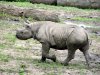
The first part of Tanzania is a kopje exhibit. Mostly, large, spacious exhibits are a carved into the rock. Meerkats is habit two large, rocky exhibits, white greater galagos and black-footed cats have small exhibits carved into the boulders. Bat-eared foxes, black-throated monitors, and servals all have spacious exhibits on realistic-looking (fake) rock. An enormous aviary for rock hyraxes and masked lovebirds has plenty of climbing spaces for the hyraxes. The main exhibit here is an enormous lion exhibit. This can be seen from across a moat in several locations, or inside a building through glass. It is the best lion exhibit I’ve ever seen, and offers views of the antelope for the lions. A long, wooded bridge leads you to the other side of Africa. The first exhibit visible is a large, muddy exhibit for black rhinos. Up ahead is a mixed species savannah for Masai giraffes, Grant’s zebras, and ostriches. Though much smaller and less grassy than the other savannah, it is still a good exhibit. A side trail leads over the Gomber stream to what may be Kansas City’s best exhibit; a three acre chimpanzee exhibit. 17 chimps are free to roam a great hillside exhibit, complete with tons of trees to climb. They can be seen from across a moat, or inside a building from behind glass. Back on the main loop, the path passes by large exhibits for secretary birds (viewing is quite poor), a kori bustard, and leopard tortoises. A building has underwater views of a slender-snouted crocodile exhibit. Further on is a (smallish) hippopotamus exhibit that offers overviews of the lake and giraffe exhibit.
Uganda
Uganda is home to two exhibits. It is set in a temperate forest. A theater and overlook of the giraffe exhibit is set here. The first exhibit is an average African wild dog (formerly black-backed jackals [formerly African crested porcupines]) exhibit. The main attraction here is a 1.5 acre guinea baboon exhibit. The large family group of baboons can often be seen playing is this amazing exhibit.
Congolese Forest
The Congolese Forest is located deep in the Missouri forest, giving the feel of a rainforest. You can reach it from a very large, nearly 100 year old swinging bridge. Both red-capped and black mangabeys have large, mesh exhibits to climb in. A leopard has an exhibit that allows it to cross over visitors head, a cool idea, but too small. A boardwalk goes through average exhibits for African crowned cranes, bongos, yellow-backed duikers, and a nice one for red river hogs. The main exhibit is a 3 acre western lowland gorilla exhibit. The exhibit is easily visible and offers plenty of trees for the apes to climb. They can be seen from above on a boardwalk, or a cave-like viewing shelter.
Australia
Australia starts with a restaurant and train station. The first exhibit is a large woodland aviary with pools and streams. Animals include eclectus parrots, white cockatoo, sulfur-crested cockatoo, straw-necked ibis, black swan Australian shelduck, chestnut teal, smew (oddly enough), silver gull, pied imperial pigeon, and wompoo fruit dove. Up ahead are large exhibits for emu and New Guinea singing dogs. A nice exhibit for parma and red-necked wallabies cannot hardly be seen. A aviary like walk-through enclosure houses Matschie’s tree kangaroos. A sheep station has two buildings; a replica of an Australian farmhouse and a museum with artifacts and exhibits for laughing kookaburras and a couple of snake exhibits. Domestic sheep can be found wandering around the farm. A big exhibit houses dromedary camels. The whole loop surrounds a massive red kangaroo exhibit, with over 50 of the marsupials.
Entrance
Though formerly a scar on the zoo, the new entrance is very attractive. It consist of two buildings (formerly one). The building on the left is the learning center, while the one on the righ houses a gift shop, restaurant, and restrooms, as well as the administration offices. A curving wetland exhibit is home to trumpeter swans, as well a wild ducks and turtles. A large, rocky, exhibit is home to North American river otters. They can be seen behind glass either on the land, or underwater in a large, filtered pool. The main attraction of this area is Polar Bear Passage, a brand new exhibit opened for “Nikita”, the polar bear. The bear has a large land area, and a sand pit. He can also swim in a 130,000 gallon pool, which can be viewed underwater in a large viewing shelter.
Tropics
Tropics is in a small, hundred year old building, formerly home to the zoo’s entire collection. It is not an indoor rainforest at all like the ones in Omaha of the Bronx, but simply features some tropical animals. Exhibits include an aviary for green aracari and freshwater stingray. Another exhibit is home to a playful pair of golden lion tamarins. White-cheeked gibbons and Asian small-clawed otters live in an Asian exhibit. The gibbons can pass over the visitor walkway, while the otters can swim underneath it. A mixed-species South American exhibit is home to prehensile-tailed porcupines, white-faced sakis, capybaras, and crested screamers. A mixed-species African exhibit is home to African spurred tortoises, mona monkeys, and blue monkeys. This exhibit was built for the zoo’s 100 year anniversary.
KidZone
KidZone is basically a mix of exhibits, such as a small California sea lion pool, walkthrough lorikeet feeding cage, small snake house, snack stand, carousel, abandoned great ape house, and exhibits for miniature pigs, miniature goats, koi, donkeys, llamas, and fallow deer. A memorable place is the two-story Discovery Barn, with nice exhibits for meerkats, macaws, Prevost’s squirrels, ring-tailed lemurs, squirrel monkeys, and small frog exhibits. Most of the exhibits have play structures near then, as well as a slide from one story to the next. Next to the Discovery Barn is the Peek-a-Boo Tree, a large tree-like playing structure with slides and stuff. Also nearby is a traditional playground.
Tropical Animals
Tropical animals is a small row of exhibits for spectacled owls, black-billed magpies, green iguanas, common peafowl, golden lion tamarins, red-handed tamarins, Brazilian agoutis, green-winged macaws, military-macaws, and chestnut-mandibled toucans. The exhibits are small but lushly planted.
Tiger Trail
Even I cannot complement this exhibit. Average cages house francois langurs/red pandas, wreathed hornbills, demoiselle cranes, golden pheasants, and a binturong. An indoor tunnel houses red pandas/francois langurs and Bali mynahs. Two Sumatran tigers live in a dreadfully small exhibit, next to a horrible “Primadome” bird cage exhibit for orangutans. This area is a great stain on this zoo, and should be demolished soon. An Asian waterfowl exhibit is found near the Great Ape House, featuring common shelducks, mandarin ducks, and Manchurian cranes.
Summary
The zoo is great, one of the best. Africa is awesome, Australia is good, the rest is pretty average, and Tiger Trail is horrible. Over 101 years old, this zoo has a rich history, and will hopefully have a rich future. It is a must see for anyone not afraid of some walking.
Kansas City Zoo is one of my favorite zoos. Though the collection cannot compete with nearby zoos (Sedgwick County, St. Louis, and Omaha), the exhibitory is incredible. It is home to some of the largest exhibits in the country. The Africa section is absolutely brilliant, but the rest of the zoo has some catching up to do. Overall, it is defiantly a good zoo, but still cannot compete with the “giants” of North America.
Africa
Africa is huge, bigger than many zoos. Its immersion is very subtle, but believable. The whole area is open, but surrounded by a forest, and one side has tall hills, giving a calm and reclusive atmosphere. It is split into 5 sections, representing countries: Botswana, Kenya, Tanzania, Uganda, and The Congolese Forest. A tram will transport you through Botswana, and drop you off in Nairobi Market in Kenya. A mile long loop circling a lake takes you around the exhibit. A boat travels across this lake from Nairobi market to near the hippo exhibit, but this only cuts off about a fourth or less of the walking, skipping the Uganda section. Most exhibits are spaced widely apart from each other, and have a variety of display techniques.
Botswana
Botswana is home to two exhibits. The smaller one is a large valley exhibit home to black-necked swans, a mute swan, lesser flamingos, and Chilean flamingos. The main attraction, however, is African elephants. The all-female heard can be seen in a quarter mile long, 4.5 acre exhibit, complete with a watering hole. The main walk can be skipped, however, by a shortcut created in 2007, that leads visitors right to the end of the elephant exhibit. Botswana can be seen by tram also, but the animals can be viewed for only a short time, making walking preferable. At the end of Botswana is a long bridge over the Blue river, leading to Nairobi Market in Kenya.
Kenya
Kenya starts with an authentic African village. It can be reached by crossing Botswana on foot, or by tram. Nairobi Village is home to a restaurant, bar/boat house, snack stand, gift shop, tram station, and small aviary with masked lovebirds and a white-cheeked turaco. Also here, is a viewing deck onto the incredible 17 acre African plains exhibit. This large, grassy exhibit can be seen from several points around Kenya. Living on this immense savannah are gray corwned cranes, common elands, scimitar-horned oryxes, lesser kudu, and springbok. As you begin the loop, the first exhibit you come to is a huge, long, cheetah exhibit that can be seen from several places, including a viewing cave and behind the warthogs, cresting an interesting predator/prey panorama. The sunken warthog exhibit is average at best, and quite muddy. It is from here that you can reach the Congolese Forest (more on that later). A large wetlands exhibit is home to saddle-billed storks. Several pools covered in duckweed fill this exhibit. A Bomas village, complete with huts, has two above-average aviaries for lappet-faced vultures and Bateleur eagles. Large pens also house red-flanked duikers, blue duikers, and Aldabra giant tortoises. A walkthrough scrubland aviary has a few pools, as well as trees for the birds. Several species of birds, such as cattle egrets, hottentot teals, marbled ducks, white-faced whistling ducks, rose-ringed parakeet, white-cheeked turaco, bare-faced go-away-bird, white-headed buffalo weaver, and superb starling call this exhibit home. Two small, side exhibits house red-ruffed lemurs and silvery-cheeked hornbills. The last exhibit is a quite large one for southern ground hornbills.
Tanzania
The first part of Tanzania is a kopje exhibit. Mostly, large, spacious exhibits are a carved into the rock. Meerkats is habit two large, rocky exhibits, white greater galagos and black-footed cats have small exhibits carved into the boulders. Bat-eared foxes, black-throated monitors, and servals all have spacious exhibits on realistic-looking (fake) rock. An enormous aviary for rock hyraxes and masked lovebirds has plenty of climbing spaces for the hyraxes. The main exhibit here is an enormous lion exhibit. This can be seen from across a moat in several locations, or inside a building through glass. It is the best lion exhibit I’ve ever seen, and offers views of the antelope for the lions. A long, wooded bridge leads you to the other side of Africa. The first exhibit visible is a large, muddy exhibit for black rhinos. Up ahead is a mixed species savannah for Masai giraffes, Grant’s zebras, and ostriches. Though much smaller and less grassy than the other savannah, it is still a good exhibit. A side trail leads over the Gomber stream to what may be Kansas City’s best exhibit; a three acre chimpanzee exhibit. 17 chimps are free to roam a great hillside exhibit, complete with tons of trees to climb. They can be seen from across a moat, or inside a building from behind glass. Back on the main loop, the path passes by large exhibits for secretary birds (viewing is quite poor), a kori bustard, and leopard tortoises. A building has underwater views of a slender-snouted crocodile exhibit. Further on is a (smallish) hippopotamus exhibit that offers overviews of the lake and giraffe exhibit.
Uganda
Uganda is home to two exhibits. It is set in a temperate forest. A theater and overlook of the giraffe exhibit is set here. The first exhibit is an average African wild dog (formerly black-backed jackals [formerly African crested porcupines]) exhibit. The main attraction here is a 1.5 acre guinea baboon exhibit. The large family group of baboons can often be seen playing is this amazing exhibit.
Congolese Forest
The Congolese Forest is located deep in the Missouri forest, giving the feel of a rainforest. You can reach it from a very large, nearly 100 year old swinging bridge. Both red-capped and black mangabeys have large, mesh exhibits to climb in. A leopard has an exhibit that allows it to cross over visitors head, a cool idea, but too small. A boardwalk goes through average exhibits for African crowned cranes, bongos, yellow-backed duikers, and a nice one for red river hogs. The main exhibit is a 3 acre western lowland gorilla exhibit. The exhibit is easily visible and offers plenty of trees for the apes to climb. They can be seen from above on a boardwalk, or a cave-like viewing shelter.
Australia
Australia starts with a restaurant and train station. The first exhibit is a large woodland aviary with pools and streams. Animals include eclectus parrots, white cockatoo, sulfur-crested cockatoo, straw-necked ibis, black swan Australian shelduck, chestnut teal, smew (oddly enough), silver gull, pied imperial pigeon, and wompoo fruit dove. Up ahead are large exhibits for emu and New Guinea singing dogs. A nice exhibit for parma and red-necked wallabies cannot hardly be seen. A aviary like walk-through enclosure houses Matschie’s tree kangaroos. A sheep station has two buildings; a replica of an Australian farmhouse and a museum with artifacts and exhibits for laughing kookaburras and a couple of snake exhibits. Domestic sheep can be found wandering around the farm. A big exhibit houses dromedary camels. The whole loop surrounds a massive red kangaroo exhibit, with over 50 of the marsupials.
Entrance
Though formerly a scar on the zoo, the new entrance is very attractive. It consist of two buildings (formerly one). The building on the left is the learning center, while the one on the righ houses a gift shop, restaurant, and restrooms, as well as the administration offices. A curving wetland exhibit is home to trumpeter swans, as well a wild ducks and turtles. A large, rocky, exhibit is home to North American river otters. They can be seen behind glass either on the land, or underwater in a large, filtered pool. The main attraction of this area is Polar Bear Passage, a brand new exhibit opened for “Nikita”, the polar bear. The bear has a large land area, and a sand pit. He can also swim in a 130,000 gallon pool, which can be viewed underwater in a large viewing shelter.
Tropics
Tropics is in a small, hundred year old building, formerly home to the zoo’s entire collection. It is not an indoor rainforest at all like the ones in Omaha of the Bronx, but simply features some tropical animals. Exhibits include an aviary for green aracari and freshwater stingray. Another exhibit is home to a playful pair of golden lion tamarins. White-cheeked gibbons and Asian small-clawed otters live in an Asian exhibit. The gibbons can pass over the visitor walkway, while the otters can swim underneath it. A mixed-species South American exhibit is home to prehensile-tailed porcupines, white-faced sakis, capybaras, and crested screamers. A mixed-species African exhibit is home to African spurred tortoises, mona monkeys, and blue monkeys. This exhibit was built for the zoo’s 100 year anniversary.
KidZone
KidZone is basically a mix of exhibits, such as a small California sea lion pool, walkthrough lorikeet feeding cage, small snake house, snack stand, carousel, abandoned great ape house, and exhibits for miniature pigs, miniature goats, koi, donkeys, llamas, and fallow deer. A memorable place is the two-story Discovery Barn, with nice exhibits for meerkats, macaws, Prevost’s squirrels, ring-tailed lemurs, squirrel monkeys, and small frog exhibits. Most of the exhibits have play structures near then, as well as a slide from one story to the next. Next to the Discovery Barn is the Peek-a-Boo Tree, a large tree-like playing structure with slides and stuff. Also nearby is a traditional playground.
Tropical Animals
Tropical animals is a small row of exhibits for spectacled owls, black-billed magpies, green iguanas, common peafowl, golden lion tamarins, red-handed tamarins, Brazilian agoutis, green-winged macaws, military-macaws, and chestnut-mandibled toucans. The exhibits are small but lushly planted.
Tiger Trail
Even I cannot complement this exhibit. Average cages house francois langurs/red pandas, wreathed hornbills, demoiselle cranes, golden pheasants, and a binturong. An indoor tunnel houses red pandas/francois langurs and Bali mynahs. Two Sumatran tigers live in a dreadfully small exhibit, next to a horrible “Primadome” bird cage exhibit for orangutans. This area is a great stain on this zoo, and should be demolished soon. An Asian waterfowl exhibit is found near the Great Ape House, featuring common shelducks, mandarin ducks, and Manchurian cranes.
Summary
The zoo is great, one of the best. Africa is awesome, Australia is good, the rest is pretty average, and Tiger Trail is horrible. Over 101 years old, this zoo has a rich history, and will hopefully have a rich future. It is a must see for anyone not afraid of some walking.




 I don't beleive they are here to breed, as they are with an older male (also, jbnbsn99 says they are here for non-breeding purposes, so this is probably true