IN THE JUNGLE, THE OTHER JUNGLE ...
It has occurred to me that in the previous chapter where I mention Marwell Hall, it is only in brevity - so perhaps, here, I will try to discuss the building in more detail. The Hall was built around 1310, making it today over 700 years old. Some 140[?] metres in perimeter, it was built in the time of the Tudors, its style is typical of manor houses built during the Tudor time period. I think. Maybe before writing this bit of the review I should have consulted a Tudor historian ... anyways, in 1520, around 200 years after its construction, interestingly enough, Henry Seymour - brother of Jane Seymour, was owner of the Hall - and it is believed that Henry VIII himself married Jane at the Hall before doing various other things.
Some other people have since owned the Hall - one notable owner being the interesting character of John Gully - who is known to have, over the course of his life, fought a 64-round boxing match, trained a number of racehorses [though none of those lived on the Marwell estate] and had two wives - and twenty-four children. In 1868, the Standish family owned the estate - and currently are, and will be until the year 2037, ranked as the longest owners of the Marwell estate - owning Marwell for 65 years - until the last Standish - William Standish - died in a car accident in 1902. In 1968, the most eminent owner of Marwell hall arrived - John Knowles, who, amidst some criticism from locals who were not keen of sharing their livelihoods with wild beasts, started his zoological park. And so it was.
The Hall is certainly an impressive building - which, as far as manors built on future zoological land go, has not suffered the worst fate. When the Drayton Manor was sold in 1926, the manor was almost immediately destroyed - and a theme park was erected ... which later had a zoo as a side-attraction. In Marwell's case, the presence of a large old building on premises is not necessarily detrimental to further development, thankfully. More than could be said, seemingly, for London Zoo which has the space for good development in theory ... but much of the land is taken up by skeleton buildings which just cannot be destroyed, because the law won't allow them to.
The Hall has a nice patch of empty garden which children may use to run around in, if nothing in regards to animals. That is to say, some animals are to be found close to the Marwell Hall - in the form of small monkeys and birds - namely, Cotton-top Tamarins [according to the app though I usually don't go around this area ...] and some birds, including but probably not limited to Village Weavers, in an enclosure once for Bearded Reedlings. Both species are held in fairly standard cages. But, Marwell Hall, nice of a building as it is, is not the main reason the title was named as it was ...
The reason in question would be the exhibit 'Life Among the Trees' - where, as the title implies, tree-living animals can be found. In prior years, and up to recent times, the area, or part of it, was titled as the 'World of Lemurs' - imaginatively named for its holding of lemurs. The area was once used as Marwell Hall's kitchen gardens, if I recall correctly. And, at its 'lemur-peak', it held something of a fairly wide, taxonomically speaking, array of lemurs - Ring-Tailed Lemurs, Red-Ruffed Lemurs, Black-Ruffed Lemurs, Aloatra Gentle Lemurs, and, in a darkened enclosure, Lesser Giant Mouse Lemur. [The latter was identified by Marwell Zoo as being the Coquerel's Mouse Lemur - but it is believed that animals held as this species in Europe were actually this newer-coined species, described in 2005.] In addition to these lemurs, the fossa, a predator of lemurs, was also displayed. But alas, this fairly nice array of fairly nice species would be hammered upon with the announcement of Lemur Loop in 2016 - where the lemurs would be destined for the following year. Though, interestingly enough, whilst the Black-and-White Ruffed Lemur was held at Lemur Loop for quite some time, it seems that recently, that species was moved back to the original World of Lemurs, and supposedly the Red-Ruffed Lemur is still there as well, though I have not seen it, though some people insist it is still there. In any case, with the advent of Lemur Loop, the World of Lemurs would be absorbed into the Life Among the Trees exhibit.
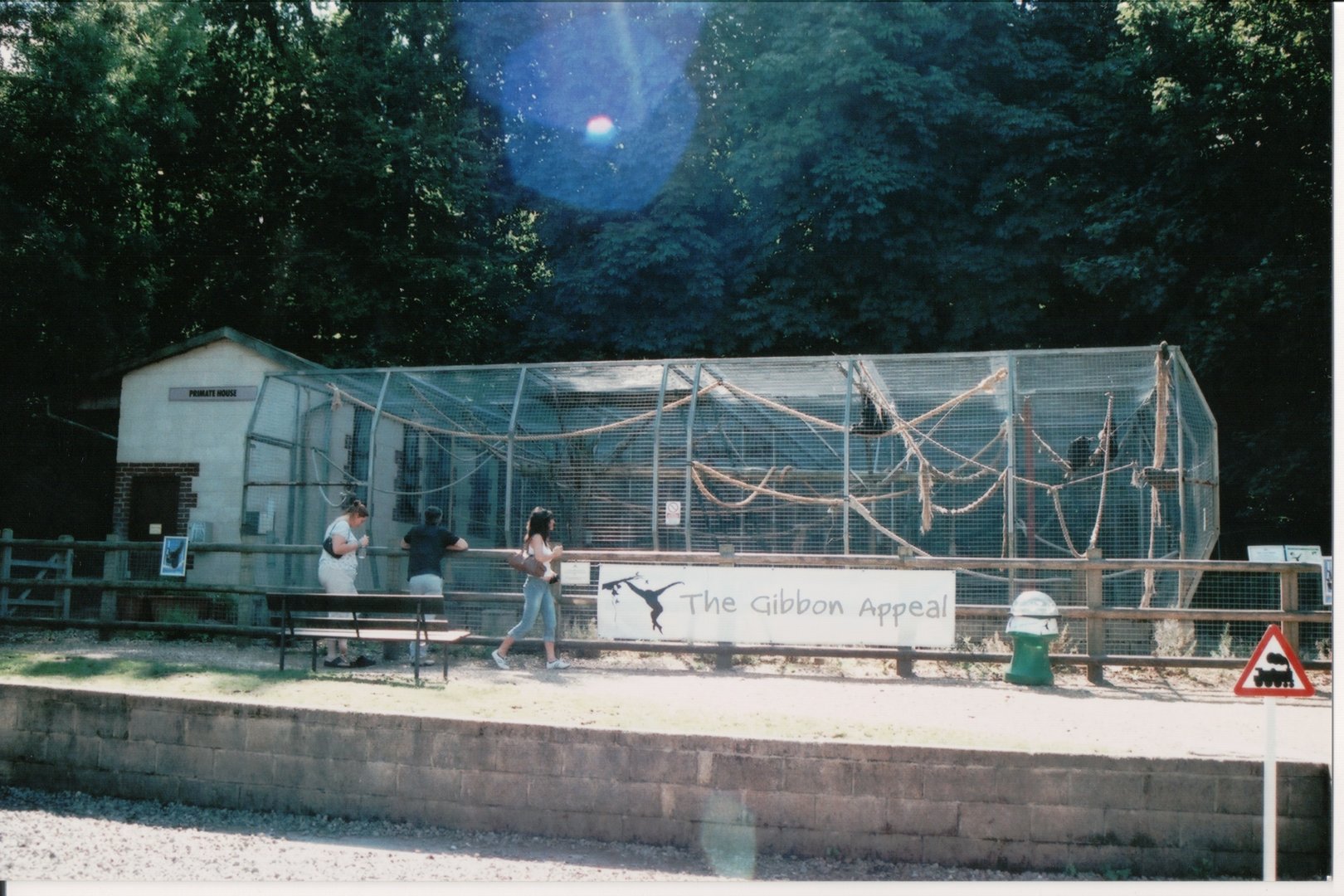
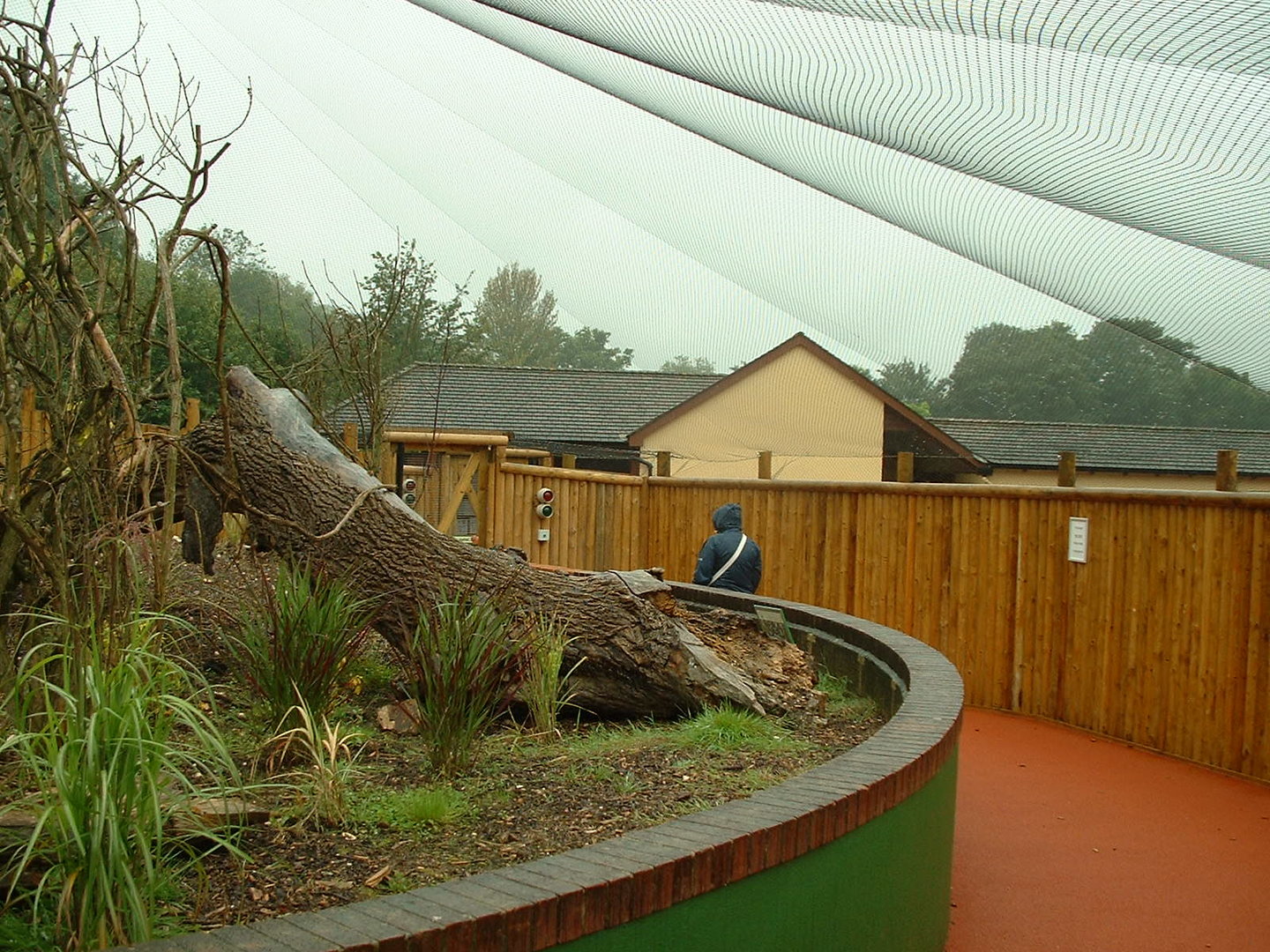
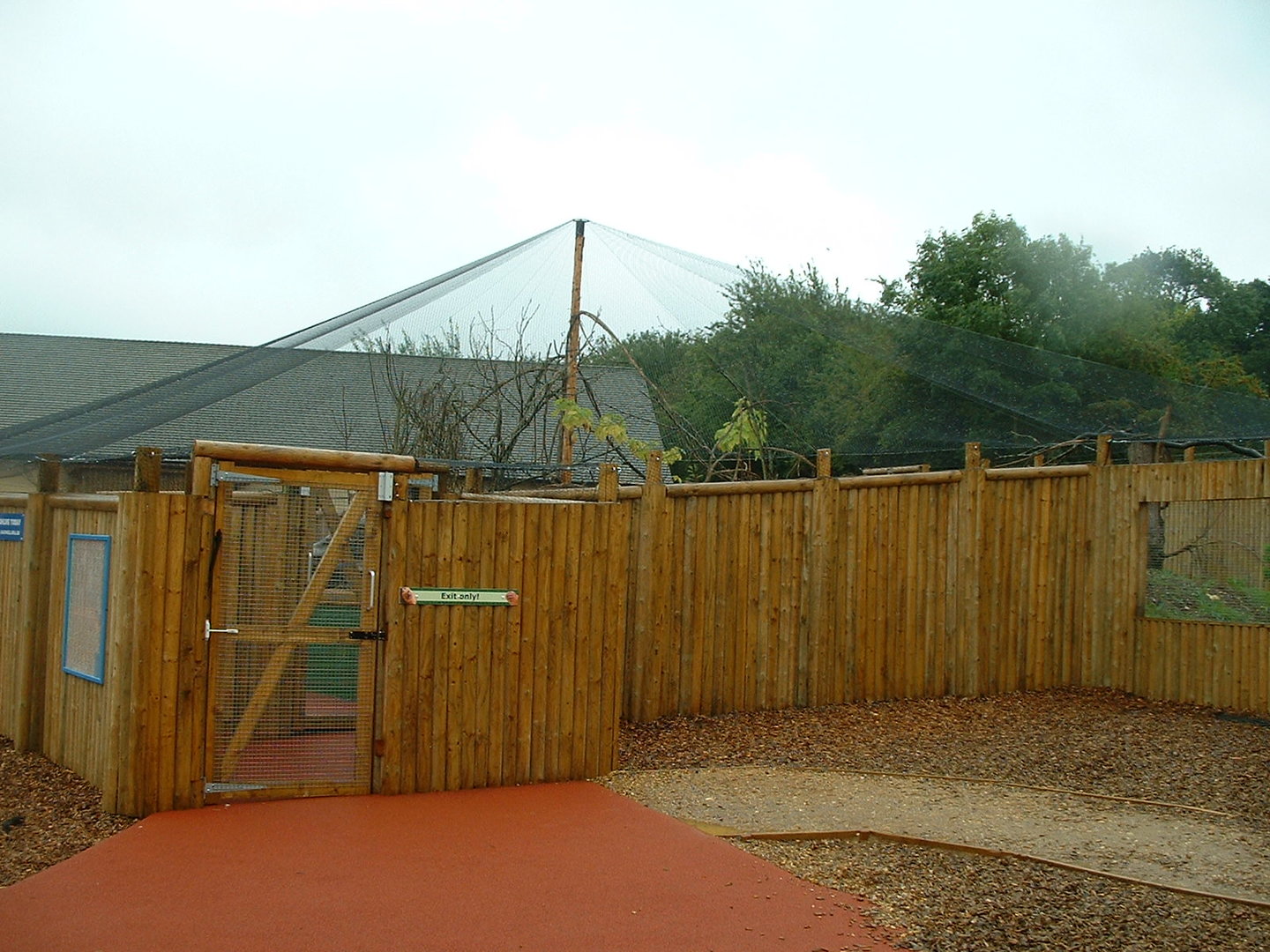
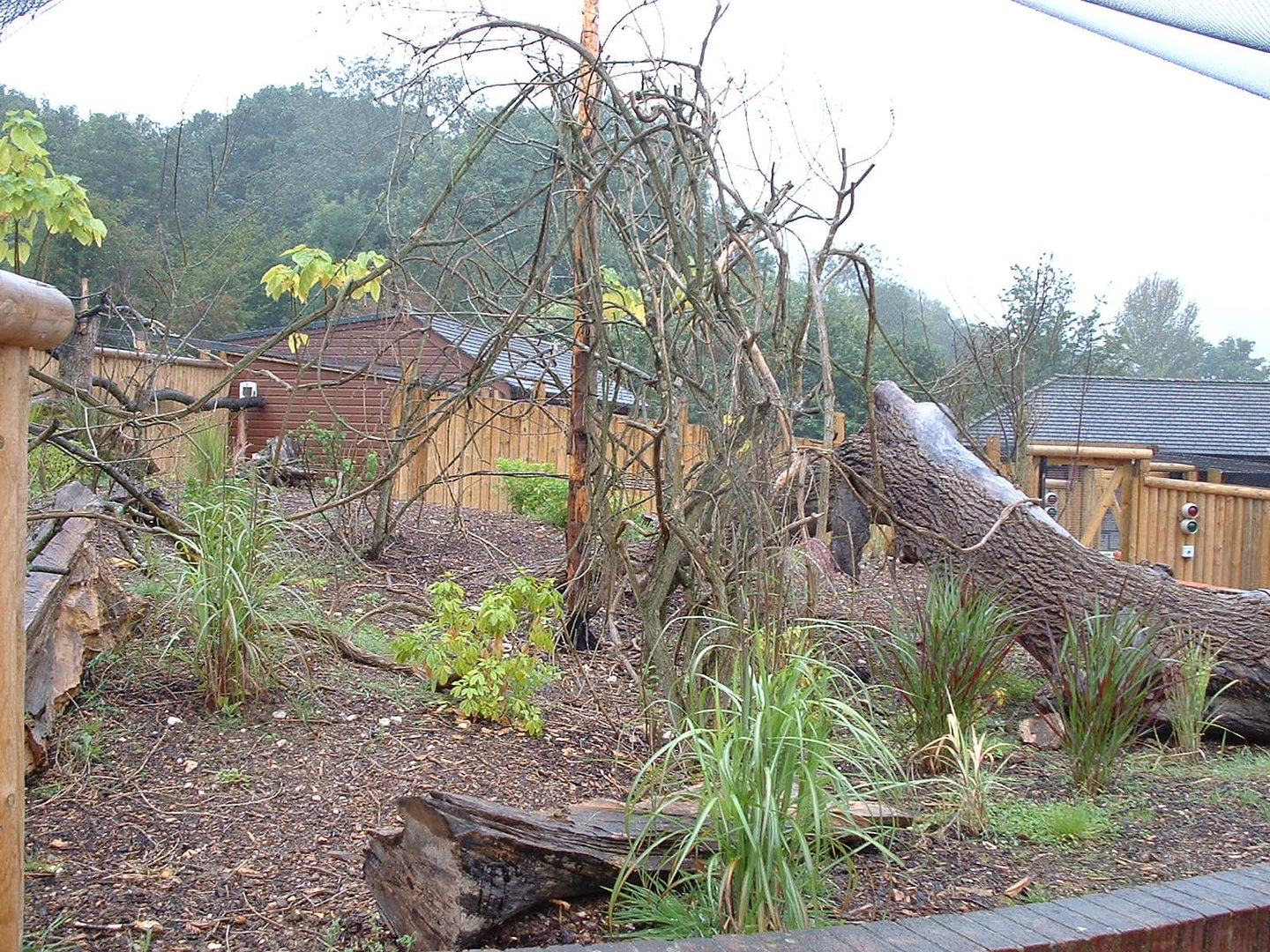
The first enclosure one finds at the Life Among the Trees exhibit is a large enclosure for Siamangs. This enclosure opened in 2007 - in the years up to this enclosure's creation, the siamangs at Marwell had been relegated to a rather smaller metal-fronted cage where climbing opportunities were few in number - an enclosure worthy of photography by, perhaps, one of the people who produces harrowing images of animals behind bars in areas of low animal welfare. And so, the move in 2007 was a definite step up - and the enclosure is, from my personal aesthetic point of view, rather nice to look at, with all of the colourful flowers and attractive 'moat'. Though, as pity would have it, the siamangs are, in my experience anyway, not usually utilising this amount of space, and so may not be visible.
One main critique I recall from years prior was that the enclosure lacked something fairly noteworthy in designing an enclosure for gibbons - that is, branchiation opportunities to a meaningful degree. But, from what I see, some ropes have since been added, so perhaps that has been dealt with. Though, there is still, from my point of view, and others' - still a rather incongruous thing in the enclosure - in the rough centre, there is some attempt at replicating Hollywood's impression of 'an ancient temple with a similarly ancient tree sprouting on top of it', alongside other temple-themed architecture. And so, I feel another need to ramble about another thing I feel is worth rambling about - what I call 'Hollywood Geography' - the kind of geography and architecture found not based in reality, but in aesthetic and consumerism. I am thinking along the lines of - 'Um Bongo, Um Bongo, they drink it in the Congo.' sort of thing - the usage of real places and identities to create a malformed impression of those places and identities. But - does, one may ask, Um Bongo's advertising campaign truly reduce the percived identity of Congo indigenous tribes to a more 'primitive' state of mind? To which I answer, I think it does. I do see the appeal of 'Hollywood Geography' in zoo architecture [Amazon World Zoo Park was, during the 2000s, quite an execution of this trope!] - in that, where the Western World is concerned, the only exposure many people may get of these cultures + identities is through dramatised interpretations of it - the interpretations we see in the movies, video games, commercials - but - a zoo is a place of education, a place to portray animals' zoography in a reasonable and responsible manner - and so, Hollywood Geography, as is perhaps shown here, should be avoided when creating animal exhibits, and the cultural identities, should we talk about them, should be in as accurate a manner as possible. But at least, the rest of the exhibit works well for siamangs. In my opinion, however, the enclosure does feel as if it is building up to something larger somehow - but, it is not really - it is the only instance of its sort of thing. If the siamangs don't show themselves, there are also animals on the other side - concrete islands for Asian Short-Clawed Otter - a species ubiquitous in UK captivity, though I consider it rather cute - and Visayan Warty Pig. In Autumn, the enclosures look particularly attractive with Autumn leaves on the floor - though I can't imagine it is very much so at other times of year. In prior years, the current pig house was a viewing window with tanks for various species of rodent - including some uncommon in the UK today; [i.e. Striped Grass-Mouse] some absent from the UK today; [i.e. Pallid Jird, Reed + Levant Voles etc. ...] and some absent from Europe altogether. [i.e. Edward's Swamp Rat] Today said area offers essentially nothing for the rodent enthusiast - unless said enthusiast enjoys spending time looking at cinderblock, too.
Binturong nearby are held in the enclosure previously used for fossa - though I don't recall paying too much attention to this one. Works well, and is a nice size. And nearby begins a trail of primates with two obvious outliers - the single bokiboky the zoo has [which I still have yet to see; though I have seen the species at London and Berlin - which seem to actually have more of an active effort in cultivating the species], and the cusimanse, held in an enclosure with a good deal of wood and woodchip. And so the procession of primates in nicely-planted and sized enclosures begins - Pygmy Marmoset and Golden-Headed Lion Tamarin in one - Coppery Titi, Midas' Tamarin and Geoldi's Monkey in another [all were obtained in 2022, I believe] - Golden Lion Tamarin and White-Headed Saki in one; Cotton-Top and Emperor Tamarin in one if I recall correctly - and, lastly, the Black-and-White Ruffed Lemurs which, if I have heard reliably, are due to leave in future. [And possibly also Red-Ruffed too; if they truly are still there...] all in all, one that, although unremarkable, works nicely. And so we are done with this exhibit - which is something of a dog's breakfast in places - some parts done well, others not so much.
It has occurred to me that in the previous chapter where I mention Marwell Hall, it is only in brevity - so perhaps, here, I will try to discuss the building in more detail. The Hall was built around 1310, making it today over 700 years old. Some 140[?] metres in perimeter, it was built in the time of the Tudors, its style is typical of manor houses built during the Tudor time period. I think. Maybe before writing this bit of the review I should have consulted a Tudor historian ... anyways, in 1520, around 200 years after its construction, interestingly enough, Henry Seymour - brother of Jane Seymour, was owner of the Hall - and it is believed that Henry VIII himself married Jane at the Hall before doing various other things.
Some other people have since owned the Hall - one notable owner being the interesting character of John Gully - who is known to have, over the course of his life, fought a 64-round boxing match, trained a number of racehorses [though none of those lived on the Marwell estate] and had two wives - and twenty-four children. In 1868, the Standish family owned the estate - and currently are, and will be until the year 2037, ranked as the longest owners of the Marwell estate - owning Marwell for 65 years - until the last Standish - William Standish - died in a car accident in 1902. In 1968, the most eminent owner of Marwell hall arrived - John Knowles, who, amidst some criticism from locals who were not keen of sharing their livelihoods with wild beasts, started his zoological park. And so it was.
The Hall is certainly an impressive building - which, as far as manors built on future zoological land go, has not suffered the worst fate. When the Drayton Manor was sold in 1926, the manor was almost immediately destroyed - and a theme park was erected ... which later had a zoo as a side-attraction. In Marwell's case, the presence of a large old building on premises is not necessarily detrimental to further development, thankfully. More than could be said, seemingly, for London Zoo which has the space for good development in theory ... but much of the land is taken up by skeleton buildings which just cannot be destroyed, because the law won't allow them to.
The Hall has a nice patch of empty garden which children may use to run around in, if nothing in regards to animals. That is to say, some animals are to be found close to the Marwell Hall - in the form of small monkeys and birds - namely, Cotton-top Tamarins [according to the app though I usually don't go around this area ...] and some birds, including but probably not limited to Village Weavers, in an enclosure once for Bearded Reedlings. Both species are held in fairly standard cages. But, Marwell Hall, nice of a building as it is, is not the main reason the title was named as it was ...
The reason in question would be the exhibit 'Life Among the Trees' - where, as the title implies, tree-living animals can be found. In prior years, and up to recent times, the area, or part of it, was titled as the 'World of Lemurs' - imaginatively named for its holding of lemurs. The area was once used as Marwell Hall's kitchen gardens, if I recall correctly. And, at its 'lemur-peak', it held something of a fairly wide, taxonomically speaking, array of lemurs - Ring-Tailed Lemurs, Red-Ruffed Lemurs, Black-Ruffed Lemurs, Aloatra Gentle Lemurs, and, in a darkened enclosure, Lesser Giant Mouse Lemur. [The latter was identified by Marwell Zoo as being the Coquerel's Mouse Lemur - but it is believed that animals held as this species in Europe were actually this newer-coined species, described in 2005.] In addition to these lemurs, the fossa, a predator of lemurs, was also displayed. But alas, this fairly nice array of fairly nice species would be hammered upon with the announcement of Lemur Loop in 2016 - where the lemurs would be destined for the following year. Though, interestingly enough, whilst the Black-and-White Ruffed Lemur was held at Lemur Loop for quite some time, it seems that recently, that species was moved back to the original World of Lemurs, and supposedly the Red-Ruffed Lemur is still there as well, though I have not seen it, though some people insist it is still there. In any case, with the advent of Lemur Loop, the World of Lemurs would be absorbed into the Life Among the Trees exhibit.
The first enclosure one finds at the Life Among the Trees exhibit is a large enclosure for Siamangs. This enclosure opened in 2007 - in the years up to this enclosure's creation, the siamangs at Marwell had been relegated to a rather smaller metal-fronted cage where climbing opportunities were few in number - an enclosure worthy of photography by, perhaps, one of the people who produces harrowing images of animals behind bars in areas of low animal welfare. And so, the move in 2007 was a definite step up - and the enclosure is, from my personal aesthetic point of view, rather nice to look at, with all of the colourful flowers and attractive 'moat'. Though, as pity would have it, the siamangs are, in my experience anyway, not usually utilising this amount of space, and so may not be visible.
One main critique I recall from years prior was that the enclosure lacked something fairly noteworthy in designing an enclosure for gibbons - that is, branchiation opportunities to a meaningful degree. But, from what I see, some ropes have since been added, so perhaps that has been dealt with. Though, there is still, from my point of view, and others' - still a rather incongruous thing in the enclosure - in the rough centre, there is some attempt at replicating Hollywood's impression of 'an ancient temple with a similarly ancient tree sprouting on top of it', alongside other temple-themed architecture. And so, I feel another need to ramble about another thing I feel is worth rambling about - what I call 'Hollywood Geography' - the kind of geography and architecture found not based in reality, but in aesthetic and consumerism. I am thinking along the lines of - 'Um Bongo, Um Bongo, they drink it in the Congo.' sort of thing - the usage of real places and identities to create a malformed impression of those places and identities. But - does, one may ask, Um Bongo's advertising campaign truly reduce the percived identity of Congo indigenous tribes to a more 'primitive' state of mind? To which I answer, I think it does. I do see the appeal of 'Hollywood Geography' in zoo architecture [Amazon World Zoo Park was, during the 2000s, quite an execution of this trope!] - in that, where the Western World is concerned, the only exposure many people may get of these cultures + identities is through dramatised interpretations of it - the interpretations we see in the movies, video games, commercials - but - a zoo is a place of education, a place to portray animals' zoography in a reasonable and responsible manner - and so, Hollywood Geography, as is perhaps shown here, should be avoided when creating animal exhibits, and the cultural identities, should we talk about them, should be in as accurate a manner as possible. But at least, the rest of the exhibit works well for siamangs. In my opinion, however, the enclosure does feel as if it is building up to something larger somehow - but, it is not really - it is the only instance of its sort of thing. If the siamangs don't show themselves, there are also animals on the other side - concrete islands for Asian Short-Clawed Otter - a species ubiquitous in UK captivity, though I consider it rather cute - and Visayan Warty Pig. In Autumn, the enclosures look particularly attractive with Autumn leaves on the floor - though I can't imagine it is very much so at other times of year. In prior years, the current pig house was a viewing window with tanks for various species of rodent - including some uncommon in the UK today; [i.e. Striped Grass-Mouse] some absent from the UK today; [i.e. Pallid Jird, Reed + Levant Voles etc. ...] and some absent from Europe altogether. [i.e. Edward's Swamp Rat] Today said area offers essentially nothing for the rodent enthusiast - unless said enthusiast enjoys spending time looking at cinderblock, too.
Binturong nearby are held in the enclosure previously used for fossa - though I don't recall paying too much attention to this one. Works well, and is a nice size. And nearby begins a trail of primates with two obvious outliers - the single bokiboky the zoo has [which I still have yet to see; though I have seen the species at London and Berlin - which seem to actually have more of an active effort in cultivating the species], and the cusimanse, held in an enclosure with a good deal of wood and woodchip. And so the procession of primates in nicely-planted and sized enclosures begins - Pygmy Marmoset and Golden-Headed Lion Tamarin in one - Coppery Titi, Midas' Tamarin and Geoldi's Monkey in another [all were obtained in 2022, I believe] - Golden Lion Tamarin and White-Headed Saki in one; Cotton-Top and Emperor Tamarin in one if I recall correctly - and, lastly, the Black-and-White Ruffed Lemurs which, if I have heard reliably, are due to leave in future. [And possibly also Red-Ruffed too; if they truly are still there...] all in all, one that, although unremarkable, works nicely. And so we are done with this exhibit - which is something of a dog's breakfast in places - some parts done well, others not so much.