Brookfield Zoo Master Plan Discussion and Speculation

Next Century Plan Summary

Tropical Forests: This will be the first major development as has been known for some time now. It will feature four outdoor primate enclosures abutting the existing Tropic World building: two for gorillas (one for the current family troop and one for a new bachelor troop), one for orangutans and one for neotropical monkeys. The habitats will include mesh tops, glass viewing windows, lush vegetation, vines and running water features. The orangutans and monkeys will still utilize their current indoor areas within Tropic World, but the brand new Gorilla Conservation Center will include new dayrooms for both gorilla troops and a second level with classrooms and learning spaces for the zoo’s Conservation Leadership Academy. The area has been under construction for more than a year and will be completed in Summer 2025.

AD_4nXeNJ0Sozq3Vl7Kfc1xfzaYwyHzpi6-JHfNyA6MvdvYp99p-jVeRhWdwOgZbJBduNZFyWDP8aB_pgRvxMbZWj7JHb1OsnUfT6exWcEpptMtp0L4hcKA9LTCl5Xn4f4MbhLTA9CXBjjHRWIo53_30Hf3N-H0

Western Lowland Gorilla Exhibit - Tropical Forests

Southwest Australian Provinces: A series of new outdoor habitats are being added to the North side of the Australia House, consolidating the zoo’s collection of Oceanian wildlife. An elevated boardwalk trail will primarily overlook a large mixed-species enclosure with kangaroo, wallaby and emu. Tasmanian devils will be added with both outdoor and indoor exhibits, while the koalas will receive two new outdoor exhibits and become a permanent addition. Various aviaries will also be included along the trail for kookaburra, galah, tawny frogmouth, and Raggiana bird-of-paradise. The existing Australia House will be extensively renovated, including new/upgraded exhibits for wombats, echidnas, owls, reptiles and insects.

Pacific Coasts of the Americas: This complex will consist of two new habitats for the zoo’s pinnipeds and penguins that will wrap around the North and East sides of the Discovery Center. The new pinniped exhibit will be called Sea Lion Cove and will be themed around the Galapagos Islands. There will be a covered underwater viewing area and a training/education area where keepers can perform public demonstrations with the animals. Humboldt penguins, inca terns, and gray gulls will be featured in a walkthrough seabird aviary modeled after the Punta San Juan National Reserve Network, a region where the zoo is heavily involved in conservation work.

Gateway to Africa: This will be the single largest project completed as part of the master plan and will see a complete redevelopment of the zoo’s Northwest quadrant. There will be several components of the project representing an array of African biomes.

The first phase of the project is the African Savanna, primarily centered around mixed-species enclosures connected via a lengthy track. Giraffes, zebras, ostriches and several antelope species will rotate through four savanna habitats designed to accommodate different combinations of species at different times. The idea is you’ll never know what you’ll see in each yard on a given day. Cheetahs will be added to the collection in a habitat at the center of the area. The interior of the historic pachyderm house is being fully revamped, now primarily serving as a grandiose savanna viewing gallery lined with glass windows. On the North side of the building guests will look out at two large flex savannas separated by a ha-ha moat, while the south side will be transformed into the East African Forest section featuring habitats for Nile hippo and Nile crocodile, both with underwater viewing.

98166213-a995-4ce3-ab6b-a080c820dfd7-jpg.716245

Pachyderm House Interior View - African Savanna


Nile Hippo and Nile Crocodile Exhibits - East African Forest

The other major component of Gateway to Africa will see the long awaited return of elephants to the zoo. The South African Forest will include multiple acres of forested paddocks for African elephants and black rhinos. Additional species will share the space with the elephants, making it one of the only mixed-species elephant exhibits in the country. These exhibits will also be rotational, separated by overhead bridges and a lengthy savanna passage. Near the savanna will be a large elephant/rhino barn where they can be viewed during the colder months. Satellite enclosures for lions and congo buffalo will be constructed along the trail, as well as modified existing yards for other species. Additionally, the south-most portion of the complex will represent the Central African Forest and feature two new enclosures for pygmy hippos. A habitat for bongo will be added nearby as well as a brand new exhibit for the zoo’s white-bellied pangolins. Ground breaks on Gateway to Africa in 2026.

539b0132-97b2-47a5-a5d2-15377476879a-jpg.716246

African Elephant Exhibit - South African Forest

Our Rivers to the Gulf: Renovations to the Seven Seas Dolphinarium wrapped up earlier this year, which consisted of some welcome aesthetic and quality-of-life improvements. In the future however, the dolphins will receive a far more elaborate upgrade in the form of an entirely new building. The new space will contrast the open waters of the current stadium by showcasing cetaceans in a simulated mangrove environment underneath a glass dome. Free-flight wading birds will also occupy the space and various turtles and fish may cohabitate with the dolphins. There will also be new outdoor spaces for the dolphins. The whole area will be themed to tell the story of Sarasota’s coastal waters and the extensive conservation work the zoo does in the region.

027595bb-033b-44bb-9527-56f24ac1d95f-jpg.716250

Dolphin Mangrove - Our Rivers to the Gulf

Wildlife Discovery: The East side of the zoo will be receiving a number of upgrades aimed at emphasizing interactive exhibits and attractions. After sitting empty for well over a decade, the historic bear grottos will be revitalized as part of an extension of Wild Encounters. The rock facades will be preserved while the exhibit areas will be completely renovated for several Asian carnivore species including sloth bear, sun bear, wolverine and red panda. A new amphitheater will be constructed adjacent to the East Mall. Daily animal ambassador demonstrations will take place here. It will also serve as the zoo's new primary event venue for concerts and other live programming for families, student field trips, community groups and the like. Other entertainment focused attractions will also be added including a zip-line and an arial adventure course.

2df319f1-b49c-4d6d-84f3-21cf0b7f5df0-jpg.716242

Amphitheater w/ Macaws - Wildlife Discovery

Central Asian Steppes & Himalayas: This will be the first of several exhibits that will be built on undeveloped land on the zoo’s furthest west side. The focus will be relocating the tigers, amur leopards and snow leopards to new enclosures that will blend in with the existing forest environment. Visitors will view the habitats underneath viewing trellis and rocky outcroppings. The snow leopard habitat will feature a predator-prey set-up with takin in a mountainous habitat in the background, separated by an invisible mesh barrier. A large new restaurant will be constructed on the Salt Creek Trail which will be complimented by a new guest amenities plaza.

4bd66d06-d699-4a08-a742-f635ca21d80d-jpg.716248

Snow Leopard and Takin Exhibits - Central Asian Steppes & Himalayas

North Entrance: Emphasizing its role as the main entrance of the zoo, the North Entrance will be fully revamped to make for a more attractive and lively first impression. Instead of entering through the tunnel underneath 31st street, a winding pedestrian bridge will now lead guests over the road and into zoo grounds past a natural wetland habitat for local wildlife. The main plaza will be completely replanted and pathways will be repaved to create a formal promenade lined with trees. The original north gate building will be transformed into an indoor/outdoor gift shop with flexible capabilities, featuring visual connectivity to 31st street. The butterflies will be relocated to a new permanent greenhouse building next to the Discovery Center that will open year-round. Other quality of life adjustments will make accessing the zoo easier such as low-profile ticket scanners, parking shuttles, and enhancing the entry point for visitors who did not arrive by car.

c132a3d7-29c1-4573-bbab-49c8b7d6818b-jpg.716249

North Gate Plaza w/ Sea Lion Exhibit in the Distance

Conservation Campus: A number of the historic animal buildings and back-of-house areas around the south side of the zoo will be gradually reconfigured and renovated to focus on upgraded conservation and research centers, as well as exhibits for Illinois native species. Native turtle exhibits have already been completed and later this month the North American Prairie Aviary will be unveiled in the Hamill Family Nature Plaza, exhibiting native midwestern birds like sandhill cranes and prairie-chickens. In addition, an outdoor river otter exhibit will be added to the front of The Swamp building. Several new and upgraded conservation related buildings will be added, some of which will have publicly accessible areas. The veterinary hospital will receive an expansion that will also incorporate a visitor viewing gallery.

1709740083856

North American Prairie Aviary - Conservation Campus

Other: North American Grasslands will be the next new exhibit built on undeveloped land, featuring habitats for grizzly bears, bison, elk, pronghorn and more. Once the grizzlies and bison relocate, Great Bear Wilderness will be refocused to represent a Tundra/Taiga environment. Caribou will take residence in the current bison yard and polar bears will have access to all three existing bear enclosures. The Southwest corner of the zoo will be home to several South American exhibits including South American Pantanal/Atlantic Forest, Amazon Waters, and Andean Lagoons. They will be home to capybara, flamingos, anacondas and various other mammals, birds, herps and fish. The Fragile Kingdom is also slated to undergo renovations in the future. Lastly, while not explicitly mentioned, there are still plans for a Prairie Dog Exhibit and a Eagle Owl Aviary as individual exhibit areas.

Phasing:

Phase 1 (2023-2025): Tropical Forests, Seven Seas Renovation, Nature Plaza Exhibits, Roosevelt Fountain Gardenscape

Phase 2 (2025-2034): Gateway to Africa, Southwest Australian Provinces, Pacific Coasts of the Americas, North Entrance

Phase 3 (2034+): Central Asian Steppes/Himalayas, Our Rivers to the Gulf, Wild Encounters Expansion, Amphitheater, North American Grasslands, Tundra/Taiga, South American Pantanal/Atlantic Forest, Amazon Waters, South American Andean Lagoon

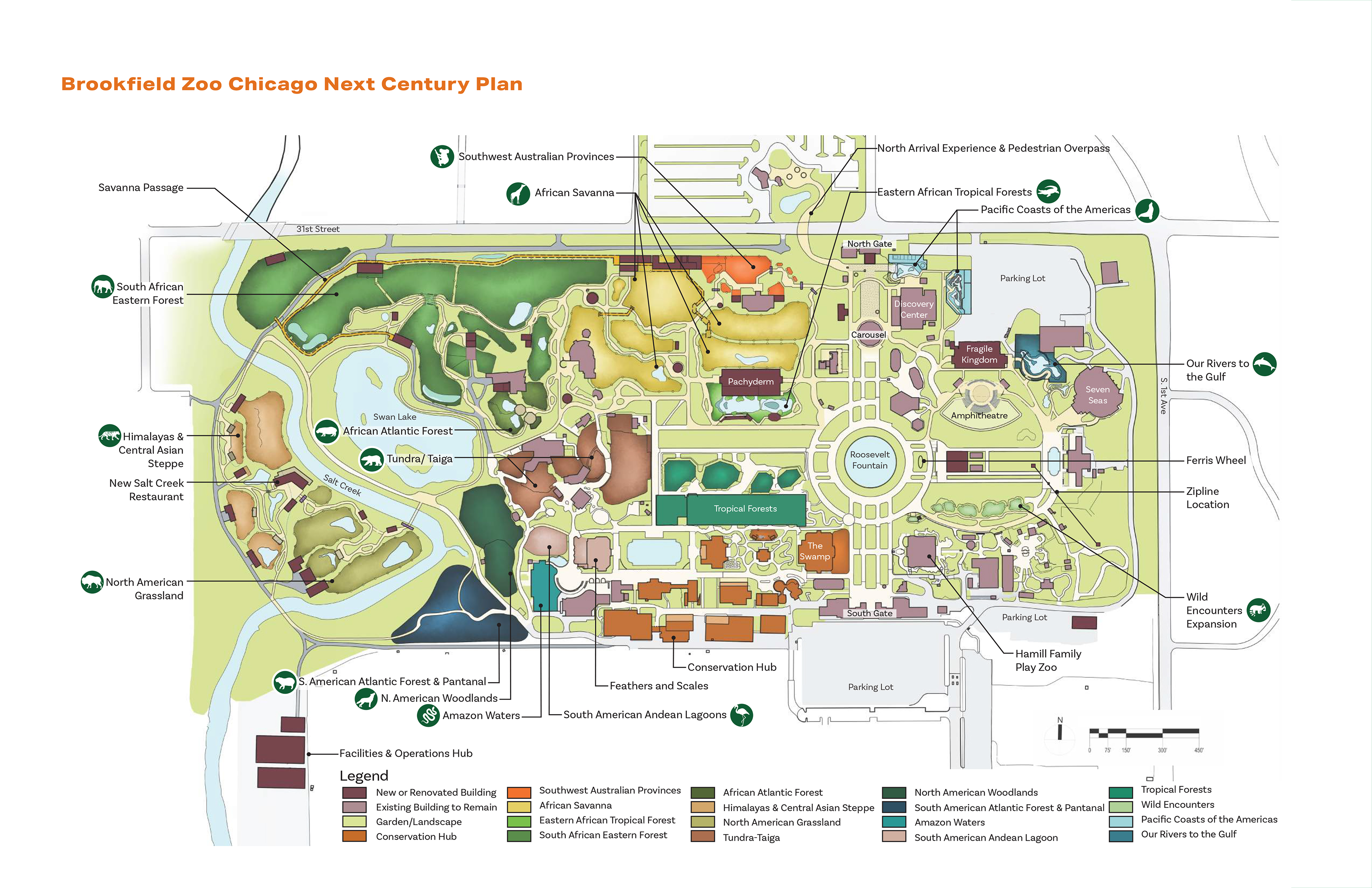
Full Map:
46df2929-59af-4f3f-940c-53ad1f79550a.jpg
 
Last edited:
I'm concerned about a lack of focus and space for Asia. Where for example will the Amur tigers be...Himalayas and Central Asian Steppe or somewhere else like the Tundra/Taiga? But overall the plan is very bold and exciting. I hope we actually see the vast majority of this completed.

The smaller maps on page 31 have the site plan for Himalayas & Asia Steppe and North American Prairie expansion. You can find the Amur tiger there.
https://www.brookfieldzoo.org/custom.czs/files/81/81f42ebd-4781-40e2-a77d-65738a8ad9a2.pdf
 
What is set to be finished first?
Gateway to Africa will break ground in 2026 and will presumably be the next project following Tropical Forests next year. Southwest Australian Provinces, Pacific Coasts of the Americas and the revamped North Entrance are also slated to be completed earlier on.
 
Tropical Forests: This will be the first major development as has been known for some time now. It will feature four outdoor primate enclosures abutting the existing Tropic World building: two for gorillas (one for the current family troop and one for a new bachelor troop), one for orangutans and one for neotropical monkeys. The habitats will include mesh tops, glass viewing windows, lush vegetation, vines and running water features. The orangutans and monkeys will still utilize their current indoor areas within Tropic World, but the brand new Gorilla Conservation Center will include new dayrooms for both gorilla troops and a second level with classrooms and learning spaces for the zoo’s Conservation Leadership Academy. The area has been under construction for more than a year and will be completed in Summer 2025.

I'm most curious at this point as to what will happen to the existing gorilla exhibit. I know more African monkeys was the stated plan, however I'm curious as to what monkeys those will be. Larger troops of the Schmidt's red-tailed monkey and Angolan colobus? The return of Allen's swamp monkey, mandrills, or mangabeys? Something completely new? Just something I'm interested to see what becomes of.

Pacific Coasts of the Americas: This complex will consist of two new habitats for the zoo’s pinnipeds and penguins that will wrap around the North and East sides of the Discovery Center. The new pinniped exhibit will be called Sea Lion Cove and will be themed around the Galapagos Islands. There will be a covered underwater viewing area and a training/education area where keepers can perform public demonstrations with the animals. Humboldt penguins, inca terns, and gray gulls will be featured in a walkthrough seabird aviary modeled after the Punta San Juan National Reserve Network, a region where the zoo is heavily involved in conservation work.
At first glance, this was one of the projects that I wasn't very excited about. However, at a closer glance that walk-through aviary seems exciting. I'm hopeful the zoo takes inspiration from Bronx Zoo's Sea Bird Aviary, as that is one of the most impressive bird exhibits I've ever seen.

The first phase of the project is the African Savanna, primarily centered around mixed-species enclosures connected via a lengthy track. Giraffes, zebras, ostriches and several antelope species will rotate through four savanna habitats designed to accommodate different combinations of species at different times. The idea is you’ll never know what you’ll see in each yard on a given day. Cheetahs will be added to the collection in a habitat at the center of the area. The interior of the historic pachyderm house is being fully revamped, now primarily serving as a grandiose savanna viewing gallery lined with glass windows. On the North side of the building guests will look out at two large flex savannas separated by a ha-ha moat, while the south side will be transformed into the East African Forest section featuring habitats for Nile hippo and Nile crocodile, both with underwater viewing.

I'd be curious to hear @Kudu21's thought on this proposed rotational exhibit. I know in the past he's talked about the challenges of shifting ungulates, and I know a lot of prey animals tend to be extremely neophobic, so I wonder how feasible this rotational plan will be in the long-term. It's certainly an intriguing concept,

The hippo exhibit is the one planned exhibit I have concerns about. Most of this masterplan looks awesome, however the concept art showing underwater viewing of a small pool with three hippos, and seemingly not much land area available, makes me seem like this will be yet another major zoo design a new hippo exhibit that falls short. Hopefully the hippos will be integrated into the planned rotational habitats, as if so then it could be one of the top three hippo exhibits in the country by giving them access to an incredible amount of land area.

The other major component of Gateway to Africa will see the long awaited return of elephants to the zoo. The South African Forest will include multiple acres of forested paddocks for African elephants and black rhinos. Additional species will share the space with the elephants, making it one of the only mixed-species elephant exhibits in the country. These exhibits will also be rotational, separated by overhead bridges and a lengthy savanna passage. Near the savanna will be a large elephant/rhino barn where they can be viewed during the colder months. Satellite enclosures for lions and congo buffalo will be constructed along the trail, as well as modified existing yards for other species. Additionally, the south-most portion of the complex will represent the Central African Forest and feature two new enclosures for pygmy hippos. A habitat for bongo will be added nearby as well as a brand new exhibit for the zoo’s white-bellied pangolins. Ground breaks on Gateway to Africa in 2026.

Glad to see the zoo dedicated to the white-bellied tree pangolins! Hopefully this new exhibit means multiple pangolins will be on exhibit at any given time, but either way a species I am glad to see the zoo go all-in on.

Congo buffalo is a species that stands out in this plan too- as it is a species I'm unaware of any US zoos with. How does Brookfield plan to acquire this species, and what is the compelling reasons to prioritize Congo buffalo over any of the AZA-managed ungulate programs?

Wildlife Discovery: The East side of the zoo will be receiving a number of upgrades aimed at emphasizing interactive exhibits and attractions. After sitting empty for well over a decade, the historic bear grottos will be revitalized as part of an extension of Wild Encounters. The rock facades will be preserved while the exhibit areas will be completely renovated for several Asian carnivore species including sloth bear, sun bear, wolverine and red panda. A new amphitheater will be constructed adjacent to the East Mall. Daily animal ambassador demonstrations will take place here. It will also serve as the zoo's new primary event venue for concerts and other live programming for families, student field trips, community groups and the like. Other entertainment focused attractions will also be added including a zip-line and an arial adventure course.

Similar to the Congo buffalo, sun bears are the other species that stands out to me here. Given that sun bears are on their way out of US zoos, I'm curious as to how Brookfield Zoo plans to acquire this species. Furthermore, given that this isn't in a zoogeographic complex, I wonder what the compelling reasons to go with sun bears are. Given the limited space available for exotic bears in US zoos, I'd rather see Brookfield Zoo opt for Andean bears or multiple sloth bear exhibits over doubling down on the phase-out species of sun bears.

Central Asian Steppes & Himalayas: This will be the first of several exhibits that will be built on undeveloped land on the zoo’s furthest west side. The focus will be relocating the tigers, amur leopards and snow leopards to new enclosures that will blend in with the existing forest environment. Visitors will view the habitats underneath viewing trellis and rocky outcroppings. The snow leopard habitat will feature a predator-prey set-up with takin in a mountainous habitat in the background, separated by an invisible mesh barrier. A large new restaurant will be constructed on the Salt Creek Trail which will be complimented by a new guest amenities plaza.

The concept art of the snow leopard/takin exhibit looks incredible! This exhibit has strong potential, in my opinion, to be one of the best snow leopard exhibits in the country, rivaling those at a quartet of northeast zoos (Bronx, Central Park, Stone, and Roger Williams).
 
Congo buffalo is a species that stands out in this plan too- as it is a species I'm unaware of any US zoos with. How does Brookfield plan to acquire this species, and what is the compelling reasons to prioritize Congo buffalo over any of the AZA-managed ungulate programs?
There are no Congo buffalo in the US currently. Brookfield was one of the last holders of the species in the country and has a bit of a history with them which is probably what's encouraged the zoo to include them here. They would have to import from either Europe or Africa, which could be tricky given regulations on bovid imports, but very possible. The fact that they are even considering bringing the species back is incredible and I will be delighted if it goes through.
Similar to the Congo buffalo, sun bears are the other species that stands out to me here. Given that sun bears are on their way out of US zoos, I'm curious as to how Brookfield Zoo plans to acquire this species. Furthermore, given that this isn't in a zoogeographic complex, I wonder what the compelling reasons to go with sun bears are. Given the limited space available for exotic bears in US zoos, I'd rather see Brookfield Zoo opt for Andean bears or multiple sloth bear exhibits over doubling down on the phase-out species of sun bears.
Now this one I'm much more skeptical about. Love this species, but no idea how the zoo will intend to go about acquiring them when they're actively being phased-out of the AZA with only geriatric animals remaining. Keep in mind that this exhibit is at least another decade away and they could've just been included as a wishlist species. In all likelihood the space will go towards additional sloth bears.
 
The ambitions for red forest buffalo and sun bear makes me hope that, even if the attempt to have those two won’t come to fruition, Brookfield might be into getting smaller mammals like springhare, mustelids, and phalangeriformes (that aren’t sugar glider and common brushtail possum).

The hippo exhibit is the one planned exhibit I have concerns about. Most of this masterplan looks awesome, however the concept art showing underwater viewing of a small pool with three hippos, and seemingly not much land area available, makes me seem like this will be yet another major zoo design a new hippo exhibit that falls short. Hopefully the hippos will be integrated into the planned rotational habitats, as if so then it could be one of the top three hippo exhibits in the country by giving them access to an incredible amount of land area.
Call me crazy but for me, I could see the crocodiles getting scrapped for hippopotamuses.
 
Call me crazy but for me, I could see the crocodiles getting scrapped for hippopotamuses.
See, on the other hand, I question the zoo's need for nile hippos all together and would rather see the space dedicated for crocodiles. Brookfield's new master plan is heavy on the charismatic megafauna: calling for African elephants, giraffes, black rhinos, nile and pygmy hippos, okapi, gorillas and orangutans, at least three bear species, most of the big cats, etc. Surely the zoo could be fine with one less of these megafauna species, and hippos seem like an obvious choice for a species that could be cut.
 
The hippo exhibit is the one planned exhibit I have concerns about. Most of this masterplan looks awesome, however the concept art showing underwater viewing of a small pool with three hippos, and seemingly not much land area available, makes me seem like this will be yet another major zoo design a new hippo exhibit that falls short. Hopefully the hippos will be integrated into the planned rotational habitats, as if so then it could be one of the top three hippo exhibits in the country by giving them access to an incredible amount of land area.

Let's keep in mind these are renderings and maps for donors, board members, etc. and not exhibit blueprints to scale. The hippo exhibit rendering specifically shows the hippo and giraffe exhibits with a natural barrier, but the overhead map shows the path into the renovated Pachyderm House between them.
 
What a magnificent master plan! I cannot believe the cost. $500 million is what Shedd is spending for their renovation and education plan. How can this plan cost below a billion dollars? The mangrove dolphin tank is a wonderful surprise! Forest Buffalos?! I remember them at Brookfield from 15 years ago. A wonderful and surprising return!
 
That dolphin mangrove building seems really unique. I'm the farthest thing from an expert, but I've never heard of another zoo exhibit putting dolphins in that kind of naturalistic setting with birds, turtles, and fish. If it works out as planned, that sounds like a reason to visit Brookfield on its own!
 
After looking at the plan again, I'm starting to become curious as to what us happening to certain animals, mainly species like Klipspringer, African Painted Dog, most of the Saltwater fish, and Bactrian Camels
 
I'd be curious to hear @Kudu21's thought on this proposed rotational exhibit. I know in the past he's talked about the challenges of shifting ungulates, and I know a lot of prey animals tend to be extremely neophobic, so I wonder how feasible this rotational plan will be in the long-term. It's certainly an intriguing concept
Ask and you shall receive :p I would not expect it to be a feasible concept in the long-term. The logistics of shifting multiple herds of ungulates between different exhibits and off-show holding on a regular basis is something that is going to be near impossible without the expectation of semi-regular casualties. It is not uncommon for shifting even just between exhibit and holding to prove injurious or even deadly for ungulates, so I would not expect shifting them between multiple exhibits to prove any less so... I do not hate the idea of having multiple exhibits for ungulate herds for pasture regeneration, but moving ungulates always poses a risk, so moving them regularly for exhibition purposes does not seem worth the risk to the animals to me... The more you move ungulates, the more likely they are to hurt themselves. It does not even really matter how familiar they are with a space -- all it takes is one little thing to spook them (often times it is something that you are not ever able to ascertain yourself) or for them to lose visual of their herdmates, and they panic. Once they panic, they no longer really have control of their senses, and this when you'll see blind running (running without perception of obstacles in their path) and jumping at walls and fencing. Add in all the theming elements that will likely be present... I think it's likely a recipe for disaster.


Congo buffalo is a species that stands out in this plan too- as it is a species I'm unaware of any US zoos with. How does Brookfield plan to acquire this species, and what is the compelling reasons to prioritize Congo buffalo over any of the AZA-managed ungulate programs?
There are still some forest buffalo knocking around in private hands, specifically in Florida, but not very many. As much as I love forest buffalo, I think that if Brookfield is committed to having buffalo (and I think they should be!), I would implore them to chose Cape buffalo instead. There is already an active Cape buffalo consortium, the facilities housing them are actively breeding (B Bryan, Denver, SDZSP, White Oak), and there is interest within the AZA Sustainability Partner private sector, so additional holders coming on in the near future would really help secure the future of the program and these animals in the United States. They are very impressive animals and recognizable to the general public, and there are a lot of stories you can tell with them about the African savannas, about prey species that are able to fight back against predators, about dynamic social structures and familial relationships in unexpected taxa (Cape buffalo are matriarchal and the care that they show for their offspring and fellow herdmates into adulthood is incredible). They are very intelligent and not as difficult to work with as I think people might imagine.
 
Ask and you shall receive :p I would not expect it to be a feasible concept in the long-term. The logistics of shifting multiple herds of ungulates between different exhibits and off-show holding on a regular basis is something that is going to be near impossible without the expectation of semi-regular casualties. It is not uncommon for shifting even just between exhibit and holding to prove injurious or even deadly for ungulates, so I would not expect shifting them between multiple exhibits to prove any less so... I do not hate the idea of having multiple exhibits for ungulate herds for pasture regeneration, but moving ungulates always poses a risk, so moving them regularly for exhibition purposes does not seem worth the risk to the animals to me... The more you move ungulates, the more likely they are to hurt themselves. It does not even really matter how familiar they are with a space -- all it takes is one little thing to spook them (often times it is something that you are not ever able to ascertain yourself) or for them to lose visual of their herdmates, and they panic. Once they panic, they no longer really have control of their senses, and this when you'll see blind running (running without perception of obstacles in their path) and jumping at walls and fencing. Add in all the theming elements that will likely be present... I think it's likely a recipe for disaster.
Are there any factors that you are aware of that'd make a shifting situation like the one Brookfield proposes more or less successful? For example, are certain species typically better at shifting than other species? Could the size of the herd play a factor? Males versus females? I'd hate to see a zoo invest in a rotational system that is doomed as unusable from the start, but on the same hand it is an interesting concept from an exhibitry and educational perspective so I'm hopeful they'll find a welfare-conscious way for the system to work.
 
Are there any factors that you are aware of that'd make a shifting situation like the one Brookfield proposes more or less successful? For example, are certain species typically better at shifting than other species? Could the size of the herd play a factor? Males versus females? I'd hate to see a zoo invest in a rotational system that is doomed as unusable from the start, but on the same hand it is an interesting concept from an exhibitry and educational perspective so I'm hopeful they'll find a welfare-conscious way for the system to work.
To a certain extent, the risks are going to be unavoidable. The design aspects that would decrease the risks the most, are going to also make the final project a lot less visually pleasing and interesting. Ideally, you would want very wide, very open passageways with solid walls that gently funnel inward towards the opening between the exhibits, so that the passageways are very easily seen by the animals, so that the animals can see as much of where they are going as possible, and so that the animals can easily maintain visuals with their herdmates. The gentle funnel would prevent them from pacing the wall or hitting the fence. You would not want there to be any obstacles or visual barriers on either side, and you would want the terrain to be as flat as possible. The perimeter of the exhibit would need to be solid, so that they are easily perceived by the animals so they do not run into them. The exhibits would ideally directly conjoin with each other, with no alleyways or tunnels between them, as these would greatly increase the likelihood of injury.

As far as species go, your larger, open land ungulates are usually going to be calmer -- giraffe, zebra, eland, wildebeest, addax, etc. are probably the safest choices, but I have still seen all of the above kill or seriously injure themselves in contained spaces or during shifting. Males are also usually calmer than females in most ungulate species, and usually less valuable too, so bachelor herds of the above would be the least injurious choices for their respective programs and the animals themselves.
 
The smaller maps on page 31 have the site plan for Himalayas & Asia Steppe and North American Prairie expansion. You can find the Amur tiger there.
https://www.brookfieldzoo.org/custom.czs/files/81/81f42ebd-4781-40e2-a77d-65738a8ad9a2.pdf
Thank you! That eases my concern a bit to see the dedicated areas for Amur tigers and leopards. I still think the space given to Asia is too small at 3.6 acres not counting some additional areas like the Asia area at Tropical Forests, Clouded Leopards Forest, and the Asian species that will be in the old bear grottos compared to over 25 acres given to Africa. Asia is the largest continent after all. South America gets over 5.2 acres, North America over 16.4 ac, and even Australia gets 3.5 ac.
 
  • Like
Reactions: JVM
Back
Top