Masterplan of my Zoo - Zoológico e jardins do World Conservation Center

Bactrian Deer

Well-Known Member
Hello, and welcome to my presentation for one of my many, many fantasy zoos, although I am only allowing myself to do this singular one after much contemplation.

Zoológico e jardins do World Conservation Center (World Conservation Center Zoo and Gardens)
full
full

This zoo, based in the city of Viana do Castelo, Portugal (which is why most buildings will have a Portuguese-English translation) is a historic zoo founded in the 1920s and since has been a world leader in conservation and husbandry.


The zoo, split into 17 separate sections, is a founding member of the WCSZI (World Conservation Society of Zoological Institutes) (An organization that I made up in which all my fantasy zoos are a part of). The sections include


Africa (50 habitats, 1 building)

North America (12 habitats, 1 building)

Iberia (7 habitats)

South America (31 habitats, 3 buildings)

Mongolia (9 habitats, 1 building)

Australia (23 habitats, 1 building)

Asia (42 habitat, 1 building)

Madagascar (12 habitats, 1 building)

Galapagos (5 habitats)

Indiana (5 habitats, 1 building)

Gardens (2 habitats, 1 building) (Only going to give species list for fauna)

Aquarium (7 habitats, 1 building)

Amphibian-Nocturnal House (2 habitats, 1 building)

Reptile Plaza (3 habitats, 2 buildings)

Petting Zoo (5 habitats, 1 building)

Bats! (3 habitats 1 building)

Native Waterways (1 habitat, 1 building)


Animals with breeding programs in the zoo will be italicized.


DISCLAIMER: This zoo will follow Grove’s and Grubb’s system for family Bovidae and family Bovidae only, this is because I have Castelo’s book and it is much easier to look at the book.
 
The 1st 4 sections I will be going over are Indiana, Gardens, Galapagos, and Madagascar. Today will be the Madagascan section known as, “Madagascan Bush.”
full
full


Madagascar (Madagascan Bush):
Madagascar is a historic part of the zoo as the building dates to the 50s.

This part of the zoo’s flora includes a single Baobab tree (by the entrance to the area) with the sign hanging from it. Flora by the paths include many Madagascan dry forest species including; Delonix regia, Fabaceae species, Rubiaceae species, and finally, Eulophiinae species.


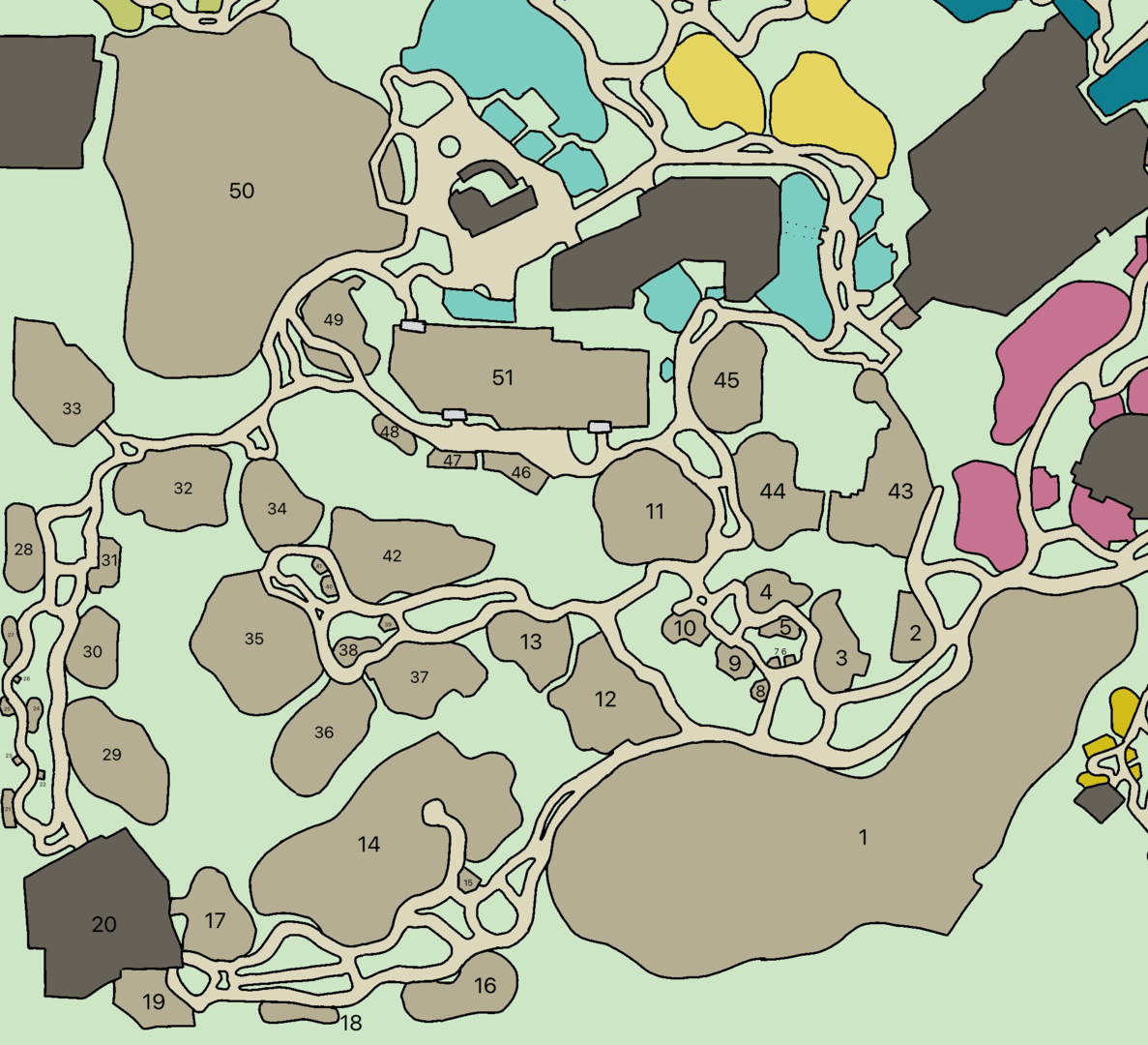
1 - This building known as, “Prédio Histórico Lêmur,” or, “Historic Lemur Building,” was a building made in the 50s that housed 10 species of lemur. Now it is a center for teaching of conservation about Madagascar, most of these buildings are filled with trees (as some species are folivores) and climbing structures. Outdoor habitats -2, 3, 4, 5, and 6- are all outdoor habitats for inside habitats - 1, 4, 6, 7, 8- . In the indoor habitats, habitat 1 is home to 2.3 Golden Bamboo Lemurs (Hapalemur aureus) and 1.2 Lac Alaotra Bamboo Lemurs (Hapalemur alaotrensis). The zoo has breeding programs for these species as 1.1 of the Golden Bamboo Lemurs are juveniles and the same for 0.1 of the Lac Alaotra Lemurs. Habitat 2 is home to 1.1 Aye-Aye (Daubentonia madagascariensis), 1.1 Votsovotsa (Hypogeomys antimena), and a 0.1 Madagascar Rail (Rallus madagascariensis). Habitat 3 is home to 1.0 Malagasy Ground Boa (Acrantophis madagascariensis) and habitat 4 holds 1.1 Boettger’s Girdled Lizard (Zonosaurus boettgeri). Habitat 5 holds 2.2 Madame Berthe’s Mouse Lemur (Microcebus berthae) and habitat 6 holds 1.1 Fat-Tailed Dwarf Lemur (Cheirogaleus medius). Lastly, habitat 7 and 8 holds 1.1 Silky Sifaka (Propithecus candidus) and 1.2 Red-Bellied Lemur (Eulemur rubriventer).

2 - Outdoor habitat for Fat-Tailed Dwarf Lemur

3 - Outdoor habitat for Boettger’s Girdled Lizard

4 - Outdoor habitat for Golden Bamboo Lemur, Lac Alaotra Bamboo Lemur

5 - Outdoor habitat for Golden Bamboo Lemur, Lac Alaotra Bamboo Lemur

6 - Outdoor habitat for Silky Sifaka or Red-Bellied Lemur

7 - Outdoor pen for the zoo’s 1.2 Radiated Tortoise (Astrochelys radiata). This species is being bred in the zoo for the release of the species into the wild. The pen is also able to have a keeper talk which will talk to guests about the tortoise of Madagascar and rather not this specific species.

8 - A notable species for the zoo as it is featured on the zoo logo (in progress) this aviary is home to 0.2 Seychelles Black Parrot (Coracopsis barklyi). This habitat is based on a single tree and a moat around this tree. The parrots are named Velma and Susanna and can often be seen being walked around the zoo as ambassador animals, while this is happening, the aviary is used as a bird show checkpoint for the zoo’s bird show, which species I am not saying until the end of the zoo presentation.

9 - A rather simple terrarium that holds 1.1 Malagasy Giant Chameleons (Furcifer oustaleti).

10 - A netted aviary that contains 1.1 Madagascar Fish Eagles (Haliaeetus vociferoides). This aviary has been long standing as an original habitat that once housed a female orangutan caught near Medan, over the years it has housed many fish eagles and dwarf crocodiles.

11 - The Madagascan Aviary. The aviary is based on a River like system in the front that was a clear beach for the nesting birds. Behind it, a jungle of native trees arises for the tropical birds. Right in front of the view and the lake is a dry bush area for said species, this aviary has lots of breeding for many endangered species. The following in the aviary:

1.1 Eastern Vasa Parrot (Coracopsis Vasa Vasa)
0.3 Grey-Headed Lovebird (Agapornis canus)
1.1 Madagascar Green Pigeon (Treron australis)
1.1 Madagascar Blue Pigeon (Alectroenas madagascariensis)
2.2 Madagascan Pochard (Aythya innotata)
1.1 Berneir’s Teal (Anas bernieri)
1.1 Meller’s Duck (Anas melleri)
0.1 Yellow-Billed Stork (Mycteria ibis)
1.1 Madagascan Snipe (Gallinago macrodactyla)
0.4 Madagascar Buttonquail (Turnix nigricollis)
0.1 Madagascar Partridge (Margaroperdix madagarensis)
1.0 Red-Fronted Coua (Coua reynaudii)
2.0 Blue Coua (Coua caerulea)
1.1 Humblot’s Heron (Ardea humbloti)
3.3 Malagasy Sacred Ibis (Threskiornis bernieri)
1.0 Slender-Billed Flufftail (Sarothrura watersi)
1.1 Madagascar Rail (Rallus madagascariensis)
0.1 Madagascar Wood Rail (Mentocrex kioloides)
1.2 Long-Tailed Ground Roller (Uratelornis chimaera)
1.1 Scaly Ground Roller (Geobiastes squamiger)
0.1 Malagasy Kingfisher (Corythornis vintsioides)
1.1 Madagascar Grebe (Tachybaptus pelzelnii)
1.1 Brown Mesite (Mesitornis unicolor)
1.1 Cuckoo-Roller (Leptosomus discolor)
1.1 Van Dam’s Vanga (Xenopirostris damii)
1.1 Yellow-Bellied Sunbird-Asity (Neodrepanis hypoxantha)
0.5 Schlegel’s Asity (Philepitta schlegeli)
0.3 Common Jery (Neomixis tenella)
1.0 Forest Fody (Foudia omissa)
0.1 Madagascan Cuckooshrike (Ceblepyris cinereus)
1.1 Malagasy Paradise Flycatcher (Terpsiphone mutata)

12 - As you enter the zoo, the first animal, other than native wild birds, you will notice is the Fossa, this habitat, slightly larger than habitat 13 is home to 1.0 Fossa (Cryptoprocta ferox). The zoo has a breeding program for this species now that the Grandider’s Mongoose has left the zoo for Blue Rock Biopark (Another zoo I made).

13 - Smaller habitat for 0.1 Fossa (Cryptoprocta ferox)

Next stop… Galapagos!

Total Species Count:
Mammal: 9 (19.6%)
Birds: 33 (71.7%)
Reptiles: 4 (8.7%)
Amphibian: 0
Primitive Fish: 0
Cartilaginous Fish: 0
Bony Fish: 0
Invertebrates: 0
Total Animals: 46 (100.0%)
 
Why do you have such strange numbers of animals? I understand having a pair or a group, but why are so many of your species either singular or of only one sex? Why have five female asities or three female jerys and no males, for example? Why have only one Yellow-billed Stork or only one Forest Fody?
 
I wouldn't keep most chamaeolons together as pairs for a longer period of time. It usually stresses out the female after a while.

I will change it to 0.1

Why do you have such strange numbers of animals? I understand having a pair or a group, but why are so many of your species either singular or of only one sex? Why have five female asities or three female jerys and no males, for example? Why have only one Yellow-billed Stork or only one Forest Fody?

I meant to have only one Yellow-Billed Stork. The point of this section is focusing more on endangered species, so some groups could be targeted as phase outs. Also, once I have finished with all the sections, a list will be made of species behind the scenes, some of which will breed and reproduce but won’t be on habitat.
 
Galapagos:
This section, known as Land of the Great Testudines, is more of an educational experience as it tells about the diversity of the Galapagos Giant Tortoises.

This zoo section’s flora includes: Cactus, Yellow Cordia and Passionflower.

14 - The Galapagos Aviary. Based around a small pond made to mimic the sea, as well as dry bush in the region, the aviary contains 1.0 Woodpecker Finch (Camarhynchus pallidus), 1.0 Galapagos Mockingbird (Mimus parvulus), 0.2 Galapagos Doves (Zenaida galapagoensis), 1.1 Lava Herons (Butorides sundevalli), and 1.2 Genovesa Cactus Finches (Geospiza propinqua).

15 - This paddock is based on a shoreline and is home to 1.5 Humboldt Penguins (Spheniscus humboldti), 1.1 Lava Gulls (Leucophaeus fuliginosus), and 0.1 Marine Iguana (Amblyrhynchus cristatus). The zoo's Penguin colony has grown from 1.2 to 1.5 with many transactions, sadly, the male has been castrated and the Penguin is hoping to be replaced with another breeding male.The marine iguana was a rescue and is possibly going back to a rescue center in the Galapagos in the future. The zoo does not want to breed them.

16 - Home to one of the 2 Galapagos Giant Tortoise paddocks, which tell about the diversity of the tortoise species in the Galapagos. This one is home to 1.2 Chatham Island Tortoises (Chelonoidis niger chathamensis), and 1.1 Galapagos Land Iguana (Conolophus subcristatus).

17 - Home to the second tortoise paddock, this habitat holds 0.2 Iguana Cove Tortoises (Chelonoidis niger vicina). The zoo is hoping to get a male to breed in the near future

18 - A recently created habitat, rather simple one to add, holds the zoos only 0.1 Short-Eared Owl (Asio flammeus galapagoensis). The habitat was built on a former waterfowl stream with pond sliders.

To the left of habitat 17, a simple statue garden stands with a center figure of Charles Darwin with finches crowding on his shoulders while standing on a rock, by the rock is a sign teaching about Charles Darwin’s lesser known Barnacle research. Around Charles Darwin are 10 statues of Giant tortoise subspecies.

Total Species Count:
Mammal: 9 (15.5%)
Birds: 41 (70.7%)
Reptiles: 8 (13.8%)
Amphibian: 0
Primitive Fish: 0
Cartilaginous Fish: 0
Bony Fish: 0
Invertebrates: 0
Total Animals: 58 (100.0%)


Next Stop… Indiana and the Gardens Species List
 
sadly, the male has been castrated and the Penguin is hoping to be replaced with another breeding male.The marine iguana was a rescue and is possibly going back to a rescue center
I have yet to see a zoo castrate a penguin...Neutering birds is tricky, even with endoscopy, due to the proximity of the testes to large blood vessels and the kidneys, and I have never heard of chemical castration via hormonal implants in penguins. I also doubt that penguins hope to be replaced....

There are no marine iguanas rescues. Furthermore, Ecuador does not "rent out" its Galapagos fauna.

Both concepts so far include endemic species that are not currently kept in any zoo and are quite impossible for an officially certified zoo to get legally - which, among others, brings us to the point @Chlidonias raised. The time of single specimen species "stamp collections" like back at Ludwig Heck's reign at Zoo Berlin are, with very few exceptions, long, long gone.
 
I meant to have only one Yellow-Billed Stork. The point of this section is focusing more on endangered species, so some groups could be targeted as phase outs. Also, once I have finished with all the sections, a list will be made of species behind the scenes, some of which will breed and reproduce but won’t be on habitat.
If I understand that answer correctly, are you saying that you don't really want the stork in there because the focus is supposed to be endangered species and so it is "phase out"? So ... why is it there in the first place? If endangered species are the focus why include something you don't even want in there?

You're making this whole zoo up from scratch, so you can literally start with the optimum population figures and optimum species. Instead there are all these random single animals which, frankly, are pointless in your scenario of the zoo being the "world leader in conservation and husbandry"; and also random pointless inclusions like the "rescue but going to be sent back to Ecuador" Marine Iguana. You even specify that some species like the Galapagos Short-eared Owl are the lone individuals at the zoo.

When you can create a perfect collection why make a poor collection instead?

Imagine describing your ideal fantasy sandwich to someone and then just randomly saying there is also a slice of raw potato in the middle, and then when someone asks why you say "oh I don't want the potato in there but in my fantasy sandwich factory there is a guy who puts potato in all the sandwiches".

I just don't understand it.
 
0.1 Short-Eared Owl (Asio flammeus galapagoensis)
It is now 1.1 Short-Eared Owls
I have yet to see a zoo castrate a penguin...Neutering birds is tricky, even with endoscopy, due to the proximity of the testes to large blood vessels and the kidneys, and I have never heard of chemical castration via hormonal implants in penguins. I also doubt that penguins hope to be replaced....

There are no marine iguanas rescues. Furthermore, Ecuador does not "rent out" its Galapagos fauna.

Both concepts so far include endemic species that are not currently kept in any zoo and are quite impossible for an officially certified zoo to get legally - which, among others, brings us to the point @Chlidonias raised. The time of single specimen species "stamp collections" like back at Ludwig Heck's reign at Zoo Berlin are, with very few exceptions, long, long gone.
Keep in mind this is a fantasy zoo, some species may not exist in captivity, note how I never said it was rented from Ecuador, it could have been a customs seizure and the zoo is planning to send it back to a rescue center in Ecuador.
If I understand that answer correctly, are you saying that you don't really want the stork in there because the focus is supposed to be endangered species and so it is "phase out"? So ... why is it there in the first place? If endangered species are the focus why include something you don't even want in there?

You're making this whole zoo up from scratch, so you can literally start with the optimum population figures and optimum species. Instead there are all these random single animals which, frankly, are pointless in your scenario of the zoo being the "world leader in conservation and husbandry"; and also random pointless inclusions like the "rescue but going to be sent back to Ecuador" Marine Iguana. You even specify that some species like the Galapagos Short-eared Owl are the lone individuals at the zoo.

When you can create a perfect collection why make a poor collection instead?

Imagine describing your ideal fantasy sandwich to someone and then just randomly saying there is also a slice of raw potato in the middle, and then when someone asks why you say "oh I don't want the potato in there but in my fantasy sandwich factory there is a guy who puts potato in all the sandwiches".

I just don't understand it.
If it makes it better, I will change that whole idea to a new one.
The new one is that the zoo breeds all these birds and the ones that don’t have enough space behind the scenes are sent to hear in that aviary. So they are surplus animals. I didn’t want tens of birds breeding in one aviary as I would feel it could stress some animals

And why can’t I have an obscure number, I’d like to point out that it is my zoo, not yours.

Eww…potatoes and sandwiches
 
Keep in mind this is a fantasy zoo, some species may not exist in captivity
*Sigh* Let's save us all some unnecessary waste of time: there have been quite a lot of discussions on this topic on ZC in the past (@Haliaeetus can tell you a thing or two about it).
In general, the officially supported consensus is to try to keep the planning as realistic as possible and the fantasy aspect as low as possible.

As for
And why can’t I have an obscure number, I’d like to point out that it is my zoo, not yours.
Not the best strategic argument...
Still looking forward to that paper on penguin castration techniques. ;)
 
*Sigh* Let's save us all some unnecessary waste of time: there have been quite a lot of discussions on this topic on ZC in the past (@Haliaeetus can tell you a thing or two about it).
In general, the officially supported consensus is to try to keep the planning as realistic as possible and the fantasy aspect as low as possible.

As for
Not the best argument...
Still looking forward to that paper on penguin castration techniques. ;)
Let’s put these things aside and stop arguing.
As for the Penguin, there is a new one so they can breed making this:
the male has been castrated and the Penguin is hoping to be replaced with another breeding male
Obsolete

I will try to make it more realistic with a few animals being completely exotic. Breeding numbers will be higher.
 
Indiana is going to be reworked, gardens as well, I plan on being more descriptive so it will be a while before I post again.
 
Welcome once again! I’m sorry for such a long wait and the past posts now being obsolete. Now then, the section we will be going over is, “Cabo ao Cairo, a aventura africana,” or in English, “Cape to Cairo, The African Adventure.”

—Disclaimer! Some species may be deemed as phase outs or too elderly to breed, I’m sorry if this interferes with me saying, “Masterplan,” as it interferes with things going on at the zoo, as I have a whole imaginary thing with my zoos so please be aware!—


This as mentioned above has 50 habitats and a building (a Congo Discovery Center). This will be over 2 habitats that hold 14 species.

Our first (1) habitat is the second largest enclosure in the zoo, it is based off of Southern Africa with 2 exceptions (Hirola and Giant Eland)

It is around 10-20 acres with 3 main parts; a dry open area, an open scrubland, and a bird wetland (where only the birds can come in and live). The following animals reside in the Savannah:
  • Giant Eland (Taurotragus derbianus) 3.7 - Recently a large group of 7.7 have been distributed to 4 zoos in Europe and Morocco
  • Hirola (Beatragus hunteri) 2.7 - One of the zoos highest accredited breeding programs for hoofstock, 0.1 is an infant and there are 2 herds 1.3 and 1.3 with the later having the infant. Recently a male had died but the name passed to the next male that will be born, in all the zoo has produced 6.8 offspring in the last 4 years
  • Southern Giraffe (Giraffa giraffa angolensis) 1.3 - The giraffes have recently moved into the paddock with the death of the final reticulated giraffe in the collection, the recent imports have found acquainted themselves into the habitat
  • Springbok (Antidorcas marsupialis) 2.12 - The springbok population has sprung up in the last 3 years, with 3.6 relocations and 4.9 births. The zoo’s board is in a debate whether to keep these animals of perhaps change them to either Gerenuk or Eritrean Gazelle
  • Gemsbok (Oryx gazella) 1.2 - The most unsuccessful breeding species in the paddock, the gemsboks are most likely going to pass in a few years
  • Grant’s Zebra (Equus quagga boehmi) 1.0 - The second stallion for our zebras, the male inhabits this enclosure temporarily while breeding seasons go on and the other male is sent to breed in the rhino paddock
  • Blue Wildebeest (Connochaetes taurinus) 1.3 - A recent 1.1 transfer
  • Common Ostrich (Struthio camelus) 1.2 - A recent import to the habitat
  • Abdim’s Stork (Ciconia abdimii) 1.2 - Recent birth of 0.1 (In a Separate Wetland)
  • African Woolly-Necked Stork (Ciconia microscelis) 2.1 - Recent birth of 1.0 (In Separate Wetland)
  • Pink-Backed Pelicans (Pelecanus rufescens) 2.4 currently 0.0.10 max - The zoo served as a Pelican rescue, at max a group of 10 pelicans can be seen in this habitat, all animals here have been rescued but can’t be released back into the wild(In Separate Wetland)
  • Maccoa Duck () 1.2 - (In Separate Wetland)
  • Grey-Crowned Crane () 1.1 - Currently has an egg (In Separate Wetland)
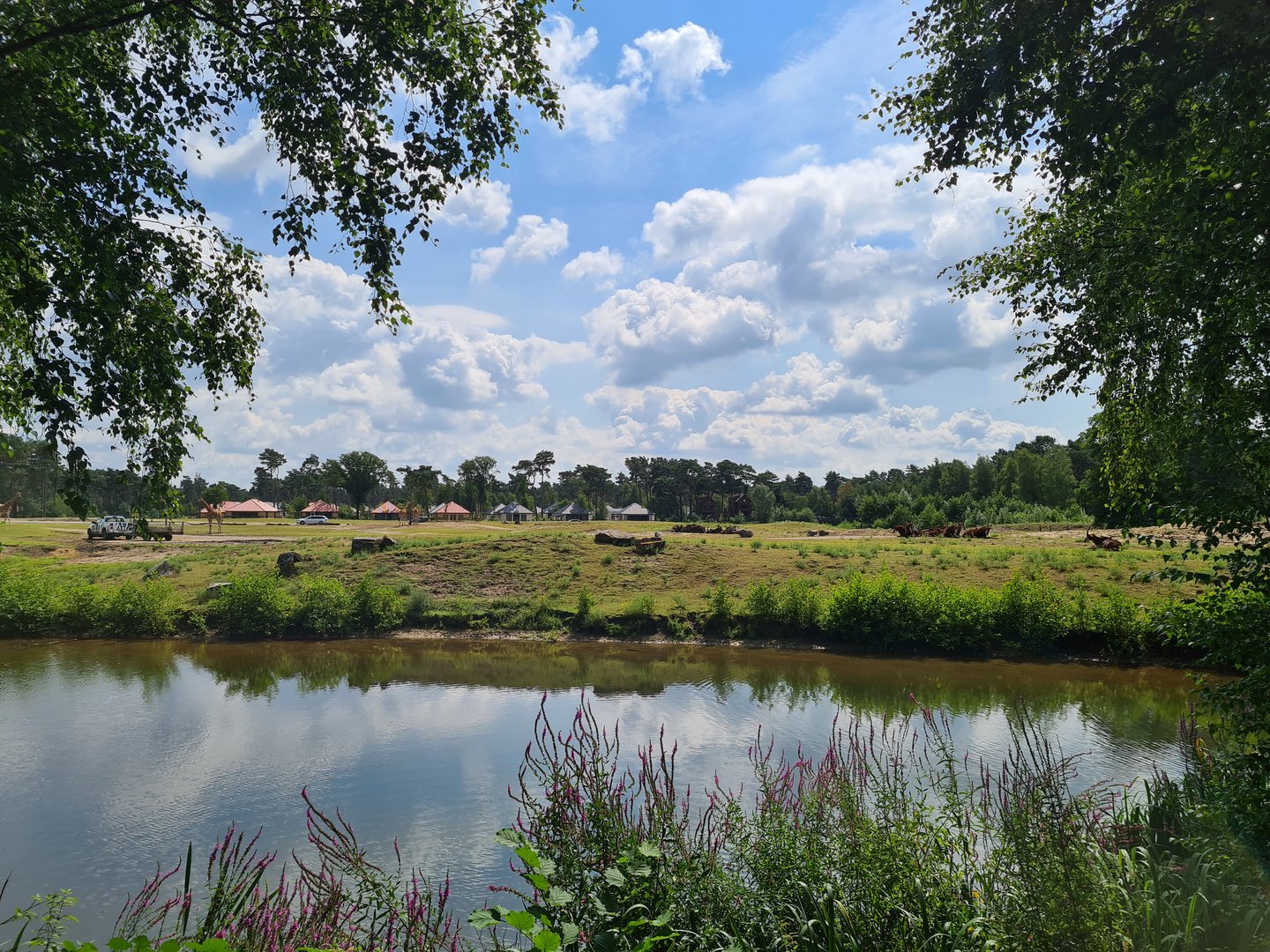
Possible Look of the habitat:
(South Side)

(Wetland and same idea repeated on North Side)

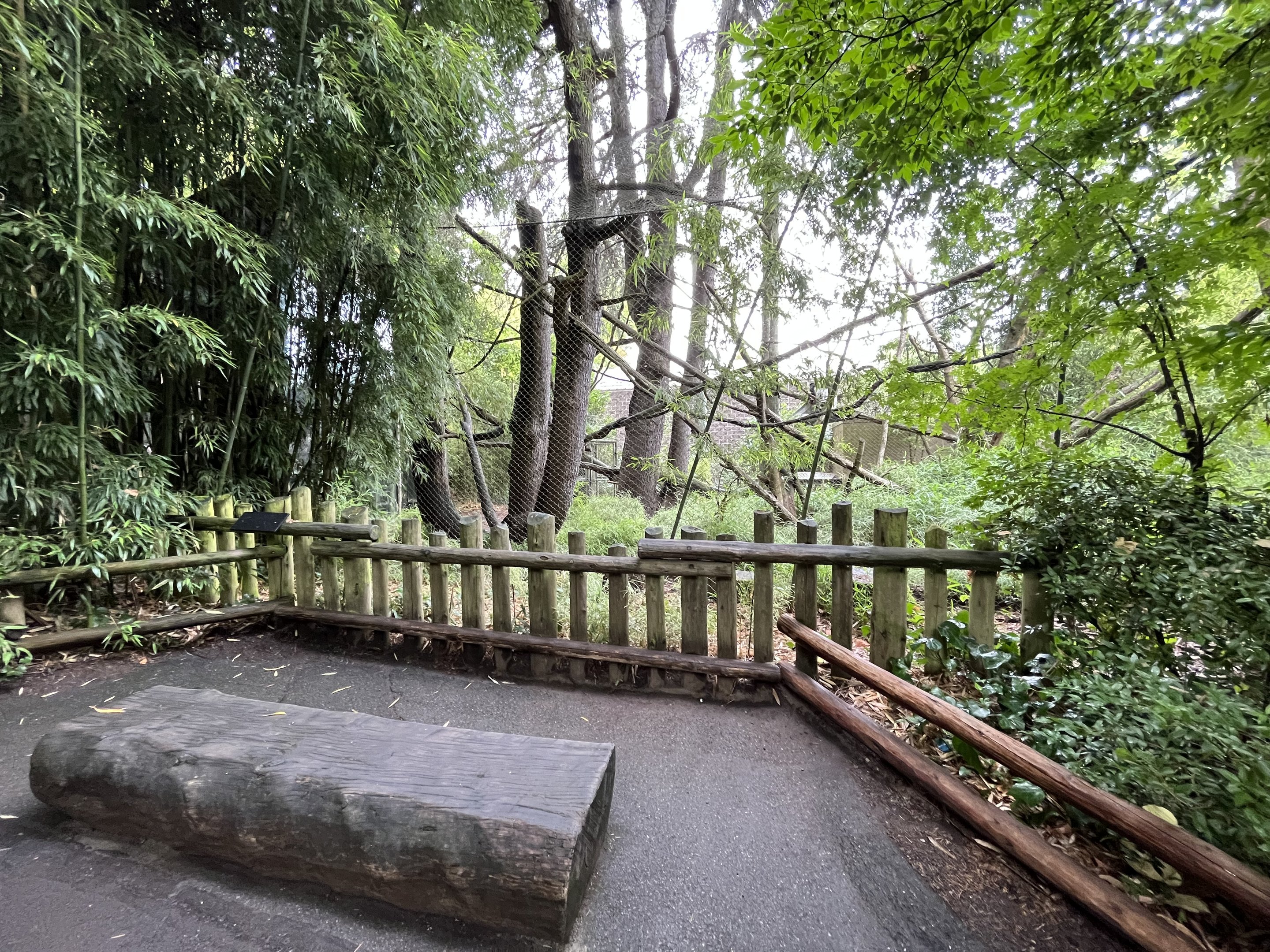
Our second (2) habitat of the section is the Angolan Colobus (Colobus angolensis) habitat! The colony has 1.3 individuals with 2.1 infants that have recently joined the group. Tha animals' names are Cabinda, Bíe, Hulía, Benguela, and the infants Moxico, Namibe, and Malanje (all named after provinces in Angola. The enclosure is fully netted and is around 15 feet tall with a ground area of around 1,200 feet with multiple streams of water and climbing structures

Possible Look of the habitat:


The next few habitats (mentioned later today or tomorrow) are part of the mini wetland court (all except the Lion paddock and last 2 habitats on that post)


Photo Credits: @snowleopard @Mr Gharial
 

Attachments

  • upload_2023-9-2_8-19-50.jpeg
    upload_2023-9-2_8-19-50.jpeg
    268.9 KB · Views: 1
  • upload_2023-9-2_8-20-25.jpeg
    upload_2023-9-2_8-20-25.jpeg
    251.4 KB · Views: 1
  • upload_2023-9-2_8-24-55.jpeg
    upload_2023-9-2_8-24-55.jpeg
    316.6 KB · Views: 1
Hello, sorry for the delay, I’m here to talk about the next 11 habitats which hold 19 species in the African section!


(3) - A habitat for the zoo’s African Penguins (Spheniscus demersus), it is roughly 2,100 feet squared. The zoo currently has 8.9 African Penguin with 6 breeding pairs and 2.3 chicks. The penguin's habitat is themed as a small seaside village with each of the houses in the small village being nest boxes. The penguins also share the habitat with roughly 20 Red Steenbras (Petrus rupestris), 12 Garrick (Lichia amia), 5 Cape Knifejaw (Oplegnathus conwayi), and 2 African Angelshark (Squatina africana). Fish small enough and the sharks have their own separate area if they were to escape the penguins. When there are chicks, the parent with the chicks will be moved to a bts area so the chicks can’t be attacked by the fish
Possible Look:
full


(4) - The zoo's habitat for Spotted-Necked Otter (Hydrictis maculicollis). The habitat has a waterfall stream that curves and cuts through the habitat. On one side of the stream it is very scrubby and well-foliaged and the other is open with many enrichment items and the deck to get into the pond at the end of the pool. The habitat is roughly 1,400 square feet and contains a breeding pair of otters (1.1) with 2 pups (1.1). The habitat formerly contained pied kingfishers and was an aviary, but due to predation, the aviary was taken down and the remaining kingfisher was sent elsewhere.
Possible Look:
full


(5) - A generously large habitat for the zoo’s Nile monitors (Varanus niloticus), in total the zoo has 2.1 monitors but they rotate and occasionally the habitat is split into 2 with only the males rotating and the female getting the other side. The habitat is around 630 feet squared and is very, very forested with a large river like water structure in the enclosure.
Possible Look
full


(6) (7) - 2 aviaries in an aviary row containing Blue-Breasted Kingfisher (Halcyon malimbica) and Common Waxbill (Estrilda astrild). The zoo has a pair of both species mentioned. The aviaries are identical with a fake tree structure on the right and a small waterfall on the left with multiple bushes on the ground. The aviaries are around 150 feet squared.
Possible look:
full


(8) - An aviary in the zoo, with 2 unique species in Europe; the Aldabra Drongo (Dicrurus aldabranus) 1.1 and the Comoro Green Pigeon (Treron griveaudi) 1.2. Both of the species have been imported from the wild recently and the zoo hopes to breed both of them to send to other zoos. The aviary is octagonal and is around 300 feet squared.
Possible Look (with netting):
full


(9) - A 1000 feet cubed aviary with 4 (2.2) rotational Palm-Nut Vultures (Gypohierax angolensis). The zoo has bred the vulture for years now as they have gotten more and more attention over the last years. Within the past 3 years the zoo has bred 7 vultures. Recently a third pair has been sent to another zoo
Possible Look:
full


(10) - This pond contains more unique species, the Madagascan Pochard (Aythya innotata) 1.4, and the Meller’s Duck (Anas melleri) 1.2. Over the years, the zoo has had a long breeding group of Madagascan grebes and anseriformes. This year the zoo announced that 0.1 Madagascan Pochard had been raised so far. Sadly, the mother rejected it and the Pochard is now with the other breeding group in the Madagascan section.
Possible Look:
full


(11) - The first habitat on this post that isn’t in the subsection known as the Wetlands. This is an impressive 13,000 square foot habitat for 4 (2.2) Barbary Lions (Panthera leo leo). The animals will rotate the habitat. Nothing is truly special in the habitat but the path around it is elevated.
Possible Look:
full


(12) - The zoo’s habitat for 1.1 Pygmy Hippopotamus (Choeropsis liberiensis) and 1.5 Sykes’ Monkey (Cercopithecus mitis albogularis). The zoo breeds the Pygmy Hippopotamus but not the Sykes’ Monkey, this is because of possible aggression from the hippos, currently the zoo if hoping to transport they Hippos to another location or with the other Pygmy Hippopotamus in the Madagascar section. The habitat has a large mound in the middle with climbing frames surrounding it.
Possible Look:
full


(13) - A habitat dedicated to the 2.3 (split in rotation of 1.2 and 1.1 or 2.0 and 0.3) Red Lechwe (Kobus leche) and 1.1 Marabou Stork (Leptoptilos crumenifer). The habitat is very grassy with a small pond. In management news, the zoo is possibly looking into combining this habitat with the Hippos and moving the Marabous elsewhere.
Possible Look:
full


As always, I’m open to any criticism, comments, advice, and ideas!

Photo Credits: Braydon Delashmutt, Mr. Weasel, David Matos Mendes, vogelcommando, snowleopard, Pleistohorse, MagpieGoose
 
Back
Top