You are using an out of date browser. It may not display this or other websites correctly.
You should upgrade or use an alternative browser.
You should upgrade or use an alternative browser.
Melbourne Zoo Melbourne Zoo Historic Map
- Thread starter Jambo
- Start date
-
- Tags
- history map melbourne zoo


1992 Map
For comparison, here is the zoo a decade and half later in 1992:
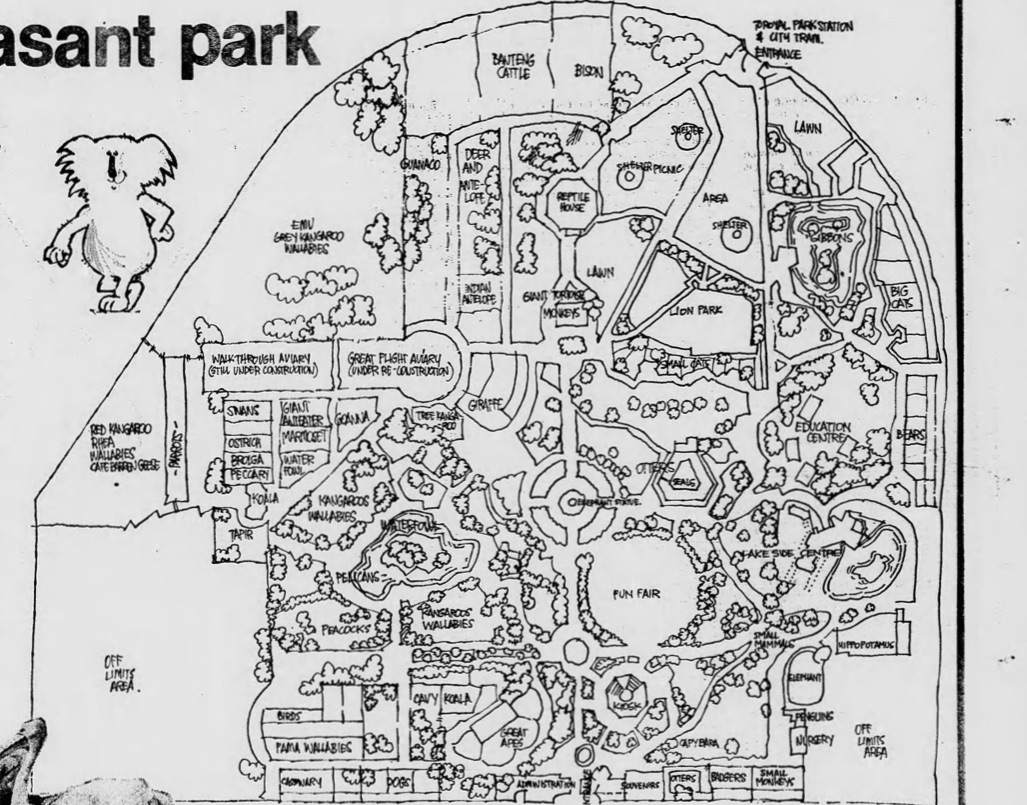
By 1992, the Common hippopotamus and Polar bear had been phased out. The latter was replaced with a Japanese Garden.
Several primate species including the Chacma baboon were phased out in favour of reallocating the space to the Gorilla Rainforest; while several Australian species were relocated to other areas of the zoo.
The rows of big cats and bears arranged by taxonomy represent a typical mid to late 20th Century zoo.

Photo source: @Chlidonias (media)
For comparison, here is the zoo a decade and half later in 1992:
By 1992, the Common hippopotamus and Polar bear had been phased out. The latter was replaced with a Japanese Garden.
Several primate species including the Chacma baboon were phased out in favour of reallocating the space to the Gorilla Rainforest; while several Australian species were relocated to other areas of the zoo.
The rows of big cats and bears arranged by taxonomy represent a typical mid to late 20th Century zoo.
Photo source: @Chlidonias (media)
Attachments
This map dates from only three years before I visited Melbourne Zoo the first time (when I saw Buluman in the old grottoes, but only realised after I saw my photos that it was him and not Rigo I had seen) Obviously can't remember a great deal else from that visit- also I'd literally just touched down in Australia and so was jet-lagged too. But I remember a zoo of two halves really- quite a lot of modern enclosures but then some much older-style yards at the further end for ungulates, quite a contrast with the newer areas of the zoo.
This map dates from only three years before I visited Melbourne Zoo the first time (when I saw Buluman in the old grottoes, but only realised after I saw my photos that it was him and not Rigo I had seen) Obviously can't remember a great deal else from that visit- also I'd literally just touched down in Australia and so was jet-lagged too. But I remember a zoo of two halves really- quite a lot of modern enclosures but then some much older-style yards at the further end for ungulates, quite a contrast with the newer areas of the zoo.
You picked a great time to visit as the zoo had recently (within the last decade) completed several developments as part of their taxonomic plan of the early 70’s - which included Big Cat Alley and the Great Ape grottos with the gorillas, chimpanzees and orangutans. The zoo had 2.5 chimpanzee upon your visit in 1981, one of which died in August of that year.
The Lion Park (opened 1967) would have only been 14 years old and surely a highlight. In terms of size, it would have been one of the world’s best lion exhibits within a city zoo of its time.
You picked a great time to visit as the zoo had recently (within the last decade) completed several developments as part of their taxonomic plan of the early 70’s - which included Big Cat Alley and the Great Ape grottos with the gorillas, chimpanzees and orangutans. The zoo had 2.5 chimpanzee upon your visit in 1981, one of which died in August of that year.
The Lion Park (opened 1967) would have only been 14 years old and surely a highlight. In terms of size, it would have been one of the world’s best lion exhibits within a city zoo of its time.
Despite all the amazing species, i'm fairly sure their enclosures would've been tiny. In one spot, they've crammed eight species and their respective into a space only about 60 metres squared!
The Great Ape Grottos surely would've been a highlight. The zoo had three grottos (one each for gorilla, orangutan and chimps). They eventually demolished one to make way for the Gorilla Rainforest in 1992, leaving two (for gorillas still, and orangutans) with chimps being phased out.
The Lion Park was Melbourne's premier enclosure at the time. Possibly one of the best lion enclosures worldwide, it was designed to put visitors in a cage when viewing the most famous predator on earth! It was absolutely massive, and I am one to be disappointed they demolished it. They easily could've made renovations and kept it. Instead they now have a simple enclosure only half the size.
The zoo had 2.5 chimpanzee upon your visit in 1981, one of which died in August of that year.
The Lion Park (opened 1967) would have only been 14 years old and surely a highlight. In terms of size, it would have been one of the world’s best lion exhibits within a city zoo of its time.
I do very clearly remember the Chimp group as I still have a photo of them(somewhere) that I took then and yes, 7 would be right from memory.
The Lion enclosure was good, I remember that too.
I do very clearly remember the Chimp group as I still have a photo of them(somewhere) that I took then and yes, 7 would be right from memory.
The Lion enclosure was good, I remember that too.
These were the chimpanzee they had at the start of 1981 (Molly died in August):
Beautiful (F)
Born in the wild 01/01/1957
Arrived at Melbourne Zoo 18/10/1961
Died at Melbourne Zoo 20/11/1988
Teddy (M)
Born in the wild 01/01/1952
Arrived at Melbourne Zoo 27/10/1966
Died at Melbourne Zoo 17/01/1992
Molly (F)
Born in the wild 01/06/1953
Arrived at Melbourne Zoo 27/10/1966
Died at Melbourne Zoo 28/08/1981
June (F)
Born at Wellington Zoo 15/09/1960
Arrived at Melbourne Zoo 27/10/1966
Sent to Hyderabad Zoo 15/10/1992
Ernie (M)
Born at Melbourne Zoo 15/12/1969
Died at Melbourne Zoo 23/02/1993
Sandra (F)
Born at Rotterdam Zoo 28/02/1971
Arrived at Melbourne Zoo 16/10/1976
Sent to Taronga Zoo 23/02/1993
Koko (F)
Born in the wild 01/01/1972
Arrived at Melbourne Zoo 16/10/1976
Sent to Taronga Zoo 23/02/1993
The Great Ape Grottos surely would've been a highlight. The zoo had three grottos (one each for gorilla, orangutan and chimps). They eventually demolished one to make way for the Gorilla Rainforest in 1992, leaving two (for gorillas still, and orangutans) with chimps being phased out.
Yes, I remember the grottoes very well as the Gorillas were my main interest(they still are..
 ) There were a trio onshow, one male I somehow assumed was Rigo, plus the two females Betsy and Yuska. Only later I discovered the male I photo'd was Buluman so it was Rigo that I didn't see on that first visit.
Next visit about 10(?) years later- new Gorilla enclosure built. Rigo- a fine male in his prime by then, was living seperately in one of the remaining grottoes.
These were the chimpanzee they had at the start of 1981 (Molly died in August):
Beautiful (F)
Born in the wild 01/01/1957
Arrived at Melbourne Zoo 18/10/1961
Died at Melbourne Zoo 20/11/1988
Teddy (M)
Born in the wild 01/01/1952
Arrived at Melbourne Zoo 27/10/1966
Died at Melbourne Zoo 17/01/1992
Molly (F)
Born in the wild 01/06/1953
Arrived at Melbourne Zoo 27/10/1966
Died at Melbourne Zoo 28/08/1981
June (F)
Born at Wellington Zoo 15/09/1960
Arrived at Melbourne Zoo 27/10/1966
Sent to Hyderabad Zoo 15/10/1992
Ernie (M)
Born at Melbourne Zoo 15/12/1969
Died at Melbourne Zoo 23/02/1993
Sandra (F)
Born at Rotterdam Zoo 28/02/1971
Arrived at Melbourne Zoo 16/10/1976
Sent to Taronga Zoo 23/02/1993
Koko (F)
Born in the wild 01/01/1972
Arrived at Melbourne Zoo 16/10/1976
Sent to Taronga Zoo 23/02/1993
I remember the older(?) male- he was very grey, a bit like a 'silverback' in a chimp.
I remember the older(?) male- he was very grey, a bit like a 'silverback' in a chimp.
That would have been Teddy. He ruled over the troop as alpha for many years by virtue of being the only male. He was wild born in 1952 and previously lived at Wellington Zoo, where he was the beta male to Tom, who sired all offspring from 1960-1987. Being exported to Melbourne gave Teddy a chance to breed, but sadly his only surviving offspring (Ernie) was euthanised at the age of 23 years. He was a very genetically valuable male, but there was no options for placing him within the region. Ernie had assumed the alpha role by the 1980’s.
Yes, I remember the grottoes very well as the Gorillas were my main interest(they still are..
Next visit about 10(?) years later- new Gorilla enclosure built. Rigo- a fine male in his prime by then, was living seperately in one of the remaining grottoes.
Yes, Rigo always has lived separately, especially after Buluman and Betsy arrived in 1980.
They built the Gorilla Rainforest enclosure in 1992. They initially moved Buluman, Besty, Yuska, Mzuri, Motoba and Buzandi, with Rigo living in the grottos alongside the Orangutans.
I probably visited some time soon after it opened. I remember there was a net in front of Rigo's grotto as he was a 'thrower'.They built the Gorilla Rainforest enclosure in 1992. They initially moved Buluman, Besty, Yuska, Mzuri, Motoba and Buzandi, with Rigo living in the grottos alongside the Orangutans.
I probably visited some time soon after it opened. I remember there was a net in front of Rigo's grotto as he was a 'thrower'.
Its a great shame that Rigo lived so much of his life in isolation. He was an impressive male in his prime, even if he was ineffective as a troop leader. Yuska and the other females ran rings around him. Yuska clearly knew her role as a female, but knew with Rigo she could get away with things another silverback would never allow.
I probably visited some time soon after it opened. I remember there was a net in front of Rigo's grotto as he was a 'thrower'.
Yes, I read an article were he once threw a rock at a visitor and knocked them out. Someone threw that rock in there for him though.
Its a great shame that Rigo lived so much of his life in isolation. He was an impressive male in his prime, even if he was ineffective as a troop leader. Yuska and the other females ran rings around him. Yuska clearly knew her role as a female, but knew with Rigo she could get away with things another silverback would never allow.
Rigo's life in isolation only made him somewhat more anti social. He wasn't interested in anyone when he was reunited with the group in 2006, let alone Yuska who he had seemed to have forgotten. As a youngster, he was boistreous yet always serious. As a grew, and lived in isolation, he often spent his days sitting upright in a very mannered position, staring at the public. As if he were attempting to study them. He was quite the male.
Yes, I read an article were he once threw a rock at a visitor and knocked them out. Someone threw that rock in there for him though.
Rigo's life in isolation only made him somewhat more anti social. He wasn't interested in anyone when he was reunited with the group in 2006, let alone Yuska who he had seemed to have forgotten. As a youngster, he was boistreous yet always serious. As a grew, and lived in isolation, he often spent his days sitting upright in a very mannered position, staring at the public. As if he were attempting to study them. He was quite the male.
I was struck by what an impressive male he was when I saw him- and I'd seen a lot of males in Europe and a few in the USA by then. I think his enforced isolation for so long was very damaging for him- a better option would have been getting him into a group outside Australia soon after he was fully mature- his life might have been very different then. As it was by the time they gave him charge of the group he was already approaching his later years, when males characteristically are more placid and set in the ways they established earlier in life.

That takes me back.
That takes me back.
It must have been such an experience to visit so many species all in one place. I appreciate it’s a trade off with what we’d now consider unsuitable exhibits to put it mildly, but to see rows of felids, pits of bears and cages of monkeys would have offered a fascinating opportunity to compare and contrast the taxonomic groups - as well as visiting the then world class Lion Park and great ape grottos.
Instead, Melbourne now has Growing Wild and a lion exhibit insufficient to hold anything beyond a pair of male lions.
I still have a Melbourne zoo guide book from the mid 70sIt must have been such an experience to visit so many species all in one place. I appreciate it’s a trade off with what we’d now consider unsuitable exhibits to put it mildly, but to see rows of felids, pits of bears and cages of monkeys would have offered a fascinating opportunity to compare and contrast the taxonomic groups - as well as visiting the then world class Lion Park and great ape grottos.
Instead, Melbourne now has Growing Wild and a lion exhibit insufficient to hold anything beyond a pair of male lions.

1992 Map
For comparison, here is the zoo a decade and half later in 1992:
By 1992, the Common hippopotamus and Polar bear had been phased out. The latter was replaced with a Japanese Garden.
Several primate species including the Chacma baboon were phased out in favour of reallocating the space to the Gorilla Rainforest; while several Australian species were relocated to other areas of the zoo.
The rows of big cats and bears arranged by taxonomy represent a typical mid to late 20th Century zoo.
View attachment 559165
Photo source: @Chlidonias (media)
This was close to Melbourne at its historical best, I think, and also as I first remember it. The mistakes started with Trail of the Elephants - they should have been moved to Werribee back then.