Melbourne Zoo Melbourne Zoo

I visited recently and have a few new tidbits of news. Maybe my favourite thing is the Brazilian agouti that has moved into the badger exhibit near the bear. It's the first time I've seen this species so I was very excited. Does anyone know where it came from?
The peccaries also have a new home. Two exhibits have been constructed near the tapir exhibit to the right of the train station entrance. They are just basic exhibits fenced by green colourbond and filled with logs, plants etc.

On a side note I visited with a friend from america and she was really excited about being able to see a platypus. When she saw it she was shocked at how small it was. She was expecting something the size of a seal.
 
That is really common for people to think platypus are going to be much bigger than they really are. The opposite thing occurs with kiwi - most people think they are going to be tiny like a quail.
 
I visited recently and have a few new tidbits of news. Maybe my favourite thing is the Brazilian agouti that has moved into the badger exhibit near the bear. It's the first time I've seen this species so I was very excited. Does anyone know where it came from?
The peccaries also have a new home. Two exhibits have been constructed near the tapir exhibit to the right of the train station entrance. They are just basic exhibits fenced by green colourbond and filled with logs, plants etc.

The agoutis were already at the zoo, but were tucked away, with the cotton-top tamarins, in an exhibit that faces into the function room. You *can* access it, but you have to walk around the side of the function centre and there's no signage to tell you the exhibit is there. I imagine they close it off when there's a function on. You seem to imply there's only one in the former badger enclosure (I never did see that badger, which was ancient - I assume it has died). Maybe the others are still around there.

The update re: peccaries is interesting. I wonder if this presages the arrival of animals that will take up the two former peccary exhibits. Possibly the return of maned wolves to the zoo?

On a side note I visited with a friend from america and she was really excited about being able to see a platypus. When she saw it she was shocked at how small it was. She was expecting something the size of a seal.

:eek:;)
 
That is really common for people to think platypus are going to be much bigger than they really are. The opposite thing occurs with kiwi - most people think they are going to be tiny like a quail.

Animal size expectations- Almost worth a thread of its own?:)

For most species the usual expectation seems to be for larger size than the animal is in reality. But conversly the one that has always surprised me is the British/European Otter- the males in particular are really big, heavy-bodied animals, can reach 4ft including tail.
 
There could have been more. I hope there are more. You can see all of the exhibit and I only saw one so just assumed that was all.
 
The peccaries also have a new home. Two exhibits have been constructed near the tapir exhibit to the right of the train station entrance. They are just basic exhibits fenced by green colourbond and filled with logs, plants etc.

I counted at least 8 in the exhibit closest to the visitor path (the better viewing exhibit) and at least 4 in the background exhibit. I am not sure if this number is the total population of peccaries at Melbourne Zoo.
 
On a side note I visited with a friend from america and she was really excited about being able to see a platypus. When she saw it she was shocked at how small it was. She was expecting something the size of a seal.
I was also quite amazed. I thought it would be a third larger than it was, and it was so damn fast. I know it sounds stupid, but I somehow expected an animal which is a bit 'primitive' to be smaller, which it was definitely not. However, I am glad I have seen it, since the chances of seeing one outside of australia or really small.
 
Well Johnny, that proves the value of actually seeing an animal in real life, rather than just on television, and therefore proves the true value of zoos.

The small son of a friend of mine was amazed at his first sight of a living elephant at Taronga zoo. He knew what an elephant looked like, from books and television, but was expecting something the size of a sheep!
 
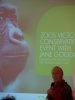
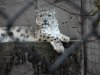
A couple pics from my visit to the Melbourne Zoo to attend the Jane Goodall lecture. Really inspiring, powerful stuff - the lecture, not the pics :p.
 

Attachments

  • jane for forum.jpg
    jane for forum.jpg
    215.3 KB · Views: 2
  • snow leopard for forum.jpg
    snow leopard for forum.jpg
    187.2 KB · Views: 0
I have also noticed a change in the names of Melbourne's blackback gorilla males 'Ganyeka' and 'Yakini'. Up until a few months ago, these names used to be their 'exhibit' names with their other names as 'Ganini' (for 'Ganyeka'), according to their website. But as of lately, they have been referring to the boys as 'Ghubari' and 'Yadumu'. So my question is, does anyone know the 'official' names of these two blackbacks?
 
Never understood why Melbourne use so many different names for some of their Gorillas. Something to do with preventing the public confusing them by calling out their names? If so, why don't all their Gorillas have two names?:confused: I've not seen this anywhere else- keepers' nicknames or shortened names nearly always yes, but not a full 'set' of two different sounding names. The previous young of old female Betsi- Buzandi and Bambuti also had more than one name each- just very confusing.
 
According to the 'Daily Telegraph' newspaper she was meant to be inseminated the end of last month, so fingers crossed for a pregnancy.

I hope its a female! However fighting the chances.

I enquired to a zookeeper about the high percentage of males produced from A.I. His theory was that females inseminated that are calm usually produce males ( which they have to be in order to be inseminated) and when stressed, they give birth to females. Apparently Kulab was more calm when being inseminated than Dokkoon.
Correct me if I'm wrong, I think Mali and Daizy in albuquerque zoo are the only two female asian elephants that are products of AI.
 
I hope its a female! However fighting the chances.

I enquired to a zookeeper about the high percentage of males produced from A.I. His theory was that females inseminated that are calm usually produce males ( which they have to be in order to be inseminated) and when stressed, they give birth to females. Apparently Kulab was more calm when being inseminated than Dokkoon.
Correct me if I'm wrong, I think Mali and Daizy in albuquerque zoo are the only two female asian elephants that are products of AI.

YOU are so correct! In 2008 Chai at woodland park had a miscarriage of a female fetus. The pregnancy was through AI.
 
Melbourne Zoo branches out for jumbo meals | News.com.au
18 July 2011

Tree prunings will be collected from inner-city homes and fed to Melbourne Zoo's elephants under a new recycling plan.

The Parkville zoo is offering to send horticulturalists to properties where branches and plants are in need of removal to assess whether they are compatible with the diets of its seven elephants

Two four-tonne trucks will patrol the streets on Tuesdays and Fridays to collect fresh cut green waste given the zoo's tick of approval.

Simon Andrews, from the zoo's horticulture department, said elephants loved to snack on a host of tree and plant species, including bamboo, acacia, elm and elephant grass.

The five adults and two calves had such voracious appetites - consuming dozens of 2m branches each week as well as fruit, hay and lucerne - that it was difficult for staff to keep up.

Mr Andrews said the animals also used the greenery for bedding.

"This is partly a call for help, as we need as many branches as we can get our hands on," he said.

Mr Andrews said the zoo welcomed as many donations as the public could muster, but the zoo couldn't accept plants sprayed with chemicals.

City of Melbourne councillor Cathy Oke said the zoo's plan would neatly complement the council's own recycling program.

"(The proposal) would be a really efficient way of closing the loop, as people would know exactly where their green waste was going," Cr Oke said.

People interested in making contributions should phone the zoo on 9285 9300.
 
Back
Top