Miniature Animal Figure Collection

It's the Dango Mushi Cubaris murina in original colour (they have a second release with more intrincate pattern belonging to a series of 5 species of rollable isopods, but the original versions were only 2 species, this one and Armadillidium vulgare).

The horseshoe crab with wheels is Kitan Club, Tachypleus tridentatus, belonging to a set of 5 different colour versions with the same sculpt.

CollectA doesn't mark this octopus at species level, just "octopus", but general fan-made ID is either Common octropus or Giant Pacific octopus, it can work fine as either. For my own taste, it's just too gigantic even for a Giant Pacific.
 
Although I had already made Abe's Coffinfish (it was the first model I made for the collection), I wasn't happy with the original (it was orange, didn't have an esca, lacked the species' distinctive spotting and the face looked nothing like it should) so I made a new, better one.

Abe's Coffinfish (Chaunax abei) - A deep sea anglerfish found off Japan. It rarely swims, instead using it's pectoral fins to walk along the seafloor, a more energy-efficient method of locomotion useful in the deep sea where food is scarce. It has loose skin that it can inflate to appear larger if threatened to dissuade predators.
View attachment 488558

That's Amazing!
 
Last homemade model, finished yesterday: the Choiseul pigeon (Microgoura meeki). Sole member of its genus, this bird endemic to Solomon islands went extinct in the early XX century.

index.php

index.php

index.php


With my only other pigeon, a Snow Pigeon:
index.php


In the Museum of Sadness, with other extinct species and subspecies (vaquita is still not extinct, but with a world population reduced to 12 individuals it will be very soon)
index.php
 
Great job @Kakapo, have you ever thought about using an airbrush to paint the models? It would avoid any obvious brush strokes on the model. Over all an awesome job, the sculpts are perfect! :)
 
Thanks a lot LowlandGorilla4 :-) I tought sometimes in the possibilities that I had with an airbrush, but, besides I have really no idea about how to get one, and that it would be impossible to use (I would need to put the mix of paints of the desired colour each time in it?!?!?!), it would give me advantages only in little selected groups, basically cetaceans and sharks (big animals with smooth skin). I wish to have been able to use an airbrush for the repaint of the thresher shark, that seen up close it have noticeable traces of the normal brushes, but for the remaining models it's no needed :-)
 
Leaf Scorpionfish (Taenianotus triacanthus), also known as the Paperfish, an ambush predator of tropical reefs in the Indo-Pacific, Red Sea and East African coast, as well as north to the Ryukyu Islands and Galapagos, and south to New South Wales. The species has a great variety in colour, ranging from hot pink to yellow, ochre, brown and white, but always with lighter or darker blotches. These colour variations are non-genetic and an individual can change colour to suit a particular habitat. They are fairly small, reaching a maximum of 10cm, and shed their skin every 10-14 days to remove parasites and encrusting organisms like algae and hydroids. They will use their pectoral fins to rock back and forth, mimicking a leaf, soft coral or piece of seaweed rocking in the waves, as to not draw the attention of the small fishes, larvae and invertebrates on which it preys. The dorsal spines can inject venom, either from being stepped on or though handling, although the toxin is much milder than that of the related lionfish and stonefish.
upload_2021-6-12_21-17-53.png
 

Attachments

  • upload_2021-6-12_21-17-53.png
    upload_2021-6-12_21-17-53.png
    639.9 KB · Views: 69
Last homemade model, finished yesterday: the Choiseul pigeon (Microgoura meeki). Sole member of its genus, this bird endemic to Solomon islands went extinct in the early XX century.

index.php

index.php

index.php


With my only other pigeon, a Snow Pigeon:
index.php


In the Museum of Sadness, with other extinct species and subspecies (vaquita is still not extinct, but with a world population reduced to 12 individuals it will be very soon)
index.php
Love that Snow Pigeon
 
I think that those I've seen in aquaria were a bit bigger than 10 cm... now my memory is blurry
Yeah, I think I've seen them larger than 10cm. 10cm is just what FishBase said for size.
My immediate reaction was the same - however I was actually thinking of Rhinopias frondosa which gets at least twice as big.

(But checking on that, I was actually actually thinking of Rhinopias eschmeyeri, which is the one I have seen).
 
Last edited:
I think that those I've seen in aquaria were a bit bigger than 10 cm... now my memory is blurry

Yeah, I think I've seen them larger than 10cm. 10cm is just what FishBase said for size.

My immediate reaction was the same - however I was actually thinking of Rhinopias frondosa which gets at least twice as big.

(But checking on that, I was actually actually thinking of Rhinopias eschmeyeri, which is the one I have seen).
Wait, I think I know what might be going on. Measurements of fish do not include the tail or any other fins, and in the Leaf Scorpionfish the tail is quite large in proportion to the body, making the fish seem longer than 10cm.
 
One of my favourite raptors, the Black-and-White Hawk Eagle (Spizaetus melanoleucus) have a striking coat in pure white and black. I've finished it today.

index.php

index.php

index.php

index.php


Of course the obligated comparison figure is the best known species of South American eagle: the harpy eagle. From Colorata, Raptors of the World set.
index.php


Comparison shot with random raptors: Science & Nature wedge-tailed eagle, Colorata bald eagle, Safari LTD California condor.
index.php


And all my South American team complete (well not complete, I forgot the blue morpho butterfly). Now my Amazonian family (plus few Andean/Patagonian water birds) grew a lot and it's already difficult to get all in a single shot!
index.php
 
Giant Pacific Octopus (Enteroctopus dofleini) - The largest known octopus species, with the largest reliably recorded individual weighing in at 71kg (156lb). The species is found from the intertidal zone all they way down to 2000 metres (6600ft) in the North Atlantic from Korea, Japan and Russia to Alaska, Canada and the US. Octopuses are highly intelligent, roughly equivalent to a small child, and are extremely good at escaping their tanks. Their beak is the only hard part in their body, and this allows the octopus to slip though any gap larger than their beak (about the same size as their eye). Like all other octopuses, the Giant Pacific has a venomous bite, although, unlike the incredibly toxic blue-ringed octopuses, Giant Pacific Octopus venom is mostly digestive enzymes and in humans only causes localized pain and swelling.octo.PNG
 

Attachments

  • octo.PNG
    octo.PNG
    1.3 MB · Views: 63
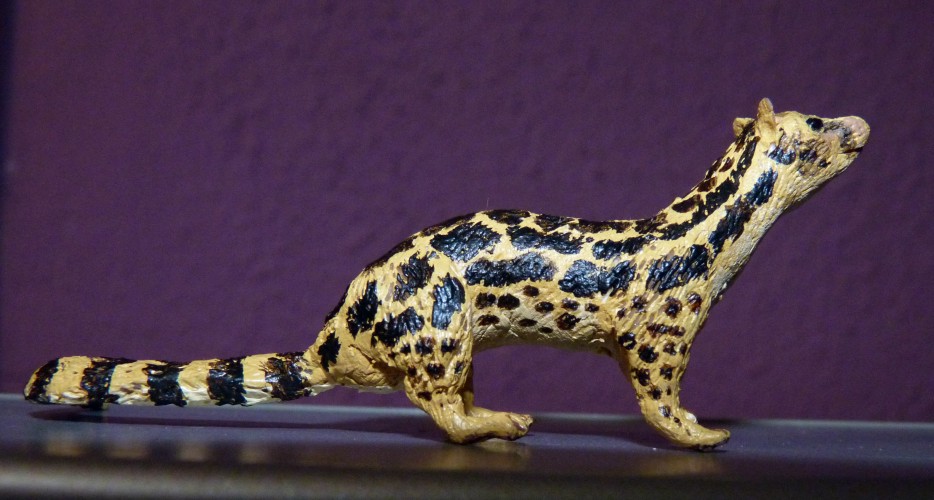
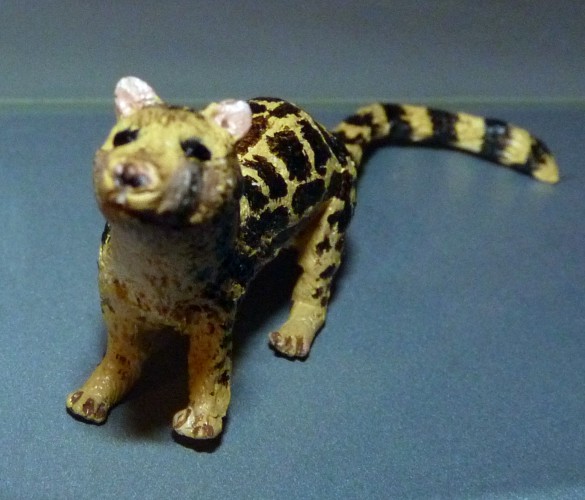
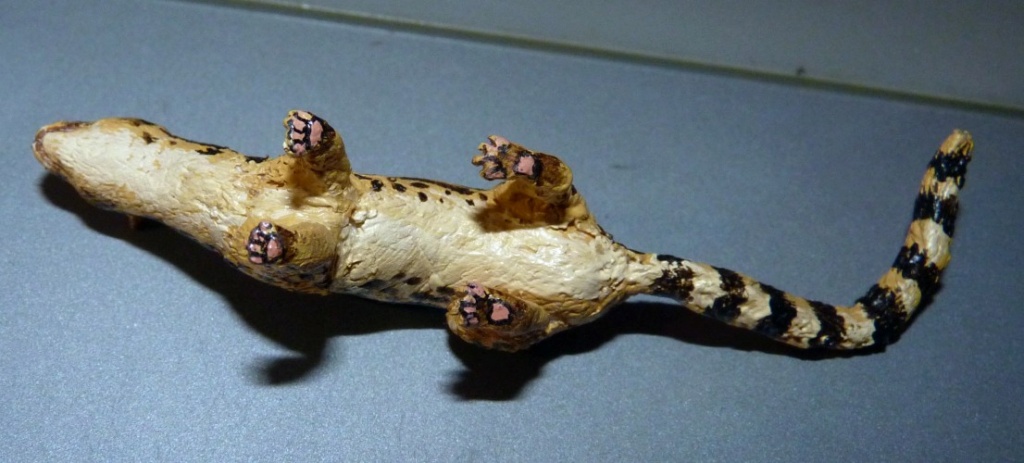
Long time without update. Now it's the turn of the Banded linsang. I finished it on day 13th August but failed to take photos and present it to the forum :oops:

copia_11.jpg

copia_10.jpg


here I just wanted to show the tiny paws :cool:
copia_12.jpg


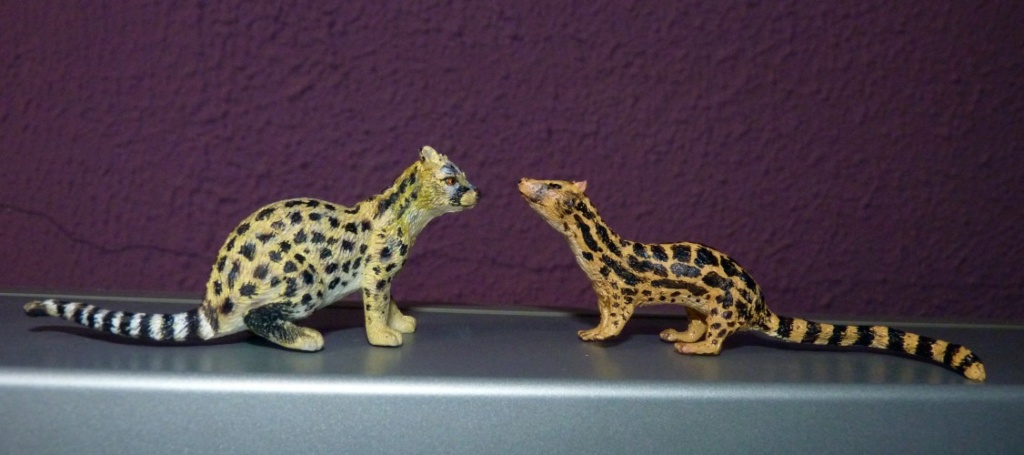
Comparison with closest cousin in my collection, the (repainted) Nayab genet:
copia_14.jpg


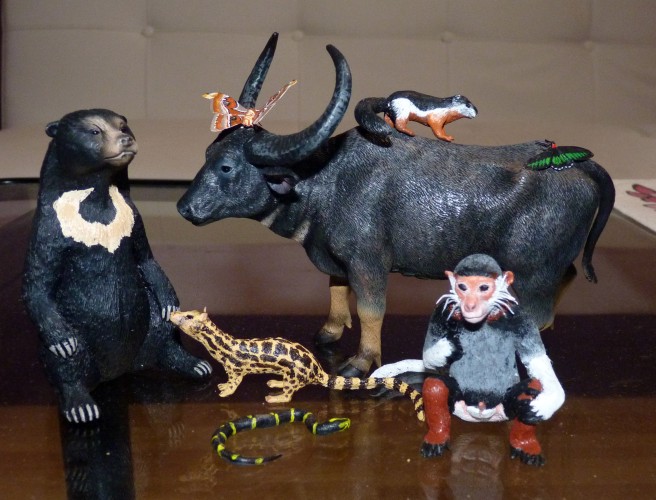
Comparison with random Indonesian animals:
copia_13.jpg
 
-My first one was in the gift shop of Birch Aquarium in California. Gift shops of aquariums and zoos usually have them.
-Next ones in a commercial center, in the toy section.
-Next ones in a stationery. Many of my figures come from stationeries (kiosks).
-Soon I had my first online purchase. There are many international online shops specialized in selling this kind of figues. I can provide a list if you want.
-I also bought some in toy shops.
-After many figures I did my first purchase of Japanese figures by contacting a person specialized in getting Japanese figures to western world by a fee.
-Then I started to use eBay and similar sites, tough this method can be a bit more expensive. I do not use it often.
-My 27th purchase was bought in a veterinary-pet shop.
-The 29th purchase was my first trade with another collector.
-My 33th purchase was buying in an art shop.
-When I reached 99 figures, I did my first homemade model (37th batch in my collection). Then I did many many more after.
-The 55th purchase was asked to my sister as a gift for Epiphany. She bought them online. I also received them in birthdays.

These are all the methods I used.
 
-My first one was in the gift shop of Birch Aquarium in California. Gift shops of aquariums and zoos usually have them.
-Next ones in a commercial center, in the toy section.
-Next ones in a stationery. Many of my figures come from stationeries (kiosks).
-Soon I had my first online purchase. There are many international online shops specialized in selling this kind of figues. I can provide a list if you want.
-I also bought some in toy shops.
-After many figures I did my first purchase of Japanese figures by contacting a person specialized in getting Japanese figures to western world by a fee.
-Then I started to use eBay and similar sites, tough this method can be a bit more expensive. I do not use it often.
-My 27th purchase was bought in a veterinary-pet shop.
-The 29th purchase was my first trade with another collector.
-My 33th purchase was buying in an art shop.
-When I reached 99 figures, I did my first homemade model (37th batch in my collection). Then I did many many more after.
-The 55th purchase was asked to my sister as a gift for Epiphany. She bought them online. I also received them in birthdays.

These are all the methods I used.
That was helpful but do you buy them online?
 
Back
Top