Monarto Safari Park Monarto Safari Park News 2025

Well with the confirmation of breeding now secured, looking forward to hearing about the EEHV action plan and safeguards for the elephants.

At this point in time, I imagine the protocol would look very similar to Werribee - routine, regular testing of young elephants via blood draws. I’m hopeful Monarto would establish an onsite laboratory like Werribee, which would allow a six hour turn (same day) turn around for results, which as we know is instrumental in fighting this disease (early detection).

Though the main danger period is 2-8 years, Werribee test from 1 year of age and continue until their elephant are 15 years of age. Monarto would surely follow the same guidelines here too.

I will note all of the above is what I would envisage them putting in place here and now. Monarto won’t have a calf on the ground until at least 2027 (probably 2028). By the time that calf is 12 months old, close to four years would have passed and that’s a significant amount of time in the field of science and research. At a minimum, we would have strong indications on whether the vaccine trail has been effective overseas - with several young elephants having now received it.

With this in mind, the above protocol could well be adapted to include the calves receiving the aforementioned trial vaccine; which depending on its effectiveness, may be rolled out to Australasian zoos as it (optimistically) is developed into a standard and effective vaccine routinely given to all captive elephant calves globally (the end goal).
 
Monarto Safari Park Visit – 30/01/2025
PART ONE


I visited Monarto Safari Park today with my girlfriend and had a fantastic experience. The park was busier than expected, despite schools having returned, but the high visitation is always a positive sign. There was an exciting buzz around the park due to the arrival of Permai from Perth, and I was fortunate to watch a press conference in the visitor centre courtyard. It was also quite windy, and the park was the driest I have ever seen it—essentially devoid of grass, with most animals congregating around feed rather than grazing naturally. South Australia is under increasing pressure to officially declare a drought, but the state government remains hesitant, as doing so would require subsidies for certain farmers. As a result, the park was exceptionally dry and dusty!
Example of how dry Monarto is currently!
View attachment 767851


My Visit and Experiences
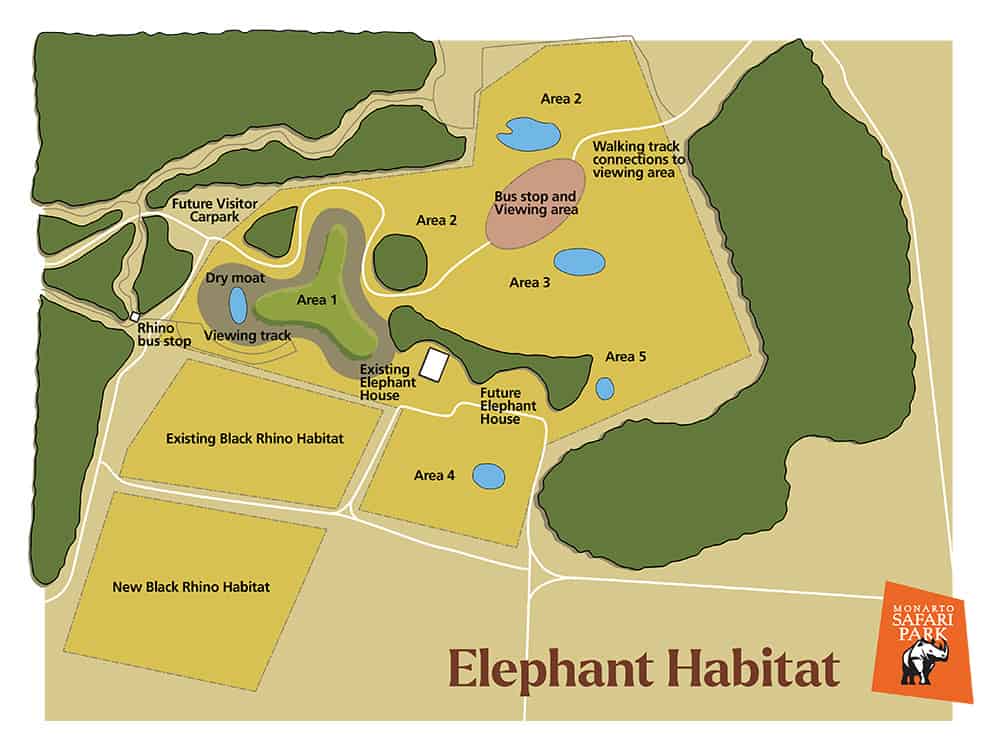
I arrived at opening and completed an entire bus loop without getting off, which took approximately 1 hour and 20 minutes. I then embarked on a second loop, hopping off at the Outpost (Stop 2) and exploring the rest of the park on foot. Along the way, I attended the chimpanzee keeper talk—where I had an engaging conversation with a keeper—and visited the elephant precinct (speaking with a volunteer), as well as the Waterhole and carnivore precincts. Construction activity around the elephant exhibit remains ongoing following Permai’s arrival. Notably, the elephant tunnel has now been completed, allowing visitors to pass under the exhibits at the intersection of Elephant Areas 2 and 3. Although the elephants don't have access to these areas as of yet.

Link to Monarto Safari Park Map -
https://www.monartosafari.com.au/wp-content/uploads/sites/3/2025/01/Monarto-Safari-Park-Map.pdf
Current Elephant Complex plan/schematic - (Elephant tunnel links Areas 2 & 3)
Elephant-Precinct-Map.jpg

At 3:15 PM, I participated in the Rhino Keeper Experience, which included hand-feeding the resident Black Rhino bull, Induna (nicknamed ‘Doon’ by the keepers), some apples. I also hand-fed lucerne to the on-display White Rhino bull, Umfana (‘Fana’ to the keepers) as well as patted him and touched his horn. During this experience, I had insightful conversations with both the Black and White Rhino keepers. Overall, I highly recommend the experience—it was incredibly rewarding, though I would have liked it to last a little longer. The behind-the-scenes aspect was just as enjoyable, as I was able to see off-display species such as Waterbuck and Bull Nyala en route to the rhinos.
Induna the South-Central Black Rhinoceros Bull
View attachment 767848
Patting Umfana the Southern White Rhinoceros Bull

View attachment 767850
Notable Sightings
Here are some observations from my visit, many of which may already be known but are worth mentioning:
  • Six new Barbary Sheep lambs – encouraging to see this species still breeding successfully, given that several facilities have phased them out in recent years.
  • I counted ten Red Deer in total, the Stag currently exhibits an impressive set of antlers
  • The breeding bull Bison is named Colin (sire of six calves), while the breeding bull Eland is named Bruce. I found the simplicity of their names amusing and it is interesting that the cows do not necessarily have unique names.
  • Three young Zebra now inhabit the secondary Black Rhino exhibit, formerly occupied by Sentwali. Any idea who these could be? As a few solitary Zebra still inhabit the exhibit adjacent to the waterhole?
  • I counted fifteen Giraffes on display in the Waterhole exhibit (although my count may not be precise). My girlfriend wanted me to include that these were her favorite animals from our trip :) (potential Zoochater?!)
  • Sixteen adolescent Ostrich chicks from two pairings I was told are mostly set to be transferred to other zoos. Watching them move as a large, dust-kicking flock was a highlight.
  • I noticed a tranquilizer dart hanging from a Nyala cow, which was quite interesting—I assume this is a method of administering medication, though I wonder what it was for?
  • Monarto still has its Bongo bull—apparently the most elusive animal in the park! The rhino keeper I spoke with has only seen him once in three years (though he does not work directly with Bongo). We passed his large, scrubby enclosure, but I, too, failed to spot him.
  • The Hyena clan consists of seven individuals, as previously reported by @WhistlingKite24. It was fascinating to see them behaving as a cohesive, dynamic group. I also observed them bathing, which was a first for me!

So does that mean the hyena are all kept together ?
Either way it would be such a cool sight to see the 7 being kept that way.

Nice review!
 
So does that mean the hyena are all kept together ?
Either way it would be such a cool sight to see the 7 being kept that way.

Nice review!
They have four clans in total; the clan of seven referenced is the main breeding clan consisting of male 'Endesha', females 'Kanzi' and 'Fahari' and their recent offspring:

1.0 Endesha (2013) Singapore
0.1 Kanzi (2017) Piltengi x Thandiwe
0.1 Fahari (2020) Gamba x Forest
0.1 Utundu (2024) Endesha x Kanzi
1.0 Kicheko (2024) Endesha x Kanzi
0.1 Tufani (2024) Endesha x Fahari
1.0 Thembayo (2024) Endesha x Fahari

They also have seven others in three additonal seperate groups:

0.1 Forest (2007) Mwenka x Kigali
1.0 Jabali (2022) Gamba x Forest
1.0 Gotoa (2023) Gamba x Forest

1.0 Enzi (2013) Singapore
1.0 Mkoko (2015) Gamba x Forest

1.0 Jaali (2017) Piltengi x Thandiwe
1.0 Majani (2018) Gamba x Forest
 
They have four clans in total; the clan of seven referenced is the main breeding clan consisting of male 'Endesha', females 'Kanzi' and 'Fahari' and their recent offspring:

1.0 Endesha (2013) Singapore
0.1 Kanzi (2017) Piltengi x Thandiwe
0.1 Fahari (2020) Gamba x Forest
0.1 Utundu (2024) Endesha x Kanzi
1.0 Kicheko (2024) Endesha x Kanzi
0.1 Tufani (2024) Endesha x Fahari
1.0 Thembayo (2024) Endesha x Fahari

They also have seven others in three additonal seperate groups:

0.1 Forest (2007) Mwenka x Kigali
1.0 Jabali (2022) Gamba x Forest
1.0 Gotoa (2023) Gamba x Forest

1.0 Enzi (2013) Singapore
1.0 Mkoko (2015) Gamba x Forest

1.0 Jaali (2017) Piltengi x Thandiwe
1.0 Majani (2018) Gamba x Forest

Nice, thank you. For some reason i didn't clock that there main group had gotten that big.
It's a pitty that captive hyenas are on the more difficult side to create larger cohesive groups.
 
Nice, thank you. For some reason i didn't clock that there main group had gotten that big.
It's a pitty that captive hyenas are on the more difficult side to create larger cohesive groups.
Hopefully now with more consistent breeding Monarto's group will be able to grow up to a size that would usually be seen in the wild! Not many captive facilities have the ability to do this - due to space constraints.
 
Nice, thank you. For some reason i didn't clock that there main group had gotten that big.
It's a pitty that captive hyenas are on the more difficult side to create larger cohesive groups.

Typically, females are the main issue when establishing a cohesive pack. They have a seperate dominance hierarchy from the males, which is reinforced by aggressive interactions. Infanticide of the cubs of lower ranking females has also been observed in captivity.

Monarto have done well as their main pack contains offspring of two breeding females, which they have successfully integrated.
 
Hopefully now with more consistent breeding Monarto's group will be able to grow up to a size that would usually be seen in the wild! Not many captive facilities have the ability to do this - due to space constraints.

Especially if they are able to utilise Fahari and not just Kanzi. I wonder if keeping the females together and bringing in new males would be a go. As they could retain Kanzi, Utundu and Tufani. Then mix in one of the other male pairs. Which would then give them potentially 3 breeding females 4 if they keep Fahari. That would really give them the ability to breed up some decent numbers. Especially if they have a large exhibit like with the lions where there is plenty of space to see if it'll work.
 
Typically, females are the main issue when establishing a cohesive pack. They have a seperate dominance hierarchy from the males, which is reinforced by aggressive interactions. Infanticide of the cubs of lower ranking females has also been observed in captivity.

Monarto have done well as their main pack contains offspring of two breeding females, which they have successfully integrated.

Thats what i mean, if they retain the cohesive female part of the pack then move in new males. They would be able to effectively breed from all females. Potentially creating a larger pack.
 
Especially if they are able to utilise Fahari and not just Kanzi. I wonder if keeping the females together and bringing in new males would be a go. As they could retain Kanzi, Utundu and Tufani. Then mix in one of the other male pairs. Which would then give them potentially 3 breeding females 4 if they keep Fahari. That would really give them the ability to breed up some decent numbers. Especially if they have a large exhibit like with the lions where there is plenty of space to see if it'll work.
I believe they do rotate a similar sized exhibit with the African Wild Dogs so they do have the space if desired.

Both Fahari and Kanzi have breed last year. It will be interesting to see if Monarto give both girls the opportunity to have some more cubs in a few years time.
 
Especially if they are able to utilise Fahari and not just Kanzi. I wonder if keeping the females together and bringing in new males would be a go. As they could retain Kanzi, Utundu and Tufani. Then mix in one of the other male pairs. Which would then give them potentially 3 breeding females 4 if they keep Fahari. That would really give them the ability to breed up some decent numbers. Especially if they have a large exhibit like with the lions where there is plenty of space to see if it'll work.

Utundu is one of the females identified as a candidate for transferring out (in addition to the young female from Sydney). My assumption is they would continue with the main pack as is (plus or minus Utundu); perhaps breeding with the adult females once more each.

0.1 Forest (24/10/2007) Mwenka x Kigali
1.0 Jabali (26/08/2022) Gamba x Forest
1.0 Gotoa (17/11/2023) Gamba x Forest

0.1 Kanzi (13/09/2017) Piltengi x Thandiwe
0.1 Fahari (03/11/2020) Gamba x Forest
1.0 Endesha (01/03/2013) Imported 2019 (Singapore)
0.1 Utundu (23/01/2024) Endesha x Kanzi
1.0 Kicheko (23/01/2024) Endesha x Kanzi
0.1 Tufani (05/03/2024) Endesha x Fahari
1.0 Thembayo (05/03/2024) Endesha x Fahari

1.0 Enzi (01/03/2013) Imported 2019 (Singapore)
1.0 Mkoko (13/07/2015) Gamba x Forest

1.0 Jaali (13/09/2017) Piltengi x Thandiwe
1.0 Majani (15/01/2018) Gamba x Forest
 
I was told no females are currently pregnant and that all are currently on contraceptives. However, the keeper believed Galatea would definitely receive another recommendation for breeding soon (*) as she is highly maternal and that Lani will receive her first recommendation in 3-4 years (*)

She also informed me that Zuri, Zola, and Hope are all potential for transfer. Zola and Hope are guaranteed to transfer out together. The last time I visited a New Zealand Zoo was mentioned (by a different older keeper), however, no specific zoo/destination was mentioned this time. (odd?)

Space-wise I was informed that the troop has room for a "decade of continued breeding" (odd she gave me a timeframe rather than a number). However the chimp team dreams of expanding the habitat out into the surrounding scrub and apparently this is on the official park plans in the far far future (*). She joked she wanted a huge naturalistic troop larger than Tarongas. Monarto seem to really pride themselves on the fact of having the 'biggest' and 'most' when it comes to animals/enclosures.

Monarto Safari Park currently have the largest chimpanzee exhibit in the region at 3000m2.

Considering Taronga Zoo hold a community of 21 chimpanzees in an exhibit around 2/3 the size of Monarto’s, I would absolutely say there’s room to expand their troop.

Sizes of chimpanzee exhibits in Australasian zoos:

Rockhampton: 1000
Wellington: 1500 estimate
Taronga: 1910
Hamilton: 2500 approx
Monarto: 3000

I imagine there’s a few reasons why Monarto have been hesitant to expand too quickly including:

First of all, in contrast to Taronga’s troop which consist solely of males born and raised within their natal community (as is the natural social order), Monarto began their troop with four males from three troops. Though they’ve managed their integration and subsequent management extremely well over the past decade and a half, the culture remains potentially volatile, with separations of Sandali etc having been required over time. From your update, it appears breeding is still on hold until the new alpha is locked in, Sandali has been reintegrated and the troop are more settled.

Second of all, Monarto are surely aspiring to establish a community that has a relatively even distribution of ages. Taronga’s community has formed over decades and the ages of its members are relatively evenly distributed (with chimpanzees in their 40’s right down to infants). Monarto are clearly following the female dispersal pattern with 3/5 of their youngest cohort (2012-2022) currently planned to transfer out; but bear in mind their replacements will likely be females at the lower end of that age group (born 2020’s), who in turn will begin their families at Monarto. Not only do they want to avoid a baby boom of young chimpanzees - that decades later will translate to an ageing population; they will likely want to avoid incoming females having to contend with hostile incumbent females, who not only have the advantage of home turf and status; but four plus grown offspring to back them in any conflicts.

Thirdly, the studbook coordinator will surely be considering where to place female offspring; though looking at the regional population, I struggle to see this being an issue - with Wellington and Hamilton’s troops currently containing one breeding female each at the moment; and Taronga needing to consider succession as Ceres, Kuma and Naomi age.

The reasons for breeding from Galatea and Lani are obvious given they have no offspring in the troop; and Galatea’s genetic value. Zombi and Hannah each have a son and assuming their daughters do indeed transfer out, I hope each would be allowed to have at least one more offspring so as to ensure their family support isn’t solely reliant on a single male offspring.

Monarto’s chimpanzee troop (2025):

1.0 Boyd (29/10/1978) Tom x Bebe
1.0 Gombe (04/02/1993) Boyd x Jodie
1.0 Sandali (26/02/1996) Snowy x Sacha
1.0 Enzi (19/10/2015) Sandali x Zombi
1.0 Happy (21/12/2022) Unknown x Hannah

0.1 Zombi (15/03/1993) Ayo x Zola; Imported 2010
0.1 Hannah (28/11/1993) Andy x Annie; Imported 2015
0.1 Galatea (24/02/1999) Fons x Gaby; Imported 2010
0.1 Lani (26/05/2002) Lubutu x Lisa (Pregnant)
0.1 Zuri (21/08/2012) Sandali x Zombi
0.1 Hope (19/02/2019) Tsotsi x Hannah
0.1 Zola (08/09/2019) Unknown x Zombi
 
How big Sydney zoo chimp exhibit… the only Australian zoo chimp exhibit not listed?

Sydney Zoo (Blacktown) has never (a.f.a.i.k) officially publicly stated the size of their Chimp' exhibit.

Here it is: Google Maps.

You can use the google maps 'measure distance' tool to work out the size by connecting measurement lines to make a polygon/closed-shape surface area size estimate (if you're not already familiar with using the tool).

Monarto's is the biggest (Chimpanzee exhibit) in Australasia but.
 
Last edited:
How big Sydney zoo chimp exhibit… the only Australian zoo chimp exhibit not listed?
Sydney Zoo (Blacktown) has never (a.f.a.i.k) officially publicly stated the size of their Chimp' exhibit.

Here it is: Google Maps.

You can use the google maps 'measure distance' tool to work out the size by connecting measurement lines to make a polygon/closed-shape surface area size estimate (if you're not already familiar with using the tool).

Monarto's is the biggest (Chimpanzee exhibit) in Australasia but.

Hix noted the chimpanzee exhibit was around 800m2 in his review of Sydney Zoo.

It’ll be interesting to see what age the three youngest females transfer out as at stage, that would reduce Monarto’s troop to nine chimpanzees. There have will hopefully be infants from Galatea and Lani in the coming years, which has previously been the intention (they both recently lost as infant) - which will not only contribute to the succession of the troop, but provide further education to Hope and Zola of how infants are raised. Their experience is otherwise limited to observing Hannah raise Happy, who was born when they were three years old.

The obvious designation for Hope and Zola is Wellington Zoo. They have each other for support going into a troop with multiple domineering females - Cara is the mother of the alpha male; Sally is the alpha female; Samantha has the support of two adult daughters. Assuming the region is to continue with this rule of not breeding from females until their mid-teens, a transfer around the age of 12-13 years seems likely.

Zuri’s designation is less clear. Wellington wouldn’t want an additional breeding female beyond Hope/Zola (plus Malika who is their upcoming breeding female; and potentially Keza). Hamilton and Taronga have both said any future incoming females would be introduced with the support of females from their natal troop. Given Leakey’s personality, it would be unwise to transfer Zuri in after she’s had time to settle into Sydney’s troop; and Rockhampton clearly have no intention to receive her any time soon as they recently received a young adult female from Sydney Zoo; and have announced plans to import a female from South Korea this year.

At a stretch, it’s possible Zuri and Sembe (who’s in the same boat within Taronga’s troop) could be integrated and then introduced to Hamilton’s troop together, though there would have to be a lot of confidence around the strength of their bond being sufficient for them to support each other against Luka etc.

Bearing in mind contraception of female chimpanzee for an extended period (a decade or more) doesn’t appear to hinder their reproductive performance, its a possibility Zuri could remain at Monarto Safari Park into her 20’s at least. From there a decision could be made based on the dynamics of the region’s troop. She’s unrelated to Hamilton’s females, so if their males passed during that time, she could transfer to Hamilton, with a new male/males joining Hamilton’s troop. Alternatively Happy will be of reproductive age by then and they may have some confidence around him siring an infant to Zuri rather than her brother (especially if separation is required as it has been for Sandali, which would assist in engineering this).
 
Permai is comfortable enough to sleep now. From socials

After her long journey and a few days spent adjusting to her new surroundings, Permai has been spotted on CCTV fast asleep in her new elephant barn at Monarto Safari Park.

We're very happy to hear she's feeling comfortable enough to rest, munching on fresh fruits and interacting happily with her carers

Moving to South Australia has been a big change for Permai and it'll take small steps everyday before she feels at right at home.

But with the love and support of her carers and the wonderful team at Monarto, she's slowly getting back to her normal, cheeky self.

IMG_2590.jpeg
 

Attachments

  • IMG_2590.jpeg
    IMG_2590.jpeg
    57.3 KB · Views: 62
Permai is comfortable enough to sleep now. From socials

After her long journey and a few days spent adjusting to her new surroundings, Permai has been spotted on CCTV fast asleep in her new elephant barn at Monarto Safari Park.

We're very happy to hear she's feeling comfortable enough to rest, munching on fresh fruits and interacting happily with her carers

Moving to South Australia has been a big change for Permai and it'll take small steps everyday before she feels at right at home.

But with the love and support of her carers and the wonderful team at Monarto, she's slowly getting back to her normal, cheeky self.

View attachment 769046

That’s good to know. Going into a deep sleep (laying down) is what the staff have been hoping to see for a while now and suggests she feels comfortable in her new surroundings.

Even once Burma and Permai are introduced face to face, we can likely expect them to remain separated overnight for a while yet.
 
That’s good to know. Going into a deep sleep (laying down) is what the staff have been hoping to see for a while now and suggests she feels comfortable in her new surroundings.

Even once Burma and Permai are introduced face to face, we can likely expect them to remain separated overnight for a while yet.

I think the aim is to have they sleeping together soon. Andrew said something along the lines of the possums in the barn scare the elephants so it would be good to have them together to have a “united front” against them, aswell as the kangaroos.
 
I think the aim is to have they sleeping together soon. Andrew said something along the lines of the possums in the barn scare the elephants so it would be good to have them together to have a “united front” against them, aswell as the kangaroos.

Regarding the Australian fauna, Andrew referred to hopes the elephants would look to each other for support when they encountered things they were unsure of. The keepers have very much fulfilled this role to date, but the idea (like Werribee) is that the elephants will function as a natural herd - making decisions and thinking for themselves.

For the older elephants, this could potentially be stressful; but for the prime aged females, it will be enriching and is a good opportunity for Pak Boon (Zoos South Australia) and Kulab (Zoos Victoria) respectively to step up and provide that support to their herd mates.
 
Back
Top