
Onychorhynchus coronatus
Well-Known Member
@Onychorhynchus coronatus if your interested I have a photo of the moonlit potoroos with their food.
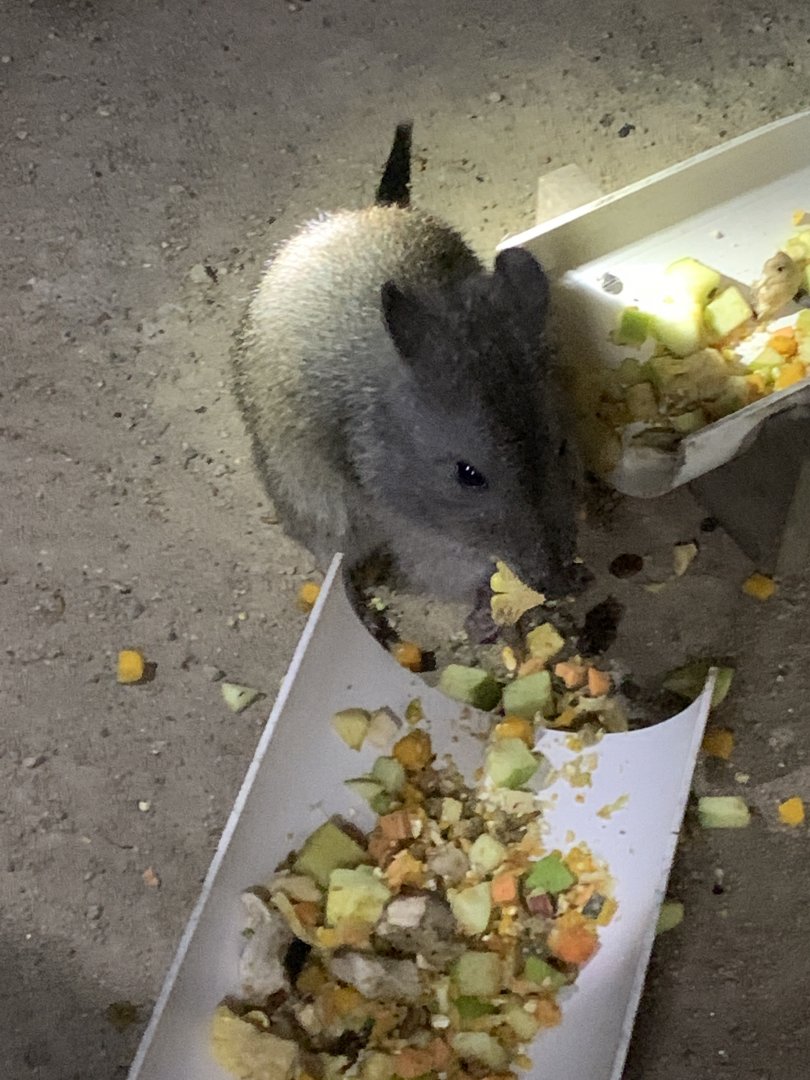
He is really tucking that food away , hahaha, potoroos are adorable.
@Onychorhynchus coronatus if your interested I have a photo of the moonlit potoroos with their food.

He is really tucking that food away , hahaha, potoroos are adorable.
They really are adorable, they have soft fur as well although I found them to be quite wary as I had to make a very pronounced approach.
Speaking of soft fur, feeding and petting a Squirrel Glider is an experience like no other!

AgreedThey really are adorable, they have soft fur as well although I found them to be quite wary as I had to make a very pronounced approach.
Speaking of soft fur, feeding and petting a Squirrel Glider is an experience like no other!


@MRJ This is a bit of a random question, but I'm sort of curious (I guess my fascination with the Potoroidae is pretty obvious by now from the other thread), what do you feed your potoroos and what are their temperaments like in captivity ?
Sorry to butt in, but maybe you might like this short vid too (not from Moonlit sanctuary). It shows afternoon meal for 3 adult potoroos at my home zoo (a lot of vegetable and salad, some pellets/waffers for herbivores, cocroaches, champignon mushroom). Their morning snack is Oyster mushrooms. BTW that animal with white fur around eyes is over 11 years old sweet lady.
 This is brilliant stuff !
She is really quite old for a potoroo isn't she considering that they live such comparatively short lives in the wild ?
Yes, she is old, I think usually potoroos reach only around 6 years, even in captivity. Her name is Prašivka (it means both "unedible mushroom species" in Czech, and it´s also name used for "Scabbers" from local translation of Harry Potter books). She and another large mushroom, note how tame she is, being filmed from few cm.
And very last vid, enrichment for potoroos. A thick layer of dry leaves mixed with various seeds, nuts and insects.

Log into Facebook | FacebookWe are so excited to announce that Luna and Shy, our pair of Yellow-bellied Gliders, have successfully bred for another season and again had TWINS - which is rare!
Shy (female) has been trained to stretch her body out whilst receiving nectar to allow keepers to be able to monitor the health and development of the joeys.
You can see our Yellow-bellied Gliders and Squirrel Gliders on one of our night tours which are currently running on Wednesday, Friday, Saturday and Sunday nights.
Tickets must be booked online.
www.moonlitsanctuary.com.au
#FindYourWayMorningtonPeninsula #VisitFrankston
Log into Facebook | FacebookOur first Orange-bellied Parrot chick for the season has hatched! With less than 50 of these Critically Endangered parrots left in the wild, every chick in captivity counts.
We have more pairs incubating eggs and hope for a great breeding season!
www.moonlitsanctuary.com.au
#FindYourWayMorningtonPeninsula #VisitFrankston

How many now worldwide in captivity?Moonlit has received a Rough-scaled Python (Morelia carinata) from Symbio Wildlife Park: Log into Facebook | Facebook
How many now worldwide in captivity?
Any idea as to current status in wild?

They are rare / rarely seen in the wild but are not of conservation concern. @CGSwans is right they do breed readily in captivity. We obtained one because we use pythons extensively in education and encounters, and they show variation from the stock standard carpet python. Useful when discussing concepts such as evolution and adaption.How many now worldwide in captivity?
Any idea as to current status in wild?
If you mean why are they not seen more often in the wild, they are an uncommon species that live in a rugged, remote and sparsely populated part of the country. If you are implying that because they breed well in captivity they should be more common in the wild there may be any number of reasons why that may not be so. The fact they are difficult to observe makes it difficult to find out why. Catch 22.Do we have any scientific and concrete evidence to explain the lack of visual versus abundance?

I can’t see the article.A new year brings a new challenge. Moonlit Sanctuary will be working to save the New Holland mice, an iconic Mornington Peninsula species, and the smoky mouse, a close relative. An honour to work for their recovery. Thanks for the Federal government funding.
Sign Up | LinkedIn
ps: Sorry not sure if you have to be a member of Linkedin to see the article but when I click the link it takes me straight there.