Mutations

maybe you can see in ultraviolet, and if you can learn to control it you could be a superhero of some sort.....

Yes but I could only do it with just one bird...:confused: I really thought I was seeing things when I saw this 'shiny' jackdaw though- I've seen jackdaws and crows with white feathering(often from malnourishment as nestlings) etc but I've never seen another like this.
 
Yes but I could only do it with just one bird...:confused: I really thought I was seeing things when I saw this 'shiny' jackdaw though- I've seen jackdaws and crows with white feathering(often from malnourishment as nestlings) etc but I've never seen another like this.

Magpies often have bright blue strips on their feathers, wing tips etc. Could a magpie/jackdaw hybrid occur? I'd say a melanistic magpie, but then it wouldn't have the grey jackdaw ruff.
 
No, it was 100% normal jackdaw, BUT with a bright blue sheen(yes, similar to Magpie's) in the areas of plumage I described. It must have been some sort of freak plumage I imagine.
 
The Reptile Zoo in WA state has a Blue Eyes Leucistic Texas Rat Snake. I personally love patternless Diamondback Rattlesnakes, they are captive bred morphs achieved through selective breeding. The Staten Island Zoo has an oddly patterned Burmese Python. I don't think zoos typically display mutations and morphs, because it doesn't closely mirror what you would see in the wild, or what needs our help to conserve.
 
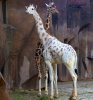
a couple more interesting mutations :)
(photos from the internet)
 

Attachments

  • white giraffe.jpg
    white giraffe.jpg
    106.6 KB · Views: 26
  • white owl.jpg
    white owl.jpg
    56.9 KB · Views: 21
The Reptile Zoo in WA state has a Blue Eyes Leucistic Texas Rat Snake. I personally love patternless Diamondback Rattlesnakes, they are captive bred morphs achieved through selective breeding. The Staten Island Zoo has an oddly patterned Burmese Python. I don't think zoos typically display mutations and morphs, because it doesn't closely mirror what you would see in the wild, or what needs our help to conserve.

The Arizona Sonora Desert Museum displayed a patternless Western Diamondback a few years ago that was wild caught (in someone's yard here in Tucson). So it can happen in the wild.
 
The Arizona Sonora Desert Museum displayed a patternless Western Diamondback a few years ago that was wild caught (in someone's yard here in Tucson). So it can happen in the wild.

wild caught in someone's yard in Tucson =/= it can happen in the wild

Or better it cetainly can but I wouldn't call all wild caught snakes wild born nad whatsmore be sure about their heritage. This way it of course happen in the wild but how naturally is the question. Moreover in Florida etc. of course.
 
Great thread the albion owl is rather spooky, Any link to the Leuthistic saltie at Australia Zoo?
 
here is a rather interesting Fishing cat!

albino-fishing-cat-photo-thumb-425x349.jpg
 
Arizona Docent said:
Wow, that is amazing. Any idea where it was? And are you sure it is a fishing cat?
The One-Eyed Hunter and the Albino Fishing Cat - NatGeo News Watch
selected quotes from the article:
Its distinctively small ears bent flat against its skull, a rare and endangered albino fishing cat paces manically inside its tiny cage at a private zoo in northeastern Bangladesh.

Fishing cats are made for the water, and this one is clearly unhappy with the bars standing between her and Bangladesh's many waterways--but at least she's alive. Washed downriver from India as a small cub during the rainy season four years ago, she was rescued by villagers and carried to an unlikely protector.........
And then there's the albino fishing cat, whose cage bears a sign misidentifying it as a "White Tiger." "It's the only one in Bangladesh," Deb says with a rare bit of pride.

Just how unusual is this mystery cat?

"I've never seen a white fishing cat and, while any species of cat can have an albino turn up, they are extremely rare," says Mel Sunquist, co-author of Wild Cats of the World, and one of the world's leading authorities on the subject.
 
That's a very interesting article. However, in the photo the cat appears to have light colored eyes, NOT red eyes, which would mean it is leucistic and not albino as they describe.
 
I think in domestic cats it's accepted that albinos can have blue eyes (though not all blue eyed white cats are albino). Eg see this example: My Albino Cat Kilo There's a note about genetics in the comments.

I've also heard it said that colourpoint cats (with darker ears, faces, legs and tails, eg Siamese) are a type of albino: they lose pigment on the warmer parts of the body, but have it on cold parts. They also have blue eyes.

Cats with blue eyes (and to a lesser extent ones with dilute gene - which turns black to blue and red to cream, not sure what the scientific term for that would be!) tend to get red eye in photos, where other cat eyes tend to reflect green or yellow.

The point of this being... to me that looks like a blue eyed cat showing a bit of red eye. So it could still be albino?
 
@RowanGreen: Ever learned about the difference between albinism and leucism?
The following (rather basic) wikipedia articles might explain to you why a blue-eyed white cat isn't an albino.
[ame=http://en.wikipedia.org/wiki/Albinism]Albinism - Wikipedia, the free encyclopedia[/ame]
[ame=http://en.wikipedia.org/wiki/Leucism]Leucism - Wikipedia, the free encyclopedia[/ame]
 
You know, that was an off-the-top of the head post, done late at night, and I really expected someone to come up with good reasons why it was at least partially incorrect. Sun, you could have done a lot better. If anything you've provided some evidence in support.

Eg from your first link:

"The human eye normally produces enough pigment to colour the iris and lend opacity to the eye. However, there are cases in which the eyes of an albinistic person appear red or purple, depending on the amount of pigment present."

Note "there are cases in which the eyes of an albinistic person appear red or purple, depending on the amount of pigment present". In other words not all albino humans have red or purple eyes. I have met a human albino: it was many years ago, but I think his eyes were pale blue with a pinkish tinge, definitely not bright pink as seen in many albino animals.

From the second article:
"A further difference between albinism and leucism is in eye colour. Due to the lack of melanin production in both the retinal pigmented epithelium (RPE) and iris, albinos typically have red eyes due to the underlying blood vessels showing through. In contrast, leucistic animals have normally coloured eyes."

Albinos 'typically' have red eyes: not always. Also albinoism alters eye colour, leucism doesn't. The white, leucistic lion shown on that page has yellow eyes, as does a normal lion. Blue eyes in mature cats are nearly always associated with white, showing a link between the white and the eyes.

And of course, blue cats eyes do still reflect red....

Just going to look up some examples *G*
 
Here you go:

Odd-eyed cat - Wikipedia, the free encyclopedia

So, to pick out a few points, blue eyes in cats are caused by lack of melanin, as in albinos.

Notice also that the in the calico cat the blue eye is on the side with the white patch over the eye: this is typical in pied cats with one blue eye.

[ame=http://en.wikipedia.org/wiki/Cat_coat_genetics]Cat coat genetics - Wikipedia, the free encyclopedia[/ame]

Note especially that it describes pointed cats as being temperature sensitive albinos.

Going back to the fishing cat, I did notice that it possibly has a creamy tail. Maybe evidence of pointing? Since points are temperature dependant, they are less distinct in cats kept in warm temperatures, as this one probably is!
 
@RowanGreen: Well, I could have done better, but why to cast pearls before swine? After all, your initial post wasn't the most elaborate piece of work, either.

1. A human eye is not a cat eye, and personal experiences with alleged human albinos are of no interest in this regard.

2. Blue eyes in mammals are a result of a lack (or at least reduction of) eumelanin in the iris. However, in a "true", complete albino, red eyes are typical, wheras in the various forms of leucism, both blue (more often) and red eyes can be observed. "temperature sensitive albinos" is a rather imprecise term.

3. The residual marking rather indicates that said Fishing cat is rather a leucistic or very high grade hypomelanistic specimen. More pics could be useful.
 
Back
Top