
Review of Ripley’s Aquarium of Myrtle Beach
Ripley’s Aquarium of Myrtle Beach | Tickets, hours, events
Amongst all the hustle and bustle of tourists, there are tons of attractions on or near the shores of Myrtle Beach, South Carolina. One of these is today’s topic: Ripley’s Aquarium of Myrtle Beach. This facility was established in June 1997 as the first of three aquariums under the Ripley’s Believe It or Not! franchise; the others are located in the Smokey Mountains (Gatlinburg, Tennessee) and Toronto, Canada. At first, coming from a popular franchise known for world records and excessive oddities, the community and science field couldn’t take the Aquarium all that seriously. Over time, however, Ripley’s would prove them wrong – not only did it succeed it making connections with the public and tourists through educating about the aquatic wildlife just a few steps away in the ocean, but even began serving as an additional hub for rescuing and rehabbing sea turtles. Through further expansions, the Aquarium has cemented itself as one of the town’s biggest hotspots, sitting at around 350 species, consisting of about 10,000 specimens.
This tour was a pretty notable one for me. First off, this is my confirmed 10th Aquarium I’ve visited in my lifetime. Might not sound like much, but for someone that prefers zoos over aquariums, it’s something I suppose. Second, other than SeaWorld Orlando, this was my first taste of experiencing a major aquatic attraction from a notable franchise; I’ve never been to any of those under the “Sea Life,” “SeaQuest,” or any other brands sprinkled around the country, although I have heard not-so-great things about these places in general. Lastly, on an unrelated note, I’m actually a big fan of the Ripley’s brand. I’ve been to a few of the museums, collected a few of their record books, and marveled at all the craziness recorded by man-kind over the years. So, I was pretty curious to see what was in store for me…
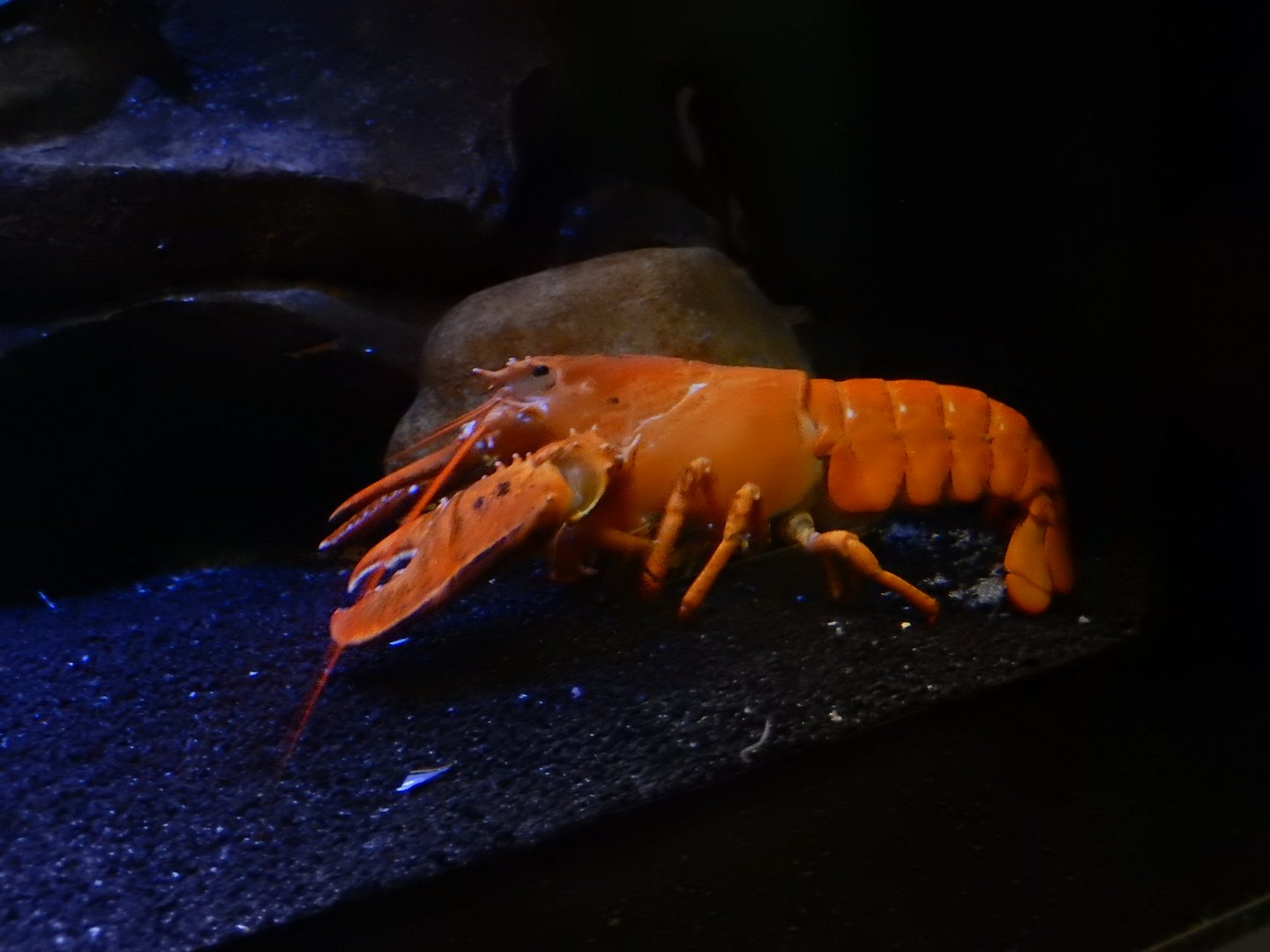
Ocean Wonders – Before going down the darkened hallway, a cylinder tank with African cichlids serves as the welcome wagon to the establishment. After that, tanks oriented on both sides of the hall contain tons of vibrant species in equally attractive environments. Most of them are smaller tropical reefs, but there are a couple exceptions scattered around. For instance, the flagtails have a more rounded display that simulates more of an open ocean as they circle and flock about. Another notable example are the American lobster tanks, which evoke a murky and rocky setting. It isn’t anything fancy, but it’s a nice start to the Aquarium tour. Some of the highlight species (some of which may be firsts for me) include clownfish, five-bar flagtail, flame angelfish, bluestreak cleaner wrasse, Banggai cardinalfish, blue and gold fusilier, potbelly seahorse, American lobster (including an orange individual named Cheddar), and zebra mantis shrimp.
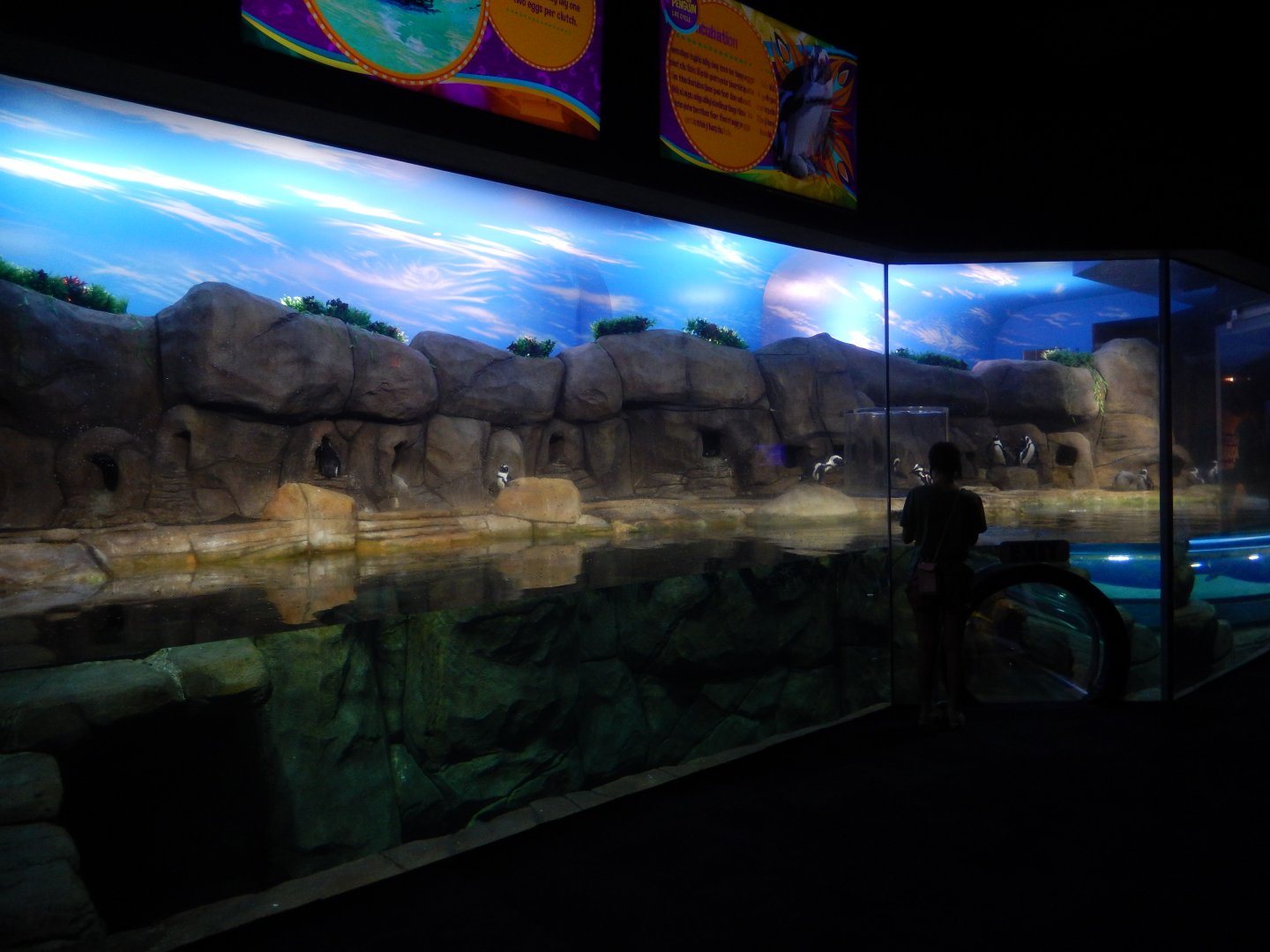
Penguin Playhouse – Opening as part of the Aquarium’s expansion in 2020, this is a single habitat dedicated to African penguins. It’s a narrow, rocky shoreline exhibit that is more or less similar to the likes of Georgia Aquarium or Minnesota’s Penguins of the African Coast, except on the smaller side. However, there are a couple components that save it from being overall run-of-the-mill; first there’s the viewing. I forgot the last time I was able to get so close to the birds without having to fight endless crowds. The viewing windows, especially above water, are massive, providing some great nose-to-beak experiences. Going beneath the water’s surface, guests can crawl through a couple short tunnels that cut through the pool (which may I add seemed a bit shallow), before reaching a pop-up bubble in the middle of the habitat. The second highlight is a dedicated room for acclimating penguins that are either learning to swim or (in the case of my visit) accommodating elderly or molting individuals. I found this to be a nice addition since these are usually reserved for behind-the-scenes.
Savage Seas – This an interesting complex for it combines animal exhibits with a theme that one probably wouldn’t expect. In this case, learning about pirate history and the duties of submarine work take the spotlight. It’s all fairly intriguing, particularly all the pirate artifacts, the ship-like décor and atmosphere of the visitor area, and some of the interactive mechanisms that were a big hit to the stream of children present. One of the coolest aspects was a display for “robotic fish,” which are aquatic robots in various testing stages to simulate the behavior of fish. The only debatable part in my opinion was the general connection of all of this to the aquatic life on-display, mostly due to how the tanks seem to be somewhat overshadowed by the museum-like elements. But on the bright side, the exhibit quality was at least decent, particularly the spadefish, which had a pop-up bubble. Species list: panther chameleon, regal blue tang, Atlantic spadefish, yellow tang, Spanish hogfish, high-hat, among others.
Rio Amazon – There are two different tanks situated side-by-side to give one something to look at as they traverse down the ramp to the rest of the Aquarium. The first is a red-bellied piranha tank that appeared to be cramped for the number of fish on display, while the second habitat is slightly bigger and has some interesting species such as dwarf caiman and catfish (red-tailed and ripsaw), but still could use more space. At first glance, this appears to be a cool section with its immersive features and highlighting a well-known ecosystem; on closer inspection though, these are simply tiny tanks with minimal details that would benefit from a renovation and/or expansion.
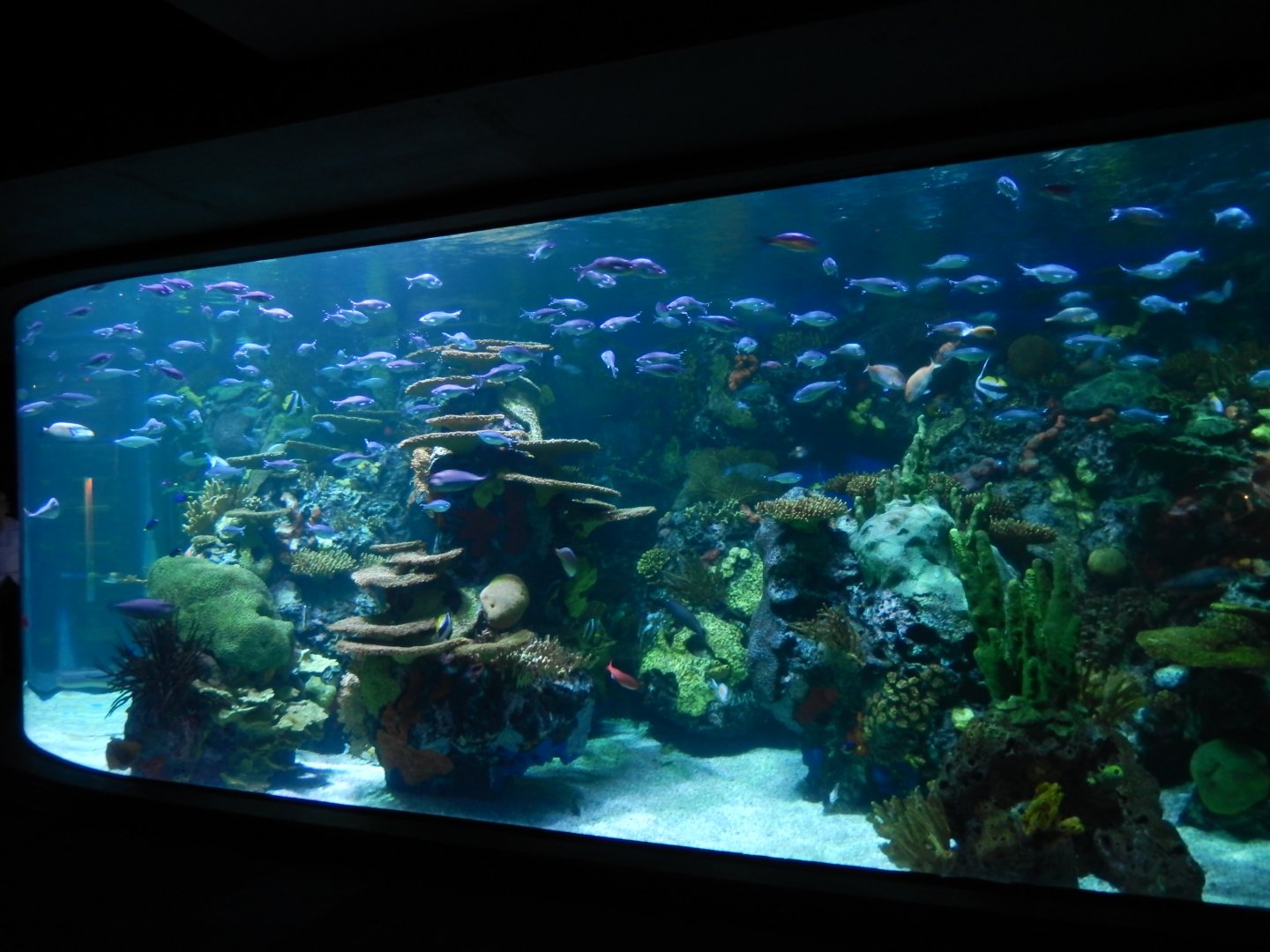
Rainbow Rock – After going past a tall tank with red lionfish (and a lot of them at that!), the main event is a huge, deep coral reef habitat teaming with schools of tropical fish. From angelfish to tangs, there are at least a dozen different species darting about through the sea plants and anemones. It truly made for a stunning and almost dizzying sight, and other than wishing there were a few stationary signs to help identify some species, it’s a “fintastic” display.
Sloth Valley – The newest habitat in the Aquarium, having opened in early 2023. Rico and Cleo are the names of the Linnaeus’ two-toed sloth superstars on display, and there are prominent posters highlighting their individual traits, from demeanors to favorite treats. The sloth display itself is pretty nice, for it’s a good size with large viewing windows, and is fairly naturalistic with plenty of branches and a hollow tree with cavities for the slow-moving critters to do what they do best. In addition, guests get catered to via some shipping crates, jungle research props, and impressive rainforest murals as one walks along to give that immersive touch to the complex. There are even a couple sloth sculptures for photo-ops, and one of my favorite parts was the series of signs showing other sloth species – I was intrigued, for instance, to discover how many species of three-toed sloths there were. Overall, I found this is to be a more successful version of Indianapolis’ former Mistery Park exhibit: a sloth-dedicated area that finds a way to be both unique and engaging at the same time.
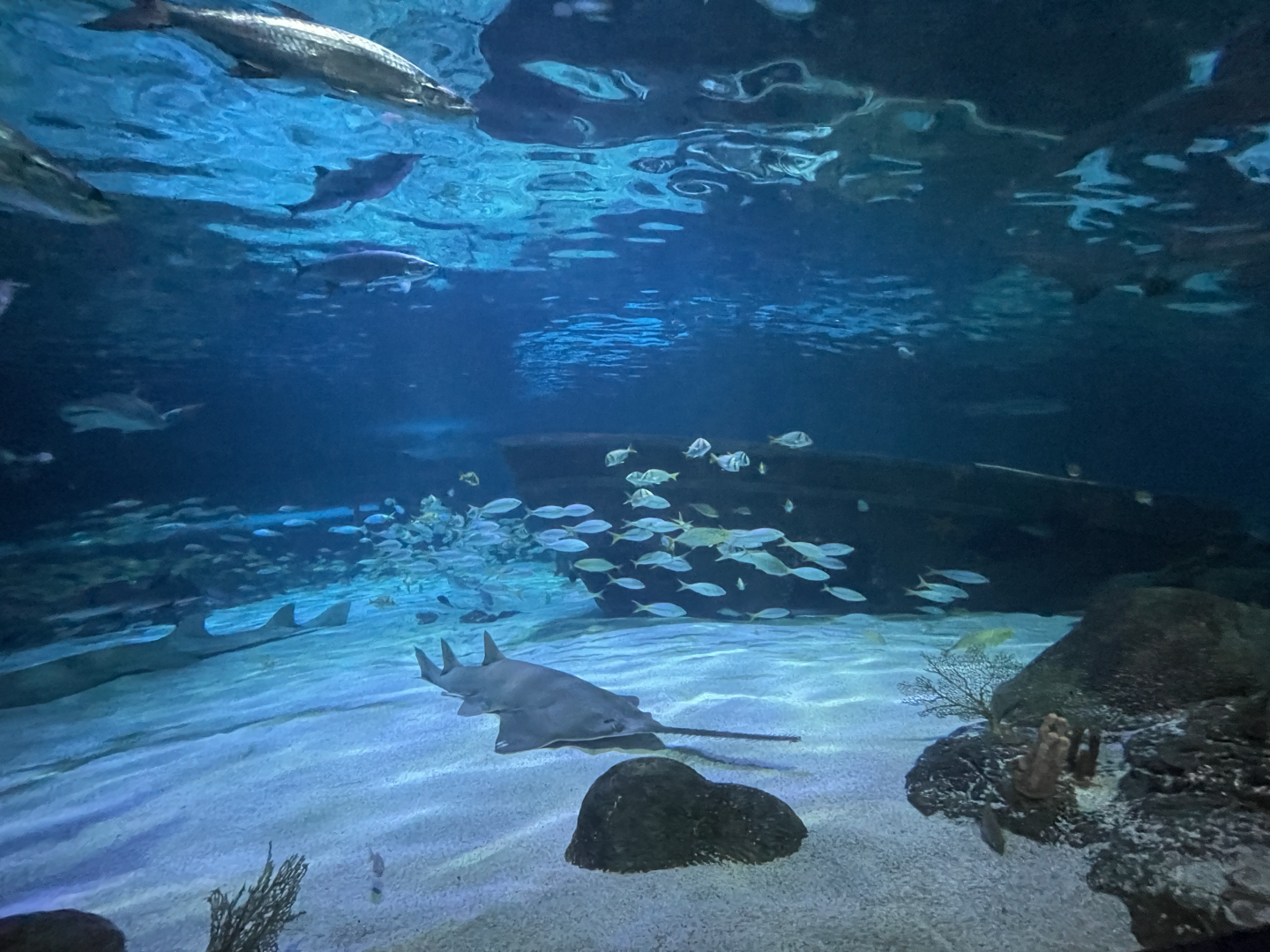
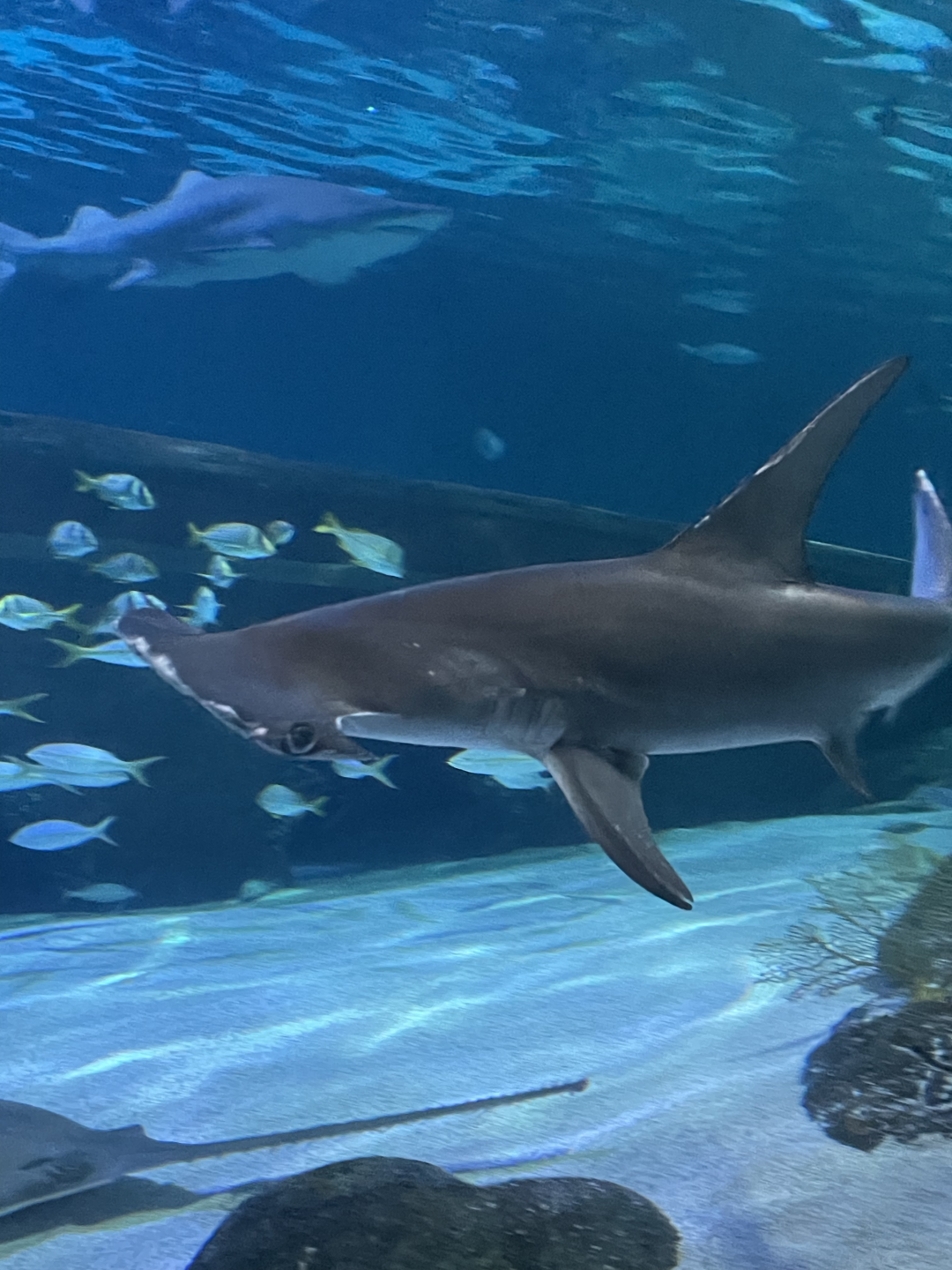
Dangerous Reef – This is, without a shadow of doubt, the biggest and best that the Aquarium has to offer. Visitors can traverse either at their own pace, or on the glidepath that inches along what is one of the longest underwater tunnels I’ve encountered. As one winds around and through the abyss, plenty of sharks (sand tiger, zebra, Atlantic nurse, sandbar, and great hammerhead – new arrivals and a first for me), Atlantic tarpon, sawfish (green and largetooth), blue runner, a green sea turtle, French grunt, and many more swim around, often appearing and disappearing into the deep blue with eerie ease. This is an awesome ocean environment, as it’s a very spacious (though a bit shallow) slice of the deep packed with a sandy bottom, naturalistic-looking rockwork and corals, and even props like an anchor and shipwreck. To go along with this individual display, there are even tanks before and afterwards. The first is home to smaller sharks like the whitetip reef (another first) and blacktip reef, while the second houses a variety of moray eels such as green and laced.
Discovery Center – In the center of the Aquarium is a zone mostly dedicated to kids and educational components. The stand-outs consist of a stationary octopus that can be climbed on for photos, a play structure that looks like a pirate ship, and windows looking into the water and filtration systems for all the facility’s tanks. TV screens nearby play videos explaining how salt, waste, and more are processed in/out of the animal’s homes. On the animal side of things, there’s a couple touch tanks that offer the opportunity to feel invertebrates like moon jellies, starfish, and sea cucumbers (see my “HIGHLIGHT OF THE DAY” section regarding this). Nearby, sharpnose puffer, porcupine fish, and burrfish share a tank that has a pop-up bubble, but seemed small for its occupants.
Living Gallery – Heading down a dimly lit ramp, one will encounter this cluster of tanks that is almost like an extension of Ocean Wonders. These habitats are not too out of the ordinary, but are still nice quality, ranging from miniature reefs with vibrant anemones and urchins, to darkened caves with rocky crags and crevices. Some of the highlights include weedy sea dragon, blue-spotted jawfish, lyretail anthias, octopus, and goldfish.
Ray Bay – A tall, circular tank dedicated mostly to those flat relatives of sharks. A huge pane of curved glass looks out into a sizable habitat, with a sandy bottom and rocky edges. Even above the water the tank is lined with some tropical plants to give off a natural vibe. The overall size and design, combined with watching several rays gliding along made for dynamic viewing, and what I found to be the facility’s second-best area. Also, an unexpected surprise came up when, while walking up the ramp towards the second floor, a ray splashed me and a couple other guests from above! This solid tank contains leopard shark and a variety of stingrays (Atlantic, Southern, cownose, and spotted eagle).
Tropical Rainforest – A quartet of terrariums (one of which was under maintenance) within a tropical setting. There’s a pair of green iguanas that inhabit a small, cave-like rocky space, followed by at least three axolotl in a lush tank that is the best of the bunch, and a minimally-detailed exhibit for bearded dragon. It’s a very brief distraction that gives everyone something to look at while heading up to the second floor, yet has little in quantity and quality that stands out.
Friendship Flats – This is more or less an extension of the Ray Bay tank. Upon coming up the ramp from the previously mentioned herps, there’s a shallow pool shelf that the rays can glide onto to escape the depths. It’s backed by a beachside-themed staff area, where one can pay an additional fee to feed the hungry animals.
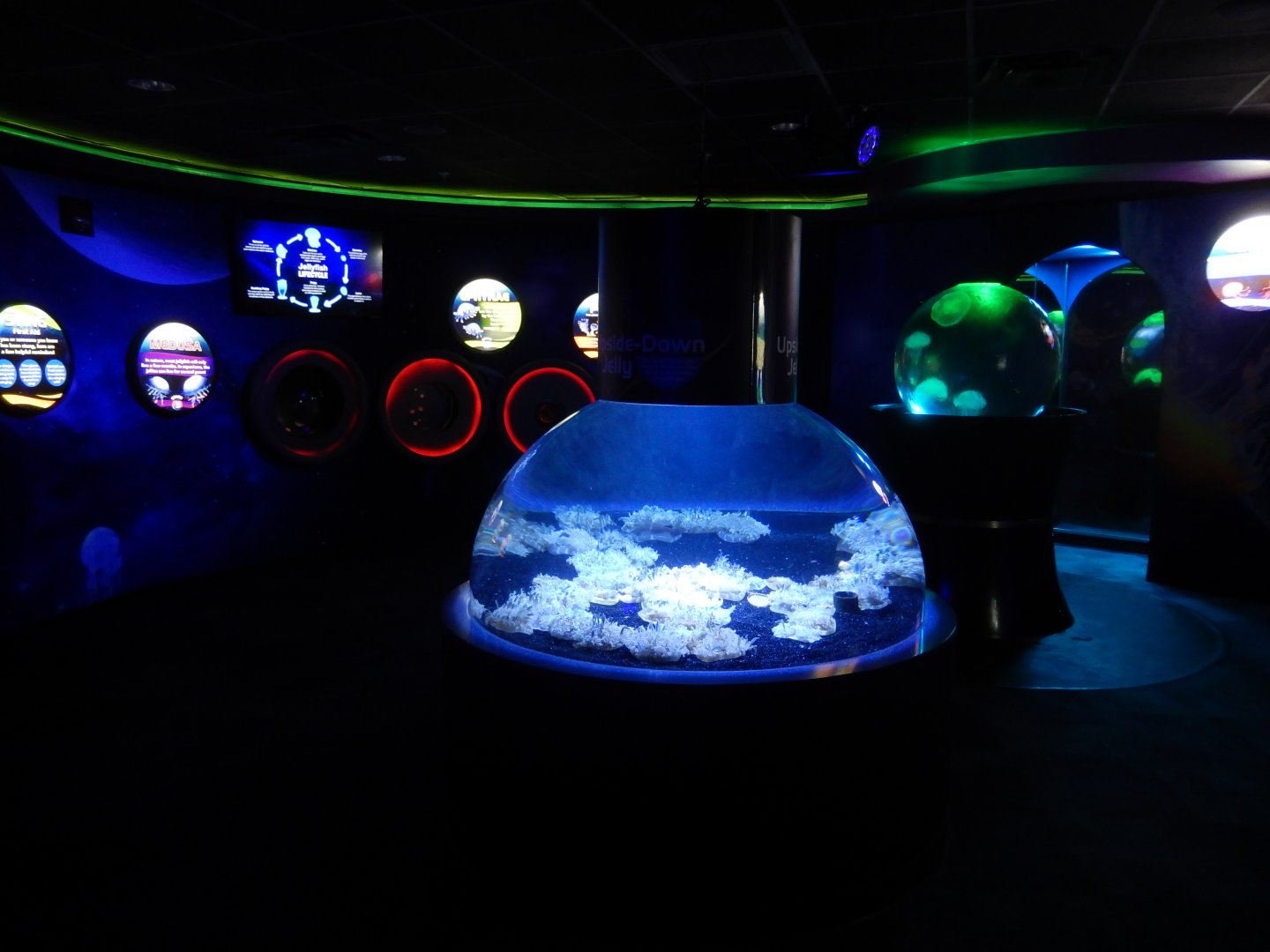
Planet Jellies – With a fascinating group of aquatic invertebrates combined with a neat method of display, this section made for a nice finale to the Aquarium. The largest tank with Pacific sea nettle is the first to be encountered, and watching them float through the water is a tranquil sight as usual. Behind is a dome tank for upside-down jelly, and a trio of tanks for moon jellies, each in different forms of life, combined with a neat timeline about the species’ lifespan and growth stages. It’s all set in a dark environment, with only the signage and occasional neon lights illuminating in the background. There is also a small fountain with frozen-cold water gushing out; this is the temperature used to keep these mysterious creatures healthy. A South American sea nettle tank finishes off this interesting world of jellyfish.
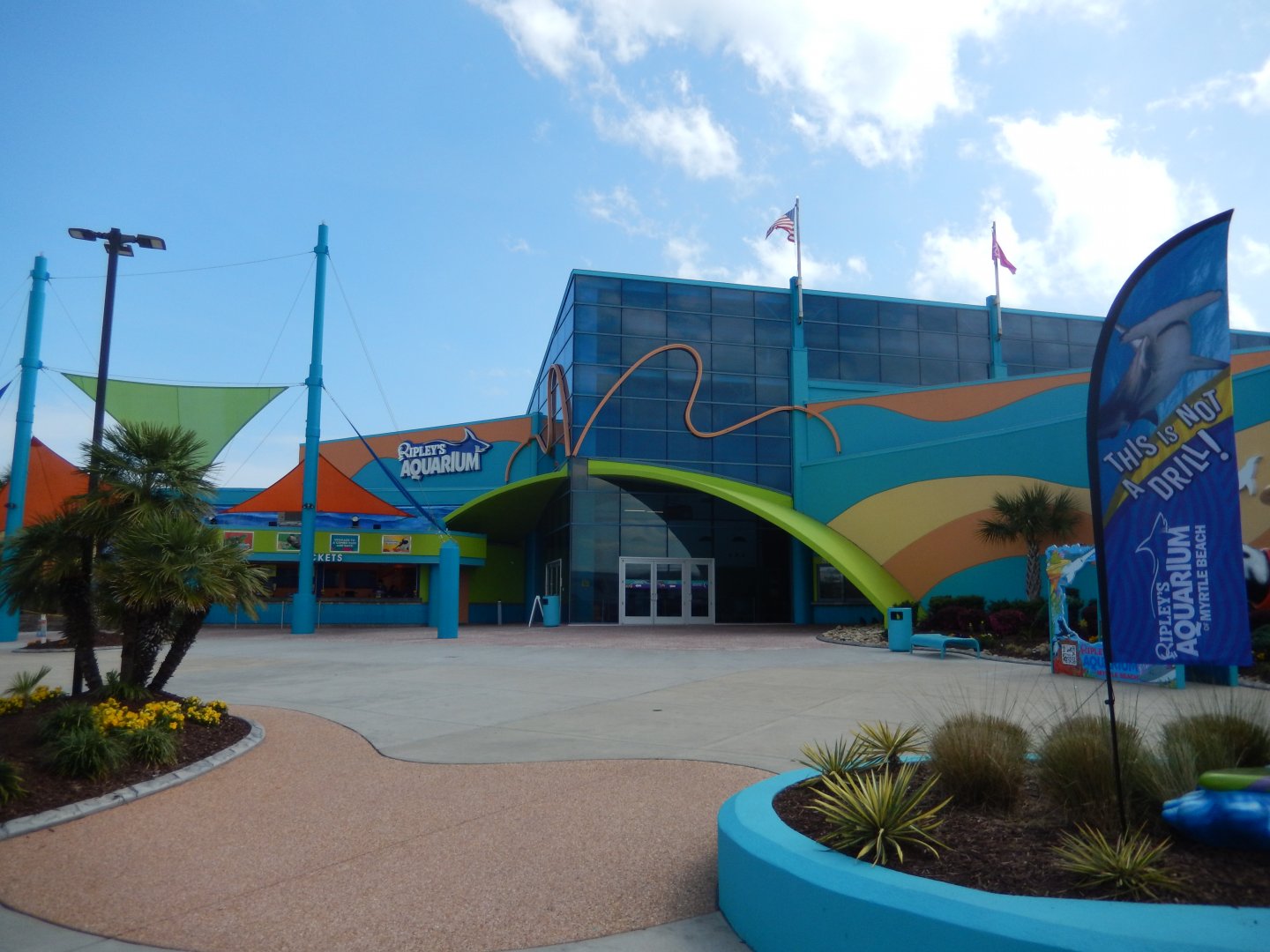
The Aquarium has the advantage of being one of several businesses located on Broadway on the Beach, a mostly outdoor shopping/entertainment venue that surrounds a pretty lagoon. So not only is it easy to fit in amongst a shopping spree or other nearby attractions such as the Hollywood Wax Museum, but it makes for a pretty location especially if one looks across the water at the colorful structure. Going inside, the two-floor facility is reminiscent to the Georgia Aquarium except on a smaller scale. There’s a more modern design and architecture, with models of sharks and a Mosasaurus skeleton hanging from the ceiling, combined with vibrant colors and the occasional theming to match the Ripley’s tone. Once in a while it can get to the point of overshadowing the animals themselves, but it’s mainly restricted to a few areas like Savage Seas and Rio Amazon. Though the signs mostly encourage one to follow a certain route and order (which I did), most of the complexes jut out and return to the main guest areas. This is a nice change of pace from most aquariums’ one-way routes, as it allows for returning to certain sections and reduced crowding. Because of the smaller size and venues outside, there aren’t as many amenities for guests, but they check off the essentials. The entrance gives off a cool first impression, with hedges, sculptures, and waterfalls scattered around the plaza to build up excitement before paying for tickets. Next to Planet Jellies is a small food court, a larger-than-expected gift shop is the last stop before leaving, and children can wear themselves out via playground found on either floor. Finally, there’s a few side attractions to take in, such as mermaid photo-ops, dive shows in Ray Bay and Rainbow Rock, and even a glass-bottom boat tour that sails into the open waters of Dangerous Reef. The latter especially stood out as an unexpected surprise that I would’ve loved to check out, but I sadly missed the day’s last tour.
HIGHLIGHT OF THE DAY: I don’t mind experiencing a touch tank here and there, whether it’s giving a ray a quick touch, or reacting with shock at the rigidness of a sturgeon. This visit marked two touch tank firsts for me. To begin with, I reached in to touch the gelatinous bell of a moon jelly, amazed at the soft squishiness, and how slowly the bell absorbed the point of contact before contracting back to normal shape. Guess the jellyfish scene in Finding Nemo proved true! I also reached into the frigid water to stroke a sea cucumber, curious about its spiked appearance. Looks were deceiving though as the creature was much softer than I imagined. Both were worthwhile and fascinating experiences – are there other jelly touch tanks out there?
OVERALL: So how does Ripley’s Aquarium of Myrtle Beach stack up compared to the lofty standards of the franchise it’s based on? Or the notorious reputation of the brand aquariums that dot the landscape? That’s honestly a tough question to answer. On one hand, it’s easy to see some of the Aquarium’s limits such as the habitat quality being an overall mixed bag (especially the smaller or overstocked displays), and working with a smaller footprint and collection, although these two aren’t exactly the fault of the establishment. On the other hand though, when this facility does apply itself, it can be pretty impressive at times, from its great location and layout, to the exhibitry that does work (Dangerous Reef, Planet Jellies, and Sloth Valley for instance), to even some of its educational elements. There is some promise that can be found here, but it’ll take some work to compete with some facilities of similar stature, particularly in striking a balance between the guest and animal experiences. My recommendation would be for families looking for a brief yet fulfilling break from the excessive tourism of the town, or if one purchases a discounted pass to also access nearby Ripley’s attractions like the haunted house or miniature golf course. For me, I’m glad I saw it and was happy with the positives I took from it, but one visit is most likely going to be enough for me.
Ripley’s Aquarium of Myrtle Beach | Tickets, hours, events
Amongst all the hustle and bustle of tourists, there are tons of attractions on or near the shores of Myrtle Beach, South Carolina. One of these is today’s topic: Ripley’s Aquarium of Myrtle Beach. This facility was established in June 1997 as the first of three aquariums under the Ripley’s Believe It or Not! franchise; the others are located in the Smokey Mountains (Gatlinburg, Tennessee) and Toronto, Canada. At first, coming from a popular franchise known for world records and excessive oddities, the community and science field couldn’t take the Aquarium all that seriously. Over time, however, Ripley’s would prove them wrong – not only did it succeed it making connections with the public and tourists through educating about the aquatic wildlife just a few steps away in the ocean, but even began serving as an additional hub for rescuing and rehabbing sea turtles. Through further expansions, the Aquarium has cemented itself as one of the town’s biggest hotspots, sitting at around 350 species, consisting of about 10,000 specimens.
This tour was a pretty notable one for me. First off, this is my confirmed 10th Aquarium I’ve visited in my lifetime. Might not sound like much, but for someone that prefers zoos over aquariums, it’s something I suppose.
Second, other than SeaWorld Orlando, this was my first taste of experiencing a major aquatic attraction from a notable franchise; I’ve never been to any of those under the “Sea Life,” “SeaQuest,” or any other brands sprinkled around the country, although I have heard not-so-great things about these places in general. Lastly, on an unrelated note, I’m actually a big fan of the Ripley’s brand. I’ve been to a few of the museums, collected a few of their record books, and marveled at all the craziness recorded by man-kind over the years. So, I was pretty curious to see what was in store for me…Animal Habitat Complexes
Ocean Wonders – Before going down the darkened hallway, a cylinder tank with African cichlids serves as the welcome wagon to the establishment. After that, tanks oriented on both sides of the hall contain tons of vibrant species in equally attractive environments. Most of them are smaller tropical reefs, but there are a couple exceptions scattered around. For instance, the flagtails have a more rounded display that simulates more of an open ocean as they circle and flock about. Another notable example are the American lobster tanks, which evoke a murky and rocky setting. It isn’t anything fancy, but it’s a nice start to the Aquarium tour. Some of the highlight species (some of which may be firsts for me) include clownfish, five-bar flagtail, flame angelfish, bluestreak cleaner wrasse, Banggai cardinalfish, blue and gold fusilier, potbelly seahorse, American lobster (including an orange individual named Cheddar), and zebra mantis shrimp.
Penguin Playhouse – Opening as part of the Aquarium’s expansion in 2020, this is a single habitat dedicated to African penguins. It’s a narrow, rocky shoreline exhibit that is more or less similar to the likes of Georgia Aquarium or Minnesota’s Penguins of the African Coast, except on the smaller side. However, there are a couple components that save it from being overall run-of-the-mill; first there’s the viewing. I forgot the last time I was able to get so close to the birds without having to fight endless crowds. The viewing windows, especially above water, are massive, providing some great nose-to-beak experiences. Going beneath the water’s surface, guests can crawl through a couple short tunnels that cut through the pool (which may I add seemed a bit shallow), before reaching a pop-up bubble in the middle of the habitat. The second highlight is a dedicated room for acclimating penguins that are either learning to swim or (in the case of my visit) accommodating elderly or molting individuals. I found this to be a nice addition since these are usually reserved for behind-the-scenes.
Savage Seas – This an interesting complex for it combines animal exhibits with a theme that one probably wouldn’t expect. In this case, learning about pirate history and the duties of submarine work take the spotlight. It’s all fairly intriguing, particularly all the pirate artifacts, the ship-like décor and atmosphere of the visitor area, and some of the interactive mechanisms that were a big hit to the stream of children present. One of the coolest aspects was a display for “robotic fish,” which are aquatic robots in various testing stages to simulate the behavior of fish. The only debatable part in my opinion was the general connection of all of this to the aquatic life on-display, mostly due to how the tanks seem to be somewhat overshadowed by the museum-like elements.
But on the bright side, the exhibit quality was at least decent, particularly the spadefish, which had a pop-up bubble. Species list: panther chameleon, regal blue tang, Atlantic spadefish, yellow tang, Spanish hogfish, high-hat, among others.Rio Amazon – There are two different tanks situated side-by-side to give one something to look at as they traverse down the ramp to the rest of the Aquarium. The first is a red-bellied piranha tank that appeared to be cramped for the number of fish on display, while the second habitat is slightly bigger and has some interesting species such as dwarf caiman and catfish (red-tailed and ripsaw), but still could use more space. At first glance, this appears to be a cool section with its immersive features and highlighting a well-known ecosystem; on closer inspection though, these are simply tiny tanks with minimal details that would benefit from a renovation and/or expansion.
Rainbow Rock – After going past a tall tank with red lionfish (and a lot of them at that!), the main event is a huge, deep coral reef habitat teaming with schools of tropical fish. From angelfish to tangs, there are at least a dozen different species darting about through the sea plants and anemones. It truly made for a stunning and almost dizzying sight, and other than wishing there were a few stationary signs to help identify some species, it’s a “fintastic” display.
4/1/2025 - Rainbow Rock
Many species of angelfish, tang, etc. swim around this beautiful slice of the ocean.
Sloth Valley – The newest habitat in the Aquarium, having opened in early 2023. Rico and Cleo are the names of the Linnaeus’ two-toed sloth superstars on display, and there are prominent posters highlighting their individual traits, from demeanors to favorite treats. The sloth display itself is pretty nice, for it’s a good size with large viewing windows, and is fairly naturalistic with plenty of branches and a hollow tree with cavities for the slow-moving critters to do what they do best. In addition, guests get catered to via some shipping crates, jungle research props, and impressive rainforest murals as one walks along to give that immersive touch to the complex. There are even a couple sloth sculptures for photo-ops, and one of my favorite parts was the series of signs showing other sloth species – I was intrigued, for instance, to discover how many species of three-toed sloths there were. Overall, I found this is to be a more successful version of Indianapolis’ former Mistery Park exhibit: a sloth-dedicated area that finds a way to be both unique and engaging at the same time.
Dangerous Reef – This is, without a shadow of doubt, the biggest and best that the Aquarium has to offer. Visitors can traverse either at their own pace, or on the glidepath that inches along what is one of the longest underwater tunnels I’ve encountered. As one winds around and through the abyss, plenty of sharks (sand tiger, zebra, Atlantic nurse, sandbar, and great hammerhead – new arrivals and a first for me), Atlantic tarpon, sawfish (green and largetooth), blue runner, a green sea turtle, French grunt, and many more swim around, often appearing and disappearing into the deep blue with eerie ease. This is an awesome ocean environment, as it’s a very spacious (though a bit shallow) slice of the deep packed with a sandy bottom, naturalistic-looking rockwork and corals, and even props like an anchor and shipwreck. To go along with this individual display, there are even tanks before and afterwards. The first is home to smaller sharks like the whitetip reef (another first) and blacktip reef, while the second houses a variety of moray eels such as green and laced.
4/1/2025 - Dangerous Reef General View
This is the facility's greatest area without question.
4/1/2025 - Great Hammerhead
This species was brand-new to the Aquarium at the time of my visit.
Discovery Center – In the center of the Aquarium is a zone mostly dedicated to kids and educational components. The stand-outs consist of a stationary octopus that can be climbed on for photos, a play structure that looks like a pirate ship, and windows looking into the water and filtration systems for all the facility’s tanks. TV screens nearby play videos explaining how salt, waste, and more are processed in/out of the animal’s homes. On the animal side of things, there’s a couple touch tanks that offer the opportunity to feel invertebrates like moon jellies, starfish, and sea cucumbers (see my “HIGHLIGHT OF THE DAY” section regarding this). Nearby, sharpnose puffer, porcupine fish, and burrfish share a tank that has a pop-up bubble, but seemed small for its occupants.
Living Gallery – Heading down a dimly lit ramp, one will encounter this cluster of tanks that is almost like an extension of Ocean Wonders. These habitats are not too out of the ordinary, but are still nice quality, ranging from miniature reefs with vibrant anemones and urchins, to darkened caves with rocky crags and crevices. Some of the highlights include weedy sea dragon, blue-spotted jawfish, lyretail anthias, octopus, and goldfish.
Ray Bay – A tall, circular tank dedicated mostly to those flat relatives of sharks. A huge pane of curved glass looks out into a sizable habitat, with a sandy bottom and rocky edges. Even above the water the tank is lined with some tropical plants to give off a natural vibe. The overall size and design, combined with watching several rays gliding along made for dynamic viewing, and what I found to be the facility’s second-best area. Also, an unexpected surprise came up when, while walking up the ramp towards the second floor, a ray splashed me and a couple other guests from above!
This solid tank contains leopard shark and a variety of stingrays (Atlantic, Southern, cownose, and spotted eagle).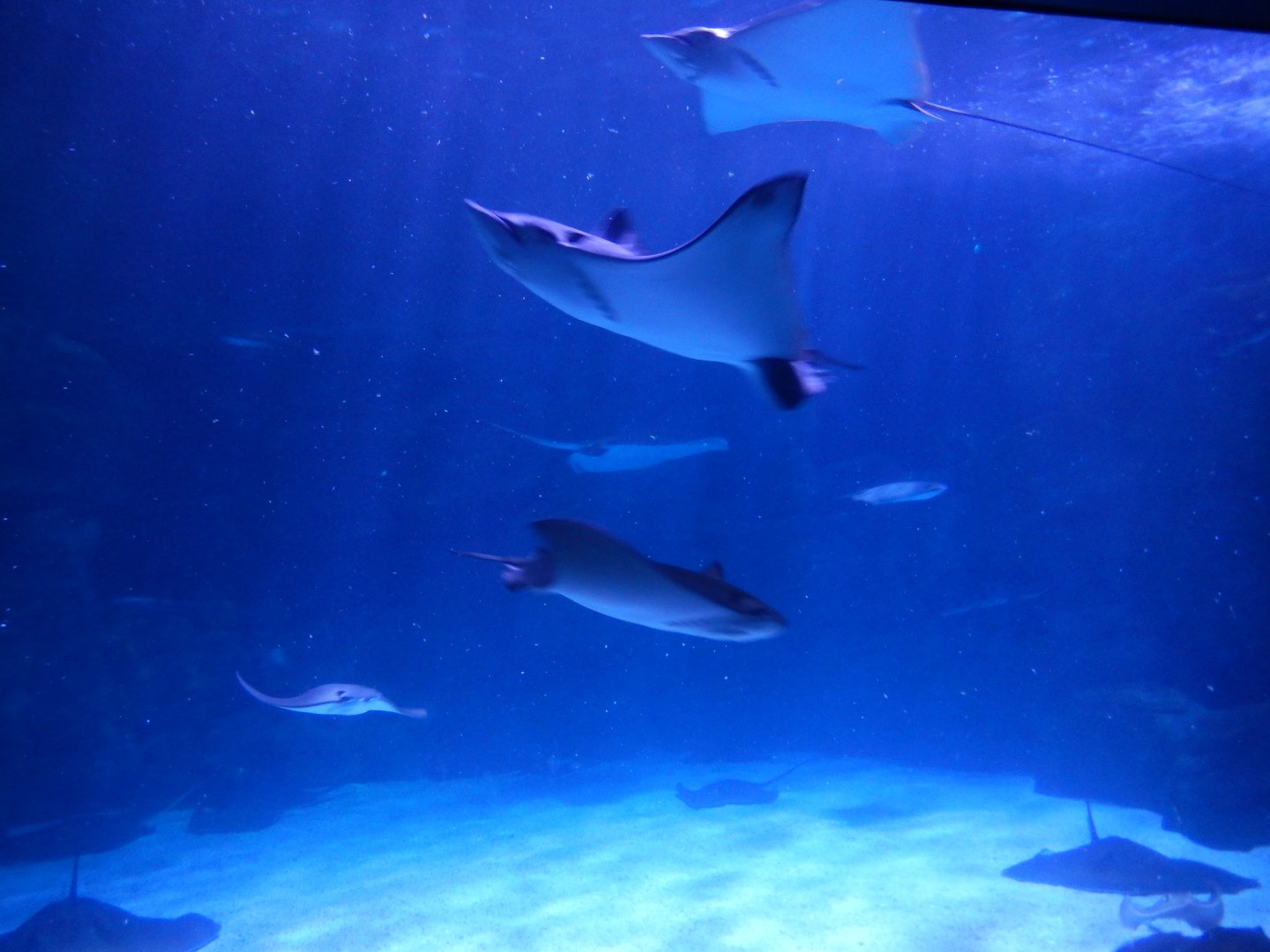
Tropical Rainforest – A quartet of terrariums (one of which was under maintenance) within a tropical setting. There’s a pair of green iguanas that inhabit a small, cave-like rocky space, followed by at least three axolotl in a lush tank that is the best of the bunch, and a minimally-detailed exhibit for bearded dragon. It’s a very brief distraction that gives everyone something to look at while heading up to the second floor, yet has little in quantity and quality that stands out.
Friendship Flats – This is more or less an extension of the Ray Bay tank. Upon coming up the ramp from the previously mentioned herps, there’s a shallow pool shelf that the rays can glide onto to escape the depths. It’s backed by a beachside-themed staff area, where one can pay an additional fee to feed the hungry animals.
Planet Jellies – With a fascinating group of aquatic invertebrates combined with a neat method of display, this section made for a nice finale to the Aquarium. The largest tank with Pacific sea nettle is the first to be encountered, and watching them float through the water is a tranquil sight as usual. Behind is a dome tank for upside-down jelly, and a trio of tanks for moon jellies, each in different forms of life, combined with a neat timeline about the species’ lifespan and growth stages. It’s all set in a dark environment, with only the signage and occasional neon lights illuminating in the background. There is also a small fountain with frozen-cold water gushing out; this is the temperature used to keep these mysterious creatures healthy. A South American sea nettle tank finishes off this interesting world of jellyfish.
4/1/2025 - Planet Jellies General Area
Pictured here is the upside down jelly tank, a trio of jellyfish life-stage tank, and other...
Visitor Experiences
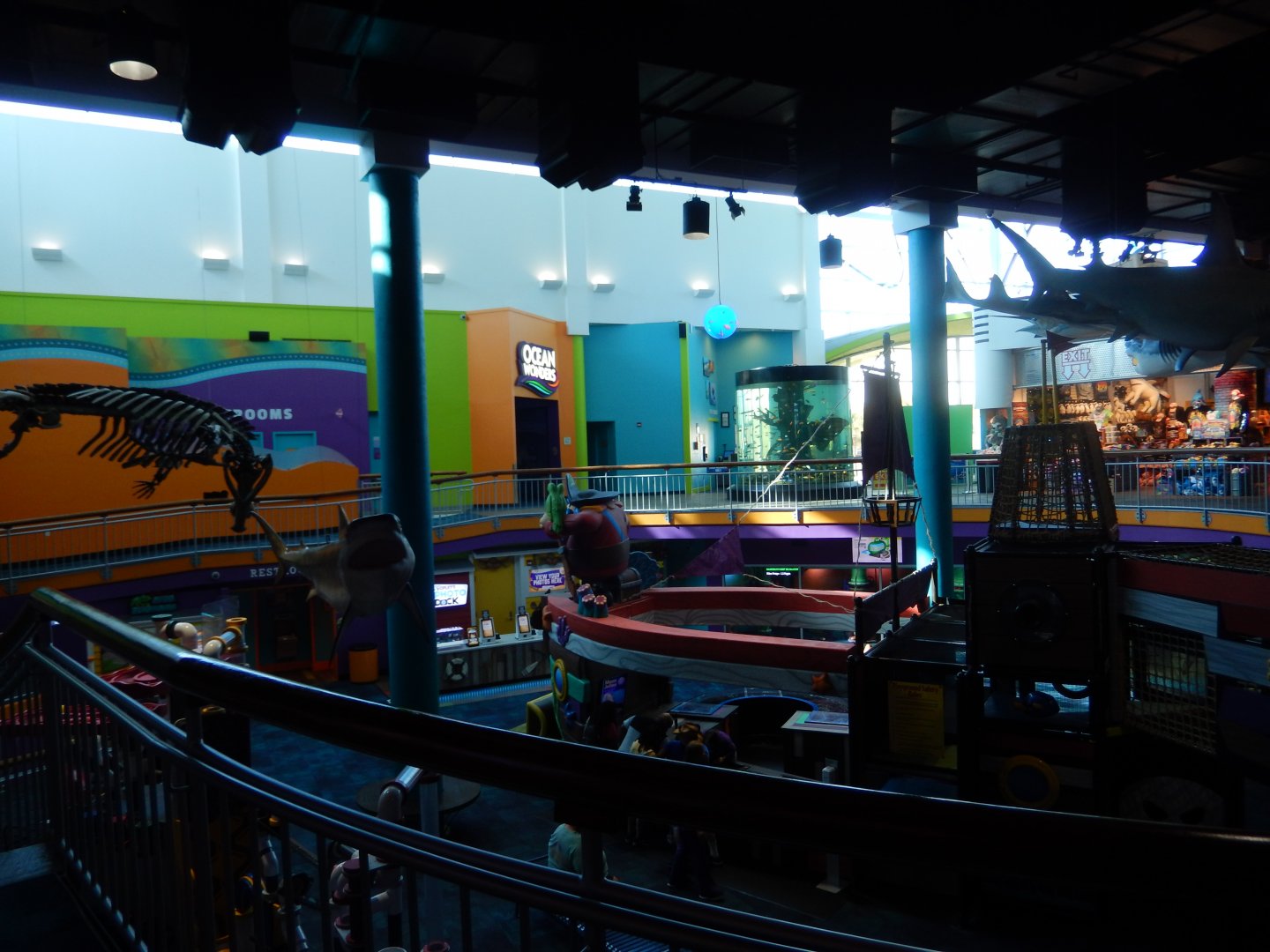
The Aquarium has the advantage of being one of several businesses located on Broadway on the Beach, a mostly outdoor shopping/entertainment venue that surrounds a pretty lagoon. So not only is it easy to fit in amongst a shopping spree or other nearby attractions such as the Hollywood Wax Museum, but it makes for a pretty location especially if one looks across the water at the colorful structure. Going inside, the two-floor facility is reminiscent to the Georgia Aquarium except on a smaller scale. There’s a more modern design and architecture, with models of sharks and a Mosasaurus skeleton hanging from the ceiling, combined with vibrant colors and the occasional theming to match the Ripley’s tone. Once in a while it can get to the point of overshadowing the animals themselves, but it’s mainly restricted to a few areas like Savage Seas and Rio Amazon. Though the signs mostly encourage one to follow a certain route and order (which I did), most of the complexes jut out and return to the main guest areas. This is a nice change of pace from most aquariums’ one-way routes, as it allows for returning to certain sections and reduced crowding. Because of the smaller size and venues outside, there aren’t as many amenities for guests, but they check off the essentials. The entrance gives off a cool first impression, with hedges, sculptures, and waterfalls scattered around the plaza to build up excitement before paying for tickets. Next to Planet Jellies is a small food court, a larger-than-expected gift shop is the last stop before leaving, and children can wear themselves out via playground found on either floor. Finally, there’s a few side attractions to take in, such as mermaid photo-ops, dive shows in Ray Bay and Rainbow Rock, and even a glass-bottom boat tour that sails into the open waters of Dangerous Reef. The latter especially stood out as an unexpected surprise that I would’ve loved to check out, but I sadly missed the day’s last tour.
4/1/2025 - General Area of the Aquarium
This over looks the Discovery Center on the lower floor.
HIGHLIGHT OF THE DAY: I don’t mind experiencing a touch tank here and there, whether it’s giving a ray a quick touch, or reacting with shock at the rigidness of a sturgeon. This visit marked two touch tank firsts for me. To begin with, I reached in to touch the gelatinous bell of a moon jelly, amazed at the soft squishiness, and how slowly the bell absorbed the point of contact before contracting back to normal shape. Guess the jellyfish scene in Finding Nemo proved true! I also reached into the frigid water to stroke a sea cucumber, curious about its spiked appearance. Looks were deceiving though as the creature was much softer than I imagined. Both were worthwhile and fascinating experiences – are there other jelly touch tanks out there?
OVERALL: So how does Ripley’s Aquarium of Myrtle Beach stack up compared to the lofty standards of the franchise it’s based on? Or the notorious reputation of the brand aquariums that dot the landscape? That’s honestly a tough question to answer. On one hand, it’s easy to see some of the Aquarium’s limits such as the habitat quality being an overall mixed bag (especially the smaller or overstocked displays), and working with a smaller footprint and collection, although these two aren’t exactly the fault of the establishment. On the other hand though, when this facility does apply itself, it can be pretty impressive at times, from its great location and layout, to the exhibitry that does work (Dangerous Reef, Planet Jellies, and Sloth Valley for instance), to even some of its educational elements. There is some promise that can be found here, but it’ll take some work to compete with some facilities of similar stature, particularly in striking a balance between the guest and animal experiences. My recommendation would be for families looking for a brief yet fulfilling break from the excessive tourism of the town, or if one purchases a discounted pass to also access nearby Ripley’s attractions like the haunted house or miniature golf course. For me, I’m glad I saw it and was happy with the positives I took from it, but one visit is most likely going to be enough for me.