You are using an out of date browser. It may not display this or other websites correctly.
You should upgrade or use an alternative browser.
You should upgrade or use an alternative browser.
Myrtle Beach Zoological Park - A 'New' Project
- Thread starter Van Beal
- Start date


Van Beal
Well-Known Member
Our ventures into the Mediterranean Aquatic Centre begin with a group of four terrestrial tanks with 30cmx30cmx40cm dimensions. Replicating the rocky and arid landscapes of the Mediterranean nations, rock shelves conceal the central silk-lined retreat for the solitary Mediterranean Ladybird Spider Eresus walckenaeri (2.2) which inhabit each tank. While the spiders' main hides are concealed, their web tunnels extend from the sides and up the exhibit walls, connecting with the smaller branch structures which form pseudo-root systems to provide these hides with further structural integrity.
Beyond these four tanks, visitors can find a pair of 3 sq. meter (800 gallon) tanks, focalized by a series of rock structures and a small quantity of aquatic plants. This entire area is under surveillance, as are the backstage areas, with the added security intended to make note of the reputation the first tank's inhabitant has. This is the Common Octopus Octopus vulgaris (0.0.1), a true escape artist of a cephalopod. Next door is a more calm-natured species in the European Conger Conger conger (0.0.4), often seen poking their heads out of the crevices in the rocks.

Possible Look of Spider Tanks
Image Credit -> @CarnotaurusSastrei
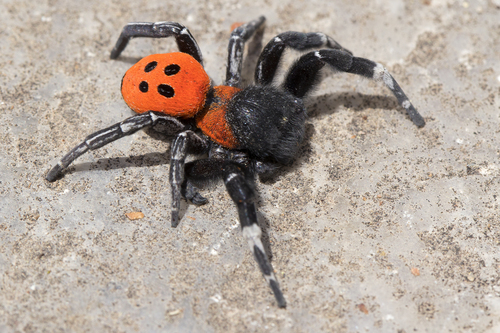
Mediterranean Ladybird Spider
Image Source -> iNaturalist

Possible Look of Octopus and Conger Tanks
Image Credit -> @British explorer

Common Octopus
Image Credit -> @SusScrofa

European Conger
Image Source -> ZooTierListe
A short walk down a blue-lit hallway, and visitors find themselves face-to-face with a 10m long, 3m high viewing window (which goes from the floor to about 1.5m below the water's surface) into a massive tank which does feed into the "separate" area for the Loggerhead Turtle Caretta caretta which we saw outside the building. This 275,000-gallon Mediterranean reef tank is the home to eight other species alongside the previously-seen rescued turtles. The two largest of the inhabitants are often seen along the tank's sandy floor, deftly maneuvering between the larger false-coral structures. Each of the two larger species, being our Atlantic Nurse Shark Ginglymostoma cirratum (0.3) and Common Guitarfish Rhinobatos rhinobatos (2.2), are often found sifting through the loose sand for the shrimp and crab the keepers drop down into the tank. When these larger species have had their share of the crustacean meat, a slew of smaller fish will make their way to the leftovers, chief among them being our sizeable schools of East Atlantic Peacok Wrasse Symphodus tinca (0.0.15) and Derbio Trachinotus ovatus (0.0.30), with our smaller school of Pearly Razorfish Xyrichthys novacula (0.0.6) and Sharpsnout Seabream Diplodus puntazzo (0.0.10) also making opportunity of the larger species' leftovers, with the seabream making the majority of its diet from the eelgrass growing around the reef. The two latter species will also take morsels of the diet given to our European Seabass Dicentrarchus labrax (0.0.10), made up predominantly of smaller fish. All the while, in a shimmering ball of silver, our school of Flathead Mullet Mugil cephalus (0.0.40) feeds on the microorganisms in the water, while breeding at a rate which neutralizes any potential predation by other larger species.


Possible Look of Mediterranean Reef Aquarium
Top Image -> @Philipine eagle
Bottom Image -> @Moebelle

Atlantic Nurse Shark
Image Credit -> @Northwest_FIsh_Keeping

Common Guitarfish
Image Credit -> @RatioTile

East Atlantic Peacock Wrasse
Image Credit -> @DaLilFishie
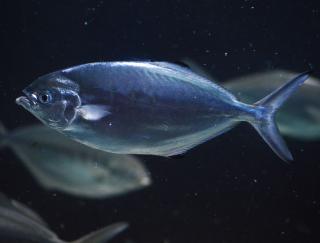
Derbio
Image Source -> ZooTierListe

Pearly Razorfish
Image Credit -> @Sicarius

Sharpsnout Seabream
Image Source -> ZooTierListe


Top: European Seabass
Bottom: Flathead Mullet
Image Credit -> @KevinB
And with that, the exit door is to the left of the viewing window, though there is bench seating and trash bins if you would rather stay put for a while, maybe eat your lunch. Regardless, upon deciding to finally exit the Mediterranean Aquatic Centre, the realization comes that we have completed the first subsection of the Eurasian-Oriental Trail! Ahead, what was a bare landscape for the very brief duration of the Mediterranean Shores already begins to fade into dense woodlands, as we delve into the temperate regions of Europe and the border between Europe and Asia, with the Eurasia's Divide region of the zoo.
For now, stay tuned and enjoy!
Beyond these four tanks, visitors can find a pair of 3 sq. meter (800 gallon) tanks, focalized by a series of rock structures and a small quantity of aquatic plants. This entire area is under surveillance, as are the backstage areas, with the added security intended to make note of the reputation the first tank's inhabitant has. This is the Common Octopus Octopus vulgaris (0.0.1), a true escape artist of a cephalopod. Next door is a more calm-natured species in the European Conger Conger conger (0.0.4), often seen poking their heads out of the crevices in the rocks.
Possible Look of Spider Tanks
Image Credit -> @CarnotaurusSastrei
Mediterranean Ladybird Spider
Image Source -> iNaturalist
Possible Look of Octopus and Conger Tanks
Image Credit -> @British explorer
Common Octopus
Image Credit -> @SusScrofa
European Conger
Image Source -> ZooTierListe
A short walk down a blue-lit hallway, and visitors find themselves face-to-face with a 10m long, 3m high viewing window (which goes from the floor to about 1.5m below the water's surface) into a massive tank which does feed into the "separate" area for the Loggerhead Turtle Caretta caretta which we saw outside the building. This 275,000-gallon Mediterranean reef tank is the home to eight other species alongside the previously-seen rescued turtles. The two largest of the inhabitants are often seen along the tank's sandy floor, deftly maneuvering between the larger false-coral structures. Each of the two larger species, being our Atlantic Nurse Shark Ginglymostoma cirratum (0.3) and Common Guitarfish Rhinobatos rhinobatos (2.2), are often found sifting through the loose sand for the shrimp and crab the keepers drop down into the tank. When these larger species have had their share of the crustacean meat, a slew of smaller fish will make their way to the leftovers, chief among them being our sizeable schools of East Atlantic Peacok Wrasse Symphodus tinca (0.0.15) and Derbio Trachinotus ovatus (0.0.30), with our smaller school of Pearly Razorfish Xyrichthys novacula (0.0.6) and Sharpsnout Seabream Diplodus puntazzo (0.0.10) also making opportunity of the larger species' leftovers, with the seabream making the majority of its diet from the eelgrass growing around the reef. The two latter species will also take morsels of the diet given to our European Seabass Dicentrarchus labrax (0.0.10), made up predominantly of smaller fish. All the while, in a shimmering ball of silver, our school of Flathead Mullet Mugil cephalus (0.0.40) feeds on the microorganisms in the water, while breeding at a rate which neutralizes any potential predation by other larger species.
Possible Look of Mediterranean Reef Aquarium
Top Image -> @Philipine eagle
Bottom Image -> @Moebelle
Atlantic Nurse Shark
Image Credit -> @Northwest_FIsh_Keeping
Common Guitarfish
Image Credit -> @RatioTile
East Atlantic Peacock Wrasse
Image Credit -> @DaLilFishie
Derbio
Image Source -> ZooTierListe
Pearly Razorfish
Image Credit -> @Sicarius
Sharpsnout Seabream
Image Source -> ZooTierListe
Top: European Seabass
Bottom: Flathead Mullet
Image Credit -> @KevinB
And with that, the exit door is to the left of the viewing window, though there is bench seating and trash bins if you would rather stay put for a while, maybe eat your lunch. Regardless, upon deciding to finally exit the Mediterranean Aquatic Centre, the realization comes that we have completed the first subsection of the Eurasian-Oriental Trail! Ahead, what was a bare landscape for the very brief duration of the Mediterranean Shores already begins to fade into dense woodlands, as we delve into the temperate regions of Europe and the border between Europe and Asia, with the Eurasia's Divide region of the zoo.
For now, stay tuned and enjoy!
Van Beal
Well-Known Member
From the bare, xeric landscape of the Mediterranean to the dense temperate woodlands of western Europe, visitors make the journey into the second portion of the Eurasian-Oriental Trail. As the concrete we've become used to feeling underfoot turns into fragmented, overgrown cobblestone, and the Mediterranean Aquatic Centre disappears behind the trees, the first habitat in the area comes into view. It is a more inconspicuous space along the left-hand side of the path, with a chest-high palisade of logs forming the barrier on the visitor side, while a simple sloping moat down to a level where the inhabitants cannot jump out provides the animal-side separation. For the most part, the rest of the habitat's fences remain concealed by the dense foliage around the perimeter of the 2.5-acre space, with the only other signs of development being the barn located on the right-hand corner of this space at the far end. This barn provides indoor housing for the inhabitants of this space, the next space, and the two off-display yards on the opposite side of the barn. In this habitat, visitors can look in on our herd of European Fallow Deer Dama dama (4.7), made up of the breeding buck, five does, and 3.2 orphaned fawns. A second adult male (1.0) is kept off-display, as he shares the same purpose as his competitor.
A short walk along the path brings visitors to a 2,450 sq. meter habitat which utilizes the same palisade-like barrier as the sole separation between visitor and animal. However, this palisade is firmly built into a concrete foundation, and each log is reinforced with a simple metal pole running through it. These two fortifications are made to ensure the species in this space, given access to the fence, is unable to break the barrier down and gain access to visitors. Unlike the deer yard, which was dense with low-lying plant life, the only surviving greenery in this space comes in the form of thick-trunked broadleaf trees, while all other plants fail to thrive under the constant rummaging of our Eurasian Wild Boar Sus scrofa (3.6). Much like the fallow deer, the boars have an off-display yard, however this one is more rotational, with the males and females swapping between the two.

Possible Look of Fallow Deer Habitat
Image Credit -> @Philipine eagle

European Fallow Deer
Image Credit -> @SivatheriumGuy

Possible Look of Boar Habitat
Image Credit -> @gulogulogulo

Wild Boar
Image Credit -> @Jakub
While the woods return to their seemingly impenetrable nature beyond the boar habitat, they open up across the path into a large swathe of wetland. This area, covering roughly 3 acres and contained within two 1.5-acre aviaries, was formed by the zoo with this exact layout in mind. The visitor path splits, with one branch running alongside the front of these aviaries, while the other runs through the middle of each space. In each space, the pathway winds alongside and beneath the boughs of willow and cypress trees, with stands of reeds concealing the elevated walkway's supports, which provide a sheltered area for many of our waterfowl to nest. The first aviary displays half a dozen species, while the second displays just four, with one having made the trip between the two following a bit of interspecies hostility.
In the first aviary, visitors can see two species flying overhead, while the other four are more often found paddling along the shallow water. Up above are the Eurasian Hoopoe Upupa epops epops (1.4) and Bearded Reedling Panurus biarmicus (10.10), while on the water are our flocks of Smew Mergellus albellus (2.6), Common Shelduck Tadorna tadorna (4.10), Eurasian Wigeon Mareca penelope (3.7), and Greater White-fronted Goose Anser albifrons (3.5).
Our second wetland aviary, on the other hand, sees the majority of the inhabitants spending a bulk of their time on the ground, while only one is often seen perched overhead. This friendly flyer comes in the colorful form of our European Roller Coracias garrulus (2.2), while the other three inhabitants, coming in the white plumage of our Eurasian Spoonbill Platalea leucorodia (13.13), European White Stork Ciconia ciconia ciconia (4.4), and Whooper Swan Cygnus cygnus (1.1), stick to the water and its shores. The storks, however, do venture to the top of our manmade nesting platforms when breeding season comes around, but are also often removed when the others are breeding, to prevent their predation on the young of our other birds.
In both cases, these aviaries can be viewed from outside through the mesh structure of the aviaries, as well as the walkthrough described.


Top: Possible Look of Aviaries (Outside Route)
Bottom: Possible Look of Aviaries (Walkthrough Route)
Image Credit -> @WhistlingKite24

Eurasian Hoopoe
Image Credit -> @splendens

Bearded Reedling
Image Credit -> @ro6ca66

Smew
Image Credit -> @Gab_1

Common Shelduck
Image Credit -> @honeybadger

Eurasian Wigeon
Image Credit -> @KevinB

Greater White-fronted Goose
Image Credit -> @Daniel Sörensen

European Roller
Image Credit -> @ralph

Eurasian Spoonbill
Image Credit -> @evilmonkey239

European White Stork
Image Credit -> @SivatheriumGuy

Whooper Swan
Image Credit -> @Rizz Carlton
And with that, our journey through the woods and wetlands will halt for the moment. However, seeing as my schedule has become less chaotic and I have forced my focus to one spec zoo project rather than dividing it between two, there will be a number of posts coming this week, with the next one coming tomorrow. With that, stay tuned and enjoy!
A short walk along the path brings visitors to a 2,450 sq. meter habitat which utilizes the same palisade-like barrier as the sole separation between visitor and animal. However, this palisade is firmly built into a concrete foundation, and each log is reinforced with a simple metal pole running through it. These two fortifications are made to ensure the species in this space, given access to the fence, is unable to break the barrier down and gain access to visitors. Unlike the deer yard, which was dense with low-lying plant life, the only surviving greenery in this space comes in the form of thick-trunked broadleaf trees, while all other plants fail to thrive under the constant rummaging of our Eurasian Wild Boar Sus scrofa (3.6). Much like the fallow deer, the boars have an off-display yard, however this one is more rotational, with the males and females swapping between the two.
Possible Look of Fallow Deer Habitat
Image Credit -> @Philipine eagle
European Fallow Deer
Image Credit -> @SivatheriumGuy
Possible Look of Boar Habitat
Image Credit -> @gulogulogulo
Wild Boar
Image Credit -> @Jakub
While the woods return to their seemingly impenetrable nature beyond the boar habitat, they open up across the path into a large swathe of wetland. This area, covering roughly 3 acres and contained within two 1.5-acre aviaries, was formed by the zoo with this exact layout in mind. The visitor path splits, with one branch running alongside the front of these aviaries, while the other runs through the middle of each space. In each space, the pathway winds alongside and beneath the boughs of willow and cypress trees, with stands of reeds concealing the elevated walkway's supports, which provide a sheltered area for many of our waterfowl to nest. The first aviary displays half a dozen species, while the second displays just four, with one having made the trip between the two following a bit of interspecies hostility.
In the first aviary, visitors can see two species flying overhead, while the other four are more often found paddling along the shallow water. Up above are the Eurasian Hoopoe Upupa epops epops (1.4) and Bearded Reedling Panurus biarmicus (10.10), while on the water are our flocks of Smew Mergellus albellus (2.6), Common Shelduck Tadorna tadorna (4.10), Eurasian Wigeon Mareca penelope (3.7), and Greater White-fronted Goose Anser albifrons (3.5).
Our second wetland aviary, on the other hand, sees the majority of the inhabitants spending a bulk of their time on the ground, while only one is often seen perched overhead. This friendly flyer comes in the colorful form of our European Roller Coracias garrulus (2.2), while the other three inhabitants, coming in the white plumage of our Eurasian Spoonbill Platalea leucorodia (13.13), European White Stork Ciconia ciconia ciconia (4.4), and Whooper Swan Cygnus cygnus (1.1), stick to the water and its shores. The storks, however, do venture to the top of our manmade nesting platforms when breeding season comes around, but are also often removed when the others are breeding, to prevent their predation on the young of our other birds.
In both cases, these aviaries can be viewed from outside through the mesh structure of the aviaries, as well as the walkthrough described.
Top: Possible Look of Aviaries (Outside Route)
Bottom: Possible Look of Aviaries (Walkthrough Route)
Image Credit -> @WhistlingKite24
Eurasian Hoopoe
Image Credit -> @splendens
Bearded Reedling
Image Credit -> @ro6ca66
Smew
Image Credit -> @Gab_1
Common Shelduck
Image Credit -> @honeybadger
Eurasian Wigeon
Image Credit -> @KevinB
Greater White-fronted Goose
Image Credit -> @Daniel Sörensen
European Roller
Image Credit -> @ralph
Eurasian Spoonbill
Image Credit -> @evilmonkey239
European White Stork
Image Credit -> @SivatheriumGuy
Whooper Swan
Image Credit -> @Rizz Carlton
And with that, our journey through the woods and wetlands will halt for the moment. However, seeing as my schedule has become less chaotic and I have forced my focus to one spec zoo project rather than dividing it between two, there will be a number of posts coming this week, with the next one coming tomorrow. With that, stay tuned and enjoy!
Van Beal
Well-Known Member
As the wetlands meld back into the woods, large fallen trees are found on either side of the pathway, which has begun to slope down gradually. Each tree, fake as they may be, is supported by a shelf of natural exposed rock, and adorned with transplanted mosses and climbing plants. These climbing plants are pruned to ensure they don't totally obscure the viewing windows built into the tree trunk's surface. Each of the trees has four terrariums built into its interior, and the walls of these terrarium displays mimic the ringed interior of the tree, with these false logs intended to resemble a European Beech Fagus sylvaticus, although being a gross overexaggeration of the tree's width.
Within the left-hand log, visitors will find four species of amphibian, with each tank being 2 sq. meters and roughly 1m high. The closest at hand along our route is the driest of the bunch, with only a few smaller pools primarily allowing the inhabitants to moisten up once in a while. Within this tank, visitors can find a mixed-sex group of European Green Toad Bufotes viridis (2.3). Their neighbors in the log are each kept in much more aquatic displays, with the ecosystem surrounding the 0.5m deep aquatic space differing drastically. One replicates the forests around the Danube Delta, a region which blatantly spoils the tank's inhabitants as the Danube Crested Newt Triturus dobrogicus (2.5). Contrastingly, the other replicates the highland streams of Iran's Zagros Mountains, seemingly out of place in the dense woodlands of western Europe. Here, a group of the critically endangered Luristan or Kaiser's Spotted Newt Neurergus kaiseri (3.5) can be found either paddling among or laying atop the rocks. Lastly, another exhibit which returns to the drier landscape seen with the toads. In the same forest floor ecosystem, a notable European amphibian can be found hidden among the roots of an uprooted false tree, with the iconic black-and-yellow coloration of the Portuguese Fire Salamander Salamandra salamandra gallaica (2.2) striking against a backdrop of green and brown.

Possible Look of Toad Exhibit
Image Credit -> @SivatheriumGuy


Top: European Green Toad
Bottom: Possible Look of Danube Delta Paludarium
Image Credit -> @Ituri

Danube Crested Newt
Image Credit -> @ralph

Possible Look of Zogras Mountain Paludarium
Image Credit -> @felis silvestris

Kaiser's Spotted Newt
Image Credit -> @evilmonkey239

Possible Look of Salamander Exhibit
Image Credit -> @Batto

Portuguese Fire Salamander
Image Credit -> @MennoPebesma
Now our focus shifts to the log on the opposite side, focusing on reptiles. More specifically, squamates. Once again, our viewing begins from the closest at hand to the wetlands and ends on the other end. Again, all four spaces are identical in size, this time twice as large at 4 sq. meters. The first of the spaces is quite simplistic, with a three-dimensional rock backdrop shrouded by climbing plants, small bushes, and a small series of branches arranged to provide access to the different heights of rock shelves on the back wall. Darting across these branches, or among the bushes below, are the all-female quartet of Jewelled Lacerta Timon lepidus (0.4), whose two (2.0) male counterparts are kept off-display. Continuing down the line, visitors might impulsively think "snake" when presented with the Scheltopusik Pseudopus apodus (1.1). This would be an inaccurate description to say the least. Our legless lizards are explained by a sign which 'separates' the lizards and snakes in this log, with an in-depth description alongside what is essentially a tl;dr summary. Regardless, our rotating male and female live in a tank which, for the most part, is identical to that of our lacertas.

Possible Look of Lacerta/Scheltopusik Exhibits
Image Credit -> @zoo_enthusiast

Jewelled Lacerta
Image Credit -> @Merintia

Scheltopusik
Image Credit -> @NigeW
Shifting gears beyond the "Is it a Snake? Or a Lizard?" sign explaining our legless friends, the last two displays look almost as if they are simply one larger display. This is helped by the fact that the environment within the two spaces is identical, replicating the rocky grasslands of eastern Europe and western Asia. As cohesive as it looks, this is two separate habitats, seeing as I am unsure how well our respective groups of Armenian Montivipera raddei (3.6) and Long-nosed Vipera ammodytes (5.4) vipers would get along. For the most part, the two species are kept on display in single sex group, and as such the likelihood of spotting each species fluctuates depending on which group is out.

Possible Look of Eurasian Viper Exhibits
Image Credit -> @Ituri

Armenian Viper
Image Credit -> @Coelacanth18

Long-nosed Viper
Image Credit -> @Lucas Lang
With that, this portion of our tour has been wrapped up, with one last look between our reptiles and amphibians, we wander further into the woods, toward the sounds of many a friendly bird. While I will go no further as to spoil that particular exhibit, I will provide you with one little peek at what is to come as near the conclusion of Eurasia's Divide, a conclusion which will come either Wednesday or Friday this week.
For now, stay tuned, and enjoy!

They don't call them the 'ghosts of the forest' for nothing...
Image Credit -> @DaLilFishie

Always my first thought when I hear the words "conservation success story"
Image Credit -> @SivatheriumGuy
Within the left-hand log, visitors will find four species of amphibian, with each tank being 2 sq. meters and roughly 1m high. The closest at hand along our route is the driest of the bunch, with only a few smaller pools primarily allowing the inhabitants to moisten up once in a while. Within this tank, visitors can find a mixed-sex group of European Green Toad Bufotes viridis (2.3). Their neighbors in the log are each kept in much more aquatic displays, with the ecosystem surrounding the 0.5m deep aquatic space differing drastically. One replicates the forests around the Danube Delta, a region which blatantly spoils the tank's inhabitants as the Danube Crested Newt Triturus dobrogicus (2.5). Contrastingly, the other replicates the highland streams of Iran's Zagros Mountains, seemingly out of place in the dense woodlands of western Europe. Here, a group of the critically endangered Luristan or Kaiser's Spotted Newt Neurergus kaiseri (3.5) can be found either paddling among or laying atop the rocks. Lastly, another exhibit which returns to the drier landscape seen with the toads. In the same forest floor ecosystem, a notable European amphibian can be found hidden among the roots of an uprooted false tree, with the iconic black-and-yellow coloration of the Portuguese Fire Salamander Salamandra salamandra gallaica (2.2) striking against a backdrop of green and brown.
Possible Look of Toad Exhibit
Image Credit -> @SivatheriumGuy
Top: European Green Toad
Bottom: Possible Look of Danube Delta Paludarium
Image Credit -> @Ituri
Danube Crested Newt
Image Credit -> @ralph
Possible Look of Zogras Mountain Paludarium
Image Credit -> @felis silvestris
Kaiser's Spotted Newt
Image Credit -> @evilmonkey239
Possible Look of Salamander Exhibit
Image Credit -> @Batto
Portuguese Fire Salamander
Image Credit -> @MennoPebesma
Now our focus shifts to the log on the opposite side, focusing on reptiles. More specifically, squamates. Once again, our viewing begins from the closest at hand to the wetlands and ends on the other end. Again, all four spaces are identical in size, this time twice as large at 4 sq. meters. The first of the spaces is quite simplistic, with a three-dimensional rock backdrop shrouded by climbing plants, small bushes, and a small series of branches arranged to provide access to the different heights of rock shelves on the back wall. Darting across these branches, or among the bushes below, are the all-female quartet of Jewelled Lacerta Timon lepidus (0.4), whose two (2.0) male counterparts are kept off-display. Continuing down the line, visitors might impulsively think "snake" when presented with the Scheltopusik Pseudopus apodus (1.1). This would be an inaccurate description to say the least. Our legless lizards are explained by a sign which 'separates' the lizards and snakes in this log, with an in-depth description alongside what is essentially a tl;dr summary. Regardless, our rotating male and female live in a tank which, for the most part, is identical to that of our lacertas.
Possible Look of Lacerta/Scheltopusik Exhibits
Image Credit -> @zoo_enthusiast
Jewelled Lacerta
Image Credit -> @Merintia
Scheltopusik
Image Credit -> @NigeW
Shifting gears beyond the "Is it a Snake? Or a Lizard?" sign explaining our legless friends, the last two displays look almost as if they are simply one larger display. This is helped by the fact that the environment within the two spaces is identical, replicating the rocky grasslands of eastern Europe and western Asia. As cohesive as it looks, this is two separate habitats, seeing as I am unsure how well our respective groups of Armenian Montivipera raddei (3.6) and Long-nosed Vipera ammodytes (5.4) vipers would get along. For the most part, the two species are kept on display in single sex group, and as such the likelihood of spotting each species fluctuates depending on which group is out.
Possible Look of Eurasian Viper Exhibits
Image Credit -> @Ituri
Armenian Viper
Image Credit -> @Coelacanth18
Long-nosed Viper
Image Credit -> @Lucas Lang
With that, this portion of our tour has been wrapped up, with one last look between our reptiles and amphibians, we wander further into the woods, toward the sounds of many a friendly bird. While I will go no further as to spoil that particular exhibit, I will provide you with one little peek at what is to come as near the conclusion of Eurasia's Divide, a conclusion which will come either Wednesday or Friday this week.
For now, stay tuned, and enjoy!
They don't call them the 'ghosts of the forest' for nothing...
Image Credit -> @DaLilFishie
Always my first thought when I hear the words "conservation success story"
Image Credit -> @SivatheriumGuy
Van Beal
Well-Known Member
We return to the Eurasia's Divide region deep in the woodlands, with the sounds of songbirds resonating from up ahead, where a 1/2-acre walkthrough aviary stands. Just ahead of this walkthrough, visitors can look into a 350 sq. meter aviary which shares a wall with the walkthrough. The tall hardwood trees in the habitat, which act as supports for the 3.5m-high mesh ceiling, may be pockmarked with a variety of holes, both shallow and deep. One such hole, roughly halfway up the central beech tree, stands out from the rest. Despite the distance from the viewing area (both in distance forward and up), it can be distinguished as being a nesting hole for our pair of Eurasian Green Woodpecker Picus viridus (1.1), formed originally by our staff but expanded by the male of the pair to their liking. All the while, another flock, this time of Gray Partridge Perdix perdix (2.3), wanders the densely-planted floor of the aviary.

Possible Look of Woodpecker and Partridge Aviary
Image Credit -> @felis silvestris
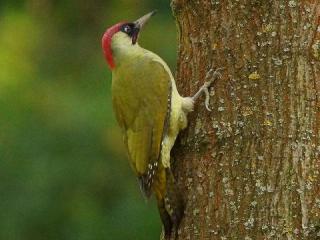
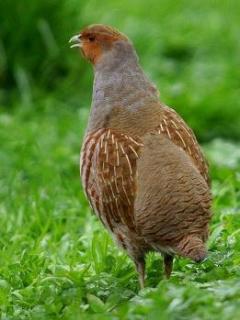
Top: Eurasian Green Woodpecker
Bottom: Gray/Grey Partridge
Image Source -> ZTL
As we venture into the walkthrough aviary, visitors may notice signage warning of a tripping hazard. Yes, you read that right, a TRIPPING hazard. No, this doesn't stem from an uneven walking path, which in itself is paved and, in the warmer months of the year, is the root cause of the tripping hazard. With all inanimate options out of play, a look to the species signage will reveal the true reason for the warning signs: a group of Marginated Tortoise Testudo marginata (2.6), the largest member of the Testudo genus. With their size, not nearly at the length or weight of some of the other tortoise species seen on other trails, these roughly foot-long and near-12-pound tortoises do occasionally lay directly in the footpath, and as such will cause congestion in this aviary from time to time. As such, there are several paths through the space, allowing for traffic to continue flowing even when such an obstruction does occur.
While the tortoises cause a bit of trouble on the ground, a trio of smaller avian species can be seen flitting between the branches of the many trees in the space. With feeding platforms dotted around the aviary, along with several locations where guests can stock up on seeds and feed the birds by hand, the chances that you see at least a couple birds are pretty good. Whether it be the rosy-chested Eurasian Bullfinch Pyrrhula pyrrhula (5.10), the bright red face of our European Goldfinch Carduelis carduelis (6.12), or even the more drab gray of our Eurasian Collared Dove Streptopelia decaocto (6.6), the interactive element of this aviary makes it all the more enjoyable (even when you're stuck in tortoise traffic).

Possible Look of Walkthrough Aviary
Image Credit -> @merlin

Marginated Tortoise
Image Credit -> @TinoPup

Eurasian Bullfinch
Image Credit -> @Hanjo

European Goldfinch
Image Credit -> @Kakapo

Eurasian Collared Dove
Image Credit -> @KevinB
Much like the woodpecker aviary, just outside the walkthrough is another aviary. At just 200 sq. meters and 2m height, visitors' eyes are instinctively drawn to the floor. With a bare patch of soil exposed, surrounded by dense undergrowth, this is the site of an extraordinary mating display when the time is right. Given their size and plumage, the main draw of this aviary will likely be the male of this species, especially during the aforementioned mating season. However, for the most part, no single member of the flock of Western Capercaillie Tetrao urogallus (1.4) is any more visible and outgoing than the others. Every single bird prefers to stick it out in the thicker undergrowth, away from the prying eyes.

Possible Look of Capercaillie Aviary
Image Credit -> @lintworm


Male (top) and Female (bottom) Western Capercaillie
Image Credit -> @RatioTile
As the songs of the finches fade into the woods, a trio of taller, 400 sq. meter, meshed-in spaces emerge from the woods, two to the right and one to the left. With all three of these spaces spanning 5m up, one might presume an eye primed for spotting high-up animals will come in handy. This rings true most of all for the left-hand space. With the large trees spanning up, and the hunter's instincts kicking in for the inhabitants, our breeding pair of European Eagle Owl Bubo bubo bubo (1.1) remain high above the heads of our visitors, eyes scanning for the arrival of keepers, and with them their food. Every now and again, if one would get so lucky (or unlucky... depends on your feelings toward squirrels, rabbits and rodents), the owls take to self-sustenance by way of hunting any poor small mammal that may find themselves on the wrong side of the aviary mesh.
And if that wasn't unlucky enough for said small mammal, they wouldn't fare much better in the two right-hand spaces. Not only are the inhabitants a lot less likely to scale the full 5m height, but they'll also just... vanish. Okay, not literally. But with the thickness of the shrubbery beneath the climbing structures and trees, our rotating male and female Eurasian Lynx Lynx lynx (1.1) may well have vanished. As for their neighbors... well, nobody calls the Eurasian Wolverine Gulo gulo gulo (1.1, same rotational scheme as lynx) the "ghost of the forest," do they?

Possible Look of Eagle Owl Aviary
Image Credit -> @gulogulogulo

European Eagle Owl
Image Credit -> @Rizz Carlton

Possible Look of Lynx and Wolverine Habitats
Image Credit -> @merlin

Eurasian Lynx
Image Credit -> @catfan

Eurasian Wolverine
Image Credit -> @Lucas Lang
As we pass by the wolverine, the forest begins to thin quite drastically. Before long, our pathway has not only transitioned to the steppes of central Asia, but we've also reached the top of a gently sloping hill. Through this hill, and beneath our feet, a crossing between the habitats to our left and right is situated. While we cannot see it directly, we know that it allows two species to navigate what is a total of 3 acres. Along the back of each 1.5 acre space, a series of rocky hills provides ample climbing space for a herd of European Mouflon Ovis orientalis musimon (5.13), while the rolling fields which directly straddle the 'natural' overpass provide grazing space for our herd of Przewalski's or Asian Wild Horse Equus ferus przewalskii (3.11).


Possible Views of Mixed Hoofstock Habitat
Top Image -> @SivatheriumGuy
Bottom Image -> @gulogulogulo

European Mouflon
Image Credit -> @zoo_sipsik

Przewalski's Horse
Image Credit -> @KevinB
And with that, we have officially concluded the Eurasia's Divide region of the Eurasian-Oriental Trail! From here, our journey will head to the southern part of Asia into the Indian Subcontinent, before beginning a kind of zig-zag, darting back to the north to visit the mountains, then south to the many archipelagos of Southeast Asia.
Our journey through the Indian Subcontinent begins when our tour continues, so stay tuned, and enjoy!
Possible Look of Woodpecker and Partridge Aviary
Image Credit -> @felis silvestris
Top: Eurasian Green Woodpecker
Bottom: Gray/Grey Partridge
Image Source -> ZTL
As we venture into the walkthrough aviary, visitors may notice signage warning of a tripping hazard. Yes, you read that right, a TRIPPING hazard. No, this doesn't stem from an uneven walking path, which in itself is paved and, in the warmer months of the year, is the root cause of the tripping hazard. With all inanimate options out of play, a look to the species signage will reveal the true reason for the warning signs: a group of Marginated Tortoise Testudo marginata (2.6), the largest member of the Testudo genus. With their size, not nearly at the length or weight of some of the other tortoise species seen on other trails, these roughly foot-long and near-12-pound tortoises do occasionally lay directly in the footpath, and as such will cause congestion in this aviary from time to time. As such, there are several paths through the space, allowing for traffic to continue flowing even when such an obstruction does occur.
While the tortoises cause a bit of trouble on the ground, a trio of smaller avian species can be seen flitting between the branches of the many trees in the space. With feeding platforms dotted around the aviary, along with several locations where guests can stock up on seeds and feed the birds by hand, the chances that you see at least a couple birds are pretty good. Whether it be the rosy-chested Eurasian Bullfinch Pyrrhula pyrrhula (5.10), the bright red face of our European Goldfinch Carduelis carduelis (6.12), or even the more drab gray of our Eurasian Collared Dove Streptopelia decaocto (6.6), the interactive element of this aviary makes it all the more enjoyable (even when you're stuck in tortoise traffic).
Possible Look of Walkthrough Aviary
Image Credit -> @merlin
Marginated Tortoise
Image Credit -> @TinoPup
Eurasian Bullfinch
Image Credit -> @Hanjo
European Goldfinch
Image Credit -> @Kakapo
Eurasian Collared Dove
Image Credit -> @KevinB
Much like the woodpecker aviary, just outside the walkthrough is another aviary. At just 200 sq. meters and 2m height, visitors' eyes are instinctively drawn to the floor. With a bare patch of soil exposed, surrounded by dense undergrowth, this is the site of an extraordinary mating display when the time is right. Given their size and plumage, the main draw of this aviary will likely be the male of this species, especially during the aforementioned mating season. However, for the most part, no single member of the flock of Western Capercaillie Tetrao urogallus (1.4) is any more visible and outgoing than the others. Every single bird prefers to stick it out in the thicker undergrowth, away from the prying eyes.
Possible Look of Capercaillie Aviary
Image Credit -> @lintworm
Male (top) and Female (bottom) Western Capercaillie
Image Credit -> @RatioTile
As the songs of the finches fade into the woods, a trio of taller, 400 sq. meter, meshed-in spaces emerge from the woods, two to the right and one to the left. With all three of these spaces spanning 5m up, one might presume an eye primed for spotting high-up animals will come in handy. This rings true most of all for the left-hand space. With the large trees spanning up, and the hunter's instincts kicking in for the inhabitants, our breeding pair of European Eagle Owl Bubo bubo bubo (1.1) remain high above the heads of our visitors, eyes scanning for the arrival of keepers, and with them their food. Every now and again, if one would get so lucky (or unlucky... depends on your feelings toward squirrels, rabbits and rodents), the owls take to self-sustenance by way of hunting any poor small mammal that may find themselves on the wrong side of the aviary mesh.
And if that wasn't unlucky enough for said small mammal, they wouldn't fare much better in the two right-hand spaces. Not only are the inhabitants a lot less likely to scale the full 5m height, but they'll also just... vanish. Okay, not literally. But with the thickness of the shrubbery beneath the climbing structures and trees, our rotating male and female Eurasian Lynx Lynx lynx (1.1) may well have vanished. As for their neighbors... well, nobody calls the Eurasian Wolverine Gulo gulo gulo (1.1, same rotational scheme as lynx) the "ghost of the forest," do they?
Possible Look of Eagle Owl Aviary
Image Credit -> @gulogulogulo
European Eagle Owl
Image Credit -> @Rizz Carlton
Possible Look of Lynx and Wolverine Habitats
Image Credit -> @merlin
Eurasian Lynx
Image Credit -> @catfan
Eurasian Wolverine
Image Credit -> @Lucas Lang
As we pass by the wolverine, the forest begins to thin quite drastically. Before long, our pathway has not only transitioned to the steppes of central Asia, but we've also reached the top of a gently sloping hill. Through this hill, and beneath our feet, a crossing between the habitats to our left and right is situated. While we cannot see it directly, we know that it allows two species to navigate what is a total of 3 acres. Along the back of each 1.5 acre space, a series of rocky hills provides ample climbing space for a herd of European Mouflon Ovis orientalis musimon (5.13), while the rolling fields which directly straddle the 'natural' overpass provide grazing space for our herd of Przewalski's or Asian Wild Horse Equus ferus przewalskii (3.11).
Possible Views of Mixed Hoofstock Habitat
Top Image -> @SivatheriumGuy
Bottom Image -> @gulogulogulo
European Mouflon
Image Credit -> @zoo_sipsik
Przewalski's Horse
Image Credit -> @KevinB
And with that, we have officially concluded the Eurasia's Divide region of the Eurasian-Oriental Trail! From here, our journey will head to the southern part of Asia into the Indian Subcontinent, before beginning a kind of zig-zag, darting back to the north to visit the mountains, then south to the many archipelagos of Southeast Asia.
Our journey through the Indian Subcontinent begins when our tour continues, so stay tuned, and enjoy!
Van Beal
Well-Known Member
Our return to the Eurasian-Oriental Trail brings back a slight encroachment of the trees around the path, more so to the right-hand side than to the left, as a series of four glass fronted, mesh-topped spaces run directly against the path's left edge, with a simplistic wooden fence acting as a standoff barrier to prevent any visitors attempting to finger-feed the four carnivores in these spaces.
First in the row is a 250 sq. meter space with 3m of height, planted heavily with low-lying foliage while branches and platforms create a complex network of elevated territory in the habitat. The habitat has solid side walls, with the intent of limiting the stress of interaction between the wall-sharing neighbor next door. Among the dense foliage, visitors may just be able to spot what is widely considered to be the smallest felid in Asia, and possibly the world, this being the Sri Lankan Rusty-spotted Cat Prionailurus rubiginosus phillipsi (2.2), with the males (being brothers) and females alternately on display.
Next door, the next two habitats scale up in size to 400 sq. meters, whilst the height varies between the two. The space which shares a wall with the rusty-spotted cats, keeping the same height, thins out the foliage, opting for a drier landscape dominated by rocks and dead trees, the latter of which provides climbing opportunity for the rotating male and female Caracal Caracal caracal (1.1). Next in the row, the environment spans upward to 3.5m, returns to the ecosystem of dense undergrowth, but also denser canopy cover, allowing privacy for the inhabitant wherever opts to take a snooze. With this extra concealment available, one could very well walk past without realizing one of our Banded Palm Civet Hemigalus derbyanus (0.2) sisters is right under their noses.
Ending the row, the habitat returns to the 250 sq. meter footprint seen for the rusty-spotted cats, but returns to the drier environment seen with the caracal. Furthermore, the inhabitants are given only 2m of vertical space, though still provided with a variety of opportunity to clamber above the habitat floor. While they can be seen among the limbs of the fallen tree that focalizes the habitat, more often than not our family of Indian Grey Mongoose Herpestes edwardsii (3.2) can be found in their den, directly beneath the roots of said tree, or poking out of a secondary burrow beneath one of the larger rock piles in the habitat.


Top: Possible Look of Rusty-spotted Cat Habitat
Bottom: Possible Look of Caracal Habitat
Image Credit -> @Philipine eagle

Sri Lankan Rusty-spotted Cat
Image Credit -> @Baringogiraffe12

Caracal
Image Credit -> @GiornoPizza

Possible Look of Civet Habitat
Image Credit -> @Kalaw

Banded Palm Civet
Image Credit -> @Al

Possible Look of Mongoose Habitat
Image Credit -> @snowleopard

Common Grey Mongoose
Image Credit -> @Giant Eland
The woodlands off to the right slowly begin to thin once more, allowing slight views of a barrier which makes up the perimeter of the zoo's largest set of interconnected habitats. While this doesn't give away much, the signage along the path warning of the presence of rhinos, wild cattle, deer, and monkeys that may or may not try to forcefully take your snacks or belongings... that certainly gives away plenty.
Rounding a bit of a bend, while there are four aviaries to the left, the focus from here out is to the right. Three yards, adding up to a whopping 8.5 acres of habitat space, house a total of six species. Half of these species have free roam of all three yards, while the other three are each restricted to a yard. This is achieved with a multi-faceted separation passage between the yards, combining cattle guards with spaces narrow enough that the smaller species can pass through, while the larger animals struggle. Along the front of all three yards, a slope leads to a 2m-high sheer concrete wall with a slight angle into the habitat. Paired with a visitor barrier similar to the standoff barrier seen for the four carnivore habitats earlier, this ensures that none of the species, with one particularly in mind, can escape any of the habitats. The first and third yards are each 3 acres, while the middle yard is just 2.5 acres. Each habitat boasts a smaller climbing structure, anchored to the ground and reinforced structurally, which appeals to the playful troop of Indochinese Rhesus Macaque Macaca mulatta (5.12), who have free roam of all three spaces alongside herds of Blackbuck Antilope cervicapra (1.10) and Pere David's Deer Elaphurus davidianus (2.10). In the first of the larger yards, visitors can find our breeding herd of Indian Gaur Bos gaurus (1.6), while the smallest yard hosts a herd of Nilgai Boselaphus tragocamelus (1.7), and the last yard, set with a mud wallow and shallow pool, hosts a lone Greater One-horned Rhinoceros Rhinoceros unicornis (0.1), whose 1.0 male counterpart is kept off-display.

Rhesus Macaque
Image Credit -> @Therabu

Blackbuck
Image Credit -> @hmb_zoo

Pere David's Deer
Image Credit -> @Lafone

Possible Look of Gaur Yard
Image Credit -> @merlin

Indian Gaur
Image Credit -> @SivatheriumGuy

Possible Look of Nilgai Yard
Image Credit -> @merlin

Nilgai
Image Credit -> @Toki

Possible Look of Rhinoceros Yard
Image Credit -> @KevinB

Greater One-horned Rhinoceros
Image Credit -> @Austin the Sengi
And with the largest complex in the zoo covered, our tour concludes for now. With the indoor holding for the rhino visible just ahead, and four aviaries still to be viewed to our left, we still have much to cover before even venturing beyond this region of the Indian Subcontinent. But for now I leave you, so stay tuned, and enjoy!
First in the row is a 250 sq. meter space with 3m of height, planted heavily with low-lying foliage while branches and platforms create a complex network of elevated territory in the habitat. The habitat has solid side walls, with the intent of limiting the stress of interaction between the wall-sharing neighbor next door. Among the dense foliage, visitors may just be able to spot what is widely considered to be the smallest felid in Asia, and possibly the world, this being the Sri Lankan Rusty-spotted Cat Prionailurus rubiginosus phillipsi (2.2), with the males (being brothers) and females alternately on display.
Next door, the next two habitats scale up in size to 400 sq. meters, whilst the height varies between the two. The space which shares a wall with the rusty-spotted cats, keeping the same height, thins out the foliage, opting for a drier landscape dominated by rocks and dead trees, the latter of which provides climbing opportunity for the rotating male and female Caracal Caracal caracal (1.1). Next in the row, the environment spans upward to 3.5m, returns to the ecosystem of dense undergrowth, but also denser canopy cover, allowing privacy for the inhabitant wherever opts to take a snooze. With this extra concealment available, one could very well walk past without realizing one of our Banded Palm Civet Hemigalus derbyanus (0.2) sisters is right under their noses.
Ending the row, the habitat returns to the 250 sq. meter footprint seen for the rusty-spotted cats, but returns to the drier environment seen with the caracal. Furthermore, the inhabitants are given only 2m of vertical space, though still provided with a variety of opportunity to clamber above the habitat floor. While they can be seen among the limbs of the fallen tree that focalizes the habitat, more often than not our family of Indian Grey Mongoose Herpestes edwardsii (3.2) can be found in their den, directly beneath the roots of said tree, or poking out of a secondary burrow beneath one of the larger rock piles in the habitat.
Top: Possible Look of Rusty-spotted Cat Habitat
Bottom: Possible Look of Caracal Habitat
Image Credit -> @Philipine eagle
Sri Lankan Rusty-spotted Cat
Image Credit -> @Baringogiraffe12
Caracal
Image Credit -> @GiornoPizza
Possible Look of Civet Habitat
Image Credit -> @Kalaw
Banded Palm Civet
Image Credit -> @Al
Possible Look of Mongoose Habitat
Image Credit -> @snowleopard
Common Grey Mongoose
Image Credit -> @Giant Eland
The woodlands off to the right slowly begin to thin once more, allowing slight views of a barrier which makes up the perimeter of the zoo's largest set of interconnected habitats. While this doesn't give away much, the signage along the path warning of the presence of rhinos, wild cattle, deer, and monkeys that may or may not try to forcefully take your snacks or belongings... that certainly gives away plenty.
Rounding a bit of a bend, while there are four aviaries to the left, the focus from here out is to the right. Three yards, adding up to a whopping 8.5 acres of habitat space, house a total of six species. Half of these species have free roam of all three yards, while the other three are each restricted to a yard. This is achieved with a multi-faceted separation passage between the yards, combining cattle guards with spaces narrow enough that the smaller species can pass through, while the larger animals struggle. Along the front of all three yards, a slope leads to a 2m-high sheer concrete wall with a slight angle into the habitat. Paired with a visitor barrier similar to the standoff barrier seen for the four carnivore habitats earlier, this ensures that none of the species, with one particularly in mind, can escape any of the habitats. The first and third yards are each 3 acres, while the middle yard is just 2.5 acres. Each habitat boasts a smaller climbing structure, anchored to the ground and reinforced structurally, which appeals to the playful troop of Indochinese Rhesus Macaque Macaca mulatta (5.12), who have free roam of all three spaces alongside herds of Blackbuck Antilope cervicapra (1.10) and Pere David's Deer Elaphurus davidianus (2.10). In the first of the larger yards, visitors can find our breeding herd of Indian Gaur Bos gaurus (1.6), while the smallest yard hosts a herd of Nilgai Boselaphus tragocamelus (1.7), and the last yard, set with a mud wallow and shallow pool, hosts a lone Greater One-horned Rhinoceros Rhinoceros unicornis (0.1), whose 1.0 male counterpart is kept off-display.
Rhesus Macaque
Image Credit -> @Therabu
Blackbuck
Image Credit -> @hmb_zoo
Pere David's Deer
Image Credit -> @Lafone
Possible Look of Gaur Yard
Image Credit -> @merlin
Indian Gaur
Image Credit -> @SivatheriumGuy
Possible Look of Nilgai Yard
Image Credit -> @merlin
Nilgai
Image Credit -> @Toki
Possible Look of Rhinoceros Yard
Image Credit -> @KevinB
Greater One-horned Rhinoceros
Image Credit -> @Austin the Sengi
And with the largest complex in the zoo covered, our tour concludes for now. With the indoor holding for the rhino visible just ahead, and four aviaries still to be viewed to our left, we still have much to cover before even venturing beyond this region of the Indian Subcontinent. But for now I leave you, so stay tuned, and enjoy!
Van Beal
Well-Known Member
For today, our venture is simple. Four aviaries to the left, and a peek inside the previously-mentioned rhinoceros indoor holding.
As mentioned, a row of four aviaries, variable in size, height, and inhabitants, run along the path opposite the complex of hoofstock yards to the right. The first of the bunch is the smallest, coming in at 200 sq. meters and 3m high. The plant life is quite dense around the perimeter of this circular aviary, though a single dead tree stands alone in the (approximate) centre, with a large mulchy patch spanning roughly 4m in every direction, and running right up to the visitor viewing area. Beneath this tree, visitors may spot chunks of fruit or shreds of lettuce scattered across the mulch. This is how our keepers distribute the food for our group of Indian Star Tortoise Geochelone elegans (4.4). Meanwhile, above the heads of the tortoises, a group of Crested Myna Acridotheres cristatellus (2.2) can be either seen in the branches of the central tree, or heard perfecting the art of mimicry, either trying to replicate the voices of the guests or the calls of visiting wild birds.
Next in the row comes the largest aviary in the bunch by floor space, at 1,750 sq. meters, and second largest by height at 4.5m. This aviary is notably marshy, with a variety of reeds and lilies growing along the shallow water's edge, where our pair of Indian Sarus Crane Grus antigone antigone (1.1) scours the shallows for food. Also living in the space are two other species of waterfowl, being the Indian Spot-billed Duck Anas poecilorhyncha poecilorhyncha (3.13) and Baer's Pochard Aythya baeri (2.10).


Top: Possible Look of Myna Aviary
Bottom: Crested Myna
Image Credit -> @merlin

Indian Star Tortoise
Image Credit -> @captain alligator

Possible Look of Crane and Waterfowl Aviary
Image Credit -> @animalman0341

Indian Sarus Crane
Image Credit -> @Rizz Carlton

Indian Spot-billed Duck
Image Credit -> @Zooish

Baer's Pochard
Image Credit -> @AdrianW1963
The third aviary decreases in both size and height, down to 400 sq. meters and the same 3m height seen with the myna aviary. This space is more open, with the larger leafy trees dominating the upper reaches of the aviary while very little foliage beyond the grass thrives below. Along the edges of the space is where the low-lying plants are most prominent, with small rock formations protruding from the bank of foliage. Among the branches of the trees, visitors can spot our flock of Rose-ringed Parakeet Psittacula krameri (5.5), a species notably established well outside its native range. While these personable birds keep the upper portion of the aviary occupied, the lower half of the space remains busy with two species, being the always-extravagant Indian Peafowl Pavo cristatus (2.6) and the smaller but equally striking Nicobar Pigeon Caloenas nicobarica (5.5).
Living high above in the 550 sq. meter and 5m tall aviary which concludes the row is one who's diet seems contrary to its name, with the Indian Tawny Eagle Aquila rapax vindhiana (1.1) being quite variable in their feeding techniques. While the aviary they inhabit, with a concrete base, allows for demonstrations of their hunting, they are also quite okay to take carrion, as they do from their carrion tables, or steal from other predatory birds (not able to be demonstrated here). Regardless, these birds have been provided with an impressive residence, with a series of elevated nesting platforms built alongside their taller tree perches.

Possible Look of Peafowl Aviary
Image Credit -> @snowleopard

Rose-ringed Parakeet
Image Credit -> @Therabu

Indian Peafowl
Image Credit -> yours truly, @Van Beal

Nicobar Pigeon
Image Credit -> @Austin the Sengi

Possible Look of Eagle Aviary
Image Credit -> @remar

Indian Tawny Eagle
Image Credit -> @Tomek
With this view of the eagle aviary, we are now directly across the path from the intended entrance to the indoor viewing building for the Indian Rhinoceros and the three species she may share her space with. The building itself draws a majority of its influence from the design of Toronto's indoor holding for the same species, with the appearance of the indoor area being near-identical but more spacious overall, and with multiple routes out of the building to ensure the blackbuck, deer, and macaques cannot be trapped by the rhino. Additionally, the viewing area is meshed across, ensuring the primates do not make a mad leap for freedom.
While the focus is obviously on the rhinos, a trio of invertebrate displays can be found at the far end of the building, adjacent to the exit. All three spaces are 2 sq. meters, with a large colony of Question-mark Cockroach Therea olegrandjeani (0.0.80) sandwiched between exhibits for two Poecilotheria species, being the Indian Ornamental Tarantula P. regalis and Ivory Ornamental Tarantula P. subfusca (0.1 of each).

Possible Look of Rhino Indoor Habitat
Image Credit -> @cypher


Top: Possible Look of Roach Exhibit
Middle: Possible Look of Poecilotheria Exhibits
Bottom: Question-Mark Cockroach
Image Credit -> @vogelcommando


Top: Indian Ornamental Tarantula
Bottom: Ivory Ornamental Tarantula
Image Credit -> @Bonobo
And with that, we have made it (roughly) halfway through the Indian Subcontinent, and with it roughly halfway through the Eurasian-Oriental Trail of the zoo! Our journey through the Indian Subcontinent will conclude with an Asian ursine species and the House of the Gharial!
For now I leave you, so stay tuned, and enjoy!
As mentioned, a row of four aviaries, variable in size, height, and inhabitants, run along the path opposite the complex of hoofstock yards to the right. The first of the bunch is the smallest, coming in at 200 sq. meters and 3m high. The plant life is quite dense around the perimeter of this circular aviary, though a single dead tree stands alone in the (approximate) centre, with a large mulchy patch spanning roughly 4m in every direction, and running right up to the visitor viewing area. Beneath this tree, visitors may spot chunks of fruit or shreds of lettuce scattered across the mulch. This is how our keepers distribute the food for our group of Indian Star Tortoise Geochelone elegans (4.4). Meanwhile, above the heads of the tortoises, a group of Crested Myna Acridotheres cristatellus (2.2) can be either seen in the branches of the central tree, or heard perfecting the art of mimicry, either trying to replicate the voices of the guests or the calls of visiting wild birds.
Next in the row comes the largest aviary in the bunch by floor space, at 1,750 sq. meters, and second largest by height at 4.5m. This aviary is notably marshy, with a variety of reeds and lilies growing along the shallow water's edge, where our pair of Indian Sarus Crane Grus antigone antigone (1.1) scours the shallows for food. Also living in the space are two other species of waterfowl, being the Indian Spot-billed Duck Anas poecilorhyncha poecilorhyncha (3.13) and Baer's Pochard Aythya baeri (2.10).
Top: Possible Look of Myna Aviary
Bottom: Crested Myna
Image Credit -> @merlin
Indian Star Tortoise
Image Credit -> @captain alligator
Possible Look of Crane and Waterfowl Aviary
Image Credit -> @animalman0341
Indian Sarus Crane
Image Credit -> @Rizz Carlton
Indian Spot-billed Duck
Image Credit -> @Zooish
Baer's Pochard
Image Credit -> @AdrianW1963
The third aviary decreases in both size and height, down to 400 sq. meters and the same 3m height seen with the myna aviary. This space is more open, with the larger leafy trees dominating the upper reaches of the aviary while very little foliage beyond the grass thrives below. Along the edges of the space is where the low-lying plants are most prominent, with small rock formations protruding from the bank of foliage. Among the branches of the trees, visitors can spot our flock of Rose-ringed Parakeet Psittacula krameri (5.5), a species notably established well outside its native range. While these personable birds keep the upper portion of the aviary occupied, the lower half of the space remains busy with two species, being the always-extravagant Indian Peafowl Pavo cristatus (2.6) and the smaller but equally striking Nicobar Pigeon Caloenas nicobarica (5.5).
Living high above in the 550 sq. meter and 5m tall aviary which concludes the row is one who's diet seems contrary to its name, with the Indian Tawny Eagle Aquila rapax vindhiana (1.1) being quite variable in their feeding techniques. While the aviary they inhabit, with a concrete base, allows for demonstrations of their hunting, they are also quite okay to take carrion, as they do from their carrion tables, or steal from other predatory birds (not able to be demonstrated here). Regardless, these birds have been provided with an impressive residence, with a series of elevated nesting platforms built alongside their taller tree perches.
Possible Look of Peafowl Aviary
Image Credit -> @snowleopard
Rose-ringed Parakeet
Image Credit -> @Therabu
Indian Peafowl
Image Credit -> yours truly, @Van Beal
Nicobar Pigeon
Image Credit -> @Austin the Sengi
Possible Look of Eagle Aviary
Image Credit -> @remar
Indian Tawny Eagle
Image Credit -> @Tomek
With this view of the eagle aviary, we are now directly across the path from the intended entrance to the indoor viewing building for the Indian Rhinoceros and the three species she may share her space with. The building itself draws a majority of its influence from the design of Toronto's indoor holding for the same species, with the appearance of the indoor area being near-identical but more spacious overall, and with multiple routes out of the building to ensure the blackbuck, deer, and macaques cannot be trapped by the rhino. Additionally, the viewing area is meshed across, ensuring the primates do not make a mad leap for freedom.
While the focus is obviously on the rhinos, a trio of invertebrate displays can be found at the far end of the building, adjacent to the exit. All three spaces are 2 sq. meters, with a large colony of Question-mark Cockroach Therea olegrandjeani (0.0.80) sandwiched between exhibits for two Poecilotheria species, being the Indian Ornamental Tarantula P. regalis and Ivory Ornamental Tarantula P. subfusca (0.1 of each).
Possible Look of Rhino Indoor Habitat
Image Credit -> @cypher
Top: Possible Look of Roach Exhibit
Middle: Possible Look of Poecilotheria Exhibits
Bottom: Question-Mark Cockroach
Image Credit -> @vogelcommando
Top: Indian Ornamental Tarantula
Bottom: Ivory Ornamental Tarantula
Image Credit -> @Bonobo
And with that, we have made it (roughly) halfway through the Indian Subcontinent, and with it roughly halfway through the Eurasian-Oriental Trail of the zoo! Our journey through the Indian Subcontinent will conclude with an Asian ursine species and the House of the Gharial!
For now I leave you, so stay tuned, and enjoy!
Van Beal
Well-Known Member
While we will be continuing our journey tonight, I would first like to provide some additional detailing for the entrance to each of the larger trails. While they will be described in more detail below (except for the Oceania Trail, which will be covered when we reach the zone), I would like to provide an (approximate) layout for each entry plaza, and further description of what each object represents.

Orange Line: main pathway which connects each trail to one another
Teal Lines: left-hand line would be the path leading to the first part of the trail, right-hand line would be the path from the final part of each trail back to the plaza
Oval: general footprint of the plaza itself; plaza of each zone would have a particular flooring to this footprint
Buildings: the two larger rectangles, would have exteriors themed around an architectural style which connects to the trail
Food, Drink, and Souvenirs: one of two buildings in the plaza, would be a small building with half being occupied by one or more fast food vendors, and the other half being a trail-themed gift shop selling typical zoo souvenirs which correlate to the plaza's trail
Restrooms: self explanatory
Garden/Official Trail Sign: metal or concrete lettering of the trail's name, as well as statues of one species per trail subsection, with each statue designed to link with the theme of their respective part of the trail
Now, for some greater detailing on each zone:
South America Trail
The flooring of the plaza would be one which replicated the architectural stylings of the ancient Inca, while a larger temple theme is not in play. The slightly mossy slabs of stone brick would directly contrast the buildings themselves, constructed in a style reminiscent of modern Brazilian favelas. The lettering in the garden would be the same stone-cut as the flooring, but brightened with a Neo-Andean color palette. Within the garden, Incan stone statues of the Jaguar and Yacare Caiman contrasts the returning Neo-Andean themed wooden statues of the Magellanic Penguin and Andean Condor.
North America Trail
In a more simplistic take, the flooring of this plaza is a more traditional asphalt, however it is a lighter variety than is used for the main pathway through the zoo. Once again, this flooring directly contrasts the log-cabin look which comes with the two buildings. The lettering once again goes more modern, being done in metal rather than concrete. The statues in this garden, which itself is quite diverse in its plant life, are quite different from one another, with each of the first four being First Nations' representations of the Bobcat (Mojave tribe, shaped clay), Plains Bison (Kiowa, wood carving), Great Horned Owl (Haudenosaunee, bone carving), and Atlantic Puffin (Haida, wood carving). The last statue, for the Everglades' American Alligator, is a more modern display of metalwork.
African Continental Trail
The more ornate formation of the floors returns, with a sandstone brick floor actually blending with the buildings, constructed in a mud brick style. Much like the South America Trail, the material used for the flooring is used (to an extent) for the lettering in the garden. Meanwhile, a lighter-colored sandstone is used to give depictions of the Meerkat and Nubian Ibex, while a darker-toned variety of stone depicts the Spotted Hyena and Western Lowland Gorilla.
Eurasian-Oriental Trail
The last of the plazas to be detailed here, the floor forms a halfway between the ornate carvings found in the floors of the South America and African Continental trails and the simplicity of the North America Trail, with a simple cobblestone look that has become seemingly quite common in European cities. Once more, the buildings themselves provide quite a contrast, with the ornate curved roofs of East Asian pagodas done in more muted earthy tones contrasting the rustic feel given by the underfoot path. The first two statues alongside the metal letterwork are both formed in a more classical style, with the Greater Flamingo shaped from marble and the European Mouflon from copper. From there, the style transitions to that of brightly-painted stonework depicting the Indian Rhinoceros and Nepalese Red Panda, before opting for the gold-accented stonework which depicts the Asian Water Monitor.
Orange Line: main pathway which connects each trail to one another
Teal Lines: left-hand line would be the path leading to the first part of the trail, right-hand line would be the path from the final part of each trail back to the plaza
Oval: general footprint of the plaza itself; plaza of each zone would have a particular flooring to this footprint
Buildings: the two larger rectangles, would have exteriors themed around an architectural style which connects to the trail
Food, Drink, and Souvenirs: one of two buildings in the plaza, would be a small building with half being occupied by one or more fast food vendors, and the other half being a trail-themed gift shop selling typical zoo souvenirs which correlate to the plaza's trail
Restrooms: self explanatory
Garden/Official Trail Sign: metal or concrete lettering of the trail's name, as well as statues of one species per trail subsection, with each statue designed to link with the theme of their respective part of the trail
Now, for some greater detailing on each zone:
South America Trail
The flooring of the plaza would be one which replicated the architectural stylings of the ancient Inca, while a larger temple theme is not in play. The slightly mossy slabs of stone brick would directly contrast the buildings themselves, constructed in a style reminiscent of modern Brazilian favelas. The lettering in the garden would be the same stone-cut as the flooring, but brightened with a Neo-Andean color palette. Within the garden, Incan stone statues of the Jaguar and Yacare Caiman contrasts the returning Neo-Andean themed wooden statues of the Magellanic Penguin and Andean Condor.
North America Trail
In a more simplistic take, the flooring of this plaza is a more traditional asphalt, however it is a lighter variety than is used for the main pathway through the zoo. Once again, this flooring directly contrasts the log-cabin look which comes with the two buildings. The lettering once again goes more modern, being done in metal rather than concrete. The statues in this garden, which itself is quite diverse in its plant life, are quite different from one another, with each of the first four being First Nations' representations of the Bobcat (Mojave tribe, shaped clay), Plains Bison (Kiowa, wood carving), Great Horned Owl (Haudenosaunee, bone carving), and Atlantic Puffin (Haida, wood carving). The last statue, for the Everglades' American Alligator, is a more modern display of metalwork.
African Continental Trail
The more ornate formation of the floors returns, with a sandstone brick floor actually blending with the buildings, constructed in a mud brick style. Much like the South America Trail, the material used for the flooring is used (to an extent) for the lettering in the garden. Meanwhile, a lighter-colored sandstone is used to give depictions of the Meerkat and Nubian Ibex, while a darker-toned variety of stone depicts the Spotted Hyena and Western Lowland Gorilla.
Eurasian-Oriental Trail
The last of the plazas to be detailed here, the floor forms a halfway between the ornate carvings found in the floors of the South America and African Continental trails and the simplicity of the North America Trail, with a simple cobblestone look that has become seemingly quite common in European cities. Once more, the buildings themselves provide quite a contrast, with the ornate curved roofs of East Asian pagodas done in more muted earthy tones contrasting the rustic feel given by the underfoot path. The first two statues alongside the metal letterwork are both formed in a more classical style, with the Greater Flamingo shaped from marble and the European Mouflon from copper. From there, the style transitions to that of brightly-painted stonework depicting the Indian Rhinoceros and Nepalese Red Panda, before opting for the gold-accented stonework which depicts the Asian Water Monitor.
Van Beal
Well-Known Member
Now, after that little sidetrack, back to the trip...
As we exit the Rhino Pavilion, it can be noted that just peeking through the trees, a second building is visible. This is the previously-mentioned House of the Gharial, which we will be venturing into shortly. Before this stop, you might just be able to spot the 500 sq. meter outdoor space provided for our flock of Indian Flying Fox, but we'll get a better look at them later.

Possible View of Outdoor Flying Fox Habitat
Image Credit -> @ralph
Directly across the path from the doorway into the House of the Gharial, visitors can look into a 3,000 sq. meter habitat which is lowered into the ground roughly 1.5m below the guest area. The space itself is quite open in the middle, with a rolling meadow of long grass occasionally broken up by the limbs of a fallen tree, scattered and arranged to allow access to the lower portions of the central (standing) dead tree. With a look straight down, visitors can look into the shallow bathing pool, situated well for our sister pair of Indian Sloth Bear Melursus ursinus ursinus (0.2), a pair orphaned by poachers. Their 1.0 male counterpart is kept in a habitat which is laid out the same, but is half the size, at 1,500 sq. meters.

Possible Look of Sloth Bear Habitat
Image Credit -> @Mr Gharial

Indian Sloth Bear
Image Credit -> @Jakub
Now we head to the doors of the House of the Gharial, two sets of double doors, with the choice of which set to use merely a formality as they both lead to the same loop of an interior. Just to the left of this entrance, however, one might be able to make out another habitat among the reeds. And if you didn't notice it... well, the signage points it out regardless. The view from a simple wooden slatted fence covers most of the 2,500 sq. meter surface area of the outdoor area for our Indian Gharial Gavialis gangeticus (2.6). While a direct view onto the aquatic space isn't provided out here, that perspective is given inside. The land area provides the connector, rather than using one large aquatic space between the indoor and outdoor areas.

Possible Look of Gharial Outdoor Habitat
Image Credit -> @Austin the Sengi

Indian Gharial
Image Credit -> @Prochilodus246
Now, as we enter the House of the Gharial, immediately to the left and right are two habitats which we've already seen the outdoor portions of. If it hasn't already slipped your mind, the left-hand space is 2,000 sq. meter indoor portion of the Indian Gharial Gavialis gangeticus space, with the isolated pool also housing a decent group of Hamilton's Pond Turtle Geoclemys hamiltonii (3.9), and the right-hand space is a 750 sq. meter housing for the flock of Indian Flying Fox Pteropus giganteus (4.18).

Possible Look of Indoor Gharial Habitat
Image Credit -> @Dhole dude

Hamilton's Pond Turtle
Image Credit -> @Andrew_NZP

Possible Look of Indoor Flying Fox Habitat
Image Credit -> @AndyJ08

Indian Flying Fox
Image Credit -> @Therabu
Beyond these previously-seen species, visitors come to the circular end of the building, with a larger exhibit directly ahead, two spaces more situated to the left, and three more to the right. This alignment seems slightly out of whack given the sheer size of the more central space. At nearly 15 sq. meters and spanning 2.5m from the floor to the ceiling of the tank, a densely-planted floor conceals a titan in the world of snakes, this coming in the form of a King Cobra Ophiophagus hannah (1.0), one of two individuals kept by the zoo, rotating with a female between the display space and the off-show area.
Situated to the left of the king's exhibit, two smaller serpents can be found in respective 5 sq. meter and 2m-high habitats. Closest to the gharial viewing, a more sparsely-planted habitat centred around a hollow log hide and a span of climbing branches provides refuge to another solitary cobra, this one being the Spectacled Cobra Naja naja (0.1), whose male counterpart also rotates on and off display. Next in line is the more densely-planted of the two, directly neighbouring the king, the more arboreal Sri Lankan Pit Viper Craspedocephalus trigonocephalus (0.3), another species where one sex (this case, again, the males) are kept off-display primarily.
Lastly, the three smaller habitats to the right of the king's exhibit. Each is smaller, at 2 sq. meters and 1.5m tall, and they are more variable in environment. The first is the most "out-of-place" in a zoo, as it replicates what looks like the interior of a typical kitchen. With the cupboards functioning as an "airlock" system for easier containment when moving the inhabitants, visitors will never actually see inside them. However, they will see roughly half the collection's Common House Gecko Hemidactylus frenatus (1.5 on-display, 2.3 off-display) running amok in this mock-kitchen. Next in line is a return to a more tropical environment, though swapping arboreal pit vipers for a more calm species in the Black-spined Toad Duttaphrynus melanostictus (1.2 on-display, 3.6 off-display). And concluding the row (and the building's species list) is a desert environment for a species more often thought of as a pet, being the Common Leopard Gecko Eublepharis macularius (1.1, with another pair off-display).
*All species listed in the above paragraph will be included in a media roundup, coming either today or tomorrow
And with that, our journey through (most of) the Indian Subcontinent comes to a conclusion, meaning we are 60% of the way through the Eurasian-Oriental Trail of the zoo. With that in mind, our journey will next make a (very) brief stop in the Far East of Russia for a species which didn't totally fit either this region or the upcoming Asian Mountain Ranges region, and so has kind of been placed in the middle. Regardless, this will be all for today, so stay tuned, and enjoy!
But now, a bit more on the timing of these posts, seeing as it has been a bit inconsistent of late.
Over the past week or so, I have decided that I will (hopefully) manage to wrap this project up around the time of the New Year (ideally before or on New Year's Eve), giving me a little over 5 weeks to finish this. With the pace I plan to take (posts on each weekend day and 2-3 weekdays out of the five), I think this is realistic, and should keep me going while not completely burning myself out. Additionally, if I start working through it faster than I'm thinking I will, this also gives me time to potentially line up a new spec zoo project for the new year (it'll be a lot smaller than this one, I promise).
As we exit the Rhino Pavilion, it can be noted that just peeking through the trees, a second building is visible. This is the previously-mentioned House of the Gharial, which we will be venturing into shortly. Before this stop, you might just be able to spot the 500 sq. meter outdoor space provided for our flock of Indian Flying Fox, but we'll get a better look at them later.
Possible View of Outdoor Flying Fox Habitat
Image Credit -> @ralph
Directly across the path from the doorway into the House of the Gharial, visitors can look into a 3,000 sq. meter habitat which is lowered into the ground roughly 1.5m below the guest area. The space itself is quite open in the middle, with a rolling meadow of long grass occasionally broken up by the limbs of a fallen tree, scattered and arranged to allow access to the lower portions of the central (standing) dead tree. With a look straight down, visitors can look into the shallow bathing pool, situated well for our sister pair of Indian Sloth Bear Melursus ursinus ursinus (0.2), a pair orphaned by poachers. Their 1.0 male counterpart is kept in a habitat which is laid out the same, but is half the size, at 1,500 sq. meters.
Possible Look of Sloth Bear Habitat
Image Credit -> @Mr Gharial
Indian Sloth Bear
Image Credit -> @Jakub
Now we head to the doors of the House of the Gharial, two sets of double doors, with the choice of which set to use merely a formality as they both lead to the same loop of an interior. Just to the left of this entrance, however, one might be able to make out another habitat among the reeds. And if you didn't notice it... well, the signage points it out regardless. The view from a simple wooden slatted fence covers most of the 2,500 sq. meter surface area of the outdoor area for our Indian Gharial Gavialis gangeticus (2.6). While a direct view onto the aquatic space isn't provided out here, that perspective is given inside. The land area provides the connector, rather than using one large aquatic space between the indoor and outdoor areas.
Possible Look of Gharial Outdoor Habitat
Image Credit -> @Austin the Sengi
Indian Gharial
Image Credit -> @Prochilodus246
Now, as we enter the House of the Gharial, immediately to the left and right are two habitats which we've already seen the outdoor portions of. If it hasn't already slipped your mind, the left-hand space is 2,000 sq. meter indoor portion of the Indian Gharial Gavialis gangeticus space, with the isolated pool also housing a decent group of Hamilton's Pond Turtle Geoclemys hamiltonii (3.9), and the right-hand space is a 750 sq. meter housing for the flock of Indian Flying Fox Pteropus giganteus (4.18).
Possible Look of Indoor Gharial Habitat
Image Credit -> @Dhole dude
Hamilton's Pond Turtle
Image Credit -> @Andrew_NZP
Possible Look of Indoor Flying Fox Habitat
Image Credit -> @AndyJ08
Indian Flying Fox
Image Credit -> @Therabu
Beyond these previously-seen species, visitors come to the circular end of the building, with a larger exhibit directly ahead, two spaces more situated to the left, and three more to the right. This alignment seems slightly out of whack given the sheer size of the more central space. At nearly 15 sq. meters and spanning 2.5m from the floor to the ceiling of the tank, a densely-planted floor conceals a titan in the world of snakes, this coming in the form of a King Cobra Ophiophagus hannah (1.0), one of two individuals kept by the zoo, rotating with a female between the display space and the off-show area.
Situated to the left of the king's exhibit, two smaller serpents can be found in respective 5 sq. meter and 2m-high habitats. Closest to the gharial viewing, a more sparsely-planted habitat centred around a hollow log hide and a span of climbing branches provides refuge to another solitary cobra, this one being the Spectacled Cobra Naja naja (0.1), whose male counterpart also rotates on and off display. Next in line is the more densely-planted of the two, directly neighbouring the king, the more arboreal Sri Lankan Pit Viper Craspedocephalus trigonocephalus (0.3), another species where one sex (this case, again, the males) are kept off-display primarily.
Lastly, the three smaller habitats to the right of the king's exhibit. Each is smaller, at 2 sq. meters and 1.5m tall, and they are more variable in environment. The first is the most "out-of-place" in a zoo, as it replicates what looks like the interior of a typical kitchen. With the cupboards functioning as an "airlock" system for easier containment when moving the inhabitants, visitors will never actually see inside them. However, they will see roughly half the collection's Common House Gecko Hemidactylus frenatus (1.5 on-display, 2.3 off-display) running amok in this mock-kitchen. Next in line is a return to a more tropical environment, though swapping arboreal pit vipers for a more calm species in the Black-spined Toad Duttaphrynus melanostictus (1.2 on-display, 3.6 off-display). And concluding the row (and the building's species list) is a desert environment for a species more often thought of as a pet, being the Common Leopard Gecko Eublepharis macularius (1.1, with another pair off-display).
*All species listed in the above paragraph will be included in a media roundup, coming either today or tomorrow
And with that, our journey through (most of) the Indian Subcontinent comes to a conclusion, meaning we are 60% of the way through the Eurasian-Oriental Trail of the zoo. With that in mind, our journey will next make a (very) brief stop in the Far East of Russia for a species which didn't totally fit either this region or the upcoming Asian Mountain Ranges region, and so has kind of been placed in the middle. Regardless, this will be all for today, so stay tuned, and enjoy!
But now, a bit more on the timing of these posts, seeing as it has been a bit inconsistent of late.
Over the past week or so, I have decided that I will (hopefully) manage to wrap this project up around the time of the New Year (ideally before or on New Year's Eve), giving me a little over 5 weeks to finish this. With the pace I plan to take (posts on each weekend day and 2-3 weekdays out of the five), I think this is realistic, and should keep me going while not completely burning myself out. Additionally, if I start working through it faster than I'm thinking I will, this also gives me time to potentially line up a new spec zoo project for the new year (it'll be a lot smaller than this one, I promise).
Van Beal
Well-Known Member
Media Roundup

Possible Look of King Cobra Exhibit
Image Credit -> @pachyderm pro

King Cobra
Image Credit -> @MagpieGoose

Possible Look of Spectacled Cobra Exhibit
Image Credit -> @vogelcommando

Spectacled Cobra
Image Credit -> @chrisroughley

Possible Look of Pit Viper Exhibit
Image Credit -> @remar

Sri Lankan Pit Viper
Image Credit -> @Lucas Lang

Possible Look of House Gecko Exhibit
Image Credit -> @KevinB

Common House Gecko
Image Credit -> @Kakapo

Possible Look of Toad Exhibit
Image Credit -> @TinoPup

Black-spined Toad
Image Credit -> @Joker1706

Possible Look of Leopard Gecko Exhibit
Image Credit -> @TinoPup

Common Leopard Gecko
Image Credit -> @captain alligator
Possible Look of King Cobra Exhibit
Image Credit -> @pachyderm pro
King Cobra
Image Credit -> @MagpieGoose
Possible Look of Spectacled Cobra Exhibit
Image Credit -> @vogelcommando
Spectacled Cobra
Image Credit -> @chrisroughley
Possible Look of Pit Viper Exhibit
Image Credit -> @remar
Sri Lankan Pit Viper
Image Credit -> @Lucas Lang
Possible Look of House Gecko Exhibit
Image Credit -> @KevinB
Common House Gecko
Image Credit -> @Kakapo
Possible Look of Toad Exhibit
Image Credit -> @TinoPup
Black-spined Toad
Image Credit -> @Joker1706
Possible Look of Leopard Gecko Exhibit
Image Credit -> @TinoPup
Common Leopard Gecko
Image Credit -> @captain alligator
Van Beal
Well-Known Member
We return to the zoo as we reach a pit-stop between the Indian Subcontinent and Asian Mountain Ranges areas of the Eurasian-Oriental Trail, this being a single aviary which replicates the rugged terrain of the Siberian coasts. While the 7m-high aviary itself is visible almost as soon as you've left the Indian Subcontinent region, the Siberian Baroque-style building which visitors enter to view the space lies a bit lower, despite having two levels, the higher of which protrudes into the aviary itself. Steep, tiered cliffs run the length of the back barrier of the aviary, with the lower shelves being the primary resting spot used by our breeding pair of Steller's Sea Eagle Haliaeetus pelagicus (1.1), though a series of rock piles, trees, and man-made nesting platforms are located along the floor of the aviary.

Possible Look of Sea Eagle Aviary
Image Credit -> @Dhole dude

Steller's Sea Eagle
Image Credit -> @Himimomi
Exiting the Siberian-themed viewing building, visitors can catch a glimpse of the aviary through the mesh before our ventures bring us through a stone archway which marks the official beginning of the Asian Mountain Ranges. This zone ranges from the well-known Himalayas, along the many mountain ranges of southwestern China, and as far north as the Urals. However, our journey begins with a mammal whose range covers many parts of the Asian continent, including the Himalayas. Within a 3,650 sq. meter "bowl" of stone, visitors will find a forested area, with very few trees toward the centre of the space, giving way to the mouth of a large cave in the back wall. With this cave facing the visitor viewing window dead-on, a look in is almost unavoidable. Luckily, this bodes well for those who are searching for the inhabiting mother-daughter pair of Asiatic Black Bear Ursus thibetanus (0.2). While these two do spend the majority of their time on-exhibit, there is a male off-display who occasionally gets rotated onto the main exhibit, to allow some privacy for our two females.


Possible Looks of Bear Habitat
Top Image -> @merlin
Bottom Image -> @snowleopard

Asiatic Black Bear
Image Credit -> @twilighter
From the viewing window into the bear habitat, the pathway begins to edge to the left, following the roughly circular shape of the bear habitat. As the wall begins to straighten out, a set of three terrarium and paludarium displays can be found within the stone wall, the first and third each with a 2 sq. meter floor space while the middle tank increases to double that, and the only other variability between the three tanks being their height. First in the row is the lone space which has no aquatic space, and stands 1m high. With a floor concealed by leaf litter and low-growing coniferous plants, visitors may not initially be able to spot our Mangshan Pit Viper Protobothrops mangshanensis (1.1), present in a pair currently being introduced to one another, though in all likelihood it will change to a rotational display of one snake at a time.
The neighbour to the camouflaged vipers is one which has a camouflage of its own, in an underwater world. With this tank being half the height of the previous, it might seem shocking that one of the world's largest amphibian species can comfortably inhabit this space. Lo and behold, the Japanese Giant Salamander Andrias japonicus (0.1). A lone female, made nearly invisible by her wrinkled brown skin against the rocky tank floor and the driftwood which provides added shelter for her. As of this moment, she is the only individual of her species cared for at the zoo.
Last in the row, returning the same dimensions as the pit viper space, comes a second paludarium, this one of a mixed-species variety. With 1/4 of the tank's height taken up by aquatic depth, visitors will often find both inhabitants swimming. The smaller of the two comes in the form of a non-breeding group of Emperor Newt Tylototriton shanjing (0.10), with two male individuals kept off-display. Their larger exhibitmate is either one of our breeding pair of Chinese Crocodile Lizard Shinisaurus crocodilurus crocodilurus (1.1), with the two rotating on and off-display unless breeding should be attempted, in which case both would be off-display, and the male newts would be introduced to the habitat.

Possible Look of Pit Viper Exhibit
Image Credit -> @Zhao yun

Mangshan Pit Viper
Image Credit -> @Batto

Possible Look of Giant Salamander Exhibit
Image Credit -> @felis silvestris

Japanese Giant Salamander
Image Credit -> @FunkyGibbon

Possible Look of Mixed Exhibit
Image Credit -> @Philipine eagle

Emperor Newt
Image Credit -> @RatioTile

Chinese Crocodile Lizard
Image Credit -> @KevinB
As the wall of the bear habitat continues curving to the left, the visitors path splits off, with the staff-access pathway continuing along the wall. Meanwhile, our pathway goes to the right, into the conifers as we jump quickly to the Ural Mountains, with the first of four aviaries along this path. This aviary, at 300 sq. meters and 4m high, is quite well separated from the other three aviaries, with the woods encroaching around the space. The pathway splits off, with the density of the trees in the aviary making visibility limited from the main pathway. Instead, we head to a building designed to replicate the camouflaged nature of a wildlife hide, used for photography or hunting. Unlike these hides, however, visitors have a floor-to-ceiling window into the aviary, ideal for spotting the inhabiting pair of Ural Owl Strix uralensis (1.1).

Possible Look of Owl Aviary
Image Credit -> @merlin

Ural Owl
Image Credit -> @captain alligator
From here, we exit the hide and return to the main pathway through the mountains, and head onward toward the remaining three aviaries, and what else may lay beyond. But for a brief moment, I will leave you, but stay here, for the next part of the tour is just around the corner.
Stay tuned, and enjoy!
Possible Look of Sea Eagle Aviary
Image Credit -> @Dhole dude
Steller's Sea Eagle
Image Credit -> @Himimomi
Exiting the Siberian-themed viewing building, visitors can catch a glimpse of the aviary through the mesh before our ventures bring us through a stone archway which marks the official beginning of the Asian Mountain Ranges. This zone ranges from the well-known Himalayas, along the many mountain ranges of southwestern China, and as far north as the Urals. However, our journey begins with a mammal whose range covers many parts of the Asian continent, including the Himalayas. Within a 3,650 sq. meter "bowl" of stone, visitors will find a forested area, with very few trees toward the centre of the space, giving way to the mouth of a large cave in the back wall. With this cave facing the visitor viewing window dead-on, a look in is almost unavoidable. Luckily, this bodes well for those who are searching for the inhabiting mother-daughter pair of Asiatic Black Bear Ursus thibetanus (0.2). While these two do spend the majority of their time on-exhibit, there is a male off-display who occasionally gets rotated onto the main exhibit, to allow some privacy for our two females.
Possible Looks of Bear Habitat
Top Image -> @merlin
Bottom Image -> @snowleopard
Asiatic Black Bear
Image Credit -> @twilighter
From the viewing window into the bear habitat, the pathway begins to edge to the left, following the roughly circular shape of the bear habitat. As the wall begins to straighten out, a set of three terrarium and paludarium displays can be found within the stone wall, the first and third each with a 2 sq. meter floor space while the middle tank increases to double that, and the only other variability between the three tanks being their height. First in the row is the lone space which has no aquatic space, and stands 1m high. With a floor concealed by leaf litter and low-growing coniferous plants, visitors may not initially be able to spot our Mangshan Pit Viper Protobothrops mangshanensis (1.1), present in a pair currently being introduced to one another, though in all likelihood it will change to a rotational display of one snake at a time.
The neighbour to the camouflaged vipers is one which has a camouflage of its own, in an underwater world. With this tank being half the height of the previous, it might seem shocking that one of the world's largest amphibian species can comfortably inhabit this space. Lo and behold, the Japanese Giant Salamander Andrias japonicus (0.1). A lone female, made nearly invisible by her wrinkled brown skin against the rocky tank floor and the driftwood which provides added shelter for her. As of this moment, she is the only individual of her species cared for at the zoo.
Last in the row, returning the same dimensions as the pit viper space, comes a second paludarium, this one of a mixed-species variety. With 1/4 of the tank's height taken up by aquatic depth, visitors will often find both inhabitants swimming. The smaller of the two comes in the form of a non-breeding group of Emperor Newt Tylototriton shanjing (0.10), with two male individuals kept off-display. Their larger exhibitmate is either one of our breeding pair of Chinese Crocodile Lizard Shinisaurus crocodilurus crocodilurus (1.1), with the two rotating on and off-display unless breeding should be attempted, in which case both would be off-display, and the male newts would be introduced to the habitat.
Possible Look of Pit Viper Exhibit
Image Credit -> @Zhao yun
Mangshan Pit Viper
Image Credit -> @Batto
Possible Look of Giant Salamander Exhibit
Image Credit -> @felis silvestris
Japanese Giant Salamander
Image Credit -> @FunkyGibbon
Possible Look of Mixed Exhibit
Image Credit -> @Philipine eagle
Emperor Newt
Image Credit -> @RatioTile
Chinese Crocodile Lizard
Image Credit -> @KevinB
As the wall of the bear habitat continues curving to the left, the visitors path splits off, with the staff-access pathway continuing along the wall. Meanwhile, our pathway goes to the right, into the conifers as we jump quickly to the Ural Mountains, with the first of four aviaries along this path. This aviary, at 300 sq. meters and 4m high, is quite well separated from the other three aviaries, with the woods encroaching around the space. The pathway splits off, with the density of the trees in the aviary making visibility limited from the main pathway. Instead, we head to a building designed to replicate the camouflaged nature of a wildlife hide, used for photography or hunting. Unlike these hides, however, visitors have a floor-to-ceiling window into the aviary, ideal for spotting the inhabiting pair of Ural Owl Strix uralensis (1.1).
Possible Look of Owl Aviary
Image Credit -> @merlin
Ural Owl
Image Credit -> @captain alligator
From here, we exit the hide and return to the main pathway through the mountains, and head onward toward the remaining three aviaries, and what else may lay beyond. But for a brief moment, I will leave you, but stay here, for the next part of the tour is just around the corner.
Stay tuned, and enjoy!
Van Beal
Well-Known Member
After quite the short break, our trip continues as we head out from the Ural Owl hide, continuing in the direction we had been going before this pit stop. The walk from this aviary to the next three isn't a long one, but it is one which is quite serene amid the conifer forests.
Now, the three aviaries. Two are located to the left of the path, on the same side as the owl aviary, while the other is to the right. The left-hand aviaries are exponentially smaller than the right-hand one, with each left-hand space totalling only 200 sq. meters beneath their 3m ceilings. The closest of the two is more densely planted, with only a small plateau providing any elevation in the space. Among the bushes, visitors will probably hear our pair of Mountain Peacock-Pheasant Polyplectron inopinatum (1.1) rather than see them. Meanwhile, in the trees above, a pair of Grey-winged Blackbird Turdus boulboul (1.1) can be found dancing among the conifer branches. Next door is an aviary which is more open in the middle, while keeping the dense planting around the perimeter. This dense plant life provides our pair of Himalayan Monal Lophophorus impejanus (1.1) have the means to stay out of view of the visitors. Meanwhile, once again dancing among the branches overhead, visitors can spot a pair of Chinese Hwamei Garrulax canorus (1.1).

Possible Look of Pheasant Aviaries
Image Credit -> @felis silvestris

Mountain Peacock-Pheasant
Image Credit -> @FoxBat

Grey-winged Blackbird
Image Credit -> @Therabu

Himalayan Monal
Image Credit -> @Zoofan15

Chinese Hwamei
Image Credit -> @Leo K.
Directly opposite these two smaller aviaries is a much larger one, covering 3,400 sq. meters beneath a 7.5m mesh ceiling. Backdropped by the conifer woods, this space has a nearly-unobstructed view across the entire space, with a large pool taking up roughly 1/5 of the total floor space, including much of the space directly in front of the main viewpoint of the aviary, while only the back wall is blocked, by trees both inside and outside the aviary.. Along this body of water, visitors can find our flock of Bar-headed Goose Anser indicus (3.9) nesting on the islands inaccessible to the other inhabitants of the space, in the middle of the pool, while a non-breeding bachelorette group of Black-necked Crane Grus nigricollis (0.4) wades the shallows along the main land area, amid stands of reeds and cattails. Meanwhile, the trees conceal a barn, utilized as the indoor stables for the mammalian inhabitant of the aviary, being a small herd of Japanese Sika Cervus nippon nippon (1.5), who often spend their time amid the trees.
While this last species can also be seen in the larger aviary, they are more often seen in their own aviary, another 200 sq. meter space which is connected to the bigger space. This separated space is given due to the breeding project surrounding our particular flock of Elliot's Pheasant Syrmaticus ellioti (1.3), which are separated when breeding is successful to reduce any potential risk of the cranes predating the eggs and hatchlings.

Possible Look of Sika Aviary
Image Credit -> @merlin

Bar-headed Goose
Image Credit -> @Rizz Carlton

Black-necked Crane
Image Credit -> @Kaelio

Japanese Sika
Image Credit -> @vogelcommando

Possible Look of Elliot's Pheasant Separation Aviary
Image Credit -> @merlin

Elliot's Pheasant
Image Credit -> @Ding Lingwei
From here, visitors begin to descend on a gentle slope into a naturally-occurring valley, into which a series of habitats, which divide the valley into very unequal thirds on either side of the central pathway. This valley is where our journey will begin tomorrow, and will conclude with the final habitats in this region, in a multi-post layout similar to the two posts made today. So for now, I leave you, but will be back shortly to give an approximation on the timeline of our journey through the remainder of the zoo.
Stay tuned, and enjoy!
Now, the three aviaries. Two are located to the left of the path, on the same side as the owl aviary, while the other is to the right. The left-hand aviaries are exponentially smaller than the right-hand one, with each left-hand space totalling only 200 sq. meters beneath their 3m ceilings. The closest of the two is more densely planted, with only a small plateau providing any elevation in the space. Among the bushes, visitors will probably hear our pair of Mountain Peacock-Pheasant Polyplectron inopinatum (1.1) rather than see them. Meanwhile, in the trees above, a pair of Grey-winged Blackbird Turdus boulboul (1.1) can be found dancing among the conifer branches. Next door is an aviary which is more open in the middle, while keeping the dense planting around the perimeter. This dense plant life provides our pair of Himalayan Monal Lophophorus impejanus (1.1) have the means to stay out of view of the visitors. Meanwhile, once again dancing among the branches overhead, visitors can spot a pair of Chinese Hwamei Garrulax canorus (1.1).
Possible Look of Pheasant Aviaries
Image Credit -> @felis silvestris
Mountain Peacock-Pheasant
Image Credit -> @FoxBat
Grey-winged Blackbird
Image Credit -> @Therabu
Himalayan Monal
Image Credit -> @Zoofan15
Chinese Hwamei
Image Credit -> @Leo K.
Directly opposite these two smaller aviaries is a much larger one, covering 3,400 sq. meters beneath a 7.5m mesh ceiling. Backdropped by the conifer woods, this space has a nearly-unobstructed view across the entire space, with a large pool taking up roughly 1/5 of the total floor space, including much of the space directly in front of the main viewpoint of the aviary, while only the back wall is blocked, by trees both inside and outside the aviary.. Along this body of water, visitors can find our flock of Bar-headed Goose Anser indicus (3.9) nesting on the islands inaccessible to the other inhabitants of the space, in the middle of the pool, while a non-breeding bachelorette group of Black-necked Crane Grus nigricollis (0.4) wades the shallows along the main land area, amid stands of reeds and cattails. Meanwhile, the trees conceal a barn, utilized as the indoor stables for the mammalian inhabitant of the aviary, being a small herd of Japanese Sika Cervus nippon nippon (1.5), who often spend their time amid the trees.
While this last species can also be seen in the larger aviary, they are more often seen in their own aviary, another 200 sq. meter space which is connected to the bigger space. This separated space is given due to the breeding project surrounding our particular flock of Elliot's Pheasant Syrmaticus ellioti (1.3), which are separated when breeding is successful to reduce any potential risk of the cranes predating the eggs and hatchlings.
Possible Look of Sika Aviary
Image Credit -> @merlin
Bar-headed Goose
Image Credit -> @Rizz Carlton
Black-necked Crane
Image Credit -> @Kaelio
Japanese Sika
Image Credit -> @vogelcommando
Possible Look of Elliot's Pheasant Separation Aviary
Image Credit -> @merlin
Elliot's Pheasant
Image Credit -> @Ding Lingwei
From here, visitors begin to descend on a gentle slope into a naturally-occurring valley, into which a series of habitats, which divide the valley into very unequal thirds on either side of the central pathway. This valley is where our journey will begin tomorrow, and will conclude with the final habitats in this region, in a multi-post layout similar to the two posts made today. So for now, I leave you, but will be back shortly to give an approximation on the timeline of our journey through the remainder of the zoo.
Stay tuned, and enjoy!
Van Beal
Well-Known Member
Okay, one last post tonight before I pack it in for the night.
While this hasn't been directly requested by anyone, I felt as though (both for my own sanity, and for a bit more understanding for the viewers) it would be beneficial to have a rough timeline for the completion of each of the five (and a bit) major zones, along with whatever will come after the fact. With that in mind, here is an approximate breakdown of the final month of 2025 for this thread.
Tomorrow (November 23): completion of the Asian Mountain Ranges region; two posts
November 24-December 10th, 12th, or 13th (13th at latest): Indo-Malay Archipelagos; 1-2 posts per day starting Monday the 24th, and continuing on subsequent weekends, Mondays, Wednesdays, and Fridays until completion
December 10th, 12th, or 13th - New Year's Eve (December 31st): dedicated to the Oceania Trail; same rough format as Indo-Malay Archipelagos, on same schedule of days
Any additional material, if necessary, will be provided in the early days of 2026, and my new project will likely begin in February.
While this hasn't been directly requested by anyone, I felt as though (both for my own sanity, and for a bit more understanding for the viewers) it would be beneficial to have a rough timeline for the completion of each of the five (and a bit) major zones, along with whatever will come after the fact. With that in mind, here is an approximate breakdown of the final month of 2025 for this thread.
Tomorrow (November 23): completion of the Asian Mountain Ranges region; two posts
November 24-December 10th, 12th, or 13th (13th at latest): Indo-Malay Archipelagos; 1-2 posts per day starting Monday the 24th, and continuing on subsequent weekends, Mondays, Wednesdays, and Fridays until completion
December 10th, 12th, or 13th - New Year's Eve (December 31st): dedicated to the Oceania Trail; same rough format as Indo-Malay Archipelagos, on same schedule of days
Any additional material, if necessary, will be provided in the early days of 2026, and my new project will likely begin in February.
Van Beal
Well-Known Member
Our return to the Asian Mountain Ranges brings us back to the mouth of the valley which we left off at yesterday. A total of six habitats line the valley's walls, with three to each side. The first spaces on each side are respective 250 sq. meter habitats, each with a glass viewing area and sheer barriers around the remainder of each space. The left-hand space is more lush with bamboo stalks, dead climbing trees, and man-made climbing structures, combining to reduce the likelihood that visitors spot our Nepalese Red Panda Ailurus fulgens fulgens (1.1) on the ground, and more likely that the only view visitors will get ultimately results from a view from below.
Directly opposite our first red pandas, the right-hand space which mirrors the dimensions seen for the red pandas is much more bare, with low-lying bushes the only splashes of color against the piles of rock. These piles of rock are often where our pair of Siberian Pallas Cat Otocolobus manul manul (1.1) are found, either perched at the top, or peeking out from the staff-reinforced crevices in the piles.


Top: Possible Look of Red Panda Habitat
Bottom: Possible Look of Pallas Cat Habitat
Image Credit -> @merlin

Nepalese Red Panda
Image Credit -> @KevinB

Siberian Pallas Cat
Image Credit -> @Rajang-GOAT
From here, the middle habitats are visible by the same manner as the previous spaces, through a long glass panel. Unlike the two smaller spaces, each of these 1,750 sq. meter habitats is contained by a mesh ceiling spanning roughly 6m overhead. This is where the similarities end. On the left, the space remains quite arboreally-oriented, with large trees of both the natural and artificial varieties intertwining with lengths of rope and firehose, as well as some smaller elevated feeding platforms. This habitat boasts one of the zoo's more notable uniquities on the North American continent, being the Golden Snub-nosed Monkey Rhinopithecus roxellana (1.7). Directly opposite them, the landscape does become more densely planted, however only around the perimeter are larger trees planted. Meanwhile, front and centre are a series of size-variable, temperature-adjustable pools, located on differing levels of land, and connected by small waterfalls. These pseudo-hot-springs are designed to replicate a popular tourist attraction which happens to be fueled not by the springs themselves, but by the Japanese Macaque Macaca fuscata (11.5) which frequent them.

Possible Look of Snub-nosed Monkey Habitat
Image Credit -> @Cichlid

Golden Snub-nosed Monkey
Image Credit -> @migdog

Possible Look of Macaque Habitat
Image Credit -> @felis silvestris

Japanese Macaque
Image Credit -> @RatioTile
As we pass by the primates, with a sharp eye one might notice that the valley begins to widen off to the left, as we near the end of the valley. Along this widening left-hand side, visitors can find a 3/4-acre mixed habitat for two of the more intriguing mountain ungulates in Asia. The space is no longer separated by glass, instead opting for a steep dry moat on the animal side, and a small stone guardrail on the visitor side. The space itself is gradually sloped upward from the visitor perspective, with larger rock formations spaced across the area, while the wall of the valley is used as the back wall of the habitat. While there is very little overall plant life beyond the grass, this is not an issue for the two inhabitants, being half of our Tajik Markhor Capra falconeri heptneri (1.4) herd, and the first of our two takin subspecies, these specifically being our Shensi or Golden Takin Budorcas taxicolor bedfordi (1.3).
Directly opposite this near-vertical ungulate habitat, a more densely forested 2,750 sq. meter habitat lies against the unwidened right wall of the valley. Unlike the ungulate habitat, this space is meshed in, and viewed once again through glass. Unlike the other viewing windows, this one is built into a false-rock formation, forming a cave-like viewing environment similar to the viewing area at the Toronto Zoo for the same species. Among the trees and sheer cliffs, visitors may just spot our Snow Leopard Panthera uncia (1.3), with a rotational system alternating our adult female and her two (0.2) cubs with an unrelated sub-adult male.

Possible Look of Mixed Ungulate Habitat
Image Credit -> @Austin the Sengi

Tajik Markhor
Image Credit -> @KevinB

Shensi/Golden Takin
Image Credit -> @Dasyurus


Possible Looks of Snow Leopard Habitat
Both Images' Credit -> @Père Damian's Deer

Snow Leopard
Image Credit -> @Wesley Renaud

Possible View into Snow Leopard Habitat (sans support pole)
Image Credit -> @Mr Wrinkly
And with that, visitors emerge from the valley, with just four habitats now remaining for the Asian Mountain Ranges area of the zoo. Fret not, for they will be up within the hour (as of my uploading of this post), and we will be set to travel the zoo's most speciose region tomorrow evening. So for now I leave you, but don't stray too far, for there is still more to come tonight.
Stay tuned, and enjoy!
Directly opposite our first red pandas, the right-hand space which mirrors the dimensions seen for the red pandas is much more bare, with low-lying bushes the only splashes of color against the piles of rock. These piles of rock are often where our pair of Siberian Pallas Cat Otocolobus manul manul (1.1) are found, either perched at the top, or peeking out from the staff-reinforced crevices in the piles.
Top: Possible Look of Red Panda Habitat
Bottom: Possible Look of Pallas Cat Habitat
Image Credit -> @merlin
Nepalese Red Panda
Image Credit -> @KevinB
Siberian Pallas Cat
Image Credit -> @Rajang-GOAT
From here, the middle habitats are visible by the same manner as the previous spaces, through a long glass panel. Unlike the two smaller spaces, each of these 1,750 sq. meter habitats is contained by a mesh ceiling spanning roughly 6m overhead. This is where the similarities end. On the left, the space remains quite arboreally-oriented, with large trees of both the natural and artificial varieties intertwining with lengths of rope and firehose, as well as some smaller elevated feeding platforms. This habitat boasts one of the zoo's more notable uniquities on the North American continent, being the Golden Snub-nosed Monkey Rhinopithecus roxellana (1.7). Directly opposite them, the landscape does become more densely planted, however only around the perimeter are larger trees planted. Meanwhile, front and centre are a series of size-variable, temperature-adjustable pools, located on differing levels of land, and connected by small waterfalls. These pseudo-hot-springs are designed to replicate a popular tourist attraction which happens to be fueled not by the springs themselves, but by the Japanese Macaque Macaca fuscata (11.5) which frequent them.
Possible Look of Snub-nosed Monkey Habitat
Image Credit -> @Cichlid
Golden Snub-nosed Monkey
Image Credit -> @migdog
Possible Look of Macaque Habitat
Image Credit -> @felis silvestris
Japanese Macaque
Image Credit -> @RatioTile
As we pass by the primates, with a sharp eye one might notice that the valley begins to widen off to the left, as we near the end of the valley. Along this widening left-hand side, visitors can find a 3/4-acre mixed habitat for two of the more intriguing mountain ungulates in Asia. The space is no longer separated by glass, instead opting for a steep dry moat on the animal side, and a small stone guardrail on the visitor side. The space itself is gradually sloped upward from the visitor perspective, with larger rock formations spaced across the area, while the wall of the valley is used as the back wall of the habitat. While there is very little overall plant life beyond the grass, this is not an issue for the two inhabitants, being half of our Tajik Markhor Capra falconeri heptneri (1.4) herd, and the first of our two takin subspecies, these specifically being our Shensi or Golden Takin Budorcas taxicolor bedfordi (1.3).
Directly opposite this near-vertical ungulate habitat, a more densely forested 2,750 sq. meter habitat lies against the unwidened right wall of the valley. Unlike the ungulate habitat, this space is meshed in, and viewed once again through glass. Unlike the other viewing windows, this one is built into a false-rock formation, forming a cave-like viewing environment similar to the viewing area at the Toronto Zoo for the same species. Among the trees and sheer cliffs, visitors may just spot our Snow Leopard Panthera uncia (1.3), with a rotational system alternating our adult female and her two (0.2) cubs with an unrelated sub-adult male.
Possible Look of Mixed Ungulate Habitat
Image Credit -> @Austin the Sengi
Tajik Markhor
Image Credit -> @KevinB
Shensi/Golden Takin
Image Credit -> @Dasyurus
Possible Looks of Snow Leopard Habitat
Both Images' Credit -> @Père Damian's Deer
Snow Leopard
Image Credit -> @Wesley Renaud
Possible View into Snow Leopard Habitat (sans support pole)
Image Credit -> @Mr Wrinkly
And with that, visitors emerge from the valley, with just four habitats now remaining for the Asian Mountain Ranges area of the zoo. Fret not, for they will be up within the hour (as of my uploading of this post), and we will be set to travel the zoo's most speciose region tomorrow evening. So for now I leave you, but don't stray too far, for there is still more to come tonight.
Stay tuned, and enjoy!
Van Beal
Well-Known Member
We begin the concluding act of the Asian Mountain Ranges portion of the Eurasian-Oriental Trail in an area where the next trail's landmark entrance is visible above the trees in the distance, aided by the fact that, by now, we've arrived at the crest of a hill. While that may draw some attention, that won't be the wow factor for long. We are in the middle of a Chinese market, arranged with pagoda-style buildings selling a variety of foods, drinks, souvenirs, and other items of need or want. All the while, you are almost entirely surrounded by habitats, with the only direction not blocked by animals being the path we will ultimately head down to reach the Indo-Malay Archipelagos.
Amid the likely bustle of the market, visitors can look to the left or the right for different scenic views. To the left, a view over a quaint ornamental lake and into a 3/4-acre habitat which resembles the ungulate paddock we just saw in the valley. This resemblance does essentially spoil the inhabitants, as this is where you can find the other half of our Tajik Markhor Capra falconeri heptneri (1.4) herd, as well as the zoo's second takin subspecies, this time being the Mishmi Takin Budorcas taxicolor taxicolor (1.3).
While the view over the lake is nice, visitors wouldn't think to look into the fenced-in area if it weren't for the signage. Decorative signs warn of dangers lurking in the water, though some might not see the reasoning for it. With a sharp eye, one might spot either of our brother pair of Chinese Alligator Alligator sinensis (2.0) lurking amid the lilies on the surface. The total space they have access to covers 300 sq. meters, of which 2/3 is aquatic space.
Possible Look of Mixed Ungulate Habitat
Image Credit -> @Austin the Sengi
Tajik Markhor
Image Credit -> @KevinB

Mishmi Takin
Image Credit -> @pachyderm pro

Possible Look of Alligator Habitat
Image Credit -> @Moebelle

Chinese Alligator
Image Credit -> @evilmonkey239
Now to the opposite side of our makeshift Market Square, visitors can look down onto an expansive bamboo grove, though they aren't the only ones looking down into the space. As you head nearer to a largely bamboo-shrouded pagoda, a 300 sq. meter mesh-enclosed habitat becomes visible to your right, while the view down into the 1.5-acre bamboo grove remains to your left. Within the mesh-enclosed safety of their own habitat, visitors get to view another pair of red pandas, these being Chinese Red Panda Ailurus fulgens styani (1.1), in their outdoor quarters, as well as their indoor quarters within the pagoda previously mentioned.
Now, once inside the pagoda, visitors are given a total of three viewing windows. The first, dead ahead, is actually the longest, providing a peek inside at one of the two animals with access to the larger grove. To the left, as expected, is a pretty impressive look out onto that very bamboo grove, and to the right is the indoor space for those red pandas you saw outside. Between the two non-red panda habitats, the fuss will likely be through the roof, given the sheer magnitude that comes with the responsibility of caring for... the Giant Panda Ailuropoda melanoleuca (1.1). With the outdoor space being large enough that both individuals can be outside at the same time, chances are the indoor space will be vacant. However, seeing as they have access to the space whenever they please, you might get lucky. And with the extensive viewing all along the right-hand side of the market plaza, chances are good you'll be able to spot at least one of these bamboo-munching bears.

Possible Look of Outdoor Red Panda Habitat
Image Credit -> @KevinB

Possible Look of Indoor Red Panda Habitat
Image Credit -> @snowleopard

Chinese Red Panda
Image Credit -> yours truly, @Van Beal

Possible Look of Indoor Giant Panda Habitat
Image Credit -> @Cichlid


Possible Look of Giant Panda Outdoor Habitat
Both Images' Credit -> @Gibbonsagainstgravity

Giant Panda
Image Credit -> @Therabu
Yes, we have to venture onward from the giant pandas. Believe me, if given the opportunity I would spend all day observing them. Alas, we must tread onward toward the Balinese-style archway which protrudes above the treeline ahead. With these final steps into the forest, the journey through the Asian Mountain Ranges officially comes to a close, bringing us nearer and nearer the final portion of the Eurasian-Oriental Trail. And when I say that this portion of the trail makes up nearly half the total species population of the entire trail, I do not exaggerate.
But for now, I leave you, awaiting what will be a true experience as we begin the Indo-Malay Archipelagos, the Eurasian-Oriental Trail's final leg, tomorrow evening.
Stay tuned, and enjoy!
Amid the likely bustle of the market, visitors can look to the left or the right for different scenic views. To the left, a view over a quaint ornamental lake and into a 3/4-acre habitat which resembles the ungulate paddock we just saw in the valley. This resemblance does essentially spoil the inhabitants, as this is where you can find the other half of our Tajik Markhor Capra falconeri heptneri (1.4) herd, as well as the zoo's second takin subspecies, this time being the Mishmi Takin Budorcas taxicolor taxicolor (1.3).
While the view over the lake is nice, visitors wouldn't think to look into the fenced-in area if it weren't for the signage. Decorative signs warn of dangers lurking in the water, though some might not see the reasoning for it. With a sharp eye, one might spot either of our brother pair of Chinese Alligator Alligator sinensis (2.0) lurking amid the lilies on the surface. The total space they have access to covers 300 sq. meters, of which 2/3 is aquatic space.
Possible Look of Mixed Ungulate Habitat
Image Credit -> @Austin the Sengi
Tajik Markhor
Image Credit -> @KevinB
Mishmi Takin
Image Credit -> @pachyderm pro
Possible Look of Alligator Habitat
Image Credit -> @Moebelle
Chinese Alligator
Image Credit -> @evilmonkey239
Now to the opposite side of our makeshift Market Square, visitors can look down onto an expansive bamboo grove, though they aren't the only ones looking down into the space. As you head nearer to a largely bamboo-shrouded pagoda, a 300 sq. meter mesh-enclosed habitat becomes visible to your right, while the view down into the 1.5-acre bamboo grove remains to your left. Within the mesh-enclosed safety of their own habitat, visitors get to view another pair of red pandas, these being Chinese Red Panda Ailurus fulgens styani (1.1), in their outdoor quarters, as well as their indoor quarters within the pagoda previously mentioned.
Now, once inside the pagoda, visitors are given a total of three viewing windows. The first, dead ahead, is actually the longest, providing a peek inside at one of the two animals with access to the larger grove. To the left, as expected, is a pretty impressive look out onto that very bamboo grove, and to the right is the indoor space for those red pandas you saw outside. Between the two non-red panda habitats, the fuss will likely be through the roof, given the sheer magnitude that comes with the responsibility of caring for... the Giant Panda Ailuropoda melanoleuca (1.1). With the outdoor space being large enough that both individuals can be outside at the same time, chances are the indoor space will be vacant. However, seeing as they have access to the space whenever they please, you might get lucky. And with the extensive viewing all along the right-hand side of the market plaza, chances are good you'll be able to spot at least one of these bamboo-munching bears.
Possible Look of Outdoor Red Panda Habitat
Image Credit -> @KevinB
Possible Look of Indoor Red Panda Habitat
Image Credit -> @snowleopard
Chinese Red Panda
Image Credit -> yours truly, @Van Beal
Possible Look of Indoor Giant Panda Habitat
Image Credit -> @Cichlid
Possible Look of Giant Panda Outdoor Habitat
Both Images' Credit -> @Gibbonsagainstgravity
Giant Panda
Image Credit -> @Therabu
Yes, we have to venture onward from the giant pandas. Believe me, if given the opportunity I would spend all day observing them. Alas, we must tread onward toward the Balinese-style archway which protrudes above the treeline ahead. With these final steps into the forest, the journey through the Asian Mountain Ranges officially comes to a close, bringing us nearer and nearer the final portion of the Eurasian-Oriental Trail. And when I say that this portion of the trail makes up nearly half the total species population of the entire trail, I do not exaggerate.
But for now, I leave you, awaiting what will be a true experience as we begin the Indo-Malay Archipelagos, the Eurasian-Oriental Trail's final leg, tomorrow evening.
Stay tuned, and enjoy!
Van Beal
Well-Known Member
Welp... plans change on the fly.
We're back, and beginning the Indo-Malay Archipelagos.
For context, seeing as I've referenced the sheer species-based size of the area several times as being the largest in the zoo, and home to approximately half the Eurasian-Oriental Trail's species, I think it best that I give the breakdown now (this will still be included in the Trail Roundup and total species update at the end of the trail).
Total Species: 99, which makes it...
- +24 on the next largest single region (African Rainforest with 75)
- only 27 species less than ALL the non-trail attractions (Central America, Nocturnia, Galapagos Ecotarium, Madagascar and African Isles all totalling to 126)
Amphibians: 8, making it tied for the second-highest amphibian population (behind Temperate and Taiga Woodlands of North America (12 species), level with Amazon and Atlantic Rainforests of South America)
Birds: 24, tied for highest bird population with Many Sides of Savanna
Fish: 14, third-highest fish population, trailing only the yet-to-be-described Great Barrier Reef (33) and African Rainforest (20)
Invertebrates: 11, second-highest invertebrate population, behind only Amazon and Atlantic Rainforests (16)
Mammals: 18, tied for highest mammal population, again with Many Sides of Savanna
Reptiles: 24, highest reptile population, +9 on next closest (Madagascar and African Isles, with 15)
Now, with those metrics out of the way, on with the tour.
Our journey begins passing beneath a Balinese archway which takes heavy inspiration from the Gilimanuk Port Triumphal Arch. With the four supports anchoring it firmly overhead, passing through officially welcomes you to the Indo-Malay Archipelagos. Along the right side beyond the arch, the woods shroud much of the larger stone-covered buildings which act as the staff facilities for the region, and also conceal the backstage housing for the first species in the area. Meanwhile, to the left, the trees thin, allowing a panoramic view out onto an acre of forested land, roughly 2m below the level of the pathway. While the trees thin somewhat around the middle of the habitat, the long grass and flowing streams provide a number of ways for our brotherly pair of Malayan Tiger Panthera tigris jacksoni (2.1) to avoid the eyes of our visitors. While the female is mentioned, she currently resides in the off-display area mentioned earlier.

Possible Look of Tiger Habitat
Image Credit -> @Cichlid

Malayan Tiger
Image Credit -> @Austin the Sengi
As we pass the tiger habitat, the trees thin out on both sides of the path, giving way to curved glass panes which each provide split above-and-below water viewing into the habitats on each side. Both spaces have roughly 1m of aquatic depth, though this quickly becomes shallower in the right-hand habitat. While the back portion of each habitat is densely planted, the 350 sq. meter habitats are more than suitable for the animals and for potential viewers. On the left, visitors will find a species quite well-known for being energetic, being the Asian Small-clawed Otter Aonyx cinerea (5.2) kept in a family group which includes five youngsters and their parents. Meanwhile, directly opposite is a more elusive and secluded species, coming in the form of our Fishing Cat Prionailurus viverrinus (1.2), with our younger female rotating with the male, while our near-geriatric female is kept in an ambassador role off-display.
Dead ahead, as the trees begin to close in once again, the pathway branches off to the left and right, around a mesh-enclosed 1,200 sq. meter habitat. Both forks lead to the same goal, so it really doesn't matter which way we go. We will venture to the left, and be gifted with a side view of this beautiful, densely-planted habitat which, as the signage will quickly make known, hosts a lone female Indochinese Clouded Leopard Neofelis nebulosa nebulosa (0.1). While she most often avoids the spotlight, if you time your visit with an ebb in the guest flow, you might find her sprawled in a sunbeam in front of one of the viewing windows... you've just gotta get lucky and hope you pick the side she picked.

Possible Look into Otter and Cat Habitats
Image Credit -> @Toledo Zoo Guide

Asian Small-clawed Otter
Image Credit -> @merlin

Fishing Cat
Image Credit -> @Austin the Sengi

Possible View of Clouded Leopard Habitat
Image Credit -> @Philipine eagle

Indochinese Clouded Leopard
Image Credit -> @KevinB
As we reconverge with the other branch of the path around the clouded leopard habitat, our trajectory leads us right to the doors of likely the zoo's highest species-density area: the Rumah Pulau. A name reutilized from a previous project of mine, the building will continue to serve as an Indonesian-themed indoor area. Before we enter however, we shall first view one of the more intriguing displays in the zoo. A 7.5 sq. meter terrarium sits on either side of the pathway right at the doors to the building, and this might not seem so special. Until you look up...
Above your heads is a perfectly safe, transparent tunnel which has conveniently become a favourite basking spot of our Reticulated Python Malayopython reticulatus (1.0), dubbed 'Kronos' for his titanic size. While he does have access to pools on either side, the positioning of heat lamps above this tunnel do provide some reasoning as to why he prefers this unfurnished part of his home to the naturalistic terrariums on either side.


Possible Looks of Python Exhibits
Top Image: @KevinB
Bottom Image: @pachyderm pro

Reticulated Python
Image Credit -> @RatioTile
And with that, I will finally be turning in for the night, and we will resume our trek tomorrow with the first (and possibly second) portions of the Rumah Pulau, with the second likely being one of at least two in the building requiring a Media Roundup post afterwards.
So for now, I leave you, but stay tuned, and enjoy!
We're back, and beginning the Indo-Malay Archipelagos.
For context, seeing as I've referenced the sheer species-based size of the area several times as being the largest in the zoo, and home to approximately half the Eurasian-Oriental Trail's species, I think it best that I give the breakdown now (this will still be included in the Trail Roundup and total species update at the end of the trail).
Total Species: 99, which makes it...
- +24 on the next largest single region (African Rainforest with 75)
- only 27 species less than ALL the non-trail attractions (Central America, Nocturnia, Galapagos Ecotarium, Madagascar and African Isles all totalling to 126)
Amphibians: 8, making it tied for the second-highest amphibian population (behind Temperate and Taiga Woodlands of North America (12 species), level with Amazon and Atlantic Rainforests of South America)
Birds: 24, tied for highest bird population with Many Sides of Savanna
Fish: 14, third-highest fish population, trailing only the yet-to-be-described Great Barrier Reef (33) and African Rainforest (20)
Invertebrates: 11, second-highest invertebrate population, behind only Amazon and Atlantic Rainforests (16)
Mammals: 18, tied for highest mammal population, again with Many Sides of Savanna
Reptiles: 24, highest reptile population, +9 on next closest (Madagascar and African Isles, with 15)
Now, with those metrics out of the way, on with the tour.
Our journey begins passing beneath a Balinese archway which takes heavy inspiration from the Gilimanuk Port Triumphal Arch. With the four supports anchoring it firmly overhead, passing through officially welcomes you to the Indo-Malay Archipelagos. Along the right side beyond the arch, the woods shroud much of the larger stone-covered buildings which act as the staff facilities for the region, and also conceal the backstage housing for the first species in the area. Meanwhile, to the left, the trees thin, allowing a panoramic view out onto an acre of forested land, roughly 2m below the level of the pathway. While the trees thin somewhat around the middle of the habitat, the long grass and flowing streams provide a number of ways for our brotherly pair of Malayan Tiger Panthera tigris jacksoni (2.1) to avoid the eyes of our visitors. While the female is mentioned, she currently resides in the off-display area mentioned earlier.
Possible Look of Tiger Habitat
Image Credit -> @Cichlid
Malayan Tiger
Image Credit -> @Austin the Sengi
As we pass the tiger habitat, the trees thin out on both sides of the path, giving way to curved glass panes which each provide split above-and-below water viewing into the habitats on each side. Both spaces have roughly 1m of aquatic depth, though this quickly becomes shallower in the right-hand habitat. While the back portion of each habitat is densely planted, the 350 sq. meter habitats are more than suitable for the animals and for potential viewers. On the left, visitors will find a species quite well-known for being energetic, being the Asian Small-clawed Otter Aonyx cinerea (5.2) kept in a family group which includes five youngsters and their parents. Meanwhile, directly opposite is a more elusive and secluded species, coming in the form of our Fishing Cat Prionailurus viverrinus (1.2), with our younger female rotating with the male, while our near-geriatric female is kept in an ambassador role off-display.
Dead ahead, as the trees begin to close in once again, the pathway branches off to the left and right, around a mesh-enclosed 1,200 sq. meter habitat. Both forks lead to the same goal, so it really doesn't matter which way we go. We will venture to the left, and be gifted with a side view of this beautiful, densely-planted habitat which, as the signage will quickly make known, hosts a lone female Indochinese Clouded Leopard Neofelis nebulosa nebulosa (0.1). While she most often avoids the spotlight, if you time your visit with an ebb in the guest flow, you might find her sprawled in a sunbeam in front of one of the viewing windows... you've just gotta get lucky and hope you pick the side she picked.
Possible Look into Otter and Cat Habitats
Image Credit -> @Toledo Zoo Guide
Asian Small-clawed Otter
Image Credit -> @merlin
Fishing Cat
Image Credit -> @Austin the Sengi
Possible View of Clouded Leopard Habitat
Image Credit -> @Philipine eagle
Indochinese Clouded Leopard
Image Credit -> @KevinB
As we reconverge with the other branch of the path around the clouded leopard habitat, our trajectory leads us right to the doors of likely the zoo's highest species-density area: the Rumah Pulau. A name reutilized from a previous project of mine, the building will continue to serve as an Indonesian-themed indoor area. Before we enter however, we shall first view one of the more intriguing displays in the zoo. A 7.5 sq. meter terrarium sits on either side of the pathway right at the doors to the building, and this might not seem so special. Until you look up...
Above your heads is a perfectly safe, transparent tunnel which has conveniently become a favourite basking spot of our Reticulated Python Malayopython reticulatus (1.0), dubbed 'Kronos' for his titanic size. While he does have access to pools on either side, the positioning of heat lamps above this tunnel do provide some reasoning as to why he prefers this unfurnished part of his home to the naturalistic terrariums on either side.
Possible Looks of Python Exhibits
Top Image: @KevinB
Bottom Image: @pachyderm pro
Reticulated Python
Image Credit -> @RatioTile
And with that, I will finally be turning in for the night, and we will resume our trek tomorrow with the first (and possibly second) portions of the Rumah Pulau, with the second likely being one of at least two in the building requiring a Media Roundup post afterwards.
So for now, I leave you, but stay tuned, and enjoy!
Van Beal
Well-Known Member
Rumah Pulau: Atrium 1
Passing under the coils of the python, visitors enter the building to an immersive rainforest environment. Up ahead, visitors can then enter first atrium through an airlock system which will be present throughout a majority of the spaces. The system itself would be electronically managed, ensuring one door is closed before the other is able to be opened. While this would likely create some congestion in the entryway, it is in place to ensure the free-roaming species in each space are securely contained.

Proposed Airlock Entry System Example
Image Credit -> @SMR
Upon getting into the first space, visitors will remain immersed in the tropical plant life, though this time within a mesh-contained half-acre aviary which ultimately spans from the floor of the building to the ceiling in terms of accessibility for the inhabitants. However, the free-roamers aren't the only ones you can see. A look to the right roughly halfway through this walkthrough, and a glass pane emerges from the undergrowth. This window gives split above-and-below water viewing into a 500 sq. meter habitat outside the mesh of the aviary, and open-topped itself, though the walls of the habitat are smooth, and any potential climbable trees or rocks are kept away from these barriers. The glass is present for another reason beyond the obvious of holding back the water: it also ensures the safety of the birds from our Asian Water Monitor Varanus salvator (1.1), with our pair of the monitors definitely not opposed to taking a feathery snack.
While the monitors might be the most enticing and easiest to spot, the aviary around you might change your mind. As mentioned, with a half-acre to explore, and this path cutting back into the thick of the brush, chances are you'll stumble across a sand dune. Seems out of place, until the inhabiting pair of Maleo Macrocephalon maleo (1.1) emerge. This sand dune, the primary nesting area of this endangered megapode, is artificially heated to a temperature which allows for on-exhibit incubation. While this pair lives on-display, the zoo boasts a grand total of six hopeful breeding pairs, with the other five kept off-display. While this pair patrols the ground, two smaller species can be found up in the trees. The first, and more populous of the two, is our sizeable flock of Chestnut-naped Imperial Pigeon Ducula aenea paulina (6.19), while the other is the more strikingly conspicuous, in the Asian Fairy-Bluebird Irena puella (4.8).

Possible Look of Monitor Habitat
Image Credit -> @Utahraptor

Asian Water Monitor
Image Credit -> @SusScrofa

Possible Look of Maleo Walkthrough
Image Credit -> @Zoofan15

Maleo
Image Credit -> @YuanChang

Chestnut-naped Imperial Pigeon
Image Credit -> @RatioTile

Asian Fairy-Bluebird
Image Credit -> @NathanTheAsian
As we emerge at the other end of the first atrium, another airlock system of doors awaits. This, again, may leave visitors waiting a bit longer than they'd hoped inside the aviary, but who can pass up on the chance to have more time to admire these birds?
Regardless, once you've managed to exit the aviary, we get a brief reprieve from the walkthrough displays, and are given a look at three smaller terrarium displays, arranged in a row in the middle of this little gap between the first and second aviaries, allowing visitors to look into the tanks from both sides. On either end of this row, 1.5 sq. meter tanks are situated to sandwich a 1 sq. meter terrarium. The two larger tanks are both more lush in plant life, while the middle space is about typical for this kind of invertebrate, with a piece of corkwood centering the tank for a large colony of Gold-banded Clown Cockroach Hemithyrsocera vittata (0.0.50). Sandwiching the roaches are two species of mantis, displaying very different manners of camouflage. On the left upon exiting the maleo walkthrough, visitors can find the Dead Leaf Mantis Deroplatys desiccata (0.0.1, with an additional 0.0.9 off-display), while the Orchid Mantis Hymenopus coronatus (0.0.1, with an additional 0.0.9 off-display) on the opposite end.

Possible Look of Roach Display
Image Credit -> @TinoPup
*no image for Gold-banded Clown Roach*

Possible Look of Mantis Tanks
Image Credit -> @Hvedekorn

Dead Leaf Mantis
Image Credit -> @BerdNerd

Orchid Mantis
Image Credit -> @RatioTile
As we pass by our invertebrates, yet another airlock managed door beckons, and while we will enter the aviary now, our journey through won't begin quite yet.
Stay tuned, and enjoy!
Passing under the coils of the python, visitors enter the building to an immersive rainforest environment. Up ahead, visitors can then enter first atrium through an airlock system which will be present throughout a majority of the spaces. The system itself would be electronically managed, ensuring one door is closed before the other is able to be opened. While this would likely create some congestion in the entryway, it is in place to ensure the free-roaming species in each space are securely contained.
Proposed Airlock Entry System Example
Image Credit -> @SMR
Upon getting into the first space, visitors will remain immersed in the tropical plant life, though this time within a mesh-contained half-acre aviary which ultimately spans from the floor of the building to the ceiling in terms of accessibility for the inhabitants. However, the free-roamers aren't the only ones you can see. A look to the right roughly halfway through this walkthrough, and a glass pane emerges from the undergrowth. This window gives split above-and-below water viewing into a 500 sq. meter habitat outside the mesh of the aviary, and open-topped itself, though the walls of the habitat are smooth, and any potential climbable trees or rocks are kept away from these barriers. The glass is present for another reason beyond the obvious of holding back the water: it also ensures the safety of the birds from our Asian Water Monitor Varanus salvator (1.1), with our pair of the monitors definitely not opposed to taking a feathery snack.
While the monitors might be the most enticing and easiest to spot, the aviary around you might change your mind. As mentioned, with a half-acre to explore, and this path cutting back into the thick of the brush, chances are you'll stumble across a sand dune. Seems out of place, until the inhabiting pair of Maleo Macrocephalon maleo (1.1) emerge. This sand dune, the primary nesting area of this endangered megapode, is artificially heated to a temperature which allows for on-exhibit incubation. While this pair lives on-display, the zoo boasts a grand total of six hopeful breeding pairs, with the other five kept off-display. While this pair patrols the ground, two smaller species can be found up in the trees. The first, and more populous of the two, is our sizeable flock of Chestnut-naped Imperial Pigeon Ducula aenea paulina (6.19), while the other is the more strikingly conspicuous, in the Asian Fairy-Bluebird Irena puella (4.8).
Possible Look of Monitor Habitat
Image Credit -> @Utahraptor
Asian Water Monitor
Image Credit -> @SusScrofa
Possible Look of Maleo Walkthrough
Image Credit -> @Zoofan15
Maleo
Image Credit -> @YuanChang
Chestnut-naped Imperial Pigeon
Image Credit -> @RatioTile
Asian Fairy-Bluebird
Image Credit -> @NathanTheAsian
As we emerge at the other end of the first atrium, another airlock system of doors awaits. This, again, may leave visitors waiting a bit longer than they'd hoped inside the aviary, but who can pass up on the chance to have more time to admire these birds?
Regardless, once you've managed to exit the aviary, we get a brief reprieve from the walkthrough displays, and are given a look at three smaller terrarium displays, arranged in a row in the middle of this little gap between the first and second aviaries, allowing visitors to look into the tanks from both sides. On either end of this row, 1.5 sq. meter tanks are situated to sandwich a 1 sq. meter terrarium. The two larger tanks are both more lush in plant life, while the middle space is about typical for this kind of invertebrate, with a piece of corkwood centering the tank for a large colony of Gold-banded Clown Cockroach Hemithyrsocera vittata (0.0.50). Sandwiching the roaches are two species of mantis, displaying very different manners of camouflage. On the left upon exiting the maleo walkthrough, visitors can find the Dead Leaf Mantis Deroplatys desiccata (0.0.1, with an additional 0.0.9 off-display), while the Orchid Mantis Hymenopus coronatus (0.0.1, with an additional 0.0.9 off-display) on the opposite end.
Possible Look of Roach Display
Image Credit -> @TinoPup
*no image for Gold-banded Clown Roach*
Possible Look of Mantis Tanks
Image Credit -> @Hvedekorn
Dead Leaf Mantis
Image Credit -> @BerdNerd
Orchid Mantis
Image Credit -> @RatioTile
As we pass by our invertebrates, yet another airlock managed door beckons, and while we will enter the aviary now, our journey through won't begin quite yet.
Stay tuned, and enjoy!
Van Beal
Well-Known Member
Rumah Pulau: Atrium 2
Yes, I'm realizing that the term "atrium" is being used loosely in the context of this building. If we want to be technical, the previous aviary and the terrarium displays combine with this larger space to form the first atrium, but I feel as though they each have a distinctive identity. Plus, they're separated for a reason.
Regardless of whether they're all one atrium or their own separate entities, our journey into the second atrium begins here. Inside a 2.5-acre personal rendition of Singapore's Fragile Forest, the look up to the ceiling shows just how high that ceiling spans above your head. 6m, to be exact. But before we get to the birds (and mammals) that make this space truly immersive, we first turn to an 10m-long and 2m-tall curved fish tank. Spanning 2.5m back and contained by mesh and additional Plexiglass, the tank is able to remain open-topped as it is protected from what could only be described as a barrage of bird and bat droppings (spoiler alert, I guess?). Within the tannin-darkened waters, five fish species can be seen swimming about, most noticeable being the lone Giant Gourami Osphronemus goramy (0.0.1). While the gourami takes the attention, every now and again you might see a jet of water aimed toward the leaves and branches overhanging the tank. These come from our Burmese Archerfish Toxotes blythii (0.0.4), picking off any unsuspecting insects who venture too close to the surface. Living alongside these two are schools of Clown Loach Chromobotia macracanthus (0.0.8), Cherry Barb Puntius titteya (0.0.45), and Flying Fox Carp Epalzeorhynchos kalopterus (0.0.6).

Possible Look of Community Tank
Image Credit -> @Corby93

Giant Gourami
Image Credit -> yours truly, @Van Beal

Burmese Archerfish
Image Credit -> @Causticjay

Clown Loach
Image Credit -> @JigerofLemuria

Cherry Barb
Image Credit -> @Lucas Lang

Flying Fox Carp
Image Credit -> @Rizz Carlton
Now... to the main event.
While you may have already been inside the 2.5-acre rendition of Singapore's Fragile Forest, but you have to really delve into the brush (while staying on the trail) if you truly want to enter the aviary. Along your walk, nine free-roaming species will potentially be visible, while a row of six tanks can be found built into a rock structure roughly halfway through the walk. Additionally, for an added cost, visitors can take the Canopy Walk Ropes Course, a highly naturalistic climbing course within the aviary that allows a whole other perspective on the space. We, however, will be staying put on the ground.
As much as I'd like to say you've got good odds of seeing the lone fully ground-restricted species in the space, this likely won't be the case. This stems from the shy nature of the Greater Indo-Malayan Chevrotain Tragulus napu (1.4), a species which is moved off-display during their own breeding season to increase the chances of success. Meanwhile, there are a couple species who frequent the understory, and are therefore likely to cross your path... sometimes literally. The first of these ground-dwellers is also the smaller of the two, being the adorable and aptly-named Crested Wood Partridge Rollulus rouloul (5.12). Also wandering the forest floor, visitors can find the more colorful of the two, in the form of our Palawan Peacock-Pheasant Polyplectron napoleonis (2.6).
Once you've spotted these three species (or even while you're still looking), it's not a stretch to say much of the remaining species count in the aviary will require a look up into the branches. Way above the rest, roosting conveniently in view from the entire aviary, but never directly overhead, is our flock of Red-necked Flying Fox Pteropus vampyrus (8.28). While they are diurnal and will occasionally fly through the whole space, chances are best that you spot them beyond the end of the ropes course, in the left-hand corner on the opposite end of the aviary from where you entered. Also visible roosting in larger flocks, though the locations are more variable, are the aviary's two species of columbiformes, being the Beautiful Fruit-dove Ptilinopus pulchellus (10.20) and Pink-necked Green Pigeon Trenon vernans (10.30). Last among the larger flocks comes a less colorful species, being the Red-billed Leiothrix Leiothrix lutea (10.20).
Last but equally notable come the two species that are present in smaller groups. These are our groups of White-rumped Shama Copsychus malabaricus (1.3) and White-breasted Wood-Swallow Artamus leucorynchus (3.3).


Possible Looks of Flying Fox Walkthrough
Top Image -> @twilighter
Bottom Image -> @snowleopard
*images for all species within this aviary will be included in a Media Roundup post
Okay, so we're gonna make a bit of a backtrack. At the halfway point of the aviary, the pathway brings us essentially right against a large, false-rock wall which acts as the barrier for the aviary, but also contains the six tanks previously mentioned. First along the wall is a 4x1x1m tannin-darkened aquatic display divided in half by a lightweight barrier which is set to be removed after the fish acclimate to one another. The space is littered with branches and low-lying aquatic plants, more so for atmosphere than for the inhabitant itself, being a pair of Malayan Bonytongue Scleropages formosus (0.0.2), better known as the Asian Arowana.

Possible Look of Bonytongue Tank
Image Credit -> @Philipine eagle

Malayan Bonytongue
Image Credit -> @biggiesmalls
From here, the remaining five tanks slowly transition from partially aquatic to totally terrestrial. Only in the tank closest to the arowana is the aquatic space large enough for full submersion and swimming, with the tank sitting on a 6 sq. meter footprint. At 1.5m high, a large branch is suspended above the water, ideal for the Philippine Sailfin Lizard Hydrosaurus pustulatus (1.1), with the male and female rotating on display. The next two in the row, while remaining the same size, decrease in the volume and depth of the water bodies within. Seeing as neither species is particularly inclined to swim unless necessary, the presence of climbing logs and rocks is suitable for the respective groups of Chameleon Forest Dragon Gonocephalus chamaeleontinus (0.3) and Mountain Horned Dragon Acanthosaura capra (1.2).
Last in the row, decreasing slightly down to 5 sq. meters but maintaining the height, come a pair of equally arboreal exhibits, though the larger bodies of water have been reduced to only the water dishes which provide the inhabitants with their drinking water. The backdrop of each exhibit is a temple overgrown with vines, playing on the name of the Temple Pit Viper Tropidolaemus wagleri (2.2), who are neighboured by our White-lipped Island Pit Viper Trimeresurus insularis (1.3). In both cases, the males are kept off-display, though the males of T. wagleri rotate with the females, while the male T. insularis is only brought on if breeding is being attempted.

Possible Look of Sailfin Lizard Exhibit
Image Credit -> @JigerofLemuria

Philippine Sailfin Lizard
Image Credit -> @Hipporex

Possible Look of Smaller Dragon Exhibits
Image Credit -> @gulogulogulo

Chameleon Forest Dragon
Image Credit -> @ralph

Mountain Horned Dragon
Image Credit -> @Zooish

Possible Look of Viper Exhibits
Image Credit -> @Nadchew_

Temple Pit Viper
Image Credit -> @FunkyGibbon

White-lipped Island Pit Viper
Image Credit -> @Goura
And with that, we exit the second aviary/"atrium," only to be engulfed in darkness as we venture into one of Southeast Asia's more intriguing geographical features: the caves.
But with that, and the media roundup coming in the following minutes, I leave you, but our journey will continue on Wednesday.
Stay tuned, and enjoy!
Yes, I'm realizing that the term "atrium" is being used loosely in the context of this building. If we want to be technical, the previous aviary and the terrarium displays combine with this larger space to form the first atrium, but I feel as though they each have a distinctive identity. Plus, they're separated for a reason.
Regardless of whether they're all one atrium or their own separate entities, our journey into the second atrium begins here. Inside a 2.5-acre personal rendition of Singapore's Fragile Forest, the look up to the ceiling shows just how high that ceiling spans above your head. 6m, to be exact. But before we get to the birds (and mammals) that make this space truly immersive, we first turn to an 10m-long and 2m-tall curved fish tank. Spanning 2.5m back and contained by mesh and additional Plexiglass, the tank is able to remain open-topped as it is protected from what could only be described as a barrage of bird and bat droppings (spoiler alert, I guess?). Within the tannin-darkened waters, five fish species can be seen swimming about, most noticeable being the lone Giant Gourami Osphronemus goramy (0.0.1). While the gourami takes the attention, every now and again you might see a jet of water aimed toward the leaves and branches overhanging the tank. These come from our Burmese Archerfish Toxotes blythii (0.0.4), picking off any unsuspecting insects who venture too close to the surface. Living alongside these two are schools of Clown Loach Chromobotia macracanthus (0.0.8), Cherry Barb Puntius titteya (0.0.45), and Flying Fox Carp Epalzeorhynchos kalopterus (0.0.6).
Possible Look of Community Tank
Image Credit -> @Corby93
Giant Gourami
Image Credit -> yours truly, @Van Beal
Burmese Archerfish
Image Credit -> @Causticjay
Clown Loach
Image Credit -> @JigerofLemuria
Cherry Barb
Image Credit -> @Lucas Lang
Flying Fox Carp
Image Credit -> @Rizz Carlton
Now... to the main event.
While you may have already been inside the 2.5-acre rendition of Singapore's Fragile Forest, but you have to really delve into the brush (while staying on the trail) if you truly want to enter the aviary. Along your walk, nine free-roaming species will potentially be visible, while a row of six tanks can be found built into a rock structure roughly halfway through the walk. Additionally, for an added cost, visitors can take the Canopy Walk Ropes Course, a highly naturalistic climbing course within the aviary that allows a whole other perspective on the space. We, however, will be staying put on the ground.
As much as I'd like to say you've got good odds of seeing the lone fully ground-restricted species in the space, this likely won't be the case. This stems from the shy nature of the Greater Indo-Malayan Chevrotain Tragulus napu (1.4), a species which is moved off-display during their own breeding season to increase the chances of success. Meanwhile, there are a couple species who frequent the understory, and are therefore likely to cross your path... sometimes literally. The first of these ground-dwellers is also the smaller of the two, being the adorable and aptly-named Crested Wood Partridge Rollulus rouloul (5.12). Also wandering the forest floor, visitors can find the more colorful of the two, in the form of our Palawan Peacock-Pheasant Polyplectron napoleonis (2.6).
Once you've spotted these three species (or even while you're still looking), it's not a stretch to say much of the remaining species count in the aviary will require a look up into the branches. Way above the rest, roosting conveniently in view from the entire aviary, but never directly overhead, is our flock of Red-necked Flying Fox Pteropus vampyrus (8.28). While they are diurnal and will occasionally fly through the whole space, chances are best that you spot them beyond the end of the ropes course, in the left-hand corner on the opposite end of the aviary from where you entered. Also visible roosting in larger flocks, though the locations are more variable, are the aviary's two species of columbiformes, being the Beautiful Fruit-dove Ptilinopus pulchellus (10.20) and Pink-necked Green Pigeon Trenon vernans (10.30). Last among the larger flocks comes a less colorful species, being the Red-billed Leiothrix Leiothrix lutea (10.20).
Last but equally notable come the two species that are present in smaller groups. These are our groups of White-rumped Shama Copsychus malabaricus (1.3) and White-breasted Wood-Swallow Artamus leucorynchus (3.3).
Possible Looks of Flying Fox Walkthrough
Top Image -> @twilighter
Bottom Image -> @snowleopard
*images for all species within this aviary will be included in a Media Roundup post
Okay, so we're gonna make a bit of a backtrack. At the halfway point of the aviary, the pathway brings us essentially right against a large, false-rock wall which acts as the barrier for the aviary, but also contains the six tanks previously mentioned. First along the wall is a 4x1x1m tannin-darkened aquatic display divided in half by a lightweight barrier which is set to be removed after the fish acclimate to one another. The space is littered with branches and low-lying aquatic plants, more so for atmosphere than for the inhabitant itself, being a pair of Malayan Bonytongue Scleropages formosus (0.0.2), better known as the Asian Arowana.
Possible Look of Bonytongue Tank
Image Credit -> @Philipine eagle
Malayan Bonytongue
Image Credit -> @biggiesmalls
From here, the remaining five tanks slowly transition from partially aquatic to totally terrestrial. Only in the tank closest to the arowana is the aquatic space large enough for full submersion and swimming, with the tank sitting on a 6 sq. meter footprint. At 1.5m high, a large branch is suspended above the water, ideal for the Philippine Sailfin Lizard Hydrosaurus pustulatus (1.1), with the male and female rotating on display. The next two in the row, while remaining the same size, decrease in the volume and depth of the water bodies within. Seeing as neither species is particularly inclined to swim unless necessary, the presence of climbing logs and rocks is suitable for the respective groups of Chameleon Forest Dragon Gonocephalus chamaeleontinus (0.3) and Mountain Horned Dragon Acanthosaura capra (1.2).
Last in the row, decreasing slightly down to 5 sq. meters but maintaining the height, come a pair of equally arboreal exhibits, though the larger bodies of water have been reduced to only the water dishes which provide the inhabitants with their drinking water. The backdrop of each exhibit is a temple overgrown with vines, playing on the name of the Temple Pit Viper Tropidolaemus wagleri (2.2), who are neighboured by our White-lipped Island Pit Viper Trimeresurus insularis (1.3). In both cases, the males are kept off-display, though the males of T. wagleri rotate with the females, while the male T. insularis is only brought on if breeding is being attempted.
Possible Look of Sailfin Lizard Exhibit
Image Credit -> @JigerofLemuria
Philippine Sailfin Lizard
Image Credit -> @Hipporex
Possible Look of Smaller Dragon Exhibits
Image Credit -> @gulogulogulo
Chameleon Forest Dragon
Image Credit -> @ralph
Mountain Horned Dragon
Image Credit -> @Zooish
Possible Look of Viper Exhibits
Image Credit -> @Nadchew_
Temple Pit Viper
Image Credit -> @FunkyGibbon
White-lipped Island Pit Viper
Image Credit -> @Goura
And with that, we exit the second aviary/"atrium," only to be engulfed in darkness as we venture into one of Southeast Asia's more intriguing geographical features: the caves.
But with that, and the media roundup coming in the following minutes, I leave you, but our journey will continue on Wednesday.
Stay tuned, and enjoy!
Last edited:
Van Beal
Well-Known Member
Media Roundup

Greater Indo-Malayan Chevrotain
Image Credit -> @Lucas Lang

Crested Wood Partridge
Image Credit -> @Zooish

Palawan Peacock-Pheasant
Image Credit -> @Toki

Red-necked Flying Fox
Image Credit -> @Leo K.

Beautiful Fruit-dove
Image Credit -> @CMP

Pink-necked Green Pigeon
Image Credit -> @Prochilodus246


Top: Red-billed Leiothrix
Bottom: White-rumped Shama
Image Credit -> @KevinB

White-breasted Woodswallow
Image Credit -> @Daniel Sörensen
Greater Indo-Malayan Chevrotain
Image Credit -> @Lucas Lang
Crested Wood Partridge
Image Credit -> @Zooish
Palawan Peacock-Pheasant
Image Credit -> @Toki
Red-necked Flying Fox
Image Credit -> @Leo K.
Beautiful Fruit-dove
Image Credit -> @CMP
Pink-necked Green Pigeon
Image Credit -> @Prochilodus246
Top: Red-billed Leiothrix
Bottom: White-rumped Shama
Image Credit -> @KevinB
White-breasted Woodswallow
Image Credit -> @Daniel Sörensen
Van Beal
Well-Known Member
Rumah Pulau: Atrium 3
The third atrium, and second true separate hall in the building, is split into two distinct sections. The first portion is atmospherically unique from the others we have seen, trading the well-associated tropical rainforests for breathtaking caverns. Within this dark and rocky landscape, visitors can find four total exhibit spaces, with the first and last being viewed predominantly through underwater viewing windows. Along the left-hand side of the path is the first of these, being a curving split-viewing window allowing a look into well-planted waters or onto a dimly-lit beach. Totalling 3,500 sq. meters between the aquatic and terrestrial portions, visitors can find three species in the space, the first being the largest of the three in the False Gharial Tomistoma schlegelii (1.1), who share the space with groups of Painted Terrapin Batagur borneoensis (4.8) and Malaysian Giant Turtle Orlitia borneensis (3.7). The latter two species are more often spotted among the aquatic plants or resting on one of the many floating logs at the surface, while the crocodilians are more often seen floating among said logs.

Possible View into False Gharial Habitat
Image Credit -> @Père Damian's Deer

False Gharial
Image Credit -> @RatioTile

Painted Terrapin
Image Credit -> @Zooish

Malaysian Giant Turtle
Image Credit -> @geomorph
While this habitat takes up the near-entirety of the cavern's left side, the remaining three spaces can be found directly opposite this reptilian haven. The first two along the way are twin exhibits of 0.5 sq. meter floor space. With each space being roughly 1m long and 0.5m back, these two terrariums replicate the floor around the entrance to the caverns, still exposed to the elements, and thus still littered with leaves and soil amid the rocks. With a single individual of each of the Scolopendra species which inhabit these spaces, visitors might spend a good chunk of time searching for the respective Vietnamese Giant S. dehaani and Asian Forest Centipedes S. subspinipes amid the undergrowth.
Beyond the twin centipede displays emerges a faint bluish glow. This glow is emitted from a 5m-long, 3m-tall aquatic display which also spans back almost 3m into the wall. The tank itself is entirely encompassed by false rock save for the window itself, and only smaller aquatic plants survive, and mostly along the tank's sandy floor. In an otherwise empty landscape, six of Asia's larger fish species can be found in the space, being the following:

Possible Look of Centipede Exhibits
Image Source -> Reddit

Vietnamese Giant Centipede
Image Credit -> @ralph

Asian Forest Centipede
Image Credit -> @RatioTile

Possible Look of Asian Titan Fish Tank
Image Credit -> @Zooish

Giant Red-tailed Gourami
Image Credit -> @vogelcommando

Mekong Giant Catfish
Image Credit -> @FoxBat


Top: Bala Shark
Bottom: Tinfoil Barb
Image Credit -> @Rizz Carlton

Grass Carp
Image Credit -> @RatioTile

Bighead Carp
Image Credit -> @Goura
Up ahead, visitors can see a glowing sign above, pointing to a door with the words "Ruang Reptil" written beside the arrow. While one can only guess what this means, the door does lead out of the cave, so on we go. As our eyes adjust to the light, it becomes quite clear what "Ruang Reptil" approximately translates to.
Welcome to the Reptile Room.
Visitors enter the second half of the third atrium to a much more open-concept and modern-style hall, with a higher ceiling than was seen in the caves. Despite this, we find ourselves directly against the wall to the left of us. To the right, however, is the star attraction of the room. At 2,500 sq. meters, this mesh-enclosed habitat will be to your right the entirety of your trip through the room itself, with every turn being a right turn around the habitat's barriers. Skylights above the habitat provide natural light, though a fine mesh just below the glass itself prevents any injury to one of the space's inhabitants. The floor of the space is sandy, with a shallow pool located along the longer face of the habitat. The bushes and trees lie thick along the habitat's perimeter, making viewing from the entrance or exit of this room near impossible. That is, unless your primary focus is the smaller of the space's two inhabitants, coming in the colorful form of the Red Avadavat Amandava amandava (4.10), a flock that spends a vast majority of their time in the higher branches of the trees in the space. And for good reason, because, realistically, why would any small bird willingly put themselves within snapping range of the Komodo Dragon Varanus komodoensis (1.1). As of this moment, the male is on display while the female is off, though they rotate, and may share the space should breeding be attempted.

Possible Look of Dragon Habitat
Image Credit -> @MagpieGoose

Red Avadavat
Image Credit -> @vogelcommando

Komodo Dragon
Image Credit -> @Daubentoniidae
Now, to the array of exhibits located around the room.
Along the remaining three walls, visitors can find a grand total of 24 terrarium, paludarium, and aquarium displays, distributed along the walls with little particular theme beyond the far wall (directly opposite the area where visitors enter the room).
And, upon viewing all those exhibits which you desire, the doorway to the fourth and final atrium in Rumah Pulau is positioned directly next to the crab paludarium, rather than sharing a wall with the dragon habitat and the entrance door into this room. Through this doorway, visitors will find themselves once again immersed in the Southeast Asian jungle...
But that's for Friday. For now I leave you momentarily, only to compile images for what will likely be (at least) two media roundup posts for the Ruang Reptil, though those will likely be up sometime tomorrow or prior to the scheduled post(s) on Friday. Regardless, stay tuned and enjoy!
The third atrium, and second true separate hall in the building, is split into two distinct sections. The first portion is atmospherically unique from the others we have seen, trading the well-associated tropical rainforests for breathtaking caverns. Within this dark and rocky landscape, visitors can find four total exhibit spaces, with the first and last being viewed predominantly through underwater viewing windows. Along the left-hand side of the path is the first of these, being a curving split-viewing window allowing a look into well-planted waters or onto a dimly-lit beach. Totalling 3,500 sq. meters between the aquatic and terrestrial portions, visitors can find three species in the space, the first being the largest of the three in the False Gharial Tomistoma schlegelii (1.1), who share the space with groups of Painted Terrapin Batagur borneoensis (4.8) and Malaysian Giant Turtle Orlitia borneensis (3.7). The latter two species are more often spotted among the aquatic plants or resting on one of the many floating logs at the surface, while the crocodilians are more often seen floating among said logs.
Possible View into False Gharial Habitat
Image Credit -> @Père Damian's Deer
False Gharial
Image Credit -> @RatioTile
Painted Terrapin
Image Credit -> @Zooish
Malaysian Giant Turtle
Image Credit -> @geomorph
While this habitat takes up the near-entirety of the cavern's left side, the remaining three spaces can be found directly opposite this reptilian haven. The first two along the way are twin exhibits of 0.5 sq. meter floor space. With each space being roughly 1m long and 0.5m back, these two terrariums replicate the floor around the entrance to the caverns, still exposed to the elements, and thus still littered with leaves and soil amid the rocks. With a single individual of each of the Scolopendra species which inhabit these spaces, visitors might spend a good chunk of time searching for the respective Vietnamese Giant S. dehaani and Asian Forest Centipedes S. subspinipes amid the undergrowth.
Beyond the twin centipede displays emerges a faint bluish glow. This glow is emitted from a 5m-long, 3m-tall aquatic display which also spans back almost 3m into the wall. The tank itself is entirely encompassed by false rock save for the window itself, and only smaller aquatic plants survive, and mostly along the tank's sandy floor. In an otherwise empty landscape, six of Asia's larger fish species can be found in the space, being the following:
- 1.1 Giant Red-tailed Gourami Osphronemus laticlavius
- 0.0.2 Mekong Giant Catfish Pangasianodon gigas
- 0.0.5 Bala Shark Balantiocheilos melanopterus
- 0.0.5 Tinfoil Barb Barbonymus schwanefeldii
- 0.0.6 Grass Carp Ctenopharyngodon idella
- 0.0.6 Bighead Carp Hypophthalmichthys nobilis
Possible Look of Centipede Exhibits
Image Source -> Reddit
Vietnamese Giant Centipede
Image Credit -> @ralph
Asian Forest Centipede
Image Credit -> @RatioTile
Possible Look of Asian Titan Fish Tank
Image Credit -> @Zooish
Giant Red-tailed Gourami
Image Credit -> @vogelcommando
Mekong Giant Catfish
Image Credit -> @FoxBat
Top: Bala Shark
Bottom: Tinfoil Barb
Image Credit -> @Rizz Carlton
Grass Carp
Image Credit -> @RatioTile
Bighead Carp
Image Credit -> @Goura
Up ahead, visitors can see a glowing sign above, pointing to a door with the words "Ruang Reptil" written beside the arrow. While one can only guess what this means, the door does lead out of the cave, so on we go. As our eyes adjust to the light, it becomes quite clear what "Ruang Reptil" approximately translates to.
Welcome to the Reptile Room.
Visitors enter the second half of the third atrium to a much more open-concept and modern-style hall, with a higher ceiling than was seen in the caves. Despite this, we find ourselves directly against the wall to the left of us. To the right, however, is the star attraction of the room. At 2,500 sq. meters, this mesh-enclosed habitat will be to your right the entirety of your trip through the room itself, with every turn being a right turn around the habitat's barriers. Skylights above the habitat provide natural light, though a fine mesh just below the glass itself prevents any injury to one of the space's inhabitants. The floor of the space is sandy, with a shallow pool located along the longer face of the habitat. The bushes and trees lie thick along the habitat's perimeter, making viewing from the entrance or exit of this room near impossible. That is, unless your primary focus is the smaller of the space's two inhabitants, coming in the colorful form of the Red Avadavat Amandava amandava (4.10), a flock that spends a vast majority of their time in the higher branches of the trees in the space. And for good reason, because, realistically, why would any small bird willingly put themselves within snapping range of the Komodo Dragon Varanus komodoensis (1.1). As of this moment, the male is on display while the female is off, though they rotate, and may share the space should breeding be attempted.
Possible Look of Dragon Habitat
Image Credit -> @MagpieGoose
Red Avadavat
Image Credit -> @vogelcommando
Komodo Dragon
Image Credit -> @Daubentoniidae
Now, to the array of exhibits located around the room.
Along the remaining three walls, visitors can find a grand total of 24 terrarium, paludarium, and aquarium displays, distributed along the walls with little particular theme beyond the far wall (directly opposite the area where visitors enter the room).
- 2 sq. meter and 1m high paludarium, home to 0.0.12 Vietnamese Mossy Frog Theloderma corticale
- 1 sq. meter and 1.5m high terrarium, home to 1.1 Wallace's Flying Frog Rhacophorus nigropalmatus
- 1 sq. meter and 1m high terrarium, home to 1.4 Yellow-spotted Climbing Toad Rentapia flavomaculata
- 1 sq. meter and 1m high terrarium, home to 1.6 Borneo Eared Frog Polypedates otilophus
- 1 sq. meter and 1m high terrarium, home to 2.5 Long-nosed Horned Frog Pelobatrachus nasutus
- 1 sq. meter and 1m high terrarium, home to 1.4 Banded Bullfrog Kaloula pulchra
- 1 sq. meter and 1.5m high terrarium, home to 1.1 Wallace's Flying Frog Rhacophorus nigropalmatus
- 1 sq. meter and 1m high terrarium, home to 1.4 Yellow-spotted Climbing Toad Rentapia flavomaculata
- 1 sq. meter and 1m high terrarium, home to 1.6 Borneo Eared Frog Polypedates otilophus
- 1 sq. meter and 1m high terrarium, home to 2.5 Long-nosed Horned Frog Pelobatrachus nasutus
- 1 sq. meter and 1m high terrarium, home to 1.4 Banded Bullfrog Kaloula pulchra
- 2 sq. meter and 1.5m high terrarium, home to 0.3 Emerald Tree Skink Lampropelpis smaragdina
- 1 sq. meter and 1.5m high terrarium, home to 1.1 Tokay Gecko Gekko gecko
- 8 sq. meter and 2m high terrarium, home to 0.1 Timor Python Malayopython timoriensis
- 6 sq. meter and 2m high terrarium, home to 1.0 Javan Spitting Cobra Naja sputatrix
- 4 sq. meter and 1.5m high terrarium, home to 1.1 Mangrove Snake Boiga dendrophila
- 4 sq. meter and 1.5m high terrarium, home to 2.0 Blue Beauty Ratsnake Elaphe taeniura callicyanous
- 4 sq. meter and 1.5m high terrarium, home to 1.1 Paradise Flying Snake Chrysopelea paradisi
- 3 sq. meter and 1m high terrarium, home to 2.5 Black-breasted Leaf Turtle Geoemyda spengleri
- 0.5 sq. meter and 0.5m high terrarium home to 0.0.8 Dragon-headed Katydid Lesina intermedia
- 0.5 sq. meter and 1m high terrarium home to 0.0.10 Malayan Jungle Nymph Heteropteryx dilatata
- 0.5 sq. meter and 0.75m high terrarium home to 0.0.60 Orange Domino Roach Therea regularis
- 1.5 sq. meter and 1m high terrarium home to 0.0.1 Peacock Tarantula Poecilotheria metallica
- 1 sq. meter and 1.5m high terrarium, home to 1.1 Tokay Gecko Gekko gecko
- 8 sq. meter and 2m high terrarium, home to 0.1 Timor Python Malayopython timoriensis
- 6 sq. meter and 2m high terrarium, home to 1.0 Javan Spitting Cobra Naja sputatrix
- 4 sq. meter and 1.5m high terrarium, home to 1.1 Mangrove Snake Boiga dendrophila
- 4 sq. meter and 1.5m high terrarium, home to 2.0 Blue Beauty Ratsnake Elaphe taeniura callicyanous
- 4 sq. meter and 1.5m high terrarium, home to 1.1 Paradise Flying Snake Chrysopelea paradisi
- 3 sq. meter and 1m high terrarium, home to 2.5 Black-breasted Leaf Turtle Geoemyda spengleri
- 0.5 sq. meter and 0.5m high terrarium home to 0.0.8 Dragon-headed Katydid Lesina intermedia
- 0.5 sq. meter and 1m high terrarium home to 0.0.10 Malayan Jungle Nymph Heteropteryx dilatata
- 0.5 sq. meter and 0.75m high terrarium home to 0.0.60 Orange Domino Roach Therea regularis
- 1.5 sq. meter and 1m high terrarium home to 0.0.1 Peacock Tarantula Poecilotheria metallica
- 2 sq. meter and 1m high aquarium, home to 0.0.30 Harlequin Rasbora Trigonostigma heteromorpha, 0.0.40 Emerald Dwarf Danio Danio erythromicron, and 0.0.3 Chinese Mystery Snail Cipangopaludina chinensis
- 3 sq. meter and 1m high paludarium, home to 0.0.8 Tentacled Snake Erpeton tentaculum
- 2 sq. meter and 0.5m high paludarium, home to 0.5 Anderson's Crocodile Newt Echinotriton andersoni
- 2 sq. meter and 0.5m high paludarium, home to 1.3 Okinawa Sword-tailed Newt Cynops ensicauda popei
- 5 sq. meter and 2m high (half of height is underwater viewing), home to 1.3 Roti Island Snake-necked Turtle Chelodina mccordi
- 2 sq. meter and 1.5m high paludarium, home to 0.0.14 Vampire Crab Geosesarma dennerle
- 3 sq. meter and 1m high paludarium, home to 0.0.8 Tentacled Snake Erpeton tentaculum
- 2 sq. meter and 0.5m high paludarium, home to 0.5 Anderson's Crocodile Newt Echinotriton andersoni
- 2 sq. meter and 0.5m high paludarium, home to 1.3 Okinawa Sword-tailed Newt Cynops ensicauda popei
- 5 sq. meter and 2m high (half of height is underwater viewing), home to 1.3 Roti Island Snake-necked Turtle Chelodina mccordi
- 2 sq. meter and 1.5m high paludarium, home to 0.0.14 Vampire Crab Geosesarma dennerle
And, upon viewing all those exhibits which you desire, the doorway to the fourth and final atrium in Rumah Pulau is positioned directly next to the crab paludarium, rather than sharing a wall with the dragon habitat and the entrance door into this room. Through this doorway, visitors will find themselves once again immersed in the Southeast Asian jungle...
But that's for Friday. For now I leave you momentarily, only to compile images for what will likely be (at least) two media roundup posts for the Ruang Reptil, though those will likely be up sometime tomorrow or prior to the scheduled post(s) on Friday. Regardless, stay tuned and enjoy!