Naturzoo Rheine NaturZoo Rheine news

After my recent visit. I go and give a major info dumb.

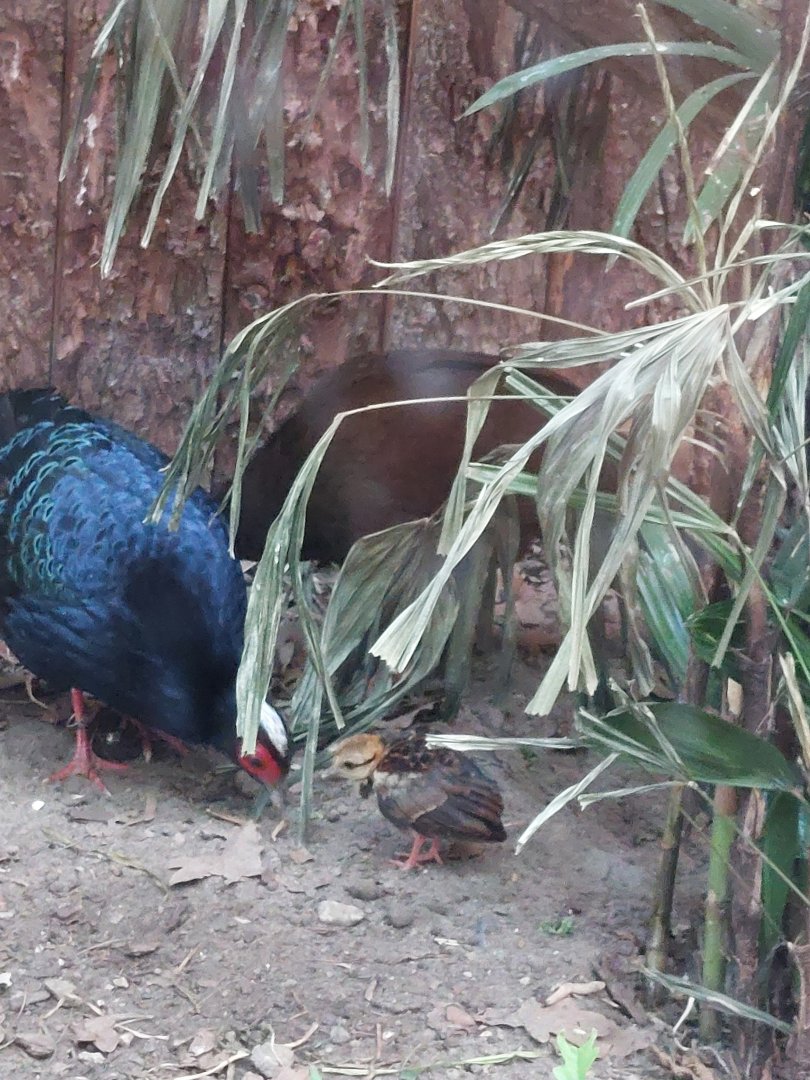
There are a few new species. The Nui Chua Stickinsect (Nuichua rabaeyae), who live in the insect house. And the species which slowly turns in to another meerkat or Ring-tailed Lemur, the Edward's pheasant (Lophura edwardsi). As well as at least 1 colorade rover toad (Incilius alvarius), in the same terraria as the bluechinned roughscaled lizards (Sceloporus cyanogenys). And some Amano shrimp in the south east asian aquaria and great ramhorn snail in the Lake Patzcuaro salamanders tank in the zoo school.

A few species (all birds) changed in the Zoo since last year. Both the scarlet and the green winged macaws left the zoo. Their aviaries next to the tigers are now home to the last of the trumpeter hornbills (Bycanistes bucinator), which after the death of the female only holds a single male. The vulterine guneafowl (Acryllium vulturinum), wich used to live together with them in the bird house left the collection. The former trumpeter hornbill aviary, is now home to the bali myna and nicobar pigeons. The former smaller aviary which kept the nicobar pigeons and bali myna is now home to the new edward's pheasant and the Red-whiskered bulbul, the later used to be free roaming in the vister path inside the bird house, but now are exclusively in the aviary. Also from the bird house, the nothern lapwing are not kept in the wader aviary any longer.
The construction work on the new "Nature Garden area" Between the bistro, the white storks is already largely in the way. The area will focus on native insects, plants and traditional gardening. But also will contain native herps in outdoor terraria. The only conformed species so far is the sand lizard (Lacerta agilis).

Besides this, there were mutable births. Mainly, multiple gelada, 1 lion-tailed macaque, 1 bactrian camel, 1 chapman's zebra, and, multiple bennet's wallabies, and 2 of the edward's pheasant who just came only a few months ago in the zoo

Also, 1 new liontailed macaque from Leipzig, 8 reticulated hillstream loaches (Sewellia lineolata) from cologne and 2 waldraps from Vienna came this year to already existing groups
edwardss-pheasants-with-chick.799236
 
Last edited:
After my recent visit. I go and give a major info dumb.

There are a few new species. The Nui Chua Stickinsect (Nuichua rabaeyae), who live in the insect house. And the species which slowly turns in to another meerkat or Ring-tailed Lemur, the Edward's pheasant (Lophura edwardsi). As well as at least 1 colorade rover toad (Incilius alvarius), in the same terraria as the bluechinned roughscaled lizards (Sceloporus cyanogenys). And some Amano shrimp in the south east asian aquaria and great ramhorn snail in the Lake Patzcuaro salamanders tank in the zoo school.

A few species (all birds) changed in the Zoo since last year. Both the scarlet and the green winged macaws left the zoo. Their aviaries next to the tigers are now home to the last of the trumpeter hornbills (Bycanistes bucinator), which after the death of the female only holds a single male. The vulterine guneafowl (Acryllium vulturinum), wich used to live together with them in the bird house left the collection. The former trumpeter hornbill aviary, is now home to the bali myna and nicobar pigeons. The former smaller aviary which kept the nicobar pigeons and bali myna is now home to the new edward's pheasant and the Red-whiskered bulbul, the later used to be free roaming in the vister path inside the bird house, but now are exclusively in the aviary. Also from the bird house, the nothern lapwing are not kept in the wader aviary any longer.
The construction work on the new "Nature Garden area" Between the bistro, the white storks is already largely in the way. The area will focus on native insects, plants and traditional gardening. But also will contain native herps in outdoor terraria. The only conformed species so far is the sand lizard (Lacerta agilis).

Besides this, there were mutable births. Mainly, multiple gelada, 1 lion-tailed macaque, 1 bactrian camel, 1 chapman's zebra, and, multiple bennet's wallabies, and 2 of the edward's pheasant who just came only a few months ago in the zoo

Also, 1 new liontailed macaque from Leipzig, 8 reticulated hillstream loaches (Sewellia lineolata) from cologne and 2 waldraps from Vienna came this year to already existing groups
edwardss-pheasants-with-chick.799236
Does this zoo have a large population of white storks?
 
Yes, it was in fact for a long time the largest population of white storks in the entire state of Northrhein-Westphalia. Over 100 pairs.
maxresdefault.jpg
Is this also the largest population in Europe? I heard that the number of white storks here peaked at over 400.
 
Is this also the largest population in Europe? I heard that the number of white storks here peaked at over 400.
Seeing that you are Chinese, you may confuse the species. The european white stork (Boyciana boyciana) is not an endengered species. In Germany alone there a circa 8000 animals. The oriental white stork (Ciconia boyciana) from East Asia is a highly endangered species has only around 2000 animals globally. From what I could find online, the largest european withe stork colony is in the spanish town of Alfaro with over 500 pairs there alone.
 
Seeing that you are Chinese, you may confuse the species. The european white stork (Boyciana boyciana) is not an endengered species. In Germany alone there a circa 8000 animals. The oriental white stork (Ciconia boyciana) from East Asia is a highly endangered species has only around 2000 animals globally. From what I could find online, the largest european withe stork colony is in the spanish town of Alfaro with over 500 pairs there alone.
In fact, I only wanted to know about white stork (Ciconia ciconia) in European zoos, not wild populations.
 
In fact, I only wanted to know about white stork (Ciconia ciconia) in European zoos, not wild populations.
ahh, sorry for misunderstanding. The problem in Rheine you could not really tell how many of these birds are "wild" or "zoo animals". As the large majority of the birds have their wings not clipped, and are able to leave the zoo ground any time they want to. Most of them nests in the large trees all over the zoo and surrounding park, epically in the Barbary macaque exhibit, Many of the zoos animals also migrate to Africa. It would be fair to describe the population mostly as "semi-captive".
 
ahh, sorry for misunderstanding. The problem in Rheine you could not really tell how many of these birds are "wild" or "zoo animals". As the large majority of the birds have their wings not clipped, and are able to leave the zoo ground any time they want to. Most of them nests in the large trees all over the zoo and surrounding park, epically in the Barbary macaque exhibit, Many of the zoos animals also migrate to Africa. It would be fair to describe the population mostly as "semi-captive".
Wow! Before this I thought they all belonged to Naturzoo Rheine. Thanks for your reply.
 
I have a question regarding Naturzoo Rheine.

I am planning to visit later this month, but I was wondering how many hours it would take to tour the zoo and take photos for a first time visitor?

This is in order to know whether it would be doable to visit this place on a day where we might miss some hours of the morning due to a long drive.
 
I have a question regarding Naturzoo Rheine.

I am planning to visit later this month, but I was wondering how many hours it would take to tour the zoo and take photos for a first time visitor?

This is in order to know whether it would be doable to visit this place on a day where we might miss some hours of the morning due to a long drive.
Even though I am mot the kind of person to look at the time, and takes his time. I would say defentivly doeble in under 3 hours. Don't forgett the Terrarias at the Zooschool next to the Bistro. It has a few rareties
 
BERT the male White-handed Gibbon has passed away at the respectable age of 43,5 years.
NaturZoo on Instagram: "ABSCHIED VON BERT Nach 43,5 Jahren, davon 37 Jahren bei uns im NaturZoo, ist Anfang des Monats der Gibbonmann „Bert“ eingeschläfert worden. Er hatte in den Wochen zuvor deutliche Anzeichen einer Verschlechterung seines Wohlbefindens gezeigt. Eine intensive veterinärmedizinische Untersuchung hat zutage gebracht, dass er trotz gesunder Ernährung unheilbar an Diabetes erkrankt war. Um ihm unnötige Leiden zu ersparen, wurde dann die Entscheidung zu einer Euthanasie getroffen. Dank großer Fortschritte in der Veterinärmedizin und verbesserter Haltungsbedingungen werden Zootiere wie "Bert" immer älter und leben oft deutlich länger als ihre wild lebenden Artgenossen. Damit nehmen jedoch auch altersbedingte Beschwerden wie beispielsweise Gelenksarthrosen zu. Ziel ist daher nicht das Erzielen neuer Altersrekorde, sondern stets die Gewährleistung des Tierwohls. Außerdem erhält mit dem Tod eines alten Tieres die nächste Generation eine Chance auf Zucht für die wichtige Arterhaltung der stark gefährdeten Weißhandgibbons. Der Gibbon kam im Jahr 1988 zur Adventszeit in den NaturZoo Rheine und wurde mit der damals bereits bei uns lebenden Gibbondame „Lizzy“ vergesellschaftet, mit der er auch viermal Nachwuchs zeugte. Nach dem Tod des Weibchens kam er mit der heute noch bei uns lebenden „Babs“ zusammen. Mit ihr verstand er sich nie so richtig gut, und deren Kontakt beschränkte sich auf Berührungen durch die Schieber der benachbarten Gehegeteile. Während seiner Zeit bei uns im Zoo erlebte „Bert“ auch Umzüge und Verbesserungen der Haltungsbedingungen. Zuerst im Affenhaus untergebracht, zog er im Jahr 2006 auf die neu gebauten Affeninseln um. Zuletzt war er dort aufgrund seines Alters nur noch selten auf der Außenanlage zu sehen. #weißhandgibbon #gibbon #abschied #naturzoorheine"
 
Arrival of 2 Pygmy Slow Lorises, a new species for the zoo
NaturZoo on Instagram: "Zwei Zwergloris für den NaturZoo Rheine Wir freuen uns eine ganz besondere Nachricht bekanntzugeben: Am letzten Wochenende ist eine neue Tierart eingezogen! Die kleinen, stark bedrohten Zwergloris werden Teil eines neu gestalteten Bereichs, dessen feierliche Eröffnung in Kürze bevorsteht. Der Einzug der nachtaktiven Primaten ist ein bedeutender Schritt für den NaturZoo. Nicht nur aufgrund der besonderen Bedürfnisse dieser faszinierenden Tiere, sondern auch wegen ihrer großen Bedeutung im Artenschutz. Zwergloris gehören zu den wenigen giftigen Säugetieren weltweit und sind im Freiland stark bedroht. Neben den Zwergloris, die in die alte Voliere der Papageien ziehen, wird im Tigerhaus auch ein neues Terrarium für seltene Krokodilschwanzechsen zu sehen sein. Das erste Tier lebt bereits im NaturZoo hinter den Kulissen. Die Art zählt zu den eindrucksvollsten, aber auch bedrohten Reptilien Südostasiens. Ihr typisch wasserreicher Lebensraum wurde im Zoo detailgetreu nachempfunden – inklusive Bachlauf, Sonnenästen und üppiger Vegetation. Mit dem neuen Bereich schafft der NaturZoo Rheine ein Zuhause für zwei hoch bedrohte Arten, die in europäischen Zoos nur selten gezeigt werden. Beide Projekte unterstreichen das zentrale Anliegen des Zoos: Artenschutz begreifbar machen. Der genaue Eröffnungstermin wird in Kürze bekanntgegeben; die finalen Arbeiten befinden sich auf der Zielgeraden. Schon bald können Besucherinnen und Besucher die neuen Bewohner erstmals entdecken."
 
Well. I wonder what they gonan do with the outfoor aviary for the macaws then ? Maybe some smaller asian bird species. Since it apears the tiger house gets transformed in to a south east asian theme. But it will kinda be as hame to lsoe all the tarnatulas in the end :(
 
Back
Top