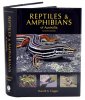
Just received in the mail to day my autographed copy of Hal Cogger's "Reptiles and Amphibians of Australia", 7th Edition.
Generally considered to be the 'bible' of Australian herpetological books, past editions are virtually impossible to come by and keenly sought after by enthusiasts. A quick search on Amazon will give you an idea of some of the tremendous prices asked for these books.
This edition lists all 1218 species of Australian reptiles and amphibian described up to October 2013, an increase of 168 species since the last edition in 2000.
I don't have a copy of the 6th edition, mine is the 5th, from 1992. But compared to that one, this book has several improvements, the most noticeable being colour on the distribution maps and - more importantly - to highlight differences in the illustrations used in the keys.
The Introduction is very much the same, with some rewrites to update or include new information, some paragraphs remain unchanged. Under the section on keeping captive reptiles he has added a section on Introduced (Exotic) Species, an important addition in my opinion. (Note: these changes are compared to my 5th Ed., they may have already been incorporated into the 6th Ed.)
The rest of the book is what you would expect: 940 pages with descriptions of the Families, Genera and the individual species, accompanied by dichotomous keys, distribution maps and brilliant colour photographs. This is followed by an addenda listing ten species and three genera that were only recently described, a glossary, and a 27 page "Selected References" list.
For anyone interested in Australian herpetofauna, particularly the diversity, this is THE book you must have.

Hix
Generally considered to be the 'bible' of Australian herpetological books, past editions are virtually impossible to come by and keenly sought after by enthusiasts. A quick search on Amazon will give you an idea of some of the tremendous prices asked for these books.
This edition lists all 1218 species of Australian reptiles and amphibian described up to October 2013, an increase of 168 species since the last edition in 2000.
I don't have a copy of the 6th edition, mine is the 5th, from 1992. But compared to that one, this book has several improvements, the most noticeable being colour on the distribution maps and - more importantly - to highlight differences in the illustrations used in the keys.
The Introduction is very much the same, with some rewrites to update or include new information, some paragraphs remain unchanged. Under the section on keeping captive reptiles he has added a section on Introduced (Exotic) Species, an important addition in my opinion. (Note: these changes are compared to my 5th Ed., they may have already been incorporated into the 6th Ed.)
The rest of the book is what you would expect: 940 pages with descriptions of the Families, Genera and the individual species, accompanied by dichotomous keys, distribution maps and brilliant colour photographs. This is followed by an addenda listing ten species and three genera that were only recently described, a glossary, and a 27 page "Selected References" list.
For anyone interested in Australian herpetofauna, particularly the diversity, this is THE book you must have.
Hix