New Zoo Books

Zoos 2.0: The AI-Powered Evolution of Animal Parks (Dennis Nagel, 2023) is a 55-page book about modern technology and zoos. Nagel's claim to fame is being the "zoo development specialist" at Safari World in Thailand.

Amazon.com

This seems like a bad idea and a ploy to make a quick buck off of how popular AI suddenly is.
 
Zoos 2.0: The AI-Powered Evolution of Animal Parks (Dennis Nagel, 2023) is a 55-page book about modern technology and zoos. Nagel's claim to fame is being the "zoo development specialist" at Safari World in Thailand.

Amazon.com

Hello snowleopard,
This is not my „claim to fame“ but the official job title in my working contract.
 
This seems like a bad idea and a ploy to make a quick buck off of how popular AI suddenly is.
Please explain why using AI is a bad idea. If you don’t see how it can be used for animal welfare, conservation, research, and many more purposes in a zoo, you might want to consider reading the book
For a „quick buck“ the price would not be 9.99 USD only.
 
Please explain why using AI is a bad idea. If you don’t see how it can be used for animal welfare, conservation, research, and many more purposes in a zoo, you might want to consider reading the book
For a „quick buck“ the price would not be 9.99 USD only.

Because there's no human involvement. Things like welfare and conservation aren't something you can break down into something programmable.
 
AI is a tool, a tool that we in certain cases don't fully understand. A tool is only as cool as the user.
 
Just thought I'd mention Martha Nussbaum's new book, Justice for Animals: Our Collective Responsibility. Among other things, it argues that recognizing the need for animal justice is a key requirement for a fuller humanity; indeed, the book argues that humanity does not exclude animality, which are otherwise regarded as polar opposites. In doing so, she questions our conceptions of rationality, identity, and of course the rationale that reinforces the convenient division between humans and animals (non-humans). She expands the term "humanity" to mean a political community in which non-human animals are also participants. Perhaps the only reason then to continue to use the term "humanity" is to call attention to the many ways in which we are affecting other species by thinking of the planet as our fundamental niche; other species, per this view, exist for our curiosity or amusement, and this is one of many problematic rationales we have to deal with. Very good book that demands readers to reconsider and grapple once more with several ethical questions.
 
Just thought I'd mention Martha Nussbaum's new book, Justice for Animals: Our Collective Responsibility. Among other things, it argues that recognizing the need for animal justice is a key requirement for a fuller humanity; indeed, the book argues that humanity does not exclude animality, which are otherwise regarded as polar opposites. In doing so, she questions our conceptions of rationality, identity, and of course the rationale that reinforces the convenient division between humans and animals (non-humans). She expands the term "humanity" to mean a political community in which non-human animals are also participants. Perhaps the only reason then to continue to use the term "humanity" is to call attention to the many ways in which we are affecting other species by thinking of the planet as our fundamental niche; other species, per this view, exist for our curiosity or amusement, and this is one of many problematic rationales we have to deal with. Very good book that demands readers to reconsider and grapple once more with several ethical questions.

This is an ARA book and has nothing to do with what this thread is for.
 
This is an ARA book and has nothing to do with what this thread is for.

What is an ARA book? I thought with discussions ranging from AI in zoo-upkeep, -management, etc this might be relevant. Besides, since most wildlife is now regulated and "held" in national parks, reserves, or zoos, I thought the book's key concerns would hold. But I'd understand if this goes against forum/thread rules. Thanks for the heads up!
 
What is an ARA book? I thought with discussions ranging from AI in zoo-upkeep, -management, etc this might be relevant. Besides, since most wildlife is now regulated and "held" in national parks, reserves, or zoos, I thought the book's key concerns would hold. But I'd understand if this goes against forum/thread rules. Thanks for the heads up!

ARA is Animal Rights Advocate. Think people like PETA, fairly extreme in their beliefs, anti-zoo. This thread is more for books about specific zoos, zoo design, etc., rather than books that might mention zoos in their abstract.
 
Entangled Encounters at the National Zoo: Stories from the Animal Archive (Vandersommers, 2023) is an upcoming 376-page book that "is a study of this important cultural landmark from 1887 to 1920." Daniel Vandersommers is an assistant professor of environmental history at the University of Drayton. (Out of curiosity, I wonder how many zoos he has visited? I know of some zoo book authors who have visited only 20 zoos in their lifetime.)

Amazon.com has a 3-paragraph description on this link:

Amazon.com
 
Entangled Encounters at the National Zoo: Stories from the Animal Archive (Vandersommers, 2023) is an upcoming 376-page book that "is a study of this important cultural landmark from 1887 to 1920." Daniel Vandersommers is an assistant professor of environmental history at the University of Drayton. (Out of curiosity, I wonder how many zoos he has visited? I know of some zoo book authors who have visited only 20 zoos in their lifetime.)

Amazon.com has a 3-paragraph description on this link:

Amazon.com

What on earth is the second paragraph?
"First, through narrative, he shows how zoo animals always ran away from the zoo. This is meant literally—animals escaped frequently—but even more so, figuratively. Living, breathing, historical zoo animals ran away from their cultural constructions, and these constructions ran away from the living bodies they were made to represent. The author shows that the resulting gaps produced by runaway animals contain concealed, distorted, and erased histories worthy of uncovering."

His previous book about zoos starts by comparing them to mental hospitals.
 
What on earth is the second paragraph?
"First, through narrative, he shows how zoo animals always ran away from the zoo. This is meant literally—animals escaped frequently—but even more so, figuratively. Living, breathing, historical zoo animals ran away from their cultural constructions, and these constructions ran away from the living bodies they were made to represent. The author shows that the resulting gaps produced by runaway animals contain concealed, distorted, and erased histories worthy of uncovering."

His previous book about zoos starts by comparing them to mental hospitals.

It comes across as pure academia nonsense. Ugh. He's probably visited less than 10 zoos in his life. However, the 3rd descriptive paragraph is a little more appealing. I'll wait until some zoo nerd friends buy the book and then their reactions will determine if I ever purchase it myself.

Here is the Amazon third paragraph description:

"Entangled Encounters at the National Zoo demonstrates how the popular zoology fostered by the National Zoo shaped every aspect of American science, culture, and conservation during the Gilded Age and Progressive Era. Between the 1880s and World War I, as intellectuals debated Darwinism and scientists institutionalized the laboratory, zoological parks suddenly appeared at the heart of nearly every major American city, captivating tens of millions of visitors. Vandersommers follows stories previously hidden within the National Zoo in order to help us reconsider the place of zoos and their inhabitants in the twenty-first century."
 
Zoos and Aquariums in the Public Mind (Fraser, Heimlich & Riedinger, 2023) is an extremely expensive new zoo book that is less than 200 pages in length. There are 11 chapters and 30+ authors and I know that Wroclaw Zoo ordered a copy...but who else will?

Here's the Amazon link:

Amazon.com

Here's another zoo psychology book from one of the editors of the publication mentioned above. The Social Value of Zoos (Fraser & Switzer, 2021) can be found on this Amazon link:

Amazon.com
 
Zoos and Aquariums in the Public Mind (Fraser, Heimlich & Riedinger, 2023) is an extremely expensive new zoo book that is less than 200 pages in length. There are 11 chapters and 30+ authors and I know that Wroclaw Zoo ordered a copy...but who else will?

Here's the Amazon link:

Amazon.com

Here's another zoo psychology book from one of the editors of the publication mentioned above. The Social Value of Zoos (Fraser & Switzer, 2021) can be found on this Amazon link:

Amazon.com

Springer has the table of contents, along with an abstract for each chapter and references: Zoos and Aquariums in the Public Mind

30+ authors means lots of people will be requiring it in their classes.
 
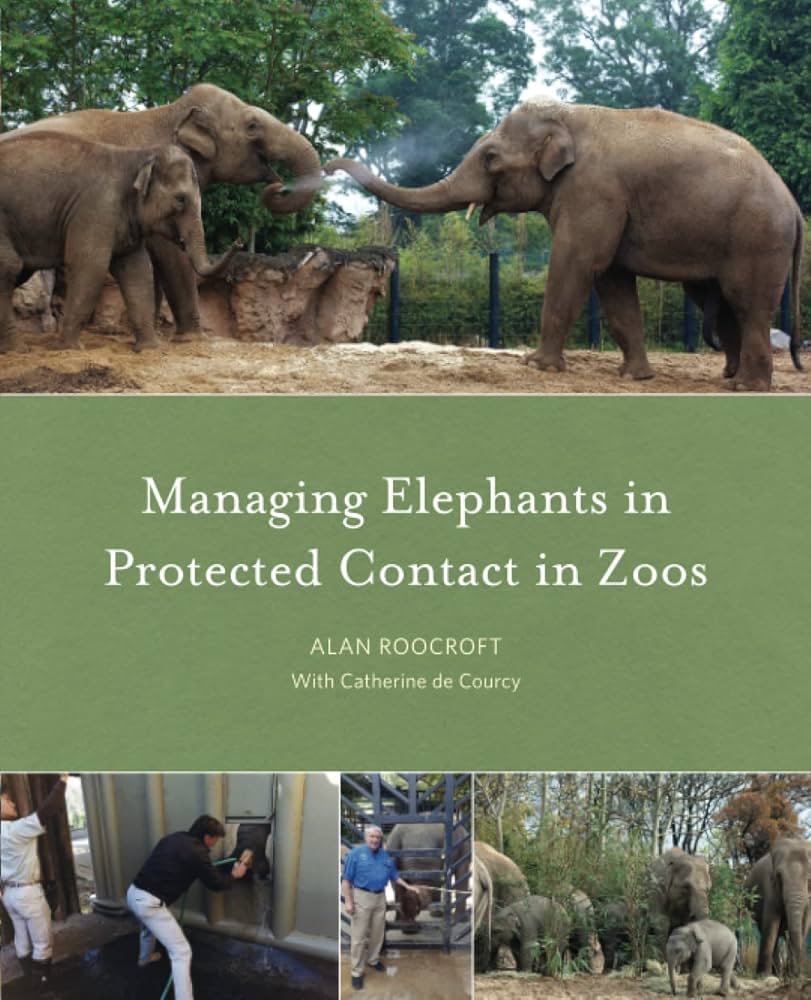
Managing Elephants in Protected Contact in Zoos (Roocroft with de Courcy, 2023) is a new book that received a rave review in Keeper Contact, which is a monthly U.K. zoo magazine.

Alan Roocroft is famous for his 55 years of working with elephants, via Chester Zoo, wild elephants in Sri Lanka, Tierpark Hagenbeck, San Diego Wild Animal Park and his own consultancy firm. Catherine de Courcy is a respected zoo author, having written fantastic books about Dublin Zoo (two editions) and contributing articles on Australian zoos to publications.

Here is the U.S. Amazon link:

Amazon.com

Here is the book cover:

71FrgAZrqbL._AC_UF1000,1000_QL80_.jpg
 
Last edited:
Back
Top