Newly discovered / described fossil species 2020

Jan. 3, 2020
Name:
Acuetzpalin carranzai
What: Ophthalmosaurid ichthyosaur
When: ~ 155,000,000 B.C.E. (Late Jurassic epoch)
Where: La Casita Formation (Mexico)
Additional Information: N/A
Study: Acuetzpalin carranzai gen et sp. nov. A new ophthalmosauridae (Ichthyosauria) from the Upper Jurassic of Durango, North Mexico - ScienceDirect
Picture Source: (Ophthalmosaurus, a related species) Ophthalmosaurus by Mark Garlick/science Photo Library
ophthalmosaurus-mark-garlickscience-photo-library.jpg

 
Jan. 08, 2020
Name:
Oriensmilus liupanensis
What: Nimravid carnivoran mammal
When: Middle Miocene epoch
Where: Tongxin Basin (northern China)
Additional Information: N/A
Study: https://www.tandfonline.com/doi/abs/10.1080/14772019.2019.1691066?journalCode=tjsp20
Picture Source: (Barbourofelis, a related species) Cougar Lion Barbourofelidae Barbourofelis PNG - Free Download
imgbin-cougar-lion-barbourofelidae-barbourofelis-lion-mqtCexiNkgBweFUzRvGkCERHz.jpg


Jan. 10, 2020

Name:
Yunyangosaurus puanensis
What: Megalosauroid? theropod dinosaur
When: ~ 174,000,000 B.C.E. (Aalenian stage of the Middle Jurassic epoch)
Where: Xintiangou Formation (Chongqing, China)
Additional Information: N/A
Study: A new possible megalosauroid theropod from the Middle Jurassic Xintiangou Formation of Chongqing, People’s Republic of China and its implication for early tetanuran evolution
Picture Source: N/A
 
Last edited:
Jan. 10, 2020
Name: Calumma benovskyi
What: Chameleon lizard
When: Early Miocene
Where: Rusinga Island, Kenya
Additional Information: Discovery suggests Calumma, a chameleon genus endemic to Madagascar, originated in mainland Africa. It's the only complete articulated early Miocene chameleon skull.
Study: Study
Picture Source: N/A
 
Jan. 15, 2020
Name:
Wulong bohaiensis
What: Microraptorine dromaeosaur theropod dinosaur
When: Aptian stage of the Late Cretaceous epoch
Where: Jiufotang Formation (Liaoning, China)
Additional Information: "The holotype possesses several feather types, including filamentous feathers, pennaceous primaries, and long rectrices, establishing that their growth preceded skeletal maturity and full adult size in some dromaeosaurids."
Study: Study
Picture Source: Microraptor (a related species)
340
 
New species of Allosaurus in the house!

Jan. 24, 2020

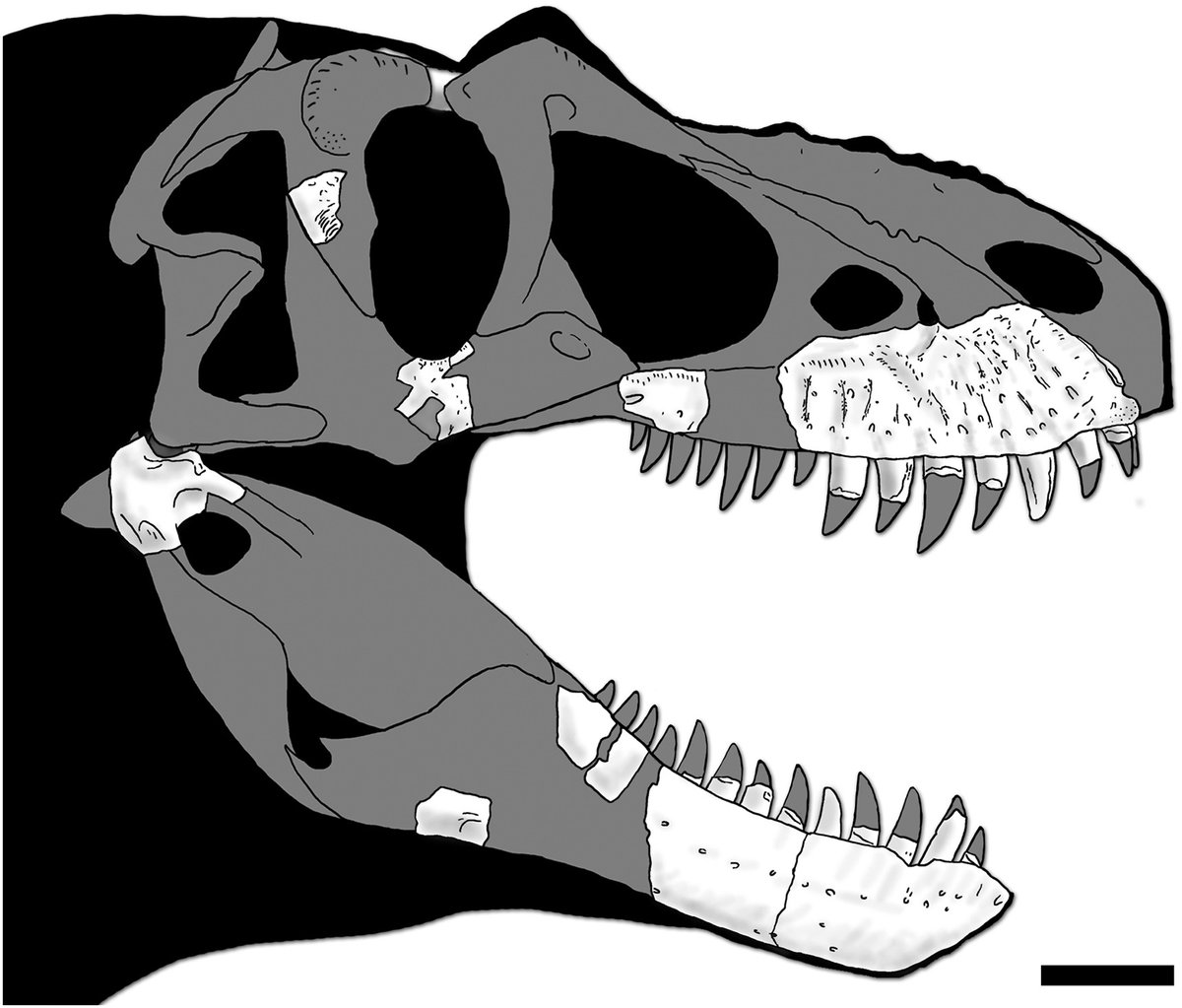
Name: Allosaurus jimmadseni
What: Allosaurid theropod dinosaur
When: ~ 157,000,000 B.C.E. to 152,000,000 B.C.E. (Kimmeridgian stage of the Late Jurassic epoch)
Where: Morrison Formation (Utah, United States)
Additional Information: Allosaurus jimmadseni represents the earliest species of Allosaurus.
Study: Cranial anatomy of Allosaurus jimmadseni, a new species from the lower part of the Morrison Formation (Upper Jurassic) of Western North America
Picture Source: Remarkable New Species of Meat-Eating Jurassic Dinosaur Discovered in Utah
Allosaurus-jimmadseni-Illustration-777x622.jpg


And a new tyrannosaur!

Jan. 23, 2020

Name: Thanatotheristes degrootorum
What: Tyrannosaurid theropod dinosaur
When: ~ 80,100,000 B.C.E. to 79,500,000 B.C.E. (Campanian stage of the Late Cretaceous epoch)
Where: Foremost Formation (Alberta, United States)
Additional Information: The new genus is found to be the sister taxon to Daspletosaurus, and together form the new clade Daspletosaurini.
Study: A new tyrannosaurine (Theropoda:Tyrannosauridae) from the Campanian Foremost Formation of Alberta, Canada, provides insight into the evolution and biogeography of tyrannosaurids - ScienceDirect
Picture Source: パンテオン on Twitter
EPAGYn7UUAAckMc.jpg
 
New species of Allosaurus in the house!

Jan. 24, 2020

Name: Allosaurus jimmadseni
What: Allosaurid theropod dinosaur
When: ~ 157,000,000 B.C.E. to 152,000,000 B.C.E. (Kimmeridgian stage of the Late Jurassic epoch)
Where: Morrison Formation (Utah, United States)
Additional Information: Allosaurus jimmadseni represents the earliest species of Allosaurus.
Study: Cranial anatomy of Allosaurus jimmadseni, a new species from the lower part of the Morrison Formation (Upper Jurassic) of Western North America
Picture Source: Remarkable New Species of Meat-Eating Jurassic Dinosaur Discovered in Utah
Allosaurus-jimmadseni-Illustration-777x622.jpg


And a new tyrannosaur!

Jan. 23, 2020

Name: Thanatotheristes degrootorum
What: Tyrannosaurid theropod dinosaur
When: ~ 80,100,000 B.C.E. to 79,500,000 B.C.E. (Campanian stage of the Late Cretaceous epoch)
Where: Foremost Formation (Alberta, United States)
Additional Information: The new genus is found to be the sister taxon to Daspletosaurus, and together form the new clade Daspletosaurini.
Study: A new tyrannosaurine (Theropoda:Tyrannosauridae) from the Campanian Foremost Formation of Alberta, Canada, provides insight into the evolution and biogeography of tyrannosaurids - ScienceDirect
Picture Source: パンテオン on Twitter
EPAGYn7UUAAckMc.jpg
It's worth noting Big Al, an Allosaurus specimen made famous by the Walking With... spin-off The Ballard of Big Al, has been placed in the new species.
 
Not really a new species discovered, but still a new fossil discovery. I hope this is the right place to share this.

New paleontological research on the Isle of Skye, Scotland has resulted in the first record of tracks of a Stegosaurian in Scotland.

Scotland Was the Real 'Jurassic Park’ During the Reign of Dinosaurs, Newfound Footprints Suggest
Ancient Stegosaurus relatives wandered across the Scottish highlands
Novel track morphotypes from new tracksites indicate increased Middle Jurassic dinosaur diversity on the Isle of Skye, Scotland
 
Fossil 'wonderchicken' could be early fowl

A 67 million year old bird skull could be the ancestor of gamebirds.

The fossil bird has been named Asteriornis maastrichtensis, after Asteria, a Greek goddess of falling stars who turns into a quail. It was found in a quarry on the Netherlands-Belgium border.

The bird weighed in at just under 400g and was an early member of the group that gave rise to modern-day chickens, ducks and other poultry.

At the time, the region was covered by a shallow sea, and conditions were similar to modern tropical beaches. With its long, slender legs, the bird may have been a shore dweller
.


The actual paper is here, but it is not open access so only the abstract can be read:
Late Cretaceous neornithine from Europe illuminates the origins of crown birds | Nature

Our understanding of the earliest stages of crown bird evolution is hindered by an exceedingly sparse avian fossil record from the Mesozoic era. The most ancient phylogenetic divergences among crown birds are known to have occurred in the Cretaceous period1,2,3, but stem-lineage representatives of the deepest subclades of crown birds—Palaeognathae (ostriches and kin), Galloanserae (landfowl and waterfowl) and Neoaves (all other extant birds)—are unknown from the Mesozoic era. As a result, key questions related to the ecology4,5, biogeography3,6,7 and divergence times1,8,9,10 of ancestral crown birds remain unanswered. Here we report a new Mesozoic fossil that occupies a position close to the last common ancestor of Galloanserae and fills a key phylogenetic gap in the early evolutionary history of crown birds10,11. Asteriornis maastrichtensis, gen. et sp. nov., from the Maastrichtian age of Belgium (66.8–66.7 million years ago), is represented by a nearly complete, three-dimensionally preserved skull and associated postcranial elements. The fossil represents one of the only well-supported crown birds from the Mesozoic era12, and is the first Mesozoic crown bird with well-represented cranial remains. Asteriornis maastrichtensis exhibits a previously undocumented combination of galliform (landfowl)-like and anseriform (waterfowl)-like features, and its presence alongside a previously reported Ichthyornis-like taxon from the same locality13 provides direct evidence of the co-occurrence of crown birds and avialan stem birds. Its occurrence in the Northern Hemisphere challenges biogeographical hypotheses of a Gondwanan origin of crown birds3, and its relatively small size and possible littoral ecology may corroborate proposed ecological filters4,5,9 that influenced the persistence of crown birds through the end-Cretaceous mass extinction.


Raptor time!

Mar. 26, 2020
Name: Dineobellator notohesperus
What: Dromaeosaurid theropod dinosaur
When: ~ 67,000,000 B.C.E. (Maastrichtian stage of the Late Cretaceous epoch)
Where: Ojo Alamo Formation, New Mexico, United States
Additional Information: Dineobellator stood only about 1 m (3.3 feet) at the hip and was about 2 m (6.6 feet) long — similar in size to famous dromaeosaurids Velociraptor and Saurornitholestes.
Study: Discovery of the oldest bilaterian from the Ediacaran of South Australia
Picture Source: New Feathered Dinosaur Unveiled: Dineobellator notohesperus | Paleontology | Sci-News.com
image_8269_1-Dineobellator-notohesperus.jpg
 
Mar. 31, 2020
Name: Martensius bromackerensis
What: Caseasaurian synapsid
When: ~ 285,000,000 B.C.E. (Artinskian stage of the Permian period)
Where: Tambach Formation (Germany)
Additional Information: N/A
Study: Study
Picture Source: Picture
2514195_web1_ptr-Carnegie-040120.jpg
 
  • Like
Reactions: AWP
Back
Top