NZ wildlife questions? Ask them here.

Chlidonias

Moderator
Staff member
15+ year member
Hi guys (and girls),

There's been a couple of general (non zoo related) questions about NZ birds on other threads, so I thought I'd start this one if anyone wants to know anything. I've seen most of NZ's land-birds in the wild and a fair whack of the seabirds (which is an accomplishment in itself given that even typing the word "boat" makes me violently seasick!). Shamefully I don't have infinite knowledge but most stuff I should be able to handle, and if not there are other NZers on here that can probably join in.

So ask away. Birds, mammals, reptiles, fish, invertebrates. Come one, come all. Etc.
 
Hey Chlidonias,

Can you tell me more about the Antipodes Island Parakeets..? I didn't even know they existed before travelling to Hamilton Zoo last Sat...

I've read a little bit about them on the net can you tell me more about the ones in capativity..? (Where, when etc...)
 
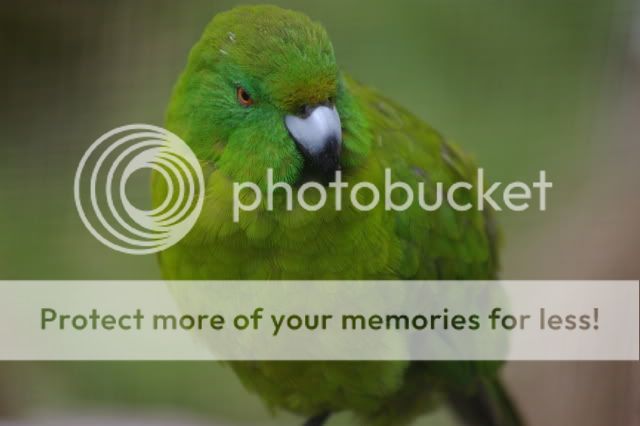
AntipodesIslandparakeet16.jpg


the last DoC management plan was the 1995 one I believe:

www.doc.govt.nz/upload/documents/science-and-technical/TSOP07.pdf

Then there were about 75 birds in captivity, all descended from a group taken from the Antipodes in the late 1970s-80s. It mentions in the publication how some birds were released on Stephens Island in Cook Strait in an attempt to establish a wild population there but they failed for reasons unknown (post-publication it was determined that it was due to tuatara attacking/eating the parrots when they were roosting in their burrows!). There are none overseas.

The wild population (on the Antipodes, which for those overseas not familiar with NZ islands, are WAY down south in the subantarctic) is around 2-3000 and is considered stable. The only real risk to the birds is from the possibilty of introduced pests somehow arriving there, especially rats, and for this reason landing on the islands is prohibited without a licence. To see a wild one you need to go on a subantarctic cruise, from which you can rove around offshore in a small inflatable in the hopes of catching a distant sight of one should it happen to be near the beach. (Something which I can't afford to do, sadly).

No more have ever been brought into captivity, and there was a period where none were being allowed to be bred by DoC, but now they are pairing up birds and moving them between holders to keep the captive population going. There are quite a few held by private persons (with permits of course) but I don't know current figures. At public places I have seen them recently at Orana Park (where the photo above was taken) and Willowbank in Christchurch and at the Dunedin Botanic Gardens aviary complex. I assume they would also be at Wellington Zoo, Otorohanga and Mt. Bruce. In the 1995 document there were 12 public holders but it doesn't list them.

As for the birds themselves, they are the largest of the Cyanoramphus spp and the only one without a distinctly-contrasting forehead and crown (although it is a noticeably-different shade of green to the rest of the body). They live entirely on the ground in the wild and are omnivorous, feeding not only on the usual parroty things but also by scavenging along the tide-line and on the carcasses of dead seals and penguins. An interesting article in Notornis 46 documents them regularly killing storm petrels after digging them out of their nesting burrows.

They are my favourite Cyanoramphus species.
 
Thanks Chlidonias,

Such a beautiful (and rare) bird I knew when I saw them at Hamilton I'd stumbled accross something special...

To me that is what zoos are all about... Finding something as precious as gold that you'd be willing to do just about anything to protect... You really do learn something new everyday..! Anywho...

Do you know why there are so many more Males than Females in captivity..? Just a captive breeding trait..?

I hope Auckland gets them in their new Te Wao Nui expansion..!
 
Last edited:
The same imbalance between male and female parakeets also occurs on mauritius with the Echo parakeets. So it's not just the ones on the Antipodes islands!

What do you know about the kokako?
 
what do you wanna bet that most visitors just think "oh a little green parrot" and move on. If they actually bother to look at them they would see they are absolutely gorgeous birds. They might be all green but it is so many different shades from bright emerald to dark moss. I love them.

No idea on the reason for the difference in numbers between the sexes. My guess would just be randomness, with no real reason behind it. Just more males hatched than females.

I forgot to put in the above bit too, and I think its not in the DoC publication, but a few birds were also released on Kapiti Island near Wellington in 1907, where they survived for about twenty years.
 
What do you know about the kokako?

this is the DoC management plan for the North Island kokako (the South Island kokako is officially extinct...but more on that later)

www.doc.govt.nz/upload/documents/science-and-technical/tsrp30.pdf

I haven't actually seen a wild kokako yet because I don't get up to the North Island much (in the coming year I will see one definitely), but I've seen captive ones at Mt. Bruce. They are really unusual birds with one of the most amazing songs of any bird in the world (see if you can find a recording on the internet, it'll blow your mind: the settlers didn't call them organ-birds for nothing!). Different populations have distinct dialects, so translocated birds find it hard to understand the local residents. And the tui (a NZ honeyeater) mimics their calls and pass them down through their generations, so kokako calls remain in some places where the birds themselves are long gone.

The South Island kokako has been "extinct" for quite a while but there are people who think it still exists. One of the problems with searching for it is the tui-imitation one. In 1987 a feather was found on Stewart Island and tests (in a German laboratory I think) determined that it had been recently dropped from a living bird (rather than having come from a museum specimen); however the feather was later lost. Recently -- as in this year -- there were claims by veteran kokako-seeker Rhys Buckingham that he had found a remote site in Fiordland where he had heard several birds calling. I'd like to think its still there, but if it is it would be down to very few birds and they would probably mostly be males (females are killed by introduced mammals such as possums and stoats while on the nest; the North Island kokako has a heavily-skewed sex ratio due to this problem).
 
what do you wanna bet that most visitors just think "oh a little green parrot" and move on.

Happened while I was there Chlidonias... I spent 30 mins with my face pressed up against the chain link, admiring and learning (I guessed that they were quite ground based just watching them, although truthfully I did think at the time it was maybe an adaption to their aviary) and twice people stopped looked at them thinking Antipodes was somewhere in India, etc... (Cause as we all know the signs are so hard to read..!)

This bird has instantly became one of my NZ favourites...
 
Ha Ha... I love on the news here in NZ every few years you get someone claiming to have proof of SI Kokako's via recordings...

Now I know why, Tui's... You know more than me Chlidonias but I don't share your optimism that they are alive and well in the SI...
 
How are they displayed at Hamilton? Their aviaries are pretty basic at Willowbank and Dunedin. The Orana one is better in that it is grassed and not too small (with a FANTASTIC mural of the Antipodes on the back wall, painted by me many years ago). Orana fairly recently got a female to pair up with one of their males, so they'll be breeding them soon no doubt.
 
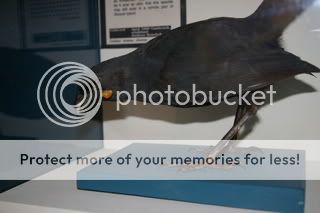
this is a South Island kokako at the Otago Museum

43SouthIslandkokakoOtagoMuseum.jpg


I'm not sure if they are still around, but it would be nice if they were. However they better be found soon if they are out there, because otherwise there won't be enough left to mount any kind of survival plan with!
 
this is a South Island kokako at the Otago Museum

I'm not sure if they are still around, but it would be nice if they were. However they better be found soon if they are out there, because otherwise there won't be enough left to mount any kind of survival plan with!

We live in hope! With so much wildlife still being "dragged up" out of the tropical rainforests of this world, it might just be there yet. NZ has fine deep forest cover in the south.

Chlidonias,

To deviate from NZ fine bird fauna, can you fill us in on why the tuatara are so special? What is their diet (you wrote they actually eat Antipodes parakeet ...)? Is it true that 2-3 different species exist and what is their conservation outlook?

Merry Christmas,

Jelle
 
@Jelle: Actually every good animal book and even wikipedia can give at least a few answers to the questions regarding the tuataras;):
Tuatara - Wikipedia, the free encyclopedia

@Chlidonias: Is there any good webpage besides the one You get using Google You can recommend in regard of extinct NZ birds, maybe even with fossil pics/reconstructions? Even with lesser known species like the Eyles' Harrier? Or the big guy itself, Harpagornis?

And for those who don't know what particular avifauna NZ has/had:
List of birds of New Zealand - Wikipedia, the free encyclopedia

BTW: The Chatham Island Sea-Eagle (Haliaeetus australis) is no longer considered a valid species, but was a mislabeled Bald Eagle.
 
@Jelle: Actually every good animal book and even wikipedia can give at least a few answers to the questions regarding the tuataras;):
Tuatara - Wikipedia, the free encyclopedia

Thanx, but .. I do not rate Wikipedia very highly myself and rather get my info from local experts like Chlidonias. I know a bit about tuatara, but their specialist reptile grouping story is never skillfully told.

So, Chlidonias can you come up with some challenging new data on tuatara and the species questions I raised?
 
Oh, wikipedia can be pretty helpful-and in a recent comparison by a larger European magazine to established encylopedias, it stood its ground...Anyway, if You want to get Your "challenging new datas" on "challenging old reptiles" otherwise, feel free to do so...

What I would consider an interesting question to Chlidonias: what native NZ birds (besides keas, Paradise Shelduck etc.) would qualify for the husbandry in European or American zoos, considering
a) international availability (so no takahe or kakapo)
b) interesting behaviour/colour in consideration of the average visitor
c) outdoor qualities i.e. having no problem in being kept outdoors most of the year in colder climates

Thanks in advance for the reply.
 
OK,

Tuatara: I don't put any faith in Wikipedia most of the time, but in this case I wouldn't dare try to go up against it's review of the species' history. The tuatara article on there is first-class. What I'll will say, in reply to the other questions, yes there are two species: the common tuatara and the Brothers Islands tuatara. The latter was actually first described as a separate species by Walter Buller back in 1877 but this was soon disregarded and it wasn't until 1989 that it was reinstated. The tiny relict population from Little Barrier Island has also been suggested as being a separate species. There are about 100,000 common tuatara and about 300 Brothers Islands tuatara. All are restricted to offshore islands except for a recently-established population of commons in the predator-fenced Karori Sanctuary in Wellington (these are treated as true wild animals not captives because they are free-living and managed as part of the island populations). The only real threats to tuatara today are rats (these are being eliminated on all offshore islands as far as possible), although smuggling will always be a problem. The islands are easy to access if a person has a boat and they fetch large sums of money from overseas collectors. There are only six foreign zoos with common tuatara and one with Brothers, but it is unfortunately not unusual to see tuatara being advertised for sale on reptile forums etc. (If you see this report it, because there are none held legally by private persons outside NZ).

Tuatara basically eat anything that moves. Invertebrates, lizards, frogs, baby tuatara (these are more diurnal and can often be found off the ground in bushes and trees, probably to avoid adult predation). The adults live in burrows, often sharing them with petrels and shearwaters. They will eat the eggs and chicks, and even the adult birds. They have a ridiculously strong bite -- when they get a hold on you, you know all about it!
 
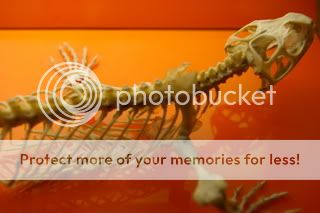
IMGP5071.jpg


tuatara skeleton showing the gastralia (abdominal ribs) and parietal eye hole
 
I love seeing the Tuatara at Chester!

When i was younger I could never see them until a few years ago, when I saw one. Since then, I can't miss them whenever I pass the exhibit. I've even helped out some other zoo-visitors is 'tuatara-spotting' ;)

They are really interesting creatures.
 
Ok whats the status of the Yellow Eyed Penguin at this time, have they thought about some captive breeding with them?.
 
Back
Top