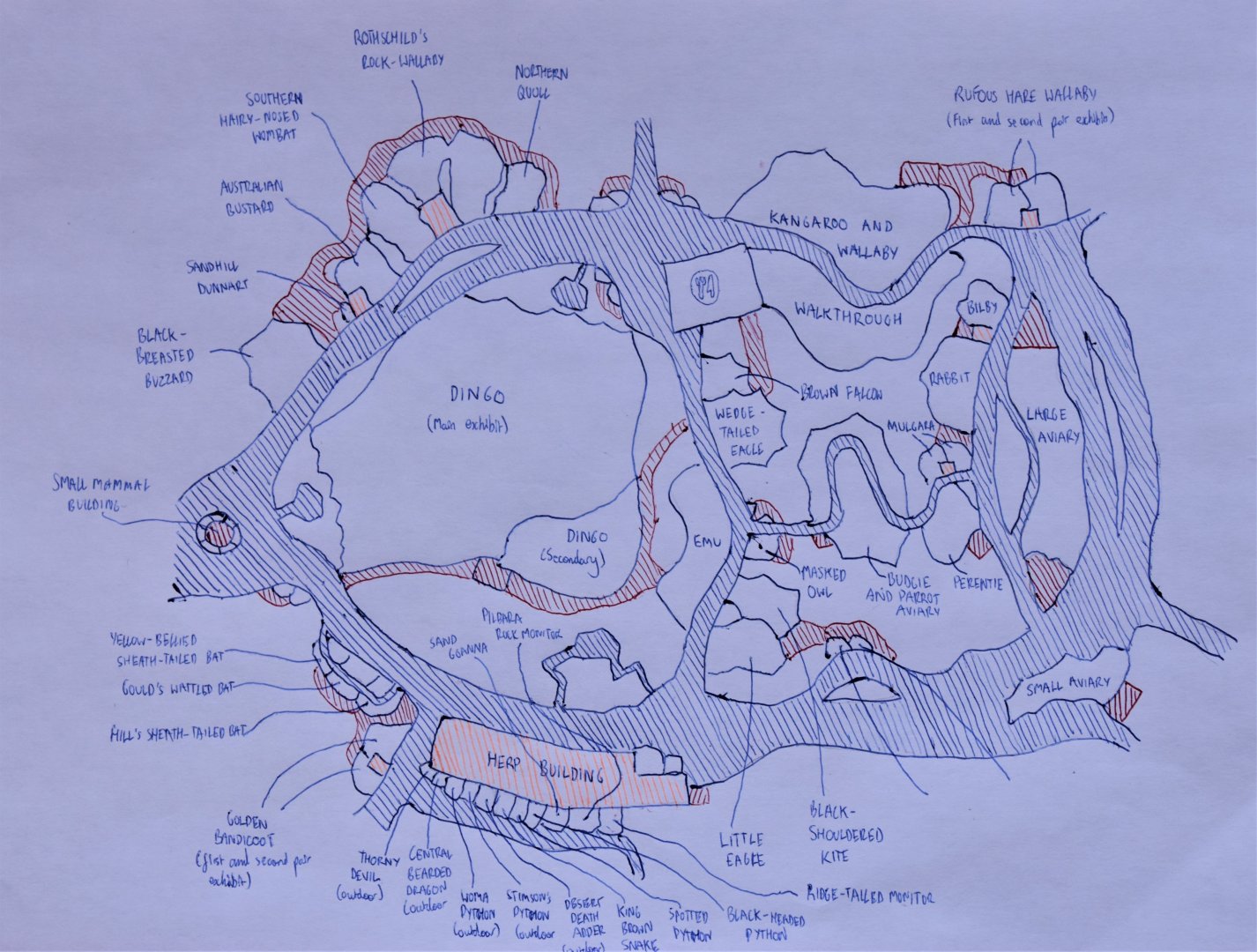
Great Deserts of the West exhibit sizes:

Brown falcon main aviary: 130 m2
Brown falcon and Wedge-tailed eagle off-show holding: 45 m2
Wedge-tailed eagle main aviary: 520 m2
Western pebble-mound mouse: 4 m2
Little Native mouse: 3 m2
Australian masked owl main aviary: 90 m2
Australian masked owl off-show: 20 m2
Budgerigar and Mulga parrot main aviary: 1600 m2
Budgerigar and Mulga parrot holding area: 40 m2
Perentie main exhibit: 120 m2
Perentie indoor on-show: 12 m2
Perentie indoor off-show: 10 m2
Crest-tailed mulgara outdoor: 12 m2
Brush-tailed mulgara outdoor: 12 m2
Mulgara shared off-show indoor: 10 m2
Mulgara viewing shed: 10 m2

Large aviary overall area: 1870 m2
Large aviary holding 1 (North): 120 m2
Large aviary holding 2 (South): 112 m2
Rabbit main exhibit: 200 m2
Rabbit and bilby off-show indoor: 45 m2
Greater bilby outdoor: 112 m2
Bilby and rabbit viewing shed: 35 m2
Rufous hare-wallaby exhibit 1: 150 m2
Rufous hare-wallaby exhibit 2: 145 m2
Rufous hare-wallaby viewing shelter: 22 m2
Rufous hare-wallaby off-show breeding building: 75 m2
Kangaroo and wallaby walkthrough outdoor: 3200 m2
Kangaroo and wallaby indoor off-show: 120 m2
Kangaroo and wallaby male separation paddock: 750 m2
Plains rat: 4.5 m2
Spinifex hopping mouse: 4.2 m2
Central rock rat: 5 m2
Long-haired rat: 5.2 m2
Desert mouse: 4 m2
Shark Bay mouse: 3.6 m2

Dingoes large outdoor: 3750 m2
Dingo separation + secondary exhibit: 950 m2
Dingo indoor off-show facility: 65 m2
Northern quoll outdoor on-show: 150 m2
Northern quoll outdoor off-show: 90 m2
Northern quoll viewing shelter: 15 m2
Northern quoll breeding facility: 75 m2
Rothschild's rock wallaby outdoor: 350 m2
Rothschild's rock wallaby separation: 100 m2
Rothschild's rock-wallaby and Southern hairy-nosed wombat indoor off-show: 50 m2
Rothschild's rock wallaby and Southern hairy-nosed wombat viewing shelter: 42 m2
Southern hairy-nosed wombat outdoor: 210 m2
Australian bustard outdoor: 145 m2
Australian bustard and Sandhill dunnart viewing shelter: 25 m2
Sandhill dunnart exhibit: 5 m2
Black-breasted buzzard main aviary: 310 m2
Black-breasted buzzard off-show: 45 m2

Little red kaluta: 4 m2
Long-tailed planigale: 4 m2
Fat-tailed false antechinus: 4.5 m2
Pilbara ningaui: 4 m2
Kultarr: 5 m2
Forrest's mouse: 4 m2
Sandy Inland mouse: 4 m2
Tiny mammal off-show facility: 25 m2
Red-cheeked dunnart: 6 m2
Western mouse: 5.5 m2
Mouse and dunnart off-show: 5 m2

Yellow-bellied sheath-tailed bat cave: 81 m2
Hill's sheath-tailed bat cave: 90 m2
Gould's wattled bat cave: 100 m2
Bat off-show: 62 m2
Golden bandicoot exhibit 1: 144 m2
Golden bandicoot exhibit 2: 133 m2
Golden bandicoot viewing shelter: 25 m2
Golden bandicoot off-show breeding facility: 33 m2

Spider terraria: 2 m2
Desert trilling frog: 2 m2
Smooth knob-tailed gecko: 2 m2
Giant cave gecko: 2 m2
Jeweled gecko: 2.5 m2
Pilbara cave gecko: 2 m2
Stoles' skink: 2.5 m2
Great Desert skink: 2.5 m2
Sharp-snouted delma: 2.5 m2
Western shingleback: 2.5 m2
Western blue-tongued skink: 5 m2
Gravel dragon: 4.5 m2
Central netted dragon: 5 m2
Bardick: 5 m2
Thorny devil indoor: 5.5 m2
Thorny devil outdoor: 5.5 m2
Central bearded dragon indoor: 5.5 m2
Central bearded dragon outdoor: 5.5 m2
Desert death adder indoor: 4.5 m2
Desert death adder outdoor: 6 m2
King Brown snake indoor: 5 m2
King Brown snake outdoor: 6.5 m2
Stimson's python indoor: 6 m2
Stimson's python outdoor: 6 m2
Spotted python indoor: 6 m2
Spotted python outdoor: 6 m2
Black-headed python indoor: 6.5 m2
Black-headed python outdoor: 6 m2
Woma python indoor: 6.5 m2
Woma python outdoor: 7 m2
Pilbara rock monitor indoor: 7.5 m2
Pilbara rock monitor outdoor: 10 m2
Ridge-tailed monitor indoor: 7.5 m2
Ridge-tailed monitor outdoor: 9 m2
Sand goanna indoor: 9 m2
Sand goanna outdoor: 15 m2
Off-show Herp house areas: 200 m2
Bar room: 36 m2
Total Herp house area: 550 m2

Greater stick-nest rat outdoor: 26 m2
Greater stick-nest rat on-show indoor: 9 m2
Garage: 30 m2
Marsupial mole viewing room: 30 m2
Marsupial mole total exhibit space: 30 m2
Torresian crow main aviary: 210 m2
Bourke's parrot main aviary: 210 m2
Crow and parrot off-show: 45 m2
Small aviary total area: 920 m2
Small aviary off-show: 120 m2

Emu outdoor: 1020 m2
Emu holding: 49 m2
Little eagle main aviary: 620 m2
Little eagle and Black-shouldered kite holding: 60 m2
Black-shouldered kite main aviary: 590 m2
 
Full species list for Great Deserts of the West exhibit:

2.1 Brown falcon
1.1 Wedge-tailed eagle
2.2 Western pebble-mound mouse
1.2 Little native mouse
1.1 Australian masked owl
14.19 Budgerigar
10.11 Mulga parrot
2.2 Perentie
1.1 Crest-tailed mulgara
0.2 Brush-tailed mulgara
3.4 Splendid fairy-wren
4.3 Chestnut quail-thrush
1.2 Australian pratincole
2.2 Southern scrub-robin
3.0 Spinifexbird
3.3 Orange chat
2.1 Red-browed pardalote
3.3 Stubble quail
2.2 Gray honeyeater
1.1 Inland thornbill
3.2 Peaceful dove
2.4 Pilbara grasswren
3.3 Crested bellbird
3.2 Little buttonquail
5.5 Flock bronzewing

14.15 Rabbit
2.2 Greater bilby
3.3 Rufous hare-wallaby
3.7 Red kangaroo
2.5 Common wallaroo
3.4 Northern nailtail wallaby
2.2 Plains rat
1.1 Spinifex hopping mouse
1.2 Central rock rat
1.2 Long-haired rat
4.5 Dingo

2.2 Northern quoll
4.5 Rothschild's rock wallaby
2.1 Southern hairy-nosed wombat
1.1 Australian bustard
2.2 Sandhill dunnart
2.1 Black-breasted buzzard

1.1 Little red kaluta
1.2 Pilbara ningaui
2.2 Forrest's mouse
1.1 Kultarr
1.1 Sandy inland mouse
2.1 Fat-tailed false antechinus
2.2 Long-tailed planigale

1.1 Red-cheeked dunnart
0.2 Western mouse
4.6 Yellow-bellied sheath-tailed bat
10.12 Gould's wattled bat
5.5 Hill's sheath-tailed bat
3.3 Golden bandicoot

1.1 Pediana occidentalis
2.2 Delena cancerides
1.1 Redback spider
2.2 Desert trilling frog
2.3 Smooth knob-tailed gecko
1.1 Pilbara cave gecko
1.2 Giant cave gecko
1.1 Jeweled gecko
1.1 Stoles' skink
2.3 Western blue-tongued skink
1.1 Western shingleback
2.1 Sharp-snouted delma
1.1 Great Desert skink
2.2 Gravel dragon
3.2 Central netted dragon
1.2 Bardick

2.3 Thorny devil
3.3 Central bearded dragon
2.2 Desert death adder
1.2 King Brown snake
1.1 Stimson's python
2.1 Spotted python
2.2 Black-headed python
2.2 Woma python
1.1 Pilbara rock monitor
1.1 Ridge-tailed monitor
1.2 Sand goanna

2.2 Greater stick-nest rat
3.3 Southern marsupial mole
2.3 Torresian crow
8.8 Bourke's parrot

3.2 Banded whiteface
3.3 Red-capped robin
2.1 Diamond dove
2.2 Crimson chat
1.1 Dusky grasswren
1.2 Mistletoebird
3.3 White-winged fairy-wren

2.3 Emu
1.1 Little eagle
1.2 Black-shouldered kite

And that is that for the Great Deserts of the West exhibit apart from the map, which will take a while longer I'm afraid :)
 
Ok, I have have a rough list of 17 areas in the zoo:

Great Deserts of the West (already done)
Mallee scrublands (South-Western Australia)
Carpentaria and Beyond (Gulf of Carpentaria and Northern Australia)
Great Barrier Reef (Just generally the sea life of Oceania)
Great Dividing Range
Along the Murray river (NSW and Victoria)

Southern Alps
North Island
Land of the kiwi (South Island rainforests)
New Zealand coast (coastal wildlife and perimeter islands)

Momase (Northern Papua)
Highlands of New Guinea
New Guinea rainforests
Islands (the islands off New Guinea)

Polynesian islands
Micronesia
Melanesia

Sound good?
Of course the exhibits are quite expansive in themselves so I'm hesitant to break them down but inside each of the last three for sure there will be aviaries and smaller areas focusing on individual archipelagos and islands :)
 
Ok so I know it will probably be SUPER controversial but do you think an exhibit for Killer Whales/Orcas would be added to the New Zealand coast habitat..

I’m just saying so bear with me
 
Ok so I know it will probably be SUPER controversial but do you think an exhibit for Killer Whales/Orcas would be added to the New Zealand coast habitat..

I’m just saying so bear with me

Fair question! I don't want to turn this into a thread about debating cetaceans in captivity, but I think I'll hold off on that for now. I certainly won't be having anything larger than an orca in the zoos, but the good news is that I can wait until I get around to North America since that's where they will be if I decide to have them or not.

NZ coast will mainly be about albatrosses (yes, I know), Subantarctic penguins, fur seals and maybe even a couple of small dolphin species (like Hector's dolphin small). It's also probably one of the more exciting ones for me, so I can't wait.

Anyway, thanks for the question.
 
I thought I might explain how exactly I make the species lists for these exhibits.

So essentially, for the last 2-3 days I have been sorting a list of the birds of Oceania into the 18 groups you can see above, and now I've just finished sorting the mammals as well. As a result, each species list is incredibly long, and it takes another few days to thin them down and make them slightly more realistic. I have sorted the more island-based groups into smaller sub-categories - for example, Melanesia has sub-categories like Bismarck, Solomon, New Caledonia, Vanuatu and Fiji.

I essentially look each species up on the IUCN red list site and decide based on the range where to put them. Sometimes this is easy - for example if the species is endemic to Tasmania, it is sorted into Tasmania, but species that have a large range or a range that is squished between two 'regions' it can be harder to decide.

The first exhibit I did (Great Deserts of the West) was done before the sorting, which means that it had fewer species than the others, and sometimes I came across species that could well have been included in that exhibit that I had missed.

I find this strategy leads to more comprehensive lists than researching the individual places, and while it often takes longer, I'd rather have a massive and accurate list than a more concise yet not very efficient or reliable one. As a result, I have not been creating exhibits on this thread for a while because of the sorting, but hopefully it will speed up now as well as on the European fantasy zoo thread, where I have also finished sorting :)

Only herps left to do here now :)
 
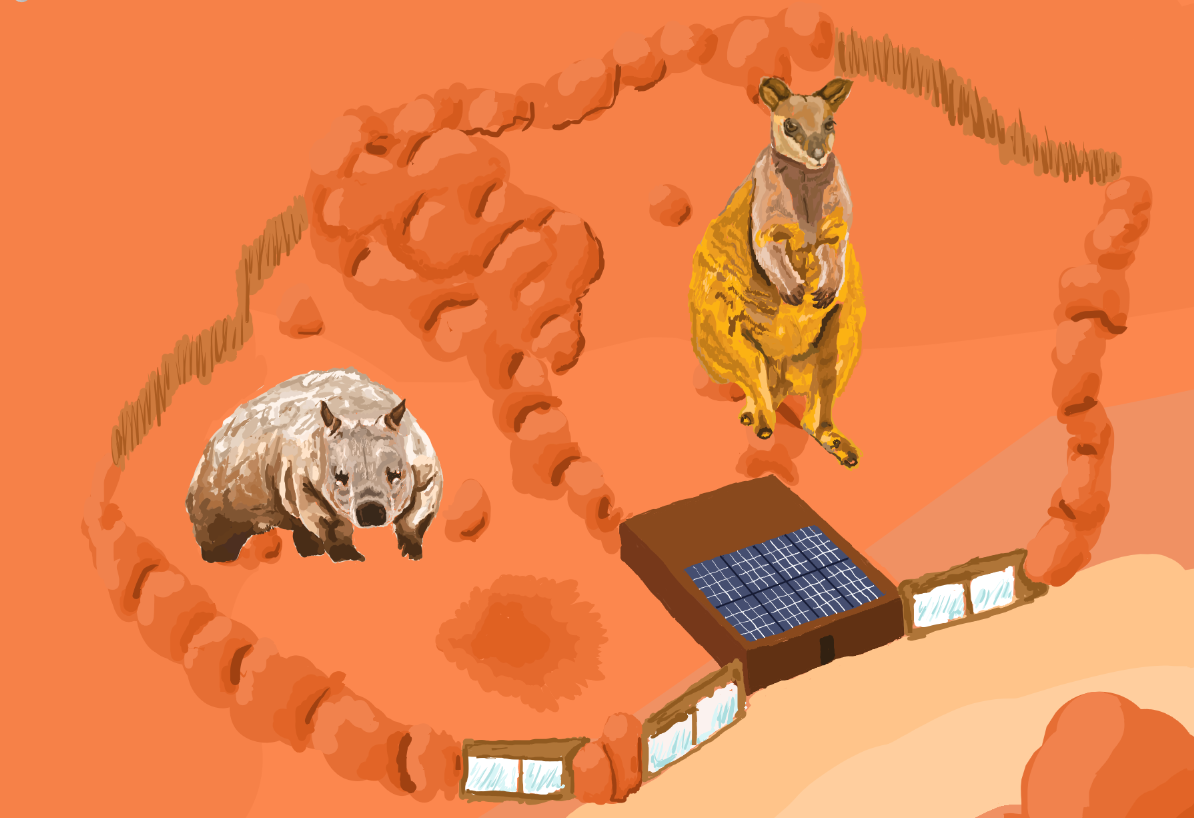
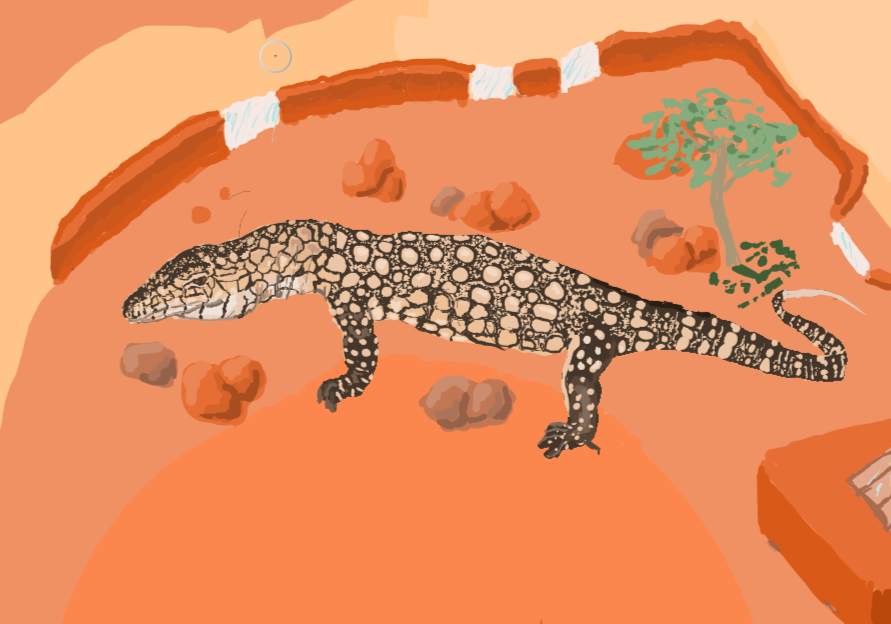
Here are a few quick teaser photos of parts of my map:


Hopefully the entire map will be finished in a couple of weeks although I can’t really guarantee anything with a school starting again.

However, I have finished the species lists for all the areas of the zoo so I hope to get descriptions out as soon as possible and more gradually, which will likely mean posting the areas in several parts as I have done in the other thread.

Apologies for the wait but the maps really take a long time. However, I am determined to finish them and I will do everything to complete at least these two threads, if not others based on other continents beyond that.
 
Back
Top