On the Road Again

I've seen some pretty ridiculous sights in the streets on Melbourne Cup Day...

Ah, see, but your mistake was to be out on the streets on Cup Day. Everybody knows that you just lay in supplies, barricade doors and wait it out (after taking a sickie on the Monday so you get a four-day weekend).
 
Zoo #1. Los Angeles Zoo.

Alright. A slow start to this thread, and a slow start to the trip in general. I rewrote my plan for 3 days in Los Angeles entirely just a couple of days before leaving, when I learned that Elizabeth Warren - the presidential candidate for whom volunteering was once the primary purpose of this trip (long story) - was going to be holding a rally in LA about 12 hours after my arrival. Gone was a quiet day in and around Hollywood, recovering from jet lag, and in was a several-hour wait in a queue to see somebody I view as one of the most brilliant, principled leaders of my lifetime. It is a desperate shame, for both America and the world, that she will not be the next President.

As an aside: this isn’t a forum about politics and I intend to focus my election-writing elsewhere, not here, but the 2020 election is a significant part of this trip for me and I imagine I will mention both it and the conduct and character of the current President in passing from time to time. If you don’t like it, don’t read.

Day two of the trip *was* to be Los Angeles Zoo, but the rather delayed jet lag recovery had me waking up at 11:40, with commitments at 5PM. No zoo today, and when I was still lying awake past 2AM that night I was starting to think LA Zoo would have to wait until I come back through the area for my flight home, as I had a bus to catch on Thursday. As it was, I woke up on the dot of 10, with a bus due to leave in 20 minutes, and had a choice: shower and breakfast, or zoo?

Zoo, of course. There are no rules on tour, and I figured there’d be plenty of Eau de Zoologique throughout the day to cover for me. Alas, I missed the first bus anyway, and so it was only a little before 12 before I arrived at the zoo, Oklahoma City Zoo membership in hand. I’ve never been to Oklahoma, of course, but the membership was $35, they happily shipped it to my LA hostel before my arrival, and it will save me at least a couple of hundred dollars (all going well: coronavirus is starting to make me very worried that the logistics of this trip might become prohibitively difficult.) Allowing for a pitstop for lunch - I’d packed sandwiches, but they became breakfast - I had about five hours to explore the zoo, which I was moderately sure would be enough.

In fact, I only needed four, and that was with iPad in hand, checking off species for the North American challenge. LA is a zoo that is worth a look, but rarely a linger: there’s lots to see, not much of it is bad, but little of it is particularly noteworthy. I started off with LAIR, for which I had high hopes: I believe I’ve now come to the right country after a somewhat disappointing standard of reptile houses in Europe (Zurich, Berlin, Cologne, Wroclaw, Zagreb, Vienna: you’re all excused. Moscow, you’re most definitely not).

LAIR is decent, but doesn’t quite excel: enclosures are big and broadly attractive, but I found the mock rock on the exterior of the first few enclosures (Kaiser newts, day geckos, etc for those familiar with LA) overbearing. I can live with a little theming - I’m in America, I suspect I’ll need to - but when all it’s achieving is making it harder to approach and view a tank, it’s too much. I also wondered about species selection when I saw floor to ceiling exhibits in the desert section for ground-dwelling snakes. It means a lot of empty vertical space and looking for reptiles down at your feet. Great collection, though, highlighted by the venomous snakes. Green mambas, bushmasters, gaboon vipers and a bunch of rattlesnakes and other vipers: I do not want to work in that reptile house. Gharials and Grey’s monitors were other highlights.

Australia was next, and the Global Challenge is going to keep me much more interested in my fellow Ohsss-tray-lians than I otherwise would be (I’ll keep working on getting that accent right). It’s actually one of the best parts of the zoo, with a relatively complete set of the basic Aussie ABCs (kangaroos, koalas, devils, wombats, a cassowary and an unseen echidna). The nocturnal hairy-nosed wombat house is actually the best exhibit I’ve seen for wombats: so often when an exhibit is brought indoors under reverse lighting the animals get short-changed for space, but that isn’t true here and I saw both wombats out and about.

Outside, I can forgive the inclusion of Komodo dragons (thanks @TeaLovingDave for informing me that they were once an Australian species), but the mixed exhibit for yellow-footed rock-wallabies and rhinoceros hornbills was flat out weird, and a cruel jest given that there are no hornbills in Australia at all, let alone in the wild. Elsewhere in the zoo is a wonderfully tall, planted walk-through aviary that lists only three common Australian species - galahs and I forget the other two, but one was a duck species - and even if they weren’t birds I see on my morning walk to work each day I’d still think the aviary is criminally under-used.

Alas, much of the rest of the zoo is in that nether-world of mediocrity that leaves little to be said: there’s not much to object to, all-concrete black bear ‘mountain’ and mandrills-in-a-roundhouse aside. The roundhouses have copped some criticism here in the past, and they’re certainly not ‘good’ exhibits, but with the right species selections (not mandrills) they’re mostly fine. In fact ‘mostly fine’ just about covers it. Unless you want to see mountain tapirs and the last uakari monkey outside South America, LA Zoo is pleasant but inessential.

By the way, did I mention that I’ve seen mountain tapirs and a uakari monkey? That monkey is the most ridiculous thing I’ve ever seen.
Thanks for the excellent review of a zoo I visited a couple of years ago.

I pretty much agree with your general assessment of the zoo; it's a nice place but it doesn't really compete with the best the U.S has to offer. My only major disagreement would be on LAIR, it was easily the highlight of my visit and probably my second favourite reptile house. The Mountain Tapir and Red Uakari were great as well; it's a shame the viewing for the Uakari is so poor.
 
I also wondered about species selection when I saw floor to ceiling exhibits in the desert section for ground-dwelling snakes. It means a lot of empty vertical space and looking for reptiles down at your feet.

Elsewhere in the zoo is a wonderfully tall, planted walk-through aviary that lists only three common Australian species (...) I’d still think the aviary is criminally under-used.

I agree a lot with your overall assessment of the zoo, and especially with these two statements. The vertical enclosures with terrestrial species has always felt bizarre to me; at one point there was a matamata turtle in one of them! And the aviary is lovely, but for some reason barely has any birds in it.

FWIW LA does have quite a few choice rarities besides the uakari and mountain tapir (although those are the best known); others include peninsular pronghorn, the aforementioned Grey's monitor, giant otters, harpy eagles, lowland anoa, blue-eyed black lemurs, red-capped mangabeys, buff-cheeked gibbons, and an African fish eagle. I hope you got the chance to see these animals while you were there. A shame that the California Condors aren't on public display, but if you have the chance to go a little further north (Santa Barbara) or south (the San Diego parks) you can see them.
 
Chestnut Teal should be the duck in the zoo's walkthrough aviary. That aviary should also hold the zoo's green-magpies, which promptly went on-exhibit after my last trip to LA...

~Thylo
 
Chestnut Teal should be the duck in the zoo's walkthrough aviary. That aviary should also hold the zoo's green-magpies, which promptly went on-exhibit after my last trip to LA...

~Thylo

Thank-you, right you are. They were the only species of the three signposted that I actually saw - I’m taking it on spec that the galahs and the something-elses (possibly masked lapwings?) were there. I didn’t look too hard because, as I said, these are all routine morning-walk birds for me.
 
Thanks for the first of what will be many intriguing reviews. Los Angeles Zoo has always been a bit of an enigma and I cannot even imagine how poor it must have been 25 years ago. Chimpanzees of the Mahale Mountains (1998), Red Ape Rain Forest (2000), Children's Zoo (2001), new entrance and Sea Lion Cliffs - now for seals (2005), Campo Gorilla Reserve (2007), Elephants of Asia (2010), LAIR reptile house(s) (2012) and Rainforest of the Americas (2014) adds up to an astonishing list of new exhibits and infrastructure that has made the zoo a must-visit establishment for zoo enthusiasts. I was there in 2008 and left feeling disappointed, but when I returned in 2017 I saw a trio of brand-new exhibits that were all excellent.

Even with all of that being added in a relatively short span of time, @CGSwans still only needed 4 hours to see everything and called the zoo "pleasant but inessential". I think that if the funding can be achieved, then the zoo plans to add a large number of new exhibits in the next 20 odd years and perhaps there will finally be a world-class zoological institution in Los Angeles. I have hope for the future, as long as those darn 'roundhouses' are eliminated as most of them are downright awful. The zoo has improved a lot over the years and the animal collection is a zoo nerd's paradise due to the many rarities.

LAIR is a terrific addition to the zoo and I was fortunate enough to see the impressive behind the scenes area in the larger building back in 2017. Below are my thoughts on what would possibly constitute the dozen best zoos in the USA for reptiles/amphibians:

- San Diego Zoo – this facility has the best outdoor reptile section plus a lot of terrariums and 200+ species in total. A truly great zoo for cold-blooded critters.

- Fort Worth Zoo – one of the best Reptile Houses on the planet and at 30,000 sq. ft. it is almost four times larger than the two buildings at Los Angeles Zoo combined. Fort Worth is unbeatable if one were to rank single, stand-alone Reptile Houses. There are 100 exhibits in MOLA and approximately 150 species of animal (not all are herps).

- Saint Louis Zoo – a grand old historic structure with 100 species. Fantastic all-around collection with another 100 species off-show.

- Detroit Zoo – one historic reptile building and one brilliant amphibian structure.

- Omaha’s Henry Doorly Zoo – 240 species in total but not all on-show. Still, at least 120+ terrariums spread around the zoo. It is startling to consider the zoo’s enormous collection without having an actual Reptile House.

- Dallas Zoo – one of the largest collections of reptiles and amphibians in the nation, with approximately 125 exhibits plus a huge off-show selection that is rumored to be incredible.

- Los Angeles Zoo – In the #7 position. There are 70 species in the two LAIR buildings and the quality is extremely high, although the desert-themed structure is very tight on space.

- Nashville Zoo – a terrific Reptile House focusing on Central & South American species.

- Denver Zoo – 150 species (including off-show) in the enormous Tropical Discovery building, with at least 80 species on-show at any given time.

- Arizona-Sonora Desert Museum – plenty of species in some very natural-looking terrariums.

- Houston Zoo – 100 species on-exhibit plus many more off-show.

- Bronx Zoo – a vast collection in a solid Reptile House.

One major omission from the list would be Zoo Atlanta, as I visited that zoo in 2008 and that was before the Scaly Slimy Spectacular reptile building opened in 2015. Also, I visited Virginia Zoo in 2012, before the World of Reptiles building was renovated and it reopened in 2018 with 65 exhibits. Knoxville Zoo is opening the Amphibian & Reptile Conservation Campus in 2021 and there will be 85 species on 2.5 acres of land.
 
You make LA sound like a sort of larger and slightly less exciting Wuppertal. Fair?
It’s not a comparison that immediately springs to mind! Whereas Wuppertal is a grand old zoo, with some grand old buildings (that are possibly not always fit for purpose) LA has that definite feel of a place that was built in one go, and is now trying very hard to move away from the homogenous feel that was a consequence of this. Possibly the Allwetter Zoo might be the closest, in Europe - although it’s hard to think of two more dissimilar cities than Munster and LA! I think @CGSwans is being a little harsh on the place. While it is flawed, certainly, there’s a great deal there that is impressive – and not just the collection. The reptile house is not perfect, but it is still wonderful. There are one or two other very nice displays. And it is a big zoo, with a big range of species. I’d return there like a shot, if I could!
 
It’s not a comparison that immediately springs to mind! Whereas Wuppertal is a grand old zoo, with some grand old buildings (that are possibly not always fit for purpose) LA has that definite feel of a place that was built in one go, and is now trying very hard to move away from the homogenous feel that was a consequence of this.

Your description of how it feels is right on the money of what it definitively is @sooty mangabey ;) the entire zoo was built from scratch in the mid-1960's and a lot of it has not been significantly modified since that time. IIRC, it was designed by a company that normally designed golf courses; hence a quintessential "American suburb" look of winding, directionless paths dotted with uniform paddocks and roundhouses.[/QUOTE]
 
I agree with @CGSwans (regarding Los Angeles Zoo) and if anything I think he is being generous. I grew up in Los Angeles and it was that zoo that started my interest in visiting zoos for photography, but honestly I have no desire to ever step foot in the place again. I know there have been some additions/improvements since I was there last, but based on what I have seen posted none of them excite me.
 
. I know for instance that I am typically more likely to like places than CGSwans and less likely to than Sooty, although this does occasionally fail catastrophically.

There are a good few wildcard collections such as Hamburg and Hannover which can sometimes throw predictions off, too.

I agree with @CGSwans (regarding Los Angeles Zoo) and if anything I think he is being generous. I grew up in Los Angeles and it was that zoo that started my interest in visiting zoos for photography, but honestly I have no desire to ever step foot in the place again. I know there have been some additions/improvements since I was there last, but based on what I have seen posted none of them excite me.

In other words, not enough cats :P
 
You make LA sound like a sort of larger and slightly less exciting Wuppertal. Fair?

It’s not a comparison that immediately springs to mind! Whereas Wuppertal is a grand old zoo, with some grand old buildings (that are possibly not always fit for purpose) LA has that definite feel of a place that was built in one go, and is now trying very hard to move away from the homogenous feel that was a consequence of this. Possibly the Allwetter Zoo might be the closest, in Europe - although it’s hard to think of two more dissimilar cities than Munster and LA! I think @CGSwans is being a little harsh on the place. While it is flawed, certainly, there’s a great deal there that is impressive – and not just the collection. The reptile house is not perfect, but it is still wonderful. There are one or two other very nice displays. And it is a big zoo, with a big range of species. I’d return there like a shot, if I could!

I can’t really speak to either comparison, not having been to Wuppertal or Munster.

I don’t think I was harsh, actually. I said there is not much wrong with the place, but that there is nothing much that makes it outstanding either. If I’d wanted to I could have criticised the hippo and mountain tapir exhibits for being minimalist to the point of barrenness, while finding something nicer to say about, perhaps, the gorillas and elephants. I could have remarked that ‘Rainforest of the Americas’ was a clear attempt at creating a landmark exhibit that doesn’t *quite* look like value for what I suspect was a lot of money. I didn’t say any of those things because I think it would have made for an over-long and repetitive post.

On the other hand, it probably *was* remiss of me not to say that the zoo’s horticulture and rough-hewn aesthetic does sit comfortably within the backdrop of Griffith Park, but I suspect that’s more by accident than design. And I did forget to mention that watching gerenuks ‘gerenuk-ing’ to reach the hedge barrier above their exhibit was wonderful to see: it’s not often that infrastructure as basic as a stand-off barrier actually becomes an opportunity to see a species’ unique behaviour.
 
Last edited:
I could have remarked that ‘Rainforest of the Americas’ was a clear attempt at creating a landmark exhibit that doesn’t *quite* look like value for what I suspect was a lot of money.
ROTA cost $19 million dollars, quite a bit less than the new Elephant exhibit (although still a lot of money). I felt broadly similar to you about the exhibit, there's some good stuff (Uakaris obviously, as well as good Giant Otter and Harpy Eagle exhibits) but it lacked planting and fell short of a truly great exhibit.
 
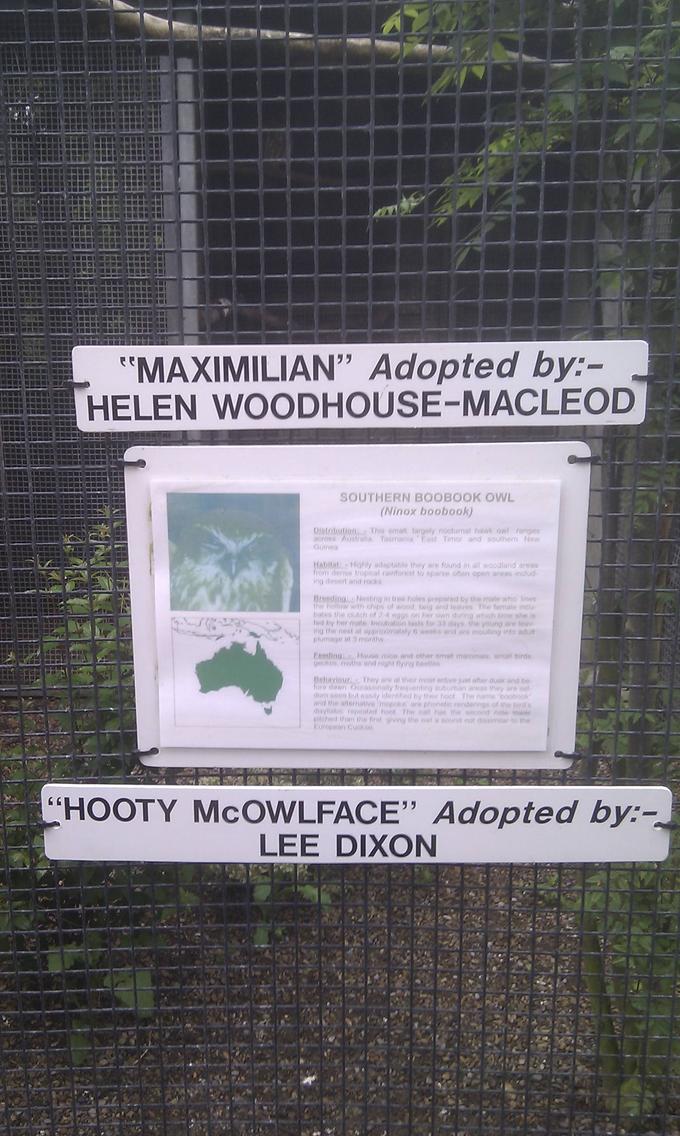
One further thing I just remembered. The zoo has signs up all over the place noting where donors have paid to name an animal. Most were unimaginative and boring, but whoever named a Komodo dragon ‘Goannasburg’ deserves a medal.
 
Most were unimaginative and boring, but whoever named a Komodo dragon ‘Goannasburg’ deserves a medal.

That's even better than the following example which is found at an owl centre near me:

f62.jpg
 
#2: Phoenix Zoo

I’ve been trying in vain for a little while now to start writing this one.

I’ll preface everything I’m saying here with the disclaimer that I am very aware of how relatively privileged I am. I have the good fortune to be from a country that is better equipped than nearly anywhere else in the world to deal with the coronavirus pandemic. Absent getting seriously ill myself, if the worst thing that happens is that I have to cancel a holiday and fly home to relative safety then so be it.

But that doesn’t mean it’s an easy situation to be in either. I am by nature a planner: I’m trying to adjust to a situation where I don’t feel sure of what’s going to happen more than perhaps three days in advance, and it’s difficult. About the only thing I know is that it’s highly unlikely I’ll be able to complete the trip, especially since the plan had been to visit home for a couple of weeks in August before returning. Lasting all the way to August feels incredibly unlikely: to then be able to secure travel insurance to go home and come back requires a miracle.

So I’m not going to get to do everything, and it’s a question of just how long I’ll be able to travel for before it gets too hard. Until I have an answer to that question I’m just carrying on as planned, as unnatural as that feels. Does gong to the zoo really make sense when the end of the world feels nigh? It doesn’t, frankly, but I’m in Phoenix, I’m healthy and there’s still food in the stores, so what else am I going to do? I went to the zoo, and as if things weren’t feeling abnormal enough, it was raining. In Phoenix, in the desert.

I’m not talking about a light shower here. This was monsoonal, torrential rain, the sort that makes a satisfying ‘smack’ as it hits hard surfaces, and a much less satisfying ‘squelch’ as it gets in your socks. There was flash flooding inundating paths all over the zoo. I’ve only ever been wetter once at a zoo, in Osaka, and that literally *was* monsoon season. On the way from my accommodation to the zoo I walked through Papago Park: the cacti looked dreadfully confused and the local ducks couldn’t believe their luck.

Oh dear. My writing gets far too flowery when I’m stressed. It’ll have to do, though.

Anyway, I found my way to the zoo and pushed through the rain, being assured on the way in by a staff member that this was absolutely, positively not an ordinary state of affairs. And thus began an unusual experience of a drowning Phoenix Zoo.

I started off in Arizona Trails, in a delightful walk-through aviary/reptile house. No, it doesn’t make sense when you say it like that, but it’s what it is: a large walk-through aviary, with enclosed or sheltered sections housing desert ectotherms, mostly Arizona natives. The reptile enclosures aren’t much to look at, but they must have close to a comprehensive line-up of Arizona species, especially venomous reptiles, and aside from being cool for a visitor, it’s a great resource for attentive locals, who can learn how to identify when the snake in their backyard is a problem. Wednesday is a great day for a reptile house, too: many zoos feed their snakes mid-week, and Phoenix must be one of them because most of their snakes were out hunting.

As an aside, I have a self-destructive tendency and Phoenix enables it. I’ve been slowly winning my girlfriend over to having snakes when my traveling life finally starts to slow down (not stop: never stop). It’s going well - she has some favourite species of her own, now - but then I see a nice viper species and I can’t help it. I have to send her the photo and tell her I want one. All it achieves is setting my own cause back six months, but *you* look at Phoenix’s speckled rattlesnakes and tell me you don’t want one too. Truly stunning animals.

The rest of Arizona Trails is fair-to-middlin’, with a noteworthy flaw in the cat department: both bobcats (unseen) and pumas (two) are confined to tiny, heavily concreted cages, while two canid species.- a big pack of Mexican wolves and a pair of coyotes - are treated exponentially better, with big, open enclosures. Arizona Trails doesn’t strike me as all that old: one wonders how these things still happen. Meanwhile, the collared peccaries were getting more joy out of the rain than I was: a puzzle feeder was suspended directly above a large puddle, and the game had become a two-step process of nudging the food out of the can, then snuffling around in the mud to eat it. Fun to watch.

(Hmm. Having struggled so much to start writing, I really am going on a bit now. I’ll try to hurry it up).

From Arizona, I continued to the Africa and ‘Desert Lives’ sections. Africa is broadly fine, if unexciting. A pleasant big savannah exhibit is made rather less pleasant by the presence of a large number of pinioned vultures. The black rhinoceros enclosure is cordoned off, with a sign saying that it’s due to a ‘sensitive’ animal. I wondered how long that state of affairs has been in place, and it got me to thinking that zoos really do need to have a permanent off-show facility where they can retire animals that simply don’t cope with attention from the public.

Desert Lives is only home to two significant exhibits, but they are both *very* significant in their respective ways. I’m a sucker for zoos using their natural environment for display purposes, and though I didn’t get the classic image of a sheep up on top of the rocks, the bighorn sheep exhibit is a master of its class: I like big buttes and I cannot lie.

I like Arabian oryx too, and it was particularly special to see them here, at the place that quite literally saved the species. One of them seemed to be taking a particular interest in me (which is saying something, because I *never* notice these things), so I was snapping a few photos when my phone died. This has been happening a lot lately - the battery is stuffed - but this time I’d forgotten to bring a charger cable.

Thus, my last three hours at the zoo were essentially cut off from the world: I didn’t even have a pen and paper to take notes for North American Challenge purposes, which left me practising the memory tricks I learned in school. I didn’t rush back, and I saw everything in the Tropic and Children’s Trails, though I don’t think there’s anything truly noteworthy to remark upon in terms of exhibitry.

It was only on the way back to my accommodation (which I was having to concentrate hard to find, given that I couldn’t look up Google Maps) that I realised what a blessing in disguise not having my phone was. See, I enjoyed those three hours far more than I should have, relative to the objective quality of the zoo. For three hours, anything coronavirus-related might as well not be happening. The zoo was nearly empty, so I wasn’t on the alert for coughing and spluttering. The news wasn’t getting in my ear, reporting that x new cases had been reported in y. For three hours, I was actually, genuinely on holiday. It even stopped raining.

I needed that.
 
Last edited:
Just as I agreed with your assessment of Los Angeles Zoo, I agree completely with your assessment of Phoenix Zoo. I have a feeling you and I see eye to eye in many ways on zoos. Since you are now in my state and I am familiar with that zoo (and currently a member), I will make a few observations.

1) Rain in March is unusual and for us in the desert rain at any time is always a blessing. I also think rainy days are the best time to visit a zoo (anywhere, unless it's a severe downpour).

2) Arizona Trails (which does have dreadfully small cat exhibits) actually is quite old, contrary to your hunch. I first visited Arizona in 1992 and it was there then. I am not sure how much earlier it was built. The only major recent change was the paving of the path all the way to Mexican wolves; it used to be a gravel path.

3) Arizona (as of now) only has a few confirmed cases of C19 virus whereas California has a lot, so I think it is good that you moved east from your starting point. The whole situation is bad for everyone - you may have seen that @lintworm was forced to cancel his trip due to yesterday's presidential proclamation about European visitors. I am a planner too who likes to have everything pre-arranged (one area that my friend @snowleopard and I have nothing in common). I certainly understand your frustration but as you say, all you can do is make the best of it and carry on and watch how things progress. My advice is to do what you did yesterday - enjoy your zoo visits (and other outings) and temporarily forget there is a pandemic.

4) The only thing I will add about the Africa section is it has the best cheetah exhibit I have seen. You may or may not know, but the neighboring wild dog exhibit (which has the same design) was a second cheetah exhibit for many years.
 
Back
Top