online newsletter for small cats

I have not read it yet, but are you saying we are back to Felis lybica and Felis sylvetris for wildcat?

Certainly sounds like it - given how different the African and Asian subspecies are to the European Wildcat I am not terribly surprised, truth be told!

However, it *does* mean that if this taxonomic reclassification stands, the vast number of impure Scottish Wildcats knocking around are actually species-level hybrids given the fact that the domestic cats causing so much trouble are derived from African stock!

However the new leopard cat distinction is a real shock.

Having seen the Palawan Leopard Cat and noted how different it looked to mainland P. bengalensis, I am not shocked. I *am* however somewhat surprised that the long-expected split of the Amur Leopard Cat has not only failed to occur, but that the Iriomote Cat appears to have been subsumed within the subspecies.
 
Whoa, whoa, whoa. I am looking at the link right now, and where did all the subspecies go?

The link is just a list of Latin names, so I will look forward to receiving the full issue in the mail with explanations. But for those of us who are into cats, this revision is extreme. I myself am more of a lumper than a splitter, but I would not have expected this rate of consolidation of subspecies (unless it states somewhere outside this document that they are left out pending further review).

Only two subspecies of tiger.

Only two subspecies of lion (and Asiatic is NOT one of them - that is apparently subsumed with all African except the extinct Cape lion).

Only two subspecies of puma (presumably North America vs Central/South America).

Four subspecies of cheetah (the one cat that could IMO be consolidated is not).

Domestic cat as a full species (a decision I personally disagree with, but of course I am not a scientist or even a pet cat owner for that matter).

Two subspecies of European wildcat (now separate from African and Asian, though even European does not include Scottish as a distinct subspecies).

Etc, etc
 
I just checked my mailbox and there was Cat News, including the special issue devoted to revised cat taxonomy. They have color graphs for each subspecies (green for certain, yellow for plausible, red for invalid, gray for uncertain or invalid). It will take me a while to read through this, but for us cat fanatics it is all very interesting. I will try to post some key points as I get to them.

Here is one teaser. The North China leopard (P.p. japonensis) is red and is no longer considered a valid subspecies. It is now joined with the Far East leopard (P.p. orientalis).
 
The North China leopard (P.p. japonensis) is red and is no longer considered a valid subspecies. It is now joined with the Far East leopard (P.p. orientalis).

Given the fact that these are two subspecies which I think *are* reasonably different from one another, but that the captive population of the latter contains genetic material from founders of the former taxon, it does make one wonder whether this decision was made in part so that they can justify combining the two captive populations and - by the by - declare that the most endangered cat taxon is actually much more secure than believed :p
 
@savethelephant - Yes I will do a couple shots of interesting pages.

@TeaLovingDave - Based on my very cursory glance, it appears the classifications were all made using objective criteria such as DNA, etc. I doubt political motivations about breeding swayed their decisions. (I will be able to better evaluate once I read the magazine).
 
Based on my very cursory glance, it appears the classifications were all made using objective criteria such as DNA, etc

Given the aforementioned issue with the captive Amur population having some North Chinese blood, one hopes that the DNA evidence came from *wild* Amur stock :p otherwise we'd be having a re-run of the Kouprey debate!
 
Are you ready for another shocker? Only two subspecies of puma! One for North and Central America (P.c. couguar) and one for South America (P.c. concolor).
 
Now that one I *did* expect to some degree :p and thankfully even though neither of the pure subspecies I have seen make the grade, they each get lumped into a different taxon so it doesn't actually make a difference!
 
Given the fact that these are two subspecies which I think *are* reasonably different from one another, but that the captive population of the latter contains genetic material from founders of the former taxon, it does make one wonder whether this decision was made in part so that they can justify combining the two captive populations and - by the by - declare that the most endangered cat taxon is actually much more secure than believed :p
the revised taxonomy was based on what they termed a "traffic-light system" reviewed by 22 members of a panel.

"A novel traffic-light system was developed to indicate certainty of each taxon based on morphological, molecular, biogeographical and other evidence. A concordance of good evidence in the three principal categories was required to strongly support the acceptance of a taxon."
 
Are you ready for another shocker? Only two subspecies of puma! One for North and Central America (P.c. couguar) and one for South America (P.c. concolor).

The genetics have shown that all of the mountain lions in North America are one population without real geographic differences. I'm not up on South American genetics studies - presumably they are different from North and Central America? Does the article say what the differences are?
 
@DavidBrown - Here is what they say regarding puma.
"Traditionally this widespread species has been split into as many as 32 subspecies ...Culver et al (2000) carried out a phylogeographical study ...On the basis of this study, six phylogeographical groups were claimed and designated as subspecies ...A more recent study of mtDNA in pumas from throughout their range, although with lower sample sizes, supports only two main geographical groupings with North American populations having colonised since c. 8,000 years b.p."
 
@DavidBrown - Here is what they say regarding puma.
"Traditionally this widespread species has been split into as many as 32 subspecies ...Culver et al (2000) carried out a phylogeographical study ...On the basis of this study, six phylogeographical groups were claimed and designated as subspecies ...A more recent study of mtDNA in pumas from throughout their range, although with lower sample sizes, supports only two main geographical groupings with North American populations having colonised since c. 8,000 years b.p."

Was the more recent study Caragiulo et al. 2013? I'm not sure I'd be using that, given that while its based on a good amount of mtDNA, its still just mtDNA, but more concerning, the sampling design is not great, with samples limited to north-west USA (+ very close SW Canada), central America (quite good sampling through here) and then relatively localised in central South America, which seems likely to give 3 distinct populations as found. In fact, the study specifically notes that:
Boundaries between groups were broad due to incomplete sampling of their entire range, with sampling deficiencies in western and northeastern South America. This study did not support the six operational taxonomic units of Culver et al. (2000); however, this difference in findings is likely due to incomplete geographic sampling.

Paper here (I think paywalled): http://www.tandfonline.com/doi/full/10.3109/19401736.2013.800486?scroll=top&needAccess=true
 
Yes. As my quote notes they do acknowledge the smaller sample size of this later study. Right after where my quote ends (which I apologize for leaving out) they have in parenthesis Caragiulo et al. 2014. They then go on to say "On this basis, we tentatively recognise two subspecies within Puma concolor." Note the word tentative.

Not that it makes any difference or adds anything, but the Culver of Culver et al who identified six subspecies via a more thorough range of samples works about a mile from my home at University of Arizona and I have met her.
 
so, not to call this whole taxonomy revision into question as to its legitimacy, but if you have 22 experts in the field all looking at a paper about mtDNA in a few puma populations, but the authors of which specifically note that they had limited samples and don't themselves believe the results are accurate overall due to their low sample sizes [i.e. in zooboy28's post] - then how do all those 22 experts come to the conclusion that that equals only two subspecies? What did they use for their tiger subspecies reduction? Tea leaves?
 
so, not to call this whole taxonomy revision into question as to its legitimacy, but if you have 22 experts in the field all looking at a paper about mtDNA in a few puma populations, but the authors of which specifically note that they had limited samples and don't themselves believe the results are accurate overall due to their low sample sizes [i.e. in zooboy28's post] - then how do all those 22 experts come to the conclusion that that equals only two subspecies? What did they use for their tiger subspecies reduction? Tea leaves?

Yeah, this is what I was getting at. If the current research is unclear, surely you would go for the more 'splitty' result, in case future research shows that, say, the Patagonian puma subspecies is super distinct and should be managed separately from the other South American pumas, and then you haven't gone and screwed up the management in the meantime. The exceptions to this would be when a population is immediately conservation dependent, and there is no time for studies to figure out exact taxonomy. In such cases conservation action is more important than inaction, and the risks of losing the distinctiveness between potential populations is far outweighed by the risk of losing all individuals. I don't think puma fall into this category yet.
 
What did they use for their tiger subspecies reduction? Tea leaves?

This reduction is one of the things which gives me the most pause, truth be told - one gets the impression that the researchers wanted to lump Panthera tigris as much as possible, given the fact that all mainland tigers have been lumped together with Amur merely deemed an "ecotype" of the overall subspecies.... this despite the fact that Malayan and Sumatran (deemed subspecifically distinct from one another) are more or less identical to the naked eye whilst Malayan and Amur (deemed subspecifically identical) differ in morphology to a massive scale!
 
it is probably as simple as them taking the two-species-of-tigers idea but not wanting to split the species, so instead they just broke them into two subspecies at the same point (archipelago versus mainland). It doesn't make any sense if that is what has happened, but otherwise I can't see any rationale.

Needing a "concordance of good evidence" in the three main points of "morphological, molecular, [and] biogeographical" means it is very difficult to see how they could possibly consider Siberian and Malayan tigers as the same.
 
it is probably as simple as them taking the two-species-of-tigers idea but not wanting to split the species, so instead they just broke them into two subspecies at the same point (archipelago versus mainland).

Suspect you are correct.....

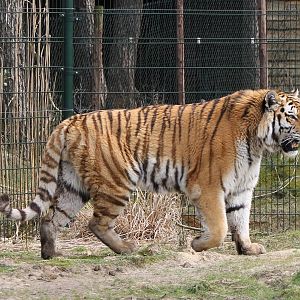
For the purposes of amusement and comparison, some photographs:


These two are deemed to be the same subspecies by the new report, yet......


These two are recognised as sufficiently different to merit separation :p which, I must add, I do actually agree with - I seem to recall that although their appearance is very similar, there are significant skeletal differences between Sumatran (along with the extinct Bali and Javan) and the mainland subspecies.
 
Back
Top