Only one wolf species according to genome study

The scientist in me immediately sees flashing red warning bulbs over that tiny sample size...

(I understand why, if they're sequencing full genomes, but even so...)

They're drawing some big conclusions from six 'lycaon' individuals and three 'rufus' individuals with, as noted in the article, no obvious way of knowing if they are representative.

That said, it does seem to indicate that whatever the truth is, some cross-breeding is a feature - question being, is this plain hybridisation or speciation via hybridogenesis?
 
A study of gray, red, and Eastern gray wolves suggests that there is only one wolf species in North America, the gray wolf. Red and Eastern wolves are grey wolves that have hybridized with coyotes.

It also appears possible that wolves and coyotes diverged 50,000 years ago rather than 1 million years ago.

http://www.nytimes.com/2016/07/28/s...on&region=bottom-well&WT.nav=bottom-well&_r=0

Tell that to the idiots in Montana, Wyoming, and Idaho who are so convinced Canadian gray wolves were introduced and have behaved like locusts.
 
The scientist in me immediately sees flashing red warning bulbs over that tiny sample size...

(I understand why, if they're sequencing full genomes, but even so...)

They're drawing some big conclusions from six 'lycaon' individuals and three 'rufus' individuals with, as noted in the article, no obvious way of knowing if they are representative.

That said, it does seem to indicate that whatever the truth is, some cross-breeding is a feature - question being, is this plain hybridisation or speciation via hybridogenesis?

I thought the same thing. The problem with the study is that senso stricto Gray Wolves have not been proven able to mate with Coyotes except in captivity. Gray Wolves kills Coyotes when they meet, not mate with them. The only hybrids seen are between "Eastern" Wolves and Coyotes.
 
They're drawing some big conclusions from six 'lycaon' individuals and three 'rufus' individuals with, as noted in the article, no obvious way of knowing if they are representative.

The individuals were deemed representative by analyzing
the genomes of 12 pure gray wolves (from areas where there are no coyotes), three coyotes (from areas where there are no gray wolves), six eastern wolves (which the researchers call Great Lakes wolves) and three red wolves.

Should the gray wolf keep its endangered species protection? | UCLA
 
If they want to call it one wolf species, then they have to lump Coyotes into that species as well.
 
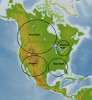
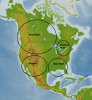
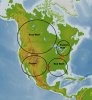
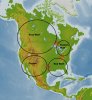
I've taken a minute to do some basic graphics outlining the general thoughts on Canis in North America. These are rough outlines and not 100% accurate, but they show some of the general ideas.

Wolf Map 1
This map shows the 4 populations (as they originally existed) in the US - Gray, Eastern, Red, and Coyote. 4 species model.

Wolf Map 2
This map indicates (via the red star) that there is considerable gene flow between Eastern and Red populations. 3 species model.

Wolf Map 3
This map indicates (via 2 red stars) gene flow between Coyote, Red, and Eastern. 2 species model.

Wolf Map 4
This map indicates gene flow between all populations. Note, there is no gene flow directly between Coyote and Gray. This is best evidenced by two facts. Coyotes and Gray live in the same region (see Mexican Gray subspecies, which is nestled into Coyote population with no hybridization).

The 4 species model is probably not valid as gene flow is too easy between the populations and the boundaries, especially with the removal of Red Wolves, is not stable. The one species model is not valid either as Coyotes and Gray Wolves are clearly distinct. It does look like a rare case of a ring species. A messy beast.
 

Attachments

  • wolf map 1.jpg
    wolf map 1.jpg
    280.4 KB · Views: 7
  • wolf map 2.jpg
    wolf map 2.jpg
    282 KB · Views: 8
  • wolf map 3.jpg
    wolf map 3.jpg
    283.2 KB · Views: 8
  • wolf map 4.jpg
    wolf map 4.jpg
    284.3 KB · Views: 6
Back
Top