@Zoofan15 Oh that makes a lot of sense about Sumatran Orangutans living on an island with Tigers unlike Borneo (and i guess Sunda Clouded Leopards in Borneo would be not be a threat to Bornean Orangs).
From the interesting points above I guess the best approach to Orangutan housing is solitary older males, younger male bachelor groups and related female small family groups (perhaps two adult females and their young) and allowing the 7-8 year gap to pass before the female Orangutan (who has had its last baby become independent) the interaction with the adult male(s) again {i'm sure this is what happens already for a long time in places like PZ, just ruminating).
P.Z has done well with for its Orang-utans upgrades over the last 20 years. So if a network of access ropes and tunnels is created between the 5(?) current exhibits this will be great for the Orangs. The Lesser Primates exhibit enclosures have been in there for 35 years now so it will be exciting to see the other primate species get future revamps which considering the new space will take over the current Nocturnal House site and 'Amazonia' circuit, the obvious size expansion will be great. Would love PZ to consider returning to housing and keeping group/troop of Sulawesi Crested Macaques.
In my opinion, the best housing is like Auckland Zoo - where the orangutans share a space, but have room to escape each other. Auckland Zoo's orangutan exhibit is based around a central exhibit; but the high ropes will allow multiple configurations around the zoo meaning the colony can easily be separated into subgroups.
Auckland Zoo have two females - Wanita (1979) and Melur (1988), who tolerate each other; and a male - Charlie (1981). They're preparing to import a mother and her adolescent daughter next year, so they may choose to integrate all four females; or if it doesn't work out - run two groups of 0.2 with Charlie rotating between them.
One of the reasons Auckland Zoo imported the three females from Sydney in 2001, was that the death of Dara has reduced their colony to a single adult female - Indra; and she was resenting the constant attention from the males; so in some cases, being housed with other females (unrelated or not) has benefits.
I believe Perths orang numbers are well down on what they had in the past also appears to be breeding far fewer off spring than they did in the past.
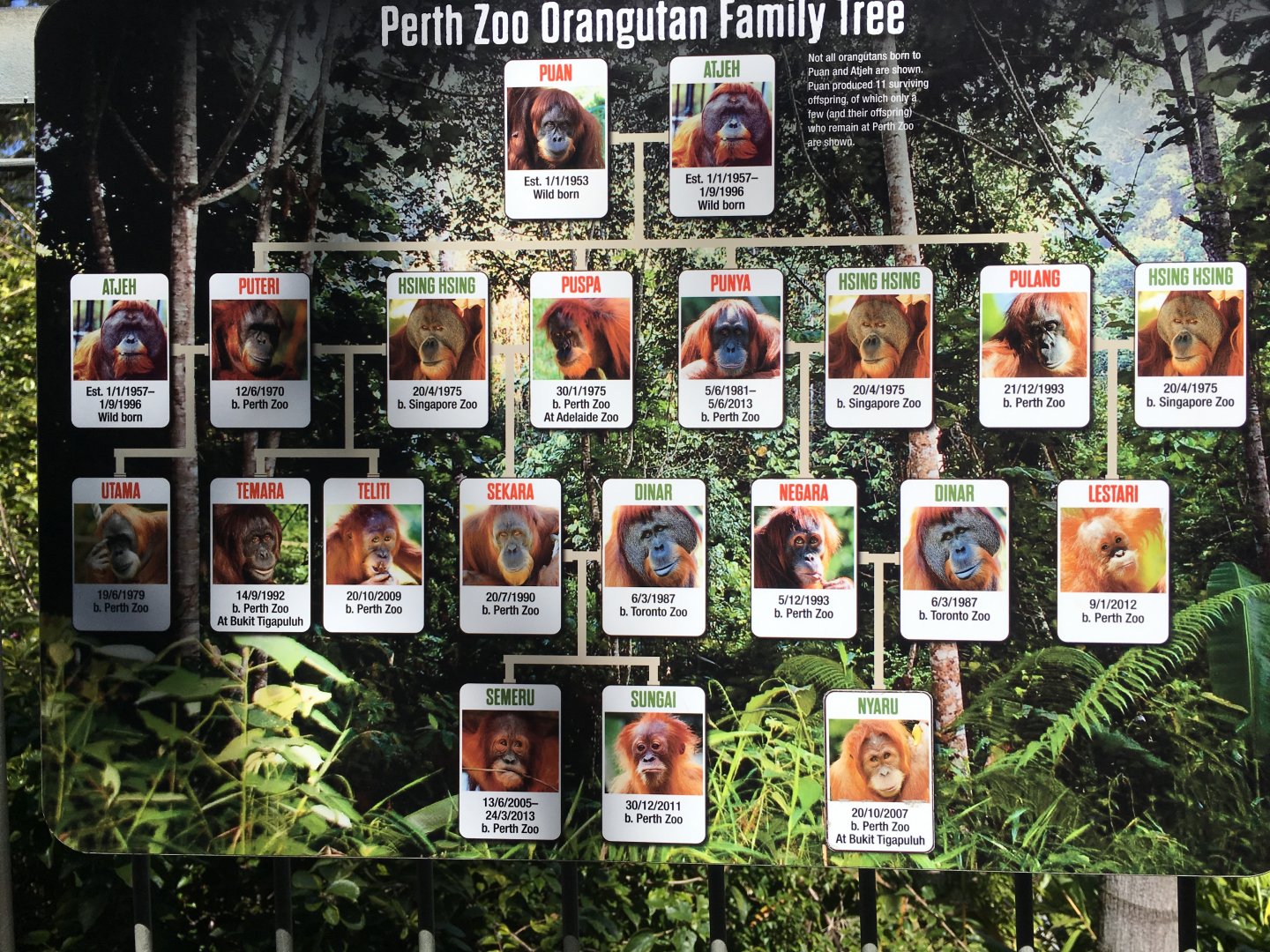
Perth Zoo have around five/six exhibits - their colony are currently housed in five groups:
Group 1:
0.1 Puteri (1970)
0.1 Teliti (2009) *also starting to spend time on her own
Group 2:
0.1 Utama (1979)
Group 3:
1.0 Dinar (1987)
Group 4:
0.1 Sekara (1990)
1.0 Sungai (2011) *also starting to spend time on his own
Group 5:
0.1 Pulang (1993)
0.1 Lestari (2012)