Day 8 #18 Walter Zoo - Gossau
Next morning, rain was pouring down. I had planned a free morning and, despite the weather conditions, decided to take the scenic Silvrettahochstrasse before travelling to my next destination. This is a scenic toll road over the Bielerhöhe, a +2000m high mountain pass on the border between Tyrol and Voralberg. The road runs along the Silvretta Mountains, a mountain range on the border between these two Austrian states and the Swiss canton of Graubünden. The whole area forms a breathtaking high-mountain landscape with deep valleys, mountain forests, alpine lakes and glaciers. I really enjoyed it and after a short traffic jam on the border, it was time for my first Swiss stop.
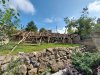
A few km from Sankt Gallen's Kybunpark football stadium, just outside the small town of Gossau, lies the Walter Zoo. Located in the hilly countryside of eastern Switzerland, it is a pleasant walk along sun-drenched slopes, although the silence can sometimes be disturbed by the nearby Swiss army training grounds. The Walter zoo is a small (just 5.5 ha) but modern zoo founded in 1961 by circus artists Walter and Edith Pischl and it is clear, given the zoo's name, who was in charge.
It is a very pleasant garden with several visitable buildings. The species list is quite general but there is a nice focus on smaller animals. The whole zoo exudes a kind of pride that is best expressed in a small expo building at the tiger enclosure where the history of the zoo over 3 generations is shown on large info panels. Special attention has also been paid to beautiful info signs and there are a lot of feeding presentations and other activities aimed at children.
The first building is the
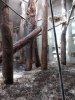
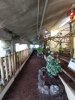
Dschungel- und Reptilienhaus, which is the zoo's oldest building and consists of several floors. The upper part used to house the chimpanzees and is now a small South-American walk-through area with two-toed sloth, green iguana, white-bearded saki, st. Vincent agouti and southern three-banded armadillo. They have retained some of the old furnishings, so the former ape enclosures are still clearly recognisable.
 Upper floor South American walk through
The lower floor has spacious terrariums for quince monitor, western dwarf crocodile, Malagasy tree boa, Chinese crocodile lizard, giant plated lizard, and others.
From this building, it is only a short step to the
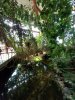
Tropenhaus. This consists primarily of a small rainforest with ponds for American alligators and alligator turtles. Among the trees roam goeldi monkeys and emperor tamarin. The alligators also have an outside pond.The second part has very spacious additional enclosures for grey-handed night monkeys, pygmy marmosets, tarantulas, poison dart frogs and common anaconda.
 Main enclosure for American alligator, snapping turtles and callithrids
I am a big fan of these types of conservatories: no matter how small and old, it is always a great joy to search among the mature vegetation, which was certainly the case here, for the animals that should be found there.
The
Tiger Höhle is an octagonal building with seminar rooms at the top and a visitor area below where the tiger boxes can be viewed. It shows 3 pens and as many outdoor areas for Siberian tigers. Surrounding this building is a large wooded outdoor area in which the former Amur leopard enclosures are integrated. At the top of the enclosure is another octagonal construction serving as the tiger feeding presentation.
 Tiger Höhle for Siberian tiger
 Siberian tiger enclosure (feeding presentation on the right)
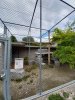
The chimpanzee holding is what has made this zoo name and fame in Switzerland. The 13 animals signify the largest group in the country, and they live in the largest outdoor enclosure in the country (not so difficult, as only Basel has bonobos in a more or less same way). The visitor path runs between the
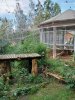
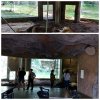
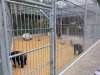
Schimpansenhaus and the 2 outdoor enclosure (which are separated by a rock). These are not that large but the animals still have some opportunities for seclusion. Underground tunnels allow the animals to get to the Chimpanzee House, which again consists of 2 separate high halls which are filled with climbing trees. The building is clearly of older date (1993), but I did not find that these enclosures stood out against modern principles, although it may lack seperation rooms.
 One of two outdoors enclosures
 One of two indoors enclosures
Next are 3 excellent
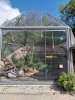
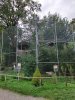
parrot aviaries, all spacious, tall and well provided with trees and other enrichment elements. On display are keas, horned parakeets and hyacinthara, among others.
 Kea aviary
A highly attractive enclosure for
Asian small-clawed otters and Nepalese red panda that came into being in 2022 marked the first realisation of the 2040 master plan (which will also see the zoo expand). The 650m² enclosure is a particularly attractive mix of shrubs and grass, trees and water.
The African-themed
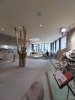
Savannenhaus displays a host of small animals, from mammals over birds and reptiles to invertebrates. The best display is a meerkat enclosure (yes I'm really writing this) with Fishers agapornis and spurred tortoises as co-inhabitants, but in this building we equally find naked mole rats, striped grass mice, gundis, African egg-eating snakes, African bullfrogs, Angolan pythons and lizards. Perhaps the main attraction here are the fennec foxes, which have a very small enclosure indoors, but fortunately have access to a wider run outside. The building also has a community terrarium for Gorongosa girdled lizard, East African girdled lizard and pancake turtle. A panther chameleon inhabits a free-standing tree. This is an excellent building, full of light, in calm earthy colours and a very attractively laid out.
 Interior of the Savannenhaus
Across the building lives a small group of Grant zebras, and next to the savannah building lies the hilly
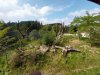
lion enclosure, which is truly stunning with its height differences, long grass, bushes and rocky outcrops. It opened in 2018 and the vegetation has only made the 1,600m² area more beautiful since then. The photo below unfortunately hides the actual height differences in the enclosure.
 Barbary lion enclosure
On top of the indoor enclosure is the Zooschüle and a nice terrace with a catering point.
Both Savannenhaus and lion enclosure are the stars of this small but extremely well-maintained zoo. They are the prelude to the Zoos 2040 master plan. It primarily means a significant expansion of the zoo to 9.5 ha. Among other things, the zoo will have a new entrance with a car park, ticket office building, shop and meeting rooms. A large savannah will feature some new species in addition to Grant zebras and ostriches.
As is often the case with gardens located in smaller locations, the options are not unlimited in terms of enclosures and species, and visitors have to be kept busy in other ways. A circus tent made me suspect the worst, but in the end, activities are limited to pony and camel rides, and lots of feeding presentations. The circus tent hosts artistic theatre performances that are mainly aiming at children and their subject is always about nature conservation. Animals, except perhaps the domestic cat, are not used in these.
I really enjoyed my visit to this zoo.


 there's six!