Philippine eagle spotted above the Alpes

Day 14 #32 Zoo de Servion

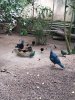
In doing so, the species list is not overwhelming: only 8 species and none of them are rare. Still, with blue-eyed black lemur, black-capped capuchin monkey, golden-headed lion tamarin, goeldi's monkey (with Palawan peacock pheasants), cotton-topped tamarin with bearded emperor tamarin, Bolivian squirrel monkey, and pygmy marmoset also not a bad line-up for a small place.
The blue-eyed black lemur is critically endangered and is kept at 17 ZTL facilities.
The cotton-top tamarin is critically endangered.
The golden-headed lion tamarin in endangered
 
Funny you enjoyed Zoo de Servion so much, I was thoroughly disappointed back in 2015. It seems there have been some upgrades though like the monkey house, but back then there were a lot of decrepit areas. The wolf enclosure in particular looked like the animals could just jump out between the wires... But glad that this space apparently has improved, it was really a poor zoo imo.
 
The blue-eyed black lemur is critically endangered and is kept at 17 ZTL facilities.
The cotton-top tamarin is critically endangered.
The golden-headed lion tamarin in endangered

True. I've seen hundreds of these tamarin, and more than 20 times the blue-eyed. But you are right that my wording is somewhat misleading. When I write 'rare / not rare' in my reviews, I always mean from my perspective and/or in zoos.
 
Funny you enjoyed Zoo de Servion so much, I was thoroughly disappointed back in 2015. It seems there have been some upgrades though like the monkey house, but back then there were a lot of decrepit areas. The wolf enclosure in particular looked like the animals could just jump out between the wires... But glad that this space apparently has improved, it was really a poor zoo imo.

That's still the case. But their enclosure is certainly spacious and the animals were very active and looked healthy.

Many zones evoke a bit of a nostalgic feeling, but overall I found it pretty ok. Pheasantry and the small predators were the weakest points.

I thought the monkey house was older, but you would definitely remember it.
 
Day 14 #33 Tropicarium de Servion

Literally just a few steps away is Servion's second zoo.

It’s is a surprisingly modern zoo for reptiles, amphibians and birds. With the 'endangered species' dome, it has a very modern facility for large reptiles, the Vivarium houses a collection of sometimes rare species, and with the rainforest greenhouse, it has a classic but abundant bird paradise to view.

The zoo consists of 8 areas, some of which are rather disappointing. There’s a very poor penguin building with only a handfull of animals, a large enclosure for South African ostrich, a meadow for African spurred tortoise and a renewable energy pavilion.

The Vivarium is connected with the entrance and the restaurant. The conservatory has about 20 terrariums bathing in daylight. It has a fairly large collection of reptiles, including white-throated and blue-spotted tree monitors, Kuhl's flying gecko, Galapagos giant tortoise, New Caledonian giant gecko and some amphibians (poison dart frogs and toads like oriental fire-bellied toad, Colorado river toad and rococo toad).

upload_2024-2-4_17-35-47.jpeg
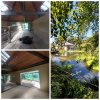
The green and bright vivarium

upload_2024-2-4_17-36-44.jpeg
Veiled chameleon (Chamaeleo calyptratus)

Two other areas/buildings stand out by far.

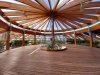
The 'Dôme des espèces menacées' of ‘dome of threatened species’ is a wooden light-flooded octagonal building. Organised around the central mast that supports the entire building, there are spacious enclosures for huge Siamese crocodiles, Galapagos giant tortoises, Hispanolian rhinoceros iguanas and Komodo dragons, all lying among tropical vegetation. You guessed it, this building might as well have been called 'Building of the Giants'. It’s excellent and would have its place in any large zoo. From a viewing platform all enclosures can be viewed from on high.

upload_2024-2-4_17-38-47.jpeg
Siamese crocodile (Crocodylus siamensis)

upload_2024-2-4_17-39-49.jpeg
Enclosures for Komodo dragon

Around the mast is an enclosure for Mexican short-tailed lizards. There is also a nursery for baby Galapagos giant tortoises and enough space for another exhibit in the future, for example for a giant boidae.

upload_2024-2-4_17-40-17.jpeg
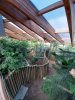
Viewing platform with central Mexican short-tailed lizard terrarium

At the back of the garden is a large walk-through aviary (demoiselle and grey crowned crane, Chilean flamingo), with access to the winter quarters and the ostrich pen, and a wading bird aviary (scarlet ibis, vulturine guineafowl, black-necked stilt and pied avocet). These are good but only a stepping stone to a real stunner, although not every Zoo chatter will agree on this.

upload_2024-2-4_17-42-0.jpeg
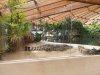
Ostrich pen - Crane aviary & winter quarters

All too often, in our zoos, I find myself in a tropical conservatory where it is dead silent. You can almost hear a pin drop there, so absent are the sounds of the forest. Not in this place.

upload_2024-2-4_17-43-17.jpeg
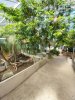
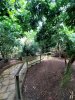
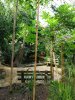
Old-school tropical greenhouse

This was not the biggest tropical conservatory on this trip, nor the most beautiful, the tallest, or the most impressive. Yet I must confess that I was astounded by the atmosphere here: while in many such buildings you have to look very carefully to spot an animal, here it was completely different. This place was truly bursting with life: birds were everywhere, and they were constantly appetising at the food points, bickering with conspecifics and other species, impacting on and off, eating, whistling and arguing. It was a real treat to visit a rainforest that was so exuberant for once.

upload_2024-2-4_17-44-45.jpeg

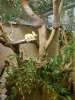
Some 20 species are kept here including 3 species of turacos (red-crested, violet and green), boat-billed heron, hottentot ducks, red-shouldered teals, Bali myna, spur-winged and southern lapwings, superb and purple-glossy starlings, Java sparrow, Victoria crowned pigeons, Nicobar pigeons, Luzon bleeding-heart, etc. The turacos were constantly nervously skimming among the foliage, avoiding both feeders and visitors, but on the ground it was a coming and going. Only the ducks did not care too much. The lapwings were the most suspicious species, but certainly the Java sparrows and starlings bickered undaunted with the crowned pigeons, without caring too much about the passing visitors.

upload_2024-2-4_17-45-11.jpeg

upload_2024-2-4_17-45-27.jpeg
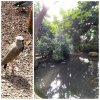
Southern lapwing (Vanellus chilensis) - Rainforest pond

I spent a good hour in this conservatory and was not bored for a second. These are fine finds, in a small(er) zoo, a true discovery on the unexpected. In that hour I saw every single species, including the broad-billed heron that was hiding in a far corner.

So the morning delivered some very good surprises. I then drove to lake Geneva, hoping for refreshing breeze.
 

Attachments

  • upload_2024-2-4_17-35-47.jpeg
    upload_2024-2-4_17-35-47.jpeg
    158.9 KB · Views: 121
  • upload_2024-2-4_17-36-44.jpeg
    upload_2024-2-4_17-36-44.jpeg
    187.6 KB · Views: 123
  • upload_2024-2-4_17-38-47.jpeg
    upload_2024-2-4_17-38-47.jpeg
    222 KB · Views: 122
  • upload_2024-2-4_17-39-49.jpeg
    upload_2024-2-4_17-39-49.jpeg
    131.1 KB · Views: 118
  • upload_2024-2-4_17-40-17.jpeg
    upload_2024-2-4_17-40-17.jpeg
    183.5 KB · Views: 121
  • upload_2024-2-4_17-42-0.jpeg
    upload_2024-2-4_17-42-0.jpeg
    189.8 KB · Views: 122
  • upload_2024-2-4_17-43-17.jpeg
    upload_2024-2-4_17-43-17.jpeg
    175 KB · Views: 124
  • upload_2024-2-4_17-44-45.jpeg
    upload_2024-2-4_17-44-45.jpeg
    222.6 KB · Views: 127
  • upload_2024-2-4_17-45-11.jpeg
    upload_2024-2-4_17-45-11.jpeg
    200.9 KB · Views: 124
  • upload_2024-2-4_17-45-27.jpeg
    upload_2024-2-4_17-45-27.jpeg
    206.7 KB · Views: 123
Day 14 #33 Tropicarium de Servion

Literally just a few steps away is Servion's second zoo.

It’s is a surprisingly modern zoo for reptiles, amphibians and birds. With the 'endangered species' dome, it has a very modern facility for large reptiles, the Vivarium houses a collection of sometimes rare species, and with the rainforest greenhouse, it has a classic but abundant bird paradise to view.

The zoo consists of 8 areas, some of which are rather disappointing. There’s a very poor penguin building with only a handfull of animals, a large enclosure for South African ostrich, a meadow for African spurred tortoise and a renewable energy pavilion.

The Vivarium is connected with the entrance and the restaurant. The conservatory has about 20 terrariums bathing in daylight. It has a fairly large collection of reptiles, including white-throated and blue-spotted tree monitors, Kuhl's flying gecko, Galapagos giant tortoise, New Caledonian giant gecko and some amphibians (poison dart frogs and toads like oriental fire-bellied toad, Colorado river toad and rococo toad).

View attachment 683594
The green and bright vivarium

View attachment 683595
Veiled chameleon (Chamaeleo calyptratus)

Two other areas/buildings stand out by far.

The 'Dôme des espèces menacées' of ‘dome of threatened species’ is a wooden light-flooded octagonal building. Organised around the central mast that supports the entire building, there are spacious enclosures for huge Siamese crocodiles, Galapagos giant tortoises, Hispanolian rhinoceros iguanas and Komodo dragons, all lying among tropical vegetation. You guessed it, this building might as well have been called 'Building of the Giants'. It’s excellent and would have its place in any large zoo. From a viewing platform all enclosures can be viewed from on high.

View attachment 683597
Siamese crocodile (Crocodylus siamensis)

View attachment 683598
Enclosures for Komodo dragon

Around the mast is an enclosure for Mexican short-tailed lizards. There is also a nursery for baby Galapagos giant tortoises and enough space for another exhibit in the future, for example for a giant boidae.

View attachment 683599
Viewing platform with central Mexican short-tailed lizard terrarium

At the back of the garden is a large walk-through aviary (demoiselle and grey crowned crane, Chilean flamingo), with access to the winter quarters and the ostrich pen, and a wading bird aviary (scarlet ibis, vulturine guineafowl, black-necked stilt and pied avocet). These are good but only a stepping stone to a real stunner, although not every Zoo chatter will agree on this.

View attachment 683600
Ostrich pen - Crane aviary & winter quarters

All too often, in our zoos, I find myself in a tropical conservatory where it is dead silent. You can almost hear a pin drop there, so absent are the sounds of the forest. Not in this place.

View attachment 683601
Old-school tropical greenhouse

This was not the biggest tropical conservatory on this trip, nor the most beautiful, the tallest, or the most impressive. Yet I must confess that I was astounded by the atmosphere here: while in many such buildings you have to look very carefully to spot an animal, here it was completely different. This place was truly bursting with life: birds were everywhere, and they were constantly appetising at the food points, bickering with conspecifics and other species, impacting on and off, eating, whistling and arguing. It was a real treat to visit a rainforest that was so exuberant for once.

View attachment 683602

Some 20 species are kept here including 3 species of turacos (red-crested, violet and green), boat-billed heron, hottentot ducks, red-shouldered teals, Bali myna, spur-winged and southern lapwings, superb and purple-glossy starlings, Java sparrow, Victoria crowned pigeons, Nicobar pigeons, Luzon bleeding-heart, etc. The turacos were constantly nervously skimming among the foliage, avoiding both feeders and visitors, but on the ground it was a coming and going. Only the ducks did not care too much. The lapwings were the most suspicious species, but certainly the Java sparrows and starlings bickered undaunted with the crowned pigeons, without caring too much about the passing visitors.

View attachment 683603

View attachment 683604
Southern lapwing (Vanellus chilensis) - Rainforest pond

I spent a good hour in this conservatory and was not bored for a second. These are fine finds, in a small(er) zoo, a true discovery on the unexpected. In that hour I saw every single species, including the broad-billed heron that was hiding in a far corner.

So the morning delivered some very good surprises. I then drove to lake Geneva, hoping for refreshing breeze.

That tropical house sounds amazing! There are (for me) few things at a zoo as wonderful as an active tropical house with lots of things to see and hear. And that one sounds like a treat.
 
Day 14 #33 Tropicarium de Servion

Literally just a few steps away is Servion's second zoo.

It’s is a surprisingly modern zoo for reptiles, amphibians and birds. With the 'endangered species' dome, it has a very modern facility for large reptiles, the Vivarium houses a collection of sometimes rare species, and with the rainforest greenhouse, it has a classic but abundant bird paradise to view.

The zoo consists of 8 areas, some of which are rather disappointing. There’s a very poor penguin building with only a handfull of animals, a large enclosure for South African ostrich, a meadow for African spurred tortoise and a renewable energy pavilion.

The Vivarium is connected with the entrance and the restaurant. The conservatory has about 20 terrariums bathing in daylight. It has a fairly large collection of reptiles, including white-throated and blue-spotted tree monitors, Kuhl's flying gecko, Galapagos giant tortoise, New Caledonian giant gecko and some amphibians (poison dart frogs and toads like oriental fire-bellied toad, Colorado river toad and rococo toad).

View attachment 683594
The green and bright vivarium

View attachment 683595
Veiled chameleon (Chamaeleo calyptratus)

Two other areas/buildings stand out by far.

The 'Dôme des espèces menacées' of ‘dome of threatened species’ is a wooden light-flooded octagonal building. Organised around the central mast that supports the entire building, there are spacious enclosures for huge Siamese crocodiles, Galapagos giant tortoises, Hispanolian rhinoceros iguanas and Komodo dragons, all lying among tropical vegetation. You guessed it, this building might as well have been called 'Building of the Giants'. It’s excellent and would have its place in any large zoo. From a viewing platform all enclosures can be viewed from on high.

View attachment 683597
Siamese crocodile (Crocodylus siamensis)

View attachment 683598
Enclosures for Komodo dragon

Around the mast is an enclosure for Mexican short-tailed lizards. There is also a nursery for baby Galapagos giant tortoises and enough space for another exhibit in the future, for example for a giant boidae.

View attachment 683599
Viewing platform with central Mexican short-tailed lizard terrarium

At the back of the garden is a large walk-through aviary (demoiselle and grey crowned crane, Chilean flamingo), with access to the winter quarters and the ostrich pen, and a wading bird aviary (scarlet ibis, vulturine guineafowl, black-necked stilt and pied avocet). These are good but only a stepping stone to a real stunner, although not every Zoo chatter will agree on this.

View attachment 683600
Ostrich pen - Crane aviary & winter quarters

All too often, in our zoos, I find myself in a tropical conservatory where it is dead silent. You can almost hear a pin drop there, so absent are the sounds of the forest. Not in this place.

View attachment 683601
Old-school tropical greenhouse

This was not the biggest tropical conservatory on this trip, nor the most beautiful, the tallest, or the most impressive. Yet I must confess that I was astounded by the atmosphere here: while in many such buildings you have to look very carefully to spot an animal, here it was completely different. This place was truly bursting with life: birds were everywhere, and they were constantly appetising at the food points, bickering with conspecifics and other species, impacting on and off, eating, whistling and arguing. It was a real treat to visit a rainforest that was so exuberant for once.

View attachment 683602

Some 20 species are kept here including 3 species of turacos (red-crested, violet and green), boat-billed heron, hottentot ducks, red-shouldered teals, Bali myna, spur-winged and southern lapwings, superb and purple-glossy starlings, Java sparrow, Victoria crowned pigeons, Nicobar pigeons, Luzon bleeding-heart, etc. The turacos were constantly nervously skimming among the foliage, avoiding both feeders and visitors, but on the ground it was a coming and going. Only the ducks did not care too much. The lapwings were the most suspicious species, but certainly the Java sparrows and starlings bickered undaunted with the crowned pigeons, without caring too much about the passing visitors.

View attachment 683603

View attachment 683604
Southern lapwing (Vanellus chilensis) - Rainforest pond

I spent a good hour in this conservatory and was not bored for a second. These are fine finds, in a small(er) zoo, a true discovery on the unexpected. In that hour I saw every single species, including the broad-billed heron that was hiding in a far corner.

So the morning delivered some very good surprises. I then drove to lake Geneva, hoping for refreshing breeze.
I knew of Tropicarium Servion mainly for its success with Galapagos Giant Tortoises, being only the second European zoo to breed them (presumably the reason behind them having multiple enclosures), so it is nice to learn that beyond that the zoo has yet more notable offerings, and the tropical hall in particular sounds excellent!
 
I'm planning a zootrip to southern Germany in april (Munich, Augsburg, Nurnberg, Karlsruhe) with a detour to Innsbruck. I had the possibility to add one more day to my trip and this thread inspired me to add Salzburg to my itinerary.

Innsbruck and Salzburg will be my first Austrian zoos that are not in the capital, and this will be my first time in the alps. Really excited.
This thread has been both fun and really helpful!
 
I'm planning a zootrip to southern Germany in april (Munich, Augsburg, Nurnberg, Karlsruhe) with a detour to Innsbruck. I had the possibility to add one more day to my trip and this thread inspired me to add Salzburg to my itinerary.

I'm surprised you're doing Karlsruhe and not Wilhelma to be honest!

Alpenzoo Innsbruck is one of my favourite zoos full stop, and it's got to be one of the most attractively-located zoological collections too; I strongly recommend that you take the opportunity to use the Nordkettenbahn (a combined funicular railway and cable car) whilst in the area in order to visit the top of Hafelekarspitze, the mountain on the lower foothills of which Alpenzoo is located.

If the weather is good, the view is excellent, and no matter the visibility conditions you cannot fail to see dozens of wild Alpine Chough. You can get combination tickets covering both the return journey to the top of the mountain *and* entry to the zoo - if you do indeed go for this option, I recommend you visit the mountain first and do the zoo on your way back down :)
 
I'm planning a zootrip to southern Germany in april (Munich, Augsburg, Nurnberg, Karlsruhe) with a detour to Innsbruck. I had the possibility to add one more day to my trip and this thread inspired me to add Salzburg to my itinerary.

Innsbruck and Salzburg will be my first Austrian zoos that are not in the capital, and this will be my first time in the alps. Really excited.
This thread has been both fun and really helpful!
Feel free to stop by at WdG when your itinerary (and my work life) allows it.
 
That tropical house sounds amazing! There are (for me) few things at a zoo as wonderful as an active tropical house with lots of things to see and hear. And that one sounds like a treat.

Don't misread or misinterpret my description. We are far away from the impressive rainforest domes in the top zoos. The building in Servion is old, dating back perhaps to the zoo's early days (1979, then started as a bird collection), and is nothing special architecturally. It is even a bit dusty, but the planting is all mature, with hardly any plants in the understorey, and a dense shrub and canopy layer. And, of course, my description is also a personal interpretation and possibly partly due to coincidence: I was there just at the right time. But the vitality and vibrancy struck me, and the collection is rich enough to enthrall me.
 
I knew of Tropicarium Servion mainly for its success with Galapagos Giant Tortoises, being only the second European zoo to breed them (presumably the reason behind them having multiple enclosures), so it is nice to learn that beyond that the zoo has yet more notable offerings, and the tropical hall in particular sounds excellent!

There is only 1 enclosure for adult tortoises, but a separate hatchery where small tortoises can grow up. It can easily be used for other species.
 
I'm planning a zootrip to southern Germany in april (Munich, Augsburg, Nurnberg, Karlsruhe) with a detour to Innsbruck. I had the possibility to add one more day to my trip and this thread inspired me to add Salzburg to my itinerary.

Innsbruck and Salzburg will be my first Austrian zoos that are not in the capital, and this will be my first time in the alps. Really excited.
This thread has been both fun and really helpful!

Feel free to ask me anything you want to know (accommodation, driving schedule, ...).

I visited southern Germany last year (similar tour to the one in this thread); including all the zoos you are interested in.
 
I'm surprised you're doing Karlsruhe and not Wilhelma to be honest!

Alpenzoo Innsbruck is one of my favourite zoos full stop

I did Wilhelma last september, along with Frankfurt and Kronberg+Darmstadt.
I'm doing Karlsruhe partially because it's geographically convenient. It might not be the most impressive zoo, but there's two smaller parks (Tierpark Oberwelt and the museum/aquarium) in the city and those 3 combined will make for a great day alltogether.

What's the benefit of doing the mountain first vs doing the zoo first? I think I will indeed have time to do both but was initially thinking of starting with the zoo because animals (captive and wild) tend to be most active in the mornings.
 
Last edited:
Feel free to ask me anything you want to know (accommodation, driving schedule, ...).

I visited southern Germany last year (similar tour to the one in this thread); including all the zoos you are interested in.

I'm taking advantage of the cheap public transportation that the Deutschlandticket is going to get me. Combined with some free entrances due to my zoo employee card, I'm keeping this a budget-friendly trip :) I've already booked my accomodations, so I'm ready to go.

Of course if you have any 'good to know' tips i'm always glad to get them.
 
Feel free to stop by at WdG when your itinerary (and my work life) allows it.

I was considering going to Haus der Natur on my way back from the Zoo since it's close to the train station and the public transportation will pass right by it.
WdG sounds great as well, but is less practical.
Not sure I will be able to tackle all 3 in one day since it will be a day trip from Munich.
 
I was considering going to Haus der Natur on my way back from the Zoo since it's close to the train station and the public transportation will pass right by it.
WdG sounds great as well, but is less practical.
Not sure I will be able to tackle all 3 in one day since it will be a day trip from Munich.
No sweat. If the weather is fine, visit Zoo Salzburg. If not, try HdN. Both on the same day is doable, but can be quite the tour de force. Just be aware that the reptile zoo at HdN is still closed for renovations and is going to open again in June.
 
What's the benefit of doing the mountain first vs doing the zoo first? I think I will indeed have time to do both but was initially thinking of starting with the zoo because animals (captive and wild) tend to be most active in the mornings.

A few reasons; firstly, at that time of year there is likely to still be some snow up at the top of the mountain, and although it's safe to walk around up there at such times (and even more beautiful) it's best to get up there before the heat of the day has caused things to melt and get a little slippery; secondly, I've always found that the most noteworthy species at Alpenzoo (wallcreeper, various grouse, occupants of the outdoor terraria) are actually most active in the afternoon. As far as the ptarmigan are concerned I've only seen them in the hour or two before closing, in fact.

Not sure I will be able to tackle all 3 in one day since it will be a day trip from Munich.

As @Batto can attest, I actually did do all three in a single day as a day trip from Munich, and that was when the reptile house at HdN was open :p given the current closure of the reptile exhibits at HdN it'll not take you long to see, if you visit it at all.
 
Back
Top