I think jaguars are already on a decline - Brookfield has been out of them for over twenty years and they were one of the species cut in Lincoln Park's Lion House renovation. For zoos that once had compact big cat houses and have to weed out species to increase space per animal, the highly demanding and less iconic Jaguar is one of the easiest to cut.
You are using an out of date browser. It may not display this or other websites correctly.
You should upgrade or use an alternative browser.
You should upgrade or use an alternative browser.
Popular Zoo Mammals and Their Best Exhibits
- Thread starter 15399
- Start date
Persephone
Well-Known Member
Yes, jaguars are on the decline, but they do have an advantage on the other big cats: they seamlessly fit into Amazon complexes, one of the most common geographic themes. The problem is that most Amazon complexes seem to be indoors and oriented around smaller species, which jaguars do not mesh well with. Chattanooga and Mesker Park at least have jaguars at the center of their complexes (although I don't recall either being a particularly great exhibit for the species). Others like Buffalo just have ocelots to save on space.

Anybody know what America's largest jaguar exhibit is? I assume it's one that's been mentioned already.
My guess is that in terms of square footage, the largest Jaguar exhibit in the USA would be either Saint Louis or Oakland.
Saint Louis Zoo's exhibit is open-topped and has quite a bit of sloped space on the outskirts of these two photos:
Oakland Zoo's exhibit is perhaps even larger and fully netted:
Persephone
Well-Known Member
My guess is that in terms of square footage, the largest Jaguar exhibit in the USA would be either Saint Louis or Oakland.
Saint Louis Zoo's exhibit is open-topped and has quite a bit of sloped space on the outskirts of these two photos:


Oakland Zoo's exhibit is perhaps even larger and fully netted:


I looked at both on MyMaps. Admittedly, I'm not entirely sure which sections of netted off enclosure are the jaguar exhibit at Oakland. I just took one, the largest of four adjacent plots. That worked out to ~0.4 acres, roughly twice the size of St. Louis's main yard. Jacksonville's is slightly smaller than Saint Louis's. I think that's probably the top three, unless someone knows of another contender.
Last edited:

I looked at both on MyMaps. Admittedly, I'm not entirely sure which sections of netted off enclosure are the jaguar exhibit at Oakland. I just took one, the largest of four adjacent plots. That worked out to ~0.4 acres, roughly twice the size of St. Louis's main yard. Jacksonville's is slightly smaller than Louisville's. I think that's probably the top three, unless someone knows of another contender.
Louisville no longer has jaguars
Persephone
Well-Known Member
Louisville no longer has jaguars
...so, I meant St. Louis when I wrote Louisville.

My guess is that in terms of square footage, the largest Jaguar exhibit in the USA would be either Saint Louis or Oakland.
Saint Louis Zoo's exhibit is open-topped and has quite a bit of sloped space on the outskirts of these two photos:
Oakland Zoo's exhibit is perhaps even larger and fully netted:

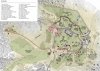
Fort anyone curious, I found this image from one of the design teams for California Trail. Shows their main exhibit is 0.27 acres and their extension is 0.46 acres.
Attachments
You are objectively correct, but it took me a moment to accept it as out of the zoos I have visited so far, all but one lack a dedicated Amazon complex and the exception happened to be one of the exhibits I skipped, so they feel quite scarce to me despite being so numerous.Yes, jaguars are on the decline, but they do have an advantage on the other big cats: they seamlessly fit into Amazon complexes, one of the most common geographic themes. The problem is that most Amazon complexes seem to be indoors and oriented around smaller species, which jaguars do not mesh well with. Chattanooga and Mesker Park at least have jaguars at the center of their complexes (although I don't recall either being a particularly great exhibit for the species). Others like Buffalo just have ocelots to save on space.
Today's post will be dedicated to a very large mammal, the black rhinoceros! The most solitary of the three rhino species found in US zoos, the criteria are similar, but modified, from the white and one-horned rhinos. Due to the fact they are seldom successful in mixed-species exhibits, black rhinos are significantly less common in US Zoos than white rhinos are.
The criteria for black rhinos are:
 Photo By: @snowleopard
 Photo By: @snowleopard
 Photo By: @snowleopard
 Photo By: @Coelacanth18
 Photo By: @TinoPup
 Photo By: @Moebelle
 Photo By: @Orion Pachs
 Photo By: @Orion Pachs
 Photo By: @TinoPup
 Photo By: @Milwaukee Man
 Photo By: @snowleopard
 Photo By: @zoofan75
 Photo By: @pachyderm pro
 Photo By: @Grizzly Hound
 Photo By: @snowleopard
 Photo By: @snowleopard
 Photo By: @Dhole dude
 Photo By: @Dhole dude
 Photo By: @Dhole dude
 Photo By: @Dhole dude
And with that, there are only three species remaining. I came slightly short of my goal of having the thread done by the end of the year, but regardless there are some incredible exhibits yet to be highlighted. Not only do I suspect anyone who has followed this thread can easily guess the three remaining species, I wouldn't be surprised if one could guess the majority of fifteen exhibits remaining, since some of them are well-known, world-class habitats.
The criteria for black rhinos are:
- Space: Rhinos are big animals that will roam across large areas of land in the wild. As such, an impressive rhino display requires large amounts of space, ideally half an acre or more.
- Plants: This can be difficult to achieve with large and destructive animals, but since rhinos are grazers in the wild, an ideal exhibit for them does include having a plant cover to graze.
- Presence of Mud Wallows: Rhinos use mud in the wild as a form of natural sunscreen, and an ideal exhibit for them will allow the rhinos to replicate this behavior.
- One of the few successful mixed-species exhibits is the rhino savanna at The Living Desert, new in 2021. this habitat uses its large size and plenty of escape routes for smaller residents to successfully mix black rhinos with various other species. While time will tell whether the success of this mix continues long-term, it is an impressive exhibit regardless due to its large size and overall greenery:
- While when most zoochatters think of Cincinnati Zoo a different rhino species comes to mind, black rhinos can be found in the very respectable Rhino Reserve. This is a sizeable black rhino exhibit and contains a number of plants to allow natural foraging opportunities:
- A very similar exhibit to Cincinnati's can be found at the Pittsburgh Zoo. This is a similarly large exhibit, surrounded by plenty of shade and vegetation to create an all-around great exhibit:
- Another similarly large, planted exhibit can be found in the River's Edge section of Saint Louis Zoo. This exhibit contains a large water feature, plenty of shaded and sunny sections, and lots of grass:
- Given they are solitary and don't tend to mix well, black rhinos can arguably be the best choice for a small zoo looking to add a rhino to their collection. No zoo proves this better than the Great Plains Zoo, whose Rare Rhinos of Africa exhibit provides a spacious, grassy habitat for this species. While large mixed-species savannas can certainly be impressive, not all zoos have as much space as North Carolina or Disney, and black rhinos can make a great choice for smaller zoos wanting a large mammal:
And with that, there are only three species remaining. I came slightly short of my goal of having the thread done by the end of the year, but regardless there are some incredible exhibits yet to be highlighted. Not only do I suspect anyone who has followed this thread can easily guess the three remaining species, I wouldn't be surprised if one could guess the majority of fifteen exhibits remaining, since some of them are well-known, world-class habitats.

Komodo Dragon
Well-Known Member
Gorilla and Polar Bear are certainly going to be two of the three. Not sure about the third.
Today's post will be dedicated to an awesome big cat species, and the one I tend to see most often, the snow leopard! These cats are a really great species, and one that many smaller zoos feature.
The criteria for snow leopards will be very similar to those for Amur leopards:
 Photo By: @Pleistohorse
 Photo By: @TinoPup
 Photo By: @TinoPup
 Photo By: @snowleopard
 Photo By: @Pleistohorse
 Photo By: @Pleistohorse
 Photo By: @TinoPup
 Photo By: @Pleistohorse
 Photo By: @Dhole dude
 Photo By: @Dhole dude
 Photo By: @Dhole dude
 Photo By: @TinoPup
 Photo By: @Dhole dude
 Photo By: @Dhole dude
 Photo By: @Dhole dude
 Photo By: @mweb08
 Photo By: @snowleopard
 Photo By: @snowleopard
 Photo By: @Ituri
 Photo By: @Ituri
The criteria for snow leopards will be very similar to those for Amur leopards:
- Climbing Opportunities and Rockwork: Compared to tigers and lions, snow leopards are much more adept climbers. As such, they require exhibits with plenty of opportunities to climb, especially on rockwork to recreate their natural, mountainous home.
- Space: Unfortunately, snow leopards are another taxa that has historically been exhibited in much smaller exhibits than they deserve. These are fast, agile climbers that can really make great use out of larger exhibits- and ideally are given enough space to truly display their entire repertoire of natural behaviors.
- Shade and Access to Cooler Spaces: Snow leopards are well-adapted to cold, harsh conditions, and unfortunately are less adapted for hot, sunny days. Zoos keeping amur leopards should be cognizant of this, and include shaded areas, cooled rocks, and/or access to climate-controlled spaces during the warmer months.
- The Roger Williams Park Zoo houses a pair of snow leopards in a large, rocky habitat that takes advantage of its height. Since snow leopards are very skilled climbers and make excellent use of the rockwork along the sides of this exhibit, which also provides many more open sections to allow them to leap and highlight their agility. This habitat is a rather shady habitat, allowing the snow leopards access to many cooler sections too:
- Snow leopards have some of the best examples of small zoos housing large species in excellent ways, with one great example being at Massachusetts' Stone Zoo. This habitat is a steep, predator-prey display, that along with the adjacent markhor habitat use a natural glacier deposit of rocks. Plenty of plants in this exhibit allow for shade, and similar to Roger Williams' exhibit this one is perfectly designed to allow the snow leopards to display their whole range of natural behaviors:
- Amongst the country's top zoos, the Bronx Zoo has by far the most impressive snow leopard exhibit, anchoring their Himalayan Highlands complex. These exhibits contain plenty of impressive, naturalistic rockwork to allow the snow leopards to climb, and utilize harp wire to create almost seamless viewing opportunities:
- Elsewhere in New York City, a very similar snow leopard exhibit can be found at the much smaller Central Park Zoo, which houses snow leopards in a pair of naturalistic, rocky exhibits. Plenty of plants provide shade for the snow leopards in this exhibit, while the large rock faces provide an excellent array of climbing opportunities. While the two New England exhibits excel at provide excellent exhibits for their snow leopards, the two New York City exhibits perhaps narrowly beat them in terms of visitor experience, as they provide the illusion of a never-ending exhibit as the back fencing is out of the visitor's sight line:
- Not all of the excellent snow leopard exhibits are found in the northeast, as Utah's Hogle Zoo provides a unique, rotational home for their snow leopards as part of the Asian Highlands complex. These exhibits, which rotate between multiple species of cat, are an enriching and engaging way to display similar species, especially when they come from similar biomes so work well with the same naturalistic features. Rockwork and plants are both top-notch in this exhibit, which makes up for the fact it is the smallest on this list due to its unique rotational elements:

I've always thought Stone had one of the best snow leopard exhibit (and not because it's my hometown zoo). Not to keep favoring the region, but I would put Southwicks up there. It was originally built for a single generic leopard but currently holds two snow leopards. It's massive and uses natural rocks for climbing structures with lots of vertical space.
I haven't been to Southwicks in a few years, and forget the leopard was replaced with snows. I have always liked that exhibit, and while I'm not sure it is of the same caliber as the five I mentioned, it's certainly very respectable in its own right. Agreed about Stone though, I think a very good case could be made it is the number one exhibit for this species in the country, although RWPZ, Bronx, and Central Park are all strong contenders too.I've always thought Stone had one of the best snow leopard exhibit (and not because it's my hometown zoo). Not to keep favoring the region, but I would put Southwicks up there. It was originally built for a single generic leopard but currently holds two snow leopards. It's massive and uses natural rocks for climbing structures with lots of vertical space.
Never seen CPZ but I am quite familiar with Bronx and especially RWPZ. The latter never really stuck out to me but Bronx may have the best.
Also regarding black rhino exhibits, I was fortunate to visit Living Desert this year. They have the best black rhino exhibit by far. Between the size, landscape and the various herds and flocks of species mixed in, no other exhibit for the species even comes close.
Also regarding black rhino exhibits, I was fortunate to visit Living Desert this year. They have the best black rhino exhibit by far. Between the size, landscape and the various herds and flocks of species mixed in, no other exhibit for the species even comes close.
The black rhinoceros post is so interesting -- I've commented on this before, elsewhere, but almost every zoo I've visited so far has held (or very recently held) black rhinoceros (the exception, Henson Robinson, is mostly smaller and native species) so it always surprises me a little bit to hear how uncommon they are. I've actually seen the Saint Louis exhibit and while I didn't get a chance to fully appreciate the inhabitants it was a pretty great habitat and very immersive.
As for snow leopards, I love the rockwork at Bronx, Stone and Central Park. I think it's absolutely true they often end up in undersized habitats especially relative to lions and tigers for which the tolerance for such exhibits has worn thin in recent years. They are also a species I see often but feel is somewhat overlooked in terms of creative exhibit design. I think they are one species that benefits from intricate rockwork in the absence of naturally hilly or mountainous terrain - definitely better than one zoo having to use wooden climbing platforms.
All that's left now is two species with some of the most zoochat discourse on their habitats... oof.
As for snow leopards, I love the rockwork at Bronx, Stone and Central Park. I think it's absolutely true they often end up in undersized habitats especially relative to lions and tigers for which the tolerance for such exhibits has worn thin in recent years. They are also a species I see often but feel is somewhat overlooked in terms of creative exhibit design. I think they are one species that benefits from intricate rockwork in the absence of naturally hilly or mountainous terrain - definitely better than one zoo having to use wooden climbing platforms.
All that's left now is two species with some of the most zoochat discourse on their habitats... oof.
The black rhinoceros post is so interesting -- I've commented on this before, elsewhere, but almost every zoo I've visited so far has held (or very recently held) black rhinoceros (the exception, Henson Robinson, is mostly smaller and native species) so it always surprises me a little bit to hear how uncommon they are. I've actually seen the Saint Louis exhibit and while I didn't get a chance to fully appreciate the inhabitants it was a pretty great habitat and very immersive.
As for snow leopards, I love the rockwork at Bronx, Stone and Central Park. I think it's absolutely true they often end up in undersized habitats especially relative to lions and tigers for which the tolerance for such exhibits has worn thin in recent years. They are also a species I see often but feel is somewhat overlooked in terms of creative exhibit design. I think they are one species that benefits from intricate rockwork in the absence of naturally hilly or mountainous terrain - definitely better than one zoo having to use wooden climbing platforms.
All that's left now is two species with some of the most zoochat discourse on their habitats... oof.
It's the complete opposite in the northeast / mid-atlantic. The only places with black are Pittsburgh (where I've never actually seen them) and Buffalo. It's very much a mid-west species, with a few holders further west and south.
Interesting. I did have a feeling it was a regional factor! I know one of the western holders is Denver which is, incidentally, the only western US zoo I've visited so far.It's the complete opposite in the northeast / mid-atlantic. The only places with black are Pittsburgh (where I've never actually seen them) and Buffalo. It's very much a mid-west species, with a few holders further west and south.

Gibbonsagainstgravity
Well-Known Member
I honestly think that Omaha is better than Roger Williams park for snow leopards.

Spike
Well-Known Member
I remember Woodland Park’s exhibit to be on the same tier as the best.Today's post will be dedicated to an awesome big cat species, and the one I tend to see most often, the snow leopard! These cats are a really great species, and one that many smaller zoos feature.
The criteria for snow leopards will be very similar to those for Amur leopards:
The exhibits selected for snow leopards are:
- Climbing Opportunities and Rockwork: Compared to tigers and lions, snow leopards are much more adept climbers. As such, they require exhibits with plenty of opportunities to climb, especially on rockwork to recreate their natural, mountainous home.
- Space: Unfortunately, snow leopards are another taxa that has historically been exhibited in much smaller exhibits than they deserve. These are fast, agile climbers that can really make great use out of larger exhibits- and ideally are given enough space to truly display their entire repertoire of natural behaviors.
- Shade and Access to Cooler Spaces: Snow leopards are well-adapted to cold, harsh conditions, and unfortunately are less adapted for hot, sunny days. Zoos keeping amur leopards should be cognizant of this, and include shaded areas, cooled rocks, and/or access to climate-controlled spaces during the warmer months.
- The Roger Williams Park Zoo houses a pair of snow leopards in a large, rocky habitat that takes advantage of its height. Since snow leopards are very skilled climbers and make excellent use of the rockwork along the sides of this exhibit, which also provides many more open sections to allow them to leap and highlight their agility. This habitat is a rather shady habitat, allowing the snow leopards access to many cooler sections too:
Photo By: @Pleistohorse
Photo By: @TinoPup
Photo By: @TinoPup
Photo By: @snowleopard
- Snow leopards have some of the best examples of small zoos housing large species in excellent ways, with one great example being at Massachusetts' Stone Zoo. This habitat is a steep, predator-prey display, that along with the adjacent markhor habitat use a natural glacier deposit of rocks. Plenty of plants in this exhibit allow for shade, and similar to Roger Williams' exhibit this one is perfectly designed to allow the snow leopards to display their whole range of natural behaviors:
Photo By: @Pleistohorse
Photo By: @Pleistohorse
Photo By: @TinoPup
Photo By: @Pleistohorse
- Amongst the country's top zoos, the Bronx Zoo has by far the most impressive snow leopard exhibit, anchoring their Himalayan Highlands complex. These exhibits contain plenty of impressive, naturalistic rockwork to allow the snow leopards to climb, and utilize harp wire to create almost seamless viewing opportunities:
Photo By: @Dhole dude
Photo By: @Dhole dude
Photo By: @Dhole dude
Photo By: @TinoPup
- Elsewhere in New York City, a very similar snow leopard exhibit can be found at the much smaller Central Park Zoo, which houses snow leopards in a pair of naturalistic, rocky exhibits. Plenty of plants provide shade for the snow leopards in this exhibit, while the large rock faces provide an excellent array of climbing opportunities. While the two New England exhibits excel at provide excellent exhibits for their snow leopards, the two New York City exhibits perhaps narrowly beat them in terms of visitor experience, as they provide the illusion of a never-ending exhibit as the back fencing is out of the visitor's sight line:
Photo By: @Dhole dude
Photo By: @Dhole dude
Photo By: @Dhole dude
Photo By: @mweb08
- Not all of the excellent snow leopard exhibits are found in the northeast, as Utah's Hogle Zoo provides a unique, rotational home for their snow leopards as part of the Asian Highlands complex. These exhibits, which rotate between multiple species of cat, are an enriching and engaging way to display similar species, especially when they come from similar biomes so work well with the same naturalistic features. Rockwork and plants are both top-notch in this exhibit, which makes up for the fact it is the smallest on this list due to its unique rotational elements:
Photo By: @snowleopard
Photo By: @snowleopard
Photo By: @Ituri
Photo By: @Ituri
I definitely wouldn't say Omaha is better than Roger Williams for snow leopards, as the Omaha exhibit seems slightly smaller, and doesn't afford as much privacy (or as much shade) to the cats. Privacy is important- and that is one thing the Omaha exhibit seems to be sorely lacking. I did consider placing Omaha above Hogle, but decided Hogle was unique enough to warrant including.I honestly think that Omaha is better than Roger Williams park for snow leopards.
Another exhibit that was considered for the fifth spot over Hogle. Also considered was Cheyenne Mountain Zoo.I remember Woodland Park’s exhibit to be on the same tier as the best.