
Kalaw
Well-Known Member
Prague Zoo Review 07/08/24:
Inarguably one of the best zoos in the world, Zoo Praha, which I will henceforth be referring to by its English name of Prague Zoo, spans 58 hectares of hilly landscape in Troja, one of the Czech capital’s northernmost districts. Divided in two by a tremendous cliff face, used as an iron mine in the 19th Century, the zoo has a very challenging setting, and yet has used it to full effect. With close to 700 species it has one of the largest zoological collections in Europe and with it being a pioneer in the captive breeding of many scarcely kept taxa, there is a reason why any zoo enthusiast who visits Prague will leave regarding it as one of the best that they have seen.
On the 7th of August, I had the pleasure of visiting this zoo for the first time, and it truly was an unforgettable experience, which I intend to describe here in great detail, with the hope that this review will be a valuable resource for anyone who is considering a Prague Zoo visit, or indeed anyone who fears they may not get to visit, and wants to learn more about the place.
All that said, as this is a first-time visit, I am not all that knowledgeable about the zoo, so will appreciate any corrections or additional facts that Prague Zoo regulars can provide me with here.
I believe that this review is comprehensive, with the only exclusion being the Farmhouse that focuses entirely on domestics, and the Gocars' House, a temporary exhibition featuring poison dart frogs that I did not get round to. That said, there is a chance I missed some of the many aviaries scattered throughout the zoo’s grounds. If this is the case, then yet again, additional information from more experienced readers would be welcome.
Enjoy the review!
Part 1 - Indonesian Jungle, Parrot Trail and Australia
The following morning, I rose at about 6:30, half-an-hour before I intended to do so, but I concluded that going back to sleep was pointless. Instead, I made my way downstairs for breakfast at the hotel buffet, while planning how to get to the zoo. Although public transport was an option, it would require three changes of line and could easily backfire. If I missed a train or, as was the case in Zurich, failed to get my head around the ticket machine in time, then I would no doubt fail in my goal to arrive at the zoo by opening time which, unlike at Zurich, could here be quite an issue. My main goal here was to spend the first hour (from 9:00 to 10:00) in the Indonéská Džungle, known to English-speaking visitors as the Indonesian Jungle Pavilion, as during this time the light in the nocturnal section was on, allowing for better views of its inhabitants which, if all went according to plan, would include my first ever pangolin! As such, I decided to travel by bicycle, which wasn’t too fast (around 35 minutes), but at least would make the duration of my journey more ‘fixed.’ Unfortunately, things didn’t go all too well in this regard either, as a huge portion of the city between our hotel and the zoo was subject to roadworks to allow for the construction of a new tram line. As such, we were delayed by ten minutes or so, but even still, by the time we had arrived at the zoo, locked up our bikes at the Southern Entrance, walked up to the Main Entrance (nearer to the pangolins, but sadly not featuring a bike lock) and scanned our online tickets (which, at a price of CZK 300, which is £10.24 or €11.88, makes Prague one of the best value for money zoos in the world), it was only 9:10 - 50 minutes to try for a pangolin!
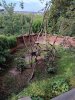
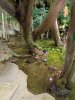
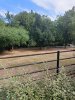
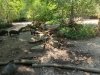
The first enclosure encountered after the main entrance was for Nepalese Red Panda. Admittedly, I rushed through this somewhat, so as to get to the Indonesian Jungle on time, but I wish I hadn’t, as it may well be the best red panda enclosure that I have ever seen, in all honesty. It fades brilliantly into the cliff face (which at this point is fairly subtle, but becomes more extreme further west in the zoo), and offers a wonderful selection of climbing, including both artificial structures and some gorgeous live trees. The inhabitants are clearly grateful, as I had never seen them so active, although it wasn’t enough to tempt me away from my pangolin. You then took an uphill path that loops around this enclosure towards the entrance to the pavilion, passing another enclosure, mirroring the red pandas, although with far less leaves remaining on the trees, this time for North American Porcupine. A wonderful species that isn’t seen often enough in zoos, and were again far more active at Prague than normal from my experience, on both instances in which I passed their enclosure.

Upon entering the Indonesian Jungle, the first thing you are greeted with is a dimly lit room featuring a series of paludariums (aquariums with a landscaped area above). While not as big as the ones at Zurich, they were just as charming, benefitting a fair amount from the very visible frogs inhabiting the portion above, the turtles in the pools, and the high numbers of fish. They were very well-constructed indeed, and truthfully, I wish that I wasn’t rushing to the pangolin, as I could have spent some time admiring these masterfully crafted habitats. The three or four tanks were signed as housing the following (and, surprisingly for an aquarium exhibit, the signage appeared to be very accurate):
Common Tree Frog
Roti Island Snake-necked Turtle
Southeast Asian Box Turtle
Red-bellied Short-necked Turtle
Pig-nosed Turtle
Southern Batagur
Mekong Snail-eating Turtle
Black Marsh Turtle
Siamese Flying Fox
Flying Fox
Moonlight Gourami
Kissing Gourami
Redtail Sharkminnow
Tinfoil Barb
Hoven’s Carp
Ghost Catfish
Clown Loach
Tricolour Sharkminnow
Bleher’s Rainbowfish
Boseman’s Rainbowfish
Dwarf Rainbowfish
Red Rainbowfish
Between the tanks, they had no less than seven freshwater turtle species, which I thought was rather impressive. The batagur is only held at a few public collections in Europe, and the Pig-nosed Turtle, while fairly commonplace, has always been a favourite of mine due to it having once been held in London’s Mappin Aquarium, always one of the livelier and more entertaining species in the building, so it was great to be ‘reunified’ with. This, along with the presence of four rainbowfish species, was my first introduction to Prague’s almost unbelievably vast collection, which often entails several taxa of the same genus being kept. The most entertaining feature here, however, was the Common Tree Frog, a lifetick, and one that was surprisingly easy to locate amidst the many branches and trees that form the terrestrial and arboreal portion of these paludariums.
Turning the corner, I came to one of Prague’s Komodo Dragon enclosures. The species was one that I had always associated with the zoo, due to having read in Sheridan’s 2015 guide that they had been the most prolific breeder of the species in Europe over the past decade (a record which I believe has continued to go strong in the time since). A large enclosure, although a little unimaginative, being fairly open in a way that resembled a desert habitat rather than a rainforest one that most visitors would associate with them, held, if memory serves, no less than four dragons, far larger than the members of this species that I have seen at London Zoo over the years, and quite possibly the biggest members of this species that I personally have ever seen.
You then enter the main portion of the Indonesian Jungle, the rainforest hall. Glass-roofed, brilliantly planted and landscaped with bizarre vines and a selection of pools, and crowned with free-flying birds, it feels as though it is trying to be Prague’s answer to Burgers’ Bush. Unfortunately, the two exhibits really cannot be compared, and I must admit that, upon first entering the hall, I was hugely disappointed by its small size. I would later come to realise that the portion of the hall that I was viewing here was far from its entirety, but even still, for a 21st Century rainforest hall at one of Europe’s greatest zoos, it is a little unremarkable. The real issue is how understocked it seems to be in terms of free-flying birds, as I only saw two (although luckily could hear many more, and their calls certainly did enhance the place), an aspect in which it not only looks poor next to just about any other tropical house that I had seen. This initial portion places visitors on a pathway down the centre, with pools on both sides, each featuring an island. On the right was a very significant lifeticks for myself, the Sunda Pig-tailed Macaque, whose enclosure is a little unattractive (entirely lacking in greenery), and seems to have no outdoor access, but there is a very impressive amount of climbing and some decent privacy. At first, only a large male revealed himself, but later on, a few other members of the troop began chasing each other up and down the branches before vanishing. The moat surrounding their enclosure was signed as being home to New Guinea Snapping Turtle, Giant Asian Pond Turtle, Clown Knifefish and Giant Pangasus, although I saw none of those, a particular shame for the two turtles who brought Prague’s turtle collection up to 9! The other island was home to Palawan Binturong and Indochinese Smooth-coated Otters, with only a pair of sleeping otters visible. While not quite as impressive as the Dresden enclosure that I saw earlier in the trip, this binturong enclosure was still excellent and could have easily passed for primates. However, neither of these were my personal favourite enclosure in this section of the pavilion, with that title instead going to the small pool sandwiched between the binturongs and the boardwalk for Spotted Green Pufferfish. A mangrove-themed tank, presumably with brackish water, for a small, but colourful and bizarre fish, that could easily be seen floating about its pool. Hardly world-class, but very charming.

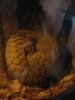
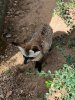
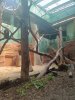
The path then led into the nocturnal portion, which was at this time diurnally lit, allowing for bright views of the animals. Naturally, at this point, my impatience to see a Chinese Pangolin was too much, and I didn’t give a second thought to any of the other animals on my way to their enclosure, which is located at the very far end of this corridor. A large crowd was gathered around, which gave me a suspicion that something was active in there, and I was not mistaken. Behind one of the logs at the far end of the enclosure, a mass of pinecone-like scales was moving along. Pangolins check all of the boxes that make animals interesting to me - endangered, rarely seen in zoos, very cute, and best of all, about as bizarre as it comes. A mammal with genuine keratin scales. As such, I had wanted to see one throughout my entire childhood, and amongst all the many rarities kept at Prague Zoo, none came close to this for me. I had made an agreement with myself that if a pangolin did not show when I first came to its enclosure, then I would sacrifice my chance to see most of the zoo’s other exhibits so as to ensure that I saw at least one, by committing time that would have been spent elsewhere moving back and forth to the Indonesian Jungle until I saw one. The pangolin began by patrolling its enclosure, inspecting the hollow logs and bark that lay throughout it, before digging itself a hole in the floor, foraging some more, and then vanishing. The moment was short-lived, but unforgettable, and may well be the best lifetick that I have ever claimed. I even managed to spot a second pangolin, this time curled up in one of the glass-fronted burrows between the main enclosures, although barring one stretch of its tail, it did not move. A special encounter indeed, although it wasn’t until after my visit that I realised that this individual curled up was most likely the female, Run Hou Tang, who recently gave birth to a ‘pangopup’ named Connie (by some coincidence, her name was announced on the same day as my visit), who was at the age where she would still be expected to remain in the burrow and clinging to the mother, thus implying that I had only narrowly missed the pangopup!
Of course, having never seen pangolins of any species before, I can’t really compare the enclosure to anything. However, I was very much impressed by Prague Zoo’s complex for the species, which features three main rooms, six glass-fronted burrows, a sizable offshow portion, and, in all of the main enclosures, deep natural substrate allowing for the animals to dig. A brilliant enclosure indeed. However, what was strangest to me, is that one of the three (the closest to the corridor’s entrance) had a large tree frog, presumably another Common, resting on the glass! They were unsigned, but if intentional and not an escapee, then this means a mixed-species exhibit with pangolins.

(Apologies for the woeful quality of this image, which was taken from a phone through reflective glass in the dark)
The other nocturnal mammals housed here are:
Sugar Glider
Northern Luzon Giant Cloud Rat
Southern Luzon Giant Cloud Rat
New Guinea Ground Cuscus
Sunda Slow Loris
Both cloud rat species share the enclosure and were the highlights for me aside from the pangolins. It was lovely to have a side-by-side comparison between the Northerns, a species that I had seen on many occasions before, and the Southerns, a lifetick which is kept at four Czech zoos, but in no other European countries. Both were perched on a wooden platform in the top corner of their enclosure, which was lovely to see, and were very easy to tell apart with the jet black colourations of the Southerns. Sadly, none of the other three inhabitants were visible, a particular shame in the case of the loris, who is allegedly the only member of the Sunda species in Europe. It isn’t just nocturnal mammals in this hall, however, as at the far end, just beyond the pangolins, are two enclosures for reptiles, based primarily around the water, but also featuring a series of leaf-covered branches for them to rest among. The smaller of the two houses Borneo Earless Monitor (unseen), while the second is a mix of two snake species, the Long-nosed Whip Snake (also unseen) and the Pacific Tree Boa, with the latter visible making good use of the pool.
The pathway then leads upstairs as you return to the rainforest hall that forms the bulk of the house, and are greeted with yet another primate enclosure, for an even higher profile species, the Sumatran Orangutan. They have a pair of indoor islands, neither of which are too impressive, but they have enough climbing and substrate on offer that I didn’t really mind. Later in the day, I also discovered an outdoor area, just behind the pavilion, which was actually of a solid size and had many ropes for swinging. On paper, this orangutan enclosure is by no means subpar, and may actually be rather good, however there were two issues that I noticed upon closer analysis: the lack of separation options, which presumably means the orangs must be confined to one of the two indoor islands if separation is an issue (I know this is possible, as while a keeper was cleaning the larger island two orangs could still be seen in the smaller one); and the fact that the orangutans don’t seem motivated to use the climbing areas, as all four that I saw throughout the day were on the ground. Overall, not a bad enclosure, but nothing to brag about either.
Moving along, one follows a boardwalk over a stream that houses Enigmatic Leaf Turtles, bringing the total number of turtles in this pavilion alone up to 10, and was also signed as housing more tree frogs who can presumably roam freely throughout the entire hall. I was very fond of how this stream lead into a deeper pool for fish that is mostly underground, albeit with a large opening in a cave (that leads visitors to a close-up viewing of the smaller orangutan island), a small touch that did well to give a feeling of a natural and random setting as opposed to an artificial and ‘clean’ one. Sadly, the fish in these pools are unsigned, and to make matters worse, the free-flying birds around the house are as well. Strange, as the quality of signage at Prague is by a country mile the best that I have ever seen at a zoo, with highly detailed information and fascinating facts that can educate even the most devout of zoo enthusiasts. After some nice views of the pavilion as a whole, you then depart via one more enclosure, a lovely mix of Philippine Porcupine and Belanger’s Treeshrew. I had seen the treeshrew before, at both Chester and Shaldon, but the former was a fleeting glimpse and the latter, although prolonged, was through some strangely thick mesh in the sunlight. The very clean glass at Prague allowed for a much better view of a lively group of them, although the porcupines (the second species of the day!) were the highlight here, a lifetick, and a rather bizarre porcupine species, with short, and at times curled, quills.
As I left the Indonesian Jungle, I felt a mixture of emotions. On one hand, if you are to perceive it as a rainforest hall, then it is hugely underwhelming, with functional but unattractive enclosures, very few free-flying birds and a lack of signage for what little they do have. But on the other hand, looking at it as an overall package, it is quite excellent. Some delightful aquaria, Komodo Dragons, orangutans, a rainforest hall, a nocturnal house and a decent reptile collection; what more could one ask for with a zoo exhibit? Overall, I thought it was an excellent start to the day, but not an excellent exhibit, and to consider that when it opened (2004) it was the most expensive project in the history of Czech zoos just feels strange. It says a lot that my favourite enclosure here was for pufferfish, and my second favourite was for turtles, frogs and rainbowfish, despite being someone who typically enjoys mammals and birds the most by far, as both of those enclosures were, in my eyes, much more interesting (and of a higher quality when considering what they hold, than the orangutan, macaque or binturong enclosures, as well as the main walkthrough. That said, the excitement of seeing a pangolin, at the time, overshadowed any scepticism. I do feel as though had I not seen it, I wouldn’t have enjoyed Prague Zoo half as much, as I would constantly have to backtrack across a huge zoo on a steep hillside to get to the Indonesian Jungle and try my luck again, no doubt resulting in me missing many of the zoo’s other exhibits. Thankfully, it all worked out well, and I left the Indonesian Jungle by about 9:50, feeling as though I was making good time.
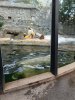
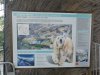
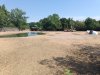
Opposite the Indonesian Jungle is the zoo’s Polar Bear enclosure. The signage here implies that this is among Prague Zoo’s oldest enclosures, having existed since its opening in 1931. Inevitably, in the time since it has aged poorly and is by no means adequate to house polar bears today. I feel as though I should provide some personal context here - before visiting Prague, I had only seen polar bears on three occasions prior (at La Flèche, Highland and Hagenbeck), and as such, even though the number of UK holders of the species has doubled in the past year or so, they still feel like a major rarity to me. At Hagenbeck, however, my most recent encounter with the species, I was somewhat disturbed by the poor quality of their enclosure, with a male bear locked outdoors and pacing all day, and as such didn’t get near as much enjoyment out of watching this delightful species as I would have liked. Although it had affected me before, it had never been quite so extreme, in that a bad enclosure completely eliminated my enjoyment of an amazing animal. Hence, upon hearing from zoo enthusiasts that Prague’s enclosure is also of a poor quality, I allowed myself to make an exception to my ‘no images’ rule, spoiling it for myself to eliminate any risk of disappointment. Here, I also had the comfort that, unlike Hagenbeck, whose enclosure opened in 2014, age is a factor in its poor quality, and that, most significantly, construction on a new and improved enclosure elsewhere in the zoo will start soon.
I think my decision paid off, as although I wasn’t fond of their enclosure (it is astronomically superior to Hagenbeck’s, however), I did find great joy in watching one of the two brothers, who recently arrived from Warsaw, swimming about their pool. Seeing them up close, and with underwater viewing, for the first time since La Flèche 5 years ago, was a real treat, and I had forgotten just how enormous these animals are. And this old enclosure far exceeded my expectations, with a decently deep pool, good separation options in the shape of a secondary enclosure (unlike at Hagenbeck where they had to be locked indoors for separation), and good enrichment, such as a pile of ice for them to roll in. That said, moving the bears to a better enclosure is still, indisputably, the right choice, and I have to wonder what the plans are for this space once they move out (presumably demolition).

Later in the day, while returning to the bears, who by this point had moved on to the secondary enclosure, resting just outside the doors to their indoors, I found a plan for their future exhibit, and it looks excellent. It claims that it will be named 'Arkitda' and will cover 8,000 square metres (not mentioned whether this refers solely to the bear enclosure, or to the whole complex), with two enclosures for the bears featuring four pools between them. It also alludes to underwater viewing and depicts in one of the images a pinniped of sorts (not mentioned whether this will be a new species, or the fur seals already at the zoo moved into a new home). There will also be a restaurant specialising in seafood. One thing that I am fairly curious about is what else will be integrated, asides from the bears and pinnipeds, as Prague has a good habit of including such extras in their exhibits. A seabird aviary, or even a cold-climate aquarium?

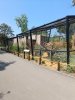
Taking the stairs down from the bears leads to a long pathway along the cliff face, and as you progress along it, it begins to develop into the towering monstrosity that it is so well-known for. This pathway offers wonderful views of Prague’s hilly city centre, with St Vilnius Cathedral within Prague Castle the highlight, although as a football fan, I was also delighted to be able to see, throughout the day, the stadium of newly promoted Dukla Praha, one of four first division Prague clubs and historically the smaller of the four, as reflected by the size of their stadium, but still nice to see. This exhibit forms the start of the Papousci Stezka, known in English as the ‘Parrot Trail,’ with aviaries for smaller parrot species, such as fig-parrots and lorikeets on the right and views of the city on the left for a very charming exhibit indeed.
In order, starting from the bears and ending at ‘Gobi’ on the map, the exhibit holds:
Purple-naped Lory
Orange-breasted Fig-parrot
Vernal Hanging Parrot
Brown Lory
Large Fig-parrot
Edwards’ Fig-parrot
Stella’s Lorikeet
Mitchell’s Lorikeet
Mindanao Lorikeet
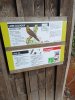
I was delighted to see all 9 species in this exhibit, which cannot often be said for such enclosures in zoos. This was particularly welcome for all three fig-parrot species, a group of birds which I had never encountered before, and got very good views of here. I was really fond of all the aviaries, which had onshow indoor areas and surprisingly spacious, densely vegetated outdoors, however, what struck me most about this area was actually the outstanding quality of the signage, something that would go on to become a recurring theme throughout the day. Every sign had a picture of the birds, in colour and usually perched on a branch, with a map showing their range to the right and a brief profile to the left (showing their family, native biome, diet and size among others), with the far right column being a written paragraph. Most species in the zoo (including all the birds here except the Stella’s) also had a second sign underneath offering even more detailed fun facts, often obscure and interesting enough to be worthwhile even for enthusiasts. At times they are specific to the species in question, and at other times they are more general. My favourite here was for the Brown Lory, which shows illustrations and descriptions of the different types of feathers found on birds - namely contour feathers, down feathers, filoplumes and bristles.

The whole Parrot Trail is very long, and with only nine aviaries there is naturally a lot of empty space, which Prague has done well to fill with plants. However, where there is none, the views of the volcanic rock that forms the cliff are also nice, something contributed to by the signed explaining how it is ‘volcanic tuff strongly saturated with hematite,’ before encouraging you to ‘take a piece of the rock in your hand,’ promising that ‘you will be surprised by how heavy it is.’ It also explains how iron ores from cliffs around here, including the cliff that today forms Prague Zoo, were essential for the ‘growth of the Bohemian metallurgy in the 19th Century.’ So not only are you paying £10 to visit one of the best zoos on the planet, but you are getting an included history and chemistry lesson all in one!
The Parrot Trail does, however, consist of a little more than these eight aviaries, as it concludes with what is (the free flight hall in the Indonesian Jungle, in which I saw free-flying birds just two times, although heard them much more, notwithstanding) the first walkthrough of the day. A small detail, but I love the placement of this walkthrough, right between the Parrot Trail and Australia, and with it featuring entirely Australian birds and predominantly parrots. In terms of the desert-like vegetation and reddish colour of the rocks, this is a fairly standard Australian walkthrough, only hugely scaled up, and instead of budgies, this stars the rarely kept Scaly-breasted Lorikeet, with a very attractive and very large ‘flock’ of these perched on branches, demonstrating the namesake feathers on their chest (with pronounced enough lower edges that they resemble scales) and their attractive tail feathers. It also held the more common, but all the same lovely, Superb Parrot, Rainbow Lorikeet, Crested Pigeon and Bush Thick-knee (although the thick-knee would have actually been a lifetick had I not encountered them just over a week ago at Dessau in the same trip.
Upon leaving the aviary, you find yourself at a junction of sorts, where four pathways converge. Carrying on along the path above the cliff, from the Parrot Trail, leads you to the zoo’s newest exhibit, ‘Gobi,’ as well as the chairlift that help scale the cliff with ease, for an additional charge of CZK 40 (€1.58 or £1.36). To the right of the Parrot Trail, two pathways lead along different sides of ‘Across the Continents,’ which the zoo map treats as one exhibit, but in reality feels a lot more like a confused cluster of multiple exhibits, and that is how I chose to treat it, not visiting it all as one entity, and rather admiring its enclosures in passing, focused on other exhibits. Hence, I now cut back on myself, taking a pathway through the aforementioned ‘Australia’ zone (which ironically is the smaller of the two Australia-themed zones at the zoo), viewing a part of ATC (as I will henceforth be abbreviating it to for convenience) in doing so.
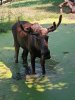
The first ATC enclosure I saw was one for Maned Wolf, which I regrettably had no luck locating from the raised platform overlooking their enclosure. It was about as standard an exhibit as it comes - spacious, grassy, undulating and shaded, with what appears to be a large, but offshow, indoor area at the far end. Good, but nothing memorable. What was just to the left of their enclosure, however, certainly was memorable - the zoo’s Eastern Wallaroo enclosure, not for the enclosure (much like the Maned Wolf enclosure in that, although very good, it was hardly special), but instead for the inhabitants. ‘Wallaroo’ is a name given to species of the osphranter genus, the same genus as Red Kangaroos, that are smaller than said animal, or indeed any other kangaroo, but far smaller than wallabies. I must confess to having been a little disappointed when I realised that they are not their own genus, with their unique name referring solely to size - it always gave the illusion of them being something special, and as such they were an animal that I longed to see throughout childhood. However, even after this, while admiring the animals at Prague, one fairly unique feature did stick out to me, that being their sexual dimorphism, which not only includes size, but also colour (the males being a very attractive blend of hazel and black, while the females are a more standard grey), something rarely seen among macropods. The nearby Addax enclosure is similarly average, although I was quite taken by how they managed to preserve such gorgeously green grass for a grazer without (unless I was missing something) rotating their pasture.

Around here was a map of Prague Zoo, something that (having made the regrettable decision of not picking up a paper copy of the map upon entry, too blinded by pangolin excitement!) I had to photograph, favouriting the photo for easy access to aid with navigation. Thankfully, I did manage to find a paper map that somebody had left lying around, that I would scavenge for my collection, however this wasn’t until the final minutes of the day, and as such this photograph proved vital for navigating one of the largest and most labyrinthine zoos on the continent. Now feels like a good time to address Prague Zoo’s map, while may will be one of my favourites ever. I love the colour-coded exhibits, the detailed silhouettes, the use of both exhibit and animal names, and, most uniquely, the contour lines. The only thing it doesn’t do that I like to see in zoo maps is use detailed illustrations of the buildings so that you know where you are standing, but as most of the Prague Zoo buildings are fairly nondescript anyways, this hardly would have helped. An excellent map, but strangely, it seems to have switched the positions of the wallaroos and Maned Wolves in ATC.
On the other side of the pathway, the Australia zone commences with Southern Cassowary. This is an animal that I hadn’t seen in quite some time, but was always one of my favourites, and thankfully, one of the cassowaries was doing us a great favour by standing right in front of the glass viewing panel, seemingly quite curious about our presence. Their indoor area is in the centre, with a second enclosure on the other side of it, and while as an overall complex I did approve of having multiple enclosures, I could not help but feel as though individually they are both far too small for such a large bird, especially when compared to the cassowary enclosures in the UK. The following pair of enclosures (for Common Emu and Swamp Wallaby) were of a much better standard in my opinion, being well-landscaped and well decorated with a selection of trees, although of course the species in question are more commonplace. The final enclosure in Australia was for Red Kangaroo, and was rather out-of-the-way, requiring the visitor to travel up a rather lengthy boardwalk to reach it, and then forcing you to backtrack. A fairly standard enclosure, but I did appreciate the placement of the rear fencing behind a slight drop to render it completely invisible, allowing visitors to admire the kangaroos with an unobstructed view of the city in the background.

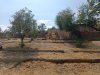
Next along in ATC is the zoo’s Turkmenian Kulan enclosure. Completely absent from the UK and a lifetick, the Kulan is a subspecies of Onager that returned to Prague earlier this year after over a decade of absence. Sadly, I could only locate one in their enclosure. The final enclosure in this initial stretch of ATC is labelled on the map as ‘South American Carnivores,’ and indeed features three species that match said description, as well as a Central American rodent. I was very much impressed by the first of these, the Bush Dog enclosure, which was huge, with a large pool, many trees, fallen logs for shelter and play, as well as a large, onshow indoor area with deep substrate for them to dig among. This is easily the biggest and best Bush Dog enclosure that I have seen aside from the temporary one at Chester, in which they were briefly given access to one of the former Jaguar enclosures (now housing bears, I believe), which feels somewhat like cheating. Now feels like an appropriate time to discuss one of the more unusual facets of Prague zoo, albeit one that I gather a fair few other continental zoos have adopted, and that is the fact that dogs are allowed to enter for CZK 150 (€5.94 or £5.08). At the bush dogs, a fellow visitor’s own dog clearly recognised its distant cousins as being related and, after a brief bark, took to attempting to play with them, placing its paws on the glass viewing window and desperately trying to get the inhabitant’s attention. One of the Bush Dogs delivered, and its roommates followed suit, and you ended up with both sides of the fence being equally curious and excited by the other. A delightful moment which resumed until the owner had to forcefully drag their dog away. It was also a moment that left me very much in favour of the practice of allowing dogs into zoos, as although I am in favour of zoos, the idea that captive animals almost never get to interact with animals who aren’t of the same species, barring mixed-species exhibits, of course, has always been a bit of a grey area for me, being a crucial part of nature. But here, both domestic dog and bush dog seemed to benefit. I also found throughout the day that most owners had enough common sense not to bring their dog into the zoo if they aren’t well-trained, as only once did I hear a sustained period of barking (although there were few other one-off barks such as the one here). All in all, I was hugely fond of this.
Adjacent to the indoor area for Bush Dogs is the Cuban Hutia enclosure, which struck me as an odd way to display a large rodent, with a cage-like outdoor area, but it seemed to get the job done. I spotted two outdoors, which served as a welcome lifetick, and a very pleasantly surprising one at that, as truth be told I did not know Prague so much as held this species prior to discovering them here. Next up is a typical small cat cage, well-planted and with decent climbing but hardly all that spacious or aesthetically appealing, that houses Jaguarundi, a taxa that I regrettably could not locate on both my visits to Exmoor Zoo during the brief period in which they were onshow, and sadly this extended their streak, as despite some thorough attempts to locate them, I had no luck. On the other side of the same house as the cats is a Tayra enclosure, in which, as is typical of mustelids (who seem to always be fast asleep or hyperactive with no real ‘in between’), was enthusiastically bounding around its enclosure. I was delighted to see how evidently curious it was with regards to the presence of a keeper, who was cleaning out its enclosure.The final enclosure around here is the zoo’s North American River Otter enclosure, which I was quite charmed by, due to the delightful water feature, many mature trees (something which seems to be a strength of this area of Prague Zoo in general), and a good choice of species, being among the rarer otter species in European zoos, although one that I had seen in the past at the New Forest Wildlife Park, so wasn’t all too phased by missing out on. Coupled with the Smooth-coateds in the Indonesian Jungle, it made a welcome change from the Asiatic Short-claweds.
-------------------------------------------------------------------------------------------------------
I hope that all readers enjoyed Part 1 of this review. I aim to release one-per-day, and they will all be around the same length (this one was just under 6,000 words). In the next one, which I will start working on this afternoon if I get the time, I aim to cover Africa Up Close, the Hippo Pavilion, Elephant Valley and African Savannah, as well as potentially the Dja Reserve depending on word count and time. Hopefully, it will be released at the same time tomorrow!
Inarguably one of the best zoos in the world, Zoo Praha, which I will henceforth be referring to by its English name of Prague Zoo, spans 58 hectares of hilly landscape in Troja, one of the Czech capital’s northernmost districts. Divided in two by a tremendous cliff face, used as an iron mine in the 19th Century, the zoo has a very challenging setting, and yet has used it to full effect. With close to 700 species it has one of the largest zoological collections in Europe and with it being a pioneer in the captive breeding of many scarcely kept taxa, there is a reason why any zoo enthusiast who visits Prague will leave regarding it as one of the best that they have seen.
On the 7th of August, I had the pleasure of visiting this zoo for the first time, and it truly was an unforgettable experience, which I intend to describe here in great detail, with the hope that this review will be a valuable resource for anyone who is considering a Prague Zoo visit, or indeed anyone who fears they may not get to visit, and wants to learn more about the place.
All that said, as this is a first-time visit, I am not all that knowledgeable about the zoo, so will appreciate any corrections or additional facts that Prague Zoo regulars can provide me with here.
I believe that this review is comprehensive, with the only exclusion being the Farmhouse that focuses entirely on domestics, and the Gocars' House, a temporary exhibition featuring poison dart frogs that I did not get round to. That said, there is a chance I missed some of the many aviaries scattered throughout the zoo’s grounds. If this is the case, then yet again, additional information from more experienced readers would be welcome.
Enjoy the review!
Part 1 - Indonesian Jungle, Parrot Trail and Australia
The following morning, I rose at about 6:30, half-an-hour before I intended to do so, but I concluded that going back to sleep was pointless. Instead, I made my way downstairs for breakfast at the hotel buffet, while planning how to get to the zoo. Although public transport was an option, it would require three changes of line and could easily backfire. If I missed a train or, as was the case in Zurich, failed to get my head around the ticket machine in time, then I would no doubt fail in my goal to arrive at the zoo by opening time which, unlike at Zurich, could here be quite an issue. My main goal here was to spend the first hour (from 9:00 to 10:00) in the Indonéská Džungle, known to English-speaking visitors as the Indonesian Jungle Pavilion, as during this time the light in the nocturnal section was on, allowing for better views of its inhabitants which, if all went according to plan, would include my first ever pangolin! As such, I decided to travel by bicycle, which wasn’t too fast (around 35 minutes), but at least would make the duration of my journey more ‘fixed.’ Unfortunately, things didn’t go all too well in this regard either, as a huge portion of the city between our hotel and the zoo was subject to roadworks to allow for the construction of a new tram line. As such, we were delayed by ten minutes or so, but even still, by the time we had arrived at the zoo, locked up our bikes at the Southern Entrance, walked up to the Main Entrance (nearer to the pangolins, but sadly not featuring a bike lock) and scanned our online tickets (which, at a price of CZK 300, which is £10.24 or €11.88, makes Prague one of the best value for money zoos in the world), it was only 9:10 - 50 minutes to try for a pangolin!
The first enclosure encountered after the main entrance was for Nepalese Red Panda. Admittedly, I rushed through this somewhat, so as to get to the Indonesian Jungle on time, but I wish I hadn’t, as it may well be the best red panda enclosure that I have ever seen, in all honesty. It fades brilliantly into the cliff face (which at this point is fairly subtle, but becomes more extreme further west in the zoo), and offers a wonderful selection of climbing, including both artificial structures and some gorgeous live trees. The inhabitants are clearly grateful, as I had never seen them so active, although it wasn’t enough to tempt me away from my pangolin. You then took an uphill path that loops around this enclosure towards the entrance to the pavilion, passing another enclosure, mirroring the red pandas, although with far less leaves remaining on the trees, this time for North American Porcupine. A wonderful species that isn’t seen often enough in zoos, and were again far more active at Prague than normal from my experience, on both instances in which I passed their enclosure.
Upon entering the Indonesian Jungle, the first thing you are greeted with is a dimly lit room featuring a series of paludariums (aquariums with a landscaped area above). While not as big as the ones at Zurich, they were just as charming, benefitting a fair amount from the very visible frogs inhabiting the portion above, the turtles in the pools, and the high numbers of fish. They were very well-constructed indeed, and truthfully, I wish that I wasn’t rushing to the pangolin, as I could have spent some time admiring these masterfully crafted habitats. The three or four tanks were signed as housing the following (and, surprisingly for an aquarium exhibit, the signage appeared to be very accurate):
Common Tree Frog
Roti Island Snake-necked Turtle
Southeast Asian Box Turtle
Red-bellied Short-necked Turtle
Pig-nosed Turtle
Southern Batagur
Mekong Snail-eating Turtle
Black Marsh Turtle
Siamese Flying Fox
Flying Fox
Moonlight Gourami
Kissing Gourami
Redtail Sharkminnow
Tinfoil Barb
Hoven’s Carp
Ghost Catfish
Clown Loach
Tricolour Sharkminnow
Bleher’s Rainbowfish
Boseman’s Rainbowfish
Dwarf Rainbowfish
Red Rainbowfish
Between the tanks, they had no less than seven freshwater turtle species, which I thought was rather impressive. The batagur is only held at a few public collections in Europe, and the Pig-nosed Turtle, while fairly commonplace, has always been a favourite of mine due to it having once been held in London’s Mappin Aquarium, always one of the livelier and more entertaining species in the building, so it was great to be ‘reunified’ with. This, along with the presence of four rainbowfish species, was my first introduction to Prague’s almost unbelievably vast collection, which often entails several taxa of the same genus being kept. The most entertaining feature here, however, was the Common Tree Frog, a lifetick, and one that was surprisingly easy to locate amidst the many branches and trees that form the terrestrial and arboreal portion of these paludariums.
Turning the corner, I came to one of Prague’s Komodo Dragon enclosures. The species was one that I had always associated with the zoo, due to having read in Sheridan’s 2015 guide that they had been the most prolific breeder of the species in Europe over the past decade (a record which I believe has continued to go strong in the time since). A large enclosure, although a little unimaginative, being fairly open in a way that resembled a desert habitat rather than a rainforest one that most visitors would associate with them, held, if memory serves, no less than four dragons, far larger than the members of this species that I have seen at London Zoo over the years, and quite possibly the biggest members of this species that I personally have ever seen.
You then enter the main portion of the Indonesian Jungle, the rainforest hall. Glass-roofed, brilliantly planted and landscaped with bizarre vines and a selection of pools, and crowned with free-flying birds, it feels as though it is trying to be Prague’s answer to Burgers’ Bush. Unfortunately, the two exhibits really cannot be compared, and I must admit that, upon first entering the hall, I was hugely disappointed by its small size. I would later come to realise that the portion of the hall that I was viewing here was far from its entirety, but even still, for a 21st Century rainforest hall at one of Europe’s greatest zoos, it is a little unremarkable. The real issue is how understocked it seems to be in terms of free-flying birds, as I only saw two (although luckily could hear many more, and their calls certainly did enhance the place), an aspect in which it not only looks poor next to just about any other tropical house that I had seen. This initial portion places visitors on a pathway down the centre, with pools on both sides, each featuring an island. On the right was a very significant lifeticks for myself, the Sunda Pig-tailed Macaque, whose enclosure is a little unattractive (entirely lacking in greenery), and seems to have no outdoor access, but there is a very impressive amount of climbing and some decent privacy. At first, only a large male revealed himself, but later on, a few other members of the troop began chasing each other up and down the branches before vanishing. The moat surrounding their enclosure was signed as being home to New Guinea Snapping Turtle, Giant Asian Pond Turtle, Clown Knifefish and Giant Pangasus, although I saw none of those, a particular shame for the two turtles who brought Prague’s turtle collection up to 9! The other island was home to Palawan Binturong and Indochinese Smooth-coated Otters, with only a pair of sleeping otters visible. While not quite as impressive as the Dresden enclosure that I saw earlier in the trip, this binturong enclosure was still excellent and could have easily passed for primates. However, neither of these were my personal favourite enclosure in this section of the pavilion, with that title instead going to the small pool sandwiched between the binturongs and the boardwalk for Spotted Green Pufferfish. A mangrove-themed tank, presumably with brackish water, for a small, but colourful and bizarre fish, that could easily be seen floating about its pool. Hardly world-class, but very charming.
The path then led into the nocturnal portion, which was at this time diurnally lit, allowing for bright views of the animals. Naturally, at this point, my impatience to see a Chinese Pangolin was too much, and I didn’t give a second thought to any of the other animals on my way to their enclosure, which is located at the very far end of this corridor. A large crowd was gathered around, which gave me a suspicion that something was active in there, and I was not mistaken. Behind one of the logs at the far end of the enclosure, a mass of pinecone-like scales was moving along. Pangolins check all of the boxes that make animals interesting to me - endangered, rarely seen in zoos, very cute, and best of all, about as bizarre as it comes. A mammal with genuine keratin scales. As such, I had wanted to see one throughout my entire childhood, and amongst all the many rarities kept at Prague Zoo, none came close to this for me. I had made an agreement with myself that if a pangolin did not show when I first came to its enclosure, then I would sacrifice my chance to see most of the zoo’s other exhibits so as to ensure that I saw at least one, by committing time that would have been spent elsewhere moving back and forth to the Indonesian Jungle until I saw one. The pangolin began by patrolling its enclosure, inspecting the hollow logs and bark that lay throughout it, before digging itself a hole in the floor, foraging some more, and then vanishing. The moment was short-lived, but unforgettable, and may well be the best lifetick that I have ever claimed. I even managed to spot a second pangolin, this time curled up in one of the glass-fronted burrows between the main enclosures, although barring one stretch of its tail, it did not move. A special encounter indeed, although it wasn’t until after my visit that I realised that this individual curled up was most likely the female, Run Hou Tang, who recently gave birth to a ‘pangopup’ named Connie (by some coincidence, her name was announced on the same day as my visit), who was at the age where she would still be expected to remain in the burrow and clinging to the mother, thus implying that I had only narrowly missed the pangopup!
Of course, having never seen pangolins of any species before, I can’t really compare the enclosure to anything. However, I was very much impressed by Prague Zoo’s complex for the species, which features three main rooms, six glass-fronted burrows, a sizable offshow portion, and, in all of the main enclosures, deep natural substrate allowing for the animals to dig. A brilliant enclosure indeed. However, what was strangest to me, is that one of the three (the closest to the corridor’s entrance) had a large tree frog, presumably another Common, resting on the glass! They were unsigned, but if intentional and not an escapee, then this means a mixed-species exhibit with pangolins.
(Apologies for the woeful quality of this image, which was taken from a phone through reflective glass in the dark)
The other nocturnal mammals housed here are:
Sugar Glider
Northern Luzon Giant Cloud Rat
Southern Luzon Giant Cloud Rat
New Guinea Ground Cuscus
Sunda Slow Loris
Both cloud rat species share the enclosure and were the highlights for me aside from the pangolins. It was lovely to have a side-by-side comparison between the Northerns, a species that I had seen on many occasions before, and the Southerns, a lifetick which is kept at four Czech zoos, but in no other European countries. Both were perched on a wooden platform in the top corner of their enclosure, which was lovely to see, and were very easy to tell apart with the jet black colourations of the Southerns. Sadly, none of the other three inhabitants were visible, a particular shame in the case of the loris, who is allegedly the only member of the Sunda species in Europe. It isn’t just nocturnal mammals in this hall, however, as at the far end, just beyond the pangolins, are two enclosures for reptiles, based primarily around the water, but also featuring a series of leaf-covered branches for them to rest among. The smaller of the two houses Borneo Earless Monitor (unseen), while the second is a mix of two snake species, the Long-nosed Whip Snake (also unseen) and the Pacific Tree Boa, with the latter visible making good use of the pool.
The pathway then leads upstairs as you return to the rainforest hall that forms the bulk of the house, and are greeted with yet another primate enclosure, for an even higher profile species, the Sumatran Orangutan. They have a pair of indoor islands, neither of which are too impressive, but they have enough climbing and substrate on offer that I didn’t really mind. Later in the day, I also discovered an outdoor area, just behind the pavilion, which was actually of a solid size and had many ropes for swinging. On paper, this orangutan enclosure is by no means subpar, and may actually be rather good, however there were two issues that I noticed upon closer analysis: the lack of separation options, which presumably means the orangs must be confined to one of the two indoor islands if separation is an issue (I know this is possible, as while a keeper was cleaning the larger island two orangs could still be seen in the smaller one); and the fact that the orangutans don’t seem motivated to use the climbing areas, as all four that I saw throughout the day were on the ground. Overall, not a bad enclosure, but nothing to brag about either.
Moving along, one follows a boardwalk over a stream that houses Enigmatic Leaf Turtles, bringing the total number of turtles in this pavilion alone up to 10, and was also signed as housing more tree frogs who can presumably roam freely throughout the entire hall. I was very fond of how this stream lead into a deeper pool for fish that is mostly underground, albeit with a large opening in a cave (that leads visitors to a close-up viewing of the smaller orangutan island), a small touch that did well to give a feeling of a natural and random setting as opposed to an artificial and ‘clean’ one. Sadly, the fish in these pools are unsigned, and to make matters worse, the free-flying birds around the house are as well. Strange, as the quality of signage at Prague is by a country mile the best that I have ever seen at a zoo, with highly detailed information and fascinating facts that can educate even the most devout of zoo enthusiasts. After some nice views of the pavilion as a whole, you then depart via one more enclosure, a lovely mix of Philippine Porcupine and Belanger’s Treeshrew. I had seen the treeshrew before, at both Chester and Shaldon, but the former was a fleeting glimpse and the latter, although prolonged, was through some strangely thick mesh in the sunlight. The very clean glass at Prague allowed for a much better view of a lively group of them, although the porcupines (the second species of the day!) were the highlight here, a lifetick, and a rather bizarre porcupine species, with short, and at times curled, quills.
As I left the Indonesian Jungle, I felt a mixture of emotions. On one hand, if you are to perceive it as a rainforest hall, then it is hugely underwhelming, with functional but unattractive enclosures, very few free-flying birds and a lack of signage for what little they do have. But on the other hand, looking at it as an overall package, it is quite excellent. Some delightful aquaria, Komodo Dragons, orangutans, a rainforest hall, a nocturnal house and a decent reptile collection; what more could one ask for with a zoo exhibit? Overall, I thought it was an excellent start to the day, but not an excellent exhibit, and to consider that when it opened (2004) it was the most expensive project in the history of Czech zoos just feels strange. It says a lot that my favourite enclosure here was for pufferfish, and my second favourite was for turtles, frogs and rainbowfish, despite being someone who typically enjoys mammals and birds the most by far, as both of those enclosures were, in my eyes, much more interesting (and of a higher quality when considering what they hold, than the orangutan, macaque or binturong enclosures, as well as the main walkthrough. That said, the excitement of seeing a pangolin, at the time, overshadowed any scepticism. I do feel as though had I not seen it, I wouldn’t have enjoyed Prague Zoo half as much, as I would constantly have to backtrack across a huge zoo on a steep hillside to get to the Indonesian Jungle and try my luck again, no doubt resulting in me missing many of the zoo’s other exhibits. Thankfully, it all worked out well, and I left the Indonesian Jungle by about 9:50, feeling as though I was making good time.
Opposite the Indonesian Jungle is the zoo’s Polar Bear enclosure. The signage here implies that this is among Prague Zoo’s oldest enclosures, having existed since its opening in 1931. Inevitably, in the time since it has aged poorly and is by no means adequate to house polar bears today. I feel as though I should provide some personal context here - before visiting Prague, I had only seen polar bears on three occasions prior (at La Flèche, Highland and Hagenbeck), and as such, even though the number of UK holders of the species has doubled in the past year or so, they still feel like a major rarity to me. At Hagenbeck, however, my most recent encounter with the species, I was somewhat disturbed by the poor quality of their enclosure, with a male bear locked outdoors and pacing all day, and as such didn’t get near as much enjoyment out of watching this delightful species as I would have liked. Although it had affected me before, it had never been quite so extreme, in that a bad enclosure completely eliminated my enjoyment of an amazing animal. Hence, upon hearing from zoo enthusiasts that Prague’s enclosure is also of a poor quality, I allowed myself to make an exception to my ‘no images’ rule, spoiling it for myself to eliminate any risk of disappointment. Here, I also had the comfort that, unlike Hagenbeck, whose enclosure opened in 2014, age is a factor in its poor quality, and that, most significantly, construction on a new and improved enclosure elsewhere in the zoo will start soon.
I think my decision paid off, as although I wasn’t fond of their enclosure (it is astronomically superior to Hagenbeck’s, however), I did find great joy in watching one of the two brothers, who recently arrived from Warsaw, swimming about their pool. Seeing them up close, and with underwater viewing, for the first time since La Flèche 5 years ago, was a real treat, and I had forgotten just how enormous these animals are. And this old enclosure far exceeded my expectations, with a decently deep pool, good separation options in the shape of a secondary enclosure (unlike at Hagenbeck where they had to be locked indoors for separation), and good enrichment, such as a pile of ice for them to roll in. That said, moving the bears to a better enclosure is still, indisputably, the right choice, and I have to wonder what the plans are for this space once they move out (presumably demolition).
Later in the day, while returning to the bears, who by this point had moved on to the secondary enclosure, resting just outside the doors to their indoors, I found a plan for their future exhibit, and it looks excellent. It claims that it will be named 'Arkitda' and will cover 8,000 square metres (not mentioned whether this refers solely to the bear enclosure, or to the whole complex), with two enclosures for the bears featuring four pools between them. It also alludes to underwater viewing and depicts in one of the images a pinniped of sorts (not mentioned whether this will be a new species, or the fur seals already at the zoo moved into a new home). There will also be a restaurant specialising in seafood. One thing that I am fairly curious about is what else will be integrated, asides from the bears and pinnipeds, as Prague has a good habit of including such extras in their exhibits. A seabird aviary, or even a cold-climate aquarium?
Taking the stairs down from the bears leads to a long pathway along the cliff face, and as you progress along it, it begins to develop into the towering monstrosity that it is so well-known for. This pathway offers wonderful views of Prague’s hilly city centre, with St Vilnius Cathedral within Prague Castle the highlight, although as a football fan, I was also delighted to be able to see, throughout the day, the stadium of newly promoted Dukla Praha, one of four first division Prague clubs and historically the smaller of the four, as reflected by the size of their stadium, but still nice to see. This exhibit forms the start of the Papousci Stezka, known in English as the ‘Parrot Trail,’ with aviaries for smaller parrot species, such as fig-parrots and lorikeets on the right and views of the city on the left for a very charming exhibit indeed.
In order, starting from the bears and ending at ‘Gobi’ on the map, the exhibit holds:
Purple-naped Lory
Orange-breasted Fig-parrot
Vernal Hanging Parrot
Brown Lory
Large Fig-parrot
Edwards’ Fig-parrot
Stella’s Lorikeet
Mitchell’s Lorikeet
Mindanao Lorikeet
I was delighted to see all 9 species in this exhibit, which cannot often be said for such enclosures in zoos. This was particularly welcome for all three fig-parrot species, a group of birds which I had never encountered before, and got very good views of here. I was really fond of all the aviaries, which had onshow indoor areas and surprisingly spacious, densely vegetated outdoors, however, what struck me most about this area was actually the outstanding quality of the signage, something that would go on to become a recurring theme throughout the day. Every sign had a picture of the birds, in colour and usually perched on a branch, with a map showing their range to the right and a brief profile to the left (showing their family, native biome, diet and size among others), with the far right column being a written paragraph. Most species in the zoo (including all the birds here except the Stella’s) also had a second sign underneath offering even more detailed fun facts, often obscure and interesting enough to be worthwhile even for enthusiasts. At times they are specific to the species in question, and at other times they are more general. My favourite here was for the Brown Lory, which shows illustrations and descriptions of the different types of feathers found on birds - namely contour feathers, down feathers, filoplumes and bristles.
The whole Parrot Trail is very long, and with only nine aviaries there is naturally a lot of empty space, which Prague has done well to fill with plants. However, where there is none, the views of the volcanic rock that forms the cliff are also nice, something contributed to by the signed explaining how it is ‘volcanic tuff strongly saturated with hematite,’ before encouraging you to ‘take a piece of the rock in your hand,’ promising that ‘you will be surprised by how heavy it is.’ It also explains how iron ores from cliffs around here, including the cliff that today forms Prague Zoo, were essential for the ‘growth of the Bohemian metallurgy in the 19th Century.’ So not only are you paying £10 to visit one of the best zoos on the planet, but you are getting an included history and chemistry lesson all in one!
The Parrot Trail does, however, consist of a little more than these eight aviaries, as it concludes with what is (the free flight hall in the Indonesian Jungle, in which I saw free-flying birds just two times, although heard them much more, notwithstanding) the first walkthrough of the day. A small detail, but I love the placement of this walkthrough, right between the Parrot Trail and Australia, and with it featuring entirely Australian birds and predominantly parrots. In terms of the desert-like vegetation and reddish colour of the rocks, this is a fairly standard Australian walkthrough, only hugely scaled up, and instead of budgies, this stars the rarely kept Scaly-breasted Lorikeet, with a very attractive and very large ‘flock’ of these perched on branches, demonstrating the namesake feathers on their chest (with pronounced enough lower edges that they resemble scales) and their attractive tail feathers. It also held the more common, but all the same lovely, Superb Parrot, Rainbow Lorikeet, Crested Pigeon and Bush Thick-knee (although the thick-knee would have actually been a lifetick had I not encountered them just over a week ago at Dessau in the same trip.
Upon leaving the aviary, you find yourself at a junction of sorts, where four pathways converge. Carrying on along the path above the cliff, from the Parrot Trail, leads you to the zoo’s newest exhibit, ‘Gobi,’ as well as the chairlift that help scale the cliff with ease, for an additional charge of CZK 40 (€1.58 or £1.36). To the right of the Parrot Trail, two pathways lead along different sides of ‘Across the Continents,’ which the zoo map treats as one exhibit, but in reality feels a lot more like a confused cluster of multiple exhibits, and that is how I chose to treat it, not visiting it all as one entity, and rather admiring its enclosures in passing, focused on other exhibits. Hence, I now cut back on myself, taking a pathway through the aforementioned ‘Australia’ zone (which ironically is the smaller of the two Australia-themed zones at the zoo), viewing a part of ATC (as I will henceforth be abbreviating it to for convenience) in doing so.
The first ATC enclosure I saw was one for Maned Wolf, which I regrettably had no luck locating from the raised platform overlooking their enclosure. It was about as standard an exhibit as it comes - spacious, grassy, undulating and shaded, with what appears to be a large, but offshow, indoor area at the far end. Good, but nothing memorable. What was just to the left of their enclosure, however, certainly was memorable - the zoo’s Eastern Wallaroo enclosure, not for the enclosure (much like the Maned Wolf enclosure in that, although very good, it was hardly special), but instead for the inhabitants. ‘Wallaroo’ is a name given to species of the osphranter genus, the same genus as Red Kangaroos, that are smaller than said animal, or indeed any other kangaroo, but far smaller than wallabies. I must confess to having been a little disappointed when I realised that they are not their own genus, with their unique name referring solely to size - it always gave the illusion of them being something special, and as such they were an animal that I longed to see throughout childhood. However, even after this, while admiring the animals at Prague, one fairly unique feature did stick out to me, that being their sexual dimorphism, which not only includes size, but also colour (the males being a very attractive blend of hazel and black, while the females are a more standard grey), something rarely seen among macropods. The nearby Addax enclosure is similarly average, although I was quite taken by how they managed to preserve such gorgeously green grass for a grazer without (unless I was missing something) rotating their pasture.
Around here was a map of Prague Zoo, something that (having made the regrettable decision of not picking up a paper copy of the map upon entry, too blinded by pangolin excitement!) I had to photograph, favouriting the photo for easy access to aid with navigation. Thankfully, I did manage to find a paper map that somebody had left lying around, that I would scavenge for my collection, however this wasn’t until the final minutes of the day, and as such this photograph proved vital for navigating one of the largest and most labyrinthine zoos on the continent. Now feels like a good time to address Prague Zoo’s map, while may will be one of my favourites ever. I love the colour-coded exhibits, the detailed silhouettes, the use of both exhibit and animal names, and, most uniquely, the contour lines. The only thing it doesn’t do that I like to see in zoo maps is use detailed illustrations of the buildings so that you know where you are standing, but as most of the Prague Zoo buildings are fairly nondescript anyways, this hardly would have helped. An excellent map, but strangely, it seems to have switched the positions of the wallaroos and Maned Wolves in ATC.
On the other side of the pathway, the Australia zone commences with Southern Cassowary. This is an animal that I hadn’t seen in quite some time, but was always one of my favourites, and thankfully, one of the cassowaries was doing us a great favour by standing right in front of the glass viewing panel, seemingly quite curious about our presence. Their indoor area is in the centre, with a second enclosure on the other side of it, and while as an overall complex I did approve of having multiple enclosures, I could not help but feel as though individually they are both far too small for such a large bird, especially when compared to the cassowary enclosures in the UK. The following pair of enclosures (for Common Emu and Swamp Wallaby) were of a much better standard in my opinion, being well-landscaped and well decorated with a selection of trees, although of course the species in question are more commonplace. The final enclosure in Australia was for Red Kangaroo, and was rather out-of-the-way, requiring the visitor to travel up a rather lengthy boardwalk to reach it, and then forcing you to backtrack. A fairly standard enclosure, but I did appreciate the placement of the rear fencing behind a slight drop to render it completely invisible, allowing visitors to admire the kangaroos with an unobstructed view of the city in the background.
Next along in ATC is the zoo’s Turkmenian Kulan enclosure. Completely absent from the UK and a lifetick, the Kulan is a subspecies of Onager that returned to Prague earlier this year after over a decade of absence. Sadly, I could only locate one in their enclosure. The final enclosure in this initial stretch of ATC is labelled on the map as ‘South American Carnivores,’ and indeed features three species that match said description, as well as a Central American rodent. I was very much impressed by the first of these, the Bush Dog enclosure, which was huge, with a large pool, many trees, fallen logs for shelter and play, as well as a large, onshow indoor area with deep substrate for them to dig among. This is easily the biggest and best Bush Dog enclosure that I have seen aside from the temporary one at Chester, in which they were briefly given access to one of the former Jaguar enclosures (now housing bears, I believe), which feels somewhat like cheating. Now feels like an appropriate time to discuss one of the more unusual facets of Prague zoo, albeit one that I gather a fair few other continental zoos have adopted, and that is the fact that dogs are allowed to enter for CZK 150 (€5.94 or £5.08). At the bush dogs, a fellow visitor’s own dog clearly recognised its distant cousins as being related and, after a brief bark, took to attempting to play with them, placing its paws on the glass viewing window and desperately trying to get the inhabitant’s attention. One of the Bush Dogs delivered, and its roommates followed suit, and you ended up with both sides of the fence being equally curious and excited by the other. A delightful moment which resumed until the owner had to forcefully drag their dog away. It was also a moment that left me very much in favour of the practice of allowing dogs into zoos, as although I am in favour of zoos, the idea that captive animals almost never get to interact with animals who aren’t of the same species, barring mixed-species exhibits, of course, has always been a bit of a grey area for me, being a crucial part of nature. But here, both domestic dog and bush dog seemed to benefit. I also found throughout the day that most owners had enough common sense not to bring their dog into the zoo if they aren’t well-trained, as only once did I hear a sustained period of barking (although there were few other one-off barks such as the one here). All in all, I was hugely fond of this.
Adjacent to the indoor area for Bush Dogs is the Cuban Hutia enclosure, which struck me as an odd way to display a large rodent, with a cage-like outdoor area, but it seemed to get the job done. I spotted two outdoors, which served as a welcome lifetick, and a very pleasantly surprising one at that, as truth be told I did not know Prague so much as held this species prior to discovering them here. Next up is a typical small cat cage, well-planted and with decent climbing but hardly all that spacious or aesthetically appealing, that houses Jaguarundi, a taxa that I regrettably could not locate on both my visits to Exmoor Zoo during the brief period in which they were onshow, and sadly this extended their streak, as despite some thorough attempts to locate them, I had no luck. On the other side of the same house as the cats is a Tayra enclosure, in which, as is typical of mustelids (who seem to always be fast asleep or hyperactive with no real ‘in between’), was enthusiastically bounding around its enclosure. I was delighted to see how evidently curious it was with regards to the presence of a keeper, who was cleaning out its enclosure.The final enclosure around here is the zoo’s North American River Otter enclosure, which I was quite charmed by, due to the delightful water feature, many mature trees (something which seems to be a strength of this area of Prague Zoo in general), and a good choice of species, being among the rarer otter species in European zoos, although one that I had seen in the past at the New Forest Wildlife Park, so wasn’t all too phased by missing out on. Coupled with the Smooth-coateds in the Indonesian Jungle, it made a welcome change from the Asiatic Short-claweds.
-------------------------------------------------------------------------------------------------------
I hope that all readers enjoyed Part 1 of this review. I aim to release one-per-day, and they will all be around the same length (this one was just under 6,000 words). In the next one, which I will start working on this afternoon if I get the time, I aim to cover Africa Up Close, the Hippo Pavilion, Elephant Valley and African Savannah, as well as potentially the Dja Reserve depending on word count and time. Hopefully, it will be released at the same time tomorrow!
Attachments
-
 IMG20240807091439.jpg202.8 KB · Views: 314
 -
 IMG20240807092643.jpg174 KB · Views: 341
 -
 IMG20240807092152.jpg37.6 KB · Views: 329
 -
 IMG20240807094913.jpg166.7 KB · Views: 328
 -
 IMG20240807095654.jpg142.3 KB · Views: 343
 -
 IMG20240807101327.jpg185 KB · Views: 341
 -
 IMG20240807102621.jpg201.8 KB · Views: 332
 -
 IMG20240807192254.jpg176.2 KB · Views: 330
Last edited:







 ) times.
 This thread has made me even more excited for my own trip to Prague next month, and it has helped me think more about my intended route, so I very much appreciate it for that, as well!