Protecting half the planet could help solve climate change and save species

Great dialogue and great posts here! @Ned about addressing people buying more and more stuff, I think a solution that could go a long way if implemented globally would be for the world's economies to adopt a system called circular economics which I will post some relevant videos and lectures about. I would also add to that banning/outlawing planned obsolescence, which I see the European Union did, and good on them for taking that step.

Kate Raworth from the University of Oxford is one of my favorite and most respected economists. Here are some videos from her;


And this one is the video where I first learned about her, and man she was such an inspiration to me!


Another circular economist I have a lot of respect for is Maayke Aimee-Damen who is a Dutch circular economist. Here are some video lectures from her;


About people in more impoverished circumstances on average having more children and how overpopulation effects our environment, that is why I strongly believe in and support universal basic income. Here is what Ioannis "Yanis" Varoufakis has to say about this. He and I both think it would be a great way to replace the current and contriversial welfare state. He also explains how we could pay for it without taxes. With all of the money that gets spent on the welfare state,
wow, imagine how much money we could allocate towards conservation and mitigation of climate change and biodiversity loss, if we abolished and replaced the welfare state with UBI. I would take it slightly further than Andrew Yang and Yanis Varoufakis are proposing.

This is going to be especially contriversial with some, but one thing I strongly believe in, support and advocate for as a solution to many of the issues brought up by @Dassie rat is a maximum wage/wage ceiling. Here is what former Minnesota governor Jesse Ventura had to say about this.
and here is what David Le Page, an environmental journalist had to say about that
 
I look forward to watching the videos. Might not be for a day or two though.
 
I never said it won’t reach that stage, I know it’s inevitable but the factor is how long will it take to reach that stage? Protecting half or more of land would make war erupt immediately, the map has over half of the USA to be protected, how are 300 million people supposed to live in that amount of area.
No need for the bold type bro I dont wear glasses and I do understand English! ;)
 
Great dialogue and great posts here! @Ned about addressing people buying more and more stuff, I think a solution that could go a long way if implemented globally would be for the world's economies to adopt a system called circular economics which I will post some relevant videos and lectures about. I would also add to that banning/outlawing planned obsolescence, which I see the European Union did, and good on them for taking that step.

Kate Raworth from the University of Oxford is one of my favorite and most respected economists. Here are some videos from her;


And this one is the video where I first learned about her, and man she was such an inspiration to me!


Another circular economist I have a lot of respect for is Maayke Aimee-Damen who is a Dutch circular economist. Here are some video lectures from her;


About people in more impoverished circumstances on average having more children and how overpopulation effects our environment, that is why I strongly believe in and support universal basic income. Here is what Ioannis "Yanis" Varoufakis has to say about this. He and I both think it would be a great way to replace the current and contriversial welfare state. He also explains how we could pay for it without taxes. With all of the money that gets spent on the welfare state,
wow, imagine how much money we could allocate towards conservation and mitigation of climate change and biodiversity loss, if we abolished and replaced the welfare state with UBI. I would take it slightly further than Andrew Yang and Yanis Varoufakis are proposing.

This is going to be especially contriversial with some, but one thing I strongly believe in, support and advocate for as a solution to many of the issues brought up by @Dassie rat is a maximum wage/wage ceiling. Here is what former Minnesota governor Jesse Ventura had to say about this.
and here is what David Le Page, an environmental journalist had to say about that

Thanks for sharing ! Some food for thought here , will definitely check out some of these links.
 
You mean the same scientists that are paid millions by media corporations to produce the results they desire? I’m not saying my essay is credible but your giving ‘scientists’ a little too much credit.
Do you really believe that scientists are paid by media corporations to fake their results? In the case of climate change 97-98% of climate scientists believe that the current raise of temperature on earth is human-caused. Do you actually believe that 98% of the world's climate scientists are paid by media corporations? I would argue that the 2-3% who claim otherwise are paid by people who actually have interests in climate change not being human-caused, like filthy rich oil companies. The evidence of human-caused climate change is just so evident, that I can't believe that people are still falling for all those fake news/troll articles online. Based on studies in the Greenlandic ice sheets, we were able to determine the carbon dioxide concentrations of the very distant past. That's because these ice sheets have been frozen for such a long time that it has accumulated into layers 'of time'. This creates a record of what the conditions on earth at that time were, we can amongst others determine the climate conditions of that time, including the composition of the air (carbon dioxide concentration). This, amongst others, is how we know that carbon dioxide concentrations (globally) have never been as high as today. Why? because we humans need fuel to get our machinery going, we are now getting carbon (fossil fuels) which has accumulated in the earth's crust out of the crust at a very fast rate and burn it. This releases carbon dioxide in the air, but not at the normal very slow rate of the carbon cycle, but at a very fast rate. Because of this fast rate there's more carbon going out of the crust than there is going back in there which causes an increase in carbon dioxide (because whe burn the carbon) in the atmosphere. We are disrupting a cycle by speeding up one process, while the reverse process is very very slow. So now we've established that carbon dioxide concentrations are rising, and that that is caused by humans. Now the last link is that the rise in carbon dioxide is causing the earth to heat up. Well, it is has also been studied that carbon dioxide can absorb heat. Preventing the suns heat to go back in space, causes it to stay on earth, and so the temperatures here rise. If there was no carbon dioxide in the air, the Arctic ice sheets would reach the northern US states, even in summer.
Here are some sites you could check out on the topic, if another report/essay has to be written:
About Ice Cores
Evidence | Facts – Climate Change: Vital Signs of the Planet
 
Do you really believe that scientists are paid by media corporations to fake their results? In the case of climate change 97-98% of climate scientists believe that the current raise of temperature on earth is human-caused. Do you actually believe that 98% of the world's climate scientists are paid by media corporations? I would argue that the 2-3% who claim otherwise are paid by people who actually have interests in climate change not being human-caused, like filthy rich oil companies. The evidence of human-caused climate change is just so evident, that I can't believe that people are still falling for all those fake news/troll articles online. Based on studies in the Greenlandic ice sheets, we were able to determine the carbon dioxide concentrations of the very distant past. That's because these ice sheets have been frozen for such a long time that it has accumulated into layers 'of time'. This creates a record of what the conditions on earth at that time were, we can amongst others determine the climate conditions of that time, including the composition of the air (carbon dioxide concentration). This, amongst others, is how we know that carbon dioxide concentrations (globally) have never been as high as today. Why? because we humans need fuel to get our machinery going, we are now getting carbon (fossil fuels) which has accumulated in the earth's crust out of the crust at a very fast rate and burn it. This releases carbon dioxide in the air, but not at the normal very slow rate of the carbon cycle, but at a very fast rate. Because of this fast rate there's more carbon going out of the crust than there is going back in there which causes an increase in carbon dioxide (because whe burn the carbon) in the atmosphere. We are disrupting a cycle by speeding up one process, while the reverse process is very very slow. So now we've established that carbon dioxide concentrations are rising, and that that is caused by humans. Now the last link is that the rise in carbon dioxide is causing the earth to heat up. Well, it is has also been studied that carbon dioxide can absorb heat. Preventing the suns heat to go back in space, causes it to stay on earth, and so the temperatures here rise. If there was no carbon dioxide in the air, the Arctic ice sheets would reach the northern US states, even in summer.
Here are some sites you could check out on the topic, if another report/essay has to be written:
About Ice Cores
Evidence | Facts – Climate Change: Vital Signs of the Planet

:(

You really misinterpreted my point.

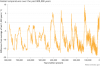
upload_2020-9-9_10-7-48.png

Heres a graph which shows my evidence, these massive spikes and drops are normal, however, as you can see the temperature started spiking a few thousand years ago and rapidly increasing due to human activity. The massive spike which happened about 20,000 years ago was definitely not human caused, if we go back, look at around the 460,000 mark, massive spike larger than our spike there. What is evident though is that if the world doesn't get their act together and convert to a more sustainable form of energy there are definitely going to be record spikes in the future.

I don't believe that humans caused this bout of climate change and neither do the statistics i'm showing, but just because humans didn't cause the problem it doesn't mean that humans aren't contributing over 90+% of that problem.

Like I said before it is human activity such as the enhanced greenhouse effect and the burning of fossil fuels which greatly accelerate an otherwise natural process.
 

Attachments

  • upload_2020-9-9_10-7-48.png
    upload_2020-9-9_10-7-48.png
    47.8 KB · Views: 34
:(

You really misinterpreted my point.

View attachment 456015

Heres a graph which shows my evidence, these massive spikes and drops are normal, however, as you can see the temperature started spiking a few thousand years ago and rapidly increasing due to human activity. The massive spike which happened about 20,000 years ago was definitely not human caused, if we go back, look at around the 460,000 mark, massive spike larger than our spike there. What is evident though is that if the world doesn't get their act together and convert to a more sustainable form of energy there are definitely going to be record spikes in the future.

I don't believe that humans caused this bout of climate change and neither do the statistics i'm showing, but just because humans didn't cause the problem it doesn't mean that humans aren't contributing over 90+% of that problem.

Like I said before it is human activity such as the enhanced greenhouse effect and the burning of fossil fuels which greatly accelerate an otherwise natural process.
I am sorry if I was a bit fierce in my previous post.:oops:

But I'm still not sure if accelerating is the right term.
203_co2-graph-061219.jpg

(Source: Evidence | Facts – Climate Change: Vital Signs of the Planet)
As you can see in this graph of the CO2-levels in the atmosphere (which matches your temperature graph pretty well), CO2-levels are already way higher than at the last spike in tempreature. It is not because we accelerated the process (carbon cycle), but we disrupted it. Nature always recovered from previous spikes in temperature/CO2, but it probably won't be able to recover from this unless humans undertake action. That's because the natural process of getting carbon out of the air is very slow, and cant be sped up. So while I agree that the (previous) oscillations in temperature and CO2 are natural, I do believe humans are the cause of disrupting this process by rapidly emitting CO2.
 
:(

You really misinterpreted my point.

View attachment 456015

Heres a graph which shows my evidence, these massive spikes and drops are normal, however, as you can see the temperature started spiking a few thousand years ago and rapidly increasing due to human activity. The massive spike which happened about 20,000 years ago was definitely not human caused, if we go back, look at around the 460,000 mark, massive spike larger than our spike there. What is evident though is that if the world doesn't get their act together and convert to a more sustainable form of energy there are definitely going to be record spikes in the future.

I don't believe that humans caused this bout of climate change and neither do the statistics i'm showing, but just because humans didn't cause the problem it doesn't mean that humans aren't contributing over 90+% of that problem.

Like I said before it is human activity such as the enhanced greenhouse effect and the burning of fossil fuels which greatly accelerate an otherwise natural process.
I am sorry if I was a bit fierce in my previous post.:oops:

But I'm still not sure if accelerating is the right term.
203_co2-graph-061219.jpg

(Source: Evidence | Facts – Climate Change: Vital Signs of the Planet)
As you can see in this graph of the CO2-levels in the atmosphere (which matches your temperature graph pretty well), CO2-levels are already way higher than at the last spike in tempreature. It is not because we accelerated the process (carbon cycle), but we disrupted it. Nature always recovered from previous spikes in temperature/CO2, but it probably won't be able to recover from this unless humans undertake action. That's because the natural process of getting carbon out of the air is very slow, and cant be sped up. So while I agree that the (previous) oscillations in temperature and CO2 are natural, I do believe humans are the cause of disrupting this process by rapidly emitting CO2.
Both of these graphs seem to come from reliable sources, yet are quite different. Why?
 
Both of these graphs seem to come from reliable sources, yet are quite different. Why?
I think they are quite similar, but the one posted by @Yoshistar888 is for the temperature and the one I posted is for the carbon dioxide in the atmosphere.
I think the only difference is the spike in CO2 that has recently happened, this doesn't yet show in the temperature graph. But I think it is because the temperature follows the CO2 but lags a bit. (if you just built a greenhouse it is also not immediately hot inside)
 
I think they are quite similar, but the one posted by @Yoshistar888 is for the temperature and the one I posted is for the carbon dioxide in the atmosphere.
I think the only difference is the spike in CO2 that has recently happened, this doesn't yet show in the temperature graph. But I think it is because the temperature follows the CO2 but lags a bit. (if you just built a greenhouse it is also not immediately hot inside)
Ah, okay.
 
@Ned and @Onychorhynchus coronatus did you guys ever end up watching these videos? If so, what did you think of them?

It was a while back but yes I did watch the one with Yanis and found it both interesting and I agree with his point about UBI but it doesnt take much to convince me on matters like that as I am already inclined towards socialism.

Actually strangely enough Yanis was the academic advisor of a close family member of mine while he was an undergraduate and he has only positive things to say about him.
 
I also watched them a while ago. Whilst they highlight the problems that economic growth cause I didn't think they offered a clear solution, just some vague notions. I did like the idea of the materials passport.
I've often wondered whether we should seek to have low energy economies. By this I mean that activities such as manufacturing and air travel are high energy whilst repairing things, buying second-hand, renting and services such as child minding use little energy. Perhaps we should think of the lowest energy solution to a problem for example, instead of trying to invent machines that capture CO2 from the atmosphere, plant trees.
 
I also watched them a while ago. Whilst they highlight the problems that economic growth cause I didn't think they offered a clear solution, just some vague notions. I did like the idea of the materials passport.
I've often wondered whether we should seek to have low energy economies. By this I mean that activities such as manufacturing and air travel are high energy whilst repairing things, buying second-hand, renting and services such as child minding use little energy. Perhaps we should think of the lowest energy solution to a problem for example, instead of trying to invent machines that capture CO2 from the atmosphere, plant trees.

Ah thank you for sharing your thoughts with us.
 
Here is another relevant article.

In Half-Earth Project, a full-on bid to get countries to protect biodiversity
  • Last year, the Half-Earth Project launched its “national report cards,” which show how much land is currently protected in each country, how many land vertebrate species (including endemics) each country holds, and how much and also which areas of land should be preserved to protect its biodiversity in the future.
  • Each country also receives a score based on several indicators, including the National Species Protection Index (SPI), which was generated by the Map of Life and endorsed by the Convention on Biological Diversity.
  • The team at the Half-Earth Project say the map and accompanying tools can be valuable resources for decision-makers trying to reach the objective of protecting 30% of land by 2030, although they argue that the ultimate goal should be protecting half of the Earth.
  • While supporters of the Half-Earth Project say achieving their goal benefits everyone, critics say a large number of people, particularly those living in poorer countries, could be adversely affected by such large-scale area-based protection.
  • As the world grapples with unparalleled rates of deforestation and extinction, an increasing number of governments and other entities are recognizing the importance of protecting 30% of the land and oceans by 2030. In fact, this goal is listed as a target in the first draft of the post-2020 global biodiversity framework published in July.

But is protecting 30% enough?

No, says quantitative ecologist Scott Rinnan of the E.O. Wilson Biodiversity Foundation’s Half-Earth Project. The ultimate goal, according to him, would be to preserve half of the Earth, which he says would be a sufficient area capable of preserving global biodiversity. However, he added that protecting 30% is a “worthwhile objective that we support on the way to half” and that the Half-Earth Project is able to help nations adopt a “coordinated approach to identifying the targets with positive outcomes for global biodiversity.”

The concept of protecting half of the world stems from E.O. Wilson’s Half-Earth:Our Planet’s Fight For Life
, a 2016 book that argues that protecting at least half of the planet would help preserve 80% of species and places the Earth in a “safe zone.” The Half-Earth Project provides an array of resources to help make this ambitious goal a reality, the backbone of which is the
Half-Earth Project Map, developed by the Map of Life Project at Yale University’s Center for Biodiversity and Global Change; the E.O. Wilson Biodiversity Foundation; science and technology company Vizzuality; and geographic information system company Esri.

https://news-mongabay-com.cdn.amppr...to-get-countries-to-protect-biodiversity/amp/
 
I know it’s been a while since this thread was commented on, but Survival International is opposed to the “30% by 2030” plan for reasons explained here:

Survival International launches campaign to stop “30x30” – “the biggest land grab in history”

Thank you for sharing this. I appreciate it. I disagree with Survival International as I believe protected areas should be a non-negotiable priority! There is a reason eminent domain laws exist and they have their place. The fact is thar over-population is also a major issue and we need to find ways to properly deal with that.
 
Back
Top