Rank these UK orangutan outdoor enclosures

Benosaurus

Well-Known Member
10+ year member
Blackpool
full


Chester (Bornean)
full


Chester (Sumatran)
full


Colchester
full


Dudley
full


Jersey
full


Monkey World
full


Paignton

Paignton's orangutan islands seem to be ever-changing, however I could find no recent photos of the large island the gallery. Although, I do believe this photo from 2018 is a close depiction of what it currently looks like. Please correct me if I am wrong.
full


Twycross
full


Wingham
full


- Please rank them from best (i.e. 1st position) to worst (i.e. 10th position).
- Remember this is a comparison of outdoor areas only.
- Where a zoo has multiple outdoor enclosure for their orangutans, I have included only the largest/best one to represent that zoo.
- Chester Zoo features twice due to having separate enclosures for Bornean and Sumatran orangutans. Monkey World also holds both Bornean and Sumatran orangutans, however I believe their 3 Sumatran orangs are all youngsters who live in the nursery group. Therefore, I have only included the Bornean orangutan enclosure for Monkey World.
- Of course places like Twycross and Paignton are due to have new or revamped enclosures in the coming years, so this is merely a comparison of these enclosures as it stands in 2022.

My list is as follows:

1. Monkey World (best).
2. Jersey.
3. Dudley.
4. Chester (Bornean).
5. Chester (Sumatran).
6. Wingham.
7. Paignton (if the above picture is an accurate representation then I reluctantly have to knock Paignton down several places due to the severe lack of climbing opportunities).
8. Twycross.
9. Blackpool.
10. Colchester (worst).

The factors I have used to decide the order of my list is (i) The size, complexity and usability of the climbing structures, (ii) the amount of natural vegetation, and (iii) the size of the enclosure.
 
  • Like
Reactions: TNT
1. Monkey World
2. Dudley
3. Chester Bornean
4. Jersey
5. Chester Sumatran
6. Wingham
7. Paignton
8. Colchester
9. Twycross
10. Blackpool

For me there’s a big gap between the top and bottom 5, I’m no expert but although Wingham’s exhibit is big there is almost no variety in the climbing structure, which surely holds back the natural climbing behaviours the apes can experience. Twycross and Blackpool’s exhibits are so small and lacking in privacy that I think they drop below Colchester, despite that enclosure’s lack of sunlight.
 
I'd suggest that just because an enclosure has a whole load of logs and ropes and tubes, doesn't mean it's the best of the lot. Orangutans tend to stick to the canopy, where the branch density is much lower and they are a lot higher up. I'd therefore think that both Chester exhibits should be at least higher up, if not two of the top three. The only exhibit that comes close is probably Jersey. But for me Chester's Bornean exhibit is possibly the best in Europe and definitely the country.
 
The factors I have used to decide the order of my list is (i) The size, complexity and usability of the climbing structures, (ii) the amount of natural vegetation, and (iii) the size of the enclosure.

So you naturally bumped your local zoo, Dudley, above both of Chester's, despite it having (i) significantly shorter climbing structures and (as far as I can tell) zero rope swings or hammocks, (ii) less vegetation and (iii) being less than half the overall size :p bearing in mind you've omitted some of the outdoor exhibits for both species.
 
So you naturally bumped your local zoo, Dudley, above both of Chester's, despite it having (i) significantly shorter climbing structures and (as far as I can tell) zero rope swings or hammocks, (ii) less vegetation and (iii) being less than half the overall size :p bearing in mind you've omitted some of the outdoor exhibits for both species.

Yes I think Dudley's climbing structures are way more complex, interesting and usable than both of Chester's linear structures, where it seems they can only go from telegraph pole to telegraph pole and back again (don't forget the concrete tree :D). This was the most important factor when deciding my list.

Both Chester's and Dudley's climbing structures are high (Dudley's has quite the elevation change). Yes Chester's Bornean one looks higher.

Dudley's does include a couple of hammocks and large nets (Chester's Sumatran enclosure doesn't appear to contain any). Dudley's also has loads of ropes to swing on.

Yes Chester's Bornean enclosure has more vegetation, but it's all quite low and doesn't exactly envelop the climbing structures. It's no Jersey or peak Paignton.

Both Dudley's and Chester's are good sizes. Obviously Chester's are much larger however. Although it's not like Chester's climbing structures cover a large proportion of its floor area (Dudley's does). Orangs being arboreal not terrestrial.

Chester's Bornean enclosure could move above Dudley's in my list if the size, height and vegetation had more weight, but definitely not the Sumatran one for me.

It's just my opinion however. Don't worry about it, it's not the law :p. Please share your own list.

I stated above that I was using the best enclosure to represent each zoo (i.e. the best each zoo has to offer), otherwise the lists would be huge if you wanted to compare every single little secondary enclosure. Should I have included stuff like this for Chester and compared it to Monkey World's for example?

I'd suggest that just because an enclosure has a whole load of logs and ropes and tubes, doesn't mean it's the best of the lot. Orangutans tend to stick to the canopy, where the branch density is much lower and they are a lot higher up. I'd therefore think that both Chester exhibits should be at least higher up, if not two of the top three. The only exhibit that comes close is probably Jersey. But for me Chester's Bornean exhibit is possibly the best in Europe and definitely the country

I think captivity and the wild are completely different. I believe captive orangs need much more interesting, complicated, stimulating enclosures to keep them from getting bored; these are after all intelligent animals. Again just my opinion.
 
Last edited:
I think captivity and the wild are completely different. I believe captive orangs need much more interesting, complicated, stimulating enclosures to keep them from getting bored; these are after all intelligent animals. Again just my opinion.
Indeed a zoo enclosure is not a forest.
But why would we assume that a very crowded climbing traffic interchange is motivating to an orang (or anyone else?). The animals in the (hideous) MonkeyWorld or Dudley enclosures have no reason to navigate that mess of hoses and logs. It looks like it could afford choice to individuals of different ages and abilities but it does not create motivation.
The only method of evaluation I would respect is observed behavior at different hours, different seasons by different individuals.
What "looks good" t us is meaningless to them.
 
I would add that the structures with more poles tied together, structures that do not move at all, are the least attractive to orangs. Studies show that in the wild the animals evaluate trees by how they swing and so prefer some tree species to others.
The very child-safe jungle gyms may appear best to nervous humans but they offer nothing but occasional elevated easy chairs to arboreal orangs
 
For me the order would be:
Chester bornean
Monkey World
Chester sumatran
Jersey
Dudley
Blackpool
Paignton
Wingham
Colchester
Twycross
 
What Orangutans in zoos need more than anything is height- the ability to get high off the ground. For that reason I would rate Chester's as the best. Paignton used to be, but they have destroyed all the good trees leaving it as naturalistic but without very much climbing opportunity nowadays.

I'm not going to rate the others in any order, but with the exception of Jersey they are all very ugly and unsatisfactory. What most of them share are the solid heavy duty climbing poles & frames which are more suitable for species like bears or leopards than arboreal apes. Monkeyworld excels in this respect. I know captive orangs can be destructive but there has been generally little attempt to install facilities that will really allow high climbing( including swinging and brachiating) opportunities. I was also disappointed to see the photo of Wingham's new enclosure, as despite being netted most of the climbing structures are so low level. But Colchester's is still the worst IMO as the Orangutans have no views whatsoever outside the walls of their rather prison exercise yard-like enclosure.
 
Last edited:
Interestingly, only Chester, Jersey and Paington allow orangutans to disappear from each others view, and all offer very little protection from sun or rain.
 
Interestingly, only Chester, Jersey and Paington allow orangutans to disappear from each others view, and all offer very little protection from sun or rain.
I think it is worth pointing out that ranking outdoor exhibits may not be the best way to rate a zoo's orang husbandry and management. Protection from sun and rain out of doors does not matter too much if the apes also have access to indoor and off-show areas. I cannot comment on all these examples, but I do know that the orangs at Chester and Paignton do have such access throughout the day.
 
This is probably a daft question but is there a reason natural tall trees / replicated canopies aren’t grown and used in these sort of enclosures? Strength of branches not being enough or they eat and so destroy them? Long time to grow?

A couple of them have some trees in.

Wondered as even the good ones bear little resemblance to having a natural canopy. There’s no cover / rest space in most of them. So is it just tell telegraph poles replicate height and the frames are interesting to navigate and the whole thing lasts longer that makes the jungle gym style with optional plants dominate?

Hasn’t really occurred to me to ask before seeing them all compared so feel free to point and laugh at my ignorance :)
 
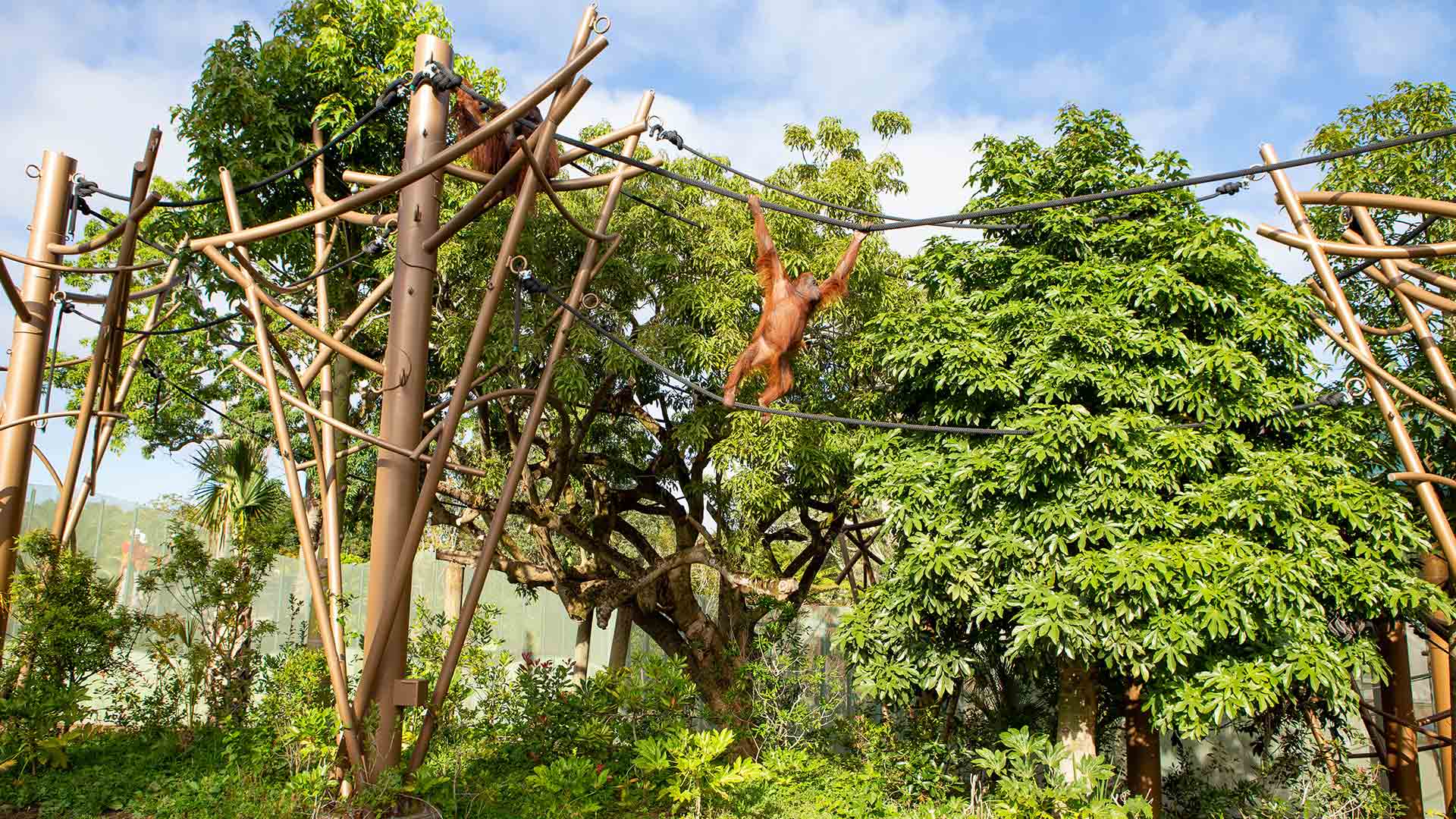
I cannot like this fashion of British zoos of making climbing structures of completely straight poles, all the same length, width and connected at the same angle. Of 10 exhibits, 8 look like a construction scaffold of an industrial building.

I think it is worth pointing out that ranking outdoor exhibits may not be the best way to rate a zoo's orang husbandry and management.

I fully agree. Important is said to be social environment, especially ability to get away. So two small enclosures can be better than one large. As well as manipulable elements and entertainment.

Protection from sun and rain out of doors does not matter too much if the apes also have access to indoor and off-show areas. I cannot comment on all these examples, but I do know that the orangs at Chester and Paignton do have such access throughout the day.

Zoo professionals complain that many great apes don't use expensive outdoor exhibits built for them and they don't know where the flaw is. Dislike of bright sun is thought to be one of the flaws. In Britain, protection from wind is likely more important.

A couple of them have some trees in.

Orangutans break branches and kill trees, especially because they make sleeping and resting nests. But this is not an excuse. Chester-Bornean, Jersey and Paington have bushes trying to grow into young trees. Wingham planted something. 6 remaining exhibits have mowed grass lawn.
 
Last edited:
I cannot like this fashion of British zoos of making climbing structures of completely straight poles, all the same length, width and connected at the same angle. Of 10 exhibits, 8 look like a construction scaffold of an industrial building.

That is what I dislike most about all these exhibits. I, and I think the Orangutans too, much prefer the indoor exhibits that have covered roofs that enable firehoses, plastic vines etc to be hung from them, and which the Orangutans will use to swing , whereas heavy poles are not really of any interest to them. Of the indoor areas, both Chester and Jersey in particular have the height and 'furniture' that allow for this.
 
Last edited:
Zoo professionals complain that many great apes don't use expensive outdoor exhibits built for them and they don't know where the flaw is. Dislike of bright sun is thought to be one of the flaws. In Britain, protection from wind is likely more important.


.

The flaw is that Great Apes, particularly gorillas, like overhead cover, which for them represents the security of forest canopy. Open outdoor exhibits represent clearings in the forest that wild gorillas venture into for shorter periods e.g. for feeding or travel, but then retreat back into the forest. Most gorilla exhibits have a smaller indoor area they prefer to use, and a huge outside area they don't. I often think the relative sizes would be better reversed! For Orangutans too- the indoor areas represent security and cover and usually, far superior climbing opportunities compared to their outside areas as equipment can be hung from cage ceilings etc. Swinging on fire hoses, and even better, hanging plastic vines, is far more natural for them than clambering along solid wooden poles. So again, they often prefer to be 'inside'. Weather conditions, shade, wind, rain are all other considerations too.
 
Last edited:
Orangutans break branches and kill trees, especially because they make sleeping and resting nests. But this is not an excuse. Chester-Bornean, Jersey and Paington have bushes trying to grow into young trees. Wingham planted something. 6 remaining exhibits have mowed grass lawn.

Jersey and Chester are examples where the pole-style solid frames have been masked with increasing foliage growth and present a much less ugly exhibit. Paignton's was almost completely naturalistic but the grove of tall live trees was eventually killed by the Orangutans and most of the dead wood lopped-off for safety, reducing them to tall stumps. So a great exhibit has become less so.
 
Interestingly, only Chester, Jersey and Paington allow orangutans to disappear from each others view, and all offer very little protection from sun or rain.
Certainly the Jersey Orangs have indoor access. However, I’ve seen them use Gunnera leaves as umbrellas/sunshades
 
In regard to Paignton, I believe this island is used primarily now.

New climbing frame for the Bornean orangutans, January 2022 - ZooChat

@Gigit are you able to confirm this, or even share a photo taken during the summer months? Thank you!
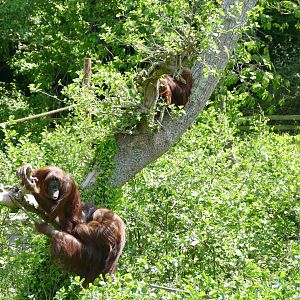
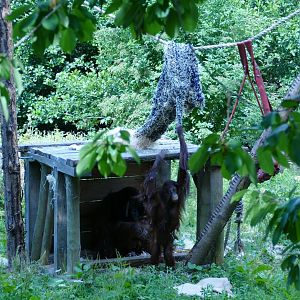
I've not taken many orang photos lately as they rarely provide good opportunities. I've noticed that male, Wousan, and female, Chinta, are often separated while Chinta's daughter, Natty, moves between them. Chinta tends to sit on the top platform just outside the house on the large island side while Wousan often sits in the little shelter next to the climbing frame (which is largely ignored). There is one tree on the large island which they can sit in.

I've just posted two photos of the shelter and the tree in the gallery.

Paignton's current orangs are not very adventurous so maybe don't miss the former climbing opportunities too much, but I think young Natty would enjoy some. They used to prefer crossing the water via the ropes rather than the bridges. The higher trees and ropes used to give Mali and Tatty a lot of fun particularly when combined with sheets which Tatty converted into swings. She even had many different ways of crossing the bridges. They made full use of the islands and were a joy to watch while they communed with Nature. To flog a dead horse again, they're now at Colchester where they're well cared for but have none of these opportunities and for that reason, I'd still place Colchester near or at the bottom of the list. It's been a few years since I visited any of them apart from Paignton and Colchester and I haven't seen Wingham or Dudley's new exhibit in the flesh.

 
Last edited:
  • Like
Reactions: TNT
Back
Top