Taronga Zoo Recent history of Taronga and developments etc

Taronga Zoo basic timeline 1969-1999 so far.pdf

Still very very preliminary draft, lots missing

Thanks very much!

Here is a list of animals and the last year they were at the zoo, that I can find:

*Ground Cuscus (Phalanger gymnotis) – until 1997
*Spotted Cuscus (Spilocuscus maculatus) – until 1980s
*Grey Dorcopsis Wallaby (Dorcopsis luctuosa) – until 1990s

*Greater Tree Shrew (Tupaia glis) – until 2008

*Northern Red-fronted Lemur (Eulemur rufus) – post 1991
*Golden Lion Tamarin (Leontopithecus rosalia) – until 2003
*Emperor Tamarin (Saguinus imperator) – 1990s
*Common Squirrel Monkey (Saimiri sciureus) – until at least 2007
*Black-capped Capuchin (Sapajus (Cebus) apella) – post 1991
*Geoffroy's (Black-handed) Spider Monkey (Ateles geoffroyi) – until at least 2007
*Patas Monkey (Erythrocebus patas) – until 1990
*De Brazza’s Monkey (Cercopithecus neglectus) – until at least 2008
*Mandrill (Mandrillus sphinx) – until 2000s
*Crab-eating Macaque (Macaca fascicularis) – until 1999
*White-cheeked Gibbon (Nomascus leucogenys) - 2023
*White-handed (Lar) Gibbon (Hylobates lar) – post 1991
*Silvery (Javan) Gibbon (Hylobates moloch) – until 2009
*Muller's (Bornean) Gibbon (Hylobates muelleri) – until 2015
*Bornean Orangutan (Pongo pygmaeus) – until 2001
*Sumatran Orangutan (Pongo abelii) – until 2007
*Hybrid Orangutan (Pongo pygmaeus X Pongo abelii) – until 2018

*Giant Anteater (Myrmecophaga tridactyla) – until 1970s

*Indian Crested Porcupine (Hystrix indica) – until 2007
*Northern Palm Squirrel (Funambulus pennantii) – until 2010s
*Coypu (Myocastor coypus) – until 1960s
*Brazilian Agouti (Dasyprocta leporina) – until 2016

*Asian Lion (Panthera leo persica) ––until 1970s, Hybrids in 1990s
*Bengal/Generic Tigers (Panthera tigris) – until 2000
*Snow Leopard (Panthera uncia) – until 2015
*Jaguar (Panthera onca) – until 1996
*Clouded Leopard (Neofelis nebulosa) – until 2005
*Cheetah (Acinonyx jubatus) – until 2001
*Puma (Puma concolor) – until 1991
*Caracal (Caracal caracal) – until 1990s
*Serval (Leptailurus serval) – 1990s
*Asiatic Golden Cat (Catopuma temminckii) – until 2008
*Bobcat (Lynx rufus) – until 1990s
*Jaguarundi (Puma yagouaroundi) – until 1980s

*Polar Bear (Ursus maritimus) – until 1984
*Kodiak Bear (Ursus arctos middendorffi) – until 2012
*American Black Bear (Ursus americanus) – until 1992
*Asian Black Bear (Ursus thibetanus) – until 1980s or 1990s
*Giant Panda (Ailuropoda melanoleuca) – 1988

*New Guinea Singing Dog (Canis familiaris hallstromi) – until 1980s
*Black-backed Jackal (Canis mesomelas) – until 1980s
*Dhole (Cuon alpinus) – until 2015
*African Wild Dog (Lycaon pictus) – until 1980s
*Raccoon Dog (Tanuki) (Nyctereutes procyonoides) – until 1980s

*Southern Elephant Seal (Mirounga leonine) – until 1996
*Pacific Harbour Seal (Phoca vitulina richardii) – until 1990s

*African Elephant (Loxodonta africana) – until 1979

*Brazilian Tapir (Tapirus terrestris) – until 2015
*Malayan Tapir (Tapirus indicus) – until 2015
*Southern White Rhinoceros (Ceratotherium simum) – until 1980s, then in 2002/03
*Black Rhinoceros (Diceros bicornis) – until 1991, then in 2004-06
*Indian Rhinoceros (Rhinoceros unicornis) – 2002, 2006-07

*Spotted Deer (Chital) (Axis axis) – until 2017
*Pere David's Deer (Elaphurus davidianus) – until 1977
*Lowland Anoa (Bubalus depressicornis) – 1979
*Domestic Water Buffalo (Bubalus bubalis) – post 1994
*Barbary Sheep (Aoudad) (Ammotragus lervia) – until 2017
*Himalayan Tahr (Hemitragus jemlahicus) – until 2016
*Sitatunga (Tragelaphus spekii) – post 1994
*Scimitar-horned Oryx (Oryx dammah) – until 2005ish
*Blue/Common wildebeest/Brindled gnu (Connochaetes taurinus) – until 1977
*Collared Peccary (Pecari tajacu) – until 2007
*Wild boar (Sus scrofa) – 1980s
*Common Hippopotamus (Hippopotamus amphibius) – until 1992

Feel free to add to this list or correct me if I'm wrong.
 
Digitising my late Grandmother's super 8 films, and found what looks like Taronga Zoo, footage is from 1961. These are the final shots of the film reel so hopefully she loaded new film for the remainder of the zoo visit and it might show up as I continue to digitise the reels.
 
Digitising my late Grandmother's super 8 films, and found what looks like Taronga Zoo, footage is from 1961.
The enclosures for the alligator and eland certainly look like what I remember of Taronga in the '70's. Hopefully you'll find another reel with more concrete evidence (like a harbour view or the elephant temple, floral clock or monkey pits).

:p

Hix
 
Digitising my late Grandmother's super 8 films, and found what looks like Taronga Zoo, footage is from 1961. These are the final shots of the film reel so hopefully she loaded new film for the remainder of the zoo visit and it might show up as I continue to digitise the reels.

Thanks so much for sharing

@decat

Wow getting to see your list you put together its really impressive
 
Keith died in 1990. He was imported from Indonesia in 1963 - along with a female who died of septicaemia in 1967. They arrived thanks to political lobbying by Sir Edward Hallstrom.

Tuka was Keith’s replacement, imported from Ragunan Zoo in 1991, where he’d been captured as a juvenile in 1983. He died in 2015.

It’s unclear when Tuka’s mate arrived - but I’d assume the late 80’s to early 90’s. It was mentioned they had a female when Tuka arrived.

source: Sir Edward Hallstrom with Komodo Dragons 1.1 at Taronga Zooin 1960s.jpg & 100 years of Sydney's Taronga zoo – in pictures (←this the primary source, and has many brilliant other photos of Taronga over the last 100+ years; highly recommend looking at if anyone hasn't seen already)
u6xzo6%2Fpreview%2F64137741%2Fmain_large.jpg
 
Last edited:
@Osedax thanks man, yeah was surprising mix hey

thought this was interesting too:

Zoo02b.jpg

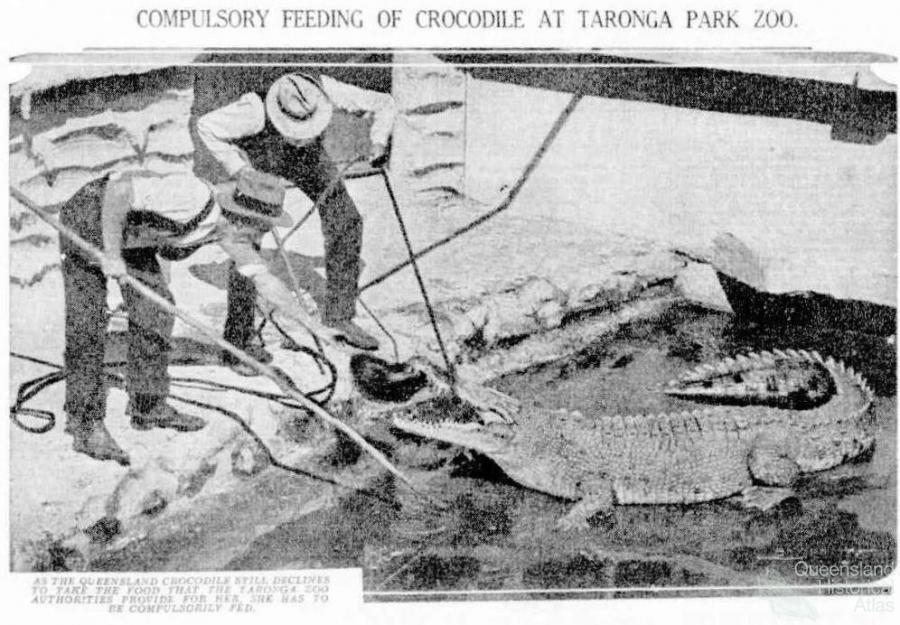
''Compulsory feeding of crocodile at Taronga Park Zoo, 1934. This specimen was shipped from Mount St John to Taronga Park, where it refused to eat and was forcibly fed by propping its jaws open with long wooden poles. Sydney Morning Herald, 4 May 1934, p.12''

sources: Compulsory feeding of crocodile at Taronga Park Zoo, 1934 & Townsville’s Mount St John Zoo

''In October 1932, even before officially opening his zoo (Mt St John Zoo Townsville), he (John Edmund Robinson a.k.a 'St John' Robinson) swapped a stuffed crocodile for a pair of white swans from Taronga Zoological Park in Sydney. In 1934 he sent Taronga a live sixteen-foot crocodile, captured in the Bohle River, and followed it with other live crocodiles sent to Taronga and the Melbourne Zoo during the 1930s and 1940s. In return he received a steady stream of animals including water fowl, ostriches, emus, antelope, monkeys, a giant tortoise, a zebra and an American alligator, pedantically referred to as the ‘real’ alligator to distinguish it from the Australian saurians.''
 
Last edited:
Have personally been wondering for many years when Taronga did last have (P.pardus) Leopards, only had rough idea (late 1980s/early 1990s), got a nice email reply from the zoo just now saying they last held Leopards in 1987. The email (I should have asked for name(s), gender(s) {belive last two individuals at the zoo were two females 0.2 though thanks to Hix's knowledge}, age, date of birth(s), arrival(s) & death(s) etc but was just hoping for a reply in general which they did do and elaborated in a different way) so thought would share it here:

'' Taronga has held species such as leopards and jaguars until 1987 and 1996 respectively, snow leopards were cared for recently up until 2015. At Taronga we have dedicated our focus for big cats toward African lions and Sumatran tigers. We have taken the approach we would rather do these species well and invest heavily in large, complex habitats that support best welfare rather than many species with smaller enclosures.''
 
Have personally been wondering for many years when Taronga did last have (P.pardus) Leopards, only had rough idea (late 1980s/early 1990s), got a nice email reply from the zoo just now saying they last held Leopards in 1987. The email (I should have asked for name(s), gender(s) {belive last two individuals at the zoo were two females 0.2 though thanks to Hix's knowledge}, age, date of birth(s), arrival(s) & death(s) etc but was just hoping for a reply in general which they did do and elaborated in a different way) so thought would share it here:

'' Taronga has held species such as leopards and jaguars until 1987 and 1996 respectively, snow leopards were cared for recently up until 2015. At Taronga we have dedicated our focus for big cats toward African lions and Sumatran tigers. We have taken the approach we would rather do these species well and invest heavily in large, complex habitats that support best welfare rather than many species with smaller enclosures.''

Thanks for sharing @steveroberts.

The history of leopards across our region’s zoos over the past century is fascinating, with a number of observable trends:

Initially, a number of zoos in the region imported wild born leopards (predominantly of the Indian subspecies) throughout the early to mid twentieth century, with reasonable breeding success by the mid twentieth century. Auckland Zoo bred a number of leopards and supplied Melbourne Zoo with a male named Kim in 1962.

In 1967, Auckland Zoo imported black leopard cubs from the US, which subsequently bred; and I suspect (I’m open to correction) that Australian zoos such as Melbourne, which also held melanistic leopards towards the end of the twentieth century imported from Auckland. This may have also been the case for Taronga regarding melanistic specimens. Melanism is more prevalent in the Indian and Indochinese subspecies, but I’m unsure if the melanistic leopards in the region were purebred by the late 20th century, when captive breeding had replaced importing from the wild and hybridisation would have inevitably occurred.

This uncertainty around purebred status may be why the zoos who continued with leopard chose to acquire the purebred Persian leopard (echoing the phase out of generic tigers across the region’s main zoos in favour of purebred Sumatrans).

Fast forward to the present day and we have the purebred Sri Lankan leopard in the region.
 
That’s interesting to know @steveroberts. From what I’ve researched, a number of zoos in the region imported and bred leopards (predominantly of the Indian subspecies) throughout the early to mid twentieth century.

In 1967, Auckland Zoo imported black leopard cubs from the US, which subsequently bred; and I suspect (I’m open to correction) that Australian zoos such as Melbourne, which also held melanistic leopards towards the end of the twentieth century imported from Auckland. This may have also been the case for Taronga regarding melanistic specimens. Auckland Zoo bred a number of leopards and had supplied Melbourne Zoo with a golden male named Kim in 1962. Melanism is more prevalent in the Indian and Indochinese subspecies, but I’m unsure if the melanistic leopards in the region were purebred by the late 20th century, when captive breeding had replaced importing from the wild and hybridisation would have inevitably occurred.

This uncertainty may be why those zoos who continued with leopard chose to acquire the purebred Persian leopard (echoing the phase out of generic tigers across the region’s main zoos in favour of purebred Sumatrans). Of course today, we have the purebred Sri Lankan leopard in the region.

Cheers man, I imagine a lot of the Leopards in Australia in 20th century came from south and south-east Asia (can imagine too a higher number {than proportionately in the wild} of melanistic Leopards due to their coloration came to Australia and New Zealand back in the day (via circuses when not imported directly by zoos, sometimes imported from other zoos overseas too but again am sure melanistic individual Leopards were a significant percentage of). Thanks for the background info on Auckland and Melbourne with their Leopards too. Yeah come the mid 1980s both Adelaide and Perth were doing well with their Persian Leopards (and Melbourne would join them with a bit later but in the meantime was holding Leopards of unknown or mixed sbsp origins like Taronga was and Alma Park with Puss the Leopard til '01, and believe the notorious private Notre Dame Zoo of Emmanuel Margolin had some Leopards too until mid '90s).

Hey btw this was a fantastic find you found on youtube few years back with not only Taronga's Chimpanzees back then in January 1995, but a rare glimpse of Tuka staring at visitors near the front of his old exhibit only two months away from being walked down to his new 'digs' at Serpentaria, aswell as a rare video footage glimpse of Chester again (he must have only recently returned from Dubbo seeing as think Kemari had his exhibit just before), aswell as one of the Alligators, the Giraffes, Cottontops', Black-necked storks, Pelicans, Red kangaroo, Barbary sheeps, Zebras, Aldabra tortoise and B+Y macaw & Scarlet macaw together:

Starts at: 8:16 and ends at 10:46 :


also in same video from 4:30 to 5:40 is the Australian Reptile Park's 'Reptiles Alive' centre they established either next to or at the base of Centrepoint Tower in Sydney cbd from 1990-1995 (so this would be just before it closed), it was like a mini completely indoor version of the ARP and apparently was very popular. Personally was a young kid and newbie to Sydney at the time, unfortunately never went there or knew about it, read about it in @Kevin Markwell 's excellent biography of the park with Nancy Cushing.
 
Last edited:
Cheers man, I imagine a lot of the Leopards in Australia in 20th century came from south and south-east Asia (can imagine too a higher number {than proportionately in the wild} of melanistic Leopards due to their coloration came to Australia and New Zealand back in the day (via circuses when not imported directly by zoos, sometimes imported from other zoos overseas too but again am sure melanistic individual Leopards were a significant percentage of). Thanks for the background info on Auckland and Melbourne with their Leopards too. Yeah come the mid 1980s both Adelaide and Perth were doing well with their Persian Leopards (and Melbourne would join them with a bit later but in the meantime was holding Leopards of unknown or mixed sbsp origins like Taronga was and Alma Park with Puss the Leopard til '01, and believe the notorious private Notre Dame Zoo of Emmanuel Margolin had some Leopards too until mid '90s).

Hey btw this was a fantastic find you found on youtube few years back with not only Taronga's Chimpanzees back then in January 1995, but a rare glimpse of Tuka staring at visitors near the front of his old exhibit only two months away from being walked down to his new 'digs' at Serpentaria, aswell as a rare video footage glimpse of Chester again (he must have only recently returned from Dubbo seeing as think Kemari had his exhibit just before), aswell as one of the Alligators, the Giraffes, Cottontops', Black-necked storks, Pelicans, Red kangaroo, Barbary sheeps, Zebras, Aldabra tortoise and B+Y macaw & Scarlet macaw together

Starts at: 8:16 and ends at 10:46


It was great see that video again, in particular the shot of Lisa the chimpanzee with an infant Lubutu. Her eldest offspring Lobo would have been offscreen somewhere, tragically passing away a year later after drowning in the exhibit moat. Interestingly, Lisa initially rejected him, but with the staff’s perseverance, he was returned to her within days and she went on to become a model mother to him and her subsequent infants. Apparently her own mother Lulu was neglectful to her last infant and particularly struggled with her ill-fated twins; but I suspect Lisa’s momentary lapse could have been medical related (which is known to affect the maternal bond in great apes), albeit a minor medical issue or even exhaustion from a difficult labour.

Since the turn of the century (especially since 2010), everything regarding zoos (from exhibits to species and individuals held there) is so well documented online, it’s not hard to pull up a photo of an individual or exhibit at a moments notice. Conversely, it’s a lot harder to find information prior to that era, so it’s always nice to see old videos which have thrown up the most unexpected answers (and questions) on here - the most recent being the Syrian bears at Melbourne.
 
Have personally been wondering for many years when Taronga did last have (P.pardus) Leopards, only had rough idea (late 1980s/early 1990s), got a nice email reply from the zoo just now saying they last held Leopards in 1987. The email (I should have asked for name(s), gender(s) {belive last two individuals at the zoo were two females 0.2 though thanks to Hix's knowledge}, age, date of birth(s), arrival(s) & death(s) etc but was just hoping for a reply in general which they did do and elaborated in a different way) so thought would share it here:

'' Taronga has held species such as leopards and jaguars until 1987 and 1996 respectively, snow leopards were cared for recently up until 2015. At Taronga we have dedicated our focus for big cats toward African lions and Sumatran tigers. We have taken the approach we would rather do these species well and invest heavily in large, complex habitats that support best welfare rather than many species with smaller enclosures.''
I assume those were generic leopards who were last held up until 1987. And the last Jaguar passing in 1996 also makes sense; they used to have a breeding pair who mothered Melbourne's last female.

To your interest, Taronga also recently held Clouded Leopards up until 2005 ish. They were apparently a sibling pair. The female was sent to Melbourne following her brother's passing and she passed their fourteen years ago.
 
I assume those were generic leopards who were last held up until 1987. And the last Jaguar passing in 1996 also makes sense; they used to have a breeding pair who mothered Melbourne's last female.

To your interest, Taronga also recently held Clouded Leopards up until 2005 ish. They were apparently a sibling pair. The female was sent to Melbourne following her brother's passing and she passed their fourteen years ago.

The Jaguar that Taronga Zoo sent to Melbourne Zoo was named Maya and was actually a male. I long assumed Maya was a female due to his name! Maya and his mate, Muana (who came from Budapest Zoo) were indeed Melbourne Zoo’s last Jaguar. Maya was born at Taronga Zoo in 1987 and was sent to Melbourne Zoo in 1989. His parents were Ali (melanistic) and Wendy (golden). They also had a son named Quito in 1984, who like Ali and Maya, was melanistic. After Wendy’s death, Taronga received a female named Jacunda from Melbourne Zoo in 1988. She was transferred to Adelaide Zoo in 1992, leaving Taronga Zoo with Ali.

The Clouded leopard were both born 1990, but were an unrelated pair. The male (Samar) was born 18/07/1990; and the female (Nonah) was born a month prior on 17/06/1990. Samar died at Taronga Zoo in 2004; a year after Nonah was transferred to Melbourne Zoo in 2003, where she died 2008.
 
I'm really glad Nonah had a decent five years at Melbourne. Was nice to have her (and Samar) in Australia for 10 and 14 years respectively hey (and now WCCC is incredible with their Cloudies', with adorable Mirri, probably soon of to Europe thanks @Tigergal for sharing that, and sounds like Moana & Mark will have more cubs very soon too hopefully).

Btw with Ali the Jaguar, personally remember last seeing him in late 1995, he died in July 1996 but know there was a period of time where his exhibit and the Squirrel monkeys one next to his were knocked down to create the Malayan tapirs exhibit for Berani's (and Denise's albeit 2 years later) arrival in mid '96**, so not sure when Ali was taken boh for his final months except am certain that is what happened (am sure he was probably still on display in early 1996, what can say though is when visited Taronga again on my 7th birthday in March '96, I dont remember seeing Ali, but the thing is I cant remember if that was because he was having an illusive day of non-showiness to visitors or if he was no longer on public-dipslay and the area was under renovation - that unfortunately is gone from memory..but definitely remember seeing him still in late '95.

**it is possible Ali was moved to the adjacen-to-Waterhole cat pit exhibit for his last month as Kutch the Lion left for Dubbo again on 13 June '96 until returning 23 Sep '96.. but if that was the case Ali would have only been back in that exhibit for a month or less.

It’s fitting that Taronga Zoo’s Clouded leopard (the first in Australia) were imported in 1994; while 30 years later in 2024 was when Australia’s first Clouded leopard was born. I love coincidences like that such as reports Taronga Zoo (the first zoo in Australia to hold Komodo dragon) were to receive a Komodo dragon from the first clutch to hatch in Australia (albeit this never eventuated, with one of them instead going to Cairns); or Monarto Safari Park acquiring elephants in 2024, 30 years after the death of Samorn in 1994.

Taronga did intend to breed Clouded leopard, but they were imported as adults and the male demonstrated aggression to the female, hindering introductions. Husbandry has come a long way since and pairing as juveniles or at least adolescents as discussed in the WCCC thread is widely recognised as best practice.
 
The Jaguar that Taronga Zoo sent to Melbourne Zoo was named Maya and was actually a male. I long assumed Maya was a female due to his name! Maya and his mate, Muana (who came from Budapest Zoo) were indeed Melbourne Zoo’s last Jaguar. Maya was born at Taronga Zoo in 1987 and was sent to Melbourne Zoo in 1989. His parents were Ali (melanistic) and Wendy (golden). They also had a son named Quito in 1984, who like Ali and Maya, was melanistic. After Wendy’s death, Taronga received a female named Jacunda from Melbourne Zoo in 1988. She was transferred to Adelaide Zoo in 1992, leaving Taronga Zoo with Ali.

The Clouded leopard were both born 1990, but were an unrelated pair. The male (Samar) was born 18/07/1990; and the female (Nonah) was born a month prior on 17/06/1990. Samar died at Taronga Zoo in 2004; a year after Nonah was transferred to Melbourne Zoo in 2003, where she died 2008.
Wow that's really interesting to know! It seems we weren't the only ones as a lot of older posts by members from years back all seem to reference 'Maya' as a female.:D

Nonah spent her last years in the Small Cat Row which were quite small exhibits - however from all accounts she enjoyed her last years here. Most of the enclosures provided great privacy; being more deep than the Big Cat cages and therefore a lot of positive breeding results were achieved here over the years.
 
Wow that's really interesting to know! It seems we weren't the only ones as a lot of older posts by members from years back all seem to reference 'Maya' as a female.:D

Nonah spent her last years in the Small Cat Row which were quite small exhibits - however from all accounts she enjoyed her last years here. Most of the enclosures provided great privacy; being more deep than the Big Cat cages and therefore a lot of positive breeding results were achieved here over the years.

Maya is an interesting name all round as it has multiple meanings across multiple cultures. It’s a Sanskrit name meaning ‘dream’ as well as a Hindu goddess. It’s also a Māori name meaning courage and may have been the inspiration for Auckland Zoo’s female red panda Maya (1997), given her older sister, Reka (1995) was also given a Māori name, which I thought was fitting since they were New Zealand’s first red panda cubs.

In this case, we can assume the Jaguar was named Maya in reference to the Mayan civilisation of South America.

——————————————

Taronga Zoo - Jaguar History

Taronga Zoo’s last breeding pair were:

1.0 Ali (born 1978 at Rotterdam Zoo; arrived January 1979)
0.1 Wendy (born 1975 at Auckland Zoo; arrived June 1975)

Ali and Wendy had two litters:

Litter One:

1.0 Quito
Born at Taronga Zoo 24/05/1984
Sent to Ponderosa Fauna Park 23/09/1985 (fate unknown)

Litter Two:

1.0 Maya
Born at Taronga Zoo 28/09/1987
Sent to Melbourne Zoo 01/03/1989 (died 2008)

After Wendy died in 1988, a new female was imported from Melbourne Zoo:

0.1 Jacunda
Born at Melbourne Zoo 24/01/1981
Arrived at Taronga Zoo 01/12/1988
Sent to Adelaide Zoo 11/11/1992 (died 2003)

Jacunda never bred at Taronga Zoo.

Ali was the last Jaguar at Taronga Zoo and died in 1996.

——————————————

Quito (1984) and Maya (1987) were notable as the last Jaguar cubs born at Taronga Zoo; and the first surviving cubs of their species since 1958.

Photo of Quito:

The Taronga Zoo News Release read ... Announcing the birth of a... News Photo - Getty Images

Photo of Maya:

The new baby Jaguar at Taronga Zoo Maya., Mother Wendy. December 9,... News Photo - Getty Images
 

Great video. The elephant is Sarina, who was wild born in 1933 and lived at Taronga Zoo from 1938-1971. There’s a great story about her in Darill Clements Postcards from the Zoo, about how her keeper would walk her around the zoo at the end of each day (after she was finished giving rides), stopping at the kiosk where the staff would feed her one of the unsold current buns from that day. Somedays, they’d arrive after the kiosk was closed and on those occasions, he would have considerable trouble persuading her to move on.

That pinniped exhibit was phenomenal, especially for that era. It would have undoubtedly been the best in the region imo.
 
Back
Top