Remembering Dead Animals in Zoos

Why not the dog/pets?
Because the dog is a pet, in some cases a member of the family and loved in different way to animals you breed at home as a 'hobby' or zoo animals.
Some people have their pets 'stuffed' simply because they were loved.
Done well (or badly) it is a long-winded and expensive procedure; and I presume whoever had my Grandmothers Chihuahuas done must have considered them very special.
Please also remember that the animal is not actually being stuffed, but its skin is mounted on an entirely artificial frame, and there is comparatively little of the original carcass involved.
 
Some people have their pets 'stuffed' simply because they were loved.
Done well (or badly) it is a long-winded and expensive procedure; and I presume whoever had my Grandmothers Chihuahuas done must have considered them very special.
Please also remember that the animal is not actually being stuffed, but its skin is mounted on an entirely artificial frame, and there is comparatively little of the original carcass involved.

I must say, I have not in my time come across people having a pet dog stuffed, until I read your family experiences!. I guess this was around 80 -100 years ago? Quite a long time and not practised now, or very rarely.
I used the term 'stuffed' for ease, I roughly know what occurs in the taxidermy process. I have two barn owls, a jay and a sparrow hawk, which I inherited from my grandmother ironically!. One owl is excellent (including the eyes), the other a little less attractive. All 4 in glass domes with a countryside/woodland display theme.
PS- I am on the lookout for an English mirror carp in a glass case also...
 
I must say, I have not in my time come across people having a pet dog stuffed, until I read your family experiences!. I guess this was around 80 -100 years ago? Quite a long time and not practised now, or very rarely.
I used the term 'stuffed' for ease, I roughly know what occurs in the taxidermy process. I have two barn owls, a jay and a sparrow hawk, which I inherited from my grandmother ironically!. One owl is excellent (including the eyes), the other a little less attractive. All 4 in glass domes with a countryside/woodland display theme.
PS- I am on the lookout for an English mirror carp in a glass case also...
Yes it was very fashionable in Victorian times, but the ones I remember in my grand-parents house were all hidden or in cupboards, as they were obviously out of fashion by the time I was a child. All of the others they had were birds. I remember 2 cases, one with some mixed song-birds of which I only recall a Silver-beaked Tanager, and one huge case maybe 8 feet across with a full grown Mute Swan with its wings outstretched, surrounded by wetland birds, including a Bittern, Kingfishers and Bearded Tits. I presume they were thrown out when the house changed hands over the generations. Someone further back in the family, perhaps the owner of the Chihuahuas, must have been 'into it'! My wife's parents had a few including an almost totally white English Partridge which had a sticker saying 'Harrods Taxidermy Department' on the back of its case. It had been shot on a family shoot and had been done because it was so unusual/special which was the commonest reason for a commission.
 
Yes it was very fashionable in Victorian times, but the ones I remember in my grand-parents house were all hidden or in cupboards, as they were obviously out of fashion by the time I was a child. All of the others they had were birds. I remember 2 cases, one with some mixed song-birds of which I only recall a Silver-beaked Tanager, and one huge case maybe 8 feet across with a full grown Mute Swan with its wings outstretched, surrounded by wetland birds, including a Bittern, Kingfishers and Bearded Tits. I presume they were thrown out when the house changed hands over the generations. Someone further back in the family, perhaps the owner of the Chihuahuas, must have been 'into it'! My wife's parents had a few including an almost totally white English Partridge which had a sticker saying 'Harrods Taxidermy Department' on the back of its case. It had been shot on a family shoot and had been done because it was so unusual/special which was the commonest reason for a commission.
When I was a child I remember there was a ' stuffed' (taxidermied) dog in the waiting room of Bournemouth railway station. I cannot remember its significance but its presence cast a rather eerie effect, as although I was already a regular to mammal galleries in museums, I hadn't come across stuffed dogs before. Of course a visit to Tring later revealed a whole gallery of them, devoted to the various breeds. The mounts are all old and compared to the 'improvements' created in their modern versions, some are hard to recognise.
 
When I was a child I remember there was a ' stuffed' (taxidermied) dog in the waiting room of Bournemouth railway station. I cannot remember its significance but its presence cast a rather eerie effect, as although I was already a regular to mammal galleries in museums, I hadn't come across stuffed dogs before. Of course a visit to Tring later revealed a whole gallery of them, devoted to the various breeds. The mounts are all old and compared to the 'improvements' created in their modern versions, some are hard to recognise.

There is a famous stuffed dog from Victorian times on display on a railway station platform at the train station of Slough just outside of London.
 
There is a famous stuffed dog from Victorian times on display on a railway station platform at the train station of Slough just outside of London.
I wonder what the connection between railways and dogs is then. The Bournemouth one was obviously a Victorian-era one also- it may also have been on the platform rather than in the waiting room- memory fails me exactly there.
 
I wonder what the connection between railways and dogs is then. The Bournemouth one was obviously a Victorian-era one also- it may also have been on the platform rather than in the waiting room- memory fails me exactly there.

I think it was probably a combination of these animals being popular or famous station pets and the Victorian love of taxidermy.

The steam train and railways facilitating the increased movement of people all around the country would have probably made many of these animals famous to crowds.

It wouldn't suprise me if there are several examples of these across the UK and Ireland and probably throughout Europe.
 
I wonder what the connection between railways and dogs is then.
Continuing with this digression from zoo animals.....

In addition to the stuffed dogs, already mentioned, at Bournemouth and Slough railway stations, I remember when there was a stuffed dog in a glass case on one of the platforms at Wimbledon station.

And I know there were once similar examples at several other railway stations too including Brighton station and London's Waterloo station.

In most (probably all?) instances these stuffed dogs were accompanied by a collecting box to raise money for charity.
 
I wonder what the connection between railways and dogs is then. The Bournemouth one was obviously a Victorian-era one also- it may also have been on the platform rather than in the waiting room- memory fails me exactly there.

As @Tim May has mentioned, these station dogs were often associated with charitable collections. In life, the Slough dog 'Station Jim', carried around a little moneybox on his back for travellers to make a charitable donation to the Great Western Railway Widows and Orphans fund. When he died, he was mounted and placed in the station, along with his moneybox, to continue his charitable work.

Station Jim
 
As @Tim May has mentioned, these station dogs were often associated with charitable collections. In life, the Slough dog 'Station Jim', carried around a little moneybox on his back for travellers to make a charitable donation to the Great Western Railway Widows and Orphans fund. When he died, he was mounted and placed in the station, along with his moneybox, to continue his charitable work.

Station Jim
Pretty sure the Bournemouth one had a similar connection with something charitable, now I think of it.
 
Thinking Outside the Box

I’m always interested to see alternatives to the usual statues, plaques and taxidermy. Some alternatives I’ve seen:

Auckland Zoo have a plaza named after the Indian elephant Jamuna, who lived at the zoo from 1923 until her death in 1965. They also held a memorial service for another elephant, Kashin, who died in 2009.

Auckland and Wellington Zoo have renovated their elephant houses into restaurants. Wellington Zoo have named their’s after the last elephant to live at the zoo. Auckland Zoo have the name plates of the elephants above their old stalls (though one of these is alive and well in the current exhibit).

Adelaide Zoo fundraised to build a guard post to protect wild orangutans in honour of their female orangutan, Karta, who died tragically in 2017.

At Singapore Zoo, their beloved orangutan Ah Meng got the full works - the next orangutan born at the zoo (her grandaughter) was named after her; a Durian tree was planted at her grave; a restaurant was named after her; and she got the requisite statue. This was in addition to a memorial service.

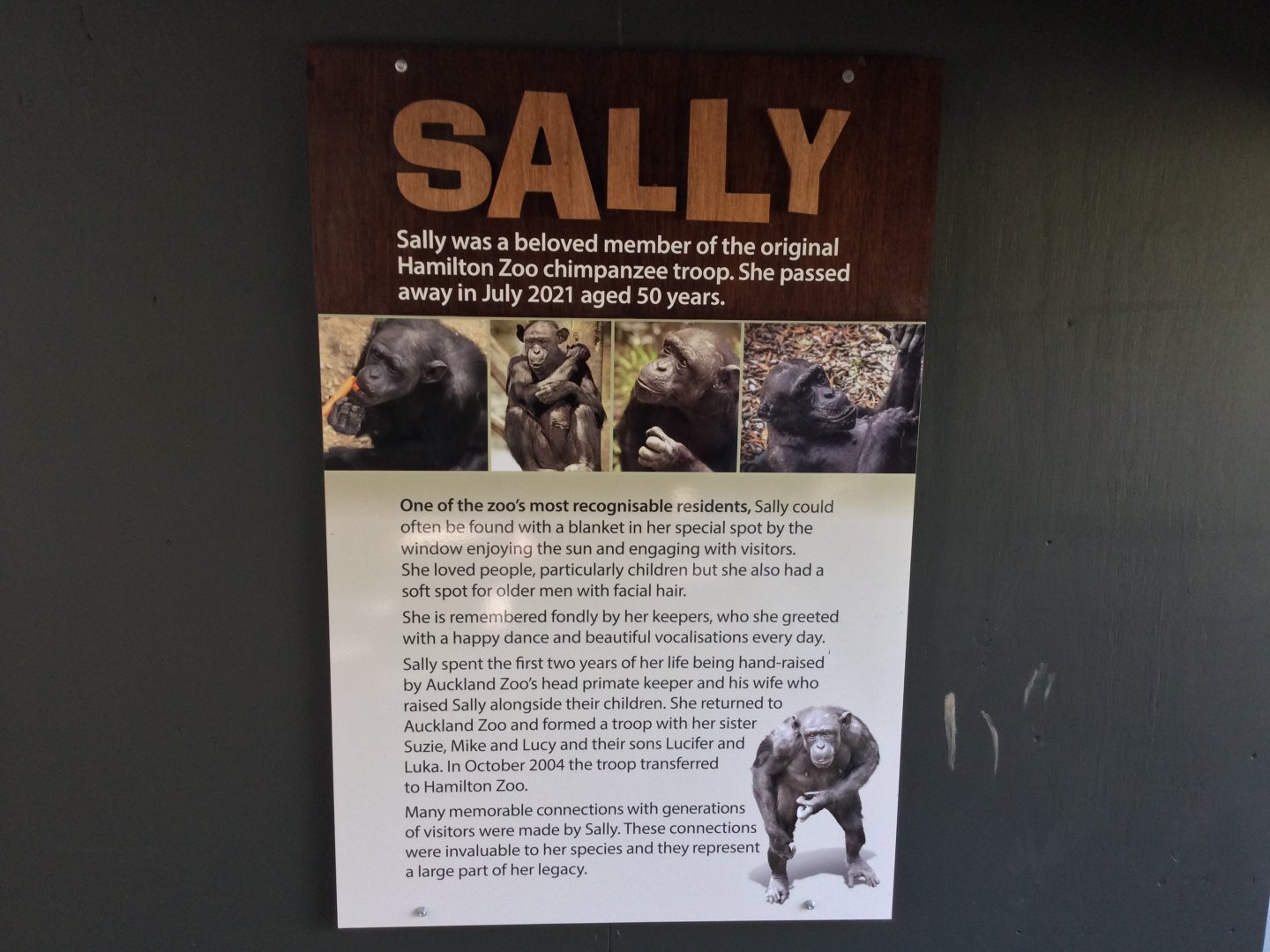
When Sally the beloved chimpanzee at Hamilton Zoo (she was originally born at Auckland Zoo) passed away, the zoo paid tribute to her by dubbing the window she frequently used to sit beside "Sally's Window" and made a tribute mural to her, complete with photographs and signage detailing Sally's story.
 
When Sally the beloved chimpanzee at Hamilton Zoo (she was originally born at Auckland Zoo) passed away, the zoo paid tribute to her by dubbing the window she frequently used to sit beside "Sally's Window" and made a tribute mural to her, complete with photographs and signage detailing Sally's story.

Sally was hugely popular with visitors. I have many fond memories of seeing her up by the windows (both in the lower paddock and in the night house). The births of Suzie (1964) and Sally (1970) were well before my time, but they were no doubt huge attractions.

This is the sign by Sally’s window:

 
Sally was hugely popular with visitors. I have many fond memories of seeing her up by the windows (both in the lower paddock and in the night house). The births of Suzie (1964) and Sally (1970) were well before my time, but they were no doubt huge attractions.

@Zoofan15, thanks so much for this! The first time I saw the mural for Sally (on my visit last December to Hamilton) I had tears in my eyes. I remember Sally well from my 70s childhood. She was a dear friend and I miss her greatly.
This is the sign by Sally’s window:

Sally was hugely popular with visitors. I have many fond memories of seeing her up by the windows (both in the lower paddock and in the night house). The births of Suzie (1964) and Sally (1970) were well before my time, but they were no doubt huge attractions.

This is the sign by Sally’s window:


@Zoofan15, thanks so much for this! The first time I saw the mural for Sally (on my visit last December to Hamilton) I had tears in my eyes. I remember Sally well from my 70s childhood and miss her so much.
 
Lately I had been thinking about how when animals die in zoos, there is usually never anything to remember them by.

When people die, we bury them and give them a gravestone. When zoo animals die, they are usually cremated or their skeleton is given to a museum, and there is rarely any type of plaque or stone or memorial to remember the animal.

I feel like some sort of memorial for dead zoo animals should be normalized, especially for when there is an animal (Like Packy or Colo, for instance) who is historic or really famous or who everyone knew or loves.

What are peoples' thoughts about this? Do you think that it is weird that zoos rarely provide any sort of memorial for dead animals? Or, if you do have examples of memorials for dead animals, feel free to mention them here.
I very much agree with the idea.

Of course, a literal graveyard would be (for most zoos) rather impractical space-wise, and remains sometimes go on to be part of scientific collections anyways. However, I still believe having a, let's say, memorial space would be a positive.

And they certainly already exist in some places. Russia, for instance, has many sculptures dedicated to the memory of animals used in scientific/medical research, like the "Monument to the laboratory mouse" in Novosibirsk. There is also Ol Pejeta’s Rhino Memorial, as another example.

2560px-Ol_Pejeta_Rhino_Cemetery_%26_Memorial%2C_Remembering_Sudan_%28the_last_male_northern_white_rhino%29_One_Year_On_%2846723597264%29.jpg


However they're done, memorials exist, in part (and especially in regards to animals), as a way for the living to feel close to the departed, and I believe a memorial space would be a nice way to offer zoo guests and keepers that sort of comfort. Be it in the form of a small garden, a sculpture, etc.
 
I can definitely relate to this post! Back in 2019 at the Detroit Zoo, the Pure white wolf Wazi passed from Heart Failure during surgery. White wolves are very rare in zoos I was so happy we had in Detroit for a couple of years. I got a couple of pics of her before she passed and she was one of my favorite animals when she was here. She will be greatly missed even unto this date. Rest in Peace Wazi!
 
Some of the saddest deaths I've experienced are
-Geo the Philippine Eagle
-Tamer the Tasmanian Devil
Both were significant, as Geo's was one of the Philippine eagles at Bird Paradise, and Mandai may have had plans for breeding. Tamer was the last tasmanian devil at Tama Zoo.
 
I very much agree with the idea.

Of course, a literal graveyard would be (for most zoos) rather impractical space-wise, and remains sometimes go on to be part of scientific collections anyways. However, I still believe having a, let's say, memorial space would be a positive.

And they certainly already exist in some places. Russia, for instance, has many sculptures dedicated to the memory of animals used in scientific/medical research, like the "Monument to the laboratory mouse" in Novosibirsk. There is also Ol Pejeta’s Rhino Memorial, as another example.

2560px-Ol_Pejeta_Rhino_Cemetery_%26_Memorial%2C_Remembering_Sudan_%28the_last_male_northern_white_rhino%29_One_Year_On_%2846723597264%29.jpg


However they're done, memorials exist, in part (and especially in regards to animals), as a way for the living to feel close to the departed, and I believe a memorial space would be a nice way to offer zoo guests and keepers that sort of comfort. Be it in the form of a small garden, a sculpture, etc.

Coming back to this thread to add on that another benefit of some sort of memorial space is the destigmatization of death. There are varying degrees of transparency from facility to facility when animals pass away, be it via euthanasia or otherwise, and even those with good track records for animal care can find themselves bombarded by certain comments from the public. Communicating an animal's death is already a step in the right direction, but the addition of a memorial that is open to the public can add to the conversation, in my opinion. A further acknowledgement of the cycle of life and the care that zoo staff put towards the animals they work with.
 
Most people I know don't bury their dog in a graveyard.

Also, there are sometimes memorials in the form of statues and what not to very popular animals.
I personally have only had one dog pass away, and get her cremated just so she would always be at home, with her ashes
 
Back
Top