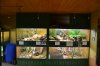
Reptilarium, schematic!

You'd also want multiple entry/exits, possibly footbaths, gloves for handling, other equipment.

Not to mention, mechanicals, filtration, chillers, air handlers, separate climate controls, the works.

Actually I have planned foothbaths in the entry, marked with red - see on plan. Filtration is also mentioned, as with HEPA filters between adjacent enclosures. - Don't know how practical and feasable will be this. But can be tried.


That is why Animals in Herp Houses should be housed by climate needs, not geography-based. The areas should also have doors or other forms of keeping climate control.

This is interesting. And of corse that will have openable roofs for climatic control - it is already mentioned that in the initial post.
 
(...) would demand higher energy consumption, and will not be very practical from husbandry aspect.

In general, your Matryoshka box in a box system isn't very practical, either. ;)

The energy consumption would be even higher if you have to adjust the micro-climate of each and every individual tank due to lumbing together species of various climate zones.


(...) anyway in most zoos reptiles are kept in reptile houses in wich there is not real, exciting trip, and combined reptiles enclosures are just one piece of such trip.''
I do not comprehend what you want to say...
 
Still not getting it, Nikola...

Do you want to say that reptile houses in zoos are not that exciting (for you) as outdoor exhibits of larger (mammalian) zoo species because they only allow (limited) indoor husbandry?
 
I wanted to sumarise why I want buillding a reptilarium with enclosures arranged as boxes:

1.Cheaper to built (one interenclosure septum for two adjacent enclosures);
2. For more natural light and reptiles to get used to (as it is case in the wild, and without a lot of, or many-hours used, artifitial lights in blue or purple nuance);
3. I don't like to use concrete/blocks for entire walls/roof, thus what other material can be used apart from plastic panels, glass and metal/wood construction (skeleton) and maybe low wall of rocks and concrete;
4. Please note that ''boxes'' are enclosures with the sizes of bathroom, small bedroom with height of 1.5 do 3 m.
5. The construction can be removeable;
6. Better warming in cold months due to glass-garden effect;
7. Removeable by hand, roof blocks for enabling direct sun light to reach to the reptiles;
8. I am aware of potential for over-heating in warm months, thus the roofs will also be shadowed;
9. Also whole trees can be grown inside enclosures (because of their height);
10. You can imagine this complex as conventional indoor tropical house or aviary of many zoos, roofed with glass, just separated inside by septa - denoting different neighboring enclosures and with not so high, simmilarly like Plzen zoo reptilaria.

What idea or concept can you recommend/create, aside from conventional reptilaria in most zoos (in buildings with artifital lights used all day)? And please don't take into consideration a lot microclimatic conditions and their control, and enclosure design (furniture, substrate, water pools, etc.), because they are other subject. Take into consideration just general concept, building materials and size of enclosures and their shape and arrangement.
 
Last edited:
Still not getting it, Nikola...

Do you want to say that reptile houses in zoos are not that exciting (for you) as outdoor exhibits of larger (mammalian) zoo species because they only allow (limited) indoor husbandry?

Yes it can be that said Batto. They can't be considered as, let say adventuristic trip, that otherwise can be experienced walking along mammalian or bird outdoor enclosures. I juts wanted to overtie to Zooplantman post about pleasing visitors who want to experience more like a trip in a zoo. Hope so I am clear.

Otherwise they are exciting for me, particularly because of their inhabitants. I do not need excitment visiting a zoo, seeing animals is exciting for me and for most zoochatters, but not for average zoo visitors who don't know a lot for zoo animals- and as Zooplantman said, they need more like a trip visiting a zoo.
 
I wanted to sumarise why I want buillding a reptilarium with enclosures arranged as boxes:

1.Cheaper to build (one interenclosure septa for two adjacent enclosures)
Not really.

2. For more natural light and reptiles to get used to (as it is case in the wild, and without a lot of, or many-hours used, artifitial lights in blue or purple nuance)
Blue and purple???!
3. I don't like to use concrete/blocks for entire walls/roof, thus what other material can be used apart from plastic panels, glass and metal/wood construction (skeleton) and maybe low wall of rocks and concrete;
What you don't like isn't relevant if the material in question is the best option.
4. Please note that boxes are enclosures with the sizes of bathroom, small bedroom with heigh of 1.5 do 3 m.
...which is not very practical for various reasons (arboreal elapids)
5. The construction can be removeable;
...safety?
6. Better warming in cold months due to glass-garden effect;
And greater heat loss...
7. Removeable by hand, roof blocks for enabling direct sun light to reach to the reptiles;
So that they can escape?:D

In a nutshell, your options are greatly influenced by the local climate and the species you want to keep.

If you live in a (sub)tropical climate, you could keep various tropical species outdoors all year long in secured outdoor enclosures (granted that the local government isn't afraid of your reptiles escaping and becoming invasive species).
If you live in a more temperate, seasonal climate, you won't be able to keep tropical species outdoors most of the year. You can offer temporary outdoor exhibits to some of them, but you will have to take them indoors or offer them indoor facilities (like isolated, heated glasshouses for tortoises). As for reptile species adjusted to colder climates (such as various Vipera species), I'd actually recommend to keep them outdoors if you can provide adequate and secure hibernation options.

For Macedonia, this would imply that you could keep local reptile species as well as "exotic" species such as Northern Pacific rattlesnakes outdoors most of the year, hibernation options provided, and subtropical species such as larger tortoises, chameleons (in gauze cages) and even some croc species outdoors during the warmer days (weather-permitted) with access to heated indoor enclosures.
 
I wanted to sumarise why I want buillding a reptilarium with enclosures arranged as boxes:

Blue and purple???! - Aren't they looks like blue or purple nuances?


5. The construction can be removeable;
...safety? - Metal construction?

6. Better warming in cold months due to glass-garden effect;
And greater heat loss... why, there is air-filled cavities in some plastic panels, and air is worst heat conducter. They may even be double (but in that case the cost of buildng increases).

7. Removeable by hand, roof blocks for enabling direct sun light to reach to the reptiles;
So that they can escape?:D - but roofed with mesh, double strong for agile elapids.


In a nutshell, your options are greatly influenced by the local climate and the species you want to keep.

If you live in a (sub)tropical climate, you could keep various tropical species outdoors all year long in secured outdoor enclosures (granted that the local government isn't afraid of your reptiles escaping and becoming invasive species).
If you live in a more temperate, seasonal climate, you won't be able to keep tropical species outdoors most of the year. You can offer temporary outdoor exhibits to some of them, but you will have to take them indoors or offer them indoor facilities (like isolated, heated glasshouses for tortoises). As for reptile species adjusted to colder climates (such as various Vipera species), I'd actually recommend to keep them outdoors if you can provide adequate and secure hibernation options.

For Macedonia, this would imply that you could keep local reptile species as well as "exotic" species such as Northern Pacific rattlesnakes outdoors most of the year, hibernation options provided, and subtropical species such as larger tortoises, chameleons (in gauze cages) and even some croc species outdoors during the warmer days (weather-permitted) with access to heated indoor enclosures.

Yes the climate plays big role. Certainly such concept will be least practical in colder climatic zones, but more practical in warmer ones.

If I reduce the size of all this ''boxed building'' and reduce the number of species, it becomes more practical and more easily to control.
 
@FunkyGibbon: sure! In regard to public institutions and offhand I would mention

- The majority of exhibits at Reptilienzoo Landau
- Reptilienzoo Nockalm's outdoor and several of the indoor exhibits
- The Indian Gharial exhibit and the Giant tortoises meadow at Prague Zoo
- The majority of exhibits at the Freilandterrarien-Anlage Stein bei Nürnberg
- Individual reptile exhibits at Bern and Zürich Zoo
- The chelonia outpost of the Auffangstation für Reptilien, München e.V.
- A Cupulatta, Corsica

Thanks Batto, I'll make sure to watch out for the ones in Prague this summer.
 
After reading all these posts, I think plan - reptilarium made of partially concrete, and partially from double, air-filled plastic pannels, and from metal or wooden skeleton, not very big (aproximately 400 m2), and with partialy removable roof blocks for allowing direct sun lights to enter and reach to the reptiles, and for up to maximum of 15 species of reptiles, would best fit in these conditions here and according to mine plan. I just also liked visitors not to enter in a building, but to see reptiles from outside, walking on natural sand road. Anyway, for now this remains a distant dream in this country with limited opportunities for proffesional development and fullfilment, and limited opportunities for earning good amount of money/or doing bussines/entrepreneurship (starting with minimal funds), and with HDI of 0.747 (by the way, Germany 0.916, USA 0.915, Hungary 0.828).
 
Last edited:
For Macedonia, this would imply that you could keep local reptile species as well as "exotic" species such as Northern Pacific rattlesnakes outdoors most of the year, hibernation options provided, and subtropical species such as larger tortoises, chameleons (in gauze cages) and even some croc species outdoors during the warmer days (weather-permitted) with access to heated indoor enclosures.

Actually Batto, Macedonia has not very warm winter as that experienced like in Greece or Italy. Springs/summers here are subtropical, but winters can be quite cold, and temperatures can drop even to -20 deg C (althought that happens maybe in 3 consecutive days, once every 3-4 years in December, January or beggining of February, and Autumn is generaly long and warm.

Some climatic data for Prilep (my living town) are as follows:
Average yearly temperature: 12.5 deg C. Temperatures can reach 41 (once every 2-3 years in summer), frequently exceed 32 (in summer), and there are about 60 days/year with freezing temperatures. Rainy pattern is Mediterranean (with driest months - July and August). Solar insolation is about 2,700 hours/year.

Average high temperature: January 4, February 6, March 11, April 17, May 21, June 26, July 29-30, August 29, September 25, October 19, November 13, December 5.
Average low temperatures: Jan -3!, Feb -3!, Mar 1, Apr 5, May 9, Jun 13, Jul 16, Aug 14, Sep 12, Oct 8, Nov 4, Dec -1.

Ordinarly palms can't be grown here, but can in some low towns in river valleys and along lower lakes.
And there are 32 native species of reptiles living here.
 
you should think more outside the (rectangular) box. some examples from Swiss zoos (I'm sure there is plenty others):


two storey vivaria for mammals and birds


crocodile vivarium with planted backdrop behind enclosure. backdrop shared by multiple enclosures on multiple levels


open barrier multi species exhibits.
 
you should think more outside the (rectangular) box. some examples from Swiss zoos (I'm sure there is plenty others):


two storey vivaria for mammals and birds


crocodile vivarium with planted backdrop behind enclosure. backdrop shared by multiple enclosures on multiple levels


open barrier multi species exhibits.

Thanks. These enclosures are beautifull, but surely cost a lot to built. I mostly liked enclosure with natural sun light reaching to the plants (enclosure for whte-faced saki, motmot and agouti).
Irespectively whether enclosure is rectangular, oval or irregular in shape, animals can't recognise that - it is enough for enclosure to be of appropriate size with appropriate conditions and furniture/design, or even better, to be as at least two-part enclosure for periodical rotation of inhabitant (stimulatory for exploration).
 
Once again: it’s hardly “natural sunlight“ what you assume to see. It’s sun light shining through windows (and thereby partly eliminating parts of the light spectre the human eye cannot see) supported by HQI lamps.
I’m sure antonmuster is very much aware of the various forms of enclosures; he, like others, just pulled your legs in regard to your original box “design“.
 
"Irespectively whether enclosure is rectangular, oval or irregular in shape, animals can't recognise that" I call BS! Any animal knows where the limits of their enclosure is. You obviously think reptiles are dumb animals, when in reality, some are extremely intelligent. As for your rooms, a room is still a box no matter how you cut it. Boxes can be open-topped, sealed, have access points, etc. Your partially removable roof and clear roof will pose issues. What do you plan to do with excess heat? May want to look into some form of geothermal heating or sending excess heat to other building that can use it. You can't cut corners and build cheap, these animals have needs, and if they can't be met, why bother? Your band-aid methods will work, but for how long? Seems like a guideline for dummies on animal cruelty..
 
"Irespectively whether enclosure is rectangular, oval or irregular in shape, animals can't recognise that" I call BS! Any animal knows where the limits of their enclosure is.

I meant can't recognise the shape - not the boundaries of enclosures...
And the shape of outline of enclosures is absolutely nothing important issue for animal, it is just for visitors - more or less appealing for eyes.
 
Thanks. These enclosures are beautifull, but surely cost a lot to built.

These enclosures would hardly have been any cheaper had they been implemented in poor design (i.e. a linear collection of rectangular boxes) - provided all other things (i.e. building materials, size, etc.) had remained unchanged. Good design is not primarily a question of money, but of... good... design.

Note that in my examples the ambient lighting level in the visitor area is substantially darker than the enclosures. In your example it is the other way round. This ensures, high visibility of visitors to animals and low visibility of animals to visitors. Such a solution ensures the worst outcome for both animals - unnecessary stress - and visitors - who on a sunny day will mostly see only their own reflections in the glass. The San Diego Zoo vivarium is a "good" example of this design mistake.

If you are interested in more than dreams you should invest a month or two on reading up on private reptile husbandry, find yourself a robust species with a stable private-bred population, invest hundreds to ~1'000$ (the proper lighting and climate control technology is what will make this expensive) and another few months in designing, building, and structuring your own naturalistic vivarium, yet another few months in planting it and optimizing the climate and microclimates in the vivarium to the needs of your designated inhabitants, after which you can finally acquire the animal(s) and learn to take care of them. There are plenty of forums that can give you additional support in such an endeavor.
 
Note that in my examples the ambient lighting level in the visitor area is substantially darker than the enclosures. In your example it is the other way round. This ensures, high visibility of visitors to animals and low visibility of animals to visitors. Such a solution ensures the worst outcome for both animals - unnecessary stress - and visitors - who on a sunny day will mostly see only their own reflections in the glass.

Good to point this, thanks.


The San Diego Zoo vivarium is a "good" example of this design mistake.

Actually I love a lot the way of how reptile house is designed in San Diego Zoo (I have just saw several pictures on google - reptile house SDZ). It's matter of taste, some will dislike such arrangement - like in row of boxes, some will love such arrangement. I personaly don't find it very beautifull, the design of enclosures (their spatial distribution and shape - not the furniture and decor), that you have provided with pictures. Such arrangement is also less rational, and rationality is particularly important when space is limited.
The most important are needs of animals - appropriate size and furniture/microclimatic conditions (with appropriate technology for microclimate control), simulating the wild place origin of inhabitant. Needs of visitors should be in second place (although that can mean less money).
It depends again of taste. Someone will like someone will dislike. Like animal_expert01 (first page) find it good - the initial mine plan for reptilarium (although that now will be a little bit changed - but row arrangement will remain - first of all because of rationality - limited space).
 
Another example of a good "box" setting.

With all due respect: despite his self-proclaimed "expert" title, said "animal_expert01" himself has acknowledged previous errors in his judgement, mainly based on his still youthful age...;)
 

Attachments

  • DSC_0360.jpg
    DSC_0360.jpg
    1.2 MB · Views: 29
Last edited:
Back
Top