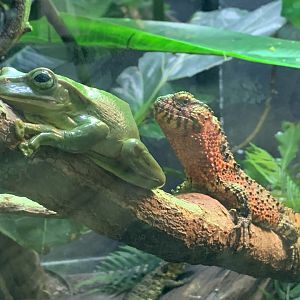
Reptile/Amphibians that can co-exist in the same exhibit?

Reptile House

Well-Known Member
A great thing with zoos is animals having a lot bigger enclosure, as this is made possible by animals sharing. Gone are the days with small exhibits with a single species and good riddance.

So ahead of the new reptile house at London Zoo opening, what reptiles and amphibians can co-exist?

I have seen a Poison Dart Frog and a Eyelash Viper live in harmony.

Just put it out there I wonder if the Western Diamondback Rattlesnake and Gila Monster could co-exist as a probably not a good example?
 
Well, the Cotswold Wildlife Park used to keep a green mamba with their Gaboon viper and they co-existed well enough. Heck, when I saw them, the mamba was resting on top of the viper.
 
  • Like
Reactions: JVM
The Bronx Zoo has a mixed species enclosure for a Green Anaconda and a Smooth-Sided Toad. Many visitors wonder if the snake will eat the toad, but I'm not aware of any serious incidents of aggression.
 
A great thing with zoos is animals having a lot bigger enclosure, as this is made possible by animals sharing. Gone are the days with small exhibits with a single species and good riddance.

So ahead of the new reptile house at London Zoo opening, what reptiles and amphibians can co-exist?

I have seen a Poison Dart Frog and a Eyelash Viper live in harmony.

Just put it out there I wonder if the Western Diamondback Rattlesnake and Gila Monster could co-exist as a probably not a good example?

Gila monster an red rattlesnake live together in Burgers' Zoo. But just like in Hagenbeck that is a large enclosure and not just a typical small tank.

The question in general: a lot of species combinations are possible if the enclosure is designed to allow it.
 
Mixes at Chester include:
Mountain chicken frog and Hispaniolan giant galliwasp

Reticulated python and tokay geckos

Panther chameleon, giant day gecko, western Zonosaur and Cuvier's Oplurus

Asian river toad and Gariau forest dragon

Eastern casquehead iguana and golden poison frog

Amazon Basin emerald tree boa, blue poison frog, Amazon poison frog

Feae's flying frog and green crested lizard

Emerald tree skink, Bornean splash frog, cinnamon frog and vampire crabs

Parson's chameleon, Henkel's leaf-tailed gecko and southeastern Zonosaur
 
Emerald tree boa and Evergreen toad together at Bronx zoo:
full
 
Haus Des Meeres in Vienna combines their gila monsters with (if I'm remembering right) Colorado river toads. There's also lace monitors in with fire salamanders, a false gharial mixed with numerous turtle species and their anaconda mixed with a similar array of turtles. I noticed these latter two are replicated at Vienna Zoo as well, but with Morelet's crocodile instead.

Generally I'd guess housing smaller species with larger ones is easiest because generally the relationships are better known. For example most crocodiles tend not to eat turtles, same with large snakes. Most snakes also don't eat other snakes, so mixing is usually safe provided they aren't too territorial.
 
. Most snakes also don't eat other snakes, so mixing is usually safe provided they aren't too territorial.
This is... a very broad generalisation, and while I don't have data to hand, I'd guess at least a couple of hundred snake species can be ophiophagous. And not many display territorial behaviours, especially towards other species.

Re crocodilians and turtles, size is a very important factor. Such mixes also work better with slender-snouted, more piscivorous species; generalist, broad-snouted crocodiles and alligators absolutely will feed on most turtles that are attempted with them.
 
Last edited:
This is... a very broad generalisation, and while I don't have data to hand, I'd guess at least a couple of hundred snake species can be ophiophagous. And not many display territorial behaviours, especially towards other species.
Plenty of snakes are ophiophagous - I wouldn't quite say most, but the number must be nearer majority than not. But if they're being well fed and are comparable in size, I find it unlikely that in captivity they would predate each other. Do I have any data to prove this? No, so chances are I'm completely wrong. But I would wager that's why so many species that are known for it can be housed with other species. I've worded my original post poorly so I'll amend. Agreed they tend not to show territorial behaviours, but this is where exhibit size is important and extends to most reptiles.

Regarding crocodiles - I don't think it's quite so black and white. For example I've heard of Cubans eating everything that was sharing their exhibit, fish, reptiles and all. But I've also seen exhibits where they are perfectly content to ignore them. My best guess would be this is due to how well they are fed and how much space they have, as well as the personalities of the crocodiles themselves.

Essentially, animals in captivity don't always fit wild patterns. But I also wouldn't suggest a king cobra + grass snake + saltwater crocodile exhibit
 
Antwerp Zoo's Reptile House has several interesting mixes.

When I visited in December last year, American Alligator shared with Black Iguana, Caiman Lizard and Weber's Sailfin Lizard with three species of turtle, Cane Toad with Green Tree Python, Long-nosed Horned Frog with Crocodile Skink, Madagascar Tree Boa with Radiated Tortoise, and several species of poison dart frogs with several species of gecko, just to name a few.

Hagenbeck also has some wonderful mixes. There is the beaded lizard and rattlesnake mix mentioned by Batto upthread, as well as one with Colorado River Toad, Gila Monster and Common Chuckwalla, and another mix of Sailfin Lizards and turtles. Poison dart frogs share with boas, as well, although I sadly forgot the species.
 
It matters not though.

Let me say it is a superb photo, that clearly shows both animals very comfortable with each other, none of the animals look distressed, If you took the photo, well done. This shows where sharing in a bigger enclosure triumphs. I would be very happy with a big enclosure, say like the ones on the inside wall at the Reptile House in London Zoo, but with several species sharing where possible.

I was in London Zoo yesterday and the 3 Emerald Tree Pythons in 3 separate enclosure, it is a spectacular looking animals, but I don't need to see it twice more, I would rather see something else.

I know this isn't always possible, for instance nothing could share with a Komodo Dragon?

In Amsterdam Zoo I saw a King Cobra sharing with a Taiwan Beauty Snake, this surprised me, I guess it was a bit of lunch for Mr Cobra.
 
Haus Des Meeres in Vienna combines their gila monsters with (if I'm remembering right) Colorado river toads.
Which is a pretty common combination in several zoos (including Zoo Vienna's Desert House). I've tried it at WdG as well.

I know this isn't always possible, for instance nothing could share with a Komodo Dragon?
If the species is small enough not to be a worthwhile prey and has ample room to escape, it can work. Several zoos, like HdM, keep small Asian birds together with their komodo dragons.
 
Back
Top