
Aquarium of the Pacific is an excellent 12-year-old facility on the harborfront of Long Beach, California, a city of nearly 500,000 that is a major suburb of Los Angeles and is about 20 miles South of its downtown. It is situated along the curving promenade of Rainbow Harbor, an attractive modern palm-lined area of commercial pleasure docks that is also home to parks and plazas and restaurants that connect with the city’s downtown. Across the harbor are the docks for the historic Queen Mary cruise ship (permanently docked here and turned into an historic tour attraction and hotel) and modern cruise ships, as well as views to the giant cranes in the massive cargo ports of Long Beach and San Pedro nearby. All the activity of the area does not cease in the aquarium; it claims to have 11,000 animals of 500 species in 19 major habitats and 32 focus exhibits. It is shortchanging itself: by my count, there are 76 tanks (7 big, 15 medium, and 54 average-to-small size) as well as 3 small terrariums and 1 large aviary (another smaller aviary covers one of the aquatic exhibits so I will not count it twice). These are divided into separate geographically-themed galleries, mostly located indoors, with clear organization along exhibit paths and educational graphics. Modern hallways with slick dark interiors and metal railings and sign frames compose most of the galleries. The aquarium building itself is a sophisticated modern composition of curved forms of various heights crowned with curved metal rooflines that mimic waves. In the front plaza is a round fountain area with broad water steps around a round raised stone arc covered with a tile mural; jets of water are propelled against the arc in intervals to abstractly represent tidal action, and the mural is called Rios de la Vida and represents the journey of local waters to the sea. It is a fitting introduction to the sophisticated presentation and quality within the building, whose entry is a wall of windows pierced by a blue architectural form that houses ticket windows outside and an information desk inside. Once inside, visitors enter the 1st floor of the Great Hall of the Pacific, a soaring two-story lobby to which all the interior facilities connect, including the Pacific Collections Gift Store and the theater (for films and lectures) seen immediately to the left. Immediately to the right is a doorway to the special exhibit gallery, a dark one-level room that is currently showing a well-designed graphic exhibit called Ocean on the Edge. It highlights the top 10 issues that the ocean faces, and features 4 small tanks: an open-top trough for petting local small rays that inhabit the nearby restored Bolsa Chica coastal wetland, a wall tank for a small jelly species that illustrates the alarming explosion in their populations, a wall tank for 9 species from coral reefs, and a round column with 4 species that inhabit mangroves. None of these tanks are impressive, they are just small punctuations to the messages of the exhibit. The Great Hall of the Pacific is certainly impressive though: its long length is covered by the curved panels of the high roofline, with bands of clerestory windows making it an airy bright space. Hanging from the ceiling is a life-size model of a blue whale mother and calf, a dramatic and realistic contrast with the abstract architectural curves of the large room. Several times a day, automatic shades descend in front of the windows to create darkness in the hall; during this time, a short educational program about whales plays on a variety of video projections scattered around the space while its soundtrack fills the air. The hall does have 3 exhibit tanks, which are previews of the main exhibit galleries to come. The first is in an alcove room with couches and chairs and is called the Tropical Pacific Preview, a beautiful medium wall tank with a curved arch window and a coral backdrop inside and 18 species listed. A curved stairway ascends nearby to the 2nd floor and the Tropical Pacific Gallery, described later. The second is in another alcove room with couches and chairs and is called the Northern Pacific Preview, a nice medium wall tank with an angled arch window and a half-water rocky shoreline inside and 16 species listed. Another curved stairway ascends nearby to the 2nd floor and the Northern Pacific Gallery, described later. The third tank is the largest, an impressive 142,000 gallon two-story wall tank that is about 30 feet high and nearly as wide that fills the far end of the hall. It is Blue Cavern, and recreates a local kelp forest, with a gravel-and-rock floor, high rocky side walls, and a dark backdrop inside with large kelp strands swaying from the seafloor to the surface. It acts as the preview for the Southern California/Baja Gallery, which begins nearby and is a two-floor exhibit path described later; fittingly, the preview tank is two floors high as well. Blue Cavern is primarily for larger fish species, while most of the smaller ones reside in smaller tanks along the later exhibit path. It is impressive, but not on the scale or species complexity of the similar Kelp Forest tank at Monterey Bay Aquarium. Throughout this aquarium review, I will not list all the species in each tank, but for a few highlights (as well as tanks with only a few species), I will: this one contains gaint sea bass, white sea bass, kelp bass, barred sandbass, yellowtail, ocean whitefish, California halibut, California barracuda, California sheephead, leopard shark, shovelnose guitarfish, bat ray, California moray eel, Pacific mackerel, and cabezon. It can be viewed from the floor of the hall as well as a curved bridge that crosses the hall on the 2nd floor. This end of the hall also leads to several education classrooms on the 1st floor and a nice counter-service dining location called Café Scuba on the 2nd floor with window views and a terrace overlooking the outdoor exhibits described later.
The Great Hall of the Pacific:
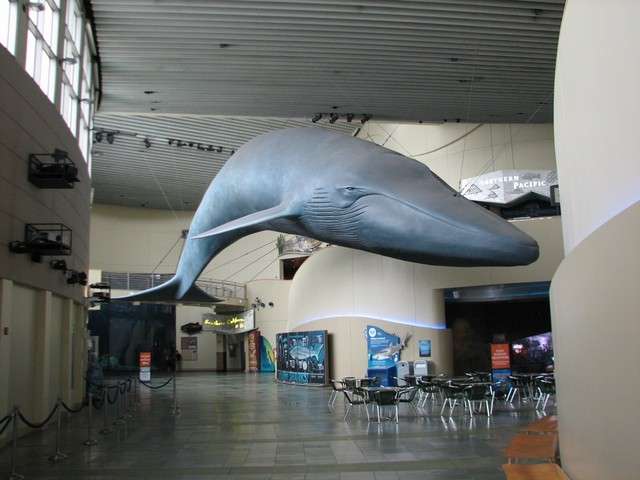
Blue Cavern in the Great Hall of the Pacific:
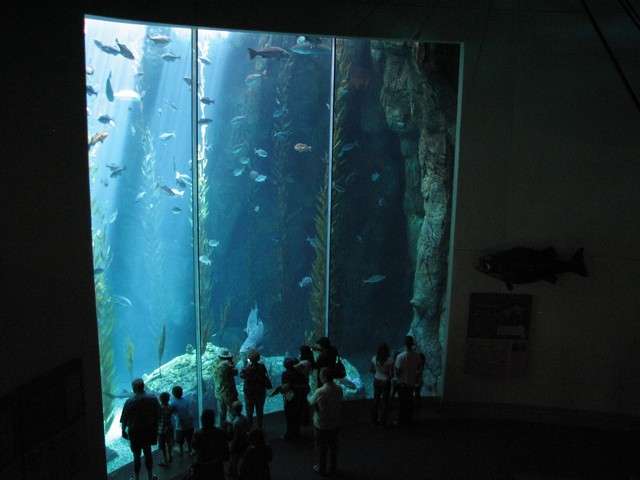
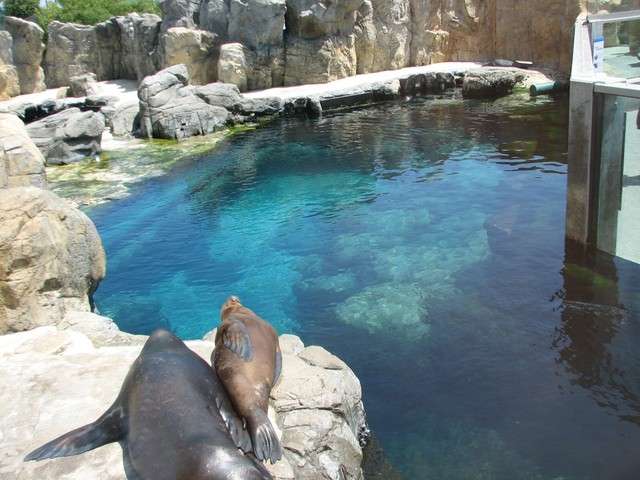
Southern California/Baja Gallery is an entirely indoor exhibit path on the 1st floor, with a doorway next to the Blue Cavern tank in the Great Hall. The first exhibit is a beautiful medium long floor-to-ceiling wall tank called Amber Forest that continues the kelp theme on a smaller scale, with a tidal surge for the 14 species inside. Next is a tiny wall tank for baby swell and horn sharks. A series of average-to-small size wall tanks follow, some with curved windows, others with flat ones. They are: Redondo Canyon with 4 species, Kelp Camouflage with 4 species, Eel Grass for bay pipefish, an exhibit that highlights spiny lobster and 4 other species, a shelf exhibit that highlights red abalone and 4 other species, a tiny tank for Giant mantis shrimp with a cutaway for viewing their seafloor burrow, Breakwater with 4 species, Pinnacle with 2 tanks for various hydrocorals, and an abstract tank for purple-striped jelly. At the end of this series, a floor-to-ceiling concave window looks into a rocky alcove at the back of the Amber Forest tank seen previously. Then the hallway turns a corner to enter the underwater viewing area for a very nice 211,000-gallon California sea lion and harbor seal exhibit. Their habitat surrounds the hall on both sides, viewed from long seamless windows that curve up to appear as a tunnel. It is a tunnel, and the pinnipeds can swim beneath its floor or climb on a rocky dry shelf on its top, but the visitor hallway does not have windows in the floor or ceiling to see these activities. Both sides look into fairly deep rocky-walled grottos of water. The exhibit path then exits the building through glass doors to an outdoor area; from here, an unrelated area of outdoor exhibits called Explorers Cove can be entered and will be described later. The Southern California/Baja Gallery loop continues from here as well by climbing a set of outdoor stairs to a terrace lined with concrete steps for viewing sea lion and seal demonstrations; it is the above-water viewing area for their exhibit, which is seen through large glass panels. A separate small dry rocky grotto is also seen from here, for occasional isolation for the pinnipeds. Their main exhibit and its rocky walls and haul-outs is seen in its entirety from this vantage point, and the realistic coastal scene contrasts with the modern aquarium architecture that rises behind it. Another set of outdoor stairs leads to a large upper terrace with more outdoor exhibits as well as another glass-panel view of the pinnipeds from a higher perspective. The terrace includes a sheltered staffed touch counter called Tidepool Treasures with an open-top touch trough, a small round tank imbedded in the rocky mussel-encrusted counter, and another small open-top tank. Along one side of the terrace is a long shallow rocky open-top tank with a tidal surge called Rocky Intertidal. Unfortunately, the invertebrate species within are unsigned and it is too dark with too much outdoor glass panel glare to be able to see inside. More successful is another long exhibit next to it, called Shorebird Sanctuary, that is an aviary for ruddy duck, American avocet, Western snowy plover, black-bellied plover, and black necked stilt. They share their habitat with 3 fish species, who inhabit a nice shallow beach tank inside. The tank is viewed through glass, while the rest of the exhibit is viewed through course netting. Although the low back walls are painted with a rather unconvincing sky mural, the interior is a nicely planted representation of beach grasses and sandy mounds. The center of the terrace is a low concrete walled touch pool for bat rays and shovelnose guitarfish, with one section contained with glass railings. It is an average size for this kind of exhibit, but a rocky mound on one side limits the perimeter space available for the large crowds that gather around it. Nearby, a door leads back inside to the small 2nd floor remainder of the Southern California/Baja Gallery, which focuses on the Gulf of California. Wall graphics detail the Northern Gulf and the Sea of Cortes, with their relationship to the Colorado River watershed, and a video monitor plays a looping program about the vaquita, a small porpoise species. The Central Gulf is represented by a nice small concave wall tank for garden eel; attached to a track on the front frame of the window is a movable magnifying glass for closer views of them. Finally, the Southern Gulf is represented by a nice medium tank for 10 species that inhabit rocky reefs there.
California Sea Lion and Harbor Seal Exhibit in Southern California/Baja Gallery:
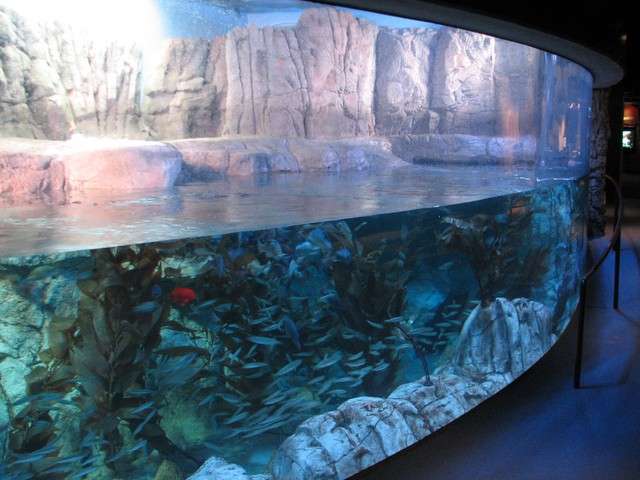
Northern Pacific Gallery continues the excellent selection and presentation of the aquarium and is a one-way loop path on the 2nd floor, focusing on the Bering Sea. It begins with two similar medium-sized tanks, one on each side of the hallway, viewed from behind high glass panels. Each is a rocky scene, filled halfway with water, with surges that make the water level slosh actively. Together they are called Surge Channel, with one for 13 species and the other for 3. Next is a nice rocky habitat behind glass, filled halfway with water for Diving Birds. Inside are 4 species: horned puffin, tufted puffin, crested auklet, and pigeon guillemot. Fine graphics surround the long viewing area for the habitat, including a smell station for comparing the breeding scent of the crested auklet to tangerines and a moving display of egg models to illustrate shapes that are better suited to cliff face nests. Sea Jellies is a series of 4 small wall tanks for lions mane jelly, North Pacific sea nettle, moon jelly, and crystal jelly; a larger half-round tank for West coast sea nettle dominates them. Next is a typical small tank for giant Pacific octopus, with a video monitor that shows a short looping program about them next to it. Coastal Corner Discovery Lab is a staffed counter with 2 open-top touch tanks as well as a small round column for spiny lumpsucker and a small rectangular tank for several sculpin species. The centerpiece of this gallery is next, a habitat behind a long curved glass window for sea otter. The viewing area is very attractive, with rocky walls interspersed with coastal murals and columns that simulate large piers encrusted with invertebrates. The floor is carpeted with an abstract representation of a sandy shoreline. A seating area and walkway in the back are slightly raised above a front viewing walkway, allowing for many visitors to view the exhibit at the same time. The entire front of the exhibit is a rocky and kelp-filled clear pool for the otters and is filled with small schooling fish as well; I do not remember seeing a mix of species in any other sea otter exhibit. While this is a great feature, the depth of the pool is one of the most shallow I have seen, a drawback. The back of the exhibit features a rocky shelf and rocky backdrop, which is nice enough except for the visual confusion of one of those waterfalls-descending-from-nowhere. A hidden skylight in the back allows for some natural lighting, but it could use more. Unfortunately, this recent renovation of the existing habitat and viewing area is sponsored by an oil corporation that has been in the news everyday recently, a reminder to institutions to be careful who they get in bed with! At the end of the viewing area is a small column tank called Otter Food that displays various prey selections in a kelp-filled environment, and an interactive video kiosk station. Next are 2 small wall tanks for sea stars with 6 species, and Bays and Sounds with 6 species. Sandy Bottom is a beautiful shelf tank brimming with spot prawn and fragile urchin and 5 other species, one of my favorite small exhibits in the facility. The exhibit path ends with a medium wall aquarium for giant spider crab with about 10 of them inside, sharing their gravel-and-rock space with a large fish species, bocaccio.
Sea Otter Exhibit in Northern Pacific Gallery:
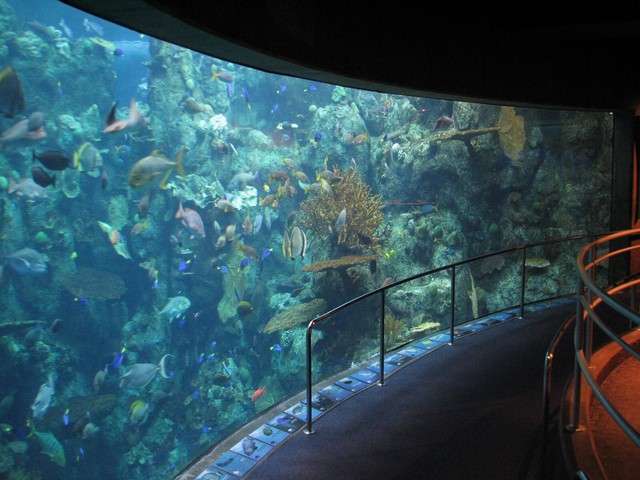
Tropical Pacific Gallery contains the largest number of tanks and is another fine one-way loop path on the 2nd floor. Inside the doorway is Coral Lagoon, a scenic medium habitat with a shallow tank behind a glass railing for 18 small fish species that inhabit the shores of the rock islands of Palau. Next is the first of four viewing areas into the largest habitat at the aquarium, the Tropical Reef Habitat, which is 350,000 gallons filled with a large array of tropical fish as well as bonnethead shark, Queensland grouper, Napoleaon wrasse, and cownose ray. This excellent tank focuses on recreating the Blue Corner, a famous dive area in Palau. The first view is a long floor-to-ceiling panel along a narrow reef wall called Sunny Exposure that gives a partial glimpse into the habitat; in fact, all four viewing areas of this tank only allow partial views, making it seem more extensive than it is. Next is a curved wall tank for giant clam and features several beautiful large specimens. Two tiny side-by-side tanks illustrate coral bleaching, with one tank having healthy small corals and the other with pure white bleached ones in a similar arrangement; I love gems like this that clearly educate on a single topic. Nearby are two small round open-top tanks, one spilling into the other, for live corals: the first features a single large leather coral surrounded by smaller varieties, and the other features live sponges and soft corals and gorgonians whose toxins have been synthesized for treating human disease. A series of average-to-small wall tanks follows, including a very active display of clownfish and anemones, a shelf tank for reef and estuarine stonefish as well as fire urchin, a Hawaiian Reef tank whose species are unsigned, a Deep Reef tank that highlights orangecup and tree corals which rely on plankton rather than photosynthetic algae, and a plain habitat for baby white-spotted and brown-banded bamboo sharks and their egg cases. In the middle of the exhibit path in front of these tanks is a strange feature: a simulated rainforest tree trunk surrounded by three small round terrariums for poison dart frogs. It is attractive enough but seems like an odd addition to a scientifically accurate reef complex. The modern architectural exhibit path that has been followed up to this point then enters a tunnel in the simulated reef for a more immersive experience. The long tunnel has a long curved window to each side; the right side is the second view into the large Tropical Reef Habitat with a larger vista of reef walls that focuses on Soft Corals, while the left side is a narrower but similar reef wall view. The ceiling of the tunnel does not have a viewing panel; above it is a separation between the two habitats, which appear to be one that connects above but does not. The left habitat is filled with similar fish species, but highlights an animal that does not have access to the main habitat to the right: olive ridley sea turtle. After these long windows, the rocky reef walls envelop the tunnel and end with a small concave floor-to-ceiling window that looks into the Blue Hole, a small alcove of the Tropical Reef Habitat and its third view. Also nearby is a beautiful medium wall tank called Sex Change that highlights many colorful fish species that experience this natural phenomenon. The simulated reef walls give way to modern architectural ones for the remainder of the exhibit path, beginning with a cluster of 6 tiny tanks called Jewels of the Pacific. Among them are displays for weedy and raggy scorpionfish, reef lobster, and Banggai cardinalfish mixed with flower pot and button corals. 5 average-to-small wall tanks of various shapes follow: one for shrimpfish and yellowspotted scorpionfish, one for baby seahorses, one for banded sea krait (a deadly sea snake!) and goldtail damselfish, one for 3 species of lionfish, and one for pot-bellied seahorse and leafy seadragon. The fourth and largest and last view of the Tropical Reef Habitat follows, this time from a long curved window that views its depths as well as a side wall that attempts to recreate the drop-off of the reef to the abyss. A ramp descends in front of it for close views, while a roomy area behind the ramp allows for larger groups to view the impressive display. Finally, another average size wall tank with a curved front ends the path, for weedy seadragon.
Fourth viewing area of the Tropical Reef Habitat in Tropical Pacific Gallery:
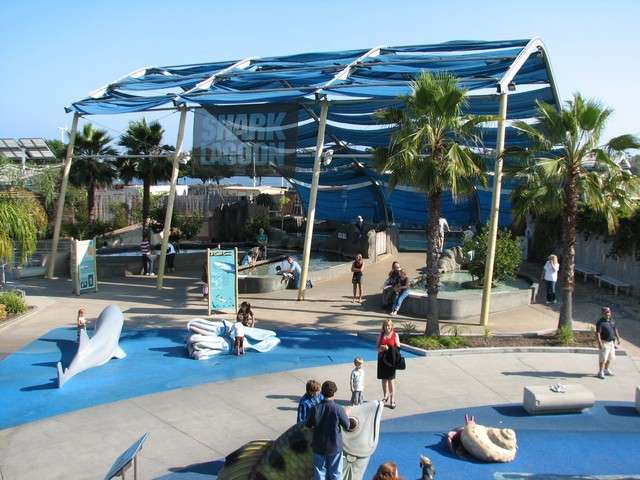
This concludes the review of the original facility; unfortunately, the outdoor exhibits area I mentioned before that connects to the outdoor part of the Southern California/Baja Gallery is a series of later haphazard additions collectively called Explorers Cove. It is sort of a chaotic trainwreck that diverges from the sophisticated arrangement and presentation of the rest of the aquarium, with disparate elements that are poorly planned although some of the features would stand well on their own in isolation. The area begins with a junky outdoor gift shop in a rustic tin-roof shelter called Shark Shack; next to it is the weird little stone-stepped Marine Life Theater covered with a modern awning that does not match the gift shop roof; next to it is a little casual food hut, Bamboo Bistro, and a tiny dining area in an alcove. A large rubber-floored play area of squirting sea creature statues is nearby, with a walkway to another part of the complex bisecting it that must pass near the sprays and shouting kids. Shark Lagoon is a complex of 3 open-top tanks. Two of them are small-to-medium irregular-shaped low walled touchpools for small sharks and rays, while the main exhibit tank is for large sharks. These include sand tiger, whitetip reef, blacktip reef, zebra, and nurse sharks as well as freshwater sawfish and reticulate whiptail ray. There are only one or a few of each species, and they are kept in a relatively shallow oval tank with little detail inside. A single small above-water viewing area with a glass railing looks at one side, while a single underwater viewing area of a few panels looks at the other side; to get from one to the other, visitors must pass through the crowded touchpool area. Graphics are in short supply, and the entire exhibit area is covered with an ugly curved steel pole structure (that simulates bamboo poles with an ersatz result) with blue awnings strung between for shade. It is such a shame that this excellent aquarium features one of the poorest large shark exhibits I have seen. Nearby is a thematic question mark to the message of the facility: for some unknown reason, Lorikeet Forest was chosen as an addition to the outdoor exhibits! The fact that their habitat borders the Pacific Ocean does not seem reason enough to feature them here, but I am sure the revenue does. It is a very fine large walkthrough aviary however, and would be a nice addition to most zoos. It is surrounded by lush foliage, and its thatched peaked hut doorway for purchasing nectar leads to a roomy meandering walkway past branch perches for 140 of the birds representing 7 species. There is also a display called Our Watersheds: Pathway to the Pacific that is more on-target with the educational mission of the facility, composed of a large 3D map of the Los Angeles basin that visitors can walk around and push buttons to simulate rainfall from nozzles above to see how water gathers and is carried through the local landscape. A series of overhead awnings and solar panels shades the display, and it is surrounded by an atrractive small indoor classroom and native plantings. It would be attractive on its own, but here it is relegated to a corner of this messy area. The final piece of this puzzle is the newest part, the Animal Care Center. It is sort of a permenent behind-the-scenes access area, with views of some of the life support and holding areas (several tanks are yet to be installed but their concrete foundations are ready to receive them). As such, it is understandably a less attractive area, but still adds to the chaos. The highlight is a modern Animal Hospital, with 2 rooms visible behind large glass panels. One is a small operating room, and when I visited they were performing a bladder stone removal for a chuckwalla! The surgery can be seen through the window, or on a large video monitor transmitting from a camera shooting down at the table. There are also several interactive screen kiosks about husbandry near the building.
Shark Lagoon and playground area in Explorers Cove:
Despite the disappointing Explorers Cove and Shark Lagoon, Aquarium of the Pacific is nice and easily recommendable. I rank it at number 7 of the 43 aqaurium facilities I have visited, and the Tropical Reef Habitat at number 15 in my top 25 individual fish exhibits. General adult admission is $24.95, a few dollars overpriced, but internet discounts and Los Angeles Zoo combination tickets lessen the impact. A few bonuses include longer summer hours (open until 10 PM with much cheaper admission after 5), an excellent 32 page map brochure with individual gallery maps and explanations, and one of the largest array of contact opportunities at an aquarium. I have posted additional pictures in the gallery.
The Great Hall of the Pacific:

Blue Cavern in the Great Hall of the Pacific:

Southern California/Baja Gallery is an entirely indoor exhibit path on the 1st floor, with a doorway next to the Blue Cavern tank in the Great Hall. The first exhibit is a beautiful medium long floor-to-ceiling wall tank called Amber Forest that continues the kelp theme on a smaller scale, with a tidal surge for the 14 species inside. Next is a tiny wall tank for baby swell and horn sharks. A series of average-to-small size wall tanks follow, some with curved windows, others with flat ones. They are: Redondo Canyon with 4 species, Kelp Camouflage with 4 species, Eel Grass for bay pipefish, an exhibit that highlights spiny lobster and 4 other species, a shelf exhibit that highlights red abalone and 4 other species, a tiny tank for Giant mantis shrimp with a cutaway for viewing their seafloor burrow, Breakwater with 4 species, Pinnacle with 2 tanks for various hydrocorals, and an abstract tank for purple-striped jelly. At the end of this series, a floor-to-ceiling concave window looks into a rocky alcove at the back of the Amber Forest tank seen previously. Then the hallway turns a corner to enter the underwater viewing area for a very nice 211,000-gallon California sea lion and harbor seal exhibit. Their habitat surrounds the hall on both sides, viewed from long seamless windows that curve up to appear as a tunnel. It is a tunnel, and the pinnipeds can swim beneath its floor or climb on a rocky dry shelf on its top, but the visitor hallway does not have windows in the floor or ceiling to see these activities. Both sides look into fairly deep rocky-walled grottos of water. The exhibit path then exits the building through glass doors to an outdoor area; from here, an unrelated area of outdoor exhibits called Explorers Cove can be entered and will be described later. The Southern California/Baja Gallery loop continues from here as well by climbing a set of outdoor stairs to a terrace lined with concrete steps for viewing sea lion and seal demonstrations; it is the above-water viewing area for their exhibit, which is seen through large glass panels. A separate small dry rocky grotto is also seen from here, for occasional isolation for the pinnipeds. Their main exhibit and its rocky walls and haul-outs is seen in its entirety from this vantage point, and the realistic coastal scene contrasts with the modern aquarium architecture that rises behind it. Another set of outdoor stairs leads to a large upper terrace with more outdoor exhibits as well as another glass-panel view of the pinnipeds from a higher perspective. The terrace includes a sheltered staffed touch counter called Tidepool Treasures with an open-top touch trough, a small round tank imbedded in the rocky mussel-encrusted counter, and another small open-top tank. Along one side of the terrace is a long shallow rocky open-top tank with a tidal surge called Rocky Intertidal. Unfortunately, the invertebrate species within are unsigned and it is too dark with too much outdoor glass panel glare to be able to see inside. More successful is another long exhibit next to it, called Shorebird Sanctuary, that is an aviary for ruddy duck, American avocet, Western snowy plover, black-bellied plover, and black necked stilt. They share their habitat with 3 fish species, who inhabit a nice shallow beach tank inside. The tank is viewed through glass, while the rest of the exhibit is viewed through course netting. Although the low back walls are painted with a rather unconvincing sky mural, the interior is a nicely planted representation of beach grasses and sandy mounds. The center of the terrace is a low concrete walled touch pool for bat rays and shovelnose guitarfish, with one section contained with glass railings. It is an average size for this kind of exhibit, but a rocky mound on one side limits the perimeter space available for the large crowds that gather around it. Nearby, a door leads back inside to the small 2nd floor remainder of the Southern California/Baja Gallery, which focuses on the Gulf of California. Wall graphics detail the Northern Gulf and the Sea of Cortes, with their relationship to the Colorado River watershed, and a video monitor plays a looping program about the vaquita, a small porpoise species. The Central Gulf is represented by a nice small concave wall tank for garden eel; attached to a track on the front frame of the window is a movable magnifying glass for closer views of them. Finally, the Southern Gulf is represented by a nice medium tank for 10 species that inhabit rocky reefs there.
California Sea Lion and Harbor Seal Exhibit in Southern California/Baja Gallery:

Northern Pacific Gallery continues the excellent selection and presentation of the aquarium and is a one-way loop path on the 2nd floor, focusing on the Bering Sea. It begins with two similar medium-sized tanks, one on each side of the hallway, viewed from behind high glass panels. Each is a rocky scene, filled halfway with water, with surges that make the water level slosh actively. Together they are called Surge Channel, with one for 13 species and the other for 3. Next is a nice rocky habitat behind glass, filled halfway with water for Diving Birds. Inside are 4 species: horned puffin, tufted puffin, crested auklet, and pigeon guillemot. Fine graphics surround the long viewing area for the habitat, including a smell station for comparing the breeding scent of the crested auklet to tangerines and a moving display of egg models to illustrate shapes that are better suited to cliff face nests. Sea Jellies is a series of 4 small wall tanks for lions mane jelly, North Pacific sea nettle, moon jelly, and crystal jelly; a larger half-round tank for West coast sea nettle dominates them. Next is a typical small tank for giant Pacific octopus, with a video monitor that shows a short looping program about them next to it. Coastal Corner Discovery Lab is a staffed counter with 2 open-top touch tanks as well as a small round column for spiny lumpsucker and a small rectangular tank for several sculpin species. The centerpiece of this gallery is next, a habitat behind a long curved glass window for sea otter. The viewing area is very attractive, with rocky walls interspersed with coastal murals and columns that simulate large piers encrusted with invertebrates. The floor is carpeted with an abstract representation of a sandy shoreline. A seating area and walkway in the back are slightly raised above a front viewing walkway, allowing for many visitors to view the exhibit at the same time. The entire front of the exhibit is a rocky and kelp-filled clear pool for the otters and is filled with small schooling fish as well; I do not remember seeing a mix of species in any other sea otter exhibit. While this is a great feature, the depth of the pool is one of the most shallow I have seen, a drawback. The back of the exhibit features a rocky shelf and rocky backdrop, which is nice enough except for the visual confusion of one of those waterfalls-descending-from-nowhere. A hidden skylight in the back allows for some natural lighting, but it could use more. Unfortunately, this recent renovation of the existing habitat and viewing area is sponsored by an oil corporation that has been in the news everyday recently, a reminder to institutions to be careful who they get in bed with! At the end of the viewing area is a small column tank called Otter Food that displays various prey selections in a kelp-filled environment, and an interactive video kiosk station. Next are 2 small wall tanks for sea stars with 6 species, and Bays and Sounds with 6 species. Sandy Bottom is a beautiful shelf tank brimming with spot prawn and fragile urchin and 5 other species, one of my favorite small exhibits in the facility. The exhibit path ends with a medium wall aquarium for giant spider crab with about 10 of them inside, sharing their gravel-and-rock space with a large fish species, bocaccio.
Sea Otter Exhibit in Northern Pacific Gallery:

Tropical Pacific Gallery contains the largest number of tanks and is another fine one-way loop path on the 2nd floor. Inside the doorway is Coral Lagoon, a scenic medium habitat with a shallow tank behind a glass railing for 18 small fish species that inhabit the shores of the rock islands of Palau. Next is the first of four viewing areas into the largest habitat at the aquarium, the Tropical Reef Habitat, which is 350,000 gallons filled with a large array of tropical fish as well as bonnethead shark, Queensland grouper, Napoleaon wrasse, and cownose ray. This excellent tank focuses on recreating the Blue Corner, a famous dive area in Palau. The first view is a long floor-to-ceiling panel along a narrow reef wall called Sunny Exposure that gives a partial glimpse into the habitat; in fact, all four viewing areas of this tank only allow partial views, making it seem more extensive than it is. Next is a curved wall tank for giant clam and features several beautiful large specimens. Two tiny side-by-side tanks illustrate coral bleaching, with one tank having healthy small corals and the other with pure white bleached ones in a similar arrangement; I love gems like this that clearly educate on a single topic. Nearby are two small round open-top tanks, one spilling into the other, for live corals: the first features a single large leather coral surrounded by smaller varieties, and the other features live sponges and soft corals and gorgonians whose toxins have been synthesized for treating human disease. A series of average-to-small wall tanks follows, including a very active display of clownfish and anemones, a shelf tank for reef and estuarine stonefish as well as fire urchin, a Hawaiian Reef tank whose species are unsigned, a Deep Reef tank that highlights orangecup and tree corals which rely on plankton rather than photosynthetic algae, and a plain habitat for baby white-spotted and brown-banded bamboo sharks and their egg cases. In the middle of the exhibit path in front of these tanks is a strange feature: a simulated rainforest tree trunk surrounded by three small round terrariums for poison dart frogs. It is attractive enough but seems like an odd addition to a scientifically accurate reef complex. The modern architectural exhibit path that has been followed up to this point then enters a tunnel in the simulated reef for a more immersive experience. The long tunnel has a long curved window to each side; the right side is the second view into the large Tropical Reef Habitat with a larger vista of reef walls that focuses on Soft Corals, while the left side is a narrower but similar reef wall view. The ceiling of the tunnel does not have a viewing panel; above it is a separation between the two habitats, which appear to be one that connects above but does not. The left habitat is filled with similar fish species, but highlights an animal that does not have access to the main habitat to the right: olive ridley sea turtle. After these long windows, the rocky reef walls envelop the tunnel and end with a small concave floor-to-ceiling window that looks into the Blue Hole, a small alcove of the Tropical Reef Habitat and its third view. Also nearby is a beautiful medium wall tank called Sex Change that highlights many colorful fish species that experience this natural phenomenon. The simulated reef walls give way to modern architectural ones for the remainder of the exhibit path, beginning with a cluster of 6 tiny tanks called Jewels of the Pacific. Among them are displays for weedy and raggy scorpionfish, reef lobster, and Banggai cardinalfish mixed with flower pot and button corals. 5 average-to-small wall tanks of various shapes follow: one for shrimpfish and yellowspotted scorpionfish, one for baby seahorses, one for banded sea krait (a deadly sea snake!) and goldtail damselfish, one for 3 species of lionfish, and one for pot-bellied seahorse and leafy seadragon. The fourth and largest and last view of the Tropical Reef Habitat follows, this time from a long curved window that views its depths as well as a side wall that attempts to recreate the drop-off of the reef to the abyss. A ramp descends in front of it for close views, while a roomy area behind the ramp allows for larger groups to view the impressive display. Finally, another average size wall tank with a curved front ends the path, for weedy seadragon.
Fourth viewing area of the Tropical Reef Habitat in Tropical Pacific Gallery:

This concludes the review of the original facility; unfortunately, the outdoor exhibits area I mentioned before that connects to the outdoor part of the Southern California/Baja Gallery is a series of later haphazard additions collectively called Explorers Cove. It is sort of a chaotic trainwreck that diverges from the sophisticated arrangement and presentation of the rest of the aquarium, with disparate elements that are poorly planned although some of the features would stand well on their own in isolation. The area begins with a junky outdoor gift shop in a rustic tin-roof shelter called Shark Shack; next to it is the weird little stone-stepped Marine Life Theater covered with a modern awning that does not match the gift shop roof; next to it is a little casual food hut, Bamboo Bistro, and a tiny dining area in an alcove. A large rubber-floored play area of squirting sea creature statues is nearby, with a walkway to another part of the complex bisecting it that must pass near the sprays and shouting kids. Shark Lagoon is a complex of 3 open-top tanks. Two of them are small-to-medium irregular-shaped low walled touchpools for small sharks and rays, while the main exhibit tank is for large sharks. These include sand tiger, whitetip reef, blacktip reef, zebra, and nurse sharks as well as freshwater sawfish and reticulate whiptail ray. There are only one or a few of each species, and they are kept in a relatively shallow oval tank with little detail inside. A single small above-water viewing area with a glass railing looks at one side, while a single underwater viewing area of a few panels looks at the other side; to get from one to the other, visitors must pass through the crowded touchpool area. Graphics are in short supply, and the entire exhibit area is covered with an ugly curved steel pole structure (that simulates bamboo poles with an ersatz result) with blue awnings strung between for shade. It is such a shame that this excellent aquarium features one of the poorest large shark exhibits I have seen. Nearby is a thematic question mark to the message of the facility: for some unknown reason, Lorikeet Forest was chosen as an addition to the outdoor exhibits! The fact that their habitat borders the Pacific Ocean does not seem reason enough to feature them here, but I am sure the revenue does. It is a very fine large walkthrough aviary however, and would be a nice addition to most zoos. It is surrounded by lush foliage, and its thatched peaked hut doorway for purchasing nectar leads to a roomy meandering walkway past branch perches for 140 of the birds representing 7 species. There is also a display called Our Watersheds: Pathway to the Pacific that is more on-target with the educational mission of the facility, composed of a large 3D map of the Los Angeles basin that visitors can walk around and push buttons to simulate rainfall from nozzles above to see how water gathers and is carried through the local landscape. A series of overhead awnings and solar panels shades the display, and it is surrounded by an atrractive small indoor classroom and native plantings. It would be attractive on its own, but here it is relegated to a corner of this messy area. The final piece of this puzzle is the newest part, the Animal Care Center. It is sort of a permenent behind-the-scenes access area, with views of some of the life support and holding areas (several tanks are yet to be installed but their concrete foundations are ready to receive them). As such, it is understandably a less attractive area, but still adds to the chaos. The highlight is a modern Animal Hospital, with 2 rooms visible behind large glass panels. One is a small operating room, and when I visited they were performing a bladder stone removal for a chuckwalla! The surgery can be seen through the window, or on a large video monitor transmitting from a camera shooting down at the table. There are also several interactive screen kiosks about husbandry near the building.
Shark Lagoon and playground area in Explorers Cove:

Despite the disappointing Explorers Cove and Shark Lagoon, Aquarium of the Pacific is nice and easily recommendable. I rank it at number 7 of the 43 aqaurium facilities I have visited, and the Tropical Reef Habitat at number 15 in my top 25 individual fish exhibits. General adult admission is $24.95, a few dollars overpriced, but internet discounts and Los Angeles Zoo combination tickets lessen the impact. A few bonuses include longer summer hours (open until 10 PM with much cheaper admission after 5), an excellent 32 page map brochure with individual gallery maps and explanations, and one of the largest array of contact opportunities at an aquarium. I have posted additional pictures in the gallery.

