
This review pertains to my November 2010 visit. Since then, the aquarium has opened a small new exhibit of 5 tanks called Claws that features Japanese spider crabs and coconut crabs. I do not know where in the aquarium this new exhibit is located.
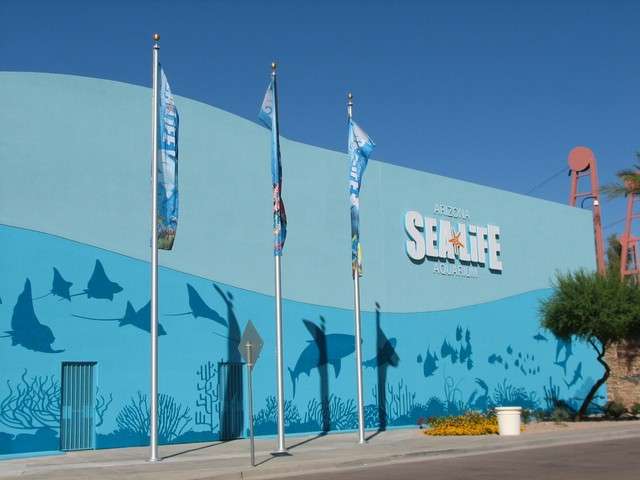
Arizona SEALIFE Aquarium is the second United States location for the Sealife chain, opened in May 2010. There are now four US locations; preceding this one was the Carlsbad (San Diego area) location, and after this one was the Minnesota (Minneapolis/St. Paul area) location (a renaming and refurbishment of the existing Underwater Adventures Aquarium at the Mall of America) and the Grapevine (Dallas/Ft. Worth area) location. Arizona is the smallest of the four at 26,000 square feet. It is located in Tempe, a very large suburb of Phoenix, and is 8 miles Southeast of downtown Phoenix. It is easily reached by several bus lines that connect to the light rail line that serves some of the metro area. The aquarium is inside the Arizona Mills Mall, a massive indoor shopping complex with a mix of standard retail and outlet stores. The part of the building it occupies is on the exterior perimeter, and that part of the façade of the mall has been refurbished with a simple modern form that features a fluid pattern and blue painted silhouettes of sea life. One of the mall entrances is adjacent, and once inside the interior façade of the aquarium space is covered by a floor-to-ceiling mural of larger-than-life fish and corals. The entrance to the aquarium is from the interior of the mall only, and once inside the doorway through the mural an attractive bright modern lobby painted in white and blue with more murals of sea life acts as the ticketing and reception area, with an adjacent darker room serving as a short video introduction before the visit begins. From here, the aquarium unfolds along a one-way circuit through many small exhibit rooms, most of which have low light levels and reasonably realistic theming in contrast to the bright modern look of the exterior and entrance. Like the other locations in the franchise, this one is aimed at young visitors; however, as I found at Carlsbad, the quality of the exhibits and the informational graphics are not as dumbed-down as I imagined they might be. In fact, this one conveys a little more educational focus than Carlsbad since it lacks all the Lego-brand toy tie-ins (sculptures and figures) that the other has since it is next to the company’s Legoland theme park. Species identification signs are simple computer monitors set in the walls with color graphics of the inhabitants, but each screen has more information about each inhabitant (the information slowly cycles for each species) as well as geographic locations and an endangerment scale. These signs are in both English and Spanish. In general, each exhibit focuses on animals that would be found together in the same region or habitat, and many exhibits are grouped in themes so that the arrangement is not completely random and unrelated, although the overall progression through the facility is a bit scatterbrained. The theming is not top-of-the-line and certainly not subtle, but it is also not cheap or temporary; despite its mall location, it does not feel like an aquarium that could be packed up and shipped out to the next location at the drop of a hat. It is not a facility with pedestal tanks or roll-away tanks behind glass windows. Most of the exhibits are of a small to small—medium size, with only a single larger one, but most have a good amount of variety and theming and are in appropriate themed settings. By my count, there are 30 exhibit tanks, with just 3 containing fresh water at the beginning of the circuit. I will describe each themed section of the aquarium as they are encountered along the visitor path.
Exterior:
Freshwater Streams and Lakes is the first exhibit room along the path, and is the aquarium’s nod to relatively local fauna, especially the Colorado River watershed. Two adjacent open-top tanks are set in simulated desert rock, one slightly higher and spilling into the other. The signs for both are identical, and the six species among the two tanks are: bluegill, largemouth bass, black crappie, channel catfish, red-eared sunfish, and common carp. A rocky backdrop has a trickling waterfall into these nice exhibits as well.
Cave is next, and is a narrow passage through desert rockwork with some simulated native Southwest American petroglyphs. There are three tanks here: first is a small bubble tank set in the rockwork for mosquitofish; the sign clearly explains that this introduced species to the Southwest is invasive and competes with native fish. Fine, but with so few oppurtunities to showcase native fish, why choose an introduced species? Despite its nice small-scale space and detail, Cave devolves further from its theme: the second tank is the first salt water one, and contains jewel moray, snowflake moray, zebra moray, and cardinalfish. This small shelf/wall tank would be ideal for desert pupfish or blind cave fish with its smooth underground cave rockwork, but no: the aquarium takes a misstep and places some reef denizens in here! The third exhibit is a transition between this room and the next, and is a low open-top pool set in rocks that appears to be a touchpool, but is not. A stream of water flows through a rocky hole above the surface, but it is unclear if this simulates a tidepool or an underground cave watersource; the inhabitants certainly suggest a tidepool, since they are rainbow wrasse, Catalina goby, Panamic star, and hermit crab. With some touchpools just a room away, I am not sure how they keep little hands from plunging into this exhibit.
Shoreline is next, and features a nice long open-top tank in a rocky desert shore setting with simulated cactus above it that suggests the coastline of the Sea of Cortez, into which the Colorado River (what is left of it after siphoning to places like Phoenix) empties. The surface of this tank rises and falls rather actively with a simulated current and contains king angelfish, surgeonfish, and Cortez rainbow wrasse.
Rockpool continues the Sea of Cortez theming with its dramatic dry rocky coast, and this room features four small touchpools filled with a small selection tidepool invertabrates. The touchpools are attractive and set in rocky outcrops that serve as counters, behind which a staff member can stand to assist and educate.
Rockpool:

Harbor is next, a theme that is split in two since it is interrupted by the next room. The first part of Harbor is a room with two tanks, in a small area that recreates the underside of a pier in a sportfishing harbor, probably like those around the Sea of Cortez in Mexico. The first tank is a small mediocre open-top tank jammed in a corner for Panamic blenny, spotted pufferfish, wrasse, and king angelfish. The second is better, a longer curved open-top tank with simulated pier columns surrounding it; inside is a school of barred flagtail as well as some blueline snapper and leopard shark. Some items of flotsam and jetsam line the sandy bottom to reinforce the theme of the tank.
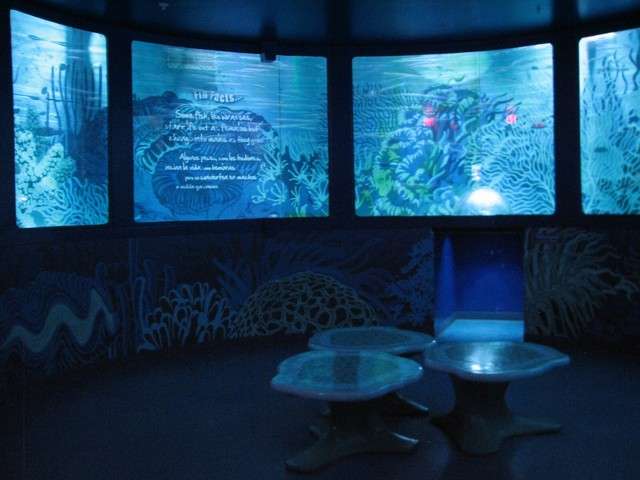
Coral Shoaling Ring is the exhibit room that interrupts the Harbor theme; this room is a modern round room with abstract painted coral graphics, in contrast to the relatively realistic theming of the rest of the exhibit path. Its only exhibit surrounds the room: a narrow cicular tank stretches around the circumference of the room and is filled with more barred flagtail. A current is created in one direction to encourage the inhabitants to swim in one direction against it, circling the room. The only lighting comes from within the tank, which illuminates the background mural and the large simple informational graphics inside. For a small space, this presentation is relatively dramatic and memorable, but its placement along the exhibit path is an unnecessary break from the previous theming. It would have been better as an entry or exit feature, matching the more abstract design of those areas.
Coral Shoaling Ring:
Harbor continues with just one more tank, a small open-top half-round one for sergeant major, spiny pufferfish, and guineafowl pufferfish.
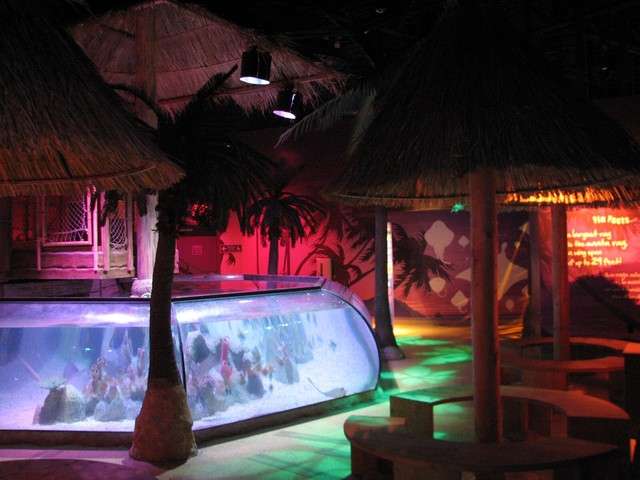
Tropical Bay of Rays is next, a large room filled with simulated palm trunks, palm frond-lined unbrellas, and backed by a sunset mural with palms in silhouette. The single exhibit is an open-top octagonal tank in the center of the room for rays and small sharks, although I did not note the species. On the backside of it is a stairway that leads to a deck, part of which hangs over the tank; that part has a see-through floor, but visitors get a much clearer view of the rays from above when they simply lean over the railing to look down.
Tropical Bay of Rays:
Shipwreck is a nicely themed room of tropical reef tanks set amidst the simulated cargo hold of a sunken galleon. The first of its five tanks is a nice quarter-round open-top tank for firefish, sleeper goby, and blood shrimp. A child-sized pop-up dome window is inside a small passage and provides a great intimate look at the small inhabitants for small visitors. This is followed by a larger round column tank with simulated coral that can be viewed on all sides and contains soldierfish, longfin spadefish, orange-lip tang, and guineafowl pufferfish. One of the simulated outer walls of the ship’s hull is seemingly missing between ribs and opens to a floor-to-ceiling concave viewing window that offers a glimpse into the large Ocean exhibit that will be described later. Next is a small bubble tank set in the wall for purple tang and squareback anthias, followed by another round column tank for lionfish, harlequin tuskfish, honeycomb moray, bannerfish, and peacock grouper. Finally, amidst the simulated treasure chest and cargo theming, is a small shelf tank for pajama cardinalfish, sebae anemone, and mushroom anemone.
After exiting the shipwreck, a passageway leads to the Dive Discovery Theater, an optional branch off the exhibit path that plays short videos in a small simple theater room. When I visited they were screening a film about their affiliation with the Whale and Dolphin Conservation Society.
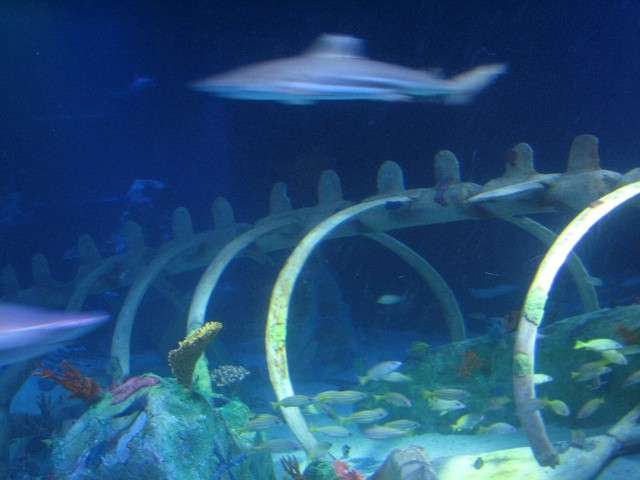
Ocean View is the next room, and it rather oddly revives the desert-like rocky cave aesthetic seen earlier. Murals illustrate sea creatures that only exist in the fossil record, and simulated fossils emerge from the rockwork on the walls. A model of a plesiosaur (Dolichorhynchops?) hangs above the space. At the end of the room is a large window into the only large exhibit at the aquarium, the Ocean exhibit. This nice tank is seen from several sides, including a view mentioned earlier in the Shipwreck. The tank is dominated by the simulated life-size skeleton of a plesiosaur; although this theming device is memorable and adds fun to the display, it is unnecessary. However, it may be useful to young minds for sparking a connection between the current live animals they see on display and the extinct animals they often learn about. This fossil connection probably explains the choice of recreating a rocky desert environment for the viewing room, similar to the environments where many fossils have been unearthed. Ignoring the skeleton inside, the tank itself is a good display full of activity, with a sandy bottom interrupted by rocky and reef outcrops and backwalls that are dimly lit so that the extent of the large tank is reasonably difficult to comprehend. As the star attraction of the aquarium, it has several shark species: sandbar, blacktip reef, and whitetip reef. It also contains Southern stingray, yellow tang, silver mono, blueline snapper, golden trevally, redtoothed triggerfish, and sailfin tang. I suspect there are more species than are identified. One additional exhibit in Ocean View is a wall tank set in the smooth rocky walls, glowing red from lighting within. It is for Pacific Giant Octopus, and is another example of an exhibit that is too small for this species. The fake fossils emerging from the smooth stonework inside the tank make this a ridiculous setting.
Ocean View:
Temple of the Seahorse disrupts the flow of viewing the Ocean exhibit, as suddenly visitors are inside a vaguely Mayan-esque dark jungle-ly room to see three average small half-column tanks. The first contains lined seahorse, cleaner shrimp, bluestripe pipefish, and multi-banded pipefish; the second contains common seahorse, cleaner shrimp, and striped shrimpfish; and the third contains Pacific seahorse and cleaner shrimp.
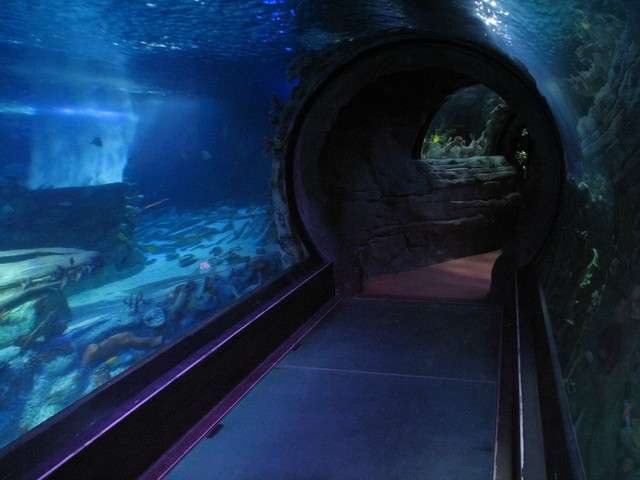
Ocean Tunnel resumes the viewing of the fine Ocean exhibit, this time through a short angled tunnel with viewing on both sides. The visitor path would have been better if this was seen right after the Ocean View room instead of being funneled into the seahorse displays.
Ocean Tunnel:
Jellyfish is a small room dominated by graphics of jellyfish; the single small round wall tank for spotted jellyfish is exceedingly unremarkable in comparison to so many other displays at other aquariums.
Sealife Conservation has some interactive conservation graphics and displays, randomly set in a South American rainforest-themed room. There are two small round tropical tanks in the center: one contains sergeant major, emperor snapper, and green bird wrasse; the other has another child-sized pop-up bubble window and contains blue-green chromis, long-nose hawkfish, and bamboo shark.
The visitor path returns to a more modern abstract aesthetic from here, arriving at a photo purchasing counter and then Playzone, an indoor playground with a nautical theme dominated by a yellow submarine play structure. This final room is the last before exiting to the giftshop and out into the mall, and it has three more tanks: one is a quarter-dome with a simulated giant clam inside and contains regal tang, yellow tang, and cleaner shrimp. The other two are small round wall tanks that can be viewed from Playzone or on the other side from the mall, providing a preview for shoppers outside: one has sergeant major, the other has longhorn cowfish.
Arizona SEALIFE Aquarium is not especially inspiring for an aquarium fan who has seen many other facilities, but it is a satisfactory experience created with care and provides a good introduction to aquatic creatures for small children. It is an asset for those who live in Phoenix, but I would not recommend visitors to the area to go out of their way to see it. It is better than most zoo aquariums I have seen. I rank it at number 36 of the 45 aquarium facilities I have visited; none of its individual exhibits make my top 25 individual exhibits list for fish however. At $18.00 general adult admission, it is overpriced by at least $4, but there are many discounts and options available that make it a possible bargain; for instance, there is currently a weekday ticket for after 4 PM that is only $5! I have posted additional pictures in the gallery.
Arizona SEALIFE Aquarium is the second United States location for the Sealife chain, opened in May 2010. There are now four US locations; preceding this one was the Carlsbad (San Diego area) location, and after this one was the Minnesota (Minneapolis/St. Paul area) location (a renaming and refurbishment of the existing Underwater Adventures Aquarium at the Mall of America) and the Grapevine (Dallas/Ft. Worth area) location. Arizona is the smallest of the four at 26,000 square feet. It is located in Tempe, a very large suburb of Phoenix, and is 8 miles Southeast of downtown Phoenix. It is easily reached by several bus lines that connect to the light rail line that serves some of the metro area. The aquarium is inside the Arizona Mills Mall, a massive indoor shopping complex with a mix of standard retail and outlet stores. The part of the building it occupies is on the exterior perimeter, and that part of the façade of the mall has been refurbished with a simple modern form that features a fluid pattern and blue painted silhouettes of sea life. One of the mall entrances is adjacent, and once inside the interior façade of the aquarium space is covered by a floor-to-ceiling mural of larger-than-life fish and corals. The entrance to the aquarium is from the interior of the mall only, and once inside the doorway through the mural an attractive bright modern lobby painted in white and blue with more murals of sea life acts as the ticketing and reception area, with an adjacent darker room serving as a short video introduction before the visit begins. From here, the aquarium unfolds along a one-way circuit through many small exhibit rooms, most of which have low light levels and reasonably realistic theming in contrast to the bright modern look of the exterior and entrance. Like the other locations in the franchise, this one is aimed at young visitors; however, as I found at Carlsbad, the quality of the exhibits and the informational graphics are not as dumbed-down as I imagined they might be. In fact, this one conveys a little more educational focus than Carlsbad since it lacks all the Lego-brand toy tie-ins (sculptures and figures) that the other has since it is next to the company’s Legoland theme park. Species identification signs are simple computer monitors set in the walls with color graphics of the inhabitants, but each screen has more information about each inhabitant (the information slowly cycles for each species) as well as geographic locations and an endangerment scale. These signs are in both English and Spanish. In general, each exhibit focuses on animals that would be found together in the same region or habitat, and many exhibits are grouped in themes so that the arrangement is not completely random and unrelated, although the overall progression through the facility is a bit scatterbrained. The theming is not top-of-the-line and certainly not subtle, but it is also not cheap or temporary; despite its mall location, it does not feel like an aquarium that could be packed up and shipped out to the next location at the drop of a hat. It is not a facility with pedestal tanks or roll-away tanks behind glass windows. Most of the exhibits are of a small to small—medium size, with only a single larger one, but most have a good amount of variety and theming and are in appropriate themed settings. By my count, there are 30 exhibit tanks, with just 3 containing fresh water at the beginning of the circuit. I will describe each themed section of the aquarium as they are encountered along the visitor path.
Exterior:

Freshwater Streams and Lakes is the first exhibit room along the path, and is the aquarium’s nod to relatively local fauna, especially the Colorado River watershed. Two adjacent open-top tanks are set in simulated desert rock, one slightly higher and spilling into the other. The signs for both are identical, and the six species among the two tanks are: bluegill, largemouth bass, black crappie, channel catfish, red-eared sunfish, and common carp. A rocky backdrop has a trickling waterfall into these nice exhibits as well.
Cave is next, and is a narrow passage through desert rockwork with some simulated native Southwest American petroglyphs. There are three tanks here: first is a small bubble tank set in the rockwork for mosquitofish; the sign clearly explains that this introduced species to the Southwest is invasive and competes with native fish. Fine, but with so few oppurtunities to showcase native fish, why choose an introduced species? Despite its nice small-scale space and detail, Cave devolves further from its theme: the second tank is the first salt water one, and contains jewel moray, snowflake moray, zebra moray, and cardinalfish. This small shelf/wall tank would be ideal for desert pupfish or blind cave fish with its smooth underground cave rockwork, but no: the aquarium takes a misstep and places some reef denizens in here! The third exhibit is a transition between this room and the next, and is a low open-top pool set in rocks that appears to be a touchpool, but is not. A stream of water flows through a rocky hole above the surface, but it is unclear if this simulates a tidepool or an underground cave watersource; the inhabitants certainly suggest a tidepool, since they are rainbow wrasse, Catalina goby, Panamic star, and hermit crab. With some touchpools just a room away, I am not sure how they keep little hands from plunging into this exhibit.
Shoreline is next, and features a nice long open-top tank in a rocky desert shore setting with simulated cactus above it that suggests the coastline of the Sea of Cortez, into which the Colorado River (what is left of it after siphoning to places like Phoenix) empties. The surface of this tank rises and falls rather actively with a simulated current and contains king angelfish, surgeonfish, and Cortez rainbow wrasse.
Rockpool continues the Sea of Cortez theming with its dramatic dry rocky coast, and this room features four small touchpools filled with a small selection tidepool invertabrates. The touchpools are attractive and set in rocky outcrops that serve as counters, behind which a staff member can stand to assist and educate.
Rockpool:

Harbor is next, a theme that is split in two since it is interrupted by the next room. The first part of Harbor is a room with two tanks, in a small area that recreates the underside of a pier in a sportfishing harbor, probably like those around the Sea of Cortez in Mexico. The first tank is a small mediocre open-top tank jammed in a corner for Panamic blenny, spotted pufferfish, wrasse, and king angelfish. The second is better, a longer curved open-top tank with simulated pier columns surrounding it; inside is a school of barred flagtail as well as some blueline snapper and leopard shark. Some items of flotsam and jetsam line the sandy bottom to reinforce the theme of the tank.
Coral Shoaling Ring is the exhibit room that interrupts the Harbor theme; this room is a modern round room with abstract painted coral graphics, in contrast to the relatively realistic theming of the rest of the exhibit path. Its only exhibit surrounds the room: a narrow cicular tank stretches around the circumference of the room and is filled with more barred flagtail. A current is created in one direction to encourage the inhabitants to swim in one direction against it, circling the room. The only lighting comes from within the tank, which illuminates the background mural and the large simple informational graphics inside. For a small space, this presentation is relatively dramatic and memorable, but its placement along the exhibit path is an unnecessary break from the previous theming. It would have been better as an entry or exit feature, matching the more abstract design of those areas.
Coral Shoaling Ring:

Harbor continues with just one more tank, a small open-top half-round one for sergeant major, spiny pufferfish, and guineafowl pufferfish.
Tropical Bay of Rays is next, a large room filled with simulated palm trunks, palm frond-lined unbrellas, and backed by a sunset mural with palms in silhouette. The single exhibit is an open-top octagonal tank in the center of the room for rays and small sharks, although I did not note the species. On the backside of it is a stairway that leads to a deck, part of which hangs over the tank; that part has a see-through floor, but visitors get a much clearer view of the rays from above when they simply lean over the railing to look down.
Tropical Bay of Rays:

Shipwreck is a nicely themed room of tropical reef tanks set amidst the simulated cargo hold of a sunken galleon. The first of its five tanks is a nice quarter-round open-top tank for firefish, sleeper goby, and blood shrimp. A child-sized pop-up dome window is inside a small passage and provides a great intimate look at the small inhabitants for small visitors. This is followed by a larger round column tank with simulated coral that can be viewed on all sides and contains soldierfish, longfin spadefish, orange-lip tang, and guineafowl pufferfish. One of the simulated outer walls of the ship’s hull is seemingly missing between ribs and opens to a floor-to-ceiling concave viewing window that offers a glimpse into the large Ocean exhibit that will be described later. Next is a small bubble tank set in the wall for purple tang and squareback anthias, followed by another round column tank for lionfish, harlequin tuskfish, honeycomb moray, bannerfish, and peacock grouper. Finally, amidst the simulated treasure chest and cargo theming, is a small shelf tank for pajama cardinalfish, sebae anemone, and mushroom anemone.
After exiting the shipwreck, a passageway leads to the Dive Discovery Theater, an optional branch off the exhibit path that plays short videos in a small simple theater room. When I visited they were screening a film about their affiliation with the Whale and Dolphin Conservation Society.
Ocean View is the next room, and it rather oddly revives the desert-like rocky cave aesthetic seen earlier. Murals illustrate sea creatures that only exist in the fossil record, and simulated fossils emerge from the rockwork on the walls. A model of a plesiosaur (Dolichorhynchops?) hangs above the space. At the end of the room is a large window into the only large exhibit at the aquarium, the Ocean exhibit. This nice tank is seen from several sides, including a view mentioned earlier in the Shipwreck. The tank is dominated by the simulated life-size skeleton of a plesiosaur; although this theming device is memorable and adds fun to the display, it is unnecessary. However, it may be useful to young minds for sparking a connection between the current live animals they see on display and the extinct animals they often learn about. This fossil connection probably explains the choice of recreating a rocky desert environment for the viewing room, similar to the environments where many fossils have been unearthed. Ignoring the skeleton inside, the tank itself is a good display full of activity, with a sandy bottom interrupted by rocky and reef outcrops and backwalls that are dimly lit so that the extent of the large tank is reasonably difficult to comprehend. As the star attraction of the aquarium, it has several shark species: sandbar, blacktip reef, and whitetip reef. It also contains Southern stingray, yellow tang, silver mono, blueline snapper, golden trevally, redtoothed triggerfish, and sailfin tang. I suspect there are more species than are identified. One additional exhibit in Ocean View is a wall tank set in the smooth rocky walls, glowing red from lighting within. It is for Pacific Giant Octopus, and is another example of an exhibit that is too small for this species. The fake fossils emerging from the smooth stonework inside the tank make this a ridiculous setting.
Ocean View:

Temple of the Seahorse disrupts the flow of viewing the Ocean exhibit, as suddenly visitors are inside a vaguely Mayan-esque dark jungle-ly room to see three average small half-column tanks. The first contains lined seahorse, cleaner shrimp, bluestripe pipefish, and multi-banded pipefish; the second contains common seahorse, cleaner shrimp, and striped shrimpfish; and the third contains Pacific seahorse and cleaner shrimp.
Ocean Tunnel resumes the viewing of the fine Ocean exhibit, this time through a short angled tunnel with viewing on both sides. The visitor path would have been better if this was seen right after the Ocean View room instead of being funneled into the seahorse displays.
Ocean Tunnel:

Jellyfish is a small room dominated by graphics of jellyfish; the single small round wall tank for spotted jellyfish is exceedingly unremarkable in comparison to so many other displays at other aquariums.
Sealife Conservation has some interactive conservation graphics and displays, randomly set in a South American rainforest-themed room. There are two small round tropical tanks in the center: one contains sergeant major, emperor snapper, and green bird wrasse; the other has another child-sized pop-up bubble window and contains blue-green chromis, long-nose hawkfish, and bamboo shark.
The visitor path returns to a more modern abstract aesthetic from here, arriving at a photo purchasing counter and then Playzone, an indoor playground with a nautical theme dominated by a yellow submarine play structure. This final room is the last before exiting to the giftshop and out into the mall, and it has three more tanks: one is a quarter-dome with a simulated giant clam inside and contains regal tang, yellow tang, and cleaner shrimp. The other two are small round wall tanks that can be viewed from Playzone or on the other side from the mall, providing a preview for shoppers outside: one has sergeant major, the other has longhorn cowfish.
Arizona SEALIFE Aquarium is not especially inspiring for an aquarium fan who has seen many other facilities, but it is a satisfactory experience created with care and provides a good introduction to aquatic creatures for small children. It is an asset for those who live in Phoenix, but I would not recommend visitors to the area to go out of their way to see it. It is better than most zoo aquariums I have seen. I rank it at number 36 of the 45 aquarium facilities I have visited; none of its individual exhibits make my top 25 individual exhibits list for fish however. At $18.00 general adult admission, it is overpriced by at least $4, but there are many discounts and options available that make it a possible bargain; for instance, there is currently a weekday ticket for after 4 PM that is only $5! I have posted additional pictures in the gallery.


