
Oakland Zoo is a mid-sized zoo with a well-rounded collection that represents a variety of geographic regions and animal types, displayed in mostly good-to-above average habitats. It is located on a hilly site perched above the densely developed shoreline of San Francisco Bay in Knowland Park, 8 miles from downtown Oakland. The citys larger neighbor across the bay is San Francisco, whose own zoo is 19 miles away from this one. While San Francisco Zoo can be considered a large one, the smaller Oakland Zoo is not its dumb nephew; its exhibit quality and organization match or surpass the more famous one in many examples. It is also blessed with warmer sunnier weather on many days, thanks to its location away from the often-foggy ocean shore of San Francisco. There are two entrances to the zoo, with the main entrance and parking lot located toward the higher part of the site near steep slopes of grass and clumps of non-native trees that rise to the upper ridges of the park as well as suburban home developments nearby. Just outside the main entrance is a free-admission area called Rides Area that features several rotating childrens rides, a childrens rollercoaster, a window-service food stand, and a birthday party area. The rides are an additional fee of course, and it is nice to have this area outside the zoo rather than a loud distraction inside the facility. In fact, this zoo emphasizes quiet more than any other I have visited and is absolutely plastered with signs featuring a logo for their own etiquette program called Quiet Coyote, whose byline is ‘reminding us to speak softly around wild animals’. The logo features a silhouette of a coyote head with a human hand in shadow making the shape of a coyote head behind it. Another feature of the Rides Area is the thatched shelter depot for the Outback Express Train, a separate-fee ride and the only way to see the newest exhibit at the zoo, Wild Australia. It is a standard small-gauge locomotive pulling several open-air passenger cars, with an interesting route. It begins in the Rides Area, then enters the zoo site and runs behind the main entrance and around the upper rim of the narrow valley of the deer exhibit described later, then loops around a plateau that is out of view from the rest of the zoo. Inside that loop is the single exhibit of Wild Australia, a yard for wallaroo and emu that surrounds the train tracks. I can not review the new exhibit, I ran out of time to ride the train! It sounds like it could be a pleasant area, especially with the possibility of the animals crossing the route and being so close. The route then backtracks the way it came to exit the zoo site and loop around the Rides Area before ending.
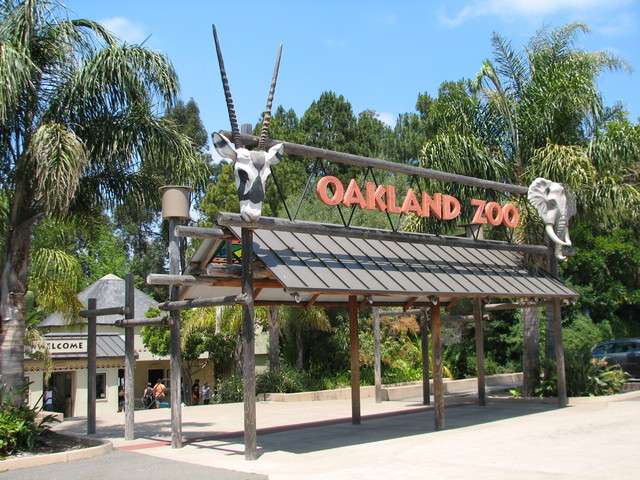
The main entrance of the zoo is called Karibu Village and is a small attractive African-themed cluster of rustic stucco buildings surrounding the entrance arch and ticket booths. One side has the Island Café, with indoor counter service and a dining area, as well as two outdoor dining terraces. The other side has the Gift Shop, visitor services, and restrooms. The buildings are covered with simulated safari travel posters and props that recreate a small faded settlement on the edge of civilization, and it sets the tone for the adventure to follow. A single animal exhibit on the far side of the plaza completes the village, a very nice open yard with a roomy pond and exotic plant backdrop for lesser flamingo and African spoonbill with a rocky waterfall on one side. One of the dining terraces is adjacent to it and creates a pleasant scene. Unfortunately, the main African exhibit area described later is not adjacent to this entrance, but is reached by a dull path from here that travels along the fence that separates it from the Rides Area. The only ride within the zoo is the Sky Ride, a long 20-minute skilift-chair-type ride that boards near the village. It follows a straight route, rising all the way to a turnaround on top of a ridge far above the zoo, with great views of the bay and hills as well as a few of the animal exhibits below it. The zoo can be generally organized into three zones. The upper part of the site is primarily composed of African exhibits; it is not a themed exhibit complex (although one part of it can be considered as such) but rather a group of individual exhibits from different building periods that link together well, although they are scattered along several paths rather than a single looping one. The middle elevation part of the zoo is another zone, primarily composed of tropical rain forest exhibits from around the world. Again, it is not a themed exhibit complex, with various mismatched exhibits from various eras located haphazardly on several routes. It is the most uneven of the zones. Finally, the lower portion of the site is another zone, this time the Childrens Zoo, that was built at the same time and is cohesive enough to be considered a themed exhibit complex. All three zones feature large swaths of exotic plantings, and many parts of the site have views of mature plantings and grassy slopes beyond the property.
Main Entrance:
After traveling the path from the main entrance to the primarily African exhibit zone, the first exhibit seen is African Veldt for reticulated giraffe, common eland, and addra gazelle. It is a long dusty sloped yard studded with rocks and some mature Canary Island date palms, viewed from across a long water moat. The back of it is contained within a high fence, part of it made of wood planks, the other part chainlink. Behind it is a solid leafy backdrop of trees. It is an average nice active exhibit. Nearby is a steep sloped yard for dromedary camel, contained within chainlink fencing. Its large expanse is bland, but it acts as the transition zone to the grassy hills beyond. The Sky Ride passes over this habitat, and continues beyond it over an even larger fenced sloped yard for bison and tule elk that has no pedestrian access. Their habitat rises to a large undeveloped part of the zoo; the master plan calls for a second Sky Ride to reach the top, where a North American themed exhibit complex is envisioned (thus these two North American species will not feel out-of-place next to all the African animals!). Simba Pori, or Lion Country, is the name of the African lion exhibit next to the camels. It is a nice large habitat with a dual personality, viewed from two different viewing areas. The first viewing area is reached through an attractive hut-like archway and set of stairs through a simulated kopje landscape, and ends with an open panorama of a grassy slope studded with rock outcrops for the lions. Reached further down the main path, the second viewing area is on an elevated timber boardwalk; it looks into a little valley with a small pond, completely surrounded by mature oaks and eucalyptus that form a shady retreat with opportunities for privacy. The chainlink fencing that surrounds this area is not distractingly visible, but the tree types do little to recreate Africa, making it an uneven exhibit. This is typical of many of the larger habitats, where the existing elevations and foliage (and sometimes, older structures) are taken into account in the design of more recent exhibits. Near the lions is a nice mid-to-large size aviary within a rectangular steelpole-and-netted enclosure that is densely planted. It contains a nice collection of birds, including blue-bellied roller, orange bishop, Fischers lovebird, red-billed hornbill, taveta golden weaver, speckled pigeon, spur-winged lapwing, white-vented bulbul, tambourine dove, Lilford crane (from Russia), Egyptian goose, hamerkop, white-faced whistling duck, and Hottentot teal. This leads to the area of this zone that can be considered a themed exhibit complex, African Village. It begins with a scenic path planted with tree aloes and small acacias and other South African shrubs, leading to another steelpole-and-netted aviary. This one is smaller but taller than the first, and viewed from both sides. It contains pied crow, Hadada ibis, buff-crested bustard, red-billed hornbill, cattle egret, and sacred ibis. Next is a rocky grotto viewed from behind a low glass railing for African spurred tortoise, next to a rustic stucco shelter with a short interior hallway for viewing three reptile exhibits. The one on either end is a small raised room exhibit behind glass with average rocky detail, one for Sudan and giant plated lizards and the other for royal python. The one in the middle is a very nice full room behind glass for white-throated monitor, with rocky walls ascending to an unseen skylight that creates a bright grotto. Back outside, low rock outcrops and a stone statue of an African mother and child lead to the central exhibit of this small loop, for slender-tailed meerkat, which is viewed from short glass railing areas on several sides. It is a fine exhibit, with a large termite mound group in the middle, scatterings of savanna plants, and a termite mound viewing tunnel for children. Nearby is a steelpole-and-netted habitat with a grassy slope inside for green monkey; it is large but could use more vegetation toward the back. Since they are primarily ground-dwellers, climbing structures inside are fairly minimal. All the paving in this area is dusty decomposed aggregate, and this lends a rustic authenticity to the feeling of the area, especially in the open plaza that fronts a group of three round buildings. They compose the village itself, and each is a round hut with a peaked thatched roof. One is an open-air dining shelter for another, which houses the window-service African Savanna Café. The third is an interior exhibit that recreates a traditional East African womans dwelling, with a central open kitchen and thatched bedroom and storage room and animal pen. Next to the buildings is a small deck that is the only viewing area for the spotted hyena exhibit. This fairly large habitat is a steep sloped fenced yard far below the deck, shaded by mature eucalyptus trees. Again, it is one of the larger habitats at the zoo that is carved in a makeshift fashion from the existing topography and flora, and appears as such, with little of the feeling of Africa. On the other side of the African Village is another small viewing area into an even larger sloped habitat dotted with eucalyptus; it is for Grants zebra. These last two habitats of this complex are spatially pleasant for their inhabitants, but aesthetically they work against the theme; native Africa does not have eucalyptus stands, and eucalpytus stands prevent most other plants from growing beneath them (well, so do zebras!). Away from the African Village, another path ends at Mahali Pa Tembo, or Place of the Elephant, a very large exhibit for African elephant. Its main yard is viewed across a moat and is a dusty area with occasional rock outcrops, termite mounds, and timber poles. A nicely detailed large rocky swimming pool is located right next to the viewing path as well. The extent of the main yard is contained within a curved plain concrete wall, but later additions beyond it have increased the size by placing earth slopes up its sides for access to back areas contained within heavy steel bar fences. One of these areas is a small alcove set within the eucalyptus forest that creates a backdrop for much of the habitat; another is a larger open grassy slope that rises far beyond and out of view; and yet another area (or two) can be separated and is out of view entirely, leading to a barn that is down the slope from the viewing area. I believe the total exhibit area is 6 acres, and while it is not the most scenic it is certainly one of the larger zoo elephant habitats and a proud feature of this facility. Another area of the African exhibit zone has an average fenced yard with several simulated burrows for warthog, and this leads to the last and newest exhibit of this zone: Baboon Cliffs. This exhibit for Hamadryas baboon opened less than a year ago, and was built to eventually house the giant pandas for which the zoo has been negotiating. It is viewed from a raised long boardwalk that ends with a small shelter; immediately adjacent to the boardwalk is a sterile concrete moat, which rises to a large grassy yard on a slope above the walkway. The yard is clumsily terraced with three long concrete walls, and scattered with several junky little shed platforms for the animals. The entire yard is chainlink fenced, except for the top backdrop, which is a detailed rockwork cliff to hide the night quarters building behind it. Plants such as timber bamboo will eventually grow to conceal much of the fencing, but it appears that the interior of the space will always be too abstract. As a baboon exhibit, it is spatially generous. As a panda exhibit, it will be the weakest of those in the United States, with far viewing and little naturalism or detail and little insight into the husbandry part of the facility. Its dead-end walkway will be a crowd access nightmare, and the slopes of the paths that lead to the walkway are steep enough to make a queue to the exhibit an uncomfortable experience for standing. In fact, the slopes of the paths may be greater than 8%, which would make it technically inaccessible for wheelchairs under ADA guidelines. Pre-building this exhibit in anticipation of the bears arrival may have been the wrong move with the results achieved here.
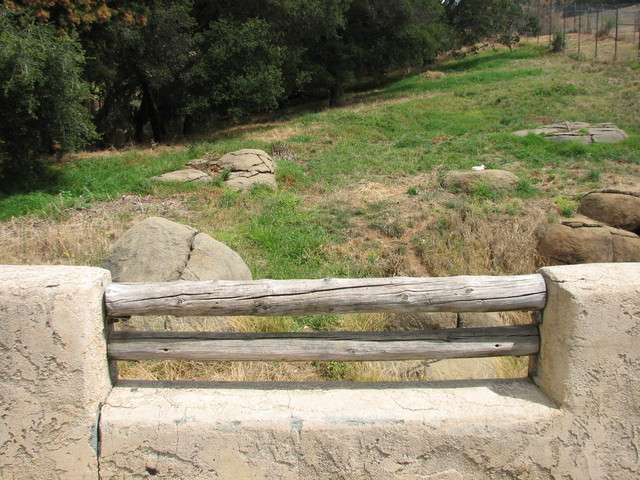
Simba Pori, or Lion Country, for African lion:
This is the grassy hillside section which is about half of the total exhibit.
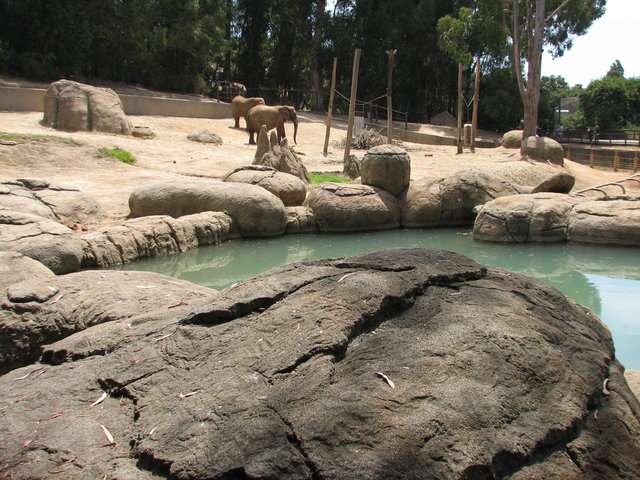
Mahali Pa Tembo, or Place of the Elephant, for African elephant:
This is the dusty main yard and swimming pool which is only a part of the vast exhibit space.
The middle elevation area of the zoo is the zone primarily composed of tropical rain forest exhibits and is lushly planted with many exotics. It has 7 Asian exhibits, 3 African exhibits, 4 South American exhibits, and 1 North American exhibit in a range of various quality habitats. Two of the large Asian exhibits are clustered together and fill a small valley. The first is a nice fenced yard for sika deer and Reeves and Indian muntjacs. It fills the head of the valley and is viewed from the rim of one side, while the train route follows the rim of the other side. It is filled with shrubs that the deer do not eat, providing a nice green scene criss-crossed by deer paths. At the bottom is a small pond, and a wooded area on one side provides plenty of cover for them to hide. A tall opaque fence divides this habitat from the even larger one adjacent, for Malayan sun bear. This excellent exhibit is viewed from a thatched shelter perched above one side of the canyon, as well as a glass railing at the mouth of the canyon floor. Inside is a pond surrounded by palms, a thicket of shrubs, grassy slopes, two climbing structures, and a large simulated tree trunk for climbing with a roost at the top. Containing these features is a wall that is simulated rock in some places and stucco in others, with a lush forest backdrop spilling over. Several of the climbing structures provide the bears with eye-level views of the humans in the upper viewing shelter. This is the largest and best sun bear exhibit I have seen, although not as finely detailed as the ones in San Diego or Columbus. In another area, another large lush exhibit is for tiger (unidentified species). Although one viewing area is through chainlink fencing in a shady spot, the other side of the exhibit has a viewing deck perched above for a nice view of the expanse. It is flat but scattered with trees and shrubs and deadfalls, as well as a rocky cliff on one side to conceal the bedroom building. The two tigers are former circus performers and lived in 3’x6’ cages previously. Another fine exhibit is for white-handed gibbon, with a lush island surrounded by a moat. Inside are rocky outcrops smothered by plants, and several live trees with sparse foliage in which they swing and perch. Nearby is a similar exhibit for siamang; it has a series of timber poles connected by ropes instead of the live trees, but both are roomy uncaged gems. An average medium steelpole-and-netted aviary is nearby for Malayan wreathed hornbill. Another cluster of exhibits is a timepiece of 1950s fluid curved gunnite design, and is primarily South American. It starts with a sheltered area for a small room exhibit behind glass for yellow anaconda; the shelter ends as the path follows the architectural curve of the backwall of the next exhibit, which is an outdoor bowl-shaped grotto for blue-and-gold macaw. Their exhibit is filled with branches for perching, but I can imagine that at one time it was a deeper grotto for some poor small carnivore. Connected to this is another shelter with a swooping roof and several small chimney skylights that make it appear as if the hobbits live there! Inside are two average small terrariums, one for Taiwan beauty snake and the other for Nosy Be panther chameleon. The connected walls then curve to form another bowl-shaped habitat, this time enclosed within a mesh tent propped up by a large steel umbrella pole; inside is a nice leafy exhibit for cotton-topped tamarin and chestnut-mandibled toucan. One other South American exhibit is seperate, an average steel-and-mesh cage for squirrel monkey that has a nice rocky and plant-filled interior. A poor steel cage only filled with architectural play elements for chimpanzee, a timber-and-mesh large exhibit with a rocky landscape for griffon vulture (formerly for Hamadryas baboon), and a short timber-and-mesh exhibit with thick plantings for bobcat round out the offerings of this part of the zoo.
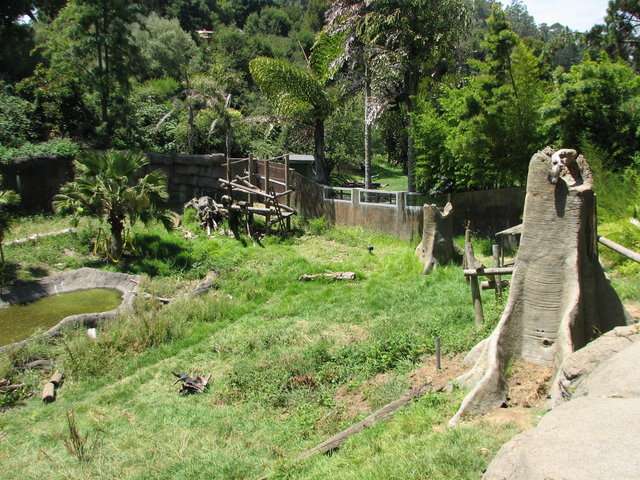
Malayan Sun Bear Exhibit:
This is a view from the upper viewing shelter looking down at the sunnier, more open half of the habitat.
The last zone of the zoo is on its lowest elevation and is the excellent Childrens Zoo. Its many features were constructed at the same time several years ago, and can be considered a themed exhibit complex, although its theme is so broad that it loses focus. It is so diverse that it seems like another major component of the zoo. In fact, its mix of domestic and wild animal exhibits from around the world would hardly seem like a childrens zoo if there were not as many play elements scattered around as there are. The scale of many of the wild animal exhibits is large and not very different from others in the zoo. The space between exhibits is also generous, so that it lacks the traditional intensity and sheltered feeling of this type of facility. Despite these slight criticisms of the result not matching the usual intent of a childrens zoo, the complex shines. It begins with a small entry plaza with a sign surrounded by several curving concrete forms made to look like a few giant snakes emerging from the ground, slithering around groups of large simulated eggs scattered amongst some erect rustic wood poles randomly fixed in the paving. Small metal bug sculptures are imbedded in the paving in random places, and they are also used throughout the complex with a delightful result, fixed to steps and walls and paving. I will not describe the scattered exhibits in strict order as they are encountered, as multiple paths provide a variety of experience options, but I will start with the wild animal ones followed by the domestics. The largest bat exhibit I have ever seen is here, for Malayan and Island flying foxes. It is housed in an immense tall hexagonal steel flight cage. The cage is entered through a doorway; within is a long sheltered viewing area separated by fabric mesh from the habitat itself. There is also a low building adjacent to the viewing area with four windows that look into the night quarters for the bats. Due to the roof overhead, observing the bats in flight in the upper space of the cage is only possible from outside the exhibit. The habitat is grassy, with scattered clumps of bamboo and other exotic shrubs. Simulated rock ledges rise at the back of the exhibit since it is nestled against a steep hill. A series of timber poles supports a network of ropes and horizontal mesh panels to provide a continuous area for climbing and hanging at eye level for the numerous inhabitants, since they fly infrequently. There are also plush bears hanging from the mesh, a form of enrichment, that are periodically moved by the keepers! When I visited, the bats seemed to be avoiding the toys as well as each other, a goal that is easily achieved in such a large and notable habitat. Next to it is another notable exhibit for ring-tailed and blue-eyed lemurs set within a large fenced steep slope. Inside are several impressive ledges of simulated rock that form a central terrace at viewing level; it supports a tall lengthy climbing structure of steel poles connected by steel ladders and ropes strung between. The habitat is mostly grassy, with scattered bamboo and flax clumps, and densely planted beyond the fenceline. The habitat drops in a moat below the viewing area, which is an attractive long series of railings and shelters and stucco planters that are on the roof of a modern stucco building complex composed of the lemur bedrooms, visitor restrooms, and the Reptile and Amphibian House. The latter is reached by going down stairs or an elevator to the ground, which has two sets of two doors (one regular sized, the other child-sized) into the one-room exhibit hall. Each of the 6 exhibits within are fine and detailed ones. The center of the room has a North American Southeast exhibit in a medium-sized square behind glass that can be viewed on all sides for green and gray tree frogs, green anole, and three-toed box and spotted turtles. The other 5 are wall terrariums of various sizes, beginning with a Madagascar exhibit with golden mantella frog, giant leaf-tailed gecko, and fringed leaf-tailed gecko. Next is an exhibit for black tree monitor, followed by a wet leafy one for Panamanian golden frog. The longest exhibit is next, a South American one for red-tailed boa, emerald tree boa, and dyeing and Golfodulcean poison dart frogs. Last, a North American Southwest exhibit features Gila monster, chuckwalla, and desert spiny lizard. Back outside, a scenic rock face features a partially exposed simulated fossil skeleton of a crocodilian; it is the back wall of a great habitat for American alligator that is viewed from several areas, including two underwater panels. The exhibit is contained within low rockwork walls on a few sides, while another side has railings and a further low metal fence that provide close views of the gators when they lie on a sandy beach. The waterway varies in depth, and curves around several grassy land areas on low banks scattered with clumps of shrubs. Several other exposed reptile skeletons set within simulated rock outcrops surround the exhibit, as well as a small sandpit for play with an alligator statue in the middle. A few other play areas are nearby, one being a small shallow pond with aquatic plants that is crossed by a series of simulated lily pads for stepping and the other a rubberized surface for climbing several frog statues. Another play feature of a few simulated tree trunks with a log slide fronts one of the many viewing points for an excellent river otter exhibit; it is a large complex habitat that can be divided in two at a small choke point in its exposed riverbank rockwork. Both halves feature small streams set in lush grassy meadows scattered with shrubs and conifers, and both have pools with underwater viewing panels as well as several other intimate railings or panels at various heights for additional views. A small waterfall also spills into one of the exhibits. When I visited, the otters were able to use both parts and I never saw them in the same place twice as they enjoyed their entire engaging habitat. Nearby is another play feature, this time a life-size statue of a tortoise and two crawl-in tortoise shells for posing, set in a rubberized play area surrounded by clumps of flax and small palms. This area is in front of an attractive low building with windows that view inside the bedrooms for Aldabra tortoise. On the other side of their exhibit, low railings separate two large grassy outdoor yards for them that are raised in the back to cover their indoor holding building. Most of the wild animal exhibits described so far are large enough that they do not provide reliably close views for children; I grew up with the one at the San Diego Zoo, so am used to much smaller intimate enclosures. Truly wild animals are the focus of another part of this complex, a small garden with plants that attract butterflies. This garden is on the edge of a large central lawn with an arc of concrete seats on one side and a rubberized play area on another edge; the play area is composed of a standard spider web rope structure and several insect statues to climb. Appropriately, nearby is the House of Bugs, housed in a low modern concrete masonry unit structure with an undulating façade and several oversized ant statues clinging to its roofline above the door. Once inside the small dark exhibit hall, a series of 4 rocky panels set in the back wall dominate the space, each with a different configuration of tiny caverns behind glass. The first panel has 4 connecting ones for honey pot ant, 1 for vinegaroon, 1 for Madagascar hissing cockroach, 1 for Asian forest scorpion, 1 for cobalt blue tarantula, and 1 for black widow spider that is only lit when visitors discover an unsigned button nearby. The second panel has a larger cavern for giant cave cockroach, one for Chilean rose-haired tarantula, and another tiny cavern that visitors illuminate themselves, although I forgot to note what it held. The third panel is dominated by a look-down display into a carpet of dermestid beetles, while the other 4 smaller caverns are connected to each other for leafcutter ant. The fourth panel has a clear tube along its front for leafcutter ant, which is connected to the caverns in the third panel as well as a small room nearby behind wire that has a source tree from which the ants gather. An empty exhibit and a few tiny caverns that appear to be connected were currently empty in the fourth panel, but 2 others feature dead leaf mantid. There are also 2 average medium terrariums on pedestals in the exhibit room, one absolutely brimming with giant thorny, Vietnamese, and New Guinea walking sticks; and the other with a few giant African millipedes. Although not as complete as some insect displays, this is still a fine House of Bugs. Back outside, the façade of the building continues as the stage wall for the Wildlife Theater; the wall ends to open to the entrance next to the stage, from which a small concrete-stepped outdoor amphitheater with integrated loudspeakers radiates. The small stage is for animal presentations, and several animal statues are perched on the sides of the stage walls in the shade of an awning that stretches over most of the theater. It is the only dedicated showplace at the zoo, and as such is a nice facility although may be too small on select days. Domestic animals are represented by a large grassy fenced slope for rabbits with a small building with a window view of their bedroom; pigs in two side-by-side grassy pens backed by a small barn; and goats and sheep in a contact yard with a large barn on one side. The goats and sheep have a rather impressive large grassy yard for this type of display, complete with a rocky outcrop they can climb that is off-limits to visitors. An attractive complex of several barn-like buildings around a plaza form the Education Center at the far end of the Childrens Zoo, complete with an auditorium and a small lower entrance to the zoo property that fronts a picnic area in Knowland Park. The fine Childrens Zoo would obviously be right at home at any major zoo.
Malayan and Island Flying Foxes Exhibit:
Does the scale of this fine exhibit look like a good match for a childrens zoo? In the foreground is the goat and sheep contact yard.

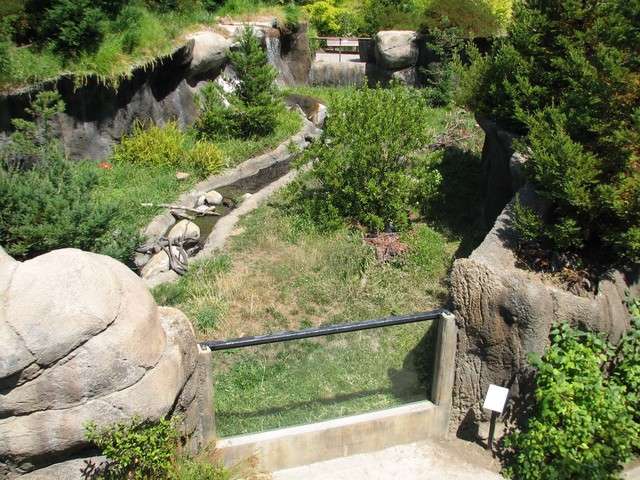
River Otter Exhibit:
This view represents only about a third of this excellent habitat composed of two yards.
As a mid-sized zoo, I rank Oakland Zoo at number 43 of the 55 zoos I have visited. It has some limitations to its collection and organization and certain exhibits that make it currently deserve this seemingly lower ranking, but it is still an enjoyable facility. The proposed North American complex will move it up to the ranks of a major zoo, and probably move it up in my rankings too; I imagine it will surpass my opinion of the major zoo across the bay once it does so. The fine Childrens Zoo does not make my list of top themed exhibit complexes, but it nearly does; its river otter exhibit does make my list of top 25 individual small mammal exhibits, at number 23. Other near-misses of my top lists include the exhibits for Malayan sun bear, white-handed gibbon, Malayan and Island flying foxes, and American alligator. General adult admission is $11, which is a buck overpriced. I have posted additional pictures in the gallery.
The main entrance of the zoo is called Karibu Village and is a small attractive African-themed cluster of rustic stucco buildings surrounding the entrance arch and ticket booths. One side has the Island Café, with indoor counter service and a dining area, as well as two outdoor dining terraces. The other side has the Gift Shop, visitor services, and restrooms. The buildings are covered with simulated safari travel posters and props that recreate a small faded settlement on the edge of civilization, and it sets the tone for the adventure to follow. A single animal exhibit on the far side of the plaza completes the village, a very nice open yard with a roomy pond and exotic plant backdrop for lesser flamingo and African spoonbill with a rocky waterfall on one side. One of the dining terraces is adjacent to it and creates a pleasant scene. Unfortunately, the main African exhibit area described later is not adjacent to this entrance, but is reached by a dull path from here that travels along the fence that separates it from the Rides Area. The only ride within the zoo is the Sky Ride, a long 20-minute skilift-chair-type ride that boards near the village. It follows a straight route, rising all the way to a turnaround on top of a ridge far above the zoo, with great views of the bay and hills as well as a few of the animal exhibits below it. The zoo can be generally organized into three zones. The upper part of the site is primarily composed of African exhibits; it is not a themed exhibit complex (although one part of it can be considered as such) but rather a group of individual exhibits from different building periods that link together well, although they are scattered along several paths rather than a single looping one. The middle elevation part of the zoo is another zone, primarily composed of tropical rain forest exhibits from around the world. Again, it is not a themed exhibit complex, with various mismatched exhibits from various eras located haphazardly on several routes. It is the most uneven of the zones. Finally, the lower portion of the site is another zone, this time the Childrens Zoo, that was built at the same time and is cohesive enough to be considered a themed exhibit complex. All three zones feature large swaths of exotic plantings, and many parts of the site have views of mature plantings and grassy slopes beyond the property.
Main Entrance:

After traveling the path from the main entrance to the primarily African exhibit zone, the first exhibit seen is African Veldt for reticulated giraffe, common eland, and addra gazelle. It is a long dusty sloped yard studded with rocks and some mature Canary Island date palms, viewed from across a long water moat. The back of it is contained within a high fence, part of it made of wood planks, the other part chainlink. Behind it is a solid leafy backdrop of trees. It is an average nice active exhibit. Nearby is a steep sloped yard for dromedary camel, contained within chainlink fencing. Its large expanse is bland, but it acts as the transition zone to the grassy hills beyond. The Sky Ride passes over this habitat, and continues beyond it over an even larger fenced sloped yard for bison and tule elk that has no pedestrian access. Their habitat rises to a large undeveloped part of the zoo; the master plan calls for a second Sky Ride to reach the top, where a North American themed exhibit complex is envisioned (thus these two North American species will not feel out-of-place next to all the African animals!). Simba Pori, or Lion Country, is the name of the African lion exhibit next to the camels. It is a nice large habitat with a dual personality, viewed from two different viewing areas. The first viewing area is reached through an attractive hut-like archway and set of stairs through a simulated kopje landscape, and ends with an open panorama of a grassy slope studded with rock outcrops for the lions. Reached further down the main path, the second viewing area is on an elevated timber boardwalk; it looks into a little valley with a small pond, completely surrounded by mature oaks and eucalyptus that form a shady retreat with opportunities for privacy. The chainlink fencing that surrounds this area is not distractingly visible, but the tree types do little to recreate Africa, making it an uneven exhibit. This is typical of many of the larger habitats, where the existing elevations and foliage (and sometimes, older structures) are taken into account in the design of more recent exhibits. Near the lions is a nice mid-to-large size aviary within a rectangular steelpole-and-netted enclosure that is densely planted. It contains a nice collection of birds, including blue-bellied roller, orange bishop, Fischers lovebird, red-billed hornbill, taveta golden weaver, speckled pigeon, spur-winged lapwing, white-vented bulbul, tambourine dove, Lilford crane (from Russia), Egyptian goose, hamerkop, white-faced whistling duck, and Hottentot teal. This leads to the area of this zone that can be considered a themed exhibit complex, African Village. It begins with a scenic path planted with tree aloes and small acacias and other South African shrubs, leading to another steelpole-and-netted aviary. This one is smaller but taller than the first, and viewed from both sides. It contains pied crow, Hadada ibis, buff-crested bustard, red-billed hornbill, cattle egret, and sacred ibis. Next is a rocky grotto viewed from behind a low glass railing for African spurred tortoise, next to a rustic stucco shelter with a short interior hallway for viewing three reptile exhibits. The one on either end is a small raised room exhibit behind glass with average rocky detail, one for Sudan and giant plated lizards and the other for royal python. The one in the middle is a very nice full room behind glass for white-throated monitor, with rocky walls ascending to an unseen skylight that creates a bright grotto. Back outside, low rock outcrops and a stone statue of an African mother and child lead to the central exhibit of this small loop, for slender-tailed meerkat, which is viewed from short glass railing areas on several sides. It is a fine exhibit, with a large termite mound group in the middle, scatterings of savanna plants, and a termite mound viewing tunnel for children. Nearby is a steelpole-and-netted habitat with a grassy slope inside for green monkey; it is large but could use more vegetation toward the back. Since they are primarily ground-dwellers, climbing structures inside are fairly minimal. All the paving in this area is dusty decomposed aggregate, and this lends a rustic authenticity to the feeling of the area, especially in the open plaza that fronts a group of three round buildings. They compose the village itself, and each is a round hut with a peaked thatched roof. One is an open-air dining shelter for another, which houses the window-service African Savanna Café. The third is an interior exhibit that recreates a traditional East African womans dwelling, with a central open kitchen and thatched bedroom and storage room and animal pen. Next to the buildings is a small deck that is the only viewing area for the spotted hyena exhibit. This fairly large habitat is a steep sloped fenced yard far below the deck, shaded by mature eucalyptus trees. Again, it is one of the larger habitats at the zoo that is carved in a makeshift fashion from the existing topography and flora, and appears as such, with little of the feeling of Africa. On the other side of the African Village is another small viewing area into an even larger sloped habitat dotted with eucalyptus; it is for Grants zebra. These last two habitats of this complex are spatially pleasant for their inhabitants, but aesthetically they work against the theme; native Africa does not have eucalyptus stands, and eucalpytus stands prevent most other plants from growing beneath them (well, so do zebras!). Away from the African Village, another path ends at Mahali Pa Tembo, or Place of the Elephant, a very large exhibit for African elephant. Its main yard is viewed across a moat and is a dusty area with occasional rock outcrops, termite mounds, and timber poles. A nicely detailed large rocky swimming pool is located right next to the viewing path as well. The extent of the main yard is contained within a curved plain concrete wall, but later additions beyond it have increased the size by placing earth slopes up its sides for access to back areas contained within heavy steel bar fences. One of these areas is a small alcove set within the eucalyptus forest that creates a backdrop for much of the habitat; another is a larger open grassy slope that rises far beyond and out of view; and yet another area (or two) can be separated and is out of view entirely, leading to a barn that is down the slope from the viewing area. I believe the total exhibit area is 6 acres, and while it is not the most scenic it is certainly one of the larger zoo elephant habitats and a proud feature of this facility. Another area of the African exhibit zone has an average fenced yard with several simulated burrows for warthog, and this leads to the last and newest exhibit of this zone: Baboon Cliffs. This exhibit for Hamadryas baboon opened less than a year ago, and was built to eventually house the giant pandas for which the zoo has been negotiating. It is viewed from a raised long boardwalk that ends with a small shelter; immediately adjacent to the boardwalk is a sterile concrete moat, which rises to a large grassy yard on a slope above the walkway. The yard is clumsily terraced with three long concrete walls, and scattered with several junky little shed platforms for the animals. The entire yard is chainlink fenced, except for the top backdrop, which is a detailed rockwork cliff to hide the night quarters building behind it. Plants such as timber bamboo will eventually grow to conceal much of the fencing, but it appears that the interior of the space will always be too abstract. As a baboon exhibit, it is spatially generous. As a panda exhibit, it will be the weakest of those in the United States, with far viewing and little naturalism or detail and little insight into the husbandry part of the facility. Its dead-end walkway will be a crowd access nightmare, and the slopes of the paths that lead to the walkway are steep enough to make a queue to the exhibit an uncomfortable experience for standing. In fact, the slopes of the paths may be greater than 8%, which would make it technically inaccessible for wheelchairs under ADA guidelines. Pre-building this exhibit in anticipation of the bears arrival may have been the wrong move with the results achieved here.
Simba Pori, or Lion Country, for African lion:
This is the grassy hillside section which is about half of the total exhibit.

Mahali Pa Tembo, or Place of the Elephant, for African elephant:
This is the dusty main yard and swimming pool which is only a part of the vast exhibit space.

The middle elevation area of the zoo is the zone primarily composed of tropical rain forest exhibits and is lushly planted with many exotics. It has 7 Asian exhibits, 3 African exhibits, 4 South American exhibits, and 1 North American exhibit in a range of various quality habitats. Two of the large Asian exhibits are clustered together and fill a small valley. The first is a nice fenced yard for sika deer and Reeves and Indian muntjacs. It fills the head of the valley and is viewed from the rim of one side, while the train route follows the rim of the other side. It is filled with shrubs that the deer do not eat, providing a nice green scene criss-crossed by deer paths. At the bottom is a small pond, and a wooded area on one side provides plenty of cover for them to hide. A tall opaque fence divides this habitat from the even larger one adjacent, for Malayan sun bear. This excellent exhibit is viewed from a thatched shelter perched above one side of the canyon, as well as a glass railing at the mouth of the canyon floor. Inside is a pond surrounded by palms, a thicket of shrubs, grassy slopes, two climbing structures, and a large simulated tree trunk for climbing with a roost at the top. Containing these features is a wall that is simulated rock in some places and stucco in others, with a lush forest backdrop spilling over. Several of the climbing structures provide the bears with eye-level views of the humans in the upper viewing shelter. This is the largest and best sun bear exhibit I have seen, although not as finely detailed as the ones in San Diego or Columbus. In another area, another large lush exhibit is for tiger (unidentified species). Although one viewing area is through chainlink fencing in a shady spot, the other side of the exhibit has a viewing deck perched above for a nice view of the expanse. It is flat but scattered with trees and shrubs and deadfalls, as well as a rocky cliff on one side to conceal the bedroom building. The two tigers are former circus performers and lived in 3’x6’ cages previously. Another fine exhibit is for white-handed gibbon, with a lush island surrounded by a moat. Inside are rocky outcrops smothered by plants, and several live trees with sparse foliage in which they swing and perch. Nearby is a similar exhibit for siamang; it has a series of timber poles connected by ropes instead of the live trees, but both are roomy uncaged gems. An average medium steelpole-and-netted aviary is nearby for Malayan wreathed hornbill. Another cluster of exhibits is a timepiece of 1950s fluid curved gunnite design, and is primarily South American. It starts with a sheltered area for a small room exhibit behind glass for yellow anaconda; the shelter ends as the path follows the architectural curve of the backwall of the next exhibit, which is an outdoor bowl-shaped grotto for blue-and-gold macaw. Their exhibit is filled with branches for perching, but I can imagine that at one time it was a deeper grotto for some poor small carnivore. Connected to this is another shelter with a swooping roof and several small chimney skylights that make it appear as if the hobbits live there! Inside are two average small terrariums, one for Taiwan beauty snake and the other for Nosy Be panther chameleon. The connected walls then curve to form another bowl-shaped habitat, this time enclosed within a mesh tent propped up by a large steel umbrella pole; inside is a nice leafy exhibit for cotton-topped tamarin and chestnut-mandibled toucan. One other South American exhibit is seperate, an average steel-and-mesh cage for squirrel monkey that has a nice rocky and plant-filled interior. A poor steel cage only filled with architectural play elements for chimpanzee, a timber-and-mesh large exhibit with a rocky landscape for griffon vulture (formerly for Hamadryas baboon), and a short timber-and-mesh exhibit with thick plantings for bobcat round out the offerings of this part of the zoo.
Malayan Sun Bear Exhibit:
This is a view from the upper viewing shelter looking down at the sunnier, more open half of the habitat.

The last zone of the zoo is on its lowest elevation and is the excellent Childrens Zoo. Its many features were constructed at the same time several years ago, and can be considered a themed exhibit complex, although its theme is so broad that it loses focus. It is so diverse that it seems like another major component of the zoo. In fact, its mix of domestic and wild animal exhibits from around the world would hardly seem like a childrens zoo if there were not as many play elements scattered around as there are. The scale of many of the wild animal exhibits is large and not very different from others in the zoo. The space between exhibits is also generous, so that it lacks the traditional intensity and sheltered feeling of this type of facility. Despite these slight criticisms of the result not matching the usual intent of a childrens zoo, the complex shines. It begins with a small entry plaza with a sign surrounded by several curving concrete forms made to look like a few giant snakes emerging from the ground, slithering around groups of large simulated eggs scattered amongst some erect rustic wood poles randomly fixed in the paving. Small metal bug sculptures are imbedded in the paving in random places, and they are also used throughout the complex with a delightful result, fixed to steps and walls and paving. I will not describe the scattered exhibits in strict order as they are encountered, as multiple paths provide a variety of experience options, but I will start with the wild animal ones followed by the domestics. The largest bat exhibit I have ever seen is here, for Malayan and Island flying foxes. It is housed in an immense tall hexagonal steel flight cage. The cage is entered through a doorway; within is a long sheltered viewing area separated by fabric mesh from the habitat itself. There is also a low building adjacent to the viewing area with four windows that look into the night quarters for the bats. Due to the roof overhead, observing the bats in flight in the upper space of the cage is only possible from outside the exhibit. The habitat is grassy, with scattered clumps of bamboo and other exotic shrubs. Simulated rock ledges rise at the back of the exhibit since it is nestled against a steep hill. A series of timber poles supports a network of ropes and horizontal mesh panels to provide a continuous area for climbing and hanging at eye level for the numerous inhabitants, since they fly infrequently. There are also plush bears hanging from the mesh, a form of enrichment, that are periodically moved by the keepers! When I visited, the bats seemed to be avoiding the toys as well as each other, a goal that is easily achieved in such a large and notable habitat. Next to it is another notable exhibit for ring-tailed and blue-eyed lemurs set within a large fenced steep slope. Inside are several impressive ledges of simulated rock that form a central terrace at viewing level; it supports a tall lengthy climbing structure of steel poles connected by steel ladders and ropes strung between. The habitat is mostly grassy, with scattered bamboo and flax clumps, and densely planted beyond the fenceline. The habitat drops in a moat below the viewing area, which is an attractive long series of railings and shelters and stucco planters that are on the roof of a modern stucco building complex composed of the lemur bedrooms, visitor restrooms, and the Reptile and Amphibian House. The latter is reached by going down stairs or an elevator to the ground, which has two sets of two doors (one regular sized, the other child-sized) into the one-room exhibit hall. Each of the 6 exhibits within are fine and detailed ones. The center of the room has a North American Southeast exhibit in a medium-sized square behind glass that can be viewed on all sides for green and gray tree frogs, green anole, and three-toed box and spotted turtles. The other 5 are wall terrariums of various sizes, beginning with a Madagascar exhibit with golden mantella frog, giant leaf-tailed gecko, and fringed leaf-tailed gecko. Next is an exhibit for black tree monitor, followed by a wet leafy one for Panamanian golden frog. The longest exhibit is next, a South American one for red-tailed boa, emerald tree boa, and dyeing and Golfodulcean poison dart frogs. Last, a North American Southwest exhibit features Gila monster, chuckwalla, and desert spiny lizard. Back outside, a scenic rock face features a partially exposed simulated fossil skeleton of a crocodilian; it is the back wall of a great habitat for American alligator that is viewed from several areas, including two underwater panels. The exhibit is contained within low rockwork walls on a few sides, while another side has railings and a further low metal fence that provide close views of the gators when they lie on a sandy beach. The waterway varies in depth, and curves around several grassy land areas on low banks scattered with clumps of shrubs. Several other exposed reptile skeletons set within simulated rock outcrops surround the exhibit, as well as a small sandpit for play with an alligator statue in the middle. A few other play areas are nearby, one being a small shallow pond with aquatic plants that is crossed by a series of simulated lily pads for stepping and the other a rubberized surface for climbing several frog statues. Another play feature of a few simulated tree trunks with a log slide fronts one of the many viewing points for an excellent river otter exhibit; it is a large complex habitat that can be divided in two at a small choke point in its exposed riverbank rockwork. Both halves feature small streams set in lush grassy meadows scattered with shrubs and conifers, and both have pools with underwater viewing panels as well as several other intimate railings or panels at various heights for additional views. A small waterfall also spills into one of the exhibits. When I visited, the otters were able to use both parts and I never saw them in the same place twice as they enjoyed their entire engaging habitat. Nearby is another play feature, this time a life-size statue of a tortoise and two crawl-in tortoise shells for posing, set in a rubberized play area surrounded by clumps of flax and small palms. This area is in front of an attractive low building with windows that view inside the bedrooms for Aldabra tortoise. On the other side of their exhibit, low railings separate two large grassy outdoor yards for them that are raised in the back to cover their indoor holding building. Most of the wild animal exhibits described so far are large enough that they do not provide reliably close views for children; I grew up with the one at the San Diego Zoo, so am used to much smaller intimate enclosures. Truly wild animals are the focus of another part of this complex, a small garden with plants that attract butterflies. This garden is on the edge of a large central lawn with an arc of concrete seats on one side and a rubberized play area on another edge; the play area is composed of a standard spider web rope structure and several insect statues to climb. Appropriately, nearby is the House of Bugs, housed in a low modern concrete masonry unit structure with an undulating façade and several oversized ant statues clinging to its roofline above the door. Once inside the small dark exhibit hall, a series of 4 rocky panels set in the back wall dominate the space, each with a different configuration of tiny caverns behind glass. The first panel has 4 connecting ones for honey pot ant, 1 for vinegaroon, 1 for Madagascar hissing cockroach, 1 for Asian forest scorpion, 1 for cobalt blue tarantula, and 1 for black widow spider that is only lit when visitors discover an unsigned button nearby. The second panel has a larger cavern for giant cave cockroach, one for Chilean rose-haired tarantula, and another tiny cavern that visitors illuminate themselves, although I forgot to note what it held. The third panel is dominated by a look-down display into a carpet of dermestid beetles, while the other 4 smaller caverns are connected to each other for leafcutter ant. The fourth panel has a clear tube along its front for leafcutter ant, which is connected to the caverns in the third panel as well as a small room nearby behind wire that has a source tree from which the ants gather. An empty exhibit and a few tiny caverns that appear to be connected were currently empty in the fourth panel, but 2 others feature dead leaf mantid. There are also 2 average medium terrariums on pedestals in the exhibit room, one absolutely brimming with giant thorny, Vietnamese, and New Guinea walking sticks; and the other with a few giant African millipedes. Although not as complete as some insect displays, this is still a fine House of Bugs. Back outside, the façade of the building continues as the stage wall for the Wildlife Theater; the wall ends to open to the entrance next to the stage, from which a small concrete-stepped outdoor amphitheater with integrated loudspeakers radiates. The small stage is for animal presentations, and several animal statues are perched on the sides of the stage walls in the shade of an awning that stretches over most of the theater. It is the only dedicated showplace at the zoo, and as such is a nice facility although may be too small on select days. Domestic animals are represented by a large grassy fenced slope for rabbits with a small building with a window view of their bedroom; pigs in two side-by-side grassy pens backed by a small barn; and goats and sheep in a contact yard with a large barn on one side. The goats and sheep have a rather impressive large grassy yard for this type of display, complete with a rocky outcrop they can climb that is off-limits to visitors. An attractive complex of several barn-like buildings around a plaza form the Education Center at the far end of the Childrens Zoo, complete with an auditorium and a small lower entrance to the zoo property that fronts a picnic area in Knowland Park. The fine Childrens Zoo would obviously be right at home at any major zoo.
Malayan and Island Flying Foxes Exhibit:
Does the scale of this fine exhibit look like a good match for a childrens zoo? In the foreground is the goat and sheep contact yard.

River Otter Exhibit:
This view represents only about a third of this excellent habitat composed of two yards.

As a mid-sized zoo, I rank Oakland Zoo at number 43 of the 55 zoos I have visited. It has some limitations to its collection and organization and certain exhibits that make it currently deserve this seemingly lower ranking, but it is still an enjoyable facility. The proposed North American complex will move it up to the ranks of a major zoo, and probably move it up in my rankings too; I imagine it will surpass my opinion of the major zoo across the bay once it does so. The fine Childrens Zoo does not make my list of top themed exhibit complexes, but it nearly does; its river otter exhibit does make my list of top 25 individual small mammal exhibits, at number 23. Other near-misses of my top lists include the exhibits for Malayan sun bear, white-handed gibbon, Malayan and Island flying foxes, and American alligator. General adult admission is $11, which is a buck overpriced. I have posted additional pictures in the gallery.


